
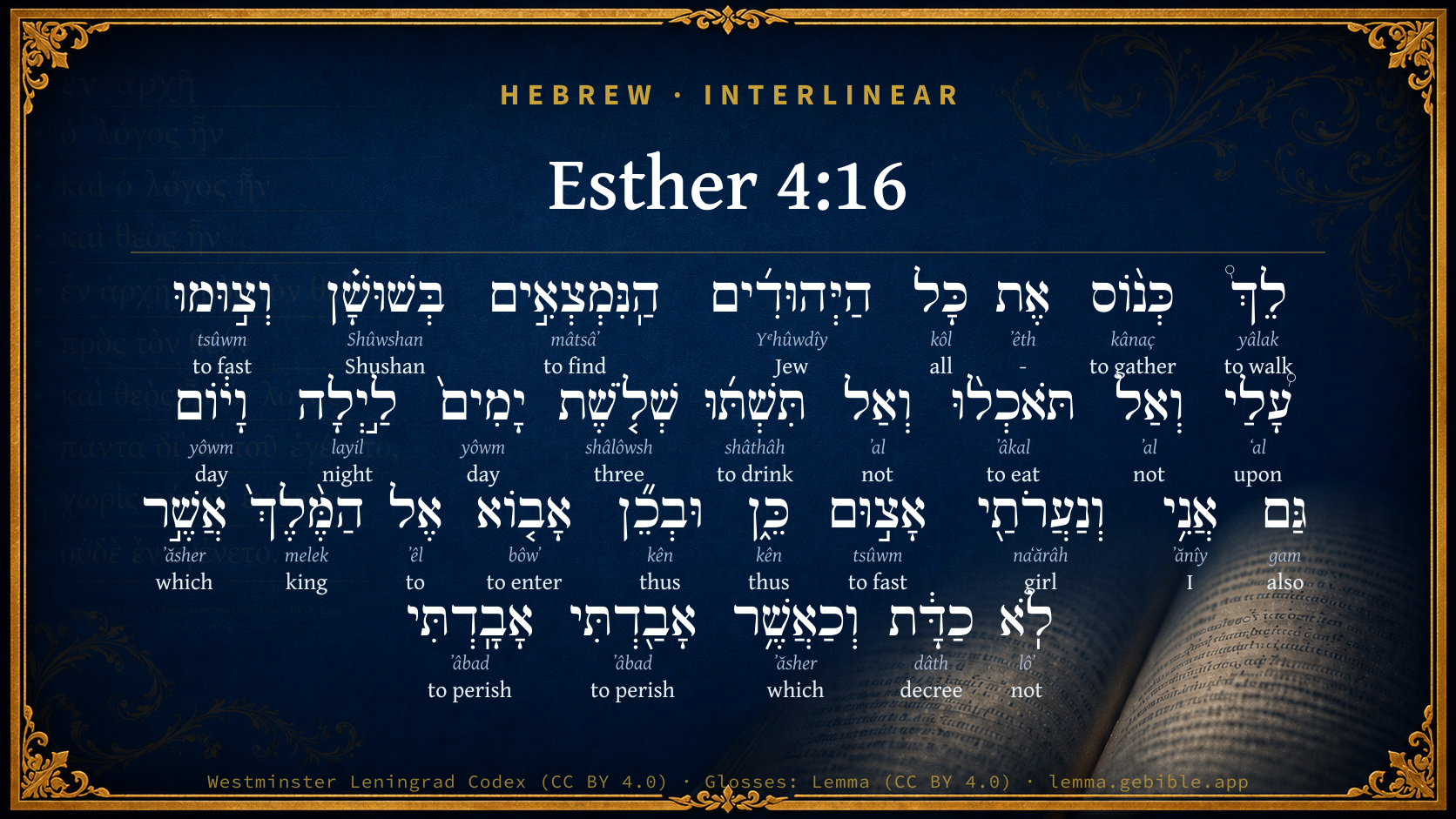
Esther 4:16

Hebrew (Westminster Leningrad Codex) Esther 4:16 appears in the Hebrew Old Testament. The text above is from the Westminster Leningrad Codex. Each word links to its Strong’s number, a concise gloss, and parsing drawn from the Open Scriptures Hebrew Bible morphology. Click any word for its full Brown-Driver-Briggs (BDB) entry.
Download image
Cite this verse

Esther 4:16 (World English Bible). Public Domain. Lemma interlinear Bible study tool, https://lemma.gebible.app/v/esther/4/16.

Show BibTeX & RIS
BibTeX
RIS
English Translation
Go, gather together all the Jews who are present in Shushan, and fast you for me, and neither eat nor drink three days, night or day: I also and my maidens will fast in like manner; and so will I go in to the king, which is not according to the law: and if I perish, I perish.
World English Bible · Public Domain
Download a study sheet

One document with this verse’s original text, its word-by-word gloss line, the meaning frame, cross-references with their text, attributed commentary, and full source and license credits — printable, and it pastes into notes with its structure intact.

This verse Autodidact and up

Study sheet (.html) Plain text (.txt)

A passage Seminary Student

Up to 50 verses in one chapter. A passage sheet keeps up to 6 commentary sources and 12 cross-references per verse, in the order this page ranks them, and says so on the sheet whenever that leaves anything out. Ask for a single verse and you get the Autodidact verse sheet above.

Everything on this page stays free to read, with no account — the sheet is a download of what is already on screen, not access to it.

Want to remove ads? Support Godless Engineer
Compare translations 3

The same verse in 3 English versions, stacked beneath the original-language interlinear above. Click any original word for its lexicon entry.

Each is an independent rendering of the whole verse — the interlinear is not word-aligned to these translations.

Highlighted words mark where these versions differ — a whole-verse word diff, not a word-by-word alignment.

  • World English Bible Public Domain
    Go, gather together all the Jews who are present in Shushan, and fast you for me, and neither eat nor drink three days, night or day: I also and my maidens will fast in like manner; and so will I go in to the king, which is not according to the law: and if I perish, I perish.
  • King James Version Public Domain
    Go, gather together all the Jews that are present in Shushan, and fast ye for me, and neither eat nor drink three days, night or day: I also and my maidens will fast likewise; and so will I go in unto the king, which is not according to the law: and if I perish, I perish.
  • unfoldingWord Literal Text CC BY-SA 4.0
    “Go, gather all the Jews who are found in Susa. And fast on account of me, neither eating nor drinking for three days, both night and day. Also, I myself and my young female attendants will fast likewise. Then, in such circumstances, I will go to the king, which is not according to the law. And if I perish, I perish.”

unfoldingWord Literal Text — © unfoldingWord, licensed CC BY-SA 4.0. Word-aligned USFM3 via Door43 (git.door43.org/unfoldingWord/en_ult).

Versions to compare (up to 4)

3 of 4 selected

Show all 18 translations

Every available English version of this verse, each an independent rendering of the whole verse.

  • World English Bible Public Domain
    Go, gather together all the Jews who are present in Shushan, and fast you for me, and neither eat nor drink three days, night or day: I also and my maidens will fast in like manner; and so will I go in to the king, which is not according to the law: and if I perish, I perish.
  • Berean Standard Bible Public Domain
    “Go and assemble all the Jews who can be found in Susa, and fast for me. Do not eat or drink for three days, night or day, and I and my maidens will fast as you do. After that, I will go to the king, even though it is against the law. And if I perish, I perish!”
  • Majority Standard Bible Public Domain
    “Go and assemble all the Jews who can be found in Susa, and fast for me. Do not eat or drink for three days, night or day, and I and my maidens will fast as you do. After that, I will go to the king, even though it is against the law. And if I perish, I perish!”
  • King James Version Public Domain
    Go, gather together all the Jews that are present in Shushan, and fast ye for me, and neither eat nor drink three days, night or day: I also and my maidens will fast likewise; and so will I go in unto the king, which is not according to the law: and if I perish, I perish.
  • American Standard Version (1901) Public Domain
    Go, gather together all the Jews that are present in Shushan, and fast ye for me, and neither eat nor drink three days, night or day: I also and my maidens will fast in like manner; and so will I go in unto the king, which is not according to the law: and if I perish, I perish.
  • Revised Version (1885) Public Domain
    Go, gather together all the Jews that are present in Shushan, and fast ye for me, and neither eat nor drink three days, night or day: I also and my maidens will fast in like manner; and so will I go in unto the king, which is not according to the law: and if I perish, I perish.
  • Geneva Bible (1599) Public Domain
    Goe, and assemble all the Iewes that are found in Shushan, and fast ye for me, and eate not, nor drinke in three dayes, day nor night. I also and my maydes will fast likewise, and so will I go in to the King, which is not according to the lawe: and if I perish, I perish.
  • Douay-Rheims (1899) Public Domain
    Go, and gather together all the Jews whom thou shalt find in Susan, and pray ye for me. Neither eat nor drink for three days and three nights: and I with my handmaids will fast in like manner, and then I will go in to the king, against the law, not being called, and expose myself to death and to danger.
  • Young's Literal Translation Public Domain
    `Go, gather all the Jews who are found in Shushan, and fast for me, and do not eat nor drink three days, by night and by day; also I and my young women do fast likewise, and so I go in unto the king, that `is' not according to law, and when I have perished -- I have perished.'
  • Literal Standard Version CC BY-SA 4.0
    “Go, gather all the Jews who are found in Shushan, and fast for me, and do not eat nor drink three days, by night and by day; also I and my young women fast likewise, and so I go in to the king, that [is] not according to law, and when I have perished—I have perished.”
  • Unlocked Literal Bible CC BY-SA 4.0
    “Go, gather together all the Jews who live in Susa, and fast for me. Do not eat nor drink for three days, night or day. My young girls and I will fast in the same way. Then I will go to the king, even though it is against the law, and if I perish, I perish.”
  • unfoldingWord Literal Text CC BY-SA 4.0
    “Go, gather all the Jews who are found in Susa. And fast on account of me, neither eating nor drinking for three days, both night and day. Also, I myself and my young female attendants will fast likewise. Then, in such circumstances, I will go to the king, which is not according to the law. And if I perish, I perish.”
  • Darby Bible Public Domain
    Go, gather together all the Jews that are found in Shushan, and fast for me, and neither eat nor drink three days, night or day: I also and my maidens will fast likewise, and so will I go in unto the king, which is not according to the law; and if I perish, I perish.
  • World Messianic Bible Public Domain
    “Go, gather together all the Jews who are present in Susa, and fast for me, and neither eat nor drink three days, night or day. I and my maidens will also fast the same way. Then I will go in to the king, which is against the law; and if I perish, I perish.”
  • Webster's Bible Public Domain
    Go, assemble all the Jews that are present in Shushan, and fast ye for me, and neither eat nor drink three days, night or day: I also and my maidens will fast likewise; and so will I go in to the king, which is not according to the law; and if I perish, I perish.
  • Free Bible Version CC BY-SA 4.0
    “Have all the Jews in Susa meet together and fast for me. Don't eat or drink anything for three days and nights. I and my girls will also fast. After that, I will go to the king, even though it's against the law, and if I die, I die.”
  • Bible in Basic English Public Domain
    Go, get together all the Jews who are present in Shushan, and go without food for me, taking no food or drink night or day for three days: and I and my women will do the same; and so I will go in to the king, which is against the law: and if death is to be my fate, then let it come.
  • JPS Tanakh (1917) Public Domain
    'Go, gather together all the Jews that are present in Shushan, and fast ye for me, and neither eat nor drink three days, night or day; I also and my maidens will fast in like manner; and so will I go in unto the king, which is not according to the law; and if I perish, I perish.'

Literal Standard Version (2020), Covenant Press — licensed CC BY-SA 4.0. Text via the HelloAO Bible API (eBible.org). Unlocked Literal Bible (unfoldingWord) — licensed CC BY-SA 4.0. Text via the HelloAO Bible API (eBible.org). unfoldingWord Literal Text — © unfoldingWord, licensed CC BY-SA 4.0. Word-aligned USFM3 via Door43 (git.door43.org/unfoldingWord/en_ult). Free Bible Version, Dr. Jonathan Gallagher — licensed CC BY-SA 4.0. Text via the HelloAO Bible API (eBible.org).

Word by word

More ways to search: Search by grammar → Find every occurrence → Compare this word →

Practice this passage: Drill this verse → Learn its vocabulary →

כְּנ֨וֹס
kânaç
H3664
“gather”
Verb, Qal, Imperative, 2nd Person, Masculine, Singular
Part of Speech
Verb
Stem
Qal
Form
Imperative
Person
2nd Person
Gender
Masculine
Number
Singular
Full BDB Definition

Origin: a primitive root

TWOT: 1000

to gather, collect, wrap - (Qal) to gather - (Piel) to gather - (Hithpael) to gather together, wrap oneself up
  1. לֵךְ֩ yâlak H3212 “walk” Verb, Qal, Imperative, 2nd Person, Masculine, Singular
  2. אֶת ʼêth H853 “-” Particle, Direct Object
  3. כָּל kôl H3605 “all of” Noun, Common, Masculine, Singular, Construct
  4. הַיְּהוּדִ֜ים Yᵉhûwdîy H3064 “the · Jews” Particle, Definite Article + Noun, Gentilic, Masculine, Plural, Absolute
  5. הַֽנִּמְצְאִ֣ים mâtsâʼ H4672 “the · finding” Particle, Definite Article + Verb, Niphal, Participle Active, Masculine, Plural, Absolute
  6. בְּשׁוּשָׁ֗ן Shûwshan H7800 “in/at · Shushan” Preposition + Noun, Proper
  7. וְצ֣וּמוּ tsûwm H6684 “and · fast” Conjunction + Verb, Qal, Imperative, 2nd Person, Masculine, Plural
  8. עָ֠לַי ʻal H5921 “upon · me” Preposition + Suffix, Personal, 1st Person, Common, Singular
  9. וְאַל ʼal H408 “and · not” Conjunction + Particle, Negative
  10. תֹּאכְל֨וּ ʼâkal H398 “to eat” Verb, Qal, Jussive, 2nd Person, Masculine, Plural
  11. וְאַל ʼal H408 “and · not” Conjunction + Particle, Negative
  12. תִּשְׁתּ֜וּ shâthâh H8354 “to drink” Verb, Qal, Jussive, 2nd Person, Masculine, Plural
  13. שְׁלֹ֤שֶׁת shâlôwsh H7969 “three” Adjective, Cardinal number, Masculine, Singular, Construct
  14. יָמִים֙ yôwm H3117 “days” Noun, Common, Masculine, Plural, Absolute
  15. לַ֣יְלָה layil H3915 “night” Noun, Common, Masculine, Singular, Absolute
  16. וָי֔וֹם yôwm H3117 “and · day” Conjunction + Noun, Common, Masculine, Singular, Absolute
  17. גַּם gam H1571 “also” Particle, Accusative
  18. אֲנִ֥י ʼănîy H589 “I” Pronoun, Personal, 1st Person, Common, Singular
  19. וְנַעֲרֹתַ֖י naʻărâh H5291 “and · girls · my” Conjunction + Noun, Common, Feminine, Plural, Construct + Suffix, Personal, 1st Person, Common, Singular
  20. אָצ֣וּם tsûwm H6684 “to fast” Verb, Qal, Imperfect, 1st Person, Common, Singular
  21. כֵּ֑ן kên H3651 “thus” Particle, Demonstrative
  22. וּבְכֵ֞ן kên H3651 “and · in/at · thus” Conjunction + Preposition + Adverb
  23. אָב֤וֹא bôwʼ H935 “to enter” Verb, Qal, Imperfect, 1st Person, Common, Singular
  24. אֶל ʼêl H413 “to” Preposition
  25. הַמֶּ֨לֶךְ֙ melek H4428 “the · king” Particle, Definite Article + Noun, Common, Masculine, Singular, Absolute
  26. אֲשֶׁ֣ר ʼăsher H834 “which” Particle, Relative
  27. לֹֽא lôʼ H3808 “not” Particle, Negative
  28. כַדָּ֔ת dâth H1881 “like/as the · decree” Preposition, Determined + Noun, Common, Feminine, Singular, Absolute
  29. וְכַאֲשֶׁ֥ר ʼăsher H834 “and · like/as · which” Conjunction + Preposition + Particle, Relative
  30. אָבַ֖דְתִּי ʼâbad H6 “to perish” Verb, Qal, Perfect, 1st Person, Common, Singular
  31. אָבָֽדְתִּי ʼâbad H6 “to perish” Verb, Qal, Perfect, 1st Person, Common, Singular

About this verse

These counts appear in no published source. They are computed here, from the morphology-tagged text and Lemma’s own curated glosses. What Lemma adds →

32
words
26
distinct lemmas
Historical
section

Notable vocabulary

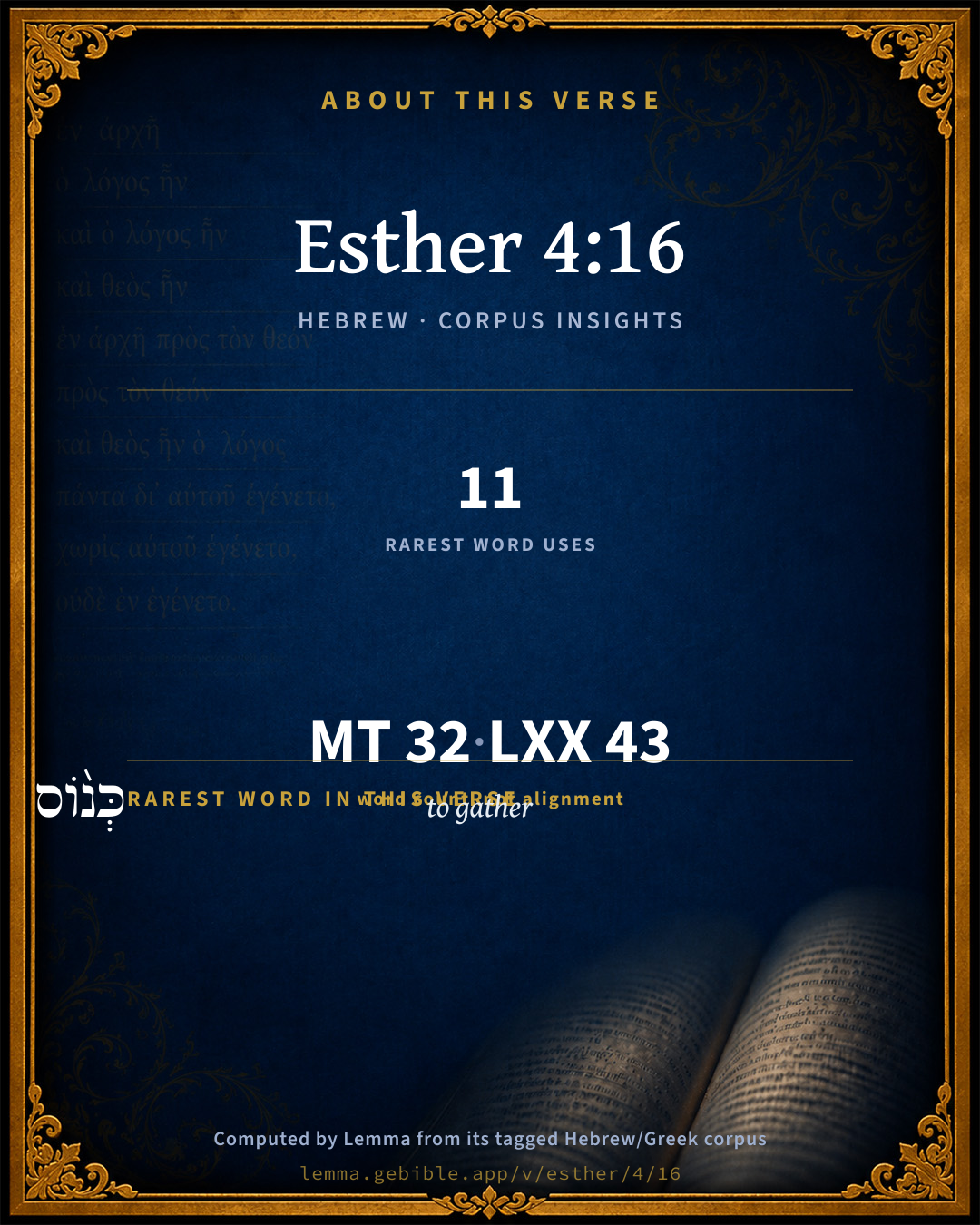
The rarest word here is כְּנ֨וֹס to gather H3664 — appearing just 11 times in the whole Hebrew Bible.

Shared distinctive vocabulary

כְּנ֨וֹס to gather H3664 occurs in 11 verses of the Hebrew Bible. Also found in:

Grammatical profile

  • 10 verbs
  • 9 nouns
  • 1 adjective
  • 1 pronoun
  • 2 prepositions
  • 1 adverb
  • 8 particles

Verb forms

  • לֵךְ֩ Qal · Imperative
  • כְּנ֨וֹס Qal · Imperative
  • הַֽנִּמְצְאִ֣ים Niphal · Participle Active
  • וְצ֣וּמוּ Qal · Imperative
  • תֹּאכְל֨וּ Qal · Jussive
  • תִּשְׁתּ֜וּ Qal · Jussive
  • אָצ֣וּם Qal · Imperfect
  • אָב֤וֹא Qal · Imperfect
  • אָבַ֖דְתִּי Qal · Perfect
  • אָבָֽדְתִּי Qal · Perfect

Repetition

Words recur within this verse — often emphatic in Hebrew:

  • וְצ֣וּמוּ to fast H6684 ×2
  • יָמִים֙ day H3117 ×2
  • כֵּ֑ן thus H3651 ×2
  • אָבַ֖דְתִּי to perish H6 ×2
  • וְאַל not H408 ×2
  • אֲשֶׁ֣ר which H834 ×2

Hebrew & Septuagint length

In English translation the verse runs 58 words from the Hebrew and 52 from the Septuagint (LXX English) — closely comparable.

A rough comparison of the two English renderings, which tokenize alike — not a word-level alignment.

Word counts can differ between the Hebrew and the Greek without any difference in meaning — e.g. the Hebrew direct-object marker אֵת has no separate Greek word, and Greek often adds the article ὁ.

In the original languages it is 32 Hebrew tokens and 43 Greek tokens — but the two are counted differently (Hebrew bundles its prefixes and suffixes into one token; the Greek is in lemma form), so that isn’t a like-for-like length.

Cross-references

17

Topical passages linked to Esther 4:16 in the Treasury of Scripture Knowledge — connected by theme and wording, ordered by reader-vote popularity; previews shown in the World English Bible.

  • Acts 20:24 But these things don't count; nor do I hold my life dear to myself, so that I may finish my race with joy, and the ministry which I received from the Lord Jesus, to fully testify to the Gospel of the grace of God.
  • 2 Chronicles 20:3 Jehoshaphat feared, and set himself to seek to Yahweh; and he proclaimed a fast throughout all Judah.
  • Joel 2:12–17 "Yet even now," says Yahweh, "turn to me with all your heart, And with fasting, and with weeping, and with mourning."
  • Luke 9:24 For whoever desires to save his life will lose it, but whoever will lose his life for my sake, the same will save it.
  • Genesis 18:19 For I have known him, to the end that he may command his children and his household after him, that they may keep the way of Yahweh, to do righteousness and justice; to the end that Yahweh may bring on Abraham that which he has spoken of him."
  • Genesis 43:14 May God Almighty give you mercy before the man, that he may release to you your other brother and Benjamin. If I am bereaved of my children, I am bereaved."
  • Joshua 24:15 If it seem evil to you to serve Yahweh, choose you this day whom you will serve; whether the gods which your fathers served that were beyond the River, or the gods of the Amorites, in whose land you dwell: but as for me and my house, we will serve Yahweh.
  • 2 Samuel 10:12 Be of good courage, and let us play the man for our people, and for the cities of our God: and Yahweh do that which seems him good.
  • Jonah 3:4–9 Jonah began to enter into the city a day's journey, and he cried out, and said, "Yet forty days, and Nineveh shall be overthrown!"
  • Esther 5:1 Now it happened on the third day, that Esther put on her royal clothing, and stood in the inner court of the king's house, over against the king's house: and the king sat on his royal throne in the royal house, over against the entrance of the house.
  • Isaiah 22:12 In that day did the Lord, Yahweh of Hosts, call to weeping, and to mourning, and to baldness, and to girding with sackcloth:
  • Joel 1:14–15 Sanctify a fast. Call a solemn assembly. Gather the elders, And all the inhabitants of the land, to the house of Yahweh, your God, And cry to Yahweh.
  • Acts 9:9 He was without sight for three days, and neither ate nor drank.
  • Romans 16:4 who for my life, laid down their own necks; to whom not only I give thanks, but also all the assemblies of the Gentiles.
  • Philippians 2:30 because for the work of Christ he came near to death, risking his life to supply that which was lacking in your service toward me.
  • Acts 21:13 Then Paul answered, "What are you doing, weeping and breaking my heart? For I am ready not only to be bound, but also to die at Jerusalem for the name of the Lord Jesus."
  • Acts 27:33 While the day was coming on, Paul begged them all to take some food, saying, "This day is the fourteenth day that you wait and continue fasting, having taken nothing.

Cross-references courtesy of OpenBible.info (CC BY 4.0).

Hebrew and Greek witnesses Masoretic Hebrew ↔ Greek Septuagint

The same verse in the two great witnesses to the Old Testament, shown verse-for-verse.

These are two independent witnesses, not word-aligned to each other, and the Septuagint is shown in lemma (dictionary) form.

Hebrew Esther 4:16 Masoretic · Westminster Leningrad Codex

לֵךְ֩ כְּנ֨וֹס אֶת כָּל הַיְּהוּדִ֜ים הַֽנִּמְצְאִ֣ים בְּשׁוּשָׁ֗ן וְצ֣וּמוּ עָ֠לַי וְאַל תֹּאכְל֨וּ וְאַל תִּשְׁתּ֜וּ שְׁלֹ֤שֶׁת יָמִים֙ לַ֣יְלָה וָי֔וֹם גַּם אֲנִ֥י וְנַעֲרֹתַ֖י אָצ֣וּם כֵּ֑ן וּבְכֵ֞ן אָב֤וֹא אֶל הַמֶּ֨לֶךְ֙ אֲשֶׁ֣ר לֹֽא כַדָּ֔ת וְכַאֲשֶׁ֥ר אָבַ֖דְתִּי אָבָֽדְתִּי

Go, gather together all the Jews who are present in Shushan, and fast you for me, and neither eat nor drink three days, night or day: I also and my maidens will fast in like manner; and so will I go in to the king, which is not according to the law: and if I perish, I perish.

World English Bible · Public Domain

Greek LXX Esther 4:16 Septuagint · lemma form

βαδίζω ἐκκλησιάζω ὁ ἰουδαῖος ὁ ἐν σουσά καί νηστεύω ἐπί ἐγώ καί μή ἐσθίω μηδέ πίνω ἐπί ἡμέρα τρεῖς νύξ καί ἡμέρα καΐἐγώ δέ καί ὁ ἅβρα ἐγώ ἀσιτέω καί τότε εἰςἔρχομαι πρός ὁ βασιλεύς παρά ὁ νόμος ἐάν καί ἀποὀλλύω ἐγώ εἰμί

Go and assemble the Jews that are in Susa, and fast you⌃ for me, and eat not and drink not for three days, night and day: and I also and my maidens will fast; and then I will go in to the king contrary to the law, even if I must die.

LXX2012 (modern English Septuagint) · Public Domain

On this verse, Haydock's Catholic Bible Commentary discusses the Septuagint’s reading. Read the note in Commentary ↓

Hebrew: Westminster Leningrad Codex (CC BY 4.0). Greek: Septuagint (public domain); English from LXX2012 (modern English Septuagint) (Public Domain). How the Septuagint differs from the Hebrew →

Commentary

Notes on Esther 4:16 from classic Christian and Jewish commentators (each source and its license shown beneath its notes). The classic Christian expositions comment on the surrounding passage and are grouped to its opening verse, so a note may address several verses; the Jewish commentaries on the Tanakh (Rashi and others) are per-verse, so they appear only where the commentator wrote on this verse.

Lemma curates 59 commentaries, every one of them public domain or Creative Commons licensed, each selected and text-cleaned for this edition rather than reprinted as found. About our sources →

Trapp's Complete Commentary

John Trapp

Est 4:16 Go, gather together all the Jews that are present in Shushan, and fast ye for me, and neither eat nor drink three days, night or day: I also and my maidens will fast likewise; and so will I go in unto the king, which [is] not according to the law: and if I perish, I perish.

Ver. 16. Go, gather together all the Jews] Great is the power of joint prayer, it stirs heaven, and works wonders. Oh, when a Church full of good people shall set sides and shoulders to work, when they shall rouse up themselves and wrestle with God, when their pillars of incense shall come up into his presence, and their voices be heard as the voices of many waters, and as the voice of a great thunder, Rev 14:2, what may not such thundering legions have at God’s hands? Have it? they will have it: Caelum tundimus, preces fundimus, misericordiam extorquemus, said those primitive prayer-makers. Rev 9:13, the prayers of the saints from the four corners of the earth sound, and do great things in the world, they make it ring. It was the speech of a learned man, if there be but one sigh come from a gracious heart (how much more, then, a volley of sighs from many good hearts together!) it filleth the ears of God, so that God heareth nothing else.

And fast ye for me] Who am now upon my life, and, for aught I know, am shortly to appear before the Lord (who requireth to be sanctified in all them that draw near unto him), and wherein I may not look to have leave to err twice, Non licet in belle bis errare. Point, therefore, your prayers for me with holy fastings, that they may pierce heaven and prevail. Abstinence meriteth not, saith a grave divine (Dr Hall), for religion consisteth not in the belly, either full or empty; (What are meats or drinks to the kingdom of God, which is, like himself, spiritual?) but it prepareth best for good duties. Full bellies are fitter for rest. Not the body so much as the soul is more active with emptiness; hence solemn prayer taketh ever fasting to attend it; and so much the rather speedeth in heaven, when it is so accompanied. It is good so to diet the body, that the soul may be fattened.

And neither eat nor drink three days, &c.] That is, saith Drusius, two whole nights, one whole day, and part of two other days. See the like expression, Mat 12:40. Others say, that in those hot countries they might fast three days as well as we two in these cold climates. Tully in one of his epistles telleth us, that he fasted two days together, without so much as tasting a little water. For the Romans, also, and Grecians had their fasts private and public, whether it were by a secret instinct of nature, or by an imitation of the Hebrews, Faciunt et vespae favos. The Turks likewise at this day precisely observe their fasts, and will not so much as taste a cup of water, or wash their mouths with water, all the day long, before the stars appear in the sky, be the days never so long and hot. The Hollanders and French fast, but had need, saith one, to send for those mourning women, Jer 9:17, by their cunning to teach them to mourn. The English are not sick soon enough, saith another, and they are well too soon: this is true of their minds as well as of their bodies. Currat ergo poenitentia, ne praecurrat sententia; and let our fasts be either from morning till evening, Jdg 20:26 2Sa 3:35, or from evening till evening, Lev 23:32, or longer, as here, and Act 9:9, as the hand and wrath of God doth more or less threaten us, or lie upon us. There is an old Canon that defineth their continuance, till stars appear in the sky, Usque dum stellae in caelo appareant.

I also and my maids will fast] She herself would be in the head of them, as Queen Elizabeth also told her soldiers at Tilbury camp for their comfort; and as Caesar used to say to his soldiers, Go we, and not Go ye, Non ite, sed eamus; and as Joshua said, I and my house will serve Jehovah, Jos 24:15. Esther’s maids must fast and pray, or they are no maids for her.

And so will I go unto the king] It is said of Achilles, that he was Styge armatus; but he that fasteth, prayeth, believeth, Est caelo, Christo, Deo armatus, armed with an undaunted resolution to obey God whatever come of it.

Which is not according to the law] She slights not the law, but waves it, to obey God’s law, and save her people.

And if I perish, I perish] This she speaketh not rashly or desperately, as prodigal of her life, but as sacrificing the same to God and his cause, through the obedience of faith, and saying, as that martyr, Can I die but once for Christ? See the like phrase, Gen 43:14, {See Trapp on "Gen 43:14"} Better do worthily, and perish for a kingdom, than unworthily, and perish with a kingdom.

John Trapp, A Commentary or Exposition upon All the Books of the Old and New Testament (1647–1656) — public domain. Text from a community e-Sword module.

Joseph Benson's Commentary

Est 4:16. And fast ye for me — And pray, which was the main business, to which fasting was only a help; and neither eat nor drink three days — Namely, in such a manner as you used to do. Abstain from all set meals, and all pleasant food, and, as much as possible, from all food, for that space of time, in token of humiliation for sin, and a sense of our unworthiness of God’s mercies. I also and my maidens will fast likewise — They were, doubtless, either of the Jewish nation or proselytes, and pious persons, who, she knew, would sincerely join with her in these holy duties. And so will I go in unto the king — To intercede for my people. Which is not according to the law — Namely, the king’s law, now mentioned, but it is according to God’s law, and therefore whatever comes of it, I will venture, and not count my life dear to myself, so I may serve God and his church. And if I perish, I perish — Although my danger be great and evident, considering the expressness of that law, the uncertainty of the king’s mind, and that severity which he showed to my predecessor Vashti; yet, rather than neglect my duty to God and to his people, I will go to the king, and cast myself cheerfully and resolutely upon God’s providence for my safety and success. If I should be condemned to lose my life, I cannot lose it in a better cause.

Joseph Benson's Commentary on the Old and New Testaments (1811–1818) — public domain. Text from a community e-Sword module.

Tyndale Open Study Notes

Tyndale Open Resources

4:16 fast for me: Esther was convinced, but she wanted as many Jews as possible to pray that God would intervene to save her life. • Do not eat or drink for three days, night or day: A total fast without any food or water often lasted only one day (Lev 16:29-31; Judg 20:26). The three-day length was consistent with the seriousness of the situation and the absolute need for God’s intervention. • though it is against the law, I will go in to see the king: In spite of the danger, she determined that she must act for the sake of her people. • If I must die, I must die: She, like Mordecai, was a person of character who would do what was right in spite of personal danger.

Tyndale Open Study Notes — © Tyndale Open Resources, licensed CC BY-SA 4.0. Text via the HelloAO Bible API.

Geneva Bible (1599)

Geneva Bible translators

I will put my life in danger and refer the success to God, seeing it is for his glory and the deliverance of his Church.

Geneva Bible (1599) marginal notes — public domain. Text via Bolls.life.

Jamieson, Fausset & Brown

Robert Jamieson, A. R. Fausset & David Brown

so will I go in unto the king, which is not according to the law--The appeal of Mordecai was irresistible. Having appointed a solemn fast of three days, she expressed her firm resolution to make an appeal to the king, though she should perish in the attempt.

I . . . and my maidens--It is probable that she had surrounded herself with Jewish maidens, or women who were proselytes to that religion.

Next: Esther Chapter 5

Jamieson, Fausset & Brown — Commentary Critical and Explanatory on the Whole Bible (1871) — public domain (CC PDM 1.0). Text via the HelloAO Bible API.

Adam Clarke's Commentary

Verse 16. Fast ye for me, and neither eat nor drink three days] What a strange thing, that still we hear nothing of prayer, nor of God! What is the ground on which we can account for this total silence? I know it not. She could not suppose there was any charm in fasting, sackcloth garments, and lying on the ground. If these were not done to turn away the displeasure of God, which seemed now to have unchained their enemies against them, what were they done for?

If I perish, I perish.] If I lose my life in this attempt to save my people, I shall lose it cheerfully. I see it is my duty to make the attempt; and, come what will, I am resolved to do it. She must, however, have depended much on the efficacy of the humiliations she prescribed.

Adam Clarke's Commentary on the Bible (1810–1826) — public domain. Text from a community e-Sword/MySword module.

The Cambridge Bible for Schools and Colleges

gen. ed. J. J. S. Perowne

16. all the Jews that are present in Shushan] We are to suppose them to be a considerable number, if they were subsequently able to dispose of three hundred of their foes (Est_9:15).

fast ye for me] in connexion with intercession on my behalf. Prayer and fasting went together in time of sorrow or anxiety or penitence. So David (2Sa_12:16), Ahab (1Ki_21:27), Daniel (Dan_9:3).

neither eat nor drink three days, night or day] This sounds a very explicit direction to abstain from all food for seventy-two hours. It is, however, possible that for the general body of the Jews here referred to it may not have really meant more than two nights and the intervening day, a part of the twenty-four hour day being for certain purposes reckoned as a whole one. Cp. Mat_12:40 with Mat_28:1. Nevertheless to fast for the longer period is not beyond the limits of Oriental abstemiousness.

I also and my maidens will fast in like manner] Esther herself cannot have carried out this abstinence in its most rigid form. The appearance which she must in that case have presented before the king would have militated strongly against her chances of success, slender as those chances were in any case.

if I perish, I perish] She accepts the risk, acknowledging the necessity. For form of expression cp. Jacob’s words in Gen_43:14.

The Cambridge Bible for Schools and Colleges (gen. ed. J. J. S. Perowne; Cambridge University Press, 1878–1918) — public domain. Text from a community e-Sword module.

Albert Barnes' Notes on the Bible

Again the religious element shows itself. Esther’s fast could have no object but to obtain God’s favor and protection in the dangerous course on which she was about to enter.

Albert Barnes' Notes on the Bible (1834–1885) — public domain. Text from a community e-Sword/MySword module.

Haydock's Catholic Bible Commentary

Pray. Hebrew, "fast." They might take some refreshment in the evening, (Lyranus) of dried meats. (Josephus) (Grotius) --- Few constitutions could have done without any thing. Yet after two nights and one full day were elapsed, Esther ventured to go to the king, chap. v. 1. We have here another instance of places for prayer, Judith vi. 21. The old Vulgate has, "publish a fast, and tell the ancients to fast. Let the infants be kept from the breast during the night, and let no food be given to the oxen and other animals, while I and my maids shall fast," &c. Then at the end of this chapter, in the Septuagint, follow the prayers of Mardochai and of Esther, (chap. xiii. 8., and chap. xiv.; Haydock) which is their proper place. (Calmet)

George Leo Haydock (1774–1849), Haydock's Catholic Family Bible and Commentary, 1859 edition — public domain. Excludes Psalms (Douay-Rheims chapter numbering differs from Protestant) and Deuterocanonical books (Catholic canon only).

Matthew Poole's English Annotations

Fast ye, and pray; which was the main business, to which fasting was only a help and a handmaid.

Neither eat nor drink, to wit, so as you use to do, either deliciously or plentifully. Leave off your common meals, dinners by day, and suppers at night, and eat and drink no more than mere necessity requires; that so you may give yourselves to constant and fervent prayers, for which your ordinary repasts will unfit you. For it is not likely that she would impose the burden of absolute fasting so long upon all the Jews, which very few of them were able to endure. And so the like phrase is taken Act 27:33, where he saith, This is the fourteenth day that ye have continued fasting, having taking nothing.

I also and my maidens; which she had chosen to attend upon her person, and were doubtless either of the Jewish nation, or proselyted by hers or others’ means to that religion.

Will fast likewise; which may belong, either,

1. To the thing only, that as they did first, so she would. Or rather,

2. To the time of three days and three nights; for so she might do, though she went to the king on the third day. For the fast began at evening; and so she might continue her fast three whole nights, and two, whole days, and the greatest part of the third; a part of a day being reputed a day in the account of Scripture, and other authors; of which See Poole "Mat 12:40". Yea, she might fast all that day too; for it is probable she went not to the king till he had dined, when she supposed she might find him in the most mild and pleasant humour, and then returned to her apartment, where she fasted till the evening.

Which is not according to the law; which is against the law now mentioned.

If I perish, I perish: although my danger be great and evident, considering the expressness of that law, and the uncertainty of the king’s mind, and that severity which he showed to my predecessor Vashti; yet rather than neglect my duty to God, and to his people, I will go to the king, and cast myself cheerfully and resolutely upon God’s providence for my safety and success.

Matthew Poole's English Annotations on the Holy Bible (1683–1685) — public domain. Text from a community e-Sword/MySword module.

Whedon's Commentary on the Bible

Daniel D. Whedon

16. Fast ye… three days — The perilous enterprise, in which she would be so liable to perish, was not to be undertaken without much fasting and prayer. Though prayer is not mentioned, it undoubtedly accompanied the fasting, as in the cases of Nehemiah (Neh_1:4) and Daniel, (Dan_9:3.)

Night or day — Sometimes fasting was observed for many days, but intermitted at night. This special fast was to have no intermission.

Daniel D. Whedon (gen. ed.), Commentary on the Old and New Testaments (1874–1909) — public domain. Text from a community e-Sword module.

The Pulpit Commentary

A fast.

Fasting is often mere superstition, as when men suppose that there is merit in their abstaining on certain days from certain kinds of food, thinking that mortification of appetite is in itself a virtue, and that God must needs be pleased with what pains or distresses his creatures. Fasting is sometimes a mockery. It is well known that many religionists keep the letter whilst they break the spirit of a fast. It is certainly difficult to sympathise with the asceticism of those who fast on Fridays upon salmon and champagne. Yet this, like other religious observances that are now largely superstitious, or at all events formal, has its origin in laudable desires, and springs from good tendencies in human nature.

I A COMMON SORROW NATURALLY SEEKS A COMMON EXPRESSION. When a community is smitten by a general calamity, it is unbecoming that any members of that community should indulge in feasting and mirth. When the Jews were threatened with destruction, how natural that, at Esther"s suggestion, the Hebrew population of the city should join in a general fast.

II A COMMON WANT NATURALLY LEADS TO UNITED SUPPLICATION. Together the people were endangered; together they sought deliverance from their redeeming God. A fast is not only a time of abstinence from pleasure, it is a time of prayer; and God in heaven is gratified by conjoined and blended supplication and intercession. What mercies await the society, the city, the nation which will agree with one heart to seek the Lord.

III IT IS THE SPIRITUAL FASTING WHICH IS ACCEPTABLE TO THE SEARCHER OF HEARTS. Often, in the presence of fasts which are merely outward, has he addressed the indignant question to formal religionists, "Is it such a fast that I have chosen?" Often has the appeal been addressed to such, "Rend your hearts, and not your garments!" The case of the Ninevites is an illustration of the combination of a formal with a real fast, and is a proof that such a fast is not disregarded by God. Let the words of our Saviour be remembered: "When thou fastest, anoint thy head and wash thy face, that thou appear not unto men to fast; and thy Father who seeth in secret shall reward thee openly.

If I perish, I perish!

The bosom of the queen must, when she uttered these affecting words, have been rent with diverse emotions. The entreaty of Mordecai, the danger of her people, the benevolence of her own nature, all urged her to venture into the presence of the august yet capricious king. Yet her knowledge of the court rules, her fears for herself, must have withheld her from the daring act. She faced the possible consequences, she prepared herself for the worst. Doubtless she commended herself to the care of Heaven, and, forming the resolve, exclaimed, "If I perish, I perish!" Hearers of the gospel have sometimes been convinced of their sin, and yet have not been able to appropriate to themselves the promises of God"s word. They have felt that there is no refuge save in the cross of Christ, and no hope save in the mercy of God. After long, sore conflict, such anguished sufferers, with a faith which is half despair, have been able to cast themselves before the feet of the King, whose displeasure they dread, and in whose mercy they scarcely dare to hope. They have ventured all upon Divine compassion, and the earnestness, the distress, the utter helplessness of their hearts have found utterance in the cry of Esther, "If I perish, I perish!

I The cry is the utterance of SINCERITY AND EARNESTNESS. The language is full of feeling, of passion. It was no feeble emotion which could prompt to such a determination. This is the spirit in which a sinner should come into the presence of the King, seeking for pardon.

II It is the utterance of FELT UNWORTHINESS. And none can come aright unto God save he who comes with the cry of the penitent publican, "God be merciful to me a sinner!

III It is the utterance of CONSCIOUS NEED. Nothing but the keenest sense of the necessity of the case could have impelled Esther to the course of action she took. Similar is the motive which brings the sinner to the Lord.

Nothing in my hand I bring, Simply to thy cross I cling.

IV It is the utterance of MINGLED FEAR AND HOPE. Uncertainty and dread mingled in the queen"s mind with some gleam of hope. It is not unnatural that the poor helpless sinner should shrink from the view of a holy God, should scarcely dare to hope for his favour.

V It is the utterance of A MIND UPON WHICH THE KING WILL HAVE MERCY. As Esther"s fears were dispelled by the attitude and language of her consort, so the penitent, lowly, believing, and prayerful suppliant shall never be rejected by a God who delighteth in mercy. The spirit which God will not disdain is that of the lowly suppliant who casts aside every plea save the Divine compassion.

I have tried, and tried in vain, Many ways to ease my pain; Now all other hope is past, Only this is left at last: Here before thy cross I lie, Here I live, or here I die.

If I perish, be it here, With the Friend of sinners near; Lord, it is enough I know Never sinner perished so: Here before thy cross I lie, Here I cannot, cannot die!

Self"s supreme capitulation.

I perish, I perish." The suggestion of Providence being concerned in the matter was like life from the dead to Esther. The idea of Providence having been now some time working up to this point was an immense comfort and impulse to her mind. It was a flash of light that lit up the whole scene for one moment. And when that one moment was sped, the darkness that returned was not. as before, unrelieved. There was a distinct line of light athwart it. Confidence as to the final issue of all was far from present. Nothing like absolute conviction that in the end all would be well could Esther boast. Suspense in some shape still prolonged its unwelcomed sojourn. But it was no longer the agonised suspense of not knowing what to do, of not knowing whether to move at all. The pent-up heart is bad enough, but solitary confinement must make it much worse. Pent-up hope is a terrible strain, but the strain becomes much worse when it must be tolerated without one active effort, one healthy struggle. This phase of things had now passed by for Esther. She had gone faithfully through it, and was none the worse for having treated it as a thing that needed to be gone through faithfully and unhurriedly. Mordecai was not necessarily in the right when he seemed to wonder at Esther"s hesitation. Though we credit him with being a wise man, a good man, and very full of pride in Esther and love to her, Esther very likely felt that he had not put himself quite in her position, and could not do so. But it was because she had gone faithfully through the struggle, and well looked at the question on both sides, and considered its alternative difficulties and perils, that when enough light did come she used it in a moment; and when thought had done its fair amount of work, hesitation fled, and determination succeeded to its place. To wearied human inquiry, to exhausted human resources, to bewildered human wisdom, comes in most welcome the ministry little thought of before, of the Invisible. You are immediately disposed to gift it with omniscience and all power. And the theory of a Providence, anticipating, interposing, overruling, becomes faith. It is embraced with ardour, and soon shows that it possesses the highest stimulus to duty. This never fails to answer obedient to its call, even though when it answers obedient it brings this exclamation to the steps of the altar, "If I perish, I perish!" Let us observe that this is the impassioned exclamation

I Of one WHO FELT THE RELIEF OF AT LAST SEEING DUTY. The mind must have groped about in darkness, must have been distressed by doubt, must have known conflict even to anguish, before it would have expressed itself thus, and here is some part of its relief. Esther had come to see it, not "through tears," perhaps, with their more purified light, but through the most painful obscurities and harassing incertitude.

II Of one WHO SAW DUTY TO FOLLOW IT at its proper cost. The sight of duty is often the signal for shutting the eyes, for turning the back, for filling the mind with diverting occupation, for trying, by one method or another, to forget it. Not so here.

III Of one whose fixed resolve WAS NOT DUE TO DESPERATION, nor to stoicism; not due to over-wrought feeling, nor to blunted sense and affection and faculty. The fixed determination here betokened was that of one who had "counted the cost," who evidently felt the cost to be that denoted by a very large price, and one which merited consideration first.

IV Of one WHO HAD SO ESTIMATED THE TASK WHICH SHE WAS TO ATTEMPT THAT SHE BEGGED HELP, begged sympathy begged that chiefest kind of help, the union of all kindred souls in religious exercises, in religious prostration before the Unseen, in the faith unfeigned which believed it possible and right to strive with all conceivable endeavour to influence and prevail upon the sovereign Disposer of all things.

V Of one WHOSE ENTERPRISE, IF FATAL, WAS BOUND TO WIN THE CROWN OF THE MARTYR. Whose enterprise, if not fatal, but yet unsuccessful, bore testimony to the will, the courage, the spirit of the martyr. Whose enterprise, if neither fatal nor unsuccessful, but, on the contrary, leading the way to more abundant glory and joy here, yet still had this testimony about it, that it had practically shown the best part of any sacrifice, and through the cross had reached the crown.

VI Of one WHOSE SPIRIT BREATHED RESIGNATION WHERE IT DID NOT REACH TO THE SUBLIMER HEIGHT OF TRUST. For whatever reason, Esther had not attained to the exercise of a calm trust. She more distrusted the badness of the circumstances than she trusted the goodness of her cause; the badness of the king"s whim than the goodness of the purpose which was far above his; the badness of the earthly law than the goodness of that mercy which is "high as the heavens and vast as the clouds." It would seem evident that her knowledge was not clear. One of the people of God, yet, for want of priest and prophet, of sacrifice and of temple-worship, of dream, of oracle, of seer, times went hard with her religious education. The "word of God was precious in those days," and in that land of her captivity; and she the sufferer thereby.

The lessons suggested by the language of this supreme scene in the conflict of Esther are numerous, and of a remarkably diversified kind.

1. The figure of human virtue here is impressive in its consent to bow to vicarious suffering, though it were only consent; in its love, and solicitude, and obedience, and in the conduct of its own struggles.

2. The reproach is ever memorable which it conveys to how many whose knowledge is light itself, yet whose thought and deed fall so far below those of one whose knowledge was manifestly very partial, very clouded.

3. The cry is arresting because of its strong sympathy of tone with the cryof one who feels himself a real sinner against the law of God, and finds himself as yet more "driven" because of the conviction of that sin, and the overshading dread of its liability to punishment, than he finds himself drawn of the mercy of his God, and able to repose deep, calm trust in his Saviour. The soul urged by conviction of sin, oppressed with the sense of its desert of wrath, and tremblingly afraid of death, has often found its way aright to the cross, though to use words carrying the most impossible of significations for any, once arrived there I perish, I perish!

4. Whatever we may justly admire of the spirit of Esther here displayed,and of the steps by which she rose to it as she contemplated her own possible and, as she thought, likely sacrifice, how glad we are to turn away to the tremendously favourable contrast of him whose vicarious sufferings, whose infinite love, whose eternal sacrifice, was certain, was voluntary, was cheerful amid surpassing anguish, and patient with the patience of the lamb sacrificed. B.

HOMILIES BY F. HASTINGS Ver. 16.

Prayer and resolve.

gather together all the Jews that are present in Shushan, and fast ye for me," etc.

I ESTHER"S FAITH IN PRAYER. She looks to God, not to man. She has faith not only in her own prayers, but in those of others. She feels her need of the prayers of others. She is ready to share that which she enjoins on others.

II ESTHER"S PIETY KNOWN IN THE PALACE. Her maidens are so under her influence that she knows that they all will be ready to join in the observance of fasting and in offering prayer to the God of Israel. This was a remarkable thing, remembering that these maidens belonged to an Oriental and pagan court.

III ESTHER"S DECISION TO DARE ANYTHING FOR THE SAKE OF OTHERS. Great her decision of character! She will not let the opportunity for helping others pass, and then strive to atone for her neglect by useless regrets. How great her devotion! "If I perish, I perish!" She would certainly have perished if she had not gone in to the king. The decrees of a Persian monarch were unalterable. Remember how Darius was sore displeased with himself, and set his heart on Daniel to deliver him, and laboured to the going down of the sun to deliver him. He doubtless sought to devise means of maintaining the law and yet evading its import. Into the den of ions Daniel, the king"s favourite, was cast, and to the slaughter Esther, though queen, would have been, by ruthless decree, when the time was come; but prayer, fasting, decision, saved her. God interposed to soften the heart of the king, as well as to give him a sleepless night, perhaps from a disturbed conscience. H.

Esther"s resolve.

The absence throughout this book of any reference to God is a most peculiar feature. Some have, on this ground, gone the length of denying its Divine authority. But the religious spirit is so prominent in this verse as to deprive such an objection of its force. Note that the proof of piety should not be sought in the language men employ, but rather in the principles which guide their conduct. There are circumstances which compel men to be real. In the presence of a great disaster, a great sorrow, or a great danger they manifest their true character. Esther had at this time comprehended the awful possibilities of the situation; cruel, speedy, certain death stared her in the face; and the first thing she did in her agony was to appeal to God, the God of her fathers, whom she now openly acknowledged as the arbiter of events. Observe

I THAT THE BELIEVER NEVER ENTERS UPON A SOLEMN UNDERTAKING WITHOUT INVOKING THE FAVOUR OF GOD. "Go and gather all the Jews," etc. The fast was to be long and general, such as became the solemnity of the occasion. Fasting must be regarded as an Oriental custom, which well suits the demonstrative disposition of the people, who give vent to their griefs, their joys, and their religious ardour in extravagant outward manifestations. The custom is not enjoined upon us in Scripture, though doubtless it ought not to be prohibited in cases where it may be of spiritual advantage. But the principle which underlies the custom is universal, namely, that increased devotion gives strength for the performance of duty.

1. Esther desired others to interest themselves in her behalf. "Fast ye for me, and neither eat nor drink three days, night or day. The human heart craves for sympathy, which, when obtained, gives courage in the hour of trial. Thus the missionary in foreign lands, when he remembers that thousands of his brethren are pleading his cause with God at a certain appointed season, forgets his isolation and nerves himself afresh for his work. Besides this, we have reason to believe that the fervent prayers of righteous men, even when offered for others, avail on high.

2. Esther, while she sought the sympathy of others, was careful also to perform her own part. "I also and my maidens will fast likewise." The aid of others is liable to be over-estimated, and thus may become a snare to those who seek it. No scene on earth is more deeply affecting than that presented by a minister of religion kneeling at the bedside of a dying sinner, praying God to have mercy upon his soul; but if the dying man relies solely upon what the minister can do for him he is the victim of a terrible delusion. "The consolations of the Church," administered to the impenitent in his extremity, are sometimes worse than a mockery; for a notion is entertained that the priest relieves him of all responsibility as regards his spiritual condition. The prayers of others may help our own, but can never make them unnecessary. Observe again

II ESTHER"S APPEAL TO THE KING AS COMPARED WITH THE PENITENT"S APPEAL TO GOD. "And so will I go unto the king," etc. We are struck, in the first place, by several points of resemblance.

1. Esther was bowed down by a crushing load of sorrow. Her nation, her kindred, and even her own life, were in jeopardy. Their enemies were already making preparations for the ghastly carnival of blood. The thought of innocent babes and helpless women being dragged to the slaughter, amidst the derisive shouts of furious crowds, thrilled her heart with unutterable anguish. The penitent has been brought face to face with his lost condition. Ruin, death, despair, encompass him round about. Like the publican, he smites upon his breast and cries, "Lord be merciful to me a sinner.

2. Esther felt that no one besides the king had power to help her. To propitiate Haman would have been impossible, for the infamous plot was of his contrivance. To gain the favour of any other prince would have been useless so long as Haman occupied such an exalted position. There was no one left but the king to whom it was advisable to appeal. The penitent looks up to God as his only refuge. He abandons indifference, he renounces pleasure, he spurns self-righteousness; for he perceives how utterly powerless they are to shelter him from the wrath to come. He is persuaded that if he is to be rescued it must be through the intervention of the Almighty.

3. Esther was willing to stake all upon one bold appeal. "If I perish, I perish!" She knew the stern law which ordained certain death for those who came unbidden into the king"s presence, unless he held out the golden sceptre to them. She knew also the capricious temper of the king, who, after such ardent professions of attachment, had not wished to see her for the last thirty days. Still she had sufficient faith in his generosity to put it to the test, in spite, of unfavourable appearances. The penitent is probably not without some misgivings when he first turns to God. Not that he doubts for a moment the goodness; mercy, and loving-kindness of God, but because he sees the enormity of his own guilt. Yet he ventures into the Divine presence; and when he remembers that God spared not his own Son, but delivered him up for us all, he is confident that his suit will not be in vain.

But we are struck, in the second place, with several points of contrast.

1. The penitent is encouraged by Gods express invitation Esther had no encouragement of the kind. For various reasons the king desired that his privacy should be undisturbed. Hence the severity of the law in reference to intruders. But God"s heart yearns over the penitent, and, like the prodigal"s father in the parable, eagerly watches for his approach. "Look unto me," saith he, "and be ye saved, all the ends of the earth; for I am God, and there is none else." "Come unto me, all ye that labour and are heavy laden, and I will give you rest.

2. The penitent appeals to God with the certainty of being heard Esther had no certainty of the kind. Her confidence at best amounted to no more than a hope; and we can easily conceive that this hope varied in strength, from hour to hour, according to her frame of mind. But not a shadow of doubt need ever cross the penitent"s mind. He can lay hold on the Divine promises promises whose foundations are firmer than those of the eternal bills.

3. The penitent can appeal to God whenever and wherever he will Esther had to wait her opportunity. The king, no doubt, had his own way of spending his time, with which Esther must have been well acquainted. He would not be seen anywhere and at any time even by those who might venture into his presence without permission. And had he been far from home at this very time, a circumstance which sometimes happened, access to him would have been absolutely impossible. But God is not subject to the limitations of time and space. At midnight as at midday, in the wilderness as in the city, in adversity as in prosperity, the penitent can always find him. "Out of the depths," saith the Psalmist, "have I cried unto thee, O Lord. R.

The Pulpit Commentary (1880–1919), ed. H.D.M. Spence-Jones & Joseph S. Exell — public domain. Text from a community e-Sword module.

John Wesley's Explanatory Notes

Fast - And pray; so as you use to do, leave off your common dinners by day, and suppers at night, and eat and drink no more than mere necessity requires; that so you may give yourselves to constant and fervent prayers. Maidens - Which she had chosen to attend upon her person, and were doubtless either of the Jewish nation, or Proselytes. Which is not, &c. - Which may belong, either

1. to the thing only, that as they did fast, so she would. Or, rather,

2. to the time of three days and three nights; for so she might do, though she went to the king on the third day. For the fast began at evening, and so she might continue her fast three whole nights, and two whole days, and the greatest part of the third; a part of a day being reputed a day in the account of scripture, and other authors: of which see on Matt. xii, 40. Yea, she might fast all that day too: for it is probable she went not to the king 'till he had dined; when she supposed she might find him in the most mild and pleasant humour, and then returned to her apartment, where she fasted 'till the evening.

John Wesley, Explanatory Notes Upon the Whole Bible (1754–1765) — public domain. Text via the GEBible commentary corpus.

Rashi

Rabbi Shlomo Yitzchaki (Rashi)

contrary to the law for it is contrary to the law for one who is not summoned to enter. And the Midrash Aggadah [explains]: contrary to the law, for until now, I was coerced [to cohabit with him], but now [I will do so] willingly.

and if I perish, I perish And just as I have begun to go to destruction [by appearing before Ahasuerus without being summoned], I will go and die. And the Midrash Aggadah (ad loc.) [explains]: As I am lost to my father’s house, so will I be lost to you, for from now on, that I am submitting willingly to a heathen, I will be forbidden to you.

Rashi on the Tanakh — English translations: “The Judaica Press complete Tanach with Rashi, translated by A. J. Rosenberg” (CC BY 4.0); “Pentateuch with Rashi's commentary by M. Rosenbaum and A.M. Silbermann, 1929-1934” (public domain); “The Metsudah Tanach series, Lakewood, N.J” (CC BY 4.0); and “The Book of Joshua, Metsudah Publications, 1997” (CC BY 4.0). Text via Sefaria.

Lesson kit

Teaching starters — assembled from the data on this page, not authored interpretation. Every prompt links to the verse data it draws on. Edit before teaching.

Esther, in the Historical, opens this verse with 32 words (26 distinct Hebrew lemmas). Its most distinctive word is kânaç (“to gather”). A historical commentator’s framing appears above. Read the whole chapter for the surrounding context.

Discussion questions

  1. What does “to gather” (kânaç) contribute to the verse as a whole?
  2. 1 Chronicles 22:2 shares the word «to gather» with this verse. How do the two illuminate each other?
  3. “to fast” occurs 2× in this one verse. What is the effect of the repetition?
  4. These translations render this verse differently. What is at stake in choosing one wording over another?
  5. The verb «לֵךְ֩» is Qal Imperative. How does its form color the action?
  6. Reading how Trapp's Complete Commentary and Joseph Benson's Commentary read this verse, where do the two commentators agree and where do they part?

Things to notice

Reading settings

Reading text

Shown beneath each verse's original-language words.

Old Testament
Old Testament edition

Read the OT as the Masoretic Hebrew (MT) or the Greek Septuagint (LXX).

English shown for the Greek Septuagint (in the Hebrew ↔ Greek comparison).

Comparing translations? Open the Compare panel on any verse page to stack up to four side by side.