
1 Samuel 30:16

Hebrew (Westminster Leningrad Codex) 1 Samuel 30:16 appears in the Hebrew Old Testament. The text above is from the Westminster Leningrad Codex. Each word links to its Strong’s number, a concise gloss, and parsing drawn from the Open Scriptures Hebrew Bible morphology. Click any word for its full Brown-Driver-Briggs (BDB) entry.
Download image
Cite this verse

1 Samuel 30:16 (World English Bible). Public Domain. Lemma interlinear Bible study tool, https://lemma.gebible.app/v/1-samuel/30/16.

Show BibTeX & RIS
BibTeX
RIS
English Translation
When he had brought him down, behold, they were spread abroad over all the ground, eating and drinking, and dancing, because of all the great spoil that they had taken out of the land of the Philistines, and out of the land of Judah.
World English Bible · Public Domain
Download a study sheet

One document with this verse’s original text, its word-by-word gloss line, the meaning frame, cross-references with their text, attributed commentary, and full source and license credits — printable, and it pastes into notes with its structure intact.

This verse Autodidact and up

Study sheet (.html) Plain text (.txt)

A passage Seminary Student

Up to 50 verses in one chapter. A passage sheet keeps up to 6 commentary sources and 12 cross-references per verse, in the order this page ranks them, and says so on the sheet whenever that leaves anything out. Ask for a single verse and you get the Autodidact verse sheet above.

Everything on this page stays free to read, with no account — the sheet is a download of what is already on screen, not access to it.

Want to remove ads? Support Godless Engineer
Compare translations 3

The same verse in 3 English versions, stacked beneath the original-language interlinear above. Click any original word for its lexicon entry.

Each is an independent rendering of the whole verse — the interlinear is not word-aligned to these translations.

Highlighted words mark where these versions differ — a whole-verse word diff, not a word-by-word alignment.

  • World English Bible Public Domain
    When he had brought him down, behold, they were spread abroad over all the ground, eating and drinking, and dancing, because of all the great spoil that they had taken out of the land of the Philistines, and out of the land of Judah.
  • King James Version Public Domain
    And when he had brought him down, behold, they were spread abroad upon all the earth, eating and drinking, and dancing, because of all the great spoil that they had taken out of the land of the Philistines, and out of the land of Judah.
  • unfoldingWord Literal Text CC BY-SA 4.0
    And he brought him down, and behold, they were spread out over the face of all of the land, eating and drinking and celebrating for all of the great plunder that they had taken from the land of the Philistines and from the land of Judah.

unfoldingWord Literal Text — © unfoldingWord, licensed CC BY-SA 4.0. Word-aligned USFM3 via Door43 (git.door43.org/unfoldingWord/en_ult).

Versions to compare (up to 4)

3 of 4 selected

Show all 18 translations

Every available English version of this verse, each an independent rendering of the whole verse.

  • World English Bible Public Domain
    When he had brought him down, behold, they were spread abroad over all the ground, eating and drinking, and dancing, because of all the great spoil that they had taken out of the land of the Philistines, and out of the land of Judah.
  • Berean Standard Bible Public Domain
    So he led David down, and there were the Amalekites spread out over all the land, eating, drinking, and celebrating the great amount of plunder they had taken from the land of the Philistines and the land of Judah.
  • Majority Standard Bible Public Domain
    So he led David down, and there were the Amalekites spread out over all the land, eating, drinking, and celebrating the great amount of plunder they had taken from the land of the Philistines and the land of Judah.
  • King James Version Public Domain
    And when he had brought him down, behold, they were spread abroad upon all the earth, eating and drinking, and dancing, because of all the great spoil that they had taken out of the land of the Philistines, and out of the land of Judah.
  • American Standard Version (1901) Public Domain
    And when he had brought him down, behold, they were spread abroad over all the ground, eating and drinking, and dancing, because of all the great spoil that they had taken out of the land of the Philistines, and out of the land of Judah.
  • Revised Version (1885) Public Domain
    And when he had brought him down, behold, they were spread abroad over all the ground, eating and drinking, and feasting, because of all the great spoil that they had taken out of the land of the Philistines, and out of the land of Judah.
  • Geneva Bible (1599) Public Domain
    And when he had brought him thither, beholde, they lay scattered abroade vpon all the earth, eating and drinking, and dauncing, because of all the great pray that they had taken out of the lande of the Philistims, and out of the land of Iudah.
  • Douay-Rheims (1899) Public Domain
    And when he had brought him, behold they were lying spread upon all the ground, eating and drinking, and as it were keeping a festival day, for all the prey, and the spoils which they had taken out of the land of the Philistines, and out of the land of Juda.
  • Young's Literal Translation Public Domain
    And he bringeth him down, and lo, they are spread out over the face of all the earth, eating, and drinking, and feasting, with all the great spoil which they have taken out of the land of the Philistines, and out of the land of Judah.
  • Literal Standard Version CC BY-SA 4.0
    And he brings him down, and behold, they are spread out over the face of all the earth, eating, and drinking, and celebrating, with all the great spoil which they have taken out of the land of the Philistines, and out of the land of Judah.
  • Unlocked Literal Bible CC BY-SA 4.0
    When the Egyptian had brought David down, the raiders were spread out over all the ground, eating and drinking and dancing because of all the booty they had taken out of the land of the Philistines and from the land of Judah.
  • unfoldingWord Literal Text CC BY-SA 4.0
    And he brought him down, and behold, they were spread out over the face of all of the land, eating and drinking and celebrating for all of the great plunder that they had taken from the land of the Philistines and from the land of Judah.
  • Darby Bible Public Domain
    And he brought him down, and behold, they were spread over the whole land, eating and drinking, and dancing, because of all the great spoil that they had taken out of the land of the Philistines, and out of the land of Judah.
  • World Messianic Bible Public Domain
    When he had brought him down, behold, they were spread around over all the ground, eating, drinking, and dancing, because of all the great plunder that they had taken out of the land of the Philistines, and out of the land of Judah.
  • Webster's Bible Public Domain
    And when he had conducted him down, behold, they were spread abroad upon all the earth, eating and drinking, and dancing, because of all the great spoil that they had taken from the land of the Philistines, and from the land of Judah.
  • Free Bible Version CC BY-SA 4.0
    He led David to the Amalekites, where they were spread out all over the place, eating, drinking, and dancing because of the large haul of plunder they had taken from the lands of the Philistines and of Judah.
  • Bible in Basic English Public Domain
    And when he had taken him down, they saw them all, seated about on all sides, feasting and drinking among all the mass of goods which they had taken from the land of the Philistines and the land of Judah.
  • JPS Tanakh (1917) Public Domain
    And when he had brought him down, behold, they were spread abroad over all the ground, eating and drinking, and feasting, because of all the great spoil that they had taken out of the land of the Philistines, and out of the land of Judah.

Literal Standard Version (2020), Covenant Press — licensed CC BY-SA 4.0. Text via the HelloAO Bible API (eBible.org). Unlocked Literal Bible (unfoldingWord) — licensed CC BY-SA 4.0. Text via the HelloAO Bible API (eBible.org). unfoldingWord Literal Text — © unfoldingWord, licensed CC BY-SA 4.0. Word-aligned USFM3 via Door43 (git.door43.org/unfoldingWord/en_ult). Free Bible Version, Dr. Jonathan Gallagher — licensed CC BY-SA 4.0. Text via the HelloAO Bible API (eBible.org).

Word by word

More ways to search: Search by grammar → Find every occurrence → Compare this word →

Practice this passage: Drill this verse → Learn its vocabulary →

וְחֹ֣גְגִ֔ים
châgag
H2287
“and · feasting”
Conjunction + Verb, Qal, Participle Active, Masculine, Plural, Absolute
Part of Speech
Conjunction + Verb
Stem
Qal
Form
Participle Active
Gender
Masculine
Number
Plural
State
Absolute
Full BDB Definition

Origin: a primitive root [compare H2283 , H2328 ]

TWOT: 602

to hold a feast, hold a festival, make pilgrimage, keep a pilgrim-feast, celebrate, dance, stagger - (Qal) - to keep a pilgrim-feast - to reel
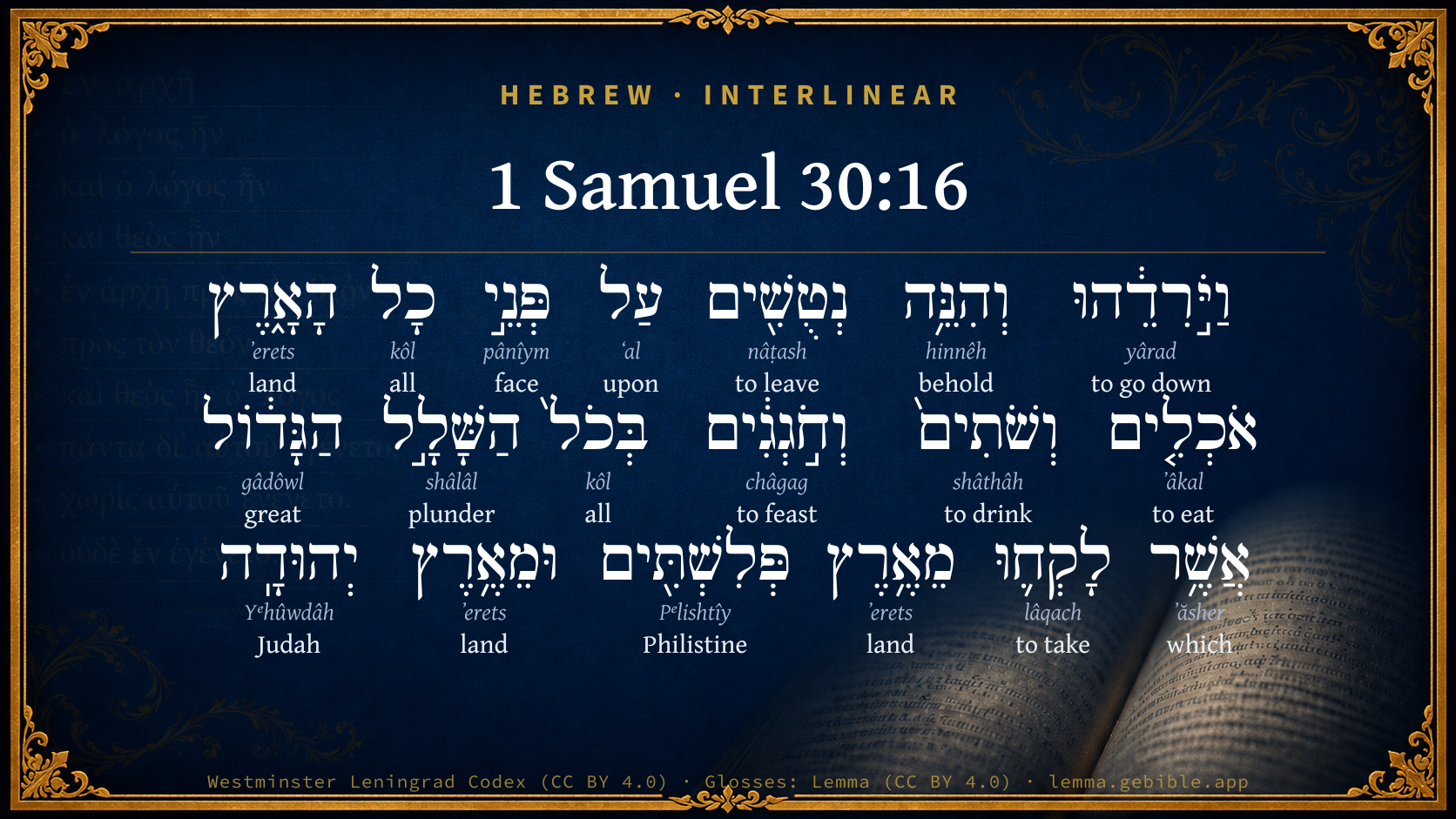
  1. וַיֹּ֣רִדֵ֔הוּ yârad H3381 “and · to go down · him” Conjunction + Verb, Hiphil, Sequential Imperfect, 3rd Person, Masculine, Singular + Suffix, Personal, 3rd Person, Masculine, Singular
  2. וְהִנֵּ֥ה hinnêh H2009 “and · behold” Conjunction + Particle, Demonstrative
  3. נְטֻשִׁ֖ים nâṭash H5203 “left” Verb, Qal, Participle Passive, Masculine, Plural, Absolute
  4. עַל ʻal H5921 “upon” Preposition
  5. פְּנֵ֣י pânîym H6440 “face(s) of” Noun, Common, Both, Plural, Construct
  6. כָל kôl H3605 “all of” Noun, Common, Masculine, Singular, Construct
  7. הָאָ֑רֶץ ʼerets H776 “the · land” Particle, Definite Article + Noun, Common, Both, Singular, Absolute
  8. אֹכְלִ֤ים ʼâkal H398 “eating” Verb, Qal, Participle Active, Masculine, Plural, Absolute
  9. וְשֹׁתִים֙ shâthâh H8354 “and · drinking” Conjunction + Verb, Qal, Participle Active, Masculine, Plural, Absolute
  10. בְּכֹל֙ kôl H3605 “in/at · all of” Preposition + Noun, Common, Masculine, Singular, Construct
  11. הַשָּׁלָ֣ל shâlâl H7998 “the · plunder” Particle, Definite Article + Noun, Common, Masculine, Singular, Absolute
  12. הַגָּד֔וֹל gâdôwl H1419 “the · great” Particle, Definite Article + Adjective, Adjective, Masculine, Singular, Absolute
  13. אֲשֶׁ֥ר ʼăsher H834 “which” Particle, Relative
  14. לָקְח֛וּ lâqach H3947 “to take” Verb, Qal, Perfect, 3rd Person, Common, Plural
  15. מֵאֶ֥רֶץ ʼerets H776 “from · land of” Preposition + Noun, Common, Both, Singular, Construct
  16. פְּלִשְׁתִּ֖ים Pᵉlishtîy H6430 “Philistines” Noun, Gentilic, Masculine, Plural, Absolute
  17. וּמֵאֶ֥רֶץ ʼerets H776 “and · from · land of” Conjunction + Preposition + Noun, Common, Both, Singular, Construct
  18. יְהוּדָֽה Yᵉhûwdâh H3063 “Judah” Noun, Proper

About this verse

These counts appear in no published source. They are computed here, from the morphology-tagged text and Lemma’s own curated glosses. What Lemma adds →

19
words
16
distinct lemmas
Historical
section

Notable vocabulary

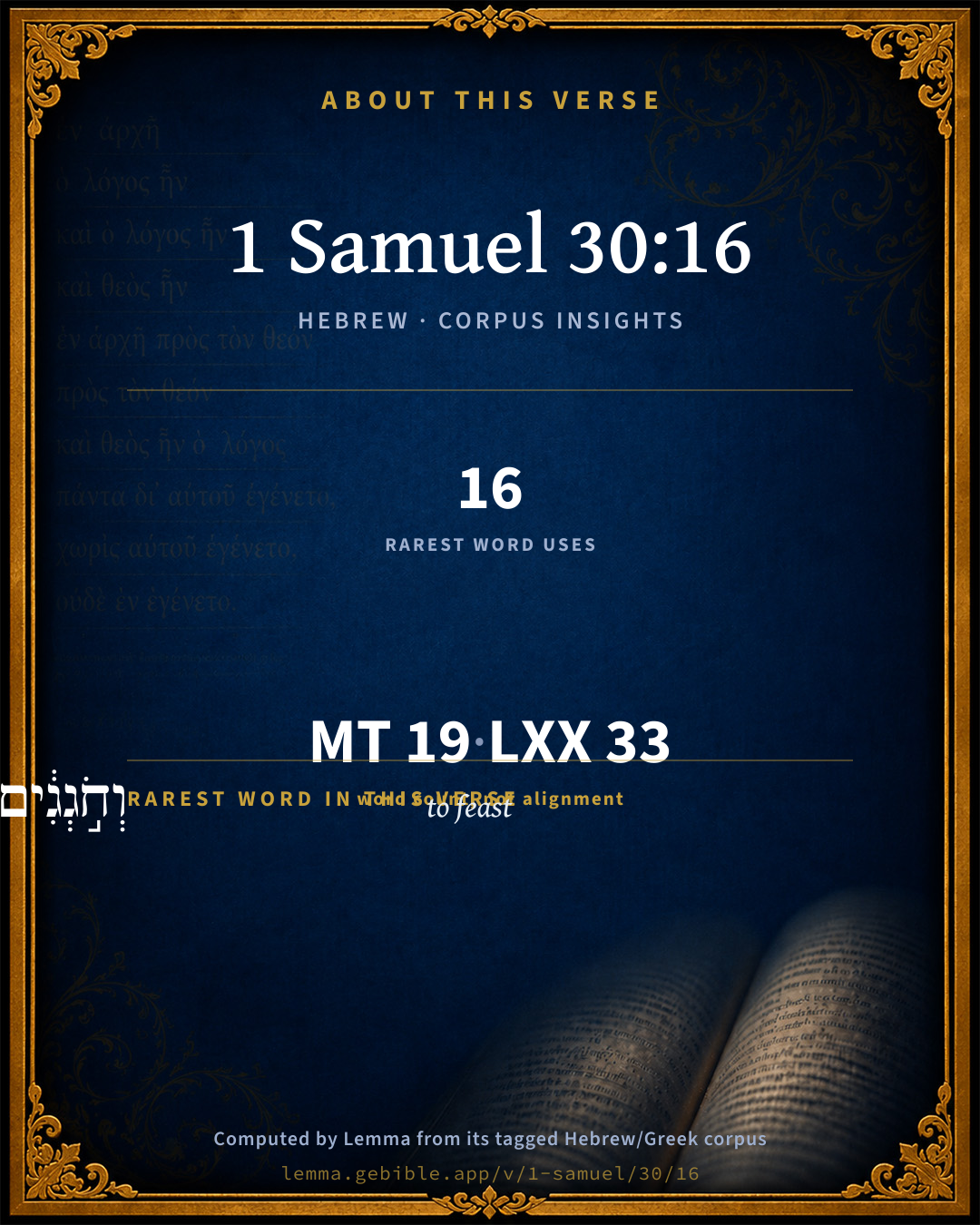
The rarest word here is וְחֹ֣גְגִ֔ים to feast H2287 — appearing just 16 times in the whole Hebrew Bible.

Shared distinctive vocabulary

וְחֹ֣גְגִ֔ים to feast H2287 occurs in 14 verses of the Hebrew Bible. Also found in:

Grammatical profile

  • 6 verbs
  • 9 nouns
  • 1 adjective
  • 1 preposition
  • 2 particles

Verb forms

  • וַיֹּ֣רִדֵ֔הוּ Hiphil · Sequential Imperfect
  • נְטֻשִׁ֖ים Qal · Participle Passive
  • אֹכְלִ֤ים Qal · Participle Active
  • וְשֹׁתִים֙ Qal · Participle Active
  • וְחֹ֣גְגִ֔ים Qal · Participle Active
  • לָקְח֛וּ Qal · Perfect

Repetition

Words recur within this verse — often emphatic in Hebrew:

  • הָאָ֑רֶץ land H776 ×3
  • כָל all H3605 ×2

Hebrew & Septuagint length

In English translation the verse runs 44 words from the Hebrew and 49 from the Septuagint (LXX English) — closely comparable.

A rough comparison of the two English renderings, which tokenize alike — not a word-level alignment.

Word counts can differ between the Hebrew and the Greek without any difference in meaning — e.g. the Hebrew direct-object marker אֵת has no separate Greek word, and Greek often adds the article ὁ.

In the original languages it is 19 Hebrew tokens and 33 Greek tokens — but the two are counted differently (Hebrew bundles its prefixes and suffixes into one token; the Greek is in lemma form), so that isn’t a like-for-like length.

Cross-references

16

Topical passages linked to 1 Samuel 30:16 in the Treasury of Scripture Knowledge — connected by theme and wording, ordered by reader-vote popularity; previews shown in the World English Bible.

  • Revelation 11:10–13 Those who dwell on the earth rejoice over them, and they will be glad. They will give gifts to one another, because these two prophets tormented those who dwell on the earth.
  • Judges 16:23–30 The lords of the Philistines gathered them together to offer a great sacrifice to Dagon their god, and to rejoice; for they said, Our god has delivered Samson our enemy into our hand.
  • 1 Samuel 30:14 We made a raid on the South of the Cherethites, and on that which belongs to Judah, and on the South of Caleb; and we burned Ziklag with fire.
  • 2 Samuel 13:28 Absalom commanded his servants, saying, Mark you now, when Amnon's heart is merry with wine; and when I tell you, Smite Amnon, then kill him; don't be afraid; haven't I commanded you? be courageous, and be valiant.
  • Job 20:5 That the triumphing of the wicked is short, The joy of the godless but for a moment?
  • Daniel 5:1–4 Belshazzar the king made a great feast to a thousand of his lords, and drank wine before the thousand.
  • Luke 12:19–20 I will tell my soul, "Soul, you have many goods laid up for many years. Take your ease, eat, drink, be merry."'
  • Luke 17:27–29 They ate, they drank, they married, they were given in marriage, until the day that Noah entered into the ark, and the flood came, and destroyed them all.
  • Luke 21:34–35 "So be careful, or your hearts will be loaded down with carousing, drunkenness, and cares of this life, and that day will come on you suddenly.
  • 1 Thessalonians 5:3 For when they are saying, "Peace and safety," then sudden destruction will come on them, like birth pains on a pregnant woman; and they will in no way escape.
  • Exodus 32:6 They rose up early on the next day, and offered burnt offerings, and brought peace-offerings; and the people sat down to eat and to drink, and rose up to play.
  • Exodus 32:17–19 When Joshua heard the noise of the people as they shouted, he said to Moses, "There is the noise of war in the camp."
  • Exodus 32:27–28 He said to them, "Thus says Yahweh, the God of Israel, 'Every man put his sword on his thigh, and go back and forth from gate to gate throughout the camp, and every man kill his brother, and every man his companion, and every man his neighbor."
  • Judges 1:24–25 The watchers saw a man come forth out of the city, and they said to him, Show us, we pray you, the entrance into the city, and we will deal kindly with you.
  • 1 Samuel 25:36–38 Abigail came to Nabal; and, behold, he held a feast in his house, like the feast of a king; and Nabal's heart was merry within him, for he was very drunken: therefore she told him nothing, less or more, until the morning light.
  • Isaiah 22:13 and behold, joy and gladness, killing oxen and killing sheep, eating flesh and drinking wine: let us eat and drink, for tomorrow we shall die.

Cross-references courtesy of OpenBible.info (CC BY 4.0).

Hebrew and Greek witnesses Masoretic Hebrew ↔ Greek Septuagint

The same verse in the two great witnesses to the Old Testament, shown verse-for-verse.

These are two independent witnesses, not word-aligned to each other, and the Septuagint is shown in lemma (dictionary) form.

Hebrew 1 Samuel 30:16 Masoretic · Westminster Leningrad Codex

וַיֹּ֣רִדֵ֔הוּ וְהִנֵּ֥ה נְטֻשִׁ֖ים עַל פְּנֵ֣י כָל הָאָ֑רֶץ אֹכְלִ֤ים וְשֹׁתִים֙ וְחֹ֣גְגִ֔ים בְּכֹל֙ הַשָּׁלָ֣ל הַגָּד֔וֹל אֲשֶׁ֥ר לָקְח֛וּ מֵאֶ֥רֶץ פְּלִשְׁתִּ֖ים וּמֵאֶ֥רֶץ יְהוּדָֽה

When he had brought him down, behold, they were spread abroad over all the ground, eating and drinking, and dancing, because of all the great spoil that they had taken out of the land of the Philistines, and out of the land of Judah.

World English Bible · Public Domain

Greek LXX 1 Samuel 30:16 Septuagint · lemma form

καί καταἄγω αὐτός ἐκεῖ καί ἰδού οὗτος διαχέω ἐπί πρόσωπον πᾶς ὁ γῆ ἐσθίω καί πίνω καί ἑορτάζω ἐν πᾶς ὁ σκῦλον ὁ μέγας ὅς λαμβάνω ἐκ γῆ ἀλλόφυλος καί ἐκ γῆ ιουδα

So he brought him down there, and behold, they were scattered abroad upon the surface of the whole land, eating and drinking, and feasting by reason of all the great spoils which they had taken out of the land of the Philistines, and out of the land of Juda.

LXX2012 (modern English Septuagint) · Public Domain

Hebrew: Westminster Leningrad Codex (CC BY 4.0). Greek: Septuagint (public domain); English from LXX2012 (modern English Septuagint) (Public Domain). How the Septuagint differs from the Hebrew →

Targum (Aramaic paraphrase)

1

The Targum is the ancient Jewish Aramaic paraphrase of the Hebrew Scriptures — an interpretive translation, not the Hebrew text itself. Onkelos (literal) and Pseudo-Jonathan (expansive) render the Torah, and Jonathan the Prophets. Coverage is partial: where no permissively-licensed English translation exists for a verse, only the Aramaic is shown. This is verse-level text, not a word-by-word alignment to the Hebrew.

  1. Targum Jonathan Prophets (Joshua–Malachi)
    וְאַחְתֵיהּ וְהָא רְטִישִׁין עַל אַפֵּי כָל אַרְעָא אָכְלִין וְשָׁתָן וְחָגְגִין בְּכָל עֲדָאָה סַגִיאָה דִשְׁבוֹ מֵאַרְעָא פְּלִשְׁתָּאֵי וּמֵאַרְעָא דְבֵית יְהוּדָה:

    (no public-domain English translation for this verse)

    Targum Jonathan — Aramaic: “Mikraot Gedolot” (public domain). English: “Sefaria Community Translation” (CC0 1.0 (public-domain dedication)); “London "Chaldee Paraphrase," 1871” (public domain). Text via Sefaria.

Commentary

Notes on 1 Samuel 30:16 from classic Christian and Jewish commentators (each source and its license shown beneath its notes). The classic Christian expositions comment on the surrounding passage and are grouped to its opening verse, so a note may address several verses; the Jewish commentaries on the Tanakh (Rashi and others) are per-verse, so they appear only where the commentator wrote on this verse.

Lemma curates 59 commentaries, every one of them public domain or Creative Commons licensed, each selected and text-cleaned for this edition rather than reprinted as found. About our sources →

Jamieson, Fausset & Brown

Robert Jamieson, A. R. Fausset & David Brown

AND RECOVERS HIS TWO WIVES AND ALL THE SPOIL. (1Sa. 30:16-31)

they were spread abroad upon all the earth--Believing that David and all his men of war were far away, engaged with the Philistine expedition, they deemed themselves perfectly secure and abandoned themselves to all manner of barbaric revelry. The promise made in answer to the devout inquiries of David (Sa1 30:8) was fulfilled. The marauders were surprised and panic-stricken. A great slaughter ensued--the people as well as the booty taken from Ziklag was recovered, besides a great amount of spoil which they had collected in a wide, freebooting excursion.

Jamieson, Fausset & Brown — Commentary Critical and Explanatory on the Whole Bible (1871) — public domain (CC PDM 1.0). Text via the HelloAO Bible API.

Trapp's Complete Commentary

John Trapp

1Sa 30:16 And when he had brought him down, behold, [they were] spread abroad upon all the earth, eating and drinking, and dancing, because of all the great spoil that they had taken out of the land of the Philistines, and out of the land of Judah.

Ver. 16. And when he had brought him down.] For he knew by some means where they would rendezvous; and there they were spread abroad at random. Security ushereth in destruction, as it did not many years since at Verona in Italy. The story is this Nicolaus Picinninus, fighting against the Venetians, and being beaten by them, rallied his forces, and suddenly set upon Verona, fearing nothing less than a beaten enemy, and took it. But whilst his soldiers were plundering, and pleasing themselves in their so-soon-gotten victory, they were easily overcome again by Francis Sfortia coming unexpectedly upon them. So that that city was twice together taken by the same means, securitate et negligentia utrisque exitiali, saith the historian; that is, by security and negligence, destructive to both parties. {a}

Eating and drinking, and dancing.] Or, Keeping holiday. So Abraham found and routed Chedorlaomer and his army: {Gen 14:15} Ahab, the Syrians: {1Ki 20:16} Tomyris, the Persians: the Turks, twenty thousand Dutchmen in Joppa, drinking themselves drunk upon Martin’s day, their arch-saint. {b} In the fight at Bannockburn, in Scotland, {c} where the English were, under Edward II, overthrown, in the English camp wassail {A salutation used when presenting a cup of wine to a guest, or drinking the health of a person, the reply being drink-hail.} and drink-hail {The customary courteous reply to a pledge in drinking in early English times. The cup was offered with the salutation wæs hail ‘health or good luck to you’ (see wassail), to which the reply was drink hail, ‘drink good health or good luck’.} were thundered extraordinarily, as accounting themselves sure of the victory. {d} Far otherwise the Bruce’s army, which by his commandment spent the evening in making humble confession of their sins, and so to fit themselves on the morrow to receive the sacrament, &c.

{a} Balth., Exner. Val. Max., Christ., p. 379.

{b} Justin.

{c} Full., Holy War.

{d} Speed, 671.

John Trapp, A Commentary or Exposition upon All the Books of the Old and New Testament (1647–1656) — public domain. Text from a community e-Sword module.

Joseph Benson's Commentary

1Sa 30:16-17. They were spread upon all the earth — Secure and careless, because they were now come almost to the borders of their own country, and the Philistines and Israelites both were otherwise engaged, and David, as they believed, with them. So they had no visible cause of danger; and yet then they were nearest to destruction! David smote them from the twilight — The word signifies both the morning and evening twilight. But the latter seems here intended, partly because their eating, and drinking, and dancing, was more proper work for the evening than the morning; and partly because the evening was more convenient for David, that the fewness of his forces might not be discovered by the daylight. It is probable that, when he came near them, he reposed himself and his army in some secret place, whereof there were many in those parts, for a convenient season; and then marched on so as to come to them at the evening time.

Joseph Benson's Commentary on the Old and New Testaments (1811–1818) — public domain. Text from a community e-Sword module.

Geneva Bible (1599)

Geneva Bible translators

The wicked in their pomp and pleasures consider not the judgment of God, which is then at hand to smite them.

Geneva Bible (1599) marginal notes — public domain. Text via Bolls.life.

Adam Clarke's Commentary

Verse 16. Out of the land of the Philistines] That these Amalekites were enemies to the Philistines is evident, but it certainly does not follow from this that those whom David destroyed were enemies also. This, I think, has been too hastily assumed by Dr. Chandler and others, in order the better to vindicate the character of David.

Adam Clarke's Commentary on the Bible (1810–1826) — public domain. Text from a community e-Sword/MySword module.

Ellicott's Commentary for English Readers

(16) Spread abroad upon all the earth, eating and drinking and dancing.—We have here a vivid picture of the wild license which these barbarians allowed themselves, now that they were secure, as they thought, from all pursuit. When the picked warriors of David’s troops looked on the scene of revelry and debauch, and thought who were among the captives in that disorderly encampment, and remembered what homes had been made desolate to provide much of that great spoil over which Amalek was rejoicing, we may well conceive with what strength and fury the little veteran force of Israelites fell upon these desert robbers, who evidently far out-numbered them.

A Bible Commentary for English Readers, edited by Charles John Ellicott (1878–1897) — public domain. Text from a community e-Sword module.

The Cambridge Bible for Schools and Colleges

gen. ed. J. J. S. Perowne

16. dancing] Or, feasting.

The Cambridge Bible for Schools and Colleges (gen. ed. J. J. S. Perowne; Cambridge University Press, 1878–1918) — public domain. Text from a community e-Sword module.

John Gill's Exposition

And when he had brought him down,.... To the place where the company of the Amalekites were, or near it:

behold, they were spread abroad upon all the earth; they were not in any regular order, and much less in any military form, but lay about in the fields, scattered here and there, were in detached parties:

some eating and drinking; in one place:

and dancing; others, in another place, expressing their joy, and perhaps their thankfulness to their idols

because of the great spoil they had taken out of the land of the Philistines, and out of the land of Judah; from Ziklag, and from the south of the Cherethites, and the south of Judah, they had invaded, Sa1 30:14; and here they were in the greatest security; knowing: that the armies of the Philistines were gone into the land of Israel, and were about to engage in battle with the Israelites, and David they supposed was with the Philistines, so that they had nothing to fear from any quarter; and thus it is often, that when men cry peace, peace, sudden destruction comes upon them.

John Gill's Exposition of the Whole Bible (1746–1763) — public domain (CC PDM 1.0). Text via the HelloAO Bible API.

Haydock's Catholic Bible Commentary

Drinking. Hebrew adds, "and dancing," (Salien) in honour of their gods. (Menochius)

George Leo Haydock (1774–1849), Haydock's Catholic Family Bible and Commentary, 1859 edition — public domain. Excludes Psalms (Douay-Rheims chapter numbering differs from Protestant) and Deuterocanonical books (Catholic canon only).

Matthew Poole's English Annotations

Spread abroad upon all the earth; secure and careless, because they were now come almost to the borders of their own country, and the Philistines and Israelites both were otherwise engaged, and David, as they believed, with them. So they had no visible cause of danger; and yet then they were nearest to their destruction.

Matthew Poole's English Annotations on the Holy Bible (1683–1685) — public domain. Text from a community e-Sword/MySword module.

The Pulpit Commentary

When he had brought them down. Though left behind, the Egyptian knew the course which the Amalekites intended to take, and was thus able to bring David quickly up to them, as they would move slowly because of their large booty of cattle. On overtaking them David found them dispersed in scattered groups abroad upon all the earth (literally, "over the face of all the land"), eating and drinking, and dancing. More probably, "feasting." The word literally means keeping festival; but though they had solemn dances at festivals, yet, as is the case with our word feasting, good eating was probably the uppermost idea; still the word may have only the general sense of "enjoying themselves as on a festival."

The Pulpit Commentary (1880–1919), ed. H.D.M. Spence-Jones & Joseph S. Exell — public domain. Text from a community e-Sword module.

John Wesley's Explanatory Notes

Upon all the earth - Secure and careless, because they were now come almost to the borders of their own country, and the Philistines and Israelites both were otherwise engaged, and David, as they believed, with them. So they had no visible cause of danger; and yet then they were nearest to destruction.

John Wesley, Explanatory Notes Upon the Whole Bible (1754–1765) — public domain. Text via the GEBible commentary corpus.

unfoldingWord translationNotes

Door43 World Missions Community

booty

the goods they had stolen in the raid

twilight

the time just after the sun goes down until the sky is dark

four hundred

400 (See: Numbers)

translationWords

Egypt

David

Philistines

Judah

camel

unfoldingWord translationNotes — © Distant Shores Media and the Door43 World Missions Community, licensed CC BY-SA 4.0. Source: git.door43.org/Door43/en_tn.

Lesson kit

Teaching starters — assembled from the data on this page, not authored interpretation. Every prompt links to the verse data it draws on. Edit before teaching.

1 Samuel, in the Historical, opens this verse with 19 words (16 distinct Hebrew lemmas). Its most distinctive word is châgag (“to feast”). A historical commentator’s framing appears above. Read the whole chapter for the surrounding context.

Discussion questions

  1. How does “to feast” (châgag) shape what this verse is saying?
  2. Exodus 5:1 shares the word «to feast» with this verse. How do the two illuminate each other?
  3. “land” occurs 3× in this one verse. What is the effect of the repetition?
  4. The translations on this page render this verse differently — a whole-verse word diff, not a word-by-word alignment. What might account for the different wordings?
  5. The verb «וַיֹּ֣רִדֵ֔הוּ» is Hiphil Sequential Imperfect. How does its form color the action?
  6. Reading how Jamieson, Fausset & Brown and Trapp's Complete Commentary read this verse, where do the two commentators agree and where do they part?

Things to notice

Reading settings

Reading text

Shown beneath each verse's original-language words.

Old Testament
Old Testament edition

Read the OT as the Masoretic Hebrew (MT) or the Greek Septuagint (LXX).

English shown for the Greek Septuagint (in the Hebrew ↔ Greek comparison).

Comparing translations? Open the Compare panel on any verse page to stack up to four side by side.