Deuteronomy 28:39

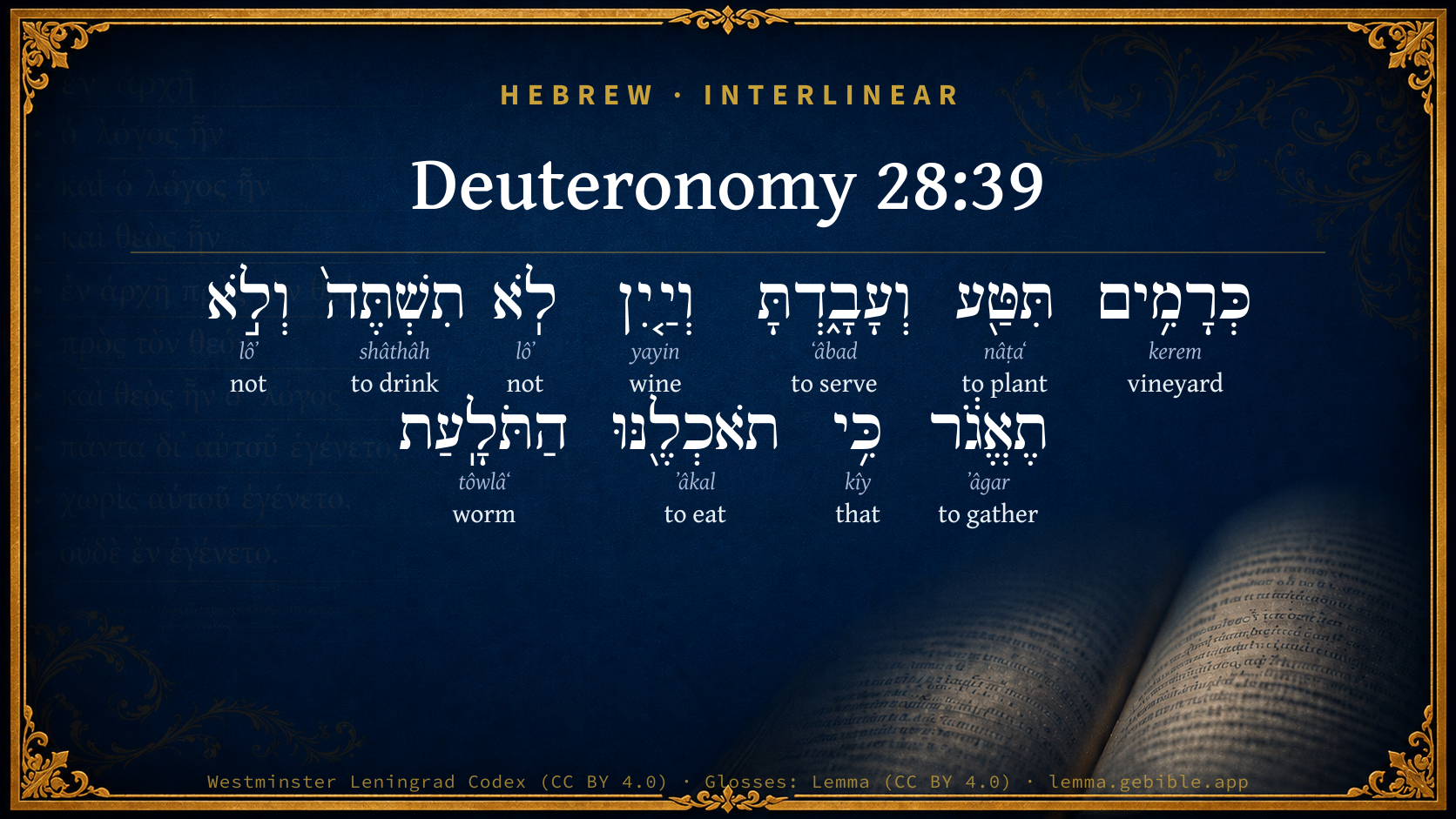
Hebrew (Westminster Leningrad Codex) Deuteronomy 28:39 appears in the Hebrew Old Testament. The text above is from the Westminster Leningrad Codex. Each word links to its Strong’s number, a concise gloss, and parsing drawn from the Open Scriptures Hebrew Bible morphology. Click any word for its full Brown-Driver-Briggs (BDB) entry.
Download image
Cite this verse

Deuteronomy 28:39 (World English Bible). Public Domain. Lemma interlinear Bible study tool, https://lemma.gebible.app/v/deuteronomy/28/39.

Show BibTeX & RIS
BibTeX
RIS
English Translation
You shall plant vineyards and dress them, but you shall neither drink of the wine, nor gather [the grapes]; for the worm shall eat them.
World English Bible · Public Domain
Highlights
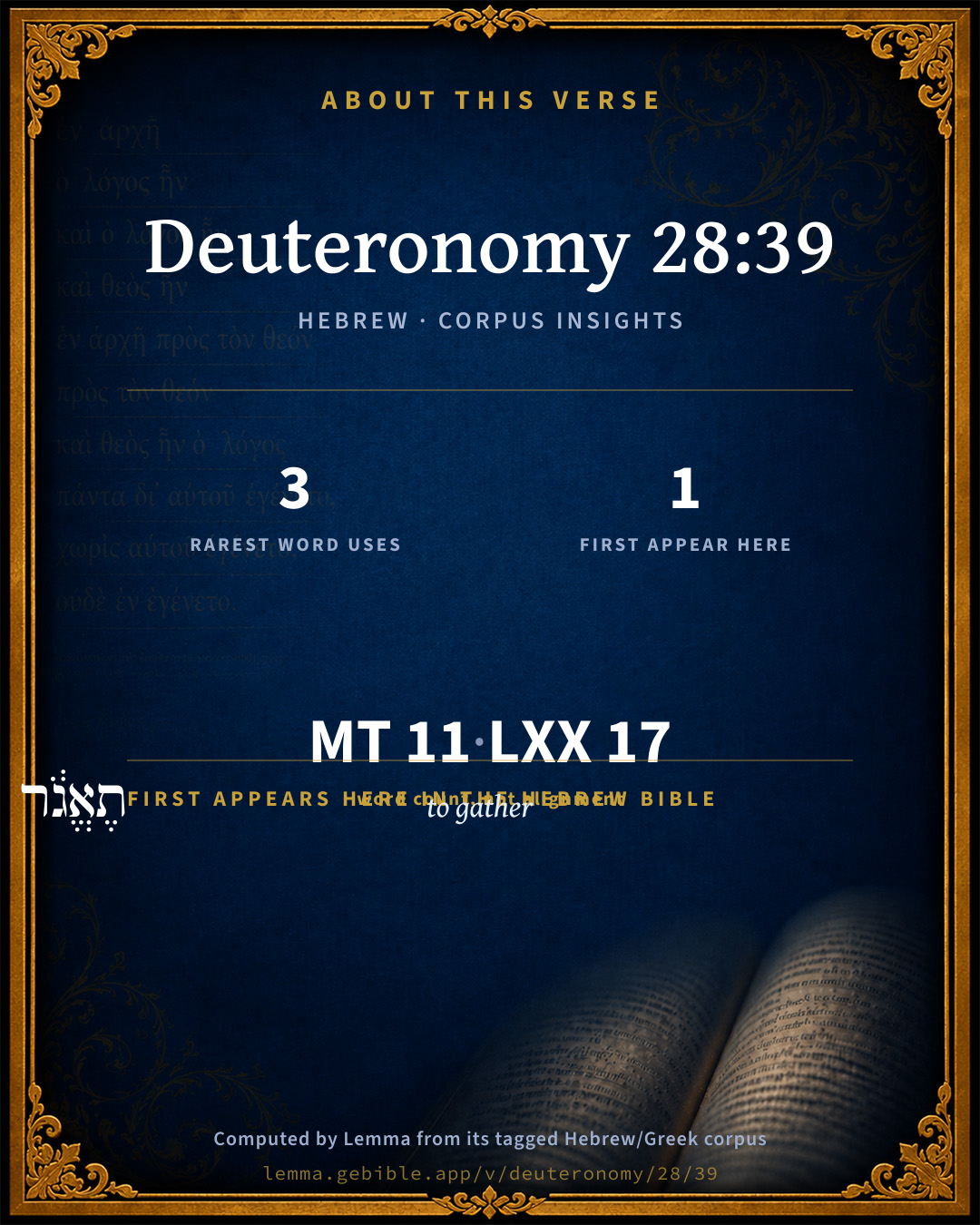
  • 1 first appearance in the Hebrew Bible
Full analysis ↓
Download a study sheet

One document with this verse’s original text, its word-by-word gloss line, the meaning frame, cross-references with their text, attributed commentary, and full source and license credits — printable, and it pastes into notes with its structure intact.

This verse Autodidact and up

Study sheet (.html) Plain text (.txt)

A passage Seminary Student

Up to 50 verses in one chapter. A passage sheet keeps up to 6 commentary sources and 12 cross-references per verse, in the order this page ranks them, and says so on the sheet whenever that leaves anything out. Ask for a single verse and you get the Autodidact verse sheet above.

Everything on this page stays free to read, with no account — the sheet is a download of what is already on screen, not access to it.

Want to remove ads? Support Godless Engineer
Compare translations 3

The same verse in 3 English versions, stacked beneath the original-language interlinear above. Click any original word for its lexicon entry.

Each is an independent rendering of the whole verse — the interlinear is not word-aligned to these translations.

Highlighted words mark where these versions differ — a whole-verse word diff, not a word-by-word alignment.

  • World English Bible Public Domain
    You shall plant vineyards and dress them, but you shall neither drink of the wine, nor gather [the grapes]; for the worm shall eat them.
  • King James Version Public Domain
    Thou shalt plant vineyards, and dress them, but shalt neither drink of the wine, nor gather the grapes; for the worms shall eat them.
  • unfoldingWord Literal Text CC BY-SA 4.0
    You will plant vineyards and cultivate, but you will not drink the wine nor harvest, for the worms will eat it.

unfoldingWord Literal Text — © unfoldingWord, licensed CC BY-SA 4.0. Word-aligned USFM3 via Door43 (git.door43.org/unfoldingWord/en_ult).

Versions to compare (up to 4)

3 of 4 selected

Show all 18 translations

Every available English version of this verse, each an independent rendering of the whole verse.

  • World English Bible Public Domain
    You shall plant vineyards and dress them, but you shall neither drink of the wine, nor gather [the grapes]; for the worm shall eat them.
  • Berean Standard Bible Public Domain
    You will plant and cultivate vineyards, but will neither drink the wine nor gather the grapes, because worms will eat them.
  • Majority Standard Bible Public Domain
    You will plant and cultivate vineyards, but will neither drink the wine nor gather the grapes, because worms will eat them.
  • King James Version Public Domain
    Thou shalt plant vineyards, and dress them, but shalt neither drink of the wine, nor gather the grapes; for the worms shall eat them.
  • American Standard Version (1901) Public Domain
    Thou shalt plant vineyards and dress them, but thou shalt neither drink of the wine, nor gather `the grapes'; for the worm shall eat them.
  • Revised Version (1885) Public Domain
    Thou shalt plant vineyards and dress them, but thou shalt neither drink of the wine, nor gather the grapes; for the worm shall eat them.
  • Geneva Bible (1599) Public Domain
    Thou shalt plant a vineyard, and dresse it, but shalt neither drinke of the wine, nor gather the grapes: for the wormes shall eate it.
  • Douay-Rheims (1899) Public Domain
    Thou shalt plant a vineyard, and dig it, and shalt not drink the wine, nor gather any thing thereof: because it shall be wasted with worms.
  • Young's Literal Translation Public Domain
    vineyards thou dost plant, and hast laboured, and wine thou dost not drink nor gather, for the worm doth consume it;
  • Literal Standard Version CC BY-SA 4.0
    you plant vineyards and have labored, but you do not drink wine, nor gather [grapes], for the worm consumes it;
  • Unlocked Literal Bible CC BY-SA 4.0
    You will plant vineyards and cultivate them, but you will neither drink any of the wine, nor even gather in the grapes, for worms will eat them.
  • unfoldingWord Literal Text CC BY-SA 4.0
    You will plant vineyards and cultivate, but you will not drink the wine nor harvest, for the worms will eat it.
  • Darby Bible Public Domain
    Thou shalt plant and till vineyards, but shalt drink no wine, nor gather [the fruit]; for the worms shall eat it.
  • World Messianic Bible Public Domain
    You will plant vineyards and dress them, but you will neither drink of the wine, nor harvest, because worms will eat them.
  • Webster's Bible Public Domain
    Thou shalt plant vineyards and dress them, but shalt neither drink of the wine, nor gather the grapes: for the worm shall eat them.
  • Free Bible Version CC BY-SA 4.0
    You will plant vineyards and care for them, but you won't harvest the grapes or drink the wine, because the grapes will be eaten by maggots.
  • Bible in Basic English Public Domain
    You will put in vines and take care of them, but you will get no wine or grapes from them; for they will be food for worms.
  • JPS Tanakh (1917) Public Domain
    Thou shalt plant vineyards and dress them, but thou shalt neither drink of the wine, nor gather the grapes; for the worm shall eat them.

Literal Standard Version (2020), Covenant Press — licensed CC BY-SA 4.0. Text via the HelloAO Bible API (eBible.org). Unlocked Literal Bible (unfoldingWord) — licensed CC BY-SA 4.0. Text via the HelloAO Bible API (eBible.org). unfoldingWord Literal Text — © unfoldingWord, licensed CC BY-SA 4.0. Word-aligned USFM3 via Door43 (git.door43.org/unfoldingWord/en_ult). Free Bible Version, Dr. Jonathan Gallagher — licensed CC BY-SA 4.0. Text via the HelloAO Bible API (eBible.org).

Word by word

More ways to search: Search by grammar → Find every occurrence → Compare this word →

Practice this passage: Drill this verse → Learn its vocabulary →

תֶאֱגֹ֔ר
ʼâgar
H103
“to gather”
Verb, Qal, Imperfect, 2nd Person, Masculine, Singular
Part of Speech
Verb
Stem
Qal
Form
Imperfect
Person
2nd Person
Gender
Masculine
Number
Singular
Full BDB Definition

Origin: a primitive root

TWOT: 22

to gather - (Qal) to gather
  1. כְּרָמִ֥ים kerem H3754 “vineyards” Noun, Common, Both, Plural, Absolute
  2. תִּטַּ֖ע nâṭaʻ H5193 “to plant” Verb, Qal, Imperfect, 2nd Person, Masculine, Singular
  3. וְעָבָ֑דְתָּ ʻâbad H5647 “and · to serve” Conjunction + Verb, Qal, Sequential Perfect, 2nd Person, Masculine, Singular
  4. וְיַ֤יִן yayin H3196 “and · wine” Conjunction + Noun, Common, Masculine, Singular, Absolute
  5. לֹֽא lôʼ H3808 “not” Particle, Negative
  6. תִשְׁתֶּה֙ shâthâh H8354 “to drink” Verb, Qal, Imperfect, 2nd Person, Masculine, Singular
  7. וְלֹ֣א lôʼ H3808 “and · not” Conjunction + Particle, Negative
  8. כִּ֥י kîy H3588 “that” Conjunction
  9. תֹאכְלֶ֖נּוּ ʼâkal H398 “to eat · him” Verb, Qal, Imperfect, 3rd Person, Feminine, Singular + Suffix, Personal, 3rd Person, Masculine, Singular
  10. הַתֹּלָֽעַת tôwlâʻ H8438 “the · worm” Particle, Definite Article + Noun, Common, Feminine, Singular, Absolute

About this verse

These counts appear in no published source. They are computed here, from the morphology-tagged text and Lemma’s own curated glosses. What Lemma adds →

11
words
10
distinct lemmas
Pentateuch
section

Notable vocabulary

The rarest word here is תֶאֱגֹ֔ר to gather H103 — appearing just 3 times in the whole Hebrew Bible.

First appearance in Scripture

This word makes its first canonical appearance in the Hebrew Bible here:

  • תֶאֱגֹ֔ר to gather H103

Shared distinctive vocabulary

תֶאֱגֹ֔ר to gather H103 occurs in 3 verses of the Hebrew Bible. Also found in:

Grammatical profile

  • 5 verbs
  • 3 nouns
  • 1 conjunction
  • 2 particles

Verb forms

  • תִּטַּ֖ע Qal · Imperfect
  • וְעָבָ֑דְתָּ Qal · Sequential Perfect
  • תִשְׁתֶּה֙ Qal · Imperfect
  • תֶאֱגֹ֔ר Qal · Imperfect
  • תֹאכְלֶ֖נּוּ Qal · Imperfect

Repetition

A word recurs within this verse — often emphatic in Hebrew:

Hebrew & Septuagint length

In English translation the verse runs 25 words from the Hebrew and 27 from the Septuagint (LXX English) — closely comparable.

A rough comparison of the two English renderings, which tokenize alike — not a word-level alignment.

Word counts can differ between the Hebrew and the Greek without any difference in meaning — e.g. the Hebrew direct-object marker אֵת has no separate Greek word, and Greek often adds the article ὁ.

In the original languages it is 11 Hebrew tokens and 17 Greek tokens — but the two are counted differently (Hebrew bundles its prefixes and suffixes into one token; the Greek is in lemma form), so that isn’t a like-for-like length.

Cross-references

5

Topical passages linked to Deuteronomy 28:39 in the Treasury of Scripture Knowledge — connected by theme and wording, ordered by reader-vote popularity; previews shown in the World English Bible.

  • Isaiah 5:10 For ten acres of vineyard shall yield one bath, And a homer of seed shall yield an ephah."
  • Isaiah 17:10–11 For you have forgotten the God of your salvation, and have not been mindful of the rock of your strength; therefore you plant pleasant plants, and set it with strange slips.
  • Joel 1:4–7 What the swarming locust has left, the great locust has eaten. What the great locust has left, the grasshopper has eaten. What the grasshopper has left, the caterpillar has eaten.
  • Joel 2:2–4 A day of darkness and gloominess, A day of clouds and thick darkness. As the dawn spreading on the mountains, A great and strong people; There has never been the like, Neither will there be any more after them, Even to the years of many generations.
  • Jonah 4:7 But God prepared a worm at dawn the next day, and it chewed on the vine, so that it withered.

Cross-references courtesy of OpenBible.info (CC BY 4.0).

Hebrew and Greek witnesses Masoretic Hebrew ↔ Greek Septuagint

The same verse in the two great witnesses to the Old Testament, shown verse-for-verse.

These are two independent witnesses, not word-aligned to each other, and the Septuagint is shown in lemma (dictionary) form.

Hebrew Deuteronomy 28:39 Masoretic · Westminster Leningrad Codex

כְּרָמִ֥ים תִּטַּ֖ע וְעָבָ֑דְתָּ וְיַ֤יִן לֹֽא תִשְׁתֶּה֙ וְלֹ֣א תֶאֱגֹ֔ר כִּ֥י תֹאכְלֶ֖נּוּ הַתֹּלָֽעַת

You shall plant vineyards and dress them, but you shall neither drink of the wine, nor gather [the grapes]; for the worm shall eat them.

World English Bible · Public Domain

Greek LXX Deuteronomy 28:39 Septuagint · lemma form

ἀμπελών φυτεύω καί καταἐργάζομαι καί οἶνος οὐ πίνω οὐδέ εὐφραίνω ἐκ αὐτός ὅτι καταἐσθίω αὐτός ὁ σκώληξ

You shall plant a vineyard, and dress it, and shall not drink the wine, neither shall you delight yourself with it, because the worm shall devour it.

LXX2012 (modern English Septuagint) · Public Domain

Hebrew: Westminster Leningrad Codex (CC BY 4.0). Greek: Septuagint (public domain); English from LXX2012 (modern English Septuagint) (Public Domain). How the Septuagint differs from the Hebrew →

Targum (Aramaic paraphrase)

2

The Targum is the ancient Jewish Aramaic paraphrase of the Hebrew Scriptures — an interpretive translation, not the Hebrew text itself. Onkelos (literal) and Pseudo-Jonathan (expansive) render the Torah, and Jonathan the Prophets. Coverage is partial: where no permissively-licensed English translation exists for a verse, only the Aramaic is shown. This is verse-level text, not a word-by-word alignment to the Hebrew.

  1. Targum Onkelos Torah (Genesis–Deuteronomy)
    כַּרְמִין תִּצוּב וְתִפְלַח וְחַמְרָא לָא תִשְׁתֵּי וְלָא תִכְנוֹשׁ אֲרֵי תֵיכְלִנֵהּ תֹּלַעְתָּא

    (no public-domain English translation for this verse)

    Targum Onkelos — Aramaic: “Onkelos Genesis” (public domain); “Onkelos Exodus” (public domain); “Onkelos Leviticus” (public domain); “Onkelos Numbers” (public domain); “Onkelos Deuteronomy” (public domain). English: “Sefaria Community Translation” (CC0 1.0 (public-domain dedication)); “J.W. Etheridge. The Targums of Onkelos and Jonathan Ben Uzziel on the Pentateuch. London: Longmans, Green, 1862” (public domain). Text via Sefaria.

  2. Targum Pseudo-Jonathan Torah (Genesis–Deuteronomy)
    כְּרָמִין תִּנְצְבוּן וְתִפְלְחוּן וְחַמְרָא לָא תִשְׁתּוּן וְלָא תְעַצְרוּן לְמִכְנוֹשׁ אֲרוּם יְגַמְרִינֵיהּ זַחֲלָא

    You will plant vineyards and till them, but will not drink the wine nor press out the vintage, because the worm will have consumed it.

    Targum Pseudo-Jonathan — Aramaic: “Targum Jonathan on Genesis” (public domain); “Targum Jonathan on Exodus” (public domain); “Targum Jonathan on Leviticus” (public domain); “Targum Jonathan on Numbers” (public domain); “Targum Jonathan on Deuteronomy” (public domain). English: “The Targum of Jonathan ben Uzziel, trans. J. W. Etheridge, London, 1862” (public domain). Text via Sefaria.

Commentary

Notes on Deuteronomy 28:39 from classic Christian and Jewish commentators (each source and its license shown beneath its notes). The classic Christian expositions comment on the surrounding passage and are grouped to its opening verse, so a note may address several verses; the Jewish commentaries on the Tanakh (Rashi and others) are per-verse, so they appear only where the commentator wrote on this verse.

Lemma curates 59 commentaries, every one of them public domain or Creative Commons licensed, each selected and text-cleaned for this edition rather than reprinted as found. About our sources →

John Gill's Exposition

All thy trees and fruit of thy land shall the locust consume. Which is a creature that not only consumes grass, and herbs, and the corn of the field, but all green trees; see Exo 10:15. This sort here has its name from the shade they make, hiding the light of the sun, and darkening the face of the earth at no on day; or from the noise they make with their wings in flying; see Joe 2:5.

.

Deuteronomy 28:43

deu 28:43

deu 28:43

deu 28:43The stranger that is within thee shall get up above thee very high,.... In wealth and riches, in power and authority, in honour and dignity. This Manasseh Ben Israel (r) interprets of the Samaritans, whom the king of Assyria drove out of Samaria, and the neighbouring places; but the design of the expression is to show how mean and abject they should be in another country; that even one who had been a stranger or proselyte of the gate, when in their own country, should now be vastly above them:

and thou shall come down, very low; into a very mean condition, to be in great subjection, a vassal and a slave; see Psa 106:41; and much more when reduced by the Romans, and sent to the mines in Egypt.

(r) De Termino Vitae, l. 3. sect. 3. p. 128.

John Gill's Exposition of the Whole Bible (1746–1763) — public domain (CC PDM 1.0). Text via the HelloAO Bible API.

The Pulpit Commentary

Worms; probably the vine weevil, the convolvulus or involvulus of the Latin writers (Pliny, "Nat. Hist.," 17:47; Care, "De Re Rust.," c. 95; Plaut., "Cistell.," 4:2), the ix er iy of the Greeks (Bochart, "Hieroz.," pt. it. bk. 4. e. 27).

The Pulpit Commentary (1880–1919), ed. H.D.M. Spence-Jones & Joseph S. Exell — public domain. Text from a community e-Sword module.

Lesson kit

Teaching starters — assembled from the data on this page, not authored interpretation. Every prompt links to the verse data it draws on. Edit before teaching.

Deuteronomy, in the Pentateuch, opens this verse with 11 words (10 distinct Hebrew lemmas). Its most distinctive word is ʼâgar (“to gather”). A historical commentator’s framing appears above. Read the whole chapter for the surrounding context.

Discussion questions

  1. The word ʼâgar carries the sense “to gather.” How does it shape the verse?
  2. This is the first place “to gather” appears in Scripture (first appears here). What does its debut here establish?
  3. How does Proverbs 6:8, which shares the word «to gather», read alongside this verse?
  4. What does the repetition of “not” (2× in this one verse) do in this verse?
  5. These translations render this verse differently; the difference is in the English rendering, not the original. What questions does that raise?
  6. «תִּטַּ֖ע» is a Qal Imperfect verb. How does that grammatical form shape the action described?
  7. Compare how John Gill's Exposition and The Pulpit Commentary read this verse. Where do they agree or differ?

Things to notice

Reading settings

Reading text

Shown beneath each verse's original-language words.

Old Testament
Old Testament edition

Read the OT as the Masoretic Hebrew (MT) or the Greek Septuagint (LXX).

English shown for the Greek Septuagint (in the Hebrew ↔ Greek comparison).

Comparing translations? Open the Compare panel on any verse page to stack up to four side by side.