Daniel 1:12

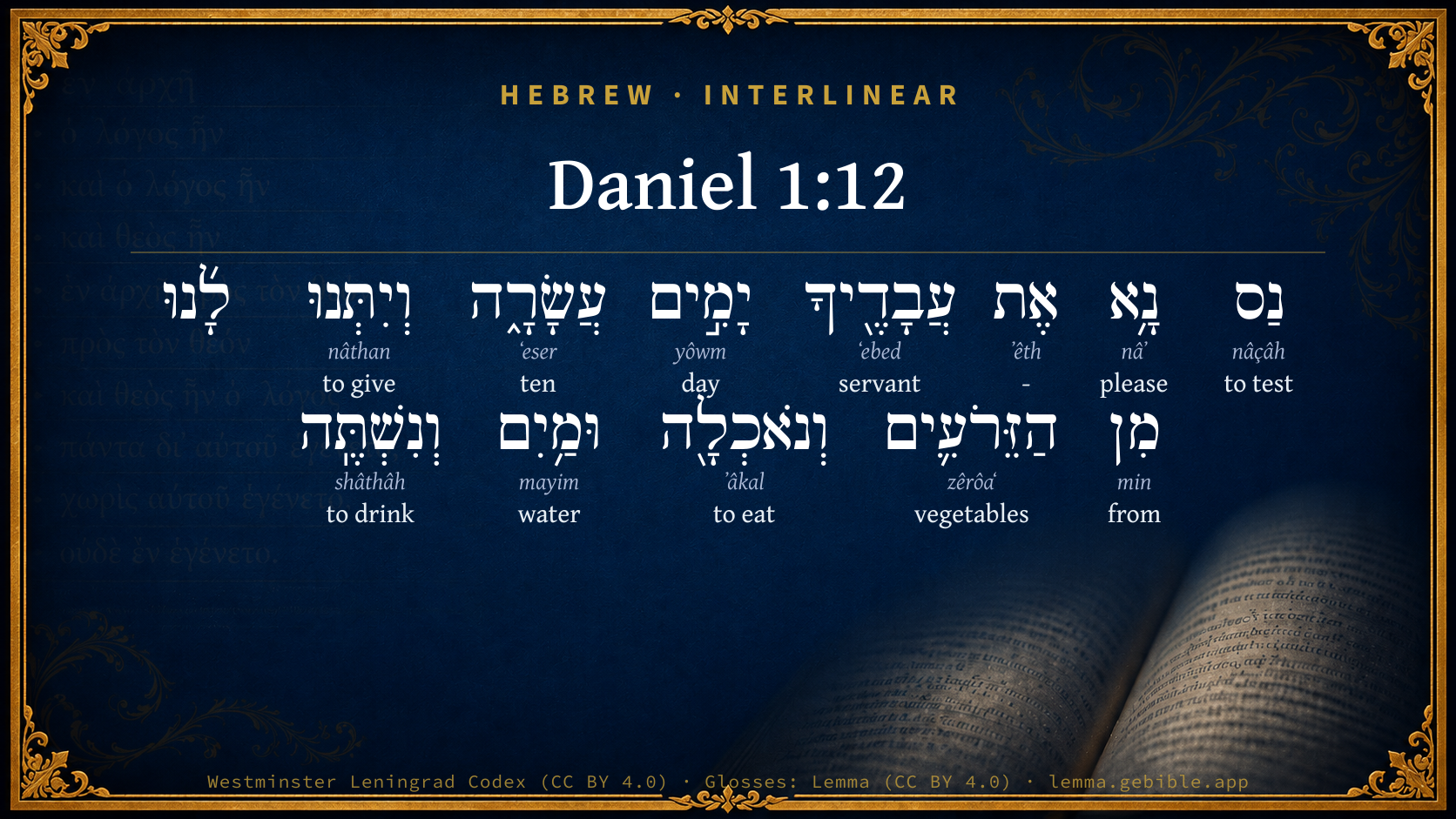
Hebrew (Westminster Leningrad Codex) Daniel 1:12 appears in the Hebrew Old Testament. The text above is from the Westminster Leningrad Codex. Each word links to its Strong’s number, a concise gloss, and parsing drawn from the Open Scriptures Hebrew Bible morphology. Click any word for its full Brown-Driver-Briggs (BDB) entry.
Download image
Cite this verse

Daniel 1:12 (World English Bible). Public Domain. Lemma interlinear Bible study tool, https://lemma.gebible.app/v/daniel/1/12.

Show BibTeX & RIS
BibTeX
RIS
English Translation
Prove your servants, I beg you, ten days; and let them give us pulse to eat, and water to drink.
World English Bible · Public Domain
Highlights
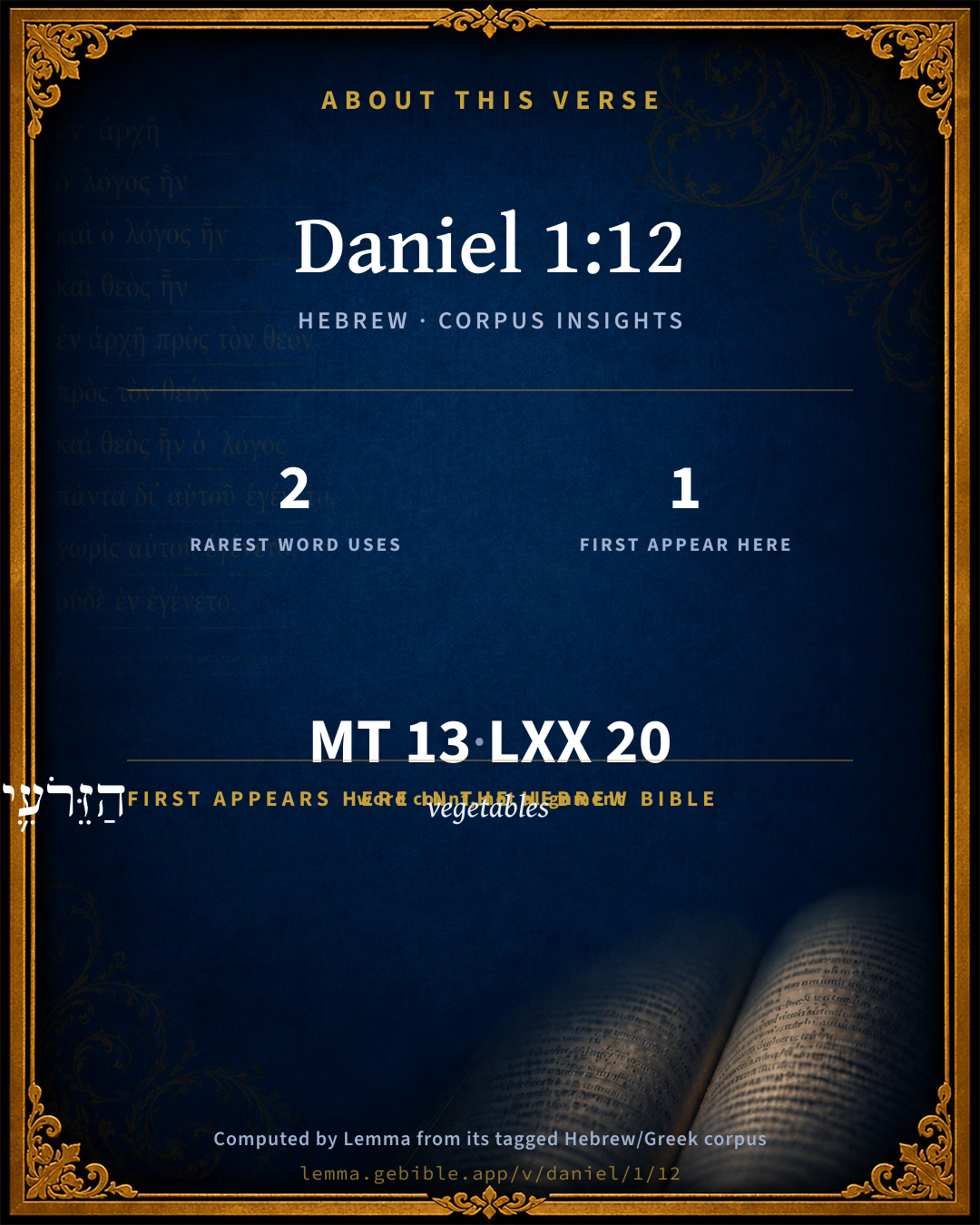
  • 1 first appearance in the Hebrew Bible
Full analysis ↓
Download a study sheet

One document with this verse’s original text, its word-by-word gloss line, the meaning frame, cross-references with their text, attributed commentary, and full source and license credits — printable, and it pastes into notes with its structure intact.

This verse Autodidact and up

Study sheet (.html) Plain text (.txt)

A passage Seminary Student

Up to 50 verses in one chapter. A passage sheet keeps up to 6 commentary sources and 12 cross-references per verse, in the order this page ranks them, and says so on the sheet whenever that leaves anything out. Ask for a single verse and you get the Autodidact verse sheet above.

Everything on this page stays free to read, with no account — the sheet is a download of what is already on screen, not access to it.

Want to remove ads? Support Godless Engineer
Compare translations 3

The same verse in 3 English versions, stacked beneath the original-language interlinear above. Click any original word for its lexicon entry.

Each is an independent rendering of the whole verse — the interlinear is not word-aligned to these translations.

Highlighted words mark where these versions differ — a whole-verse word diff, not a word-by-word alignment.

  • World English Bible Public Domain
    Prove your servants, I beg you, ten days; and let them give us pulse to eat, and water to drink.
  • King James Version Public Domain
    Prove thy servants, I beseech thee, ten days; and let them give us pulse to eat, and water to drink.
  • unfoldingWord Literal Text CC BY-SA 4.0
    “Please test your servants for ten days, and let us be given some vegetables to eat and water to drink.

unfoldingWord Literal Text — © unfoldingWord, licensed CC BY-SA 4.0. Word-aligned USFM3 via Door43 (git.door43.org/unfoldingWord/en_ult).

Versions to compare (up to 4)

3 of 4 selected

Show all 18 translations

Every available English version of this verse, each an independent rendering of the whole verse.

  • World English Bible Public Domain
    Prove your servants, I beg you, ten days; and let them give us pulse to eat, and water to drink.
  • Berean Standard Bible Public Domain
    “Please test your servants for ten days. Let us be given only vegetables to eat and water to drink.
  • Majority Standard Bible Public Domain
    “Please test your servants for ten days. Let us be given only vegetables to eat and water to drink.
  • King James Version Public Domain
    Prove thy servants, I beseech thee, ten days; and let them give us pulse to eat, and water to drink.
  • American Standard Version (1901) Public Domain
    Prove thy servants, I beseech thee, ten days; and let them give us pulse to eat, and water to drink.
  • Revised Version (1885) Public Domain
    Prove thy servants, I beseech thee, ten days; and let them give us pulse to eat, and water to drink.
  • Geneva Bible (1599) Public Domain
    Proue thy seruants, I beseeche thee, ten dayes, and let them giue vs pulse to eate, and water to drinke.
  • Douay-Rheims (1899) Public Domain
    Try, I beseech thee, thy servants for ten days, and let pulse be given us to eat, and water to drink:
  • Young's Literal Translation Public Domain
    `Try, I pray thee, thy servants, ten days; and they give to us of the vegetables, and we eat, and water, and we drink;
  • Literal Standard Version CC BY-SA 4.0
    “Please try your servants [for] ten days; and they give to us from the vegetables and we eat, and water, and we drink;
  • Unlocked Literal Bible CC BY-SA 4.0
    He said, “Please test us, your servants, for ten days. Give us only some vegetables to eat and water to drink.
  • unfoldingWord Literal Text CC BY-SA 4.0
    “Please test your servants for ten days, and let us be given some vegetables to eat and water to drink.
  • Darby Bible Public Domain
    Prove thy servants, I beseech thee, ten days; and let them give us pulse to eat, and water to drink;
  • World Messianic Bible Public Domain
    “Test your servants, I beg you, ten days; and let them give us vegetables to eat and water to drink.
  • Webster's Bible Public Domain
    Prove thy servants, I beseech thee, ten days; and let them give us pulse to eat, and water to drink.
  • Free Bible Version CC BY-SA 4.0
    “Please put us, your servants, to the test and just give us vegetables to eat and water to drink for ten days,” Daniel told him.
  • Bible in Basic English Public Domain
    Put your servants to the test for ten days; let them give us grain for our food and water for our drink.
  • JPS Tanakh (1917) Public Domain
    'Try thy servants, I beseech thee, ten days; and let them give us pulse to eat, and water to drink.

Literal Standard Version (2020), Covenant Press — licensed CC BY-SA 4.0. Text via the HelloAO Bible API (eBible.org). Unlocked Literal Bible (unfoldingWord) — licensed CC BY-SA 4.0. Text via the HelloAO Bible API (eBible.org). unfoldingWord Literal Text — © unfoldingWord, licensed CC BY-SA 4.0. Word-aligned USFM3 via Door43 (git.door43.org/unfoldingWord/en_ult). Free Bible Version, Dr. Jonathan Gallagher — licensed CC BY-SA 4.0. Text via the HelloAO Bible API (eBible.org).

Word by word

More ways to search: Search by grammar → Find every occurrence → Compare this word →

Practice this passage: Drill this verse → Learn its vocabulary →

הַזֵּרֹעִ֛ים
zêrôaʻ
H2235
“the · vegetables”
Particle, Definite Article + Noun, Common, Masculine, Plural, Absolute
Part of Speech
Particle + Noun
Type
Common
Gender
Masculine
Number
Plural
State
Absolute
Full BDB Definition

Origin: from H2232

TWOT: 582c

vegetables (as sown)
  1. נַס nâçâh H5254 “test” Verb, Piel, Imperative, 2nd Person, Masculine, Singular
  2. נָ֥א nâʼ H4994 “please” Particle, Exhortation
  3. אֶת ʼêth H853 “-” Particle, Direct Object
  4. עֲבָדֶ֖יךָ ʻebed H5650 “servants · your” Noun, Common, Masculine, Plural, Construct + Suffix, Personal, 2nd Person, Masculine, Singular
  5. יָמִ֣ים yôwm H3117 “days” Noun, Common, Masculine, Plural, Absolute
  6. עֲשָׂרָ֑ה ʻeser H6235 “ten” Adjective, Cardinal number, Masculine, Singular, Absolute
  7. וְיִתְּנוּ nâthan H5414 “and · to give” Conjunction + Verb, Qal, Jussive, 3rd Person, Masculine, Plural
  8. מִן min H4480 “from” Preposition
  9. וְנֹאכְלָ֖ה ʼâkal H398 “and · to eat” Conjunction + Verb, Qal, Cohortative, 1st Person, Common, Plural
  10. וּמַ֥יִם mayim H4325 “and · water(s)” Conjunction + Noun, Common, Masculine, Plural, Absolute
  11. וְנִשְׁתֶּֽה shâthâh H8354 “and · to drink” Conjunction + Verb, Qal, Cohortative, 1st Person, Common, Plural

About this verse

These counts appear in no published source. They are computed here, from the morphology-tagged text and Lemma’s own curated glosses. What Lemma adds →

13
words
12
distinct lemmas
Prophets
section

Notable vocabulary

The rarest word here is הַזֵּרֹעִ֛ים vegetables H2235 — appearing just 2 times in the whole Hebrew Bible.

First appearance in Scripture

This word makes its first canonical appearance in the Hebrew Bible here:

  • הַזֵּרֹעִ֛ים vegetables H2235

Shared distinctive vocabulary

הַזֵּרֹעִ֛ים vegetables H2235 occurs in 2 verses of the Hebrew Bible. Also found in:

Grammatical profile

  • 4 verbs
  • 4 nouns
  • 1 adjective
  • 2 prepositions
  • 2 particles

Verb forms

  • נַס Piel · Imperative
  • וְיִתְּנוּ Qal · Jussive
  • וְנֹאכְלָ֖ה Qal · Cohortative
  • וְנִשְׁתֶּֽה Qal · Cohortative

Hebrew & Septuagint length

In English translation the verse runs 20 words from the Hebrew and 21 from the Septuagint (LXX English) — closely comparable.

A rough comparison of the two English renderings, which tokenize alike — not a word-level alignment.

Word counts can differ between the Hebrew and the Greek without any difference in meaning — e.g. the Hebrew direct-object marker אֵת has no separate Greek word, and Greek often adds the article ὁ.

In the original languages it is 13 Hebrew tokens and 20 Greek tokens — but the two are counted differently (Hebrew bundles its prefixes and suffixes into one token; the Greek is in lemma form), so that isn’t a like-for-like length.

Cross-references

4

Topical passages linked to Daniel 1:12 in the Treasury of Scripture Knowledge — connected by theme and wording, ordered by reader-vote popularity; previews shown in the World English Bible.

  • Romans 14:2 One man has faith to eat all things, but he who is weak eats only vegetables.
  • Genesis 1:29–30 God said, "Behold, I have given you every herb yielding seed, which is on the surface of all the earth, and every tree, which bears fruit yielding seed. It will be your food.
  • Daniel 1:16 So the steward took away their dainties, and the wine that they should drink, and gave them pulse.
  • Deuteronomy 8:3 He humbled you, and allowed you to hunger, and fed you with manna, which you didn't know, neither did your fathers know; that he might make you know that man does not live by bread only, but by everything that proceeds out of the mouth of Yahweh does man live.

Cross-references courtesy of OpenBible.info (CC BY 4.0).

Hebrew and Greek witnesses Masoretic Hebrew ↔ Greek Septuagint

The same verse in the two great witnesses to the Old Testament, shown verse-for-verse.

These are two independent witnesses, not word-aligned to each other, and the Septuagint is shown in lemma (dictionary) form.

Hebrew Daniel 1:12 Masoretic · Westminster Leningrad Codex

נַס נָ֥א אֶת עֲבָדֶ֖יךָ יָמִ֣ים עֲשָׂרָ֑ה וְיִתְּנוּ לָ֜נוּ מִן הַזֵּרֹעִ֛ים וְנֹאכְלָ֖ה וּמַ֥יִם וְנִשְׁתֶּֽה

Prove your servants, I beg you, ten days; and let them give us pulse to eat, and water to drink.

World English Bible · Public Domain

Greek LXX Daniel 1:12 Septuagint · lemma form

πειράζω δή ὁ παῖς σύ ἐπί ἡμέρα δέκα καί δίδωμι ἐγώ ἀπό ὁ ὄσπριον ὁ γῆ ὥστε κάπτω καί ὑδροποτέω

Prove now your servants ten days; and let them give us pulse, and let us eat, and let us drink water:

LXX2012 (modern English Septuagint) · Public Domain

On this verse, The Pulpit Commentary discusses the Septuagint’s reading. Read the note in Commentary ↓

Hebrew: Westminster Leningrad Codex (CC BY 4.0). Greek: Septuagint (public domain); English from LXX2012 (modern English Septuagint) (Public Domain). How the Septuagint differs from the Hebrew →

Commentary

Notes on Daniel 1:12 from classic Christian and Jewish commentators (each source and its license shown beneath its notes). The classic Christian expositions comment on the surrounding passage and are grouped to its opening verse, so a note may address several verses; the Jewish commentaries on the Tanakh (Rashi and others) are per-verse, so they appear only where the commentator wrote on this verse.

Lemma curates 59 commentaries, every one of them public domain or Creative Commons licensed, each selected and text-cleaned for this edition rather than reprinted as found. About our sources →

Trapp's Complete Commentary

John Trapp

Dan 1:12 Prove thy servants, I beseech thee, ten days; and let them give us pulse to eat, and water to drink.

Ver. 12. Prove thy servants, I beseech thee, ten days.] All good means must be used for the keeping of a good conscience, and then God must be trusted for the issue. But did not Daniel herein tempt God? No; for besides that he had a word, (1.) Of precept; {Deu 14:3} and (2.) Of promise, {Exo 23:25} ex arcana revelatione certior factus est, it might be revealed unto him that no inconvenience should follow upon this course.

And let them give pulse to eat, and water to drink.] Poor fare for noblemen’s sons, but such as they were well paid for. Nature is contented with a little, grace with less. The sobriety of Democritus and Demosthenes is much celebrated among the heathen. But what saith Augustine? {a} Omnis vita infidelium peccatum est, et nihil bonum sine summo bone. Whatsoever is not of faith is sin, &c. Daniel’s sobriety was of another nature, of a better alloy. Papists crack much of their abstinence from certain meats and drinks at certain times; but Daniel’s and Papists’ fasts agree as harp and harrow. See my "Common Place of Abstinence."

{a} De Ver. lnnoc., cap. 56.

John Trapp, A Commentary or Exposition upon All the Books of the Old and New Testament (1647–1656) — public domain. Text from a community e-Sword module.

Tyndale Open Study Notes

Tyndale Open Resources

1:12 vegetables and water: Such a diet would steer clear of offensive foods (1:8) and, as a kind of fast, would demonstrate mourning over their exile in a foreign land.

Tyndale Open Study Notes — © Tyndale Open Resources, licensed CC BY-SA 4.0. Text via the HelloAO Bible API.

Ibn Ezra

Rabbi Abraham ibn Ezra

[Daniel 1:12] Nas-na (נַס־נָא - Test, please): This [Nas (נַס)] is the imperative form (leshon tzivui - לְשׁוֹן צִוּוּי), similar to [the use of na with an imperative in]: “Please entreat (chal-na - חַל־נָא) the favor of the Lord” [I Kings 13:6].

[Daniel 1:12] Yamin asarah (יָמִים עֲשָׂרָה - Ten days): And the reason for “ten days” is because a living being (chai - חַי) cannot endure hardship [or illness, without it becoming noticeable] for more than nine days. Thus the masters of natural science/biology (ba'alei ha-toladot - בַּעֲלֵי הַתּוֹלָדוֹת) have mentioned. And instead of the king's pat-bag (פַּת־בַּג) [food], give us legumes (zero'im - זֵרֹעִים). These are seeds/grains (gargirim - גַּרְגְּרִים) when they mature/dry. And instead of wine, give us water.

Ibn Ezra on the Tanakh — English translations: “Sefaria Community Translation” (CC0 1.0 (public-domain dedication)); “Yalkut, Sifsei Chachomim Chumash, Metsudah Publications, 2009” (CC BY 4.0); and “Commentary of Ibn Ezra on Isaiah - trans. by M. Friedlander, 1873” (public domain). Text via Sefaria.

Geneva Bible (1599)

Geneva Bible translators

Not that it was a thing abominable to eat dainty meats, and to drink wine, as both before and after they did, but if they should have hereby been won to the King, and have refused their own religion, that meat and drink had been accursed.

Meaning, that within this space he might have the trial, and that no man should be able to discern it: and thus he spake, being moved by the Spirit of God.

Geneva Bible (1599) marginal notes — public domain. Text via Bolls.life.

Jamieson, Fausset & Brown

Robert Jamieson, A. R. Fausset & David Brown

pulse--The Hebrew expresses any vegetable grown from seeds, that is, vegetable food in general [GESENIUS].

Jamieson, Fausset & Brown — Commentary Critical and Explanatory on the Whole Bible (1871) — public domain (CC PDM 1.0). Text via the HelloAO Bible API.

Adam Clarke's Commentary

Verse 12. Give us pulse to eat] הזרעים hazzeraim, seeds or grain, such as barley, wheat, rye, and peas, c. Though a vegetable diet might have produced that healthiness of the system in general, and of the countenance particularly, as mentioned here yet we are to understand that there was an especial blessing of God in this, because this spare diet was taken on a religious account.

Adam Clarke's Commentary on the Bible (1810–1826) — public domain. Text from a community e-Sword/MySword module.

Ellicott's Commentary for English Readers

(12) Ten days.—The number “ten” is treated as a round number here, and in Dan_1:20. (Comp. Gen_31:41.) By adopting this mode of life, Daniel resumes the simple diet commonly used by his ancestors previously to their entering Canaan (Deu_12:15-16; Deu_26:5; Deu_26:9). This simplicity of life prevailed till the early times of David (1Sa_17:17-18). At the Persian court, in later times, Daniel changed his rule of life (Dan_10:3), the infirmities of age beginning to tell upon his constitution.

A Bible Commentary for English Readers, edited by Charles John Ellicott (1878–1897) — public domain. Text from a community e-Sword module.

The Cambridge Bible for Schools and Colleges

gen. ed. J. J. S. Perowne

12. ten days] a round number of days (cf. Gen_24:55; Gen_31:7), sufficiently long to test the effects of the proposed diet.

let them] i.e. the people appointed for the purpose. A Hebrew idiom, the force of which would here be better expressed in English by the passive, ‘let there be given us’ (cf. Job_7:3 b, lit. ‘they have appointed,’ Psa_63:11 a [A.V. 10a], Psa_64:9 a [A.V. 8a]; and on ch. Dan_4:25).

pulse] rather vegetable food in general; there is no reason for restricting the Heb. word used to leguminous fruits, such as beans and peas, which is what the term ‘pulse’ properly denotes. Cf. Isa_61:11, where almost the same word is rendered ‘the things that are sown,’ i.e. vegetable products.

The Cambridge Bible for Schools and Colleges (gen. ed. J. J. S. Perowne; Cambridge University Press, 1878–1918) — public domain. Text from a community e-Sword module.

John Gill's Exposition

Prove thy servants, I beseech thee, ten days, Here Daniel manifestly includes his companions, and makes his request for himself and them; desiring that they might be tried ten days with different sort of food and drink, and see whether any alteration would be made in them for the worse; which was a proper time for such a trial; for in that time it might be reasonably supposed that their food, if it had any bad effect on them, would appear. Saadiah makes these ten days to be the days between the first day of the year and the day of atonement; but without any foundation:

and let them give us pulse to eat, and water to drink; instead of the king's meat, pulse, beans, pease, vetches, lentiles, rice, millet, and the like. The word (d) used signifies anything sown, all kinds of roots, herbs, and fruits; and, instead of wine, water; meat and drink, it may be thought, that persons of such birth and education had not been used to; and yet they preferred these to the king's dainties, by eating and drinking of which their consciences would be in danger of being defiled.

(d) , Sept.; "de seminibus", Montanus; "de sativis", Cocceius.

John Gill's Exposition of the Whole Bible (1746–1763) — public domain (CC PDM 1.0). Text via the HelloAO Bible API.

Albert Barnes' Notes on the Bible

Prove thy servants, I beseech thee, ten days - A period which would indicate the probable result of the entire experiment. If during that period there were no indications of diminished health, beauty, or vigour, it would not be unfair to presume that the experiment in behalf of temperance would be successful, and it would not be improper then to ask that it might be continued longer.

And let them give us pulse to eat - Margin, “of pulse that we may eat.” Hebrew, “Let them give us of pulse, and we will eat.” The word “pulse” with us means leguminous plants with thin seeds; that is, plants with a pericarp, or seed-vessel, of two valves, having the seeds fixed to one suture only. In popular language the “legume” is called a “pod;” as a “pea-pod,” or “bean-pod,” and the word is commonly applied to peas or beans. The Hebrew word (זרעים zēro‛ı̂ym) would properly have reference to seeds of any kind - from זרע zâra‛, to disperse, to scatter seed, to sow. Then it would refer to plants that bear seed, of all kinds, and would be by no means limited to pulse - as pease or beans. It is rendered by Gesenius, “seed-herbs, greens, vegetables; i. e., vegetable food, such as was eaten in half-fast, opposed to meats and the more delicate kinds of food.” The word occurs only here and in Dan 1:16. It is rendered in the Vulgate, “legumina;” and in the Greek, ἀπὸ τῶν σπερμάτων apo tōn spermatōn - “from seeds.” It is not a proper construction to limit this to “pulse,” or to suppose that Daniel desired to live solely on pease or beans; but the fair interpretation is to apply it to what grows up from “seeds” - such, probably, as would be sown in a garden, or, as we would now express it, “vegetable diet.” It was designed as an experiment - and was a very interesting one - to show the legitimate effect of such a diet in promoting beauty and health, and the result is worthy of special notice as contrasted with a more luxurious mode of life.

And water to drink - This, also, was a most interesting and important experiment, to show that wine was not necessary to produce healthfulness of appearance, or manly strength and beauty. It was an experiment to illustrate the effect of “cold water” as a beverage, made by an interesting group of young men, when surrounded by great temptations, and is, therefore, worthy of particular attention.

Albert Barnes' Notes on the Bible (1834–1885) — public domain. Text from a community e-Sword/MySword module.

Haydock's Catholic Bible Commentary

Pulse. That is, pease, beans, and such like. (Challoner) --- St. Basil hence shews the advantages of fasting; and Catholics, who imitate Daniel, may expect the like reward in heaven: and the hope that such a pattern would not displease their dissenting brethren, but rather screen them from their profane sarcasms. (Haydock)

George Leo Haydock (1774–1849), Haydock's Catholic Family Bible and Commentary, 1859 edition — public domain. Excludes Psalms (Douay-Rheims chapter numbering differs from Protestant) and Deuterocanonical books (Catholic canon only).

The Pulpit Commentary

Prove thy servants, I beseech thee, ten days; and let them give us pulse to eat, and water to drink. The Septuagint seems to have read yutan, "let there be given," instead of yitnu, "let them give." Zero im, "seeds" (spermatwn, Theodotion), "pulse" (ojspriwn, Septuagint and Authorized and Revised Versions). This word occurs only here; it differs, however, only by the second vowel from zeruim inrmata. Isa_61:11, and there it is rendered as by Theodotion here, spe As the vowels were not written for centuries after the latest critical date of Daniel, it is in the highest degree absurd to ground any argument on the pronunciation affixed to the word by these late scribes, probably with as great caprice as made them maintain to all time "suspended letters" here and there in the text, or sometimes begin a word with a final mere. Professor Bevan regards this word a s possibly a scribe"s mistake for zeronim , a word with the same meaning, which occurs in ver. 16, and is found in the Talmud. He might more naturally regard zero"him as a scribe"s mistake for zeroim. As, however, the word is Aramaic, occurring both in the Eastern and Western dialects, it may be a case where the original word shines through. Prove thy servants ten days. The word used for "prove" is that frequently used of God in relation to men, as in Gen_22:1," God did prove Abraham." Calvin thinks that Daniel made this request because he had been directed by the Divine Spirit. We would not for one moment deny that all wisdom comes down from above, and that it is the Spirit of the Almighty that giveth understanding, yet the suggestion was a reasonable one, the period was long enough to have given signs that it affected them injuriously, and yet not so long but the evil effects might easily be removed. Ten days. It may be that this is merely a round number an easily marked period but an experiment would have a definite period. It is approximately the third of a revolution of the moon, and as the Babylonians were attentive observers of the movements of the heavenly bodies, especially of the moon, "ten days" is likely enough to be a period with them, as certainly a week was. Moreover, among all the nations of antiquity numbers were credited with special powers, as all who have studied Greek philosophy know. Pythagoras rested the whole universe on number. This theory, in which to some extent he was followed by Plato, seems to have been derived from Assyrian, if not Babylonian sources. Thus Lenormant, in "La Magic," gives a dialogue between Hea and his son Hilgq-mulu-qi. Everything depends on knowing "the number." It may be noted, as bearing on this, that in the bas-reliefs portraying a feast from the palace of Asshurbanipal, the guests are seated in messes of four round small tables. If, then, as is probable, all these young cadets at the Babylonian court sat in the royal presence, they would have a table to themselves, and thus the peculiarity of their meal would not be patent to the whole company. Had the number of friends been more, they would have been conspicuous: had they been fewer, they would have been observed by those added to make up the number. Their request to be allotted to eat only pulse and to drink only water, had not, as we have already said, anything necessarily of the asceticism of the Essenes. They, the Essenes, rather started from Daniel and his friends. Maimonides tells us that there were three kinds of zeronim tbu"ah, "crops," wheat, barley, millet, etc.; gatonith, "small crops," peas, beans, lentils; geenah, "garden seeds," such as mint, anise, and cummin. The English versions and the Septuagint agree in regarding the second of these classes as here intended. There is this to be said, that seeds are the most nourishing form of vegetable diet. Aben Ezra suggests "rice" as the seeds used for this purpose; but as, just as in all hot climates, vegetables and fruits of all sorts were largely consumed in Babylon, definition is unnecessary. To the present day among the inhabitants of the district around ancient Babylon, indeed, over the Levant generally, dates and raisins, with grain, and in the season fresh fruit, form the staple food. Daniel really prayed to live as the common people.

The Pulpit Commentary (1880–1919), ed. H.D.M. Spence-Jones & Joseph S. Exell — public domain. Text from a community e-Sword module.

Rashi

Rabbi Shlomo Yitzchaki (Rashi)

test Heb. נַס an expression of (נִסָיוֹן) testing.

some pulse a type of beans instead of the food.

Rashi on the Tanakh — English translations: “The Judaica Press complete Tanach with Rashi, translated by A. J. Rosenberg” (CC BY 4.0); “Pentateuch with Rashi's commentary by M. Rosenbaum and A.M. Silbermann, 1929-1934” (public domain); “The Metsudah Tanach series, Lakewood, N.J” (CC BY 4.0); and “The Book of Joshua, Metsudah Publications, 1997” (CC BY 4.0). Text via Sefaria.

Lesson kit

Teaching starters — assembled from the data on this page, not authored interpretation. Every prompt links to the verse data it draws on. Edit before teaching.

Daniel, in the Prophets, opens this verse with 13 words (12 distinct Hebrew lemmas). Its most distinctive word is zêrôaʻ (“vegetables”). A historical commentator’s framing appears above. Read the whole chapter for the surrounding context.

Discussion questions

  1. What does “vegetables” (zêrôaʻ) contribute to the verse as a whole?
  2. This is the first place “vegetables” appears in Scripture (first appears here). What does its debut here establish?
  3. How does Daniel 1:16, which shares the word «vegetables», read alongside this verse?
  4. These translations render this verse differently; the difference is in the English rendering, not the original. What questions does that raise?
  5. «נַס» is a Piel Imperative verb. How does that grammatical form shape the action described?
  6. Compare how Trapp's Complete Commentary and Tyndale Open Study Notes read this verse. Where do they agree or differ?

Things to notice

Reading settings

Reading text

Shown beneath each verse's original-language words.

Old Testament
Old Testament edition

Read the OT as the Masoretic Hebrew (MT) or the Greek Septuagint (LXX).

English shown for the Greek Septuagint (in the Hebrew ↔ Greek comparison).

Comparing translations? Open the Compare panel on any verse page to stack up to four side by side.