
Zechariah 7:6

Hebrew (Westminster Leningrad Codex) Zechariah 7:6 appears in the Hebrew Old Testament. The text above is from the Westminster Leningrad Codex. Each word links to its Strong’s number, a concise gloss, and parsing drawn from the Open Scriptures Hebrew Bible morphology. Click any word for its full Brown-Driver-Briggs (BDB) entry.
Download image
Cite this verse

Zechariah 7:6 (World English Bible). Public Domain. Lemma interlinear Bible study tool, https://lemma.gebible.app/v/zechariah/7/6.

Show BibTeX & RIS
BibTeX
RIS
English Translation
When you eat, and when you drink, don't you eat for yourselves, and drink for yourselves?
World English Bible · Public Domain
Download a study sheet

One document with this verse’s original text, its word-by-word gloss line, the meaning frame, cross-references with their text, attributed commentary, and full source and license credits — printable, and it pastes into notes with its structure intact.

This verse Autodidact and up

Study sheet (.html) Plain text (.txt)

A passage Seminary Student

Up to 50 verses in one chapter. A passage sheet keeps up to 6 commentary sources and 12 cross-references per verse, in the order this page ranks them, and says so on the sheet whenever that leaves anything out. Ask for a single verse and you get the Autodidact verse sheet above.

Everything on this page stays free to read, with no account — the sheet is a download of what is already on screen, not access to it.

Want to remove ads? Support Godless Engineer
Compare translations 3

The same verse in 3 English versions, stacked beneath the original-language interlinear above. Click any original word for its lexicon entry.

Each is an independent rendering of the whole verse — the interlinear is not word-aligned to these translations.

Highlighted words mark where these versions differ — a whole-verse word diff, not a word-by-word alignment.

  • World English Bible Public Domain
    When you eat, and when you drink, don't you eat for yourselves, and drink for yourselves?
  • King James Version Public Domain
    And when ye did eat, and when ye did drink, did not ye eat for yourselves, and drink for yourselves?
  • unfoldingWord Literal Text CC BY-SA 4.0
    And when you eat and when you drink, is it not you the ones eating, and you the ones drinking?

unfoldingWord Literal Text — © unfoldingWord, licensed CC BY-SA 4.0. Word-aligned USFM3 via Door43 (git.door43.org/unfoldingWord/en_ult).

Versions to compare (up to 4)

3 of 4 selected

Show all 18 translations

Every available English version of this verse, each an independent rendering of the whole verse.

  • World English Bible Public Domain
    When you eat, and when you drink, don't you eat for yourselves, and drink for yourselves?
  • Berean Standard Bible Public Domain
    And when you were eating and drinking, were you not doing so simply for yourselves?
  • Majority Standard Bible Public Domain
    And when you were eating and drinking, were you not doing so simply for yourselves?
  • King James Version Public Domain
    And when ye did eat, and when ye did drink, did not ye eat for yourselves, and drink for yourselves?
  • American Standard Version (1901) Public Domain
    And when ye eat, and when ye drink, do not ye eat for yourselves, and drink for yourselves?
  • Revised Version (1885) Public Domain
    And when ye eat, and when ye drink, do not ye eat for yourselves, and drink for yourselves?
  • Geneva Bible (1599) Public Domain
    And when ye did eate, and when ye did drinke, did ye not eate for your selues, and drinke for your selues?
  • Douay-Rheims (1899) Public Domain
    And when you did eat and drink, did you not eat for yourselves, and drink for yourselves?
  • Young's Literal Translation Public Domain
    When ye fasted with mourning in the fifth and in the seventh `months' -- even these seventy years -- did ye keep the fast `to' Me -- Me? And when ye eat, and when ye drink, is it not ye who are eating, and ye who are drinking?
  • Literal Standard Version CC BY-SA 4.0
    When you fasted with mourning in the fifth and in the seventh [months]—even these seventy years—did you keep the fast [to] Me? And when you eat, and when you drink, is it not you who are eating, and you who are drinking?
  • Unlocked Literal Bible CC BY-SA 4.0
    When you ate and drank, did you not eat and drink for yourselves?
  • unfoldingWord Literal Text CC BY-SA 4.0
    And when you eat and when you drink, is it not you the ones eating, and you the ones drinking?
  • Darby Bible Public Domain
    And when ye ate, and when ye drank, was it not you that were eating and drinking?
  • World Messianic Bible Public Domain
    When you eat and when you drink, don’t you eat for yourselves and drink for yourselves?
  • Webster's Bible Public Domain
    And when ye ate, and when ye drank, did ye not eat for yourselves, and drink for yourselves?
  • Free Bible Version CC BY-SA 4.0
    And when you eat and drink, don't you eat and drink for yourselves?
  • Bible in Basic English Public Domain
    And when you are feasting and drinking, are you not doing it only for yourselves?
  • JPS Tanakh (1917) Public Domain
    And when ye eat, and when ye drink, are ye not they that eat, and they that drink?

Literal Standard Version (2020), Covenant Press — licensed CC BY-SA 4.0. Text via the HelloAO Bible API (eBible.org). Unlocked Literal Bible (unfoldingWord) — licensed CC BY-SA 4.0. Text via the HelloAO Bible API (eBible.org). unfoldingWord Literal Text — © unfoldingWord, licensed CC BY-SA 4.0. Word-aligned USFM3 via Door43 (git.door43.org/unfoldingWord/en_ult). Free Bible Version, Dr. Jonathan Gallagher — licensed CC BY-SA 4.0. Text via the HelloAO Bible API (eBible.org).

Word by word

More ways to search: Search by grammar → Find every occurrence → Compare this word →

Practice this passage: Drill this verse → Learn its vocabulary →

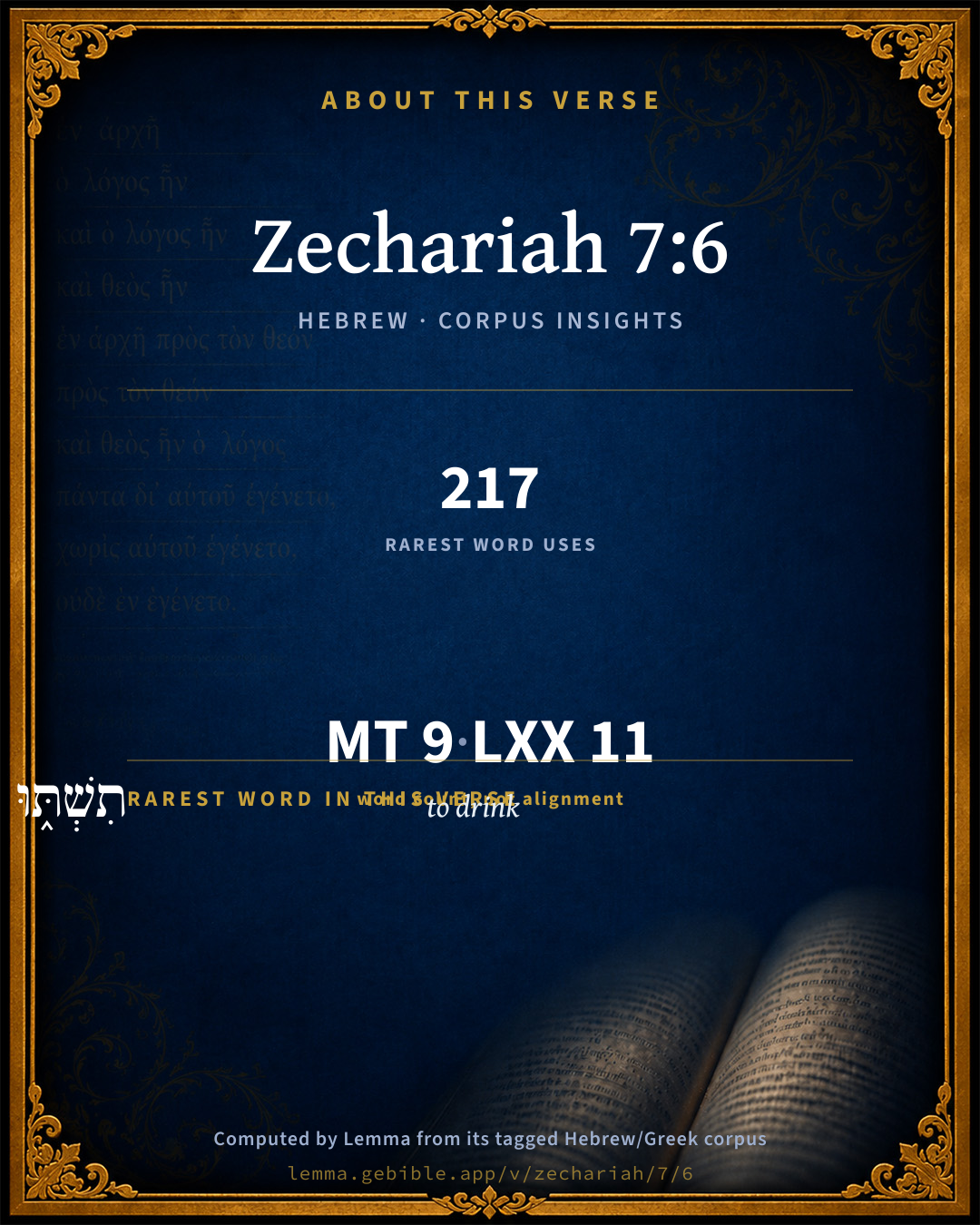
תִשְׁתּ֑וּ
shâthâh
H8354
“to drink”
Verb, Qal, Imperfect, 2nd Person, Masculine, Plural
Part of Speech
Verb
Stem
Qal
Form
Imperfect
Person
2nd Person
Gender
Masculine
Number
Plural
Full BDB Definition

Origin: a primitive root

TWOT: 2477

to drink - (Qal) - to drink - of drinking cup of God's wrath, of slaughter, of wicked deeds (figuratively) - to feast - (Niphal) to be drunk
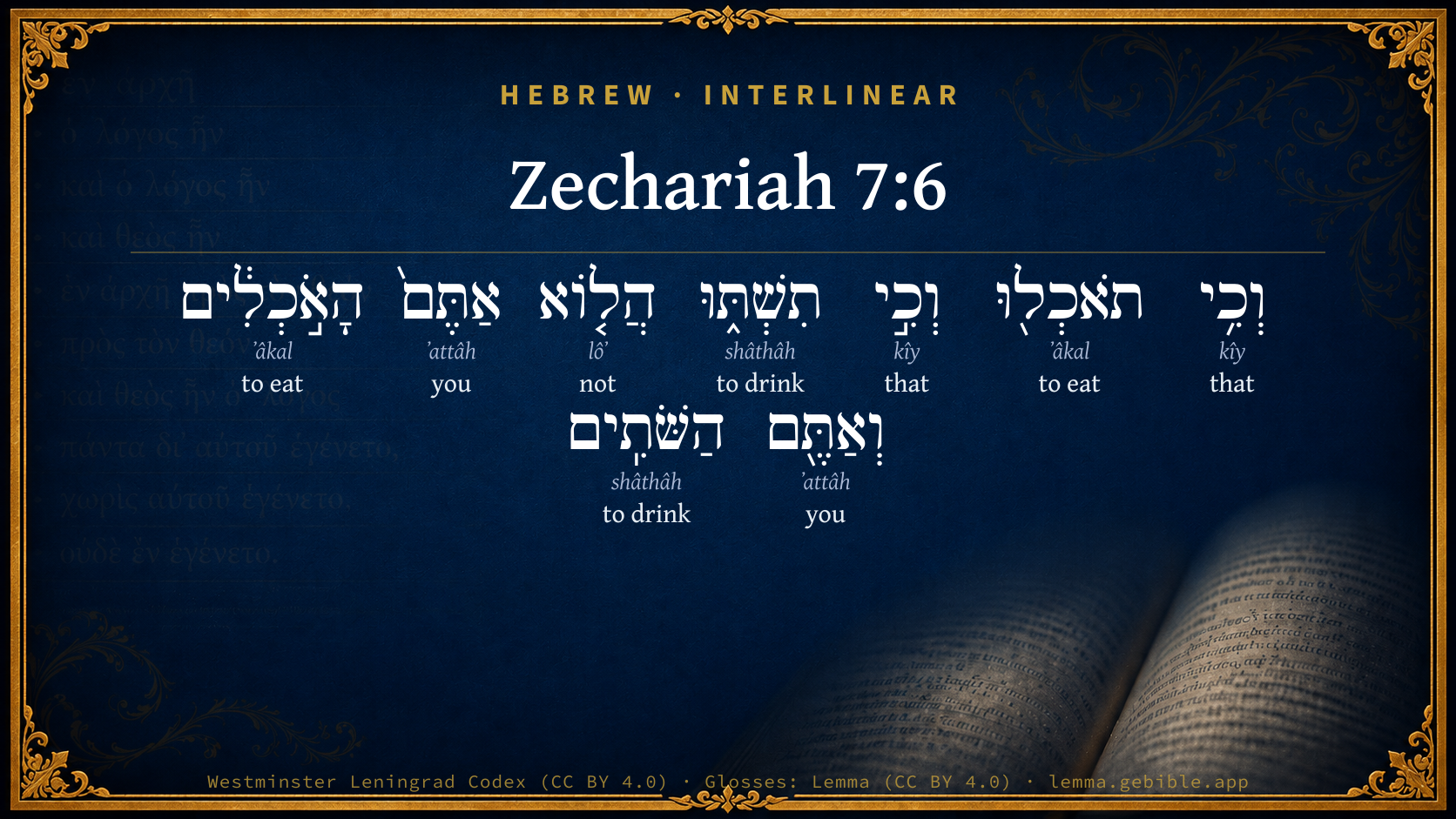
  1. וְכִ֥י kîy H3588 “and · that” Conjunction + Conjunction
  2. תֹאכְל֖וּ ʼâkal H398 “to eat” Verb, Qal, Imperfect, 2nd Person, Masculine, Plural
  3. וְכִ֣י kîy H3588 “and · that” Conjunction + Conjunction
  4. הֲל֤וֹא lôʼ H3808 “not” Particle, Interrogative + Particle, Negative
  5. אַתֶּם֙ ʼattâh H859 “you” Pronoun, Personal, 2nd Person, Masculine, Plural
  6. הָאֹ֣כְלִ֔ים ʼâkal H398 “the · eating” Particle, Definite Article + Verb, Qal, Participle Active, Masculine, Plural, Absolute
  7. וְאַתֶּ֖ם ʼattâh H859 “and · you” Conjunction + Pronoun, Personal, 2nd Person, Masculine, Plural
  8. הַשֹּׁתִֽים shâthâh H8354 “the · drinking” Particle, Definite Article + Verb, Qal, Participle Active, Masculine, Plural, Absolute

About this verse

These counts appear in no published source. They are computed here, from the morphology-tagged text and Lemma’s own curated glosses. What Lemma adds →

9
words
5
distinct lemmas
Prophets
section

Grammatical profile

  • 4 verbs
  • 2 pronouns
  • 2 conjunctions
  • 1 particle

Verb forms

  • תֹאכְל֖וּ Qal · Imperfect
  • תִשְׁתּ֑וּ Qal · Imperfect
  • הָאֹ֣כְלִ֔ים Qal · Participle Active
  • הַשֹּׁתִֽים Qal · Participle Active

Repetition

Words recur within this verse — often emphatic in Hebrew:

  • תֹאכְל֖וּ to eat H398 ×2
  • תִשְׁתּ֑וּ to drink H8354 ×2
  • וְכִ֥י that H3588 ×2
  • אַתֶּם֙ you H859 ×2

Hebrew & Septuagint length

In English translation the verse runs 16 words from the Hebrew and 14 from the Septuagint (LXX English) — closely comparable.

A rough comparison of the two English renderings, which tokenize alike — not a word-level alignment.

Word counts can differ between the Hebrew and the Greek without any difference in meaning — e.g. the Hebrew direct-object marker אֵת has no separate Greek word, and Greek often adds the article ὁ.

In the original languages it is 9 Hebrew tokens and 11 Greek tokens — but the two are counted differently (Hebrew bundles its prefixes and suffixes into one token; the Greek is in lemma form), so that isn’t a like-for-like length.

Cross-references

11

Topical passages linked to Zechariah 7:6 in the Treasury of Scripture Knowledge — connected by theme and wording, ordered by reader-vote popularity; previews shown in the World English Bible.

  • 1 Corinthians 11:20–21 When therefore you assemble yourselves together, it is not possible to eat the Lord's supper.
  • 1 Corinthians 11:26–29 For as often as you eat this bread and drink this cup, you proclaim the Lord's death until he comes.
  • Hosea 8:13 As for the sacrifices of my offerings, they sacrifice flesh and eat it; But Yahweh doesn't accept them. Now he will remember their iniquity, And punish their sins. They will return to Egypt.
  • Colossians 3:17 Whatever you do, in word or in deed, do all in the name of the Lord Jesus, giving thanks to God the Father, through him.
  • Deuteronomy 12:7 and there you shall eat before Yahweh your God, and you shall rejoice in all that you put your hand to, you and your households, in which Yahweh your God has blessed you.
  • Deuteronomy 14:26 and you shall bestow the money for whatever your soul desires, for oxen, or for sheep, or for wine, or for strong drink, or for whatever your soul asks of you; and you shall eat there before Yahweh your God, and you shall rejoice, you and your household.
  • 1 Samuel 16:7 But Yahweh said to Samuel, "Don't look on his face, or on the height of his stature; because I have rejected him: for [Yahweh sees] not as man sees; for man looks at the outward appearance, but Yahweh looks at the heart."
  • 1 Chronicles 29:22 and ate and drink before Yahweh on that day with great gladness. They made Solomon the son of David king the second time, and anointed him to Yahweh to be prince, and Zadok to be priest.
  • Jeremiah 17:9–10 The heart is deceitful above all things, and it is exceedingly corrupt: who can know it?
  • Hosea 9:4 They won't pour out wine offerings to Yahweh, Neither will they be pleasing to him. Their sacrifices will be to them like the bread of mourners; All who eat of it will be polluted; For their bread will be for their appetite. It will not come into the house of Yahweh.
  • 1 Corinthians 10:31 Whether therefore you eat, or drink, or whatever you do, do all to the glory of God.

Cross-references courtesy of OpenBible.info (CC BY 4.0).

Hebrew and Greek witnesses Masoretic Hebrew ↔ Greek Septuagint

The same verse in the two great witnesses to the Old Testament, shown verse-for-verse.

These are two independent witnesses, not word-aligned to each other, and the Septuagint is shown in lemma (dictionary) form.

Hebrew Zechariah 7:6 Masoretic · Westminster Leningrad Codex

וְכִ֥י תֹאכְל֖וּ וְכִ֣י תִשְׁתּ֑וּ הֲל֤וֹא אַתֶּם֙ הָאֹ֣כְלִ֔ים וְאַתֶּ֖ם הַשֹּׁתִֽים

When you eat, and when you drink, don't you eat for yourselves, and drink for yourselves?

World English Bible · Public Domain

Greek LXX Zechariah 7:6 Septuagint · lemma form

καί ἐάν ἐσθίω ἤ πίνω οὐ σύ ἐσθίω καί σύ πίνω

And if you⌃ eat or drink, do you⌃ not eat and drink for yourselves?

LXX2012 (modern English Septuagint) · Public Domain

Hebrew: Westminster Leningrad Codex (CC BY 4.0). Greek: Septuagint (public domain); English from LXX2012 (modern English Septuagint) (Public Domain). How the Septuagint differs from the Hebrew →

Targum (Aramaic paraphrase)

1

The Targum is the ancient Jewish Aramaic paraphrase of the Hebrew Scriptures — an interpretive translation, not the Hebrew text itself. Onkelos (literal) and Pseudo-Jonathan (expansive) render the Torah, and Jonathan the Prophets. Coverage is partial: where no permissively-licensed English translation exists for a verse, only the Aramaic is shown. This is verse-level text, not a word-by-word alignment to the Hebrew.

  1. Targum Jonathan Prophets (Joshua–Malachi)
    וּדְאַתּוּן אָכְלִין וּדְאַתּוּן שְׁתָי הֲלָא לְאַיְטָבָא לְכוֹן אַתּוּן שָׁתָן:

    (no public-domain English translation for this verse)

    Targum Jonathan — Aramaic: “Mikraot Gedolot” (public domain). English: “Sefaria Community Translation” (CC0 1.0 (public-domain dedication)); “London "Chaldee Paraphrase," 1871” (public domain). Text via Sefaria.

Commentary

Notes on Zechariah 7:6 from classic Christian and Jewish commentators (each source and its license shown beneath its notes). The classic Christian expositions comment on the surrounding passage and are grouped to its opening verse, so a note may address several verses; the Jewish commentaries on the Tanakh (Rashi and others) are per-verse, so they appear only where the commentator wrote on this verse.

Lemma curates 59 commentaries, every one of them public domain or Creative Commons licensed, each selected and text-cleaned for this edition rather than reprinted as found. About our sources →

Trapp's Complete Commentary

John Trapp

Zec 7:6 And when ye did eat, and when ye did drink, did not ye eat [for yourselves], and drink [for yourselves]?

Ver. 6. And when ye did eat, and when ye did drink] q.d. In all your actions, natural, civil, recreative, religious, you should have sought, served, and set up me, you should have done all to the glory of God, as saith the apostle; you should have eaten, drank, and slept eternal life, as it was said of a certain Scotch divine. "The way of life is above to the wise," Pro 15:24, he goes a higher way than his neighbour, who contents himself with a natural use of the creature, but he can extract a spiritual. Grace is called the divine nature, as that which, elixir-like, by contraction turns all into the same property with itself. Meat makes us not acceptable to God, 1Co 8:8. The kingdom of God consists not in meats and drinks, Rom 14:17. Howbeit the Israelites were commanded, as to fast, so to feast before the Lord; that is, in faith and obedience; and to do everything from the heart, as unto him. This these Jews did not; and are therefore worthily blamed. From their feeding themselves without fear of God is concluded their no respect to him in their fasts and holy services: since true goodness is ever like itself, and carries a uniformity in all proceedings.

John Trapp, A Commentary or Exposition upon All the Books of the Old and New Testament (1647–1656) — public domain. Text from a community e-Sword module.

Geneva Bible (1599)

Geneva Bible translators

Did ye not eat and drink for your own commodity and necessity, and so likewise ye did abstain according to your own fantasies, and not after the prescript of my Law.

Geneva Bible (1599) marginal notes — public domain. Text via Bolls.life.

Jamieson, Fausset & Brown

Robert Jamieson, A. R. Fausset & David Brown

did not ye eat for yourselves?--literally, "Is it not ye who eat?" that is, it is not unto Me and My glory. It tends no more to My glory, your feasting than your fasting.

Jamieson, Fausset & Brown — Commentary Critical and Explanatory on the Whole Bible (1871) — public domain (CC PDM 1.0). Text via the HelloAO Bible API.

Adam Clarke's Commentary

Verse 6. And when ye did eat] They had not observed those fasts as they should have done. They deplored the loss of their temple, and its riches, &c., but they did not humble themselves because of those iniquities which had brought the displeasure of God upon them, their temple, and their city.

Adam Clarke's Commentary on the Bible (1810–1826) — public domain. Text from a community e-Sword/MySword module.

John Calvin's Commentaries

By saying, that to themselves they did eat and drink, he intimates that to eat and to drink, or to abstain from eating and drinking, are things wholly unconnected with the worship of God. Another sense may indeed be elicited, — that the Jews did eat as heathens did: and there will be in this case an indirect reproof, — that they sought to pacify God only twice in the year, and that during the rest of the time they were heedless and indulged themselves in excesses. We ought indeed to bear in mind what Paul says, that

“whether we eat or drink, all things ought to be done to the praise of God.” (1 Corinthians 10:31.)

The law also expressly commanded the Jews to “feast before the Lord,” that is, not to taste food without thanksgiving, as though God were present. When, therefore, the Jews fasted themselves without any regard to God, it is no wonder that their fastings where rejected; for their course was not consistent. For though the godly do not always fast, yet while they partake most freely of meat and drink, they turn not away their thoughts from God, but on the contrary rejoice before him. They therefore eat and drink to God, as well as abstain on God’s account. But the Prophet shows here that the Jews did eat to themselves, and that hence their fasting was not regarded before God. This latter sense is not unsuitable: but as to the subject itself, it is enough for us to know, that the Prophet, as he had to deal with hypocrites, ridicules their superstition in their fastings, inasmuch as they thought that these were expiations by which their sins were blotted out, and that if they abstained for a day or two from meat and drink, God was thereby pacified.

John Calvin's Commentaries (1540-1563) — public domain. Text from the Calvin Translation Society English edition (1840s-50s) via the Christian Classics Ethereal Library (ccel.org). Calvin's coverage is partial (roughly two-thirds of the Bible); uncommented books and verses are honest gaps, never fabricated. The 19th-century editor's footnotes and remarks are omitted so the notes are faithfully Calvin's own voice.

The Cambridge Bible for Schools and Colleges

gen. ed. J. J. S. Perowne

6. did eat and … did drink] Rather, eat and drink, as R. V.

did not ye eat for yourselves, &c.?] Lit. is it not you who are eating, and you who are drinking? i.e. is it not simply an act terminating upon yourselves, which in no way affects Me? Comp. 1Co_8:8.

The Cambridge Bible for Schools and Colleges (gen. ed. J. J. S. Perowne; Cambridge University Press, 1878–1918) — public domain. Text from a community e-Sword module.

John Gill's Exposition

Should ye not hear the words which the Lord hath cried by the former prophets,.... As Hosea, Isaiah, Jeremiah, and others; suggesting that it would have been much better for them to have regarded the exhortations and instructions which the Lord sent them by his servants, which would have prevented their captivity; and so would have had no occasion of fasting and mourning: for those prophecies were delivered out

when Jerusalem was inhabited, and in prosperity, and the cities thereof round about her; when Jerusalem, and the cities about it, were full of people, and enjoyed all the blessings of life in great plenty; and which would have continued, had they attended to the exhortations, cautions, and warnings given them:

when men inhabited the south and the plain? the land of Judea, as the Misnic (x) doctors say, was divided into three parts; the mountainous part, the plain, and the valley. Jerusalem was in the mountainous part, and these are the other two; and not only those parts of the land which were hilly, and those cities that were encompassed with mountains, were in safety and prosperity; but those also that were in the champaign country, and in the low valleys. The "south" was that part of the land of Canaan formerly inhabited by the Amalekites, and which they invaded when David was at Ziklag, Num 13:29. Sometimes it was called Negeb, as here; and sometimes Daroma, as frequently in the Jewish writings; in which Judea is often called the south, with respect to Galilee; for they distinguish between the inhabitants of Galilee and the inhabitants of the south country: and say, a disciple might intercalate the year for Galilee, but not for the south, i.e. Judea. It reached from Eleutheropolis to the south of the land, eighteen or twenty miles: it was distinguished by the Jews (y) into upper and nether Daroma, or south country: the upper consisted of the hilly part of it; the nether of the plain; and by Jerom (z) mention is made of interior Daroma, by which there should be an exterior one. The "plain", or "Sephela", was all the champaign country, near to Eleutherepolis, to the north and west; and so the above writer (a) says it was called in his times: now each of these were well inhabited; Daroma, or the southern part; hence it is frequent, in Jewish writings (b), to read of such a Rabbi of Daroma, or the south, as R. Jacob, R. Simlai, and others; and of the elders of the south (c); and so Jerom speaks of Eremmon, and Duma, large villages, in his days, in Daroma or the south; the one sixteen, the other seventeen miles from Eleutheropolis; and of Ether, Jether, and Jethan, one of which was eighteen, and another twenty miles from it (d); and in the Apocrypha:

"Simon also set up Adida in Sephela, and made it strong with gates and bars.'' (1 Maccabees 12:38)

mention is made of Adida in Sephela, fortified, by Simon; and in which also were various other places well stored with inhabitants. This expresses the happy and safe state the Jews were in before their captivity, and in which they would have remained, had they hearkened to the words of the Lord.

(x) Misn. Sheviith, c. 9. sect. 2. (y) T. Hieros. Maaaser Sheni, fol. 56. 3. & Sanhedrin, fol. 18. 4. (z) De locis Hebr. fol. 91. C. & 92. I. (a) Ibid. fol. 94. M. (b) T. Hieros. Beracot, fol. 2. 2. & 11. 4. & Succah, fol. 53. 4. (c) T. Hieros. Erubin, fol. 23. 3. (d) Ut supra, fol. 90. K. & 91. C. & 92. I.

John Gill's Exposition of the Whole Bible (1746–1763) — public domain (CC PDM 1.0). Text via the HelloAO Bible API.

Albert Barnes' Notes on the Bible

And when ye eat and when ye drink, is it not ye who eat and ye who drink? - Conversely now that, after your return, ye feast for joy, this is no religious act; ye have all the good of it, there is no thanksgiving to God. Contrary to the apostle’s saying, “Whether ye eat or drink, or whatever ye do, do all to the glow of God” 1Co 10:31. “He eateth and drinketh to himself, who receiveth the nourishments of the body, which are the common gifts of the Creator, without the needy. And anyone fasts to himself, if he doth not give to the poor what for the time he withdraweth from himself, but keepeth it to be thereafter offered to his appetite. Hence, it is said by Joel, sanctify a fast. For to ‘sanctify a fast’ is to show an abstinence worthy of God through other good deeds. Let anger cease, quarrels be hushed. For in vain is the flesh worn, if the mind is not refrained from evil pleasures, since the Lord says by the prophet, “Behold, in the day of your fast ye find pleasure. Behold, ye fast for strife and debate ...” Isa 57:3-4.

Albert Barnes' Notes on the Bible (1834–1885) — public domain. Text from a community e-Sword/MySword module.

Haydock's Catholic Bible Commentary

Yourselves, to gratify the senses more than from necessity, and without doing it for God’s glory. (Haydock)

George Leo Haydock (1774–1849), Haydock's Catholic Family Bible and Commentary, 1859 edition — public domain. Excludes Psalms (Douay-Rheims chapter numbering differs from Protestant) and Deuterocanonical books (Catholic canon only).

Matthew Poole's English Annotations

I was as little minded by you in your fasts as in your feasts, and I was as little pleased with your fasts as feasts; self was all in both, you looked no higher. Such fasting commends none to God; you had not been the worse if you had forborne such fasts, nor are you the better for such ill-managed abstinence.

Matthew Poole's English Annotations on the Holy Bible (1683–1685) — public domain. Text from a community e-Sword/MySword module.

The Pulpit Commentary

When ye did eat, etc.; better, when ye eat and when ye drink. As in your fasts, so in your rejoicings and your daily life. Did not ye eat for yourselves, etc.? literally, Is it not ye who are eating and ye who are drinking? There the matter ends; it is self that is concerned, and there is no reference to God. (comp. 1Co_8:8 1Co_10:31)

The Pulpit Commentary (1880–1919), ed. H.D.M. Spence-Jones & Joseph S. Exell — public domain. Text from a community e-Sword module.

John Wesley's Explanatory Notes

For yourselves - I was as little minded by you in your fasts, as in your feasts.

John Wesley, Explanatory Notes Upon the Whole Bible (1754–1765) — public domain. Text via the GEBible commentary corpus.

Rashi

Rabbi Shlomo Yitzchaki (Rashi)

And when you eat and when you drink And, if you do not fast, that, too, means nothing to Me. Are not the food and the drink for your own pleasure?

Rashi on the Tanakh — English translations: “The Judaica Press complete Tanach with Rashi, translated by A. J. Rosenberg” (CC BY 4.0); “Pentateuch with Rashi's commentary by M. Rosenbaum and A.M. Silbermann, 1929-1934” (public domain); “The Metsudah Tanach series, Lakewood, N.J” (CC BY 4.0); and “The Book of Joshua, Metsudah Publications, 1997” (CC BY 4.0). Text via Sefaria.

Lesson kit

Teaching starters — assembled from the data on this page, not authored interpretation. Every prompt links to the verse data it draws on. Edit before teaching.

Zechariah, in the Prophets, opens this verse with 9 words (5 distinct Hebrew lemmas). Its most distinctive word is shâthâh (“to drink”). A historical commentator’s framing appears above. Read the whole chapter for the surrounding context.

Discussion questions

  1. How does “to drink” (shâthâh) shape what this verse is saying?
  2. 1 Corinthians 11:20–21 shares this passage’s theme. How do the two illuminate each other?
  3. “to eat” occurs 2× in this one verse. What is the effect of the repetition?
  4. These translations render this verse differently. What is at stake in choosing one wording over another?
  5. The verb «תֹאכְל֖וּ» is Qal Imperfect. How does its form color the action?
  6. Reading how Trapp's Complete Commentary and Geneva Bible (1599) read this verse, where do the two commentators agree and where do they part?

Things to notice

Reading settings

Reading text

Shown beneath each verse's original-language words.

Old Testament
Old Testament edition

Read the OT as the Masoretic Hebrew (MT) or the Greek Septuagint (LXX).

English shown for the Greek Septuagint (in the Hebrew ↔ Greek comparison).

Comparing translations? Open the Compare panel on any verse page to stack up to four side by side.