
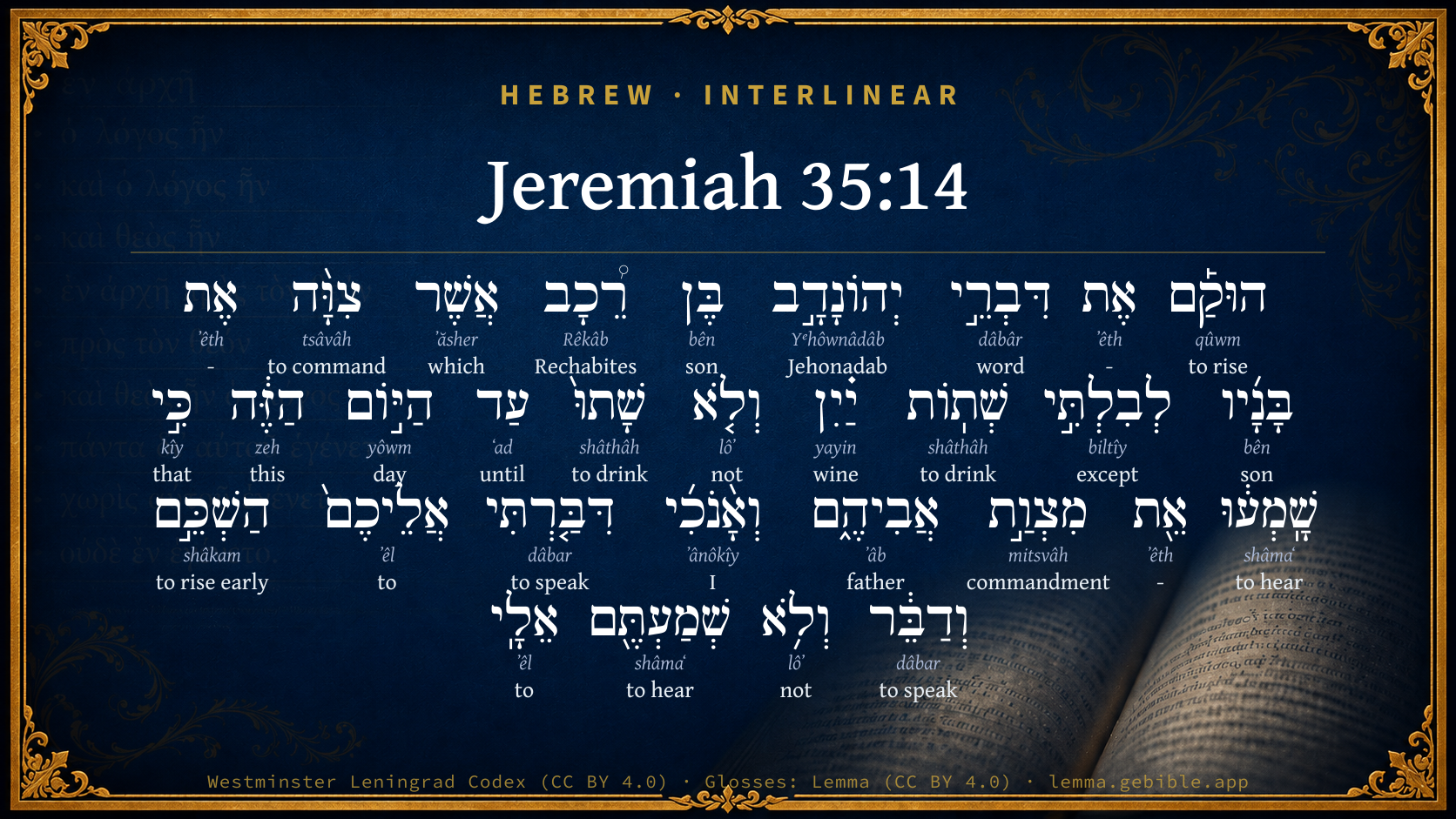
Jeremiah 35:14

Hebrew (Westminster Leningrad Codex) Jeremiah 35:14 appears in the Hebrew Old Testament. The text above is from the Westminster Leningrad Codex. Each word links to its Strong’s number, a concise gloss, and parsing drawn from the Open Scriptures Hebrew Bible morphology. Click any word for its full Brown-Driver-Briggs (BDB) entry.
Download image
Cite this verse

Jeremiah 35:14 (World English Bible). Public Domain. Lemma interlinear Bible study tool, https://lemma.gebible.app/v/jeremiah/35/14.

Show BibTeX & RIS
BibTeX
RIS
English Translation
The words of Jonadab the son of Rechab, that he commanded his sons, not to drink wine, are performed; and to this day they drink none, for they obey their father's commandment: but I have spoken to you, rising up early and speaking; and you have not listened to me.
World English Bible · Public Domain
Download a study sheet

One document with this verse’s original text, its word-by-word gloss line, the meaning frame, cross-references with their text, attributed commentary, and full source and license credits — printable, and it pastes into notes with its structure intact.

This verse Autodidact and up

Study sheet (.html) Plain text (.txt)

A passage Seminary Student

Up to 50 verses in one chapter. A passage sheet keeps up to 6 commentary sources and 12 cross-references per verse, in the order this page ranks them, and says so on the sheet whenever that leaves anything out. Ask for a single verse and you get the Autodidact verse sheet above.

Everything on this page stays free to read, with no account — the sheet is a download of what is already on screen, not access to it.

Want to remove ads? Support Godless Engineer
Compare translations 3

The same verse in 3 English versions, stacked beneath the original-language interlinear above. Click any original word for its lexicon entry.

Each is an independent rendering of the whole verse — the interlinear is not word-aligned to these translations.

Highlighted words mark where these versions differ — a whole-verse word diff, not a word-by-word alignment.

  • World English Bible Public Domain
    The words of Jonadab the son of Rechab, that he commanded his sons, not to drink wine, are performed; and to this day they drink none, for they obey their father's commandment: but I have spoken to you, rising up early and speaking; and you have not listened to me.
  • King James Version Public Domain
    The words of Jonadab the son of Rechab, that he commanded his sons not to drink wine, are performed; for unto this day they drink none, but obey their father's commandment: notwithstanding I have spoken unto you, rising early and speaking; but ye hearkened not unto me.
  • unfoldingWord Literal Text CC BY-SA 4.0
    The words of Jonadab son of Rechab that he gave to his sons as a command, not to drink any wine, have been observed to this very day. They have obeyed their ancestor’s command. But as for me, I myself have been making persistent proclamations to you, but you do not listen to me.

unfoldingWord Literal Text — © unfoldingWord, licensed CC BY-SA 4.0. Word-aligned USFM3 via Door43 (git.door43.org/unfoldingWord/en_ult).

Versions to compare (up to 4)

3 of 4 selected

Show all 18 translations

Every available English version of this verse, each an independent rendering of the whole verse.

  • World English Bible Public Domain
    The words of Jonadab the son of Rechab, that he commanded his sons, not to drink wine, are performed; and to this day they drink none, for they obey their father's commandment: but I have spoken to you, rising up early and speaking; and you have not listened to me.
  • Berean Standard Bible Public Domain
    The words of Jonadab son of Rechab have been carried out. He commanded his sons not to drink wine, and they have not drunk it to this very day because they have obeyed the command of their forefather. But I have spoken to you again and again, and you have not obeyed Me!
  • Majority Standard Bible Public Domain
    The words of Jonadab son of Rechab have been carried out. He commanded his sons not to drink wine, and they have not drunk it to this very day because they have obeyed the command of their forefather. But I have spoken to you again and again, and you have not obeyed Me!
  • King James Version Public Domain
    The words of Jonadab the son of Rechab, that he commanded his sons not to drink wine, are performed; for unto this day they drink none, but obey their father's commandment: notwithstanding I have spoken unto you, rising early and speaking; but ye hearkened not unto me.
  • American Standard Version (1901) Public Domain
    The words of Jonadab the son of Rechab, that he commanded his sons, not to drink wine, are performed; and unto this day they drink none, for they obey their father's commandment: but I have spoken unto you, rising up early and speaking; and ye have not hearkened unto me.
  • Revised Version (1885) Public Domain
    The words of Jonadab the son of Rechab, that he commanded his sons, not to drink wine, are performed, and unto this day they drink none, for they obey their father’s commandment: but I have spoken unto you, rising up early and speaking; and ye have not hearkened unto me.
  • Geneva Bible (1599) Public Domain
    The commandement of Ionadab the sonne of Rechab that hee commanded his sonnes, that they should drinke no wine, is surely kept: for vnto this day they drinke none, but obey their fathers commandement: notwithstanding I haue spoken vnto you, rising earely, and speaking, but ye would not obey me.
  • Douay-Rheims (1899) Public Domain
    The words of Jonadab the son of Rechab, by which he commanded his sons not to drink wine, have prevailed: and they have drunk none to this day, because they have obeyed the commandment of their father: but I have spoken to you, rising early and speaking, and you have not obeyed me.
  • Young's Literal Translation Public Domain
    Performed have been the words of Jonadab son of Rechab, when he commanded his sons not to drink wine, and they have not drunk unto this day, for they have obeyed the command of their father; and I -- I have spoken unto you, rising early and speaking, and ye have not hearkened unto Me.
  • Literal Standard Version CC BY-SA 4.0
    The words of Jonadab son of Rechab, when he commanded his sons not to drink wine, have stood, and they have not drunk to this day, for they have obeyed the command of their father; and I have spoken to you, rising early and speaking, and you have not listened to Me.
  • Unlocked Literal Bible CC BY-SA 4.0
    The words of Jonadab son of Rekab that he gave to his sons as a command, not to drink any wine, have been observed to this very day. They have obeyed their ancestor's command. But as for me, I myself have been making persistent proclamations to you, but you do not listen to me.
  • unfoldingWord Literal Text CC BY-SA 4.0
    The words of Jonadab son of Rechab that he gave to his sons as a command, not to drink any wine, have been observed to this very day. They have obeyed their ancestor’s command. But as for me, I myself have been making persistent proclamations to you, but you do not listen to me.
  • Darby Bible Public Domain
    The words of Jonadab the son of Rechab, that he commanded his sons not to drink wine, are performed; and to this day they have drunk none, for they have obeyed their father's commandment. But I have spoken unto you, rising early and speaking, and ye have not hearkened unto me.
  • World Messianic Bible Public Domain
    “The words of Jonadab the son of Rechab that he commanded his sons, not to drink wine, are performed; and to this day they drink none, for they obey their father’s commandment; but I have spoken to you, rising up early and speaking, and you have not listened to me.
  • Webster's Bible Public Domain
    The words of Jonadab the son of Rechab, that he commanded his sons not to drink wine, are performed; for to this day they drink none, but obey their father's commandment: notwithstanding I have spoken to you, rising early and speaking; but ye hearkened not to me.
  • Free Bible Version CC BY-SA 4.0
    The instructions of Jonadab son of Rechab have been followed. He ordered his descendants not to drink wine, and they have not drunk it to this day because they have obeyed their forefather's command. But I have told you what to do time and again, and yet you refuse to obey me!
  • Bible in Basic English Public Domain
    The orders which Jonadab, the son of Rechab, gave to his sons to take no wine, are done, and to this day they take no wine, for they do the orders of their father: but I have sent my words to you, getting up early and sending them, and you have not given ear to me.
  • JPS Tanakh (1917) Public Domain
    The words of Jonadab the son of Rechab, that he commanded his sons, not to drink wine, are performed, and unto this day they drink none, for they hearken to their father's commandment; but I have spoken unto you, speaking betimes and often, and ye have not hearkened unto Me.

Literal Standard Version (2020), Covenant Press — licensed CC BY-SA 4.0. Text via the HelloAO Bible API (eBible.org). Unlocked Literal Bible (unfoldingWord) — licensed CC BY-SA 4.0. Text via the HelloAO Bible API (eBible.org). unfoldingWord Literal Text — © unfoldingWord, licensed CC BY-SA 4.0. Word-aligned USFM3 via Door43 (git.door43.org/unfoldingWord/en_ult). Free Bible Version, Dr. Jonathan Gallagher — licensed CC BY-SA 4.0. Text via the HelloAO Bible API (eBible.org).

Word by word

More ways to search: Search by grammar → Find every occurrence → Compare this word →

Practice this passage: Drill this verse → Learn its vocabulary →

יְהוֹנָדָ֣ב
Yᵉhôwnâdâb
H3082
“Jehonadab”
Noun, Proper
Part of Speech
Noun
Type
Proper
Full BDB Definition

Origin: from H3068 and H5068

TWOT: None

Jehonadab = "Jehovah is willing" - a son of Rechab, chief of the Rechabites, in the time of Jehu and Ahab - a nephew of David
  1. הוּקַ֡ם qûwm H6965 “to rise” Verb, Hophal, Perfect, 3rd Person, Masculine, Singular
  2. אֶת ʼêth H853 “-” Particle, Direct Object
  3. דִּבְרֵ֣י dâbâr H1697 “words of” Noun, Common, Masculine, Plural, Construct
  4. בֶּן bên H1121 “son of” Noun, Common, Masculine, Singular, Construct
  5. רֵ֠כָב Rêkâb H7394 “Rechabites” Noun, Proper
  6. אֲשֶׁר ʼăsher H834 “which” Particle, Relative
  7. צִוָּ֨ה tsâvâh H6680 “to command” Verb, Piel, Perfect, 3rd Person, Masculine, Singular
  8. אֶת ʼêth H853 “-” Particle, Direct Object
  9. בָּנָ֜יו bên H1121 “sons · his” Noun, Common, Masculine, Plural, Construct + Suffix, Personal, 3rd Person, Masculine, Singular
  10. לְבִלְתִּ֣י biltîy H1115 “to/for · except” Preposition + Conjunction
  11. שְׁתֽוֹת shâthâh H8354 “to drink” Verb, Qal, Infinitive Construct
  12. יַ֗יִן yayin H3196 “wine” Noun, Common, Masculine, Singular, Absolute
  13. וְלֹ֤א lôʼ H3808 “and · not” Conjunction + Particle, Negative
  14. שָׁתוּ֙ shâthâh H8354 “to drink” Verb, Qal, Perfect, 3rd Person, Common, Plural
  15. עַד ʻad H5704 “until” Preposition
  16. הַיּ֣וֹם yôwm H3117 “the · day” Particle, Definite Article + Noun, Common, Masculine, Singular, Absolute
  17. הַזֶּ֔ה zeh H2088 “the · this” Particle, Definite Article + Pronoun, Demonstrative, Masculine, Singular
  18. כִּ֣י kîy H3588 “that” Conjunction
  19. שָֽׁמְע֔וּ shâmaʻ H8085 “to hear” Verb, Qal, Perfect, 3rd Person, Common, Plural
  20. אֵ֖ת ʼêth H853 “-” Particle, Direct Object
  21. מִצְוַ֣ת mitsvâh H4687 “commandment of” Noun, Common, Feminine, Singular, Construct
  22. אֲבִיהֶ֑ם ʼâb H1 “father · their” Noun, Common, Masculine, Singular, Construct + Suffix, Personal, 3rd Person, Masculine, Plural
  23. וְאָ֨נֹכִ֜י ʼânôkîy H595 “and · I” Conjunction + Pronoun, Personal, 1st Person, Common, Singular
  24. דִּבַּ֤רְתִּי dâbar H1696 “to speak” Verb, Piel, Perfect, 1st Person, Common, Singular
  25. אֲלֵיכֶם֙ ʼêl H413 “to · you” Preposition + Suffix, Personal, 2nd Person, Masculine, Plural
  26. הַשְׁכֵּ֣ם shâkam H7925 “to rise early” Verb, Hiphil, Infinitive Absolute
  27. וְדַבֵּ֔ר dâbar H1696 “and · to speak” Conjunction + Verb, Piel, Infinitive Absolute
  28. וְלֹ֥א lôʼ H3808 “and · not” Conjunction + Particle, Negative
  29. שְׁמַעְתֶּ֖ם shâmaʻ H8085 “to hear” Verb, Qal, Perfect, 2nd Person, Masculine, Plural
  30. אֵלָֽי ʼêl H413 “to · me” Preposition + Suffix, Personal, 1st Person, Common, Singular

About this verse

These counts appear in no published source. They are computed here, from the morphology-tagged text and Lemma’s own curated glosses. What Lemma adds →

31
words
23
distinct lemmas
Prophets
section

Notable vocabulary

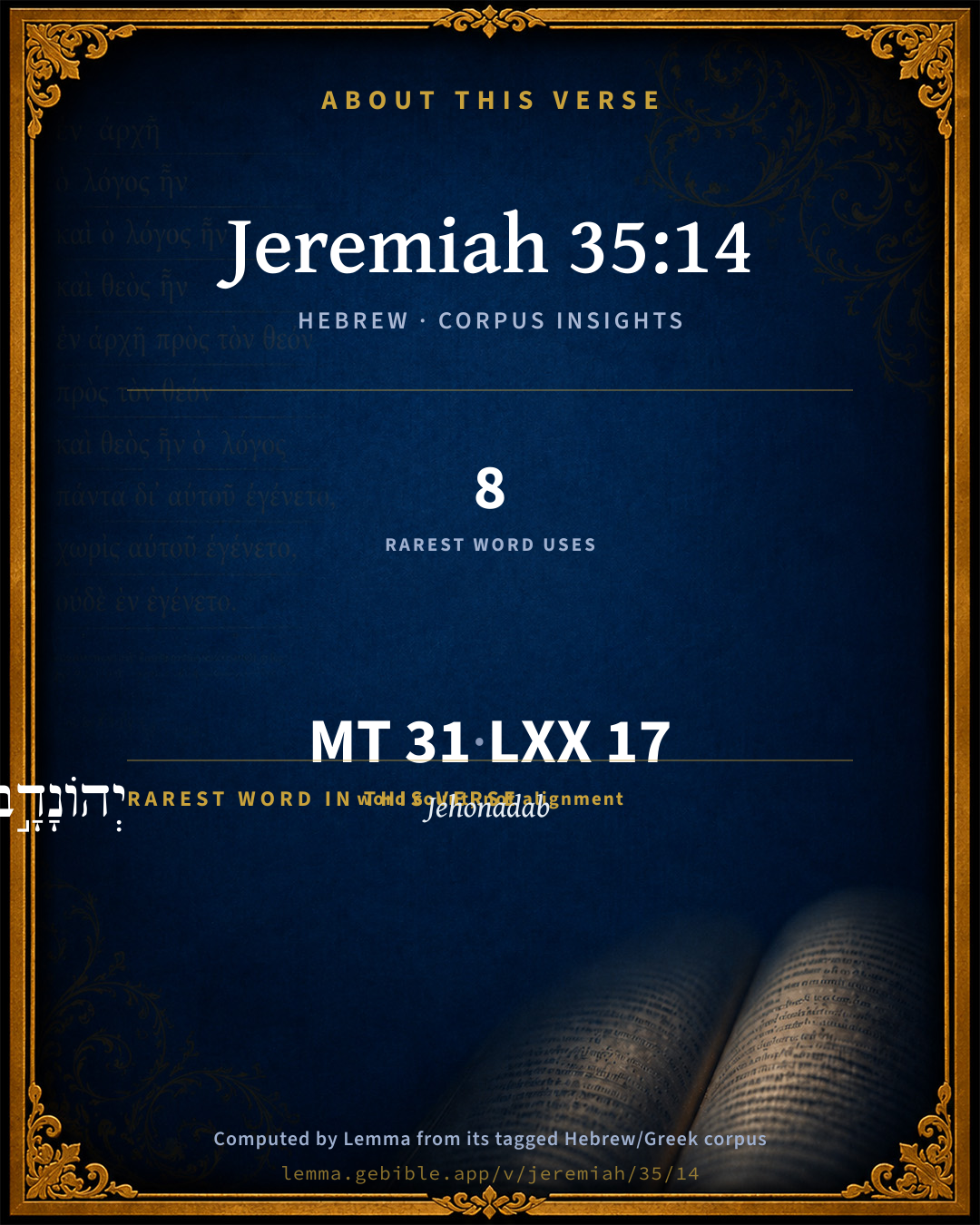
The rarest word here is יְהוֹנָדָ֣ב Jehonadab H3082 — appearing just 8 times in the whole Hebrew Bible.

Shared distinctive vocabulary

יְהוֹנָדָ֣ב Jehonadab H3082 occurs in 7 verses of the Hebrew Bible. Also found in:

Grammatical profile

  • 9 verbs
  • 9 nouns
  • 2 pronouns
  • 3 prepositions
  • 2 conjunctions
  • 6 particles

Verb forms

  • הוּקַ֡ם Hophal · Perfect
  • צִוָּ֨ה Piel · Perfect
  • שְׁתֽוֹת Qal · Infinitive Construct
  • שָׁתוּ֙ Qal · Perfect
  • שָֽׁמְע֔וּ Qal · Perfect
  • דִּבַּ֤רְתִּי Piel · Perfect
  • הַשְׁכֵּ֣ם Hiphil · Infinitive Absolute
  • וְדַבֵּ֔ר Piel · Infinitive Absolute
  • שְׁמַעְתֶּ֖ם Qal · Perfect

Repetition

Words recur within this verse — often emphatic in Hebrew:

  • בֶּן son H1121 ×2
  • שְׁתֽוֹת to drink H8354 ×2
  • שָֽׁמְע֔וּ to hear H8085 ×2
  • דִּבַּ֤רְתִּי to speak H1696 ×2
  • וְלֹ֤א not H3808 ×2
  • אֲלֵיכֶם֙ to H413 ×2

Hebrew & Septuagint length

In the original languages it is 31 Hebrew tokens and 17 Greek tokens — but the two are counted differently (Hebrew bundles its prefixes and suffixes into one token; the Greek is in lemma form), so that isn’t a like-for-like length.

Cross-references

13

Topical passages linked to Jeremiah 35:14 in the Treasury of Scripture Knowledge — connected by theme and wording, ordered by reader-vote popularity; previews shown in the World English Bible.

  • Jeremiah 25:3–4 From the thirteenth year of Josiah the son of Amon, king of Judah, even to this day, these twenty-three years, the word of Yahweh has come to me, and I have spoken to you, rising up early and speaking; but you have not listened.
  • Proverbs 1:20–33 Wisdom calls aloud in the street. She utters her voice in the public squares.
  • Isaiah 30:9 For it is a rebellious people, lying children, children who will not hear the law of Yahweh;
  • Isaiah 50:2 Why, when I came, was there no man? when I called, was there none to answer? Is my hand shortened at all, that it can't redeem? or have I no power to deliver? Behold, at my rebuke I dry up the sea, I make the rivers a wilderness: their fish stink, because there is no water, and die for thirst.
  • Jeremiah 7:13 Now, because you have done all these works, says Yahweh, and I spoke to you, rising up early and speaking, but you didn't hear; and I called you, but you didn't answer:
  • Jeremiah 7:24–26 But they didn't listen nor turn their ear, but walked in [their own] counsels [and] in the stubbornness of their evil heart, and went backward, and not forward.
  • Jeremiah 11:7 For I earnestly protested to your fathers in the day that I brought them up out of the land of Egypt, even to this day, rising early and protesting, saying, Obey my voice.
  • 2 Chronicles 36:15–16 Yahweh, the God of their fathers, sent to them by his messengers, rising up early and sending, because he had compassion on his people, and on his dwelling-place:
  • Nehemiah 9:26 Nevertheless they were disobedient, and rebelled against you, and cast your law behind their back, and killed your prophets that testified against them to turn them again to you, and they committed awful blasphemies.
  • Nehemiah 9:30 Yet many years did you bear with them, and testified against them by your Spirit through your prophets: yet would they not give ear: therefore gave you them into the hand of the peoples of the lands.
  • Jeremiah 29:19 because they have not listened to my words, says Yahweh, with which I sent to them my servants the prophets, rising up early and sending them; but you would not hear, says Yahweh.
  • Jeremiah 32:33 They have turned to me the back, and not the face: and though I taught them, rising up early and teaching them, yet they have not listened to receive instruction.
  • Jeremiah 26:5 to listen to the words of my servants the prophets, whom I send to you, even rising up early and sending them, but you have not listened;

Cross-references courtesy of OpenBible.info (CC BY 4.0).

Hebrew and Greek witnesses Masoretic Hebrew ↔ Greek Septuagint

The same verse in the two great witnesses to the Old Testament, shown verse-for-verse.

These are two independent witnesses, not word-aligned to each other, and the Septuagint is shown in lemma (dictionary) form.

Hebrew Jeremiah 35:14 Masoretic · Westminster Leningrad Codex

הוּקַ֡ם אֶת דִּבְרֵ֣י יְהוֹנָדָ֣ב בֶּן רֵ֠כָב אֲשֶׁר צִוָּ֨ה אֶת בָּנָ֜יו לְבִלְתִּ֣י שְׁתֽוֹת יַ֗יִן וְלֹ֤א שָׁתוּ֙ עַד הַיּ֣וֹם הַזֶּ֔ה כִּ֣י שָֽׁמְע֔וּ אֵ֖ת מִצְוַ֣ת אֲבִיהֶ֑ם וְאָ֨נֹכִ֜י דִּבַּ֤רְתִּי אֲלֵיכֶם֙ הַשְׁכֵּ֣ם וְדַבֵּ֔ר וְלֹ֥א שְׁמַעְתֶּ֖ם אֵלָֽי

The words of Jonadab the son of Rechab, that he commanded his sons, not to drink wine, are performed; and to this day they drink none, for they obey their father's commandment: but I have spoken to you, rising up early and speaking; and you have not listened to me.

World English Bible · Public Domain

Greek LXX Structure differs

In the Septuagint, Jeremiah is about an eighth shorter than the Hebrew and arranges its material differently — the Oracles Against the Nations (Hebrew chapters 46–51) appear in the middle of the Greek book, after 25:13. Because the chapter and verse boundaries do not line up, a verse-for-verse comparison with the Hebrew is not shown.

A verse-for-verse comparison isn’t shown here because the chapters and verses don’t line up. Switch to the LXX edition with the MT / LXX toggle above to read the Greek directly.

Hebrew: Westminster Leningrad Codex (CC BY 4.0). Greek: Septuagint (public domain); English from a public-domain English Septuagint. How the Septuagint differs from the Hebrew →

Targum (Aramaic paraphrase)

1

The Targum is the ancient Jewish Aramaic paraphrase of the Hebrew Scriptures — an interpretive translation, not the Hebrew text itself. Onkelos (literal) and Pseudo-Jonathan (expansive) render the Torah, and Jonathan the Prophets. Coverage is partial: where no permissively-licensed English translation exists for a verse, only the Aramaic is shown. This is verse-level text, not a word-by-word alignment to the Hebrew.

  1. Targum Jonathan Prophets (Joshua–Malachi)
    אִתְקַיְמוּ פִּתְגָמֵי יוֹנָדָב בַּר רֵכָב דְפַקֵיד יַת בְּנוֹהִי בְּדִיל דְלָא לְמִשְׁתֵּי חַמְרָא וְלָא אִשְׁתִּיאוּ עַד יוֹמָא הָדֵין אֲרֵי קַבִּילוּ יַת תַּפְקֵדְתָּא דַאֲבוּהוֹן וַאֲנָא שְׁלָחֵית לְוַתְכוֹן יַת כָּל עַבְדֵי נְבִיַיָא מַקְדִים וּמְמַלֵיל וְלָא קַבֵּילְתּוּן לְמֵימְרִי:

    (no public-domain English translation for this verse)

    Targum Jonathan — Aramaic: “Mikraot Gedolot” (public domain). English: “Sefaria Community Translation” (CC0 1.0 (public-domain dedication)); “London "Chaldee Paraphrase," 1871” (public domain). Text via Sefaria.

Commentary

Notes on Jeremiah 35:14 from classic Christian and Jewish commentators (each source and its license shown beneath its notes). The classic Christian expositions comment on the surrounding passage and are grouped to its opening verse, so a note may address several verses; the Jewish commentaries on the Tanakh (Rashi and others) are per-verse, so they appear only where the commentator wrote on this verse.

Lemma curates 59 commentaries, every one of them public domain or Creative Commons licensed, each selected and text-cleaned for this edition rather than reprinted as found. About our sources →

Trapp's Complete Commentary

John Trapp

Jer 35:14 The words of Jonadab the son of Rechab, that he commanded his sons not to drink wine, are performed; for unto this day they drink none, but obey their father’s commandment: notwithstanding I have spoken unto you, rising early and speaking; but ye hearkened not unto me.

Ver. 14. The words of Jonadab, … not to drink wine, are performed.] So are the words of Mohammed to like purpose, to this day, by the Turks; so are the commands of the Popish padres to their young novices, though it be to make a voyage to China or Peru,

“ Per varios casus, per tot discrimina rerum. ”

For unto this day they drink none.] Neither dwell in houses, as you do and may do, eating of the fat and drinking of the sweet without restraint, so that you keep within the bounds of sobriety. I command you nothing but what in reason should be done for a worldly good, as well as for a spiritual.

Rising early and speaking.] I began early with you, my law I gave you in Horeb, eight or nine hundred years since, and from that time to this I have constantly and instantly called upon you by my messengers for obedience, whereas it is not yet full three hundred years since Jonadab left this charge with his Rechabites, and, dying, left none to see it fulfilled, or to reprove them for their neglects.

John Trapp, A Commentary or Exposition upon All the Books of the Old and New Testament (1647–1656) — public domain. Text from a community e-Sword module.

Tyndale Open Study Notes

Tyndale Open Resources

35:14-16 The Recabites never drank wine, simply because their human ancestor had told them not to. The people of Israel should have been even more willing to listen and obey when the Lord told them to turn from their wicked ways and live according to his laws.

Tyndale Open Study Notes — © Tyndale Open Resources, licensed CC BY-SA 4.0. Text via the HelloAO Bible API.

Geneva Bible (1599)

Geneva Bible translators

I have most diligently exhorted and warned you both by myself and my Prophet.

Geneva Bible (1599) marginal notes — public domain. Text via Bolls.life.

Jamieson, Fausset & Brown

Robert Jamieson, A. R. Fausset & David Brown

obey . . . father's commandment: notwithstanding I-- (Mal 1:6).

rising early and speaking--God Himself speaking late and early by His various ways of providence and grace.

Jamieson, Fausset & Brown — Commentary Critical and Explanatory on the Whole Bible (1871) — public domain (CC PDM 1.0). Text via the HelloAO Bible API.

Adam Clarke's Commentary

Verse 14. The words of Jonadab - are performed - but ye hearkened not unto me.] The Lord, knowing the fidelity of this people, chose to try them in this way, that he might, by their conscientious obedience to the precepts of their forefathers, show the Jews, to their confusion, their ingratitude to him, and their neglect of his precepts, which if a man do, he shall live by them.

Adam Clarke's Commentary on the Bible (1810–1826) — public domain. Text from a community e-Sword/MySword module.

John Calvin's Commentaries

It is then added, confirmed have been the words of Jonadab by his children; but my people do not obey me. But as we have said in the last lecture, the Prophet touches particularly on this circumstance, — that the Rechabites obeyed the command of their father in not drinking wine: this was hard; they did not drink even to that day But what did God require from his children? only to receive his Law, and not to go astray, as it is here added, after alien gods. There is, then, a contrast between the hard precept of Jonadab and the equity of the Law; for God required nothing from his people except to render him pure worship, he says, They have drunk no wine to this day — and why? because they obeyed; that is, there was no scruple of conscience to prevent them, but the authority of a man who was dead so far prevailed witIt them, that they willingly gave up the use of wine. “As then simple obedience, that is, piety or respect for their father, produced such influence on the Rechabites, how is it that I am not heard? for I have spoken,” he says, “so that the sin of the people is not excusable on the ground of ignorance.”

Then he adds, Early rising and speaking Here assiduity and diligence are mentioned. Jonadab only once gave his command to his children; that command, which might have been forgotten, remained perpetually in the hearts of his sons, so that they taught the same to his grandsons. But God commanded what was right not only once, but rose up early, that is, he sedulously anticipated them; for by this metaphor he intimates that he did not wait until after a continued licentiousness they became more addicted to their vices; for we know that those who have for many years been without restraint, are not easily brought into order, but they become habitually refractory. And hence, also, it comes to be necessary to form those from infancy who are to be ruled by us; for if they be allowed to act as they please, their wantonness cannot afterwards be restrained by any laws. God then says, that he rose up early, that is, that he anticipated the Jews, so that together with their milk they might imbibe religion.

John Calvin's Commentaries (1540-1563) — public domain. Text from the Calvin Translation Society English edition (1840s-50s) via the Christian Classics Ethereal Library (ccel.org). Calvin's coverage is partial (roughly two-thirds of the Bible); uncommented books and verses are honest gaps, never fabricated. The 19th-century editor's footnotes and remarks are omitted so the notes are faithfully Calvin's own voice.

John Gill's Exposition

The words of Jonadab the son of Rechab, that he commanded his sons, not to drink wine, are performed,.... That article particularly, respecting drinking wine, has been carefully observed; which, though so agreeable to the nature of man, what cheers the heart of God and man, and was not prohibited them by any law of God; yet, being forbidden by their father, they abstained from it:

for unto this day they drink none, but obey their father's commandment; though prescribed them three hundred years ago; during all which time they had punctually observed it, even to that very day; which might with great truth and strictness be said; since they had that very day refused to drink any:

notwithstanding I have spoken unto you, rising early, and speaking; who am the eternal God; the King of kings; the great Lawgiver, able to save and to destroy; who had spoken to them, and given them laws as soon as they were a people, very early, in the times of Moses, on Mount Sinai and Horeb; and of which they had been reminded time after time, and enforced by proper arguments and motives; whereas the command of Jonadab was that of a mere man, not above three hundred years ago, and of which his posterity had never been put in mind, but as it was handed down from father to son; and this they constantly observed:

but ye hearkened not unto me; so that their disobedience was greatly aggravated.

John Gill's Exposition of the Whole Bible (1746–1763) — public domain (CC PDM 1.0). Text via the HelloAO Bible API.

Albert Barnes' Notes on the Bible

Are performed - Are established, i. e., are maintained in full force.

Unto this day - i. e., for more than 200 years.

Albert Barnes' Notes on the Bible (1834–1885) — public domain. Text from a community e-Sword/MySword module.

Haydock's Catholic Bible Commentary

Me. What a contrast! (Haydock) --- This was only a counsel, mine a law! (Tirinus)

George Leo Haydock (1774–1849), Haydock's Catholic Family Bible and Commentary, 1859 edition — public domain. Excludes Psalms (Douay-Rheims chapter numbering differs from Protestant) and Deuterocanonical books (Catholic canon only).

Whedon's Commentary on the Bible

Daniel D. Whedon

THE APPLICATION OF THE RECHABITES’ EXAMPLE, Jer_35:12-19.

14. The words of Jonadab… are performed;… but ye hearkened not unto me — Here is the plain application of this historical lesson. The Rechabites kept the commands of their father, and as a consequence have been rewarded. Ye violate the commands of your Father and will be punished. What could more thoroughly shame their unfaithfulness?

Daniel D. Whedon (gen. ed.), Commentary on the Old and New Testaments (1874–1909) — public domain. Text from a community e-Sword module.

The Pulpit Commentary

The children put to shame by the stranger.

The men of Judah were the children, inmates of God"s house, members especially of his family. These Rechabites, a wandering tribe of the desert, were the stranger. But their fidelity to the command laid upon them by their ancestor Jonadab is contrasted with and rebukes the shameful disregard of the laws of God, of which the men of Judah were so guilty. For near three hundred years the Rechabites had, out of regard for their father"s ordinance, adhered to their self-denying customs, and were adhering to them still, whilst God"s own people had set at nought all his counsel and would none of his Law.

I OBSERVE THIS CONTRAST.

1. In the motives for obedience which existed on either side. The one was an earthly father, the other Divine; the one man, the other God. The one, long dead, and whose right to control the actions of his descendants had therefore lapsed; the other, the ever-living God, whose right is as eternal as himself. The one had given an arbitrary command against which much might have been urged; the other had given commands which reason, conscience, and experience alike consented to as wise and good.

2. In the nature of the obedience rendered. The one was full of self-denial a hard, stern law; the other contemplated life in a land flowing with milk and honey, and its ways were ways of pleasantness, and all its paths peace.

3. In the results of obedience. In the one, obedience had kept together a small, hardy tribe of half-barbarian herdsmen, without home, friends, religion, wealth, or any marked earthly good. In the other, obedience had been crowned with every blessing, so that all men confessed," Blessed is the man that feareth the Lord." And yet, notwithstanding the service of the Lord was every way better, that service was disregarded by his people, whilst the ill-requited obedience to a long deceased ancestor had been so faithfully maintained.

II AND SUCH CONTRAST STILL EXISTS. Look at the obedience rendered to the laws of the Koran by the followers of Mahomet; to the laws of honour, of trade, of human masters; everywhere we may see human law obeyed, whilst. Divine are set at nought. The world can Command the prompt, implicit obedience of her votaries; but God calls, and no man answers.

III EXPLAIN SUCH CONTRASTS. It is because to those who faithfully obey human laws the transient and inferior are as if they were eternal and supreme, whilst to those who profess to be bound by Divine laws the eternal and supreme are as if they were transient and inferior.

IV WHAT DO SUCH FACTS SAY TO US? Seek the purged vision, that we may clearly see the relative values of things, that our estimates may be corrected, and so we may come to regard as "first" the kingdom of God and his righteousness, and "all other things" as secondary thereto. C.

The Pulpit Commentary (1880–1919), ed. H.D.M. Spence-Jones & Joseph S. Exell — public domain. Text from a community e-Sword module.

Lesson kit

Teaching starters — assembled from the data on this page, not authored interpretation. Every prompt links to the verse data it draws on. Edit before teaching.

Jeremiah, in the Prophets, opens this verse with 31 words (23 distinct Hebrew lemmas). Its most distinctive word is Yᵉhôwnâdâb (“Jehonadab”). A historical commentator’s framing appears above. Read the whole chapter for the surrounding context.

Discussion questions

  1. What does “Jehonadab” (Yᵉhôwnâdâb) contribute to the verse as a whole?
  2. 2 Samuel 13:5 shares the word «Jehonadab» with this verse. How do the two illuminate each other?
  3. “son” occurs 2× in this one verse. What is the effect of the repetition?
  4. These translations render this verse differently; the difference is in the English rendering, not the original. What questions does that raise?
  5. The verb «הוּקַ֡ם» is Hophal Perfect. How does its form color the action?
  6. Reading how Trapp's Complete Commentary and Tyndale Open Study Notes read this verse, where do the two commentators agree and where do they part?

Things to notice

Reading settings

Reading text

Shown beneath each verse's original-language words.

Old Testament
Old Testament edition

Read the OT as the Masoretic Hebrew (MT) or the Greek Septuagint (LXX).

English shown for the Greek Septuagint (in the Hebrew ↔ Greek comparison).

Comparing translations? Open the Compare panel on any verse page to stack up to four side by side.