
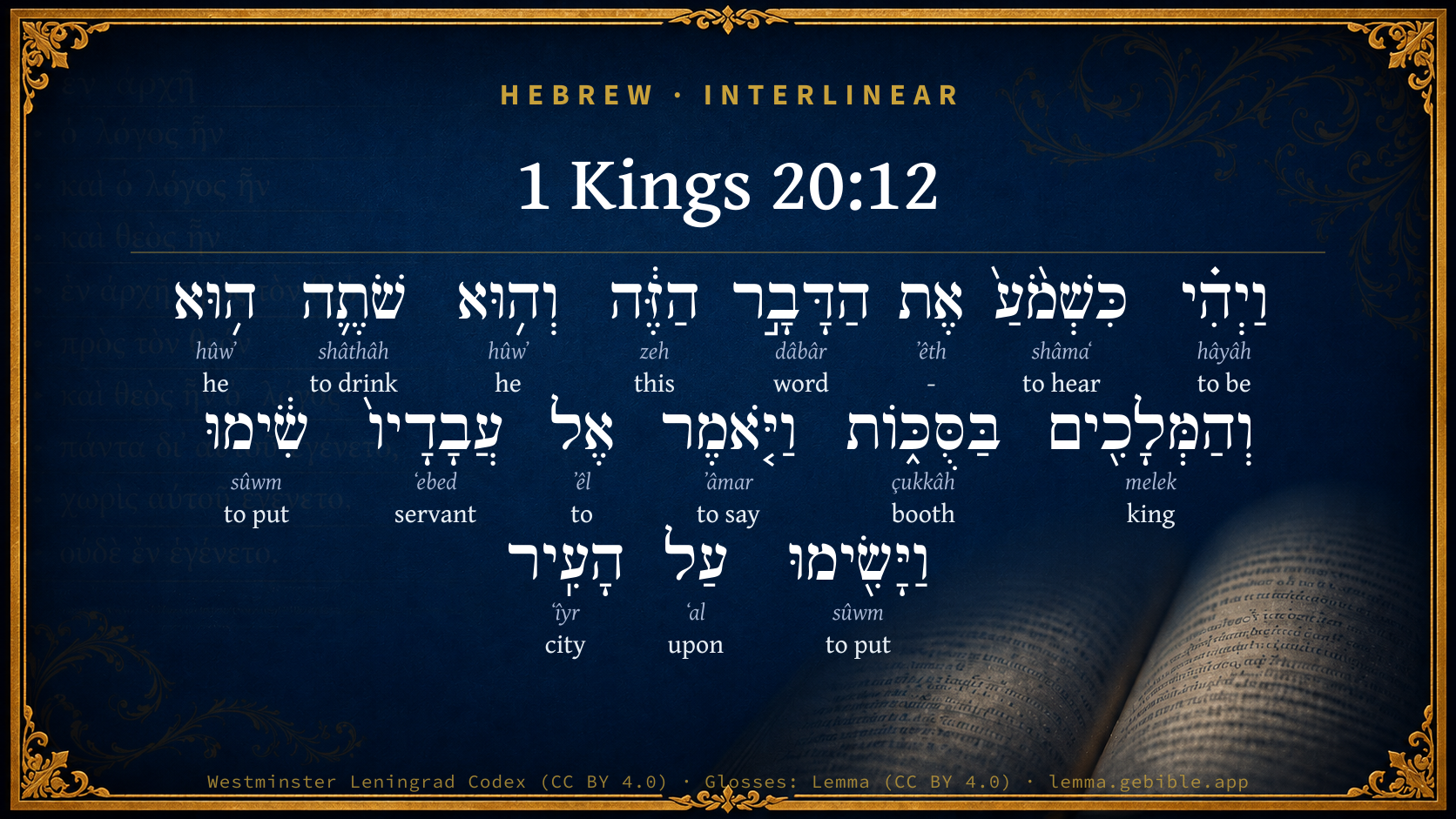
1 Kings 20:12

Hebrew (Westminster Leningrad Codex) 1 Kings 20:12 appears in the Hebrew Old Testament. The text above is from the Westminster Leningrad Codex. Each word links to its Strong’s number, a concise gloss, and parsing drawn from the Open Scriptures Hebrew Bible morphology. Click any word for its full Brown-Driver-Briggs (BDB) entry.
Download image
Cite this verse

1 Kings 20:12 (World English Bible). Public Domain. Lemma interlinear Bible study tool, https://lemma.gebible.app/v/1-kings/20/12.

Show BibTeX & RIS
BibTeX
RIS
English Translation
It happened, when [Ben Hadad] heard this message, as he was drinking, he and the kings, in the pavilions, that he said to his servants, Set [yourselves in array]. They set [themselves in array] against the city.
World English Bible · Public Domain
Download a study sheet

One document with this verse’s original text, its word-by-word gloss line, the meaning frame, cross-references with their text, attributed commentary, and full source and license credits — printable, and it pastes into notes with its structure intact.

This verse Autodidact and up

Study sheet (.html) Plain text (.txt)

A passage Seminary Student

Up to 50 verses in one chapter. A passage sheet keeps up to 6 commentary sources and 12 cross-references per verse, in the order this page ranks them, and says so on the sheet whenever that leaves anything out. Ask for a single verse and you get the Autodidact verse sheet above.

Everything on this page stays free to read, with no account — the sheet is a download of what is already on screen, not access to it.

Want to remove ads? Support Godless Engineer
Compare translations 3

The same verse in 3 English versions, stacked beneath the original-language interlinear above. Click any original word for its lexicon entry.

Each is an independent rendering of the whole verse — the interlinear is not word-aligned to these translations.

Highlighted words mark where these versions differ — a whole-verse word diff, not a word-by-word alignment.

  • World English Bible Public Domain
    It happened, when [Ben Hadad] heard this message, as he was drinking, he and the kings, in the pavilions, that he said to his servants, Set [yourselves in array]. They set [themselves in array] against the city.
  • King James Version Public Domain
    And it came to pass, when Ben-hadad heard this message, as he was drinking, he and the kings in the pavilions, that he said unto his servants, Set yourselves in array. And they set themselves in array against the city.
  • unfoldingWord Literal Text CC BY-SA 4.0
    And it happened when he heard this word (and he was drinking, he and the kings, in huts), that he said to his servants, “Set!” And they set against the city.

unfoldingWord Literal Text — © unfoldingWord, licensed CC BY-SA 4.0. Word-aligned USFM3 via Door43 (git.door43.org/unfoldingWord/en_ult).

Versions to compare (up to 4)

3 of 4 selected

Show all 18 translations

Every available English version of this verse, each an independent rendering of the whole verse.

  • World English Bible Public Domain
    It happened, when [Ben Hadad] heard this message, as he was drinking, he and the kings, in the pavilions, that he said to his servants, Set [yourselves in array]. They set [themselves in array] against the city.
  • Berean Standard Bible Public Domain
    Ben-hadad received this message while he and the kings were drinking in their tents, and he said to his servants, “Take your positions.” So they stationed themselves against the city.
  • Majority Standard Bible Public Domain
    Ben-hadad received this message while he and the kings were drinking in their tents, and he said to his servants, “Take your positions.” So they stationed themselves against the city.
  • King James Version Public Domain
    And it came to pass, when Ben-hadad heard this message, as he was drinking, he and the kings in the pavilions, that he said unto his servants, Set yourselves in array. And they set themselves in array against the city.
  • American Standard Version (1901) Public Domain
    And it came to pass, when `Ben-hadad' heard this message, as he was drinking, he and the kings, in the pavilions, that he said unto his servants, Set `yourselves in array'. And they set `themselves in array' against the city.
  • Revised Version (1885) Public Domain
    And it came to pass, when Ben-hadad heard this message, as he was drinking, he and the kings, in the pavilions, that he said unto his servants, Set yourselves in array. And they set themselves in array against the city.
  • Geneva Bible (1599) Public Domain
    And when he heard that tidings, as he was with the Kings drinking in the pauilions, he sayd vnto his seruants, Bring forth your engines, and they set them against the citie.
  • Douay-Rheims (1899) Public Domain
    And it came to pass, when Benadad heard this word, that he and the kings were drinking in pavilions, and he said to his servants: Beset the city. And they beset it.
  • Young's Literal Translation Public Domain
    And it cometh to pass at the hearing of this word -- and he is drinking, he and the kings, in the booths -- that he saith unto his servants, `Set yourselves;' and they set themselves against the city.
  • Literal Standard Version CC BY-SA 4.0
    And it comes to pass at the hearing of this word—and he is drinking, he and the kings, in the shelters—that he says to his servants, “Set yourselves”; and they set themselves against the city.
  • Unlocked Literal Bible CC BY-SA 4.0
    Ben Hadad heard this message as he was drinking, he and the kings under him who were in their tents. Ben Hadad commanded his men, “Line yourselves up in position for battle.” So they prepared themselves in position of battle to attack the city.
  • unfoldingWord Literal Text CC BY-SA 4.0
    And it happened when he heard this word (and he was drinking, he and the kings, in huts), that he said to his servants, “Set!” And they set against the city.
  • Darby Bible Public Domain
    And it came to pass when he heard this word, as he was drinking, he and the kings in the tents, that he said to his servants, Set yourselves. And they set themselves against the city.
  • World Messianic Bible Public Domain
    When Ben Hadad heard this message as he was drinking, he and the kings in the pavilions, he said to his servants, “Prepare to attack!” So they prepared to attack the city.
  • Webster's Bible Public Domain
    And it came to pass, when Ben-hadad heard this message as he was drinking, he and the kings in the pavilions, that he said to his servants, Set yourselves in array. And they set themselves in array against the city.
  • Free Bible Version CC BY-SA 4.0
    Ben-hadad received this message while he and the kings were drinking in their tents. He immediately gave the order to his officers, “Get ready to attack!” So they prepared to attack the city.
  • Bible in Basic English Public Domain
    Now when this answer was given to Ben-hadad, he was drinking with the kings in the tents, and he said to his men, Take up your positions. So they put themselves in position for attacking the town.
  • JPS Tanakh (1917) Public Domain
    And it came to pass, when Ben-hadad heard this message, as he was drinking, he and the kings, in the booths, that he said unto his servants: 'Set yourselves in array.' And they set themselves in array against the city.

Literal Standard Version (2020), Covenant Press — licensed CC BY-SA 4.0. Text via the HelloAO Bible API (eBible.org). Unlocked Literal Bible (unfoldingWord) — licensed CC BY-SA 4.0. Text via the HelloAO Bible API (eBible.org). unfoldingWord Literal Text — © unfoldingWord, licensed CC BY-SA 4.0. Word-aligned USFM3 via Door43 (git.door43.org/unfoldingWord/en_ult). Free Bible Version, Dr. Jonathan Gallagher — licensed CC BY-SA 4.0. Text via the HelloAO Bible API (eBible.org).

Word by word

More ways to search: Search by grammar → Find every occurrence → Compare this word →

Practice this passage: Drill this verse → Learn its vocabulary →

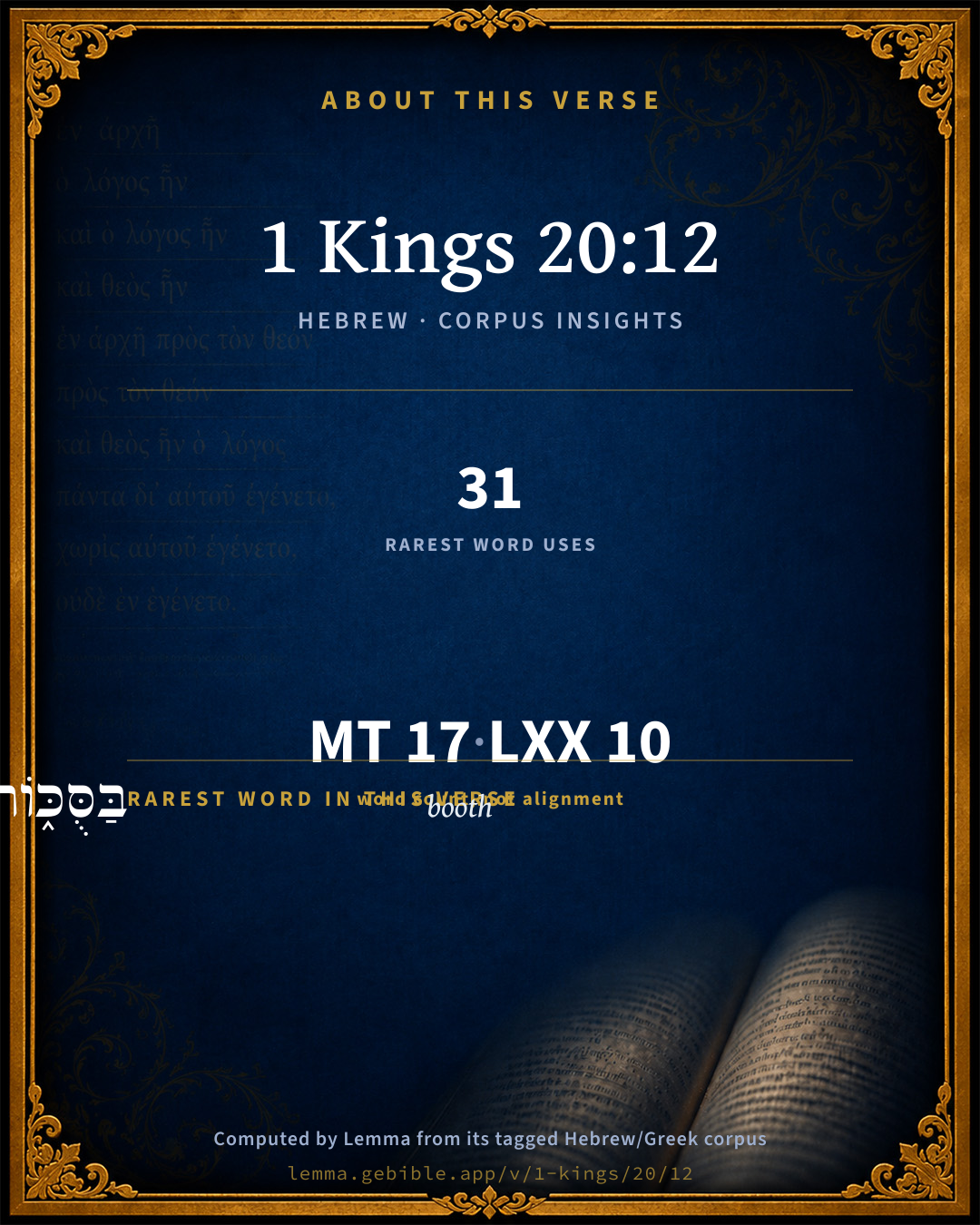
בַּסֻּכּ֑וֹת
çukkâh
H5521
“in/at the · booths”
Preposition, Determined + Noun, Common, Feminine, Plural, Absolute
Part of Speech
Preposition + Noun
Type
Common
Gender
Feminine
Number
Plural
State
Absolute
Full BDB Definition

Origin: from H5520

TWOT: 1492d

thicket, covert, booth - thicket - booth (rude or temporary shelter)
  1. וַיְהִ֗י hâyâh H1961 “and · to be” Conjunction + Verb, Qal, Sequential Imperfect, 3rd Person, Masculine, Singular
  2. כִּשְׁמֹ֨עַ֙ shâmaʻ H8085 “like/as · to hear” Preposition + Verb, Qal, Infinitive Construct
  3. אֶת ʼêth H853 “-” Particle, Direct Object
  4. הַדָּבָ֣ר dâbâr H1697 “the · word” Particle, Definite Article + Noun, Common, Masculine, Singular, Absolute
  5. הַזֶּ֔ה zeh H2088 “the · this” Particle, Definite Article + Pronoun, Demonstrative, Masculine, Singular
  6. וְה֥וּא hûwʼ H1931 “and · he” Conjunction + Pronoun, Personal, 3rd Person, Masculine, Singular
  7. שֹׁתֶ֛ה shâthâh H8354 “drinking” Verb, Qal, Participle Active, Masculine, Singular, Absolute
  8. ה֥וּא hûwʼ H1931 “he” Pronoun, Personal, 3rd Person, Masculine, Singular
  9. וְהַמְּלָכִ֖ים melek H4428 “and · the · kings” Conjunction + Particle, Definite Article + Noun, Common, Masculine, Plural, Absolute
  10. וַיֹּ֤אמֶר ʼâmar H559 “and · to say” Conjunction + Verb, Qal, Sequential Imperfect, 3rd Person, Masculine, Singular
  11. אֶל ʼêl H413 “to” Preposition
  12. עֲבָדָיו֙ ʻebed H5650 “servants · his” Noun, Common, Masculine, Plural, Construct + Suffix, Personal, 3rd Person, Masculine, Singular
  13. שִׂ֔ימוּ sûwm H7760 “put” Verb, Qal, Imperative, 2nd Person, Masculine, Plural
  14. וַיָּשִׂ֖ימוּ sûwm H7760 “and · to put” Conjunction + Verb, Qal, Sequential Imperfect, 3rd Person, Masculine, Plural
  15. עַל ʻal H5921 “upon” Preposition
  16. הָעִֽיר ʻîyr H5892 “the · city” Particle, Definite Article + Noun, Common, Feminine, Singular, Absolute

About this verse

These counts appear in no published source. They are computed here, from the morphology-tagged text and Lemma’s own curated glosses. What Lemma adds →

17
words
15
distinct lemmas
Historical
section

Shared distinctive vocabulary

בַּסֻּכּ֑וֹת booth H5521 occurs in 29 verses of the Hebrew Bible. Also found in:

Grammatical profile

  • 6 verbs
  • 5 nouns
  • 3 pronouns
  • 2 prepositions
  • 1 particle

Verb forms

  • וַיְהִ֗י Qal · Sequential Imperfect
  • כִּשְׁמֹ֨עַ֙ Qal · Infinitive Construct
  • שֹׁתֶ֛ה Qal · Participle Active
  • וַיֹּ֤אמֶר Qal · Sequential Imperfect
  • שִׂ֔ימוּ Qal · Imperative
  • וַיָּשִׂ֖ימוּ Qal · Sequential Imperfect

Repetition

Words recur within this verse — often emphatic in Hebrew:

  • שִׂ֔ימוּ to put H7760 ×2
  • וְה֥וּא he H1931 ×2

Hebrew & Septuagint length

In English translation the verse runs 37 words from the Hebrew and 15 from the Septuagint (LXX English) — the Septuagint runs noticeably shorter here. See the side-by-side →

A rough comparison of the two English renderings, which tokenize alike — not a word-level alignment.

Word counts can differ between the Hebrew and the Greek without any difference in meaning — e.g. the Hebrew direct-object marker אֵת has no separate Greek word, and Greek often adds the article ὁ.

In the original languages it is 17 Hebrew tokens and 10 Greek tokens — but the two are counted differently (Hebrew bundles its prefixes and suffixes into one token; the Greek is in lemma form), so that isn’t a like-for-like length.

Cross-references

10

Topical passages linked to 1 Kings 20:12 in the Treasury of Scripture Knowledge — connected by theme and wording, ordered by reader-vote popularity; previews shown in the World English Bible.

  • 1 Kings 16:9 His servant Zimri, captain of half his chariots, conspired against him. Now he was in Tirzah, drinking himself drunk in the house of Arza, who was over the household in Tirzah:
  • 1 Kings 20:16 They went out at noon. But Ben Hadad was drinking himself drunk in the pavilions, he and the kings, the thirty-two kings who helped him.
  • Proverbs 31:4–5 It is not for kings, Lemuel; It is not for kings to drink wine; Nor for princes to say, 'Where is strong drink?'
  • 1 Samuel 25:36 Abigail came to Nabal; and, behold, he held a feast in his house, like the feast of a king; and Nabal's heart was merry within him, for he was very drunken: therefore she told him nothing, less or more, until the morning light.
  • 2 Samuel 13:28 Absalom commanded his servants, saying, Mark you now, when Amnon's heart is merry with wine; and when I tell you, Smite Amnon, then kill him; don't be afraid; haven't I commanded you? be courageous, and be valiant.
  • Jeremiah 43:10 and tell them, Thus says Yahweh of Hosts, the God of Israel: Behold, I will send and take Nebuchadrezzar the king of Babylon, my servant, and will set his throne on these stones that I have hidden; and he shall spread his royal pavilion over them.
  • Daniel 5:2 Belshazzar, while he tasted the wine, commanded to bring the golden and silver vessels which Nebuchadnezzar his father had taken out of the temple which was in Jerusalem; that the king and his lords, his wives and his concubines, might drink from it.
  • Daniel 5:30 In that night Belshazzar the Chaldean King was slain.
  • Luke 21:34 "So be careful, or your hearts will be loaded down with carousing, drunkenness, and cares of this life, and that day will come on you suddenly.
  • Ephesians 5:18 Don't be drunken with wine, in which is dissipation, but be filled with the Spirit,

Cross-references courtesy of OpenBible.info (CC BY 4.0).

Hebrew and Greek witnesses Masoretic Hebrew ↔ Greek Septuagint

The same verse in the two great witnesses to the Old Testament, shown verse-for-verse.

Here the Septuagint runs noticeably shorter than the Hebrew — LXX2012 (modern English Septuagint) 15 words vs World English Bible 37. A rough length comparison of the two English translations, not a word-level alignment — read both below.

These are two independent witnesses, not word-aligned to each other, and the Septuagint is shown in lemma (dictionary) form.

Hebrew 1 Kings 20:12 Masoretic · Westminster Leningrad Codex

וַיְהִ֗י כִּשְׁמֹ֨עַ֙ אֶת הַדָּבָ֣ר הַזֶּ֔ה וְה֥וּא שֹׁתֶ֛ה ה֥וּא וְהַמְּלָכִ֖ים בַּסֻּכּ֑וֹת וַיֹּ֤אמֶר אֶל עֲבָדָיו֙ שִׂ֔ימוּ וַיָּשִׂ֖ימוּ עַל הָעִֽיר

It happened, when [Ben Hadad] heard this message, as he was drinking, he and the kings, in the pavilions, that he said to his servants, Set [yourselves in array]. They set [themselves in array] against the city.

World English Bible · Public Domain

Greek LXX 1 Kings 20:12 Septuagint · lemma form

καλέω νηστεία καί καταἵζω ὁ ναβουθαι ἐν ἀρχή ὁ λαός

And they proclaimed a fast, and set Nebuthai in a chief place among the people.

LXX2012 (modern English Septuagint) · Public Domain

On this verse, The Cambridge Bible for Schools and Colleges discusses the Septuagint’s reading. Read the note in Commentary ↓

Hebrew: Westminster Leningrad Codex (CC BY 4.0). Greek: Septuagint (public domain); English from LXX2012 (modern English Septuagint) (Public Domain). How the Septuagint differs from the Hebrew →

Targum (Aramaic paraphrase)

1

The Targum is the ancient Jewish Aramaic paraphrase of the Hebrew Scriptures — an interpretive translation, not the Hebrew text itself. Onkelos (literal) and Pseudo-Jonathan (expansive) render the Torah, and Jonathan the Prophets. Coverage is partial: where no permissively-licensed English translation exists for a verse, only the Aramaic is shown. This is verse-level text, not a word-by-word alignment to the Hebrew.

  1. Targum Jonathan Prophets (Joshua–Malachi)
    וַהֲוָה כַּד שְׁמַע יַת פִּתְגָמָא הָדֵין וְהוּא שָׁתֵי הוּא וּמַלְכַיָא בִּמְטָלַיָא וַאֲמַר לְעַבְדוֹהִי אִזְדְרָזוּ וּכְמַנוּ עַל קַרְתָּא:

    (no public-domain English translation for this verse)

    Targum Jonathan — Aramaic: “Mikraot Gedolot” (public domain). English: “Sefaria Community Translation” (CC0 1.0 (public-domain dedication)); “London "Chaldee Paraphrase," 1871” (public domain). Text via Sefaria.

Commentary

Notes on 1 Kings 20:12 from classic Christian and Jewish commentators (each source and its license shown beneath its notes). The classic Christian expositions comment on the surrounding passage and are grouped to its opening verse, so a note may address several verses; the Jewish commentaries on the Tanakh (Rashi and others) are per-verse, so they appear only where the commentator wrote on this verse.

Lemma curates 59 commentaries, every one of them public domain or Creative Commons licensed, each selected and text-cleaned for this edition rather than reprinted as found. About our sources →

Matthew Henry's Commentary

The treaty between the besiegers and the besieged being broken off abruptly, we have here an account of the battle that ensued immediately.

I. The Syrians, the besiegers, had their directions from a drunken king, who gave orders over his cups, as he was drinking (Kg1 20:12), drinking himself drunk (Kg1 20:16) with the kings in the pavilions, and this at noon. Drunkenness is a sin which armies and their officers have of old been addicted to. Say not thou then that the former days were, in this respect, better than these, though these are bad enough. Had he not been very secure he would not have sat to drink; and, had he not bee intoxicated, he would not have been so very secure. Security and sensuality went together in the old world, and Sodom, Luk 17:26, etc. Ben-hadad's drunkenness was the forerunner of his fall, as Belshazzar's was, Dan. 5. How could he prosper that preferred his pleasure before his business, and kept his kings to drink with him when they should have been at their respective posts to fight for him? In his drink, 1. He orders the town to be invested, the engines fixed, and every thing got ready for the making of a general attack (Kg1 20:12), but stirs not from his drunken club to see it done. Woe unto thee, O land! when thy king is such a child. 2. When the besieged made a sally (and, by that time, he was far gone) he gave orders to take them alive (Kg1 20:18), not to kill them, which might have been done more easily and safely, but to seize them, which gave them an opportunity of killing the aggressors; so imprudent was he in the orders he gave, as well as unjust, in ordering them to be taken prisoners though they came for peace and to renew the treaty. Thus, as is usual, he drinks, and forgets the law, both the policies and the justice of war.

II. The Israelites, the besieged, had their directions from an inspired prophet, one of the prophets of the Lord, whom Ahab had hated and persecuted: And behold a prophet, even one, drew near to the king of Israel; so it may be read, Kg1 20:13.

1. Behold, and wonder, that God should send a prophet with a kind and gracious message to so wicked a prince as Ahab was; but he did it, (1.) For his people Israel's sake, who, though wickedly degenerated, were the seed of Abraham his friend and Jacob his chosen, the children of the covenant, and not yet cast off. (2.) That he might magnify his mercy, in doing good to one so evil and unthankful, might either bring him to repentance or leave him the more inexcusable. (3.) That he might mortify the pride of Ben-hadad and check his insolence. Ahab's idolatry shall be punished hereafter, but Ben-hadad's haughtiness shall be chastised now; for God resists the proud, and is pleased to say that he fears the wrath of the enemy, Deu 32:26, Deu 32:27. There was but one prophet perhaps to be had in Samaria, and he drew near with this message, intimating that he had been forced to keep at a distance. Ahab, in his prosperity, would not have borne the sight of him, but now he bids him welcome, when none of the prophets of the groves can give him any assistance. He enquired not for a prophet of the Lord, but God sent one to him unasked, for he waits to be gracious.

2. Two things the prophet does: - (1.) He animates Ahab with an assurance of victory, which was more than all the elders of Israel could give him (Kg1 20:8), though they promised to stand by him. This prophet, who is not named (for he spoke in God's name), tells him from God that this very day the siege shall be raised, and the army of the Syrians routed, Kg1 20:13. When the prophet said, Thus saith the Lord, we may suppose Ahab began to tremble, expecting a message of wrath; but he is revived when it proves a gracious one. He is informed what use he ought to make of this blessed turn of affairs: "Thou shalt know that I am Jehovah, the sovereign Lord of all." God's foretelling a thing that was so very unlikely proved that it was his own doing. (2.) He instructs him what to do for the gaining of this victory. [1.] He must not stay till the enemy attacked him, but must sally out upon them and surprise them in their trenches. [2.] The persons employed must be the young men of the princes of the provinces, the pages, the footmen, who were few in number, only 232, utterly unacquainted with war, and the unlikeliest men that could be thought of for such a bold attempt; yet these must do it, these weak and foolish things must be instruments of confounding the wise and strong, that, while Ben-hadad's boasting is punished, Ahab's may be prevented and precluded, and the excellency of the power may appear to be of God. [3.] Ahab must himself so far testify his confidence in the word of God as to command in person, though, in the eye of reason, he exposed himself to the utmost danger by it. But it is fit that those who have the benefit of God's promises should enter upon them. Yet, [4.] He is allowed to make use of what other forces he has at hand, to follow the blow, when these young men have broken the ice. All he had in Samaria, or within call, were but 7000 men, Kg1 20:15. It is observable that it is the same number with theirs that he not bowed the knee to Baal (Kg1 19:18), though, it is likely, not the same men.

III. The issue was accordingly. The proud Syrians were beaten, and the poor despised Israelites were more than conquerors. The young men gave an alarm to the Syrians just at noon, at high dinner-time, supported by what little force they had, Kg1 20:16. Ben-hadad despised them at first (Kg1 20:18), but when they had, with unparalleled bravery and dexterity, slain every one his man, and so put the army into disorder, that proud man durst not face them, but mounted immediately, drunk as he was, and made the best of his way, Kg1 20:20. See how God takes away the spirit of princes, and makes himself terrible to the kings of the earth. Now where are the silver and gold he demanded of Ahab? Where are the handfuls of Samaria's dust? Those that are most secure are commonly least courageous. Ahab failed not to improve this advantage, but slew the Syrians with a great slaughter, Kg1 20:21. Note, God oftentimes makes one wicked man a scourge to another.

Matthew Henry's Commentary on the Whole Bible (1708–1710) — public domain (CC PDM 1.0). Text via the HelloAO Bible API.

Trapp's Complete Commentary

John Trapp

1Ki 20:12 And it came to pass, when [Benhadad] heard this message, as he [was] drinking, he and the kings in the pavilions, that he said unto his servants, Set [yourselves in array]. And they set [themselves in array] against the city.

Ver. 12. As he was drinking.] Even unto drunkenness, {1Ki 20:16} which is none of the best counsellors. Drunkards are besotted and disabled: as a snuff of a candle in a socket drowned in the tallow yieldeth little or no light, but only a stench.

He and the kings.] Who were, likely, preferred by him to places of honour and trust in the army, according to their ability in drinking: like as Novellus surnamed. Tricongius - for that he could drink three bottles of wine together with one breath - was therefore made proconsul by Tiberius. Alexander, also inviting various of his lords to supper, provided a crown of one hundred and eighty pounds to be given to those that should drink most.

John Trapp, A Commentary or Exposition upon All the Books of the Old and New Testament (1647–1656) — public domain. Text from a community e-Sword module.

Tyndale Open Study Notes

Tyndale Open Resources

20:12 Ben-hadad and the other kings . . . were drinking in their tents in anticipation of Ahab’s capitulation. Ahab’s reply constituted a challenge, and the Aramean officers prepared to attack.

Tyndale Open Study Notes — © Tyndale Open Resources, licensed CC BY-SA 4.0. Text via the HelloAO Bible API.

Geneva Bible (1599)

Geneva Bible translators

Or, put yourselves in order.

Geneva Bible (1599) marginal notes — public domain. Text via Bolls.life.

Jamieson, Fausset & Brown

Robert Jamieson, A. R. Fausset & David Brown

as he was drinking, he and the kings in the pavilions--booths made of branches of trees and brushwood; which were reared for kings in the camp, as they still are for Turkish pashas or agas in their expeditions [KEIL].

Set yourselves in array--Invest the city.

Jamieson, Fausset & Brown — Commentary Critical and Explanatory on the Whole Bible (1871) — public domain (CC PDM 1.0). Text via the HelloAO Bible API.

Adam Clarke's Commentary

Verse 12. In the pavilions] This word comes from papilio, a butterfly, because tents, when pitched or spread out, resembled such animals; partly because of the mode of their expansion, and partly because of the manner in which they were painted.

Set yourselves in array.] The original word, שימו simu, which we translate by this long periphrasis, is probably a military term for Begin the attack, Invest the city, Every man to his post, or some such like expression.

Adam Clarke's Commentary on the Bible (1810–1826) — public domain. Text from a community e-Sword/MySword module.

The Cambridge Bible for Schools and Colleges

gen. ed. J. J. S. Perowne

12. as he was drinking] Ben-hadad was clearly full of confidence, and was giving a banquet to the allied princes in anticipation of the victory.

he and the kings] i.e. The thirty and two, mentioned in 1Ki_20:1.

in the pavilions] The word is the same which is used for the temporary booths erected of branches of trees at the feast of Tabernacles. Doubtless the tents of Ben-hadad and his princes were of the like kind, for the erection of which material was not difficult to find.

Set yourselves in array] As there is only the verb expressed here, it is possible to substitute as is done in the margin ‘the engines’ instead of the text. The word is used elsewhere with a noun ‘battering-rams’ after it (Eze_4:2), but there is nothing in this passage to shew us whether the persons or the engines are referred to. Such elliptical phrases are common among words of command.

The LXX. has rendered ‘Build a stockade, and they set a stockade against the city.’

The Cambridge Bible for Schools and Colleges (gen. ed. J. J. S. Perowne; Cambridge University Press, 1878–1918) — public domain. Text from a community e-Sword module.

John Gill's Exposition

And it came to pass, when Benhadad heard this message (as he was drinking, he and the kings in the pavilions),.... Though it was at noon, or before, Kg1 20:16, which shows that he and they were addicted to intemperance:

that he said unto his servants; some of the principal officers of his army:

set yourselves in array; prepare for battle, betake yourselves to your arms, invest the city at once, and place the engines against it to batter it down:

and they set themselves in array against the city; besieged it in form, at least prepared for it; for it seems after all that it was not properly done.

John Gill's Exposition of the Whole Bible (1746–1763) — public domain (CC PDM 1.0). Text via the HelloAO Bible API.

Albert Barnes' Notes on the Bible

Pavilions - “Booths” (Gen 33:17 margin; Lev 23:42; Jon 4:5). The term seems to be properly applied to a stationary “booth” or “hut,” as distinguished from a moveable “tent.” On military expeditions, and especially in the case of a siege, such “huts” were naturally constructed to shelter the king and his chief officers.

Albert Barnes' Notes on the Bible (1834–1885) — public domain. Text from a community e-Sword/MySword module.

Haydock's Catholic Bible Commentary

Pavilion, (umbraculis) or even under "the shade" of the trees, in full security. (Menochius) --- Beset. Hebrew, "set, and they set against the city." Chaldean, "hold yourselves in readiness, and they laid ambushes round the city." The siege had not been yet commenced in form, as it was never expected that Achab would dare to make any resistance.

George Leo Haydock (1774–1849), Haydock's Catholic Family Bible and Commentary, 1859 edition — public domain. Excludes Psalms (Douay-Rheims chapter numbering differs from Protestant) and Deuterocanonical books (Catholic canon only).

Matthew Poole's English Annotations

Set yourselves in array; put yourselves and engines in order to make the assault.

Matthew Poole's English Annotations on the Holy Bible (1683–1685) — public domain. Text from a community e-Sword/MySword module.

Whedon's Commentary on the Bible

Daniel D. Whedon

12. Pavilions — War tents, covered either with canvass or with the boughs of trees.

Daniel D. Whedon (gen. ed.), Commentary on the Old and New Testaments (1874–1909) — public domain. Text from a community e-Sword module.

The Pulpit Commentary

And it came to pass, when Ben-hadad Heb. he heard this message Heb. word, as he was drinking, he and the kings in the pavilions Heb. booths. The word shows that, in lieu of tents, kings and generals on an expedition sometimes used leafy huts, like those of Israel. (Lev_23:34, Lev_23:42) Such booths, it is said, are still erected on military expeditions in the East, that he said unto his servants, Set yourselves in array Heb. Wmyci one short, decisive word. His indignation and astonishment were too great for more. We might perhaps render "Form." 1Sa_11:11; Jos_8:2, Jos_8:13; sate Job_1:17 Eze_23:24. Itcannot mean oijkodomh caraka (LXX) And they set themselves in array or formed. Again one word, which is more spirited and graphic, and conveys that the command was instantly obeyed against the city.

Set yourselves in array" (Heb. Wmy The command was prompt and decided enough. But observe, he himself went on drinking (ver. 16). This helps to explain his defeat. He was a man of words only. The successful generals it is a trite saying are those who say "Come," not "Go.

Vers. 12-21.

The hand of God.

The notable answer of the king of Israel to the insolent king of Syria, "Let not him that girdeth on the harness boast himself as he that putteth it off," came to Ben-hadad when he was drinking wine with the thirty and two kings that followed him. He at once gave orders to his servants to set themselves in battle array. While the enormous host which "filled the country" (see vers. 25, 27) disposed itself to attack the city, the men of Israel, who were but a handful, naturally trembled for the issue, at this juncture God interposed in the manner related here, and thereby asserted the general truths, viz.

I THAT GOD RULES IN THE DESTINIES OF MEN.

1. Here He showed His hand.

(1) He sent a prophet. Jarchi says it was Micalah, the son of Imlah, while others think it was Elijah in disguise; but it is useless to speculate on this point. We are more concerned with the purport of His message, which was to promise victory to Israel, and to indicate how that victory should be organized, so that in the issue Jehovah might be acknowledged.

(2) The hand of God was seen not only in the prophet"s foreknowledge of events, but also in the wisdom of the adjustments by which they were to be brought about. For the victory was organized according to instructions of the prophet, purporting also to be from the Lord. Who but the Lord could have foreseen that at noon Ben-hadad and his kings would be so drunken as to be unfit and indisposed to take their posts of command? Who else could have foreseen that Ben-hadad would have been so foolish as to order the sortie to be taken alive? For thereby the Syrians were put to a disadvantage, which enabled the "young men of the princes of the provinces" and those who followed them to slay "every one his man," and throw the invading host into confusion.

(3) The power of God also was evident when the disparity of numbers is considered. An army of seven thousand Israelites could never without supernatural aid, have demoralized and routed the formidable hosts of Syria.

(4) And that God was in this victory could not be reasonably doubted, since this was not an extraordinary event by itself, but one of a series of such events; therefore it could not have been an accident. It was preceded by three years of drought which began and ended according to the "word" of Elijah, with the miracle on Carmel.

2. By so showing His hand He evinced that He is ever working.

(1) When events are ordinary, men are disposed to see in them natural causes only; but extraordinary events force upon their consideration the fact of a superior agency behind these causes.

(2) This truth is the more evident when the ordinary are recognized in the extraordinary. Thus God ordered the battle. He appointed the general, disposed the attack which was to assure the victory, and timed everything so to fit in with circumstances as to bring about the promised result.

(3) With God there is no essential difference between things ordinary and extraordinary. It is simply a question of proportions. For natural causes are all second causes, and would have no existence but for the First Cause. A miracle is but the unusual action of the First Cause upon the second causes; but in the usual action, God is none the less present and necessary to the result.

II THAT HE RULES IN RIGHTEOUSNESS AND MERCY.

1. He humbles the proud is righteousness.

(1) Defeat in any case is humiliation. To Ben-hadad after his confident boasting it was eminently so. He would remember the lesson, "Let not him that girdeth on his harness boast himself as he that putteth it off." Let us observe it.

(2) The manner was an aggravation of the defeat. It was accomplished by two hundred and thirty-two "young men of the princes of the provinces," who are by some thought to have been a militia raised by provincial magistrates, and by others, with perhaps better reason for the number seems too small to answer the former description the attendants of such of those princes as were then in Samaria. It was intensely humiliating that a company of such combatants should rout a formidable army. God makes the weak confound the mighty.

(3) Ben-hadad would be mortified to think how his overweening confidence, together with his drunkenness, had directly contributed to his humiliation. He was too drunk to appear at the head of his army, but not too drunk to find his way to the cavalry to facilitate his flight. "There is but one step from the sublime to the ludicrous!

2. He shows long-suffering in mercy.

(1) The judgment upon Ben-hadad was mercy to Ahab. It delivered him from the hand of a cruel oppressor. It gave him another warning and space for repentance.

(2) Did Ahab deserve this? Certainly not, while he submitted to be led by Jezebel, and that notwithstanding his experience of the drought and the miracle on Carmel. God is long suffering in mercy.

(3) But there were "seven thousand in Israel, all the knees which had not bowed unto Baal, and every mouth which hath not kissed him" Jarchi would identify these with the "seven thousand" mentioned in verse 15. Probably some of that seven thousand went to compose this, and for their sakes it may have been that God had so signally interposed. Let us never lose sight of God. Let us discern His hand in nature, providence, grace. Let us never provoke His justice by pride, by rebellion. Let us respect His long-suffering by repentance. Let us throw ourselves upon His mercy for salvation, for help. J.A.M.

The Pulpit Commentary (1880–1919), ed. H.D.M. Spence-Jones & Joseph S. Exell — public domain. Text from a community e-Sword module.

Rashi

Rabbi Shlomo Yitzchaki (Rashi)

Prepare. The implements of siege against the city.

Rashi on the Tanakh — English translations: “The Judaica Press complete Tanach with Rashi, translated by A. J. Rosenberg” (CC BY 4.0); “Pentateuch with Rashi's commentary by M. Rosenbaum and A.M. Silbermann, 1929-1934” (public domain); “The Metsudah Tanach series, Lakewood, N.J” (CC BY 4.0); and “The Book of Joshua, Metsudah Publications, 1997” (CC BY 4.0). Text via Sefaria.

Lesson kit

Teaching starters — assembled from the data on this page, not authored interpretation. Every prompt links to the verse data it draws on. Edit before teaching.

1 Kings, in the Historical, opens this verse with 17 words (15 distinct Hebrew lemmas). Its most distinctive word is çukkâh (“booth”). The Greek Septuagint runs shorter here. A historical commentator’s framing appears above. Read the whole chapter for the surrounding context.

Discussion questions

  1. What does “booth” (çukkâh) contribute to the verse as a whole?
  2. Genesis 33:17 shares the word «booth» with this verse. How do the two illuminate each other?
  3. “to put” occurs 2× in this one verse. What is the effect of the repetition?
  4. Compared with the Hebrew, the Septuagint runs shorter here. What questions does that raise?
  5. These translations render this verse differently. What is at stake in choosing one wording over another?
  6. The verb «וַיְהִ֗י» is Qal Sequential Imperfect. How does its form color the action?
  7. Reading how Matthew Henry's Commentary and Trapp's Complete Commentary read this verse, where do the two commentators agree and where do they part?

Things to notice

Reading settings

Reading text

Shown beneath each verse's original-language words.

Old Testament
Old Testament edition

Read the OT as the Masoretic Hebrew (MT) or the Greek Septuagint (LXX).

English shown for the Greek Septuagint (in the Hebrew ↔ Greek comparison).

Comparing translations? Open the Compare panel on any verse page to stack up to four side by side.