Ezekiel 34:19

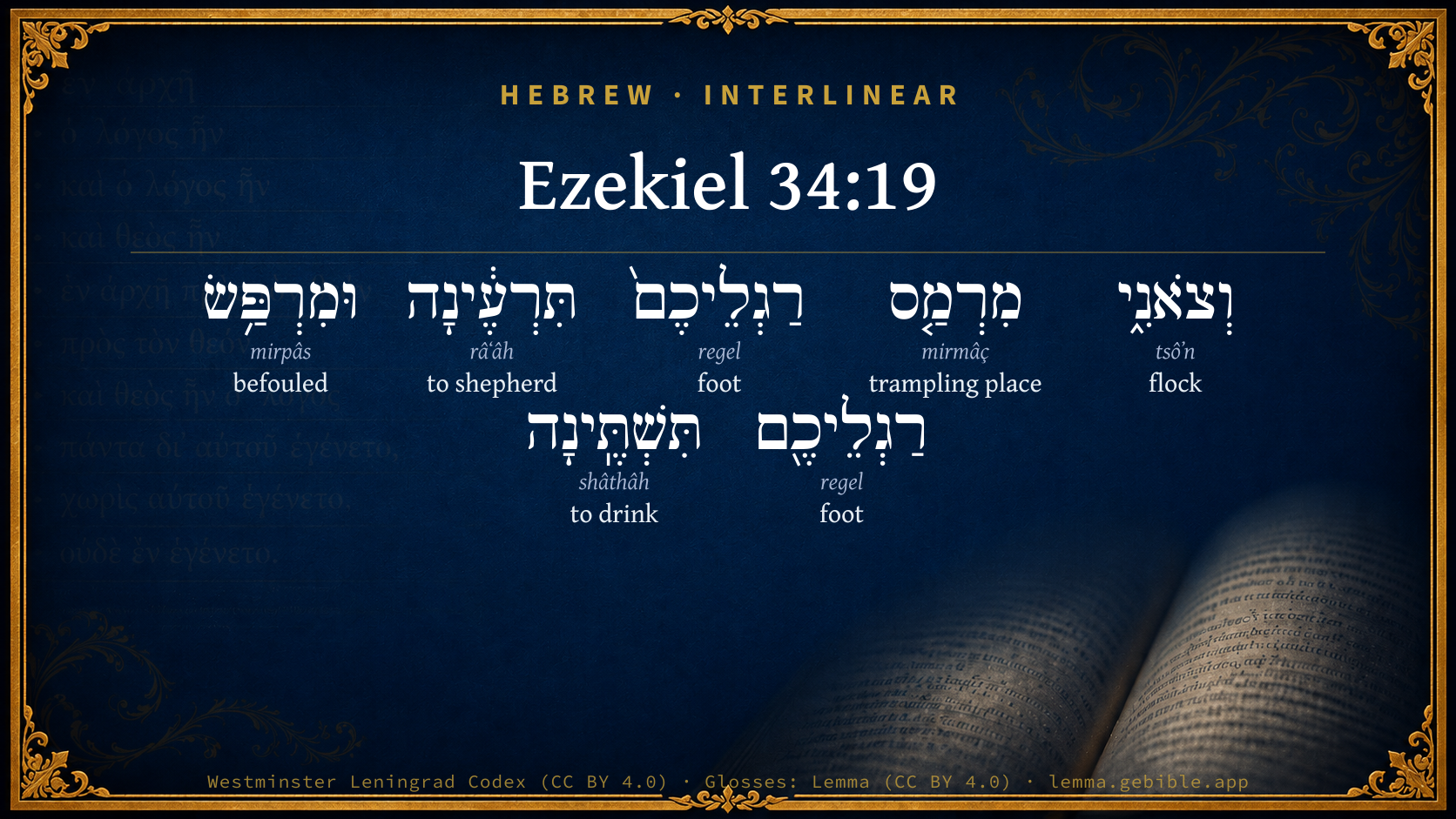
Hebrew (Westminster Leningrad Codex) Ezekiel 34:19 appears in the Hebrew Old Testament. The text above is from the Westminster Leningrad Codex. Each word links to its Strong’s number, a concise gloss, and parsing drawn from the Open Scriptures Hebrew Bible morphology. Click any word for its full Brown-Driver-Briggs (BDB) entry.
Download image
Cite this verse

Ezekiel 34:19 (World English Bible). Public Domain. Lemma interlinear Bible study tool, https://lemma.gebible.app/v/ezekiel/34/19.

Show BibTeX & RIS
BibTeX
RIS
English Translation
As for my sheep, they eat that which you have trodden with your feet, and they drink that which you have fouled with your feet.
World English Bible · Public Domain
Highlights
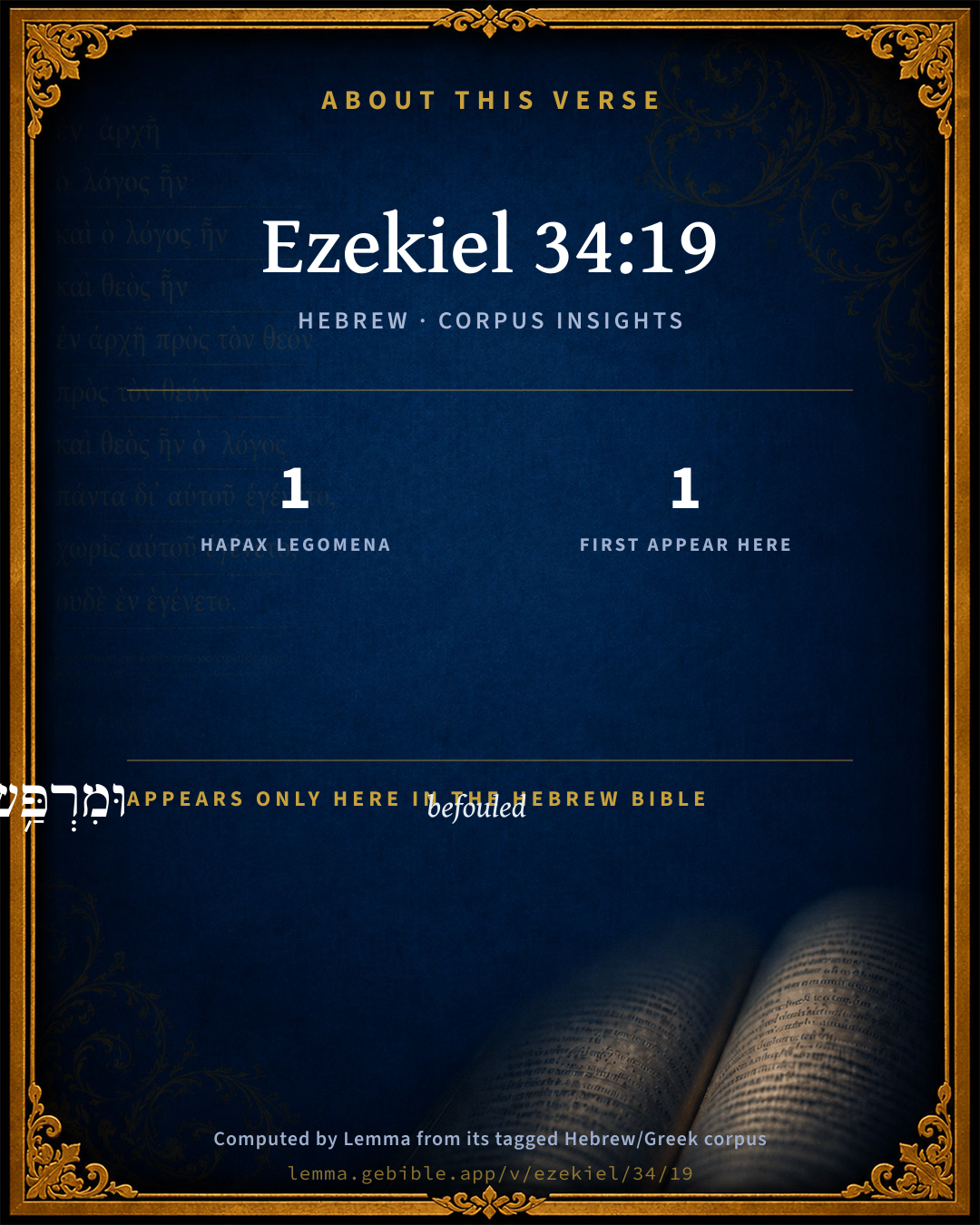
  • 1 hapax legomenon — only here in the Hebrew Bible
  • 1 first appearance in the Hebrew Bible
Full analysis ↓
Download a study sheet

One document with this verse’s original text, its word-by-word gloss line, the meaning frame, cross-references with their text, attributed commentary, and full source and license credits — printable, and it pastes into notes with its structure intact.

This verse Autodidact and up

Study sheet (.html) Plain text (.txt)

A passage Seminary Student

Up to 50 verses in one chapter. A passage sheet keeps up to 6 commentary sources and 12 cross-references per verse, in the order this page ranks them, and says so on the sheet whenever that leaves anything out. Ask for a single verse and you get the Autodidact verse sheet above.

Everything on this page stays free to read, with no account — the sheet is a download of what is already on screen, not access to it.

Want to remove ads? Support Godless Engineer
Compare translations 3

The same verse in 3 English versions, stacked beneath the original-language interlinear above. Click any original word for its lexicon entry.

Each is an independent rendering of the whole verse — the interlinear is not word-aligned to these translations.

Highlighted words mark where these versions differ — a whole-verse word diff, not a word-by-word alignment.

  • World English Bible Public Domain
    As for my sheep, they eat that which you have trodden with your feet, and they drink that which you have fouled with your feet.
  • King James Version Public Domain
    And as for my flock, they eat that which ye have trodden with your feet; and they drink that which ye have fouled with your feet.
  • unfoldingWord Literal Text CC BY-SA 4.0
    Must my sheep eat what you have trampled with your feet, and drink what you have muddied with your feet?

unfoldingWord Literal Text — © unfoldingWord, licensed CC BY-SA 4.0. Word-aligned USFM3 via Door43 (git.door43.org/unfoldingWord/en_ult).

Versions to compare (up to 4)

3 of 4 selected

Show all 18 translations

Every available English version of this verse, each an independent rendering of the whole verse.

  • World English Bible Public Domain
    As for my sheep, they eat that which you have trodden with your feet, and they drink that which you have fouled with your feet.
  • Berean Standard Bible Public Domain
    Why must My flock feed on what your feet have trampled, and drink what your feet have muddied?’
  • Majority Standard Bible Public Domain
    Why must My flock feed on what your feet have trampled, and drink what your feet have muddied?’
  • King James Version Public Domain
    And as for my flock, they eat that which ye have trodden with your feet; and they drink that which ye have fouled with your feet.
  • American Standard Version (1901) Public Domain
    And as for my sheep, they eat that which ye have trodden with your feet, and they drink that which ye have fouled with your feet.
  • Revised Version (1885) Public Domain
    And as for my sheep, they eat that which ye have trodden with your feet, and they drink that which ye have fouled with your feet.
  • Geneva Bible (1599) Public Domain
    And my sheepe eate that which yee haue troden with your feete, and drinke that which ye haue troubled with your feete.
  • Douay-Rheims (1899) Public Domain
    And my sheep were fed with that which you had trodden with your feet: and they drank what your feet had troubled.
  • Young's Literal Translation Public Domain
    And My flock the trodden thing of your feet consumeth, And the trampled thing of your feet drinketh?
  • Literal Standard Version CC BY-SA 4.0
    And My flock consumes the trodden thing of your feet, || And drinks the trampled thing of your feet?
  • Unlocked Literal Bible CC BY-SA 4.0
    Must my sheep eat what you have trampled with your feet, and drink what you have muddied with your feet?
  • unfoldingWord Literal Text CC BY-SA 4.0
    Must my sheep eat what you have trampled with your feet, and drink what you have muddied with your feet?
  • Darby Bible Public Domain
    And my sheep have to eat that which ye have trodden with your feet, and to drink that which ye have fouled with your feet.
  • World Messianic Bible Public Domain
    As for my sheep, they eat that which you have trodden with your feet, and they drink that which you have fouled with your feet.’
  • Webster's Bible Public Domain
    And as for my flock, they eat that which ye have trodden with your feet; and they drink that which ye have fouled with your feet.
  • Free Bible Version CC BY-SA 4.0
    Why does my flock have to feed on what your feet have trampled down, and drink the water that your feet have muddied?
  • Bible in Basic English Public Domain
    And as for my sheep, their food is the grass which has been stamped on by your feet, and their drink the water which has been made dirty by your feet.
  • JPS Tanakh (1917) Public Domain
    And as for My sheep, they eat that which ye have trodden with your feet, and they drink that which ye have fouled with your feet.

Literal Standard Version (2020), Covenant Press — licensed CC BY-SA 4.0. Text via the HelloAO Bible API (eBible.org). Unlocked Literal Bible (unfoldingWord) — licensed CC BY-SA 4.0. Text via the HelloAO Bible API (eBible.org). unfoldingWord Literal Text — © unfoldingWord, licensed CC BY-SA 4.0. Word-aligned USFM3 via Door43 (git.door43.org/unfoldingWord/en_ult). Free Bible Version, Dr. Jonathan Gallagher — licensed CC BY-SA 4.0. Text via the HelloAO Bible API (eBible.org).

Word by word

More ways to search: Search by grammar → Find every occurrence → Compare this word →

Practice this passage: Drill this verse → Learn its vocabulary →

About this verse

These counts appear in no published source. They are computed here, from the morphology-tagged text and Lemma’s own curated glosses. What Lemma adds →

7
words
6
distinct lemmas
Prophets
section

Notable vocabulary

1 hapax legomenon — a word that appears only here in the entire Hebrew Bible:

  • וּמִרְפַּ֥שׂ befouled H4833

First appearance in Scripture

This word makes its first canonical appearance in the Hebrew Bible here:

  • וּמִרְפַּ֥שׂ befouled H4833

Shared distinctive vocabulary

מִרְמַ֤ס trampling place H4823 occurs in 7 verses of the Hebrew Bible. Also found in:

Grammatical profile

  • 2 verbs
  • 5 nouns

Verb forms

  • תִּרְעֶ֔ינָה Qal · Imperfect
  • תִּשְׁתֶּֽינָה Qal · Imperfect

Repetition

A word recurs within this verse — often emphatic in Hebrew:

  • רַגְלֵיכֶם֙ foot H7272 ×2

Hebrew & Septuagint length

In English translation the verse runs 25 words from the Hebrew and 25 from the Septuagint (LXX English) — the same length.

A rough comparison of the two English renderings, which tokenize alike — not a word-level alignment.

Word counts can differ between the Hebrew and the Greek without any difference in meaning — e.g. the Hebrew direct-object marker אֵת has no separate Greek word, and Greek often adds the article ὁ.

Hebrew and Greek witnesses Masoretic Hebrew ↔ Greek Septuagint

The same verse in the two great witnesses to the Old Testament, shown verse-for-verse.

These are two independent witnesses, not word-aligned to each other, and the Septuagint is shown in lemma (dictionary) form.

Hebrew Ezekiel 34:19 Masoretic · Westminster Leningrad Codex

וְצֹאנִ֑י מִרְמַ֤ס רַגְלֵיכֶם֙ תִּרְעֶ֔ינָה וּמִרְפַּ֥שׂ רַגְלֵיכֶ֖ם תִּשְׁתֶּֽינָה

As for my sheep, they eat that which you have trodden with your feet, and they drink that which you have fouled with your feet.

World English Bible · Public Domain

Greek LXX Ezekiel 34:19 Septuagint · lemma form

καί ὁ πρόβατον ἐγώ ὁ πάτημα ὁ πούς σύ νέμω καί ὁ ταράσσω ὕδωρ ὑπό ὁ πούς σύ πίνω

So my sheep fed on that which you⌃ had trampled with your feet; and they drank the water that had been disturbed by your feet.

LXX2012 (modern English Septuagint) · Public Domain

Hebrew: Westminster Leningrad Codex (CC BY 4.0). Greek: Septuagint (public domain); English from LXX2012 (modern English Septuagint) (Public Domain). How the Septuagint differs from the Hebrew →

Targum (Aramaic paraphrase)

1

The Targum is the ancient Jewish Aramaic paraphrase of the Hebrew Scriptures — an interpretive translation, not the Hebrew text itself. Onkelos (literal) and Pseudo-Jonathan (expansive) render the Torah, and Jonathan the Prophets. Coverage is partial: where no permissively-licensed English translation exists for a verse, only the Aramaic is shown. This is verse-level text, not a word-by-word alignment to the Hebrew.

  1. Targum Jonathan Prophets (Joshua–Malachi)
    וְעַמִי מוֹתַר מֵיכַל שַׁמְשֵׁיכוֹן אָכְלִין וּמוֹתַר מַשְׁתֵּי שַׁמְשֵׁיכוֹן שָׁתָן:

    (no public-domain English translation for this verse)

    Targum Jonathan — Aramaic: “Mikraot Gedolot” (public domain). English: “Sefaria Community Translation” (CC0 1.0 (public-domain dedication)); “London "Chaldee Paraphrase," 1871” (public domain). Text via Sefaria.

Commentary

Notes on Ezekiel 34:19 from classic Christian and Jewish commentators (each source and its license shown beneath its notes). The classic Christian expositions comment on the surrounding passage and are grouped to its opening verse, so a note may address several verses; the Jewish commentaries on the Tanakh (Rashi and others) are per-verse, so they appear only where the commentator wrote on this verse.

Lemma curates 59 commentaries, every one of them public domain or Creative Commons licensed, each selected and text-cleaned for this edition rather than reprinted as found. About our sources →

Trapp's Complete Commentary

John Trapp

Eze 34:19 And [as for] my flock, they eat that which ye have trodden with your feet; and they drink that which ye have fouled with your feet.

Ver. 19. And as for my flock, they eat.] The poor, misled, and muzzled people are glad to eat such as they can catch. They are fed with traditions, legendary fables, indulgences, vowed pilgrimages, penances, &c. If Luther had not come in our way, say they, we could have persuaded the people to have eaten grass.

John Trapp, A Commentary or Exposition upon All the Books of the Old and New Testament (1647–1656) — public domain. Text from a community e-Sword module.

Jamieson, Fausset & Brown

Robert Jamieson, A. R. Fausset & David Brown

they eat--scantily.

they drink--sorrowfully.

Jamieson, Fausset & Brown — Commentary Critical and Explanatory on the Whole Bible (1871) — public domain (CC PDM 1.0). Text via the HelloAO Bible API.

John Gill's Exposition

Therefore thus saith the Lord God unto them,.... To the rams and he goats of the flock, that use the pastures and defile the waters after this manner, and make them unfit for the lesser cattle; or that use the poor people of God after this sort:

behold, I, even I, will judge between the fat cattle and between the lean cattle. The Targum is,

"between the rich man and the poor man;''

this is repeated, and in very strong terms, for the confirmation of it: this the Lord promised to do, and he has done it by his son, to whom he committed all judgment; and who, in the days of his flesh, made a difference between those who were full of themselves, self-righteous persons; who were self-sufficient, and needed not repentance, nor any other righteousness but their own; who trusted in themselves, and despised others: and may be meant by the "fat cattle": and between those who were low and mean in their own eyes, humble and meek, weary and heavy laden, hungering and thirsting after the righteousness of another: now for judgment did Christ come, that they which see not might see, and those who saw might be made blind; he called the one, and not the other, to repentance; made known the things of the Gospel to babes, and hid them from the wise and prudent; rejected the one, and had compassion on the other; see Joh 5:22, and when he comes a second time, he will judge between these, and separate them; and set the sheep on his right hand, and the goats on the left, Mat 25:31.

John Gill's Exposition of the Whole Bible (1746–1763) — public domain (CC PDM 1.0). Text via the HelloAO Bible API.

Rashi

Rabbi Shlomo Yitzchaki (Rashi)

And my flocks, etc. And My people eat the residue of the food of your attendants and drink the residue of the drink of your attendants.

Rashi on the Tanakh — English translations: “The Judaica Press complete Tanach with Rashi, translated by A. J. Rosenberg” (CC BY 4.0); “Pentateuch with Rashi's commentary by M. Rosenbaum and A.M. Silbermann, 1929-1934” (public domain); “The Metsudah Tanach series, Lakewood, N.J” (CC BY 4.0); and “The Book of Joshua, Metsudah Publications, 1997” (CC BY 4.0). Text via Sefaria.

Lesson kit

Teaching starters — assembled from the data on this page, not authored interpretation. Every prompt links to the verse data it draws on. Edit before teaching.

Ezekiel, in the Prophets, opens this verse with 7 words (6 distinct Hebrew lemmas). Its most distinctive word is mirpâs (“befouled”). A historical commentator’s framing appears above. Read the whole chapter for the surrounding context.

Discussion questions

  1. What does “befouled” (mirpâs) contribute to the verse as a whole?
  2. This verse holds 1 word here found nowhere else in the Hebrew Bible. What might the rare word draw attention to?
  3. The word “befouled” first appears here in Scripture. What is being introduced at this debut?
  4. Isaiah 5:5 shares the word «trampling place» with this verse. How do the two illuminate each other?
  5. “foot” occurs 2× in this one verse. What is the effect of the repetition?
  6. These translations render this verse differently; the difference is in the English rendering, not the original. What questions does that raise?
  7. The verb «תִּרְעֶ֔ינָה» is Qal Imperfect. How does its form color the action?
  8. Reading how Trapp's Complete Commentary and Jamieson, Fausset & Brown read this verse, where do the two commentators agree and where do they part?

Things to notice

  • 1 word in this verse appears nowhere else in the Hebrew Bible.
  • 1 word makes its first canonical appearance in Scripture here.
  • These translations choose different wording for 10 words in this verse.
  • “foot” occurs 2× in this single verse.
  • 6 distinct Hebrew lemmas span 7 words in this verse.

Reading settings

Reading text

Shown beneath each verse's original-language words.

Old Testament
Old Testament edition

Read the OT as the Masoretic Hebrew (MT) or the Greek Septuagint (LXX).

English shown for the Greek Septuagint (in the Hebrew ↔ Greek comparison).

Comparing translations? Open the Compare panel on any verse page to stack up to four side by side.