
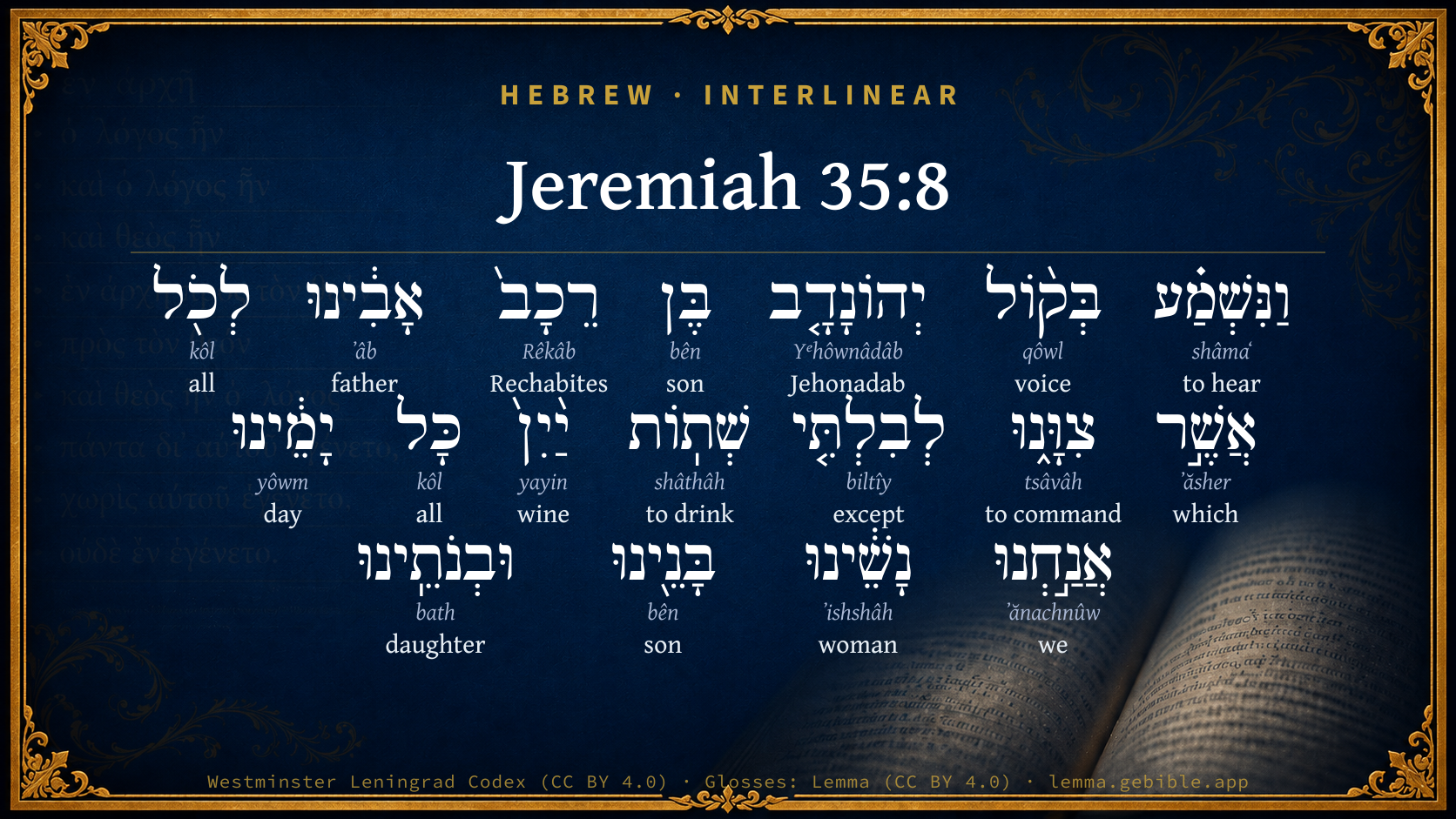
Jeremiah 35:8

Hebrew (Westminster Leningrad Codex) Jeremiah 35:8 appears in the Hebrew Old Testament. The text above is from the Westminster Leningrad Codex. Each word links to its Strong’s number, a concise gloss, and parsing drawn from the Open Scriptures Hebrew Bible morphology. Click any word for its full Brown-Driver-Briggs (BDB) entry.
Download image
Cite this verse

Jeremiah 35:8 (World English Bible). Public Domain. Lemma interlinear Bible study tool, https://lemma.gebible.app/v/jeremiah/35/8.

Show BibTeX & RIS
BibTeX
RIS
English Translation
We have obeyed the voice of Jonadab the son of Rechab, our father, in all that he charged us, to drink no wine all our days, we, our wives, our sons, or our daughters;
World English Bible · Public Domain
Download a study sheet

One document with this verse’s original text, its word-by-word gloss line, the meaning frame, cross-references with their text, attributed commentary, and full source and license credits — printable, and it pastes into notes with its structure intact.

This verse Autodidact and up

Study sheet (.html) Plain text (.txt)

A passage Seminary Student

Up to 50 verses in one chapter. A passage sheet keeps up to 6 commentary sources and 12 cross-references per verse, in the order this page ranks them, and says so on the sheet whenever that leaves anything out. Ask for a single verse and you get the Autodidact verse sheet above.

Everything on this page stays free to read, with no account — the sheet is a download of what is already on screen, not access to it.

Want to remove ads? Support Godless Engineer
Compare translations 3

The same verse in 3 English versions, stacked beneath the original-language interlinear above. Click any original word for its lexicon entry.

Each is an independent rendering of the whole verse — the interlinear is not word-aligned to these translations.

Highlighted words mark where these versions differ — a whole-verse word diff, not a word-by-word alignment.

  • World English Bible Public Domain
    We have obeyed the voice of Jonadab the son of Rechab, our father, in all that he charged us, to drink no wine all our days, we, our wives, our sons, or our daughters;
  • King James Version Public Domain
    Thus have we obeyed the voice of Jonadab the son of Rechab our father in all that he hath charged us, to drink no wine all our days, we, our wives, our sons, nor our daughters;
  • unfoldingWord Literal Text CC BY-SA 4.0
    We have obeyed the voice of Jonadab son of Rekab, our ancestor, in all that he commanded us, to never drink wine all of our days, we, our wives, our sons, and our daughters.

unfoldingWord Literal Text — © unfoldingWord, licensed CC BY-SA 4.0. Word-aligned USFM3 via Door43 (git.door43.org/unfoldingWord/en_ult).

Versions to compare (up to 4)

3 of 4 selected

Show all 18 translations

Every available English version of this verse, each an independent rendering of the whole verse.

  • World English Bible Public Domain
    We have obeyed the voice of Jonadab the son of Rechab, our father, in all that he charged us, to drink no wine all our days, we, our wives, our sons, or our daughters;
  • Berean Standard Bible Public Domain
    And we have obeyed the voice of our forefather Jonadab son of Rechab in all he commanded us. So we have not drunk wine all our lives—neither we nor our wives nor our sons and daughters.
  • Majority Standard Bible Public Domain
    And we have obeyed the voice of our forefather Jonadab son of Rechab in all he commanded us. So we have not drunk wine all our lives—neither we nor our wives nor our sons and daughters.
  • King James Version Public Domain
    Thus have we obeyed the voice of Jonadab the son of Rechab our father in all that he hath charged us, to drink no wine all our days, we, our wives, our sons, nor our daughters;
  • American Standard Version (1901) Public Domain
    And we have obeyed the voice of Jonadab the son of Rechab, our father, in all that he charged us, to drink no wine all our days, we, our wives, our sons, or our daughters;
  • Revised Version (1885) Public Domain
    And we have obeyed the voice of Jonadab the son of Rechab our father in all that he charged us, to drink no wine all our days, we, our wives, our sons, nor our daughters;
  • Geneva Bible (1599) Public Domain
    Thus haue wee obeyed the voyce of Ionadab the sonne of Rechab our father, in all that he hath charged vs, and wee drinke no wine all our dayes, neither wee, our wiues, our sonnes, nor our daughters.
  • Douay-Rheims (1899) Public Domain
    Therefore we have obeyed the voice of Jonadab the son of Rechab, our father, in all things that he commanded us: so as to drink no wine all our days: neither we, nor our wives, nor our sons, nor our daughters:
  • Young's Literal Translation Public Domain
    `And we hearken to the voice of Jonadab son of Rechab, our father, to all that he commanded us, not to drink wine all our days, we, our wives, our sons, and our daughters;
  • Literal Standard Version CC BY-SA 4.0
    And we listen to the voice of Jonadab son of Rechab, our father, to all that he commanded us, not to drink wine all our days, we, our wives, our sons, and our daughters;
  • Unlocked Literal Bible CC BY-SA 4.0
    We have obeyed the voice of Jonadab son of Rekab, our ancestor, in all that he commanded us, to never drink wine all of our days, we, our wives, our sons, and our daughters.
  • unfoldingWord Literal Text CC BY-SA 4.0
    We have obeyed the voice of Jonadab son of Rekab, our ancestor, in all that he commanded us, to never drink wine all of our days, we, our wives, our sons, and our daughters.
  • Darby Bible Public Domain
    And we have hearkened unto the voice of Jonadab the son of Rechab our father in all that he commanded us, to drink no wine all our days, we, our wives, our sons, and our daughters,
  • World Messianic Bible Public Domain
    We have obeyed the voice of Jonadab the son of Rechab, our father, in all that he commanded us, to drink no wine all our days, we, our wives, our sons, or our daughters;
  • Webster's Bible Public Domain
    Thus have we obeyed the voice of Jonadab the son of Rechab our father in all that he hath charged us, to drink no wine all our days, we, our wives, our sons, nor our daughters;
  • Free Bible Version CC BY-SA 4.0
    We have done exactly what our forefather Jonadab son of Rechab told us. None of us have ever drunk wine, and that includes our wives and our sons and daughters as well as us.
  • Bible in Basic English Public Domain
    And we have kept the rules of Jonadab, the son of Rechab our father, in everything which he gave us orders to do, drinking no wine all our days, we and our wives and our sons and our daughters;
  • JPS Tanakh (1917) Public Domain
    And we have hearkened to the voice of Jonadab the son of Rechab our father in all that he charged us, to drink no wine all our days, we, our wives, our sons, nor our daughters;

Literal Standard Version (2020), Covenant Press — licensed CC BY-SA 4.0. Text via the HelloAO Bible API (eBible.org). Unlocked Literal Bible (unfoldingWord) — licensed CC BY-SA 4.0. Text via the HelloAO Bible API (eBible.org). unfoldingWord Literal Text — © unfoldingWord, licensed CC BY-SA 4.0. Word-aligned USFM3 via Door43 (git.door43.org/unfoldingWord/en_ult). Free Bible Version, Dr. Jonathan Gallagher — licensed CC BY-SA 4.0. Text via the HelloAO Bible API (eBible.org).

Word by word

More ways to search: Search by grammar → Find every occurrence → Compare this word →

Practice this passage: Drill this verse → Learn its vocabulary →

יְהוֹנָדָ֤ב
Yᵉhôwnâdâb
H3082
“Jehonadab”
Noun, Proper
Part of Speech
Noun
Type
Proper
Full BDB Definition

Origin: from H3068 and H5068

TWOT: None

Jehonadab = "Jehovah is willing" - a son of Rechab, chief of the Rechabites, in the time of Jehu and Ahab - a nephew of David
  1. וַנִּשְׁמַ֗ע shâmaʻ H8085 “and · to hear” Conjunction + Verb, Qal, Sequential Imperfect, 1st Person, Common, Plural
  2. בְּק֨וֹל qôwl H6963 “in/at · voice of” Preposition + Noun, Common, Masculine, Singular, Construct
  3. בֶּן bên H1121 “son of” Noun, Common, Masculine, Singular, Construct
  4. רֵכָב֙ Rêkâb H7394 “Rechabites” Noun, Proper
  5. אָבִ֔ינוּ ʼâb H1 “father · our” Noun, Common, Masculine, Singular, Construct + Suffix, Personal, 1st Person, Common, Plural
  6. לְכֹ֖ל kôl H3605 “to/for · all” Preposition + Noun, Common, Masculine, Singular, Absolute
  7. אֲשֶׁ֣ר ʼăsher H834 “which” Particle, Relative
  8. צִוָּ֑נוּ tsâvâh H6680 “to command · us” Verb, Piel, Perfect, 3rd Person, Masculine, Singular + Suffix, Personal, 1st Person, Common, Plural
  9. לְבִלְתִּ֤י biltîy H1115 “to/for · except” Preposition + Conjunction
  10. שְׁתֽוֹת shâthâh H8354 “to drink” Verb, Qal, Infinitive Construct
  11. יַ֨יִן֙ yayin H3196 “wine” Noun, Common, Masculine, Singular, Absolute
  12. כָּל kôl H3605 “all of” Noun, Common, Masculine, Singular, Construct
  13. יָמֵ֔ינוּ yôwm H3117 “days · our” Noun, Common, Masculine, Plural, Construct + Suffix, Personal, 1st Person, Common, Plural
  14. אֲנַ֣חְנוּ ʼănachnûw H587 “we” Pronoun, Personal, 1st Person, Common, Plural
  15. נָשֵׁ֔ינוּ ʼishshâh H802 “women · our” Noun, Common, Feminine, Plural, Construct + Suffix, Personal, 1st Person, Common, Plural
  16. בָּנֵ֖ינוּ bên H1121 “sons · our” Noun, Common, Masculine, Plural, Construct + Suffix, Personal, 1st Person, Common, Plural
  17. וּבְנֹתֵֽינוּ bath H1323 “and · daughters · our” Conjunction + Noun, Common, Feminine, Plural, Construct + Suffix, Personal, 1st Person, Common, Plural

About this verse

These counts appear in no published source. They are computed here, from the morphology-tagged text and Lemma’s own curated glosses. What Lemma adds →

18
words
16
distinct lemmas
Prophets
section

Notable vocabulary

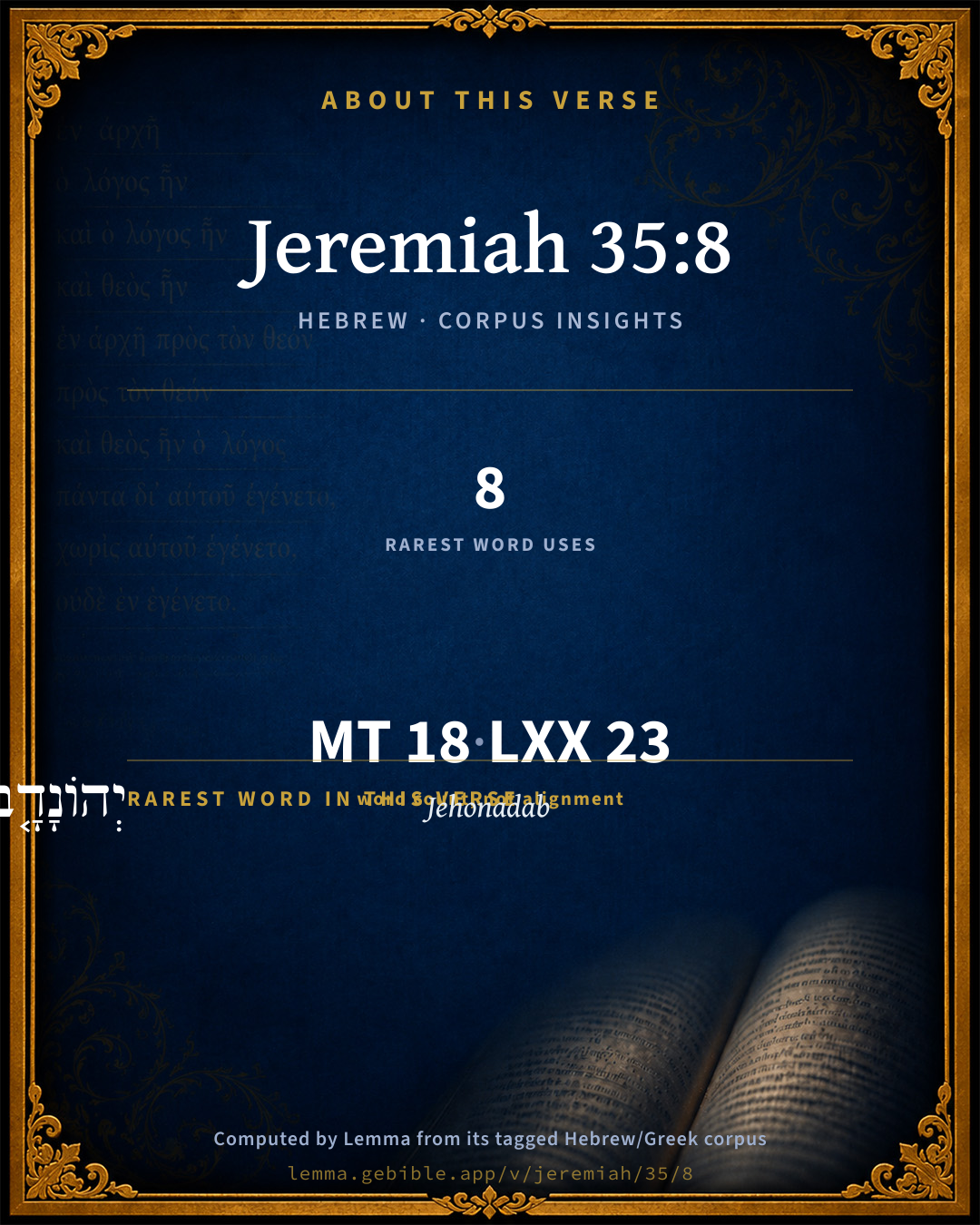
The rarest word here is יְהוֹנָדָ֤ב Jehonadab H3082 — appearing just 8 times in the whole Hebrew Bible.

Shared distinctive vocabulary

יְהוֹנָדָ֤ב Jehonadab H3082 occurs in 7 verses of the Hebrew Bible. Also found in:

Grammatical profile

  • 3 verbs
  • 12 nouns
  • 1 pronoun
  • 1 conjunction
  • 1 particle

Verb forms

  • וַנִּשְׁמַ֗ע Qal · Sequential Imperfect
  • צִוָּ֑נוּ Piel · Perfect
  • שְׁתֽוֹת Qal · Infinitive Construct

Repetition

Words recur within this verse — often emphatic in Hebrew:

  • בֶּן son H1121 ×2
  • לְכֹ֖ל all H3605 ×2

Hebrew & Septuagint length

In the original languages it is 18 Hebrew tokens and 23 Greek tokens — but the two are counted differently (Hebrew bundles its prefixes and suffixes into one token; the Greek is in lemma form), so that isn’t a like-for-like length.

Cross-references

6

Topical passages linked to Jeremiah 35:8 in the Treasury of Scripture Knowledge — connected by theme and wording, ordered by reader-vote popularity; previews shown in the World English Bible.

  • Colossians 3:20 Children, obey your parents in all things, for this pleases the Lord.
  • Proverbs 1:8–9 My son, listen to your father's instruction, And don't forsake your mother's teaching:
  • Proverbs 4:1–2 Listen, sons, to a father's instruction. Pay attention and know understanding;
  • Proverbs 4:10 Listen, my son, and receive my sayings. The years of your life will be many.
  • Proverbs 6:20 My son, keep your father's commandment, And don't forsake your mother's teaching.
  • Proverbs 13:1 A wise son listens to his father's instruction, But a scoffer doesn't listen to rebuke.

Cross-references courtesy of OpenBible.info (CC BY 4.0).

Hebrew and Greek witnesses Masoretic Hebrew ↔ Greek Septuagint

The same verse in the two great witnesses to the Old Testament, shown verse-for-verse.

These are two independent witnesses, not word-aligned to each other, and the Septuagint is shown in lemma (dictionary) form.

Hebrew Jeremiah 35:8 Masoretic · Westminster Leningrad Codex

וַנִּשְׁמַ֗ע בְּק֨וֹל יְהוֹנָדָ֤ב בֶּן רֵכָב֙ אָבִ֔ינוּ לְכֹ֖ל אֲשֶׁ֣ר צִוָּ֑נוּ לְבִלְתִּ֤י שְׁתֽוֹת יַ֨יִן֙ כָּל יָמֵ֔ינוּ אֲנַ֣חְנוּ נָשֵׁ֔ינוּ בָּנֵ֖ינוּ וּבְנֹתֵֽינוּ

We have obeyed the voice of Jonadab the son of Rechab, our father, in all that he charged us, to drink no wine all our days, we, our wives, our sons, or our daughters;

World English Bible · Public Domain

Greek LXX Structure differs

In the Septuagint, Jeremiah is about an eighth shorter than the Hebrew and arranges its material differently — the Oracles Against the Nations (Hebrew chapters 46–51) appear in the middle of the Greek book, after 25:13. Because the chapter and verse boundaries do not line up, a verse-for-verse comparison with the Hebrew is not shown.

A verse-for-verse comparison isn’t shown here because the chapters and verses don’t line up. Switch to the LXX edition with the MT / LXX toggle above to read the Greek directly.

Hebrew: Westminster Leningrad Codex (CC BY 4.0). Greek: Septuagint (public domain); English from a public-domain English Septuagint. How the Septuagint differs from the Hebrew →

Targum (Aramaic paraphrase)

1

The Targum is the ancient Jewish Aramaic paraphrase of the Hebrew Scriptures — an interpretive translation, not the Hebrew text itself. Onkelos (literal) and Pseudo-Jonathan (expansive) render the Torah, and Jonathan the Prophets. Coverage is partial: where no permissively-licensed English translation exists for a verse, only the Aramaic is shown. This is verse-level text, not a word-by-word alignment to the Hebrew.

  1. Targum Jonathan Prophets (Joshua–Malachi)
    וְקַבֵּילְנָא לְמֵימָר יוֹנָדָב בַּר רֵכָב אֲבוּנָא לְכָל דְפַקֵידְנָא בְּדִיל דְלָא לְמִשְׁתֵּי חַמְרָא כָּל יוֹמָנָא אֲנַחְנָא נְשָׁנָא בְּנָנָא וּבְנָתָנָא:

    (no public-domain English translation for this verse)

    Targum Jonathan — Aramaic: “Mikraot Gedolot” (public domain). English: “Sefaria Community Translation” (CC0 1.0 (public-domain dedication)); “London "Chaldee Paraphrase," 1871” (public domain). Text via Sefaria.

Commentary

Notes on Jeremiah 35:8 from classic Christian and Jewish commentators (each source and its license shown beneath its notes). The classic Christian expositions comment on the surrounding passage and are grouped to its opening verse, so a note may address several verses; the Jewish commentaries on the Tanakh (Rashi and others) are per-verse, so they appear only where the commentator wrote on this verse.

Lemma curates 59 commentaries, every one of them public domain or Creative Commons licensed, each selected and text-cleaned for this edition rather than reprinted as found. About our sources →

Trapp's Complete Commentary

John Trapp

Jer 35:8 Thus have we obeyed the voice of Jonadab the son of Rechab our father in all that he hath charged us, to drink no wine all our days, we, our wives, our sons, nor our daughters;

Ver. 8. Thus have we obeyed the voice of Jonadab.] Obedience to parents, in things not unlawful, is very commendable. Aristotle saith, {a} It is not good for a man to dissent from the gods, from his father, and from his teacher. We read of a king of Poland who carried the picture of his father in a plate of gold about his neck, and when he was going about any great business, he would kiss that picture and say, God grant I may observe my father’s charge, and do nothing unworthy of him, &c.

We, our wives, our sons, and our daughters.] As themselves were obedient to their father, so had they their children obedient to them, whereas ill children are punished in their posterity. One complained that never father had so undutiful a child as he had. Yes, said his son, with less grace than truth, my grandfather had. {b}

{a} Mη καλον κρινειν εναντια τοις θεοις, πατρι και διδασκαλω. - Ar. Rhet.

{b} Fuller’s Holy State.

John Trapp, A Commentary or Exposition upon All the Books of the Old and New Testament (1647–1656) — public domain. Text from a community e-Sword module.

Joseph Benson's Commentary

Jer 35:8-11. Thus have we obeyed the voice of Jonadab our father — We have conformed ourselves to his injunctions, and governed our lives by them, during the space of nearly three hundred years. But when Nebuchadrezzar came, &c., we said, Come, let us go to Jerusalem — The Rechabites appear to have retired within the walls of Jerusalem upon the hostile approach of Nebuchadnezzar and his army, in the fourth year of Jehoiakim. Calmet, indeed, supposes it was not till the latter end of Jehoiakim’s reign that the Rechabites were driven into the city for shelter, grounding his opinion upon its being said in this verse, that they entered it for fear of the army of the Chaldeans, and of the army of the Syrians, and comparing this with 2Ki 24:2, where the Lord is said to have sent bands of the Chaldees, and bands of the Syrians, against Judah to destroy it. “But this reasoning,” says Blaney, “will not hold, for, 1st, Nebuchadnezzar might have been, and most probably was, joined by the Syrians in his first expedition against Jerusalem, after the defeat of the Egyptians at Carchemish, which brought on the submission of Syria. And, 2d, Nebuchadnezzar does not appear to have come in person a second time, at least till after Jehoiakim was taken prisoner, and his generals had closely invested Jerusalem.” So we dwell at Jerusalem — Having retired to Jerusalem upon the Chaldean invasion, they were forced to continue there during the siege of the place. In such an extraordinary case, they did not think themselves obliged to a strict observance of the injunction of Jonadab respecting dwelling in tents, because all human laws admit of an equitable construction, and may be superseded in cases of necessity, or when the observance of them is attended with such great inconveniences as the lawgiver himself, if he could have foreseen them, would probably have excepted.

Joseph Benson's Commentary on the Old and New Testaments (1811–1818) — public domain. Text from a community e-Sword module.

Jamieson, Fausset & Brown

Robert Jamieson, A. R. Fausset & David Brown

all that he . . . charged us . . . all our days, we . . . wives . . . sons . . . daughters--unreserved obedience in all particulars, at all times, and on the part of all, without exception: in these respects Israel's obedience to God was wanting. Contrast Sa1 15:20-21; Psa 78:34-37, Psa 78:41, Psa 78:56-57.

Jamieson, Fausset & Brown — Commentary Critical and Explanatory on the Whole Bible (1871) — public domain (CC PDM 1.0). Text via the HelloAO Bible API.

Adam Clarke's Commentary

Verse 8. Thus have we obeyed the voice] We have considered these precepts so very reasonable, so very useful, so conducive to the health of both body and mind, and sanctioned by such a respectable antiquity that we scrupulously and religiously observe them.

Adam Clarke's Commentary on the Bible (1810–1826) — public domain. Text from a community e-Sword/MySword module.

John Calvin's Commentaries

Jeremiah explains at large what might have been expressed in few words, in order to amplify the constancy of the Rechabites. For one may obey his father, and yet be not so fixed in his purpose, but that he might on some slight occasion fail in his duty. Jeremiah here shews that such was the prompt perseverance of the Rechabites, that they could not be enticed by having wine set before them; but that as though no temptation had been presented to them, they kept the commandment of their father, who, at the same time, had been dead, as it has already appeared, some ages before.

They then said, that they hearkened to the voice of Jonabab the son of Rechab, their father; and also added, according to all the things which he has commanded us tle again relates what Jonadab had commanded, and to this belongs the sentence, According to all things, etc. For had he ordered them only to be abstemious, to obey would not have been difficult or hard; he designed to bind them to a wandering life, that they might be covered only by tents, and that they might not possess anything. As then Jonadab did not in one thing only try the obedience of his family, it appears more clearly how great was their promptitude and perseverance in obeying.

They then said, first, that they were not to drink wine; and also added, all their days We indeed know that the Nazarites were forbidden to drink wine, but it was only for a time, until they had performed their vow; we also know, that when the priest was discharging his duty, he was not allowed, for that time, to take wine. But afterwards the priests as well as the Nazarites, resumed their common mode of living. But to taste no wine throughout life was a thing far more difficult. The Prophet, no doubt, detailed these particulars, that he might load the Jews with greater disgrace, who, in a matter the most just, and by no means hard, were not, as we shall see, obedient to God. They said, We, our wives, our sons, our daughters, as though they had said, “This precept has ever been observed in our family; and what has been delivered to us, by our fathers, we have followed to this day, as also our fathers, who obeyed the command of a dead man, because his will had been explained to them.”

John Calvin's Commentaries (1540-1563) — public domain. Text from the Calvin Translation Society English edition (1840s-50s) via the Christian Classics Ethereal Library (ccel.org). Calvin's coverage is partial (roughly two-thirds of the Bible); uncommented books and verses are honest gaps, never fabricated. The 19th-century editor's footnotes and remarks are omitted so the notes are faithfully Calvin's own voice.

John Gill's Exposition

Thus have we obeyed the voice of Jonadab the son of Rechab our father,.... The above was the charge he gave them; and this, in every article of it, they had carefully and constantly kept, though it had been for the space of three hundred years, or thereabout; as follows:

in all he hath charged us, to drink no wine all our days, we, our wives, our sons, nor our daughters; which was the first of the precepts he gave them: and which they were now tempted to disregard, but were resolved to observe it, as they had hitherto done. The rest of the articles follow.

John Gill's Exposition of the Whole Bible (1746–1763) — public domain (CC PDM 1.0). Text via the HelloAO Bible API.

Albert Barnes' Notes on the Bible

Our father - Not merely our ancestor, but the founder of our institutions.

Albert Barnes' Notes on the Bible (1834–1885) — public domain. Text from a community e-Sword/MySword module.

unfoldingWord translationNotes

Door43 World Missions Community

the voice of Jonadab

The word "voice" is a metonym for the command that Jonadab spoke. AT: "the command of Jonadab" (See: Metonymy)

all of our days

"as long as we live." "Days" refers to the span of time.

translationWords

obey

voice

command

seed

possess

Nebuchadnezzar

Babylon

Jerusalem

Chaldea

Aram

unfoldingWord translationNotes — © Distant Shores Media and the Door43 World Missions Community, licensed CC BY-SA 4.0. Source: git.door43.org/Door43/en_tn.

Lesson kit

Teaching starters — assembled from the data on this page, not authored interpretation. Every prompt links to the verse data it draws on. Edit before teaching.

Jeremiah, in the Prophets, opens this verse with 18 words (16 distinct Hebrew lemmas). Its most distinctive word is Yᵉhôwnâdâb (“Jehonadab”). A historical commentator’s framing appears above. Read the whole chapter for the surrounding context.

Discussion questions

  1. How does “Jehonadab” (Yᵉhôwnâdâb) shape what this verse is saying?
  2. How does 2 Samuel 13:5, which shares the word «Jehonadab», read alongside this verse?
  3. What does the repetition of “son” (2× in this one verse) do in this verse?
  4. These translations render this verse differently; the difference is in the English rendering, not the original. What questions does that raise?
  5. «וַנִּשְׁמַ֗ע» is a Qal Sequential Imperfect verb. How does that grammatical form shape the action described?
  6. Compare how Trapp's Complete Commentary and Joseph Benson's Commentary read this verse. Where do they agree or differ?

Things to notice

Reading settings

Reading text

Shown beneath each verse's original-language words.

Old Testament
Old Testament edition

Read the OT as the Masoretic Hebrew (MT) or the Greek Septuagint (LXX).

English shown for the Greek Septuagint (in the Hebrew ↔ Greek comparison).

Comparing translations? Open the Compare panel on any verse page to stack up to four side by side.