Job 1:18

Hebrew (Westminster Leningrad Codex) Job 1:18 appears in the Hebrew Old Testament. The text above is from the Westminster Leningrad Codex. Each word links to its Strong’s number, a concise gloss, and parsing drawn from the Open Scriptures Hebrew Bible morphology. Click any word for its full Brown-Driver-Briggs (BDB) entry.
Download image
Cite this verse

Job 1:18 (World English Bible). Public Domain. Lemma interlinear Bible study tool, https://lemma.gebible.app/v/job/1/18.

Show BibTeX & RIS
BibTeX
RIS
English Translation
While he was still speaking, there came also another, and said, "Your sons and your daughters were eating and drinking wine in their eldest brother's house,
World English Bible · Public Domain
Download a study sheet

One document with this verse’s original text, its word-by-word gloss line, the meaning frame, cross-references with their text, attributed commentary, and full source and license credits — printable, and it pastes into notes with its structure intact.

This verse Autodidact and up

Study sheet (.html) Plain text (.txt)

A passage Seminary Student

Up to 50 verses in one chapter. A passage sheet keeps up to 6 commentary sources and 12 cross-references per verse, in the order this page ranks them, and says so on the sheet whenever that leaves anything out. Ask for a single verse and you get the Autodidact verse sheet above.

Everything on this page stays free to read, with no account — the sheet is a download of what is already on screen, not access to it.

Want to remove ads? Support Godless Engineer
Compare translations 3

The same verse in 3 English versions, stacked beneath the original-language interlinear above. Click any original word for its lexicon entry.

Each is an independent rendering of the whole verse — the interlinear is not word-aligned to these translations.

Highlighted words mark where these versions differ — a whole-verse word diff, not a word-by-word alignment.

  • World English Bible Public Domain
    While he was still speaking, there came also another, and said, "Your sons and your daughters were eating and drinking wine in their eldest brother's house,
  • King James Version Public Domain
    While he was yet speaking, there came also another, and said, Thy sons and thy daughters were eating and drinking wine in their eldest brother's house:
  • unfoldingWord Literal Text CC BY-SA 4.0
    That one still speaking and another came and said, “Your sons and your daughters eating and drinking wine in the house of their eldest brother.

unfoldingWord Literal Text — © unfoldingWord, licensed CC BY-SA 4.0. Word-aligned USFM3 via Door43 (git.door43.org/unfoldingWord/en_ult).

Versions to compare (up to 4)

3 of 4 selected

Show all 18 translations

Every available English version of this verse, each an independent rendering of the whole verse.

  • World English Bible Public Domain
    While he was still speaking, there came also another, and said, "Your sons and your daughters were eating and drinking wine in their eldest brother's house,
  • Berean Standard Bible Public Domain
    While he was still speaking, another messenger came and reported: “Your sons and daughters were eating and drinking wine in their oldest brother’s house,
  • Majority Standard Bible Public Domain
    While he was still speaking, another messenger came and reported: “Your sons and daughters were eating and drinking wine in their oldest brother’s house,
  • King James Version Public Domain
    While he was yet speaking, there came also another, and said, Thy sons and thy daughters were eating and drinking wine in their eldest brother's house:
  • American Standard Version (1901) Public Domain
    While he was yet speaking, there came also another, and said, Thy sons and thy daughters were eating and drinking wine in their eldest brother's house;
  • Revised Version (1885) Public Domain
    While he was yet speaking, there came also another, and said, Thy sons and thy daughters were eating and drinking wine in their eldest brother’s house:
  • Geneva Bible (1599) Public Domain
    And whiles he was yet speaking, came an other, and sayd, Thy sonnes, and thy daughters were eating, and drinking wine in their eldest brothers house,
  • Douay-Rheims (1899) Public Domain
    He was yet speaking, and behold another came in, and said: Thy sons and daughters were eating and drinking wine in the house of their elder brother:
  • Young's Literal Translation Public Domain
    While this `one' is speaking another also hath come and saith, `Thy sons and thy daughters are eating, and drinking wine, in the house of their brother, the first-born.
  • Literal Standard Version CC BY-SA 4.0
    While this [one] is speaking another has also come and says, “Your sons and your daughters are eating, and drinking wine, in the house of their brother, the firstborn.
  • Unlocked Literal Bible CC BY-SA 4.0
    While he was yet speaking, another also came and said, “Your sons and your daughters were eating and drinking wine in their oldest brother's house.
  • unfoldingWord Literal Text CC BY-SA 4.0
    That one still speaking and another came and said, “Your sons and your daughters eating and drinking wine in the house of their eldest brother.
  • Darby Bible Public Domain
    While he was yet speaking, there came another and said, Thy sons and thy daughters were eating and drinking wine in the house of their brother, the firstborn;
  • World Messianic Bible Public Domain
    While he was still speaking, there came also another, and said, “Your sons and your daughters were eating and drinking wine in their oldest brother’s house,
  • Webster's Bible Public Domain
    While he was yet speaking, there came also another, and said, Thy sons and thy daughters were eating and drinking wine in their eldest brother's house:
  • Free Bible Version CC BY-SA 4.0
    While he was still speaking another messenger arrived and said, “Your sons and daughters were eating and drinking wine in the house of their eldest brother
  • Bible in Basic English Public Domain
    And this one was still talking when another came, and said, Your sons and your daughters were feasting together in their oldest brother's house,
  • JPS Tanakh (1917) Public Domain
    While he was yet speaking, there came also another, and said: 'Thy sons and thy daughters were eating and drinking wine in their eldest brother's house;

Literal Standard Version (2020), Covenant Press — licensed CC BY-SA 4.0. Text via the HelloAO Bible API (eBible.org). Unlocked Literal Bible (unfoldingWord) — licensed CC BY-SA 4.0. Text via the HelloAO Bible API (eBible.org). unfoldingWord Literal Text — © unfoldingWord, licensed CC BY-SA 4.0. Word-aligned USFM3 via Door43 (git.door43.org/unfoldingWord/en_ult). Free Bible Version, Dr. Jonathan Gallagher — licensed CC BY-SA 4.0. Text via the HelloAO Bible API (eBible.org).

Word by word

More ways to search: Search by grammar → Find every occurrence → Compare this word →

Practice this passage: Drill this verse → Learn its vocabulary →

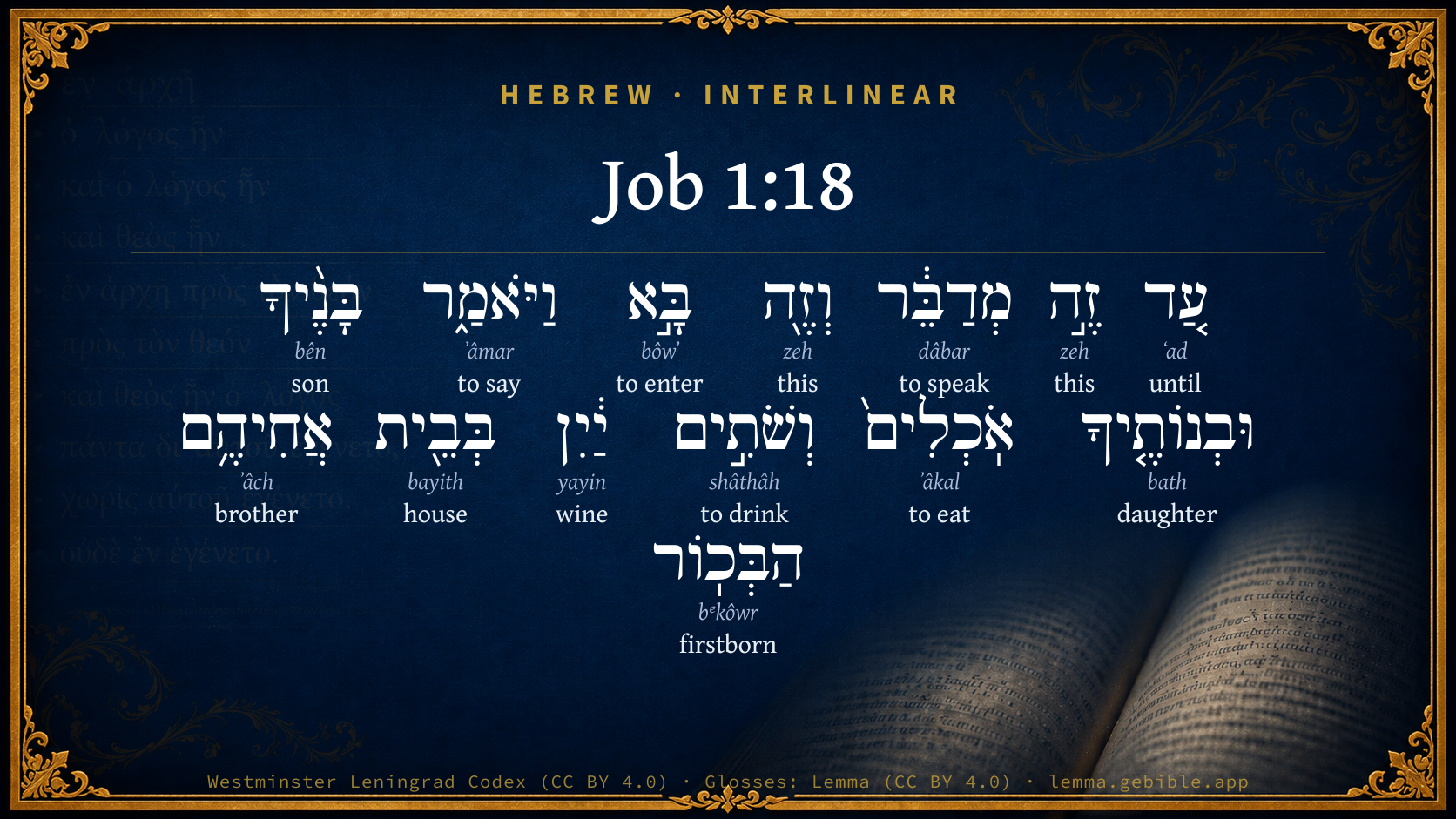
הַבְּכֽוֹר
bᵉkôwr
H1060
“the · firstborn”
Particle, Definite Article + Noun, Common, Masculine, Singular, Absolute
Part of Speech
Particle + Noun
Type
Common
Gender
Masculine
Number
Singular
State
Absolute
Full BDB Definition

Origin: from H1069

TWOT: 244a

firstborn, firstling - of men and women - of animals - noun of relation (figuratively)
  1. עַ֚ד ʻad H5704 “until” Preposition
  2. זֶ֣ה zeh H2088 “this” Pronoun, Demonstrative, Masculine, Singular
  3. מְדַבֵּ֔ר dâbar H1696 “speaking” Verb, Piel, Participle Active, Masculine, Singular, Absolute
  4. וְזֶ֖ה zeh H2088 “and · this” Conjunction + Pronoun, Demonstrative, Masculine, Singular
  5. בָּ֣א bôwʼ H935 “to enter” Verb, Qal, Perfect, 3rd Person, Masculine, Singular
  6. וַיֹּאמַ֑ר ʼâmar H559 “and · to say” Conjunction + Verb, Qal, Sequential Imperfect, 3rd Person, Masculine, Singular
  7. בָּנֶ֨יךָ bên H1121 “sons · your” Noun, Common, Masculine, Plural, Construct + Suffix, Personal, 2nd Person, Masculine, Singular
  8. וּבְנוֹתֶ֤יךָ bath H1323 “and · daughters · your” Conjunction + Noun, Common, Feminine, Plural, Construct + Suffix, Personal, 2nd Person, Masculine, Singular
  9. אֹֽכְלִים֙ ʼâkal H398 “eating” Verb, Qal, Participle Active, Masculine, Plural, Absolute
  10. וְשֹׁתִ֣ים shâthâh H8354 “and · drinking” Conjunction + Verb, Qal, Participle Active, Masculine, Plural, Absolute
  11. יַ֔יִן yayin H3196 “wine” Noun, Common, Masculine, Singular, Absolute
  12. בְּבֵ֖ית bayith H1004 “in/at · house of” Preposition + Noun, Common, Masculine, Singular, Construct
  13. אֲחִיהֶ֥ם ʼâch H251 “brother · their” Noun, Common, Masculine, Singular, Construct + Suffix, Personal, 3rd Person, Masculine, Plural

About this verse

These counts appear in no published source. They are computed here, from the morphology-tagged text and Lemma’s own curated glosses. What Lemma adds →

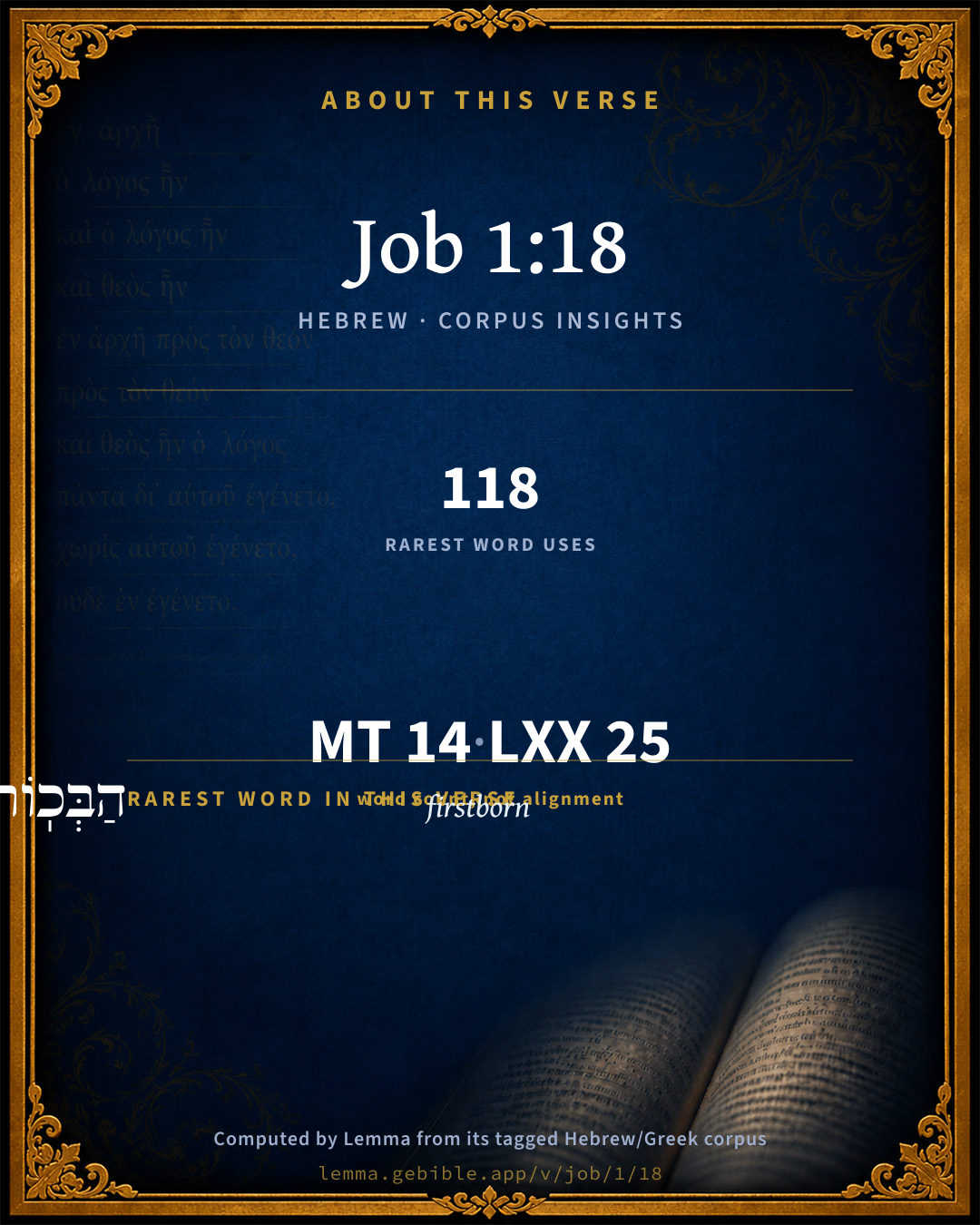
14
words
13
distinct lemmas
Wisdom
section

Grammatical profile

  • 5 verbs
  • 6 nouns
  • 2 pronouns
  • 1 preposition

Verb forms

  • מְדַבֵּ֔ר Piel · Participle Active
  • בָּ֣א Qal · Perfect
  • וַיֹּאמַ֑ר Qal · Sequential Imperfect
  • אֹֽכְלִים֙ Qal · Participle Active
  • וְשֹׁתִ֣ים Qal · Participle Active

Repetition

A word recurs within this verse — often emphatic in Hebrew:

  • זֶ֣ה this H2088 ×2

Hebrew & Septuagint length

In English translation the verse runs 26 words from the Hebrew and 25 from the Septuagint (LXX English) — closely comparable.

A rough comparison of the two English renderings, which tokenize alike — not a word-level alignment.

Word counts can differ between the Hebrew and the Greek without any difference in meaning — e.g. the Hebrew direct-object marker אֵת has no separate Greek word, and Greek often adds the article ὁ.

In the original languages it is 14 Hebrew tokens and 25 Greek tokens — but the two are counted differently (Hebrew bundles its prefixes and suffixes into one token; the Greek is in lemma form), so that isn’t a like-for-like length.

Cross-references

15

Topical passages linked to Job 1:18 in the Treasury of Scripture Knowledge — connected by theme and wording, ordered by reader-vote popularity; previews shown in the World English Bible.

  • Job 1:4 His sons went and held a feast in the house of each one on his birthday; and they sent and called for their three sisters to eat and to drink with them.
  • Job 1:13 It fell on a day when his sons and his daughters were eating and drinking wine in their eldest brother's house,
  • 2 Samuel 13:28 Absalom commanded his servants, saying, Mark you now, when Amnon's heart is merry with wine; and when I tell you, Smite Amnon, then kill him; don't be afraid; haven't I commanded you? be courageous, and be valiant.
  • Job 6:2–3 "Oh that my anguish were weighed, And all my calamity laid in the balances!
  • Job 8:4 If your children have sinned against him, He has delivered them into the hand of their disobedience;
  • Job 16:14 He breaks me with breach on breach. He runs on me like a giant.
  • Job 19:9–10 He has stripped me of my glory, And taken the crown from my head.
  • Job 23:2 "Even today is my complaint rebellious. His hand is heavy in spite of my groaning.
  • Job 27:14 If his children are multiplied, it is for the sword. His offspring shall not be satisfied with bread.
  • Psalms 34:19 Many are the afflictions of the righteous, But Yahweh delivers him out of them all.
  • Ecclesiastes 9:2 All things come alike to all. There is one event to the righteous and to the wicked; to the good, to the clean, to the unclean, to him who sacrifices, and to him who doesn't sacrifice. As is the good, so is the sinner; he who takes an oath, as he who fears an oath.
  • Isaiah 28:19 As often as it passes though, it shall take you; for morning by morning shall it pass through, by day and by night: and it shall be nothing but terror to understand the message.
  • Jeremiah 51:31 One post shall run to meet another, and one messenger to met another, to show the king of Babylon that his city is taken on every quarter:
  • Lamentations 1:12 Is it nothing to you, all you who pass by? Look, and see if there be any sorrow like my sorrow, which is brought on me, With which Yahweh has afflicted [me] in the day of his fierce anger.
  • Amos 4:6–11 "I also have given you cleanness of teeth in all your cities, And lack of bread in every town; Yet you haven't returned to me," says Yahweh.

Cross-references courtesy of OpenBible.info (CC BY 4.0).

Hebrew and Greek witnesses Masoretic Hebrew ↔ Greek Septuagint

The same verse in the two great witnesses to the Old Testament, shown verse-for-verse.

These are two independent witnesses, not word-aligned to each other, and the Septuagint is shown in lemma (dictionary) form.

Hebrew Job 1:18 Masoretic · Westminster Leningrad Codex

עַ֚ד זֶ֣ה מְדַבֵּ֔ר וְזֶ֖ה בָּ֣א וַיֹּאמַ֑ר בָּנֶ֨יךָ וּבְנוֹתֶ֤יךָ אֹֽכְלִים֙ וְשֹׁתִ֣ים יַ֔יִן בְּבֵ֖ית אֲחִיהֶ֥ם הַבְּכֽוֹר

While he was still speaking, there came also another, and said, "Your sons and your daughters were eating and drinking wine in their eldest brother's house,

World English Bible · Public Domain

Greek LXX Job 1:18 Septuagint · lemma form

ἔτι οὗτος λαλέω ἄλλος ἄγγελος ἔρχομαι λέγω ὁ ιωβ ὁ υἱός σύ καί ὁ θυγάτηρ σύ ἐσθίω καί πίνω παρά ὁ ἀδελφός αὐτός ὁ πρεσβύτερος

While he is yet speaking, another messenger comes, saying to Job, While your sons and your daughters were eating and drinking with their elder brother,

LXX2012 (modern English Septuagint) · Public Domain

Hebrew: Westminster Leningrad Codex (CC BY 4.0). Greek: Septuagint (public domain); English from LXX2012 (modern English Septuagint) (Public Domain). How the Septuagint differs from the Hebrew →

Commentary

Notes on Job 1:18 from classic Christian and Jewish commentators (each source and its license shown beneath its notes). The classic Christian expositions comment on the surrounding passage and are grouped to its opening verse, so a note may address several verses; the Jewish commentaries on the Tanakh (Rashi and others) are per-verse, so they appear only where the commentator wrote on this verse.

Lemma curates 59 commentaries, every one of them public domain or Creative Commons licensed, each selected and text-cleaned for this edition rather than reprinted as found. About our sources →

Trapp's Complete Commentary

John Trapp

Job 1:18 While he [was] yet speaking, there came also another, and said, Thy sons and thy daughters [were] eating and drinking wine in their eldest brother’s house:

Ver. 18. While he was yet speaking] See Job 1:16.

Thy sons and thy daughters were eating and drinking wine] This was the last, but not the least, of Satan’s assaults, reserved purposely to the last, to crush him quite, when he was now spent and spiritless, as he hoped. Let us look for like dealing, for a tough bout, at death howsoever; and be always ready prepared for another and a worse encounter. It is said of Caesar, that he sometimes put up, but seldom or never put off, his sword (Seneca). It is said of Queen Elizabeth, that, in the greatest calm, she provided for a storm. It is said of the bird onocrotalus, that she is so well practised to expect the hawk to grapple with her, that even when she shutteth her eyes she sleepeth with her beak exalted, as if she would contend with her adversary. Should not we stand constantly upon our guard, who have so restless and pitiless an enemy?

Thy sons and thy daughters, &c.] Men may die, then, with the meat in their mouths, and in the midst of their mirth and jollity; as did Amnon, Elah, Belshazzar. Whether, therefore, we eat or drink, &c., do all to the glory of God, 1Co 10:31. Let there be "holiness to the Lord" written upon our pots, Zec 14:21. Let us eat, and drink, and sleep eternal life, as a reverend Scotch divine was said to do. Job’s good heart ached and quaked, likely, at the hearing of this sad news, of so sudden a death of his children, amidst their merriments; for he used to say, when there was no such danger, It may be my sons have sinned, and cursed God in their hearts. Methinks I hear him saying, or rather sighing, out those sorrowful words of Cratisilea, in Plutarch, when she saw her dear children slain before her, Quo pueri estis profecti? Poor souls, what is become of you? {See Trapp on "Job 1:13"}

John Trapp, A Commentary or Exposition upon All the Books of the Old and New Testament (1647–1656) — public domain. Text from a community e-Sword module.

Joseph Benson's Commentary

Job 1:18. While he was yet speaking there came also another — Bringing tidings the most distressing of all. One messenger immediately followed another in this manner, through the contrivance of Satan, by God’s permission, that there might seem to be more than ordinary displeasure of God against Job in his troubles, and that he might not have leisure to recollect himself, but be overwhelmed by a complication of calamities Thus the children of God are often in heaviness, λυπηθεντες, distressed, burdened with grief, through manifold trials; deep calls to deep; waves and billows, one after another, go over them. Let one affliction, therefore, quicken and excite us to prepare for another; for, how deep soever we may have drunk of the bitter cup, as long as we are in the world, we cannot be sure that we have drunk our share. Thy sons and thy daughters were eating and drinking, &c. — That is, feasting after their manner, and, as Job had generally feared and suspected, perhaps sinning against God, Job 1:5.

Joseph Benson's Commentary on the Old and New Testaments (1811–1818) — public domain. Text from a community e-Sword module.

Geneva Bible (1599)

Geneva Bible translators

This last plague declareth, that when one plague is past which seemeth hard to be borne, God can send us another far more grievous, to try his, and teach them obedience.

Geneva Bible (1599) marginal notes — public domain. Text via Bolls.life.

Ellicott's Commentary for English Readers

(18) Thy sons and thy daughters.—See Job_1:13. The marvellous accumulation of disasters points us to the conclusion that it was the distinct work of Satan, according to the permission given him (Job_1:12), and consequently supernatural.

A Bible Commentary for English Readers, edited by Charles John Ellicott (1878–1897) — public domain. Text from a community e-Sword module.

The Cambridge Bible for Schools and Colleges

gen. ed. J. J. S. Perowne

18, 19. The fourth stroke, the death of Job’s children. The wind struck the four corners of the house, being a whirlwind. It came from the side or region of the desert.

The Cambridge Bible for Schools and Colleges (gen. ed. J. J. S. Perowne; Cambridge University Press, 1878–1918) — public domain. Text from a community e-Sword module.

John Gill's Exposition

While he was yet speaking, there came another,.... A servant of one of Job's sons, who was in waiting at the feast before mentioned, and here again repeated:

and said, thy sons and thy daughters were eating, and drinking wine in their eldest brother's house; See Gill on Job 1:13.

John Gill's Exposition of the Whole Bible (1746–1763) — public domain (CC PDM 1.0). Text via the HelloAO Bible API.

Albert Barnes' Notes on the Bible

Eating and drinking wine - ; the notes at Job 1:4, Job 1:13.

Albert Barnes' Notes on the Bible (1834–1885) — public domain. Text from a community e-Sword/MySword module.

Matthew Poole's English Annotations

i.e. Feasting after their manner, and, as Job generally feared and suspected, sinning against God, Job 1:5, which was a dreadful aggravation of the judgment.

Matthew Poole's English Annotations on the Holy Bible (1683–1685) — public domain. Text from a community e-Sword/MySword module.

Whedon's Commentary on the Bible

Daniel D. Whedon

18. Drinking wine — The mention of wine-drinking in so painful an association, suggests that in the mind of the messenger there may have been the thought, how ill-prepared these young people were for death’s surprise.

Daniel D. Whedon (gen. ed.), Commentary on the Old and New Testaments (1874–1909) — public domain. Text from a community e-Sword module.

The Pulpit Commentary

While he was yet speaking, there came also another, and said (see the comment on ver. 16), Thy sons and thy daughters were eating and drinking wine in their eldest brother"s house (comp. ver. 13). It is a common proverb that "misfortunes never come singly." Shakespeare says they "come not single foes, but in battalions." Still, so overwhelming a series of calamities falling upon a single individual all in one day could not but strike those who heard of them as abnormal, and almost certainly supernatural. So Job"s friends concluded. (Job_5:17)

The Pulpit Commentary (1880–1919), ed. H.D.M. Spence-Jones & Joseph S. Exell — public domain. Text from a community e-Sword module.

Keil & Delitzsch

C. F. Keil & F. Delitzsch

The Fourth Messenger:

18 While he was yet speaking, another also came, and said, Thy sons and thy daughters were eating and drinking wine in their eldest brother's house: and, behold, a great wind came across from the desert, and smote the four corners of the house, and it fell upon the young people, and they are dead; and I only am escaped alone to tell thee.

Instead of עוד, we have עד here: the former denotes continuity in time, the latter continuity in space, and they may be interchanged. עד in the signif. "while" is here construed with the participle, as Neh 7:3; comp. other constructions, Job 8:21; Sa1 14:19; Jon 4:2. "From the other side of the desert" is equivalent to, from its farthest end. הנּערים are the youthful sons and daughters of Job, according to the epicene use of נער in the Pentateuch (youths and maidens). In one day Job is now bereft of everything which he accounted the gift of Jehovah, - his herds, and with these his servants, which he not only prizes as property, but for whom he has also a tender heart (Job 31); last of all, even his dearest ones, his children. Satan has summoned the elements and men for the destruction of Job's possessions by repeated strokes. That men and nations can be excited by Satan to hostile enterprises, is nothing surprising (cf. Rev 20:8); but here, even the fire of God and the hurricane are attributed to him. Is this poetry or truth? Luther, in the Larger Catechism, question 4, says the same: "The devil causes strife, murder, rebellion, and war, also thunder and lightning, and hail, to destroy corn and cattle, to poison the atmosphere," etc., - a passage of our creed often ridiculed by rationalism; but it is correct if understood in accordance with Scripture, and not superstitiously. As among men, so in nature, since the Fall two different powers of divine anger and divine love are in operation: the mingling of these is the essence of the present Kosmos. Everything destructive to nature, and everything arising therefrom which is dangerous and fatal to the life of man, is the outward manifestation of the power of anger. In this power Satan has fortified himself; and this, which underlies the whole course of nature, he is able to make use of, so far as God may permit it as being subservient to His chief design (comp. Rev 13:13 with Th2 2:9). He has no creative power. Fire and storm, by means of which he works, are of God; but he is allowed to excite these forces to hostility against man, just as he himself is become an instrument of evil. It is similar with human demonocracy, whose very being consists in placing itself en rapport with the hidden powers of nature. Satan is the great juggler, and has already manifested himself as such, even in paradise and in the temptation of Jesus Christ. There is in nature, as among men, an entanglement of contrary forces which he knows how to unloose, because it is the sphere of his special dominion; for the whole course of nature, in the change of its phenomena, is subject not only to abstract laws, but also to concrete supernatural powers, both bad and good.

Keil & Delitzsch — Biblical Commentary on the Old Testament (1861–1891) — public domain (CC PDM 1.0). Text via the HelloAO Bible API. (Old Testament only.)

unfoldingWord translationNotes

Door43 World Missions Community

Your sons and your daughters were eating and drinking wine in their oldest brother's house

See how you translated this in Job 01:13.

A strong wind

"A tornado" or "A desert storm"

the four corners of the house

"the structural supports of the house"

It fell on the young people

"The house fell on your sons and daughters"

I alone have escaped to tell you

See how you translated this in Job 01:15.

translationWords

son

wine

brother

desert

die

unfoldingWord translationNotes — © Distant Shores Media and the Door43 World Missions Community, licensed CC BY-SA 4.0. Source: git.door43.org/Door43/en_tn.

Lesson kit

Teaching starters — assembled from the data on this page, not authored interpretation. Every prompt links to the verse data it draws on. Edit before teaching.

Job, in the Wisdom, opens this verse with 14 words (13 distinct Hebrew lemmas). Its most distinctive word is bᵉkôwr (“firstborn”). A historical commentator’s framing appears above. Read the whole chapter for the surrounding context.

Discussion questions

  1. What does “firstborn” (bᵉkôwr) contribute to the verse as a whole?
  2. How does Job 1:4, which shares this passage’s theme, read alongside this verse?
  3. What does the repetition of “this” (2× in this one verse) do in this verse?
  4. The translations on this page render this verse differently — a whole-verse word diff, not a word-by-word alignment. What might account for the different wordings?
  5. «מְדַבֵּ֔ר» is a Piel Participle Active verb. How does that grammatical form shape the action described?
  6. Compare how Trapp's Complete Commentary and Joseph Benson's Commentary read this verse. Where do they agree or differ?

Things to notice

Reading settings

Reading text

Shown beneath each verse's original-language words.

Old Testament
Old Testament edition

Read the OT as the Masoretic Hebrew (MT) or the Greek Septuagint (LXX).

English shown for the Greek Septuagint (in the Hebrew ↔ Greek comparison).

Comparing translations? Open the Compare panel on any verse page to stack up to four side by side.