
Judges 7:6

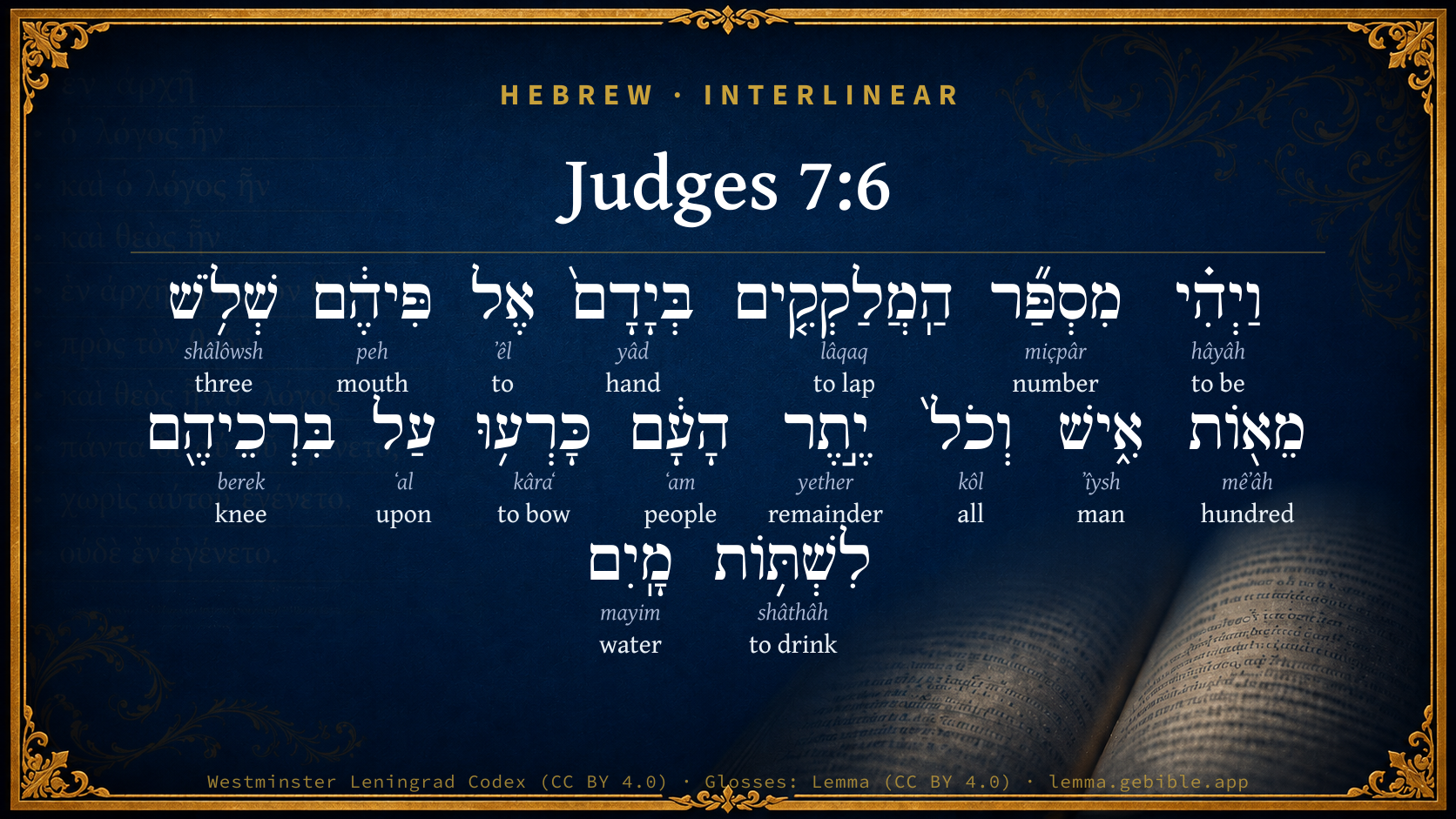
Hebrew (Westminster Leningrad Codex) Judges 7:6 appears in the Hebrew Old Testament. The text above is from the Westminster Leningrad Codex. Each word links to its Strong’s number, a concise gloss, and parsing drawn from the Open Scriptures Hebrew Bible morphology. Click any word for its full Brown-Driver-Briggs (BDB) entry.
Download image
Cite this verse

Judges 7:6 (World English Bible). Public Domain. Lemma interlinear Bible study tool, https://lemma.gebible.app/v/judges/7/6.

Show BibTeX & RIS
BibTeX
RIS
English Translation
The number of those who lapped, putting their hand to their mouth, was three hundred men: but all the rest of the people bowed down on their knees to drink water.
World English Bible · Public Domain
Download a study sheet

One document with this verse’s original text, its word-by-word gloss line, the meaning frame, cross-references with their text, attributed commentary, and full source and license credits — printable, and it pastes into notes with its structure intact.

This verse Autodidact and up

Study sheet (.html) Plain text (.txt)

A passage Seminary Student

Up to 50 verses in one chapter. A passage sheet keeps up to 6 commentary sources and 12 cross-references per verse, in the order this page ranks them, and says so on the sheet whenever that leaves anything out. Ask for a single verse and you get the Autodidact verse sheet above.

Everything on this page stays free to read, with no account — the sheet is a download of what is already on screen, not access to it.

Want to remove ads? Support Godless Engineer
Compare translations 3

The same verse in 3 English versions, stacked beneath the original-language interlinear above. Click any original word for its lexicon entry.

Each is an independent rendering of the whole verse — the interlinear is not word-aligned to these translations.

Highlighted words mark where these versions differ — a whole-verse word diff, not a word-by-word alignment.

  • World English Bible Public Domain
    The number of those who lapped, putting their hand to their mouth, was three hundred men: but all the rest of the people bowed down on their knees to drink water.
  • King James Version Public Domain
    And the number of them that lapped, putting their hand to their mouth, were three hundred men: but all the rest of the people bowed down upon their knees to drink water.
  • unfoldingWord Literal Text CC BY-SA 4.0
    And the number of the ones lapping with their hand to their mouth was 300 men, and all of the rest of the people knelt upon their knees to drink the water.

unfoldingWord Literal Text — © unfoldingWord, licensed CC BY-SA 4.0. Word-aligned USFM3 via Door43 (git.door43.org/unfoldingWord/en_ult).

Versions to compare (up to 4)

3 of 4 selected

Show all 18 translations

Every available English version of this verse, each an independent rendering of the whole verse.

  • World English Bible Public Domain
    The number of those who lapped, putting their hand to their mouth, was three hundred men: but all the rest of the people bowed down on their knees to drink water.
  • Berean Standard Bible Public Domain
    And the number of those who lapped the water with their hands to their mouths was three hundred men; all the others knelt to drink.
  • Majority Standard Bible Public Domain
    And the number of those who lapped the water with their hands to their mouths was three hundred men; all the others knelt to drink.
  • King James Version Public Domain
    And the number of them that lapped, putting their hand to their mouth, were three hundred men: but all the rest of the people bowed down upon their knees to drink water.
  • American Standard Version (1901) Public Domain
    And the number of them that lapped, putting their hand to their mouth, was three hundred men: but all the rest of the people bowed down upon their knees to drink water.
  • Revised Version (1885) Public Domain
    And the number of them that lapped, putting their hand to their mouth, was three hundred men: but all the rest of the people bowed down upon their knees to drink water.
  • Geneva Bible (1599) Public Domain
    And the nomber of them that lapped by putting their handes to their mouthes, were three hundreth men: but all the remnant of the people kneeled downe vpon their knees to drinke water.
  • Douay-Rheims (1899) Public Domain
    And the number of them that had lapped water, casting it with the hand to their mouth, was three hundred men: and all the rest of the multitude had drunk kneeling.
  • Young's Literal Translation Public Domain
    And the number of those lapping with their hand unto their mouth is three hundred men, and all the rest of the people have bowed down on their knees to drink water.
  • Literal Standard Version CC BY-SA 4.0
    And the number of those lapping with their hand to their mouth is three hundred men, and all the rest of the people have bowed down on their knees to drink water.
  • Unlocked Literal Bible CC BY-SA 4.0
    Three hundred men lapped. The rest of the men kneeled down to drink water.
  • unfoldingWord Literal Text CC BY-SA 4.0
    And the number of the ones lapping with their hand to their mouth was 300 men, and all of the rest of the people knelt upon their knees to drink the water.
  • Darby Bible Public Domain
    And the number of those that lapped, putting their hands to their mouths, was three hundred men; but all the rest of the people knelt down to drink water.
  • World Messianic Bible Public Domain
    The number of those who lapped, putting their hand to their mouth, was three hundred men; but all the rest of the people bowed down on their knees to drink water.
  • Webster's Bible Public Domain
    And the number of them that lapped, putting their hand to their mouth, were three hundred men: but all the rest of the people bowed down upon their knees to drink water.
  • Free Bible Version CC BY-SA 4.0
    Three hundred lapped water from their hands to their mouths. All the rest knelt down to drink the water.
  • Bible in Basic English Public Domain
    Now the number of those who took up the water with their tongues was three hundred; all the rest of the people went down on their knees to the water.
  • JPS Tanakh (1917) Public Domain
    And the number of them that lapped, putting their hand to their mouth, was three hundred men; but all the rest of the people bowed down upon their knees to drink water.

Literal Standard Version (2020), Covenant Press — licensed CC BY-SA 4.0. Text via the HelloAO Bible API (eBible.org). Unlocked Literal Bible (unfoldingWord) — licensed CC BY-SA 4.0. Text via the HelloAO Bible API (eBible.org). unfoldingWord Literal Text — © unfoldingWord, licensed CC BY-SA 4.0. Word-aligned USFM3 via Door43 (git.door43.org/unfoldingWord/en_ult). Free Bible Version, Dr. Jonathan Gallagher — licensed CC BY-SA 4.0. Text via the HelloAO Bible API (eBible.org).

Word by word

More ways to search: Search by grammar → Find every occurrence → Compare this word →

Practice this passage: Drill this verse → Learn its vocabulary →

הַֽמֲלַקְקִ֤ים
lâqaq
H3952
“the · lapping”
Particle, Definite Article + Verb, Piel, Participle Active, Masculine, Plural, Absolute
Part of Speech
Particle + Verb
Stem
Piel
Form
Participle Active
Gender
Masculine
Number
Plural
State
Absolute
Full BDB Definition

Origin: a primitive root

TWOT: 1126

to lap, lick, lap up - (Qal) to lap, lap up - (Piel) to lap up
  1. וַיְהִ֗י hâyâh H1961 “and · to be” Conjunction + Verb, Qal, Sequential Imperfect, 3rd Person, Masculine, Singular
  2. מִסְפַּ֞ר miçpâr H4557 “number of” Noun, Common, Masculine, Singular, Construct
  3. בְּיָדָם֙ yâd H3027 “in/at · hand · their” Preposition + Noun, Common, Both, Singular, Construct + Suffix, Personal, 3rd Person, Masculine, Plural
  4. אֶל ʼêl H413 “to” Preposition
  5. פִּיהֶ֔ם peh H6310 “mouth · their” Noun, Common, Masculine, Singular, Construct + Suffix, Personal, 3rd Person, Masculine, Plural
  6. שְׁלֹ֥שׁ shâlôwsh H7969 “three” Adjective, Cardinal number, Feminine, Singular, Absolute
  7. מֵא֖וֹת mêʼâh H3967 “hundred” Adjective, Cardinal number, Both, Plural, Absolute
  8. אִ֑ישׁ ʼîysh H376 “man” Noun, Common, Masculine, Singular, Absolute
  9. וְכֹל֙ kôl H3605 “and · all of” Conjunction + Noun, Common, Masculine, Singular, Construct
  10. יֶ֣תֶר yether H3499 “remainder of” Noun, Common, Masculine, Singular, Construct
  11. הָעָ֔ם ʻam H5971 “the · people” Particle, Definite Article + Noun, Common, Masculine, Singular, Absolute
  12. כָּרְע֥וּ kâraʻ H3766 “to bow” Verb, Qal, Perfect, 3rd Person, Common, Plural
  13. עַל ʻal H5921 “upon” Preposition
  14. בִּרְכֵיהֶ֖ם berek H1290 “knees · their” Noun, Common, Feminine, Dual, Construct + Suffix, Personal, 3rd Person, Masculine, Plural
  15. לִשְׁתּ֥וֹת shâthâh H8354 “to drink” Preposition + Verb, Qal, Infinitive Construct
  16. מָֽיִם mayim H4325 “water(s)” Noun, Common, Masculine, Plural, Absolute

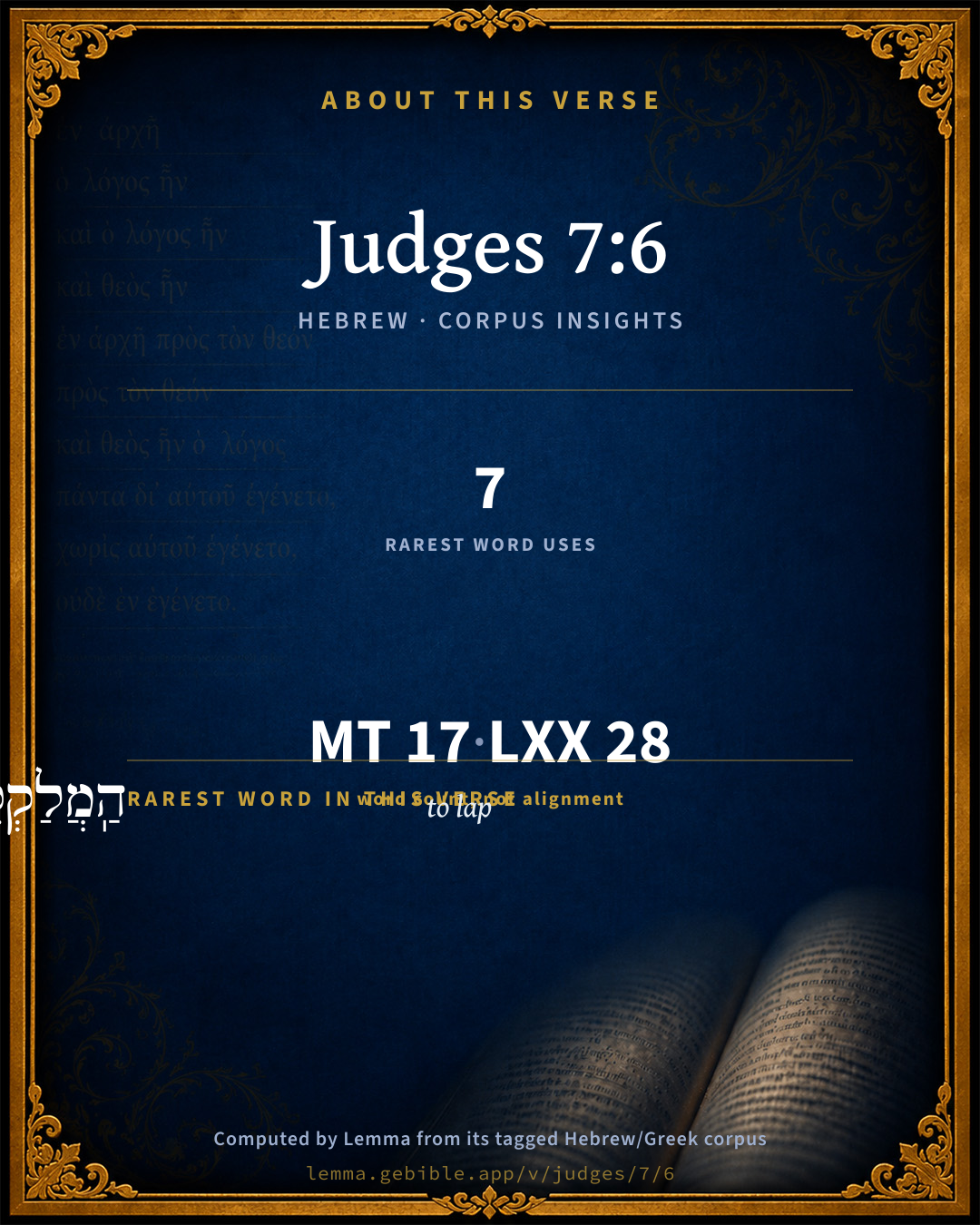
About this verse

These counts appear in no published source. They are computed here, from the morphology-tagged text and Lemma’s own curated glosses. What Lemma adds →

17
words
17
distinct lemmas
Historical
section

Notable vocabulary

The rarest word here is הַֽמֲלַקְקִ֤ים to lap H3952 — appearing just 7 times in the whole Hebrew Bible.

Shared distinctive vocabulary

הַֽמֲלַקְקִ֤ים to lap H3952 occurs in 5 verses of the Hebrew Bible. Also found in:

Grammatical profile

  • 4 verbs
  • 9 nouns
  • 2 adjectives
  • 2 prepositions

Verb forms

  • וַיְהִ֗י Qal · Sequential Imperfect
  • הַֽמֲלַקְקִ֤ים Piel · Participle Active
  • כָּרְע֥וּ Qal · Perfect
  • לִשְׁתּ֥וֹת Qal · Infinitive Construct

Hebrew & Septuagint length

In English translation the verse runs 31 words from the Hebrew and 31 from the Septuagint (LXX English) — the same length.

A rough comparison of the two English renderings, which tokenize alike — not a word-level alignment.

Word counts can differ between the Hebrew and the Greek without any difference in meaning — e.g. the Hebrew direct-object marker אֵת has no separate Greek word, and Greek often adds the article ὁ.

In the original languages it is 17 Hebrew tokens and 28 Greek tokens — but the two are counted differently (Hebrew bundles its prefixes and suffixes into one token; the Greek is in lemma form), so that isn’t a like-for-like length.

Hebrew and Greek witnesses Masoretic Hebrew ↔ Greek Septuagint

The same verse in the two great witnesses to the Old Testament, shown verse-for-verse.

These are two independent witnesses, not word-aligned to each other, and the Septuagint is shown in lemma (dictionary) form.

Hebrew Judges 7:6 Masoretic · Westminster Leningrad Codex

וַיְהִ֗י מִסְפַּ֞ר הַֽמֲלַקְקִ֤ים בְּיָדָם֙ אֶל פִּיהֶ֔ם שְׁלֹ֥שׁ מֵא֖וֹת אִ֑ישׁ וְכֹל֙ יֶ֣תֶר הָעָ֔ם כָּרְע֥וּ עַל בִּרְכֵיהֶ֖ם לִשְׁתּ֥וֹת מָֽיִם

The number of those who lapped, putting their hand to their mouth, was three hundred men: but all the rest of the people bowed down on their knees to drink water.

World English Bible · Public Domain

Greek LXX Judges 7:6 Septuagint · lemma form

καί γίγνομαι ὁ ἀριθμός ὁ λάπτω ἐν χείρ αὐτός πρός ὁ στόμα αὐτός τριακόσιοι ἀνήρ καί πᾶς ὁ κατάλοιπος ὁ λαός κλίνω ἐπί ὁ γόνυ αὐτός πίνω ὕδωρ

And the number of those that lapped with their hand to their mouth was three hundred men; and all the rest of the people bowed upon their knees to drink water.

LXX2012 (modern English Septuagint) · Public Domain

On this verse, The Cambridge Bible for Schools and Colleges discusses the Septuagint’s reading. Read the note in Commentary ↓

Hebrew: Westminster Leningrad Codex (CC BY 4.0). Greek: Septuagint (public domain); English from LXX2012 (modern English Septuagint) (Public Domain). How the Septuagint differs from the Hebrew →

Targum (Aramaic paraphrase)

1

The Targum is the ancient Jewish Aramaic paraphrase of the Hebrew Scriptures — an interpretive translation, not the Hebrew text itself. Onkelos (literal) and Pseudo-Jonathan (expansive) render the Torah, and Jonathan the Prophets. Coverage is partial: where no permissively-licensed English translation exists for a verse, only the Aramaic is shown. This is verse-level text, not a word-by-word alignment to the Hebrew.

  1. Targum Jonathan Prophets (Joshua–Malachi)
    וַהֲוָה מִנְיַן דְשָׁדָן בִּידֵיהוֹן לְפוּמְהוֹן תְּלַת מְאָה גַבְרָא וְכָל שְׁאָר עַמָא כְּרָעוּ עַל בִּרְכֵּיהוֹן לְמִשְׁתֵּי מַיָא:

    (no public-domain English translation for this verse)

    Targum Jonathan — Aramaic: “Mikraot Gedolot” (public domain). English: “Sefaria Community Translation” (CC0 1.0 (public-domain dedication)); “London "Chaldee Paraphrase," 1871” (public domain). Text via Sefaria.

Commentary

Notes on Judges 7:6 from classic Christian and Jewish commentators (each source and its license shown beneath its notes). The classic Christian expositions comment on the surrounding passage and are grouped to its opening verse, so a note may address several verses; the Jewish commentaries on the Tanakh (Rashi and others) are per-verse, so they appear only where the commentator wrote on this verse.

Lemma curates 59 commentaries, every one of them public domain or Creative Commons licensed, each selected and text-cleaned for this edition rather than reprinted as found. About our sources →

Trapp's Complete Commentary

John Trapp

Jdg 7:6 And the number of them that lapped, [putting] their hand to their mouth, were three hundred men: but all the rest of the people bowed down upon their knees to drink water.

Ver. 6. Were three hundred men.] Methe mispar, a poor few. Many are called, but few are chosen.

“ Rari quippe boni, numero vix sunt totidem quot

Thebarum portae, vel divitis ostia Nili. ” - Juvenal. {a}

{a} Sat. 13.

John Trapp, A Commentary or Exposition upon All the Books of the Old and New Testament (1647–1656) — public domain. Text from a community e-Sword module.

Joseph Benson's Commentary

Jdg 7:6. That lapped — Taking up a little water in the palm of their hands. It is probable that Gideon, upon this occasion, commanded his whole army to leave their baggage behind them, and among that the vessels and cups they used to drink out of; and, when he had brought them to the river-side, told them to drink of it, as they were going upon an expedition which would not admit of the carrying water with them, and in which they would not soon meet with any. Something of this kind we may reasonably imagine, to account for the whole army’s drinking at the same time, and not one of them using any kind of cup. The whole army, except three hundred men, upon the command being given, seem to have flung themselves down on the river’s bank, as it were, to indulge themselves, which is probably meant by bowing down their knees to drink. But the three hundred men, probably more intent on the expedition, contented themselves with taking up some water in the palm or hollow of their hands, and so quenching their thirst, without laying aside their arms, or putting themselves off their guard.

Joseph Benson's Commentary on the Old and New Testaments (1811–1818) — public domain. Text from a community e-Sword module.

Adam Clarke's Commentary

Verse 6. The number of them that lapped] From this account it appears that some of the people went down on their knees, and putting their mouths to the water, sucked up what they needed; the others stooped down, and taking up water in the hollow of their hands, applied it to their mouth.

Adam Clarke's Commentary on the Bible (1810–1826) — public domain. Text from a community e-Sword/MySword module.

Ellicott's Commentary for English Readers

(6) That lapped, putting their hand to their mouth.—Literally, licked with their hand to their mouth.

All the rest of the people—i.e., 9,700 men.

A Bible Commentary for English Readers, edited by Charles John Ellicott (1878–1897) — public domain. Text from a community e-Sword module.

The Cambridge Bible for Schools and Colleges

gen. ed. J. J. S. Perowne

6. putting their hand to their mouth] These words do not agree with Jdg_7:5, where ‘lappeth’ is explained ‘with his tongue, as a dog lappeth’; they belong to those who ‘bowed down upon their knees to drink water,’ and should be transferred to the end of the verse. LXX. cod. A and Luc. after ‘lapped’ reads with their tongue, and leaves out ‘to their mouth.’

It is difficult to see the point of the test. Was it that the majority who knelt down to drink shewed that they were thinking only of their thirst, heedless of the risk of being taken by surprise; while ‘the three hundred’ were able, while they lapped, to keep their faces towards the enemy and their hands upon their weapons? ‘The test in fact was a test of attitude, which, after all, both in physical and moral warfare, has proved of far greater value than strength or skill,’ G. A. Smith, Hist. Geogr., p. 399; perhaps this is as much as we can say.

The Cambridge Bible for Schools and Colleges (gen. ed. J. J. S. Perowne; Cambridge University Press, 1878–1918) — public domain. Text from a community e-Sword module.

John Gill's Exposition

And the number of them that lapped, putting their hand to their mouth,.... That is, that took up water in the hollow of their hands, which they lifted up to their mouths, and so lapped it, as the Egyptians about the Nile are said (d) to do, who drank not out of pots and cups, but used their hands to drink with:

were three hundred men; only such a number out of 10,000: but all the rest of the people bowed down upon their knees to drink water; even 9,700; and it was the custom of some nations, as the Ichthyophagy, or fish eaters, to cast themselves with their face to the ground, and drink after the manner of oxen (e).

(d) Achilles Tatius, l. 4. (e) Strabo. Geograph. l. 16. p. 532.

John Gill's Exposition of the Whole Bible (1746–1763) — public domain (CC PDM 1.0). Text via the HelloAO Bible API.

Matthew Poole's English Annotations

Putting their hand to their mouth; taking up a little water in the palm of their hands to put into their mouths.

Matthew Poole's English Annotations on the Holy Bible (1683–1685) — public domain. Text from a community e-Sword/MySword module.

John Wesley's Explanatory Notes

That lapped - Taking up a little water in the palm of their hands.

John Wesley, Explanatory Notes Upon the Whole Bible (1754–1765) — public domain. Text via the GEBible commentary corpus.

Rashi

Rabbi Shlomo Yitzchaki (Rashi)

Who lapped from hand. This is not the kind of bending forward as when lapping up with the tongue.

Rashi on the Tanakh — English translations: “The Judaica Press complete Tanach with Rashi, translated by A. J. Rosenberg” (CC BY 4.0); “Pentateuch with Rashi's commentary by M. Rosenbaum and A.M. Silbermann, 1929-1934” (public domain); “The Metsudah Tanach series, Lakewood, N.J” (CC BY 4.0); and “The Book of Joshua, Metsudah Publications, 1997” (CC BY 4.0). Text via Sefaria.

Lesson kit

Teaching starters — assembled from the data on this page, not authored interpretation. Every prompt links to the verse data it draws on. Edit before teaching.

Judges, in the Historical, opens this verse with 17 words (17 distinct Hebrew lemmas). Its most distinctive word is lâqaq (“to lap”). A historical commentator’s framing appears above. Read the whole chapter for the surrounding context.

Discussion questions

  1. What does “to lap” (lâqaq) contribute to the verse as a whole?
  2. How does Judges 7:5, which shares the word «to lap», read alongside this verse?
  3. The translations on this page render this verse differently — a whole-verse word diff, not a word-by-word alignment. What might account for the different wordings?
  4. «וַיְהִ֗י» is a Qal Sequential Imperfect verb. How does that grammatical form shape the action described?
  5. Compare how Trapp's Complete Commentary and Joseph Benson's Commentary read this verse. Where do they agree or differ?

Things to notice

Reading settings

Reading text

Shown beneath each verse's original-language words.

Old Testament
Old Testament edition

Read the OT as the Masoretic Hebrew (MT) or the Greek Septuagint (LXX).

English shown for the Greek Septuagint (in the Hebrew ↔ Greek comparison).

Comparing translations? Open the Compare panel on any verse page to stack up to four side by side.