
Numbers 6:3

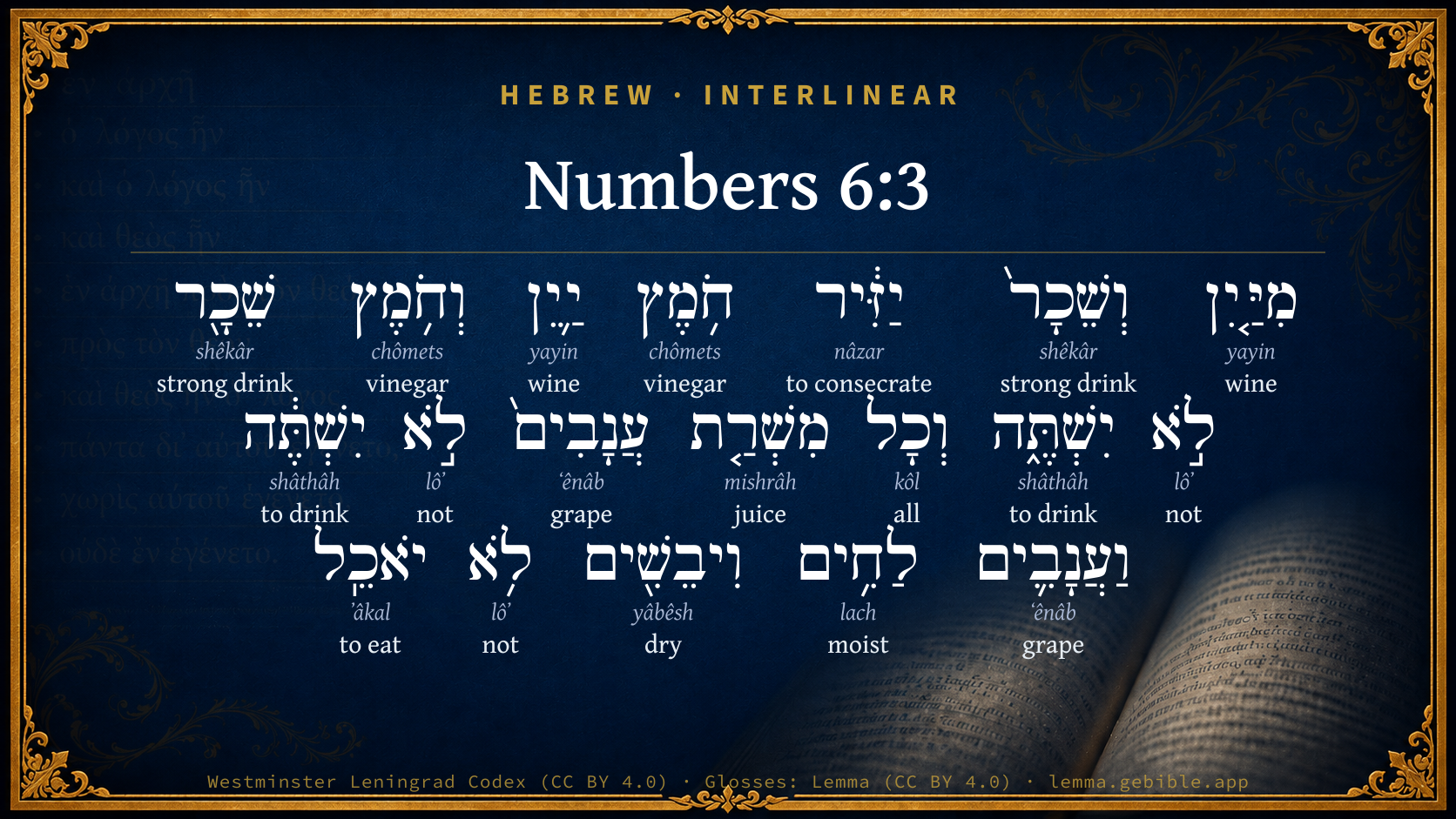
Hebrew (Westminster Leningrad Codex) Numbers 6:3 appears in the Hebrew Old Testament. The text above is from the Westminster Leningrad Codex. Each word links to its Strong’s number, a concise gloss, and parsing drawn from the Open Scriptures Hebrew Bible morphology. Click any word for its full Brown-Driver-Briggs (BDB) entry.
Download image
Cite this verse

Numbers 6:3 (World English Bible). Public Domain. Lemma interlinear Bible study tool, https://lemma.gebible.app/v/numbers/6/3.

Show BibTeX & RIS
BibTeX
RIS
English Translation
he shall separate himself from wine and strong drink. He shall drink no vinegar of wine, or vinegar of fermented drink, neither shall he drink any juice of grapes, nor eat fresh grapes or dried.
World English Bible · Public Domain
Highlights
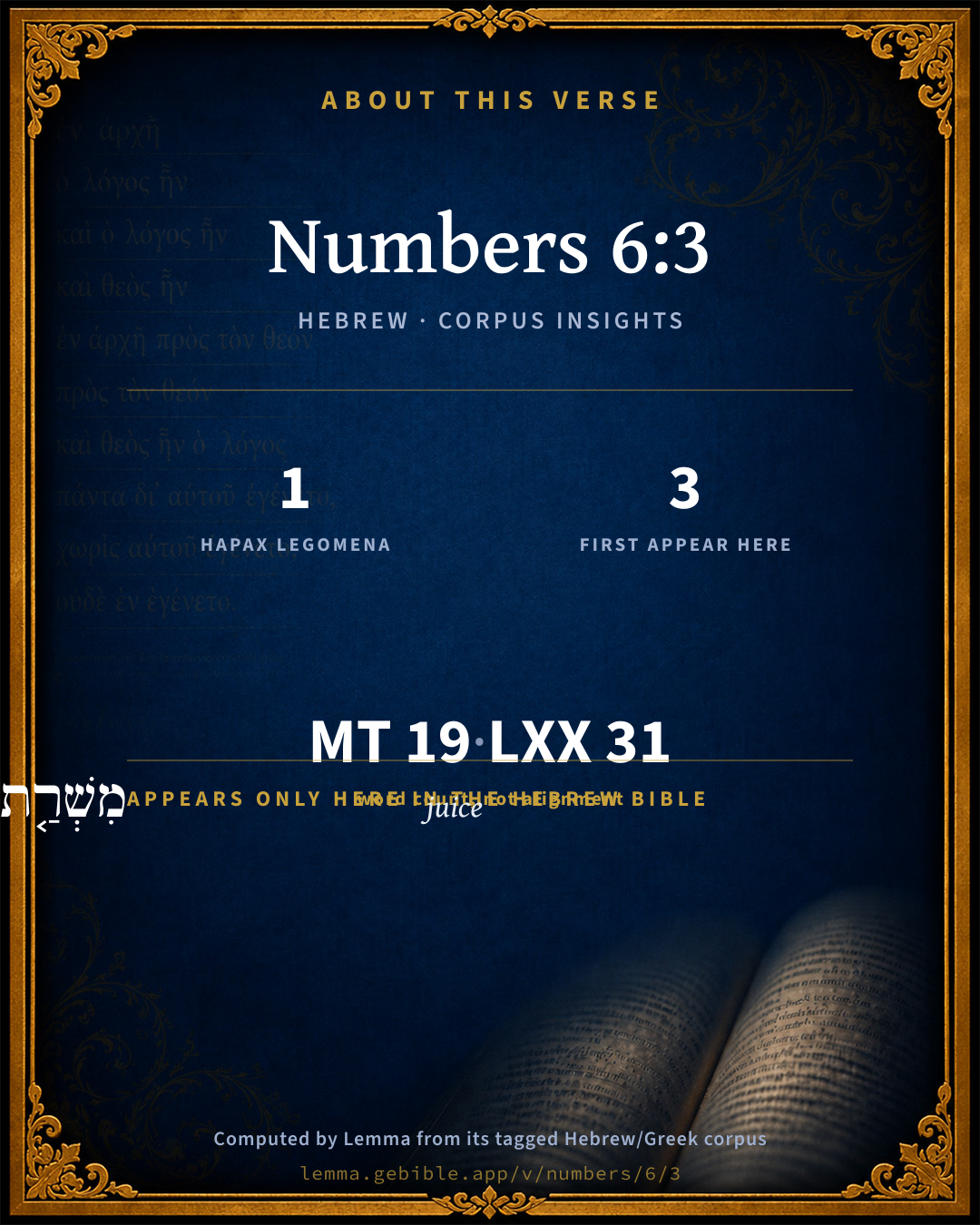
  • 1 hapax legomenon — only here in the Hebrew Bible
  • 3 first appearances in the Hebrew Bible
Full analysis ↓
Download a study sheet

One document with this verse’s original text, its word-by-word gloss line, the meaning frame, cross-references with their text, attributed commentary, and full source and license credits — printable, and it pastes into notes with its structure intact.

This verse Autodidact and up

Study sheet (.html) Plain text (.txt)

A passage Seminary Student

Up to 50 verses in one chapter. A passage sheet keeps up to 6 commentary sources and 12 cross-references per verse, in the order this page ranks them, and says so on the sheet whenever that leaves anything out. Ask for a single verse and you get the Autodidact verse sheet above.

Everything on this page stays free to read, with no account — the sheet is a download of what is already on screen, not access to it.

Want to remove ads? Support Godless Engineer
Compare translations 3

The same verse in 3 English versions, stacked beneath the original-language interlinear above. Click any original word for its lexicon entry.

Each is an independent rendering of the whole verse — the interlinear is not word-aligned to these translations.

Highlighted words mark where these versions differ — a whole-verse word diff, not a word-by-word alignment.

  • World English Bible Public Domain
    he shall separate himself from wine and strong drink. He shall drink no vinegar of wine, or vinegar of fermented drink, neither shall he drink any juice of grapes, nor eat fresh grapes or dried.
  • King James Version Public Domain
    He shall separate himself from wine and strong drink, and shall drink no vinegar of wine, or vinegar of strong drink, neither shall he drink any liquor of grapes, nor eat moist grapes, or dried.
  • unfoldingWord Literal Text CC BY-SA 4.0
    he shall make separate from wine and intoxicating drink. He shall not drink the vinegar of wine and the vinegar of intoxicating drink, and he shall not drink all the juice of grapes, and he shall not eat fresh and dried grapes.

unfoldingWord Literal Text — © unfoldingWord, licensed CC BY-SA 4.0. Word-aligned USFM3 via Door43 (git.door43.org/unfoldingWord/en_ult).

Versions to compare (up to 4)

3 of 4 selected

Show all 18 translations

Every available English version of this verse, each an independent rendering of the whole verse.

  • World English Bible Public Domain
    he shall separate himself from wine and strong drink. He shall drink no vinegar of wine, or vinegar of fermented drink, neither shall he drink any juice of grapes, nor eat fresh grapes or dried.
  • Berean Standard Bible Public Domain
    he is to abstain from wine and strong drink. He must not drink vinegar made from wine or strong drink, and he must not drink any grape juice or eat fresh grapes or raisins.
  • Majority Standard Bible Public Domain
    he is to abstain from wine and strong drink. He must not drink vinegar made from wine or strong drink, and he must not drink any grape juice or eat fresh grapes or raisins.
  • King James Version Public Domain
    He shall separate himself from wine and strong drink, and shall drink no vinegar of wine, or vinegar of strong drink, neither shall he drink any liquor of grapes, nor eat moist grapes, or dried.
  • American Standard Version (1901) Public Domain
    he shall separate himself from wine and strong drink; he shall drink no vinegar of wine, or vinegar of strong drink, neither shall he drink any juice of grapes, nor eat fresh grapes or dried.
  • Revised Version (1885) Public Domain
    he shall separate himself from wine and strong drink; he shall drink no vinegar of wine, or vinegar of strong drink, neither shall he drink any liquor of grapes, nor eat fresh grapes or dried.
  • Geneva Bible (1599) Public Domain
    He shall abstaine from wine and strong drinke, and shall drinke no sowre wine nor sowre drinke, nor shall drinke any licour of grapes, neither shall eate fresh grapes nor dryed.
  • Douay-Rheims (1899) Public Domain
    They shall abstain from wine, and from every thing that may make a man drunk. They shall not drink vinegar of wine, or of any other drink, nor any thing that is pressed out of the grape: nor shall they eat grapes either fresh or dried.
  • Young's Literal Translation Public Domain
    from wine and strong drink he doth keep separate; vinegar of wine, and vinegar of strong drink he doth not drink, and any juice of grapes he doth not drink, and grapes moist or dry he doth not eat;
  • Literal Standard Version CC BY-SA 4.0
    he keeps separate from wine and strong drink; he does not drink vinegar of wine and vinegar of strong drink, and he does not drink any juice of grapes, and he does not eat moist or dry grapes;
  • Unlocked Literal Bible CC BY-SA 4.0
    he must keep himself from wine and strong drink. He must not drink vinegar made from wine or from strong drink. He must not drink any grape juice or eat fresh grapes or raisins.
  • unfoldingWord Literal Text CC BY-SA 4.0
    he shall make separate from wine and intoxicating drink. He shall not drink the vinegar of wine and the vinegar of intoxicating drink, and he shall not drink all the juice of grapes, and he shall not eat fresh and dried grapes.
  • Darby Bible Public Domain
    he shall separate himself from wine and strong drink: he shall drink no vinegar of wine, nor vinegar of strong drink, neither shall he drink any liquor of grapes, nor eat grapes, fresh or dried.
  • World Messianic Bible Public Domain
    he shall separate himself from wine and strong drink. He shall drink no vinegar of wine, or vinegar of fermented drink, neither shall he drink any juice of grapes, nor eat fresh grapes or dried.
  • Webster's Bible Public Domain
    He shall separate himself from wine and strong drink, and shall drink no vinegar of wine, or vinegar of strong drink, neither shall he drink any liquor of grapes, nor eat moist grapes, or dried.
  • Free Bible Version CC BY-SA 4.0
    they must not drink any wine or other alcoholic drink. They must not even drink vinegar made from wine or other alcoholic drink, or any grape juice or eat grapes or raisins.
  • Bible in Basic English Public Domain
    He is to keep himself from wine and strong drink, and take no mixed wine or strong drink or any drink made from grapes, or any grapes, green or dry.
  • JPS Tanakh (1917) Public Domain
    he shall abstain from wine and strong drink: he shall drink no vinegar of wine, or vinegar of strong drink, neither shall he drink any liquor of grapes, nor eat fresh grapes or dried.

Literal Standard Version (2020), Covenant Press — licensed CC BY-SA 4.0. Text via the HelloAO Bible API (eBible.org). Unlocked Literal Bible (unfoldingWord) — licensed CC BY-SA 4.0. Text via the HelloAO Bible API (eBible.org). unfoldingWord Literal Text — © unfoldingWord, licensed CC BY-SA 4.0. Word-aligned USFM3 via Door43 (git.door43.org/unfoldingWord/en_ult). Free Bible Version, Dr. Jonathan Gallagher — licensed CC BY-SA 4.0. Text via the HelloAO Bible API (eBible.org).

Word by word

More ways to search: Search by grammar → Find every occurrence → Compare this word →

Practice this passage: Drill this verse → Learn its vocabulary →

מִשְׁרַ֤ת
mishrâh
H4952
“juice of”
Noun, Common, Feminine, Singular, Construct
Part of Speech
Noun
Type
Common
Gender
Feminine
Number
Singular
State
Construct
Full BDB Definition

Origin: from H8281 in the sense of loosening

TWOT: 2464a

juice
  1. מִיַּ֤יִן yayin H3196 “from · wine” Preposition + Noun, Common, Masculine, Singular, Absolute
  2. וְשֵׁכָר֙ shêkâr H7941 “and · strong drink” Conjunction + Noun, Common, Masculine, Singular, Absolute
  3. יַזִּ֔יר nâzar H5144 “to consecrate” Verb, Hiphil, Imperfect, 3rd Person, Masculine, Singular
  4. חֹ֥מֶץ chômets H2558 “vinegar of” Noun, Common, Masculine, Singular, Construct
  5. יַ֛יִן yayin H3196 “wine” Noun, Common, Masculine, Singular, Absolute
  6. וְחֹ֥מֶץ chômets H2558 “and · vinegar of” Conjunction + Noun, Common, Masculine, Singular, Construct
  7. שֵׁכָ֖ר shêkâr H7941 “strong drink” Noun, Common, Masculine, Singular, Absolute
  8. לֹ֣א lôʼ H3808 “not” Particle, Negative
  9. יִשְׁתֶּ֑ה shâthâh H8354 “to drink” Verb, Qal, Imperfect, 3rd Person, Masculine, Singular
  10. וְכָל kôl H3605 “and · all of” Conjunction + Noun, Common, Masculine, Singular, Construct
  11. עֲנָבִים֙ ʻênâb H6025 “grapes” Noun, Common, Masculine, Plural, Absolute
  12. לֹ֣א lôʼ H3808 “not” Particle, Negative
  13. יִשְׁתֶּ֔ה shâthâh H8354 “to drink” Verb, Qal, Imperfect, 3rd Person, Masculine, Singular
  14. וַעֲנָבִ֛ים ʻênâb H6025 “and · grapes” Conjunction + Noun, Common, Masculine, Plural, Absolute
  15. לַחִ֥ים lach H3892 “moist” Adjective, Adjective, Masculine, Plural, Absolute
  16. וִיבֵשִׁ֖ים yâbêsh H3002 “and · dry” Conjunction + Adjective, Adjective, Masculine, Plural, Absolute
  17. לֹ֥א lôʼ H3808 “not” Particle, Negative
  18. יֹאכֵֽל ʼâkal H398 “to eat” Verb, Qal, Imperfect, 3rd Person, Masculine, Singular

About this verse

These counts appear in no published source. They are computed here, from the morphology-tagged text and Lemma’s own curated glosses. What Lemma adds →

19
words
12
distinct lemmas
Pentateuch
section

Notable vocabulary

1 hapax legomenon — a word that appears only here in the entire Hebrew Bible:

  • מִשְׁרַ֤ת juice H4952

First appearance in Scripture

These words make their first canonical appearance in the Hebrew Bible here:

  • חֹ֥מֶץ vinegar H2558
  • מִשְׁרַ֤ת juice H4952
  • וִיבֵשִׁ֖ים dry H3002

Shared distinctive vocabulary

חֹ֥מֶץ vinegar H2558 occurs in 5 verses of the Hebrew Bible. Also found in:

Grammatical profile

  • 4 verbs
  • 10 nouns
  • 2 adjectives
  • 3 particles

Verb forms

  • יַזִּ֔יר Hiphil · Imperfect
  • יִשְׁתֶּ֑ה Qal · Imperfect
  • יִשְׁתֶּ֔ה Qal · Imperfect
  • יֹאכֵֽל Qal · Imperfect

Repetition

Words recur within this verse — often emphatic in Hebrew:

  • מִיַּ֤יִן wine H3196 ×2
  • וְשֵׁכָר֙ strong drink H7941 ×2
  • חֹ֥מֶץ vinegar H2558 ×2
  • יִשְׁתֶּ֑ה to drink H8354 ×2
  • עֲנָבִים֙ grape H6025 ×2
  • לֹ֣א not H3808 ×3

Hebrew & Septuagint length

In English translation the verse runs 35 words from the Hebrew and 41 from the Septuagint (LXX English) — closely comparable.

A rough comparison of the two English renderings, which tokenize alike — not a word-level alignment.

Word counts can differ between the Hebrew and the Greek without any difference in meaning — e.g. the Hebrew direct-object marker אֵת has no separate Greek word, and Greek often adds the article ὁ.

In the original languages it is 19 Hebrew tokens and 31 Greek tokens — but the two are counted differently (Hebrew bundles its prefixes and suffixes into one token; the Greek is in lemma form), so that isn’t a like-for-like length.

Cross-references

11

Topical passages linked to Numbers 6:3 in the Treasury of Scripture Knowledge — connected by theme and wording, ordered by reader-vote popularity; previews shown in the World English Bible.

  • Luke 1:15 For he will be great in the sight of the Lord, and he will drink no wine nor strong drink. He will be filled with the Holy Spirit, even from his mother's womb.
  • 1 Timothy 5:23 Be no longer a drinker of water only, but use a little wine for your stomach's sake and your frequent infirmities.
  • Leviticus 10:9 "Drink no wine nor strong drink, you, nor your sons with you, when you go into the Tent of Meeting, that you don't die: it shall be a statute forever throughout your generations:
  • Judges 13:14 She may not eat of anything that comes of the vine, neither let her drink wine or strong drink, nor eat any unclean thing; all that I commanded her let her observe.
  • Amos 2:12 "But you gave the Nazirites wine to drink, And commanded the prophets, saying, 'Don't prophesy!'
  • Ephesians 5:18 Don't be drunken with wine, in which is dissipation, but be filled with the Spirit,
  • Proverbs 31:4–5 It is not for kings, Lemuel; It is not for kings to drink wine; Nor for princes to say, 'Where is strong drink?'
  • Jeremiah 35:6–8 But they said, We will drink no wine; for Jonadab the son of Rechab, our father, commanded us, saying, You shall drink no wine, neither you, nor your sons, forever:
  • Luke 7:33–34 For John the Baptizer came neither eating bread nor drinking wine, and you say, 'He has a demon.'
  • Luke 21:34 "So be careful, or your hearts will be loaded down with carousing, drunkenness, and cares of this life, and that day will come on you suddenly.
  • 1 Thessalonians 5:22 Abstain from every form of evil.

Cross-references courtesy of OpenBible.info (CC BY 4.0).

Hebrew and Greek witnesses Masoretic Hebrew ↔ Greek Septuagint

The same verse in the two great witnesses to the Old Testament, shown verse-for-verse.

These are two independent witnesses, not word-aligned to each other, and the Septuagint is shown in lemma (dictionary) form.

Hebrew Numbers 6:3 Masoretic · Westminster Leningrad Codex

מִיַּ֤יִן וְשֵׁכָר֙ יַזִּ֔יר חֹ֥מֶץ יַ֛יִן וְחֹ֥מֶץ שֵׁכָ֖ר לֹ֣א יִשְׁתֶּ֑ה וְכָל מִשְׁרַ֤ת עֲנָבִים֙ לֹ֣א יִשְׁתֶּ֔ה וַעֲנָבִ֛ים לַחִ֥ים וִיבֵשִׁ֖ים לֹ֥א יֹאכֵֽל

he shall separate himself from wine and strong drink. He shall drink no vinegar of wine, or vinegar of fermented drink, neither shall he drink any juice of grapes, nor eat fresh grapes or dried.

World English Bible · Public Domain

Greek LXX Numbers 6:3 Septuagint · lemma form

ἀπό οἶνος καί σικερα ἁγνίζω ἀπό οἶνος καί ὄξος ἐκ οἶνος καί ὄξος ἐκ σικερα οὐ πίνω καί ὅσος καταἐργάζομαι ἐκ σταφυλή οὐ πίνω καί σταφυλή πρόσφατος καί σταφίς οὐ ἐσθίω

he shall purely abstain from wine and strong drink; and he shall drink no vinegar of wine or vinegar of strong drink; and whatever is made of the grape he shall not drink; neither shall he eat fresh grapes or raisins,

LXX2012 (modern English Septuagint) · Public Domain

Hebrew: Westminster Leningrad Codex (CC BY 4.0). Greek: Septuagint (public domain); English from LXX2012 (modern English Septuagint) (Public Domain). How the Septuagint differs from the Hebrew →

Targum (Aramaic paraphrase)

2

The Targum is the ancient Jewish Aramaic paraphrase of the Hebrew Scriptures — an interpretive translation, not the Hebrew text itself. Onkelos (literal) and Pseudo-Jonathan (expansive) render the Torah, and Jonathan the Prophets. Coverage is partial: where no permissively-licensed English translation exists for a verse, only the Aramaic is shown. This is verse-level text, not a word-by-word alignment to the Hebrew.

  1. Targum Onkelos Torah (Genesis–Deuteronomy)
    מֵחֲמַר חֲדַת וְעַתִּיק יַנְזִיר חַל דַחֲמַר חֲדַת וְחַל דַחֲמַר עַתִּיק לָא יִשְׁתֵּי וְכָל מַתְרוּת עִנְבִין לָא יִשְׁתֵּי וְעִנְבִין רַטִיבִין וִיבֵשִׁין לָא יֵיכוּל

    (no public-domain English translation for this verse)

    Targum Onkelos — Aramaic: “Onkelos Genesis” (public domain); “Onkelos Exodus” (public domain); “Onkelos Leviticus” (public domain); “Onkelos Numbers” (public domain); “Onkelos Deuteronomy” (public domain). English: “Sefaria Community Translation” (CC0 1.0 (public-domain dedication)); “J.W. Etheridge. The Targums of Onkelos and Jonathan Ben Uzziel on the Pentateuch. London: Longmans, Green, 1862” (public domain). Text via Sefaria.

  2. Targum Pseudo-Jonathan Torah (Genesis–Deuteronomy)
    מִן חֲמַר חֲדַת וְעַתִּיק יִפְרֵשׁ חֲלָא דַחֲמַר חֲדַת וַחֲלָא דַחֲמַר עַתִּיק לָא יִשְׁתֵּי וְכָל שִׁיקְיָינֵיהּ דְאִיתְרוּ בֵּיהּ עִנְבֵי לָא יִשְׁתֵּי וְעִנְבִין רְטִיבִין וּצְמוּקִין לָא יֵיכוֹל

    he shall abstain from wine, new and old, he shall drink neither vinegar of old wine or new; neither may he drink liquor in which grapes have been crushed, nor eat of grapes either fresh or dried.

    Targum Pseudo-Jonathan — Aramaic: “Targum Jonathan on Genesis” (public domain); “Targum Jonathan on Exodus” (public domain); “Targum Jonathan on Leviticus” (public domain); “Targum Jonathan on Numbers” (public domain); “Targum Jonathan on Deuteronomy” (public domain). English: “The Targum of Jonathan ben Uzziel, trans. J. W. Etheridge, London, 1862” (public domain). Text via Sefaria.

Commentary

Notes on Numbers 6:3 from classic Christian and Jewish commentators (each source and its license shown beneath its notes). The classic Christian expositions comment on the surrounding passage and are grouped to its opening verse, so a note may address several verses; the Jewish commentaries on the Tanakh (Rashi and others) are per-verse, so they appear only where the commentator wrote on this verse.

Lemma curates 59 commentaries, every one of them public domain or Creative Commons licensed, each selected and text-cleaned for this edition rather than reprinted as found. About our sources →

Trapp's Complete Commentary

John Trapp

Num 6:3 He shall separate [himself] from wine and strong drink, and shall drink no vinegar of wine, or vinegar of strong drink, neither shall he drink any liquor of grapes, nor eat moist grapes, or dried.

Ver. 3. He shall separate himself from wine.] Lest he should drink and forget the law, {Pro 31:5} which he was to study diligently: but loaden bellies make leaden wits: intemperance takes away the heart, {Hos 4:11} overchargeth it. {Luk 21:34}

Moist grapes or dried.] Dried as raisins, currants, or grapes of Corinth, whence they come, and are called.

John Trapp, A Commentary or Exposition upon All the Books of the Old and New Testament (1647–1656) — public domain. Text from a community e-Sword module.

Joseph Benson's Commentary

Num 6:3. Separate himself from wine — The first is, that every person so devoted should, during the whole time of his vow, taste no wine, nor any thing that had wine in it, nor any inflammatory liquors, which are incitements to lust; that so, by perfect temperance, his mind might be in a fit disposition for every part of the service of God. Vinegar — The word חמצ, chamets, thus rendered, properly means fermentation, and the clause might have been rendered, shall drink no fermentation of wine. Strong drink — Liquor made of dates or other fruit. See Lev 10:9. Nor eat grapes — Which he was forbidden to do for greater caution, to keep him at the farther distance from wine.

Joseph Benson's Commentary on the Old and New Testaments (1811–1818) — public domain. Text from a community e-Sword module.

Tyndale Open Study Notes

Tyndale Open Resources

6:3-4 The law required priests to avoid drinking wine before they served in the Tabernacle (Lev 10:9); the Nazirite vow allowed non-Levites to broaden that law to include all places, all times, and anything that comes from a grapevine.

Tyndale Open Study Notes — © Tyndale Open Resources, licensed CC BY-SA 4.0. Text via the HelloAO Bible API.

Adam Clarke's Commentary

Verse 3. No vinegar of wine, c.] חמץ chomets signifies fermented wine, and is probably used here to signify wine of a strong body, or any highly intoxicating liquor. Dr. Lightfoot supposes that the LEPER being the most defiled and loathsome of creatures, was an emblem of the wretched, miserable state of man by the fall and that the NAZARITE was the emblem of man in his state of innocence. Wine and grapes are here particularly forbidden to the Nazarite because, as the doctor thinks, being an emblem of man in his paradisaical state, he was forbidden that tree and its fruits by eating of which Adam fell; for the doctor, as well as the Jewish rabbins, believed the tree of knowledge to have been none other than the vine.

Vinegar of strong drink] See Clarke on Le 10:9.

Adam Clarke's Commentary on the Bible (1810–1826) — public domain. Text from a community e-Sword/MySword module.

Ellicott's Commentary for English Readers

(3) He shall separate himself from wine and strong drink . . . —The law of the Nazirite in this respect, as in regard to defilement from the dead, was more strict than that which was enjoined upon the priests, thus typifying the entire surrender of the heart and life to God, and freedom from the distraction of earthly ties. The ideal of this separation, however, was not that of a life of monastic seclusion, but of action, and of uninterrupted devotion to the Divine service. The priests were forbidden to drink wine, or strong drink, when they entered the tabernacle to perform service there, but were not prohibited the use of wine at other times. Strong drink (shecar) is supposed to have been made of barley and dates or honey. The prohibition to eat any of the produce of the vine, even of that which was not intoxicating, seems designed to denote the entire consecration of the Nazirite to the Divine service, and the obligation which rested upon him to abstain from all the desires and delights of the flesh. The love of cakes made of raisins is coupled in Hos_3:1 with idolatry.

A Bible Commentary for English Readers, edited by Charles John Ellicott (1878–1897) — public domain. Text from a community e-Sword module.

The Cambridge Bible for Schools and Colleges

gen. ed. J. J. S. Perowne

3. vinegar] Prepared from wine and other intoxicants which have gone sour.

liquor of grapes] Fresh wine, as distinct from the foregoing.

or dried] Raisins compressed into a cake (’ashîshâh) were a common article of food (2Sa_6:19, Hos_3:1).

3, 4. First regulation. Abstinence from intoxicating liquors and from any produce of the vine, liquid or solid.

The Cambridge Bible for Schools and Colleges (gen. ed. J. J. S. Perowne; Cambridge University Press, 1878–1918) — public domain. Text from a community e-Sword module.

John Gill's Exposition

He shall separate himself from wine,.... Old or new, as Ben Gersom; from drinking it, any of it: not only from an immoderate and excessive drinking of it, which every man should abstain from, but from drinking of it at all, that he might be more free and fit for the service of God; for prayer, meditation, reading the Scriptures, and attendance on the worship of God in all its branches, and be less liable to temptations to sin; for, as Aben Ezra observes, many transgressions are occasioned by wine, which, if drank immoderately, intoxicates the mind, and unfits for religious duties, excites lust, and leads on to many vices:

and strong drink; any other intoxicating and inebriating liquor besides wine, or any other sort of wines besides such that is made of the fruit of the vine, as wines of pomegranates, dates, &c. or such as are made of barley, as our ale, or of apples and pears, called cider and perry, respectively:

and shall drink no vinegar of wine, or vinegar of strong drink; all the three Targums paraphrase it, vinegar of new wine, and vinegar of old wine, these operating in like manner as wine and strong drink themselves:

neither shall he drink any liquor of grapes; any liquor in which grapes are macerated, as the Targum of Jonathan; or water into which they are squeezed, or which is made of the lees of wine, or is a second sort of wine made of the grapes after they have been pressed, which we call "tiff":

nor eat moist grapes or dried; which have somewhat of the nature and taste of wine, and produce some of the like effects, and may lead to a desire after drinking it; wherefore this, as other things mentioned, are, as Aben Ezra says, a kind of an hedge, to keep at a distance from drinking wine.

John Gill's Exposition of the Whole Bible (1746–1763) — public domain (CC PDM 1.0). Text via the HelloAO Bible API.

Haydock's Catholic Bible Commentary

Drunk. Hebrew shecar, may signify old or palm wine, Leviticus x. 9. --- Drink. Hebrew, "of shecar," which was a clear wine, with perhaps a mixture of sugar. --- Vinegar was a common beverage among the ancients. (Pliny, [Natural History?] xiv. 16; Ruth ii. 14.) The soldiers gave our Saviour some of theirs to drink. The Turks, who are not allowed to drink wine of the grape, make use of various other sorts of made wine. --- Grape, or the liquor procured from grapes, with a mixture of water, after they have served already to make wine. This liquor is called secondary wine by the Greeks, (Menochius) being designed for labourers in winter. (Varro 54, and Columella xii. 40.) Grapes of every description are forbidden to the Nazarites, as they either tend to inebriate, or at least are too luxurious. (Haydock) --- God deigns to give those a rule who voluntarily consecrate themselves to his service. "What do the Nazarites designate, but the life of those who abstain, and are continent." (St. Gregory, Mor. xxxii. 23.) (Worthington)

George Leo Haydock (1774–1849), Haydock's Catholic Family Bible and Commentary, 1859 edition — public domain. Excludes Psalms (Douay-Rheims chapter numbering differs from Protestant) and Deuterocanonical books (Catholic canon only).

Matthew Poole's English Annotations

Lest they should either inflame or dispose him to luxury, and consequently to the breaking of his vow; or cloud his reason, and thereby occasion some mistake or miscarriage in the rules to which he had bound himself. Compare Lev 10:9.

Nor eat moist grapes, or dried; which was forbidden him for greater caution to keep him at the further distance from wine.

Matthew Poole's English Annotations on the Holy Bible (1683–1685) — public domain. Text from a community e-Sword/MySword module.

Whedon's Commentary on the Bible

Daniel D. Whedon

3. Wine and strong drink — See Lev_10:8-11, notes. This law requiring abstinence from intoxicants is placed next to the law for a defiled or suspected woman, because by drunkenness unchastities frequently come. Gen_19:32-35; Pro_23:31; Pro_23:33.

Vinegar — A beverage generally of wine or strong drink (beer and cider) turned sour, but it was sometimes made by the fermentation of a mixture of barley and wine. It was acid even to a proverb, (Pro_10:26,) but was serviceable as a relish with bread, as used by labourers. See Rth_2:14, notes. The Romans called this liquid posca, either pure or mixed with water. Though offered in derision to Jesus on the cross, he drank it, and doubtless found a temporary refreshment amid his dying agonies. Mat_27:48, note. The same beverage drugged with anaesthetics he had previously refused. Mat_27:34, note.

Liquor of grapes — Unfermented wine or must.

Moist grapes — Fresh.

Dried — Raisins. As the fruit of the vine symbolizes all pampering of fleshly appetites which are at war with holiness, it was strictly forbidden to the Nazarite. The grape-cake, a dainty of epicures and debauchees, is mentioned in Hos_3:1, (R.V.) as a sensual bait of idolatry, a luxury not in keeping with the sobriety and purity of the true religion.

Daniel D. Whedon (gen. ed.), Commentary on the Old and New Testaments (1874–1909) — public domain. Text from a community e-Sword module.

The Pulpit Commentary

Strong drink. Hebrew, shekar; sikera . (Lev_10:9 Luk_1:15) Any intoxicating drink, other than wine including the beer of the Egyptians. Vinegar. Hebrew, chamets. It seems to have been freely used by the poorer people, (Rth_2:14) and was, perhaps, a thin, sour wine ("vile potet acctum," Horat.). Liquor of grapes. A drink made by soaking grape-skins in water.

Vers. 3-21. The regulations for observance of the Nazarite"s vow.

As a vow of separation, it was to be observed in as significant a way as possible. It was not only a separation in heart and sympathy, but it had its signs, which plainly indicated the separation to others. These regulations were also helpful to the Nazarite himself as remembrancers. We may conclude that not only the details of them, but the very substance, was of God"s appointment. Thus security was taken that all should be in harmony with the great body of the law, and also give the greatest chance of profit to the Nazarite himself, and the greatest chance of instruction to the people.

I REGULATIONS DURING THE CONTINUANCE OF THE VOW.

1. Abstinence from the fruit of the vine. It was to be a rigorous abstinence. This we may take to signify a protest in the most comprehensive way against all seeking of mere pleasure and comfort. The grape was the symbol of sensual delights. The spies brought back grapes of Eshcol more than any other produce to testify the riches of Canaan: this shows how much the Israelites thought of the fruit. There was, of course, no peculiar merit and advantage in abstaining from the grape itself. The abstinence was simply a sign indicating a desire to rise above the common pleasures of men. The Nazarites were not ascetics. They did not refrain from a good creature of God by way of penance. But in the grape there was the possibility of wine and strong drink, and the wine and strong drink were the testimony of the worldly soul that he loved to gratify his sensual nature, and eared not that his body should be so disciplined and restrained as to be the effectual minister of God. The appropriate joys of human life are not to be found among the powers that link us to the lower creation. We are to look for them in communion with God and following Christ. Our joy is in the Holy Ghost. "Is any merry, let him sing Psalms.

2. The unshorn head. The Nazarite was not his own. Not even the least thing about his person was at his own disposal. He was not allowed to cast away even a thing so easily and painlessly separated as the hair, seemingly of so little consequence, and so quickly growing again. It was just because the hair seemed so little a thing that leaving it unshorn was so fit for a sign. (Mat_5:36 Mat_10:30) So when we become Christ"s we become his altogether. We must be faithful in that which is least. All of life is for him, though there are many things that, hastily considered, look as little important as the short light hairs clipped from the head. The unshorn head also made a manifest difference in the sight of men. Abstaining from the vine was only known at the social board; the unshorn head revealed the Nazarite to every one he met. It was an unostentatious challenge and rebuke to the more easy-going multitude. God had accepted the Nazarite, and stamped his acceptance by this simple, impressive regulation.

3. The avoidance of the dead. Death was uncleanness. (Num_5:2) The Nazarite as a consecrated one dare not touch the dead. "Separated for God, in whose presence death and corruption can have no place, the Nazarite must ever be found in the habitations and society of the living." Not even dead kindred may the Nazarite man or woman touch. What a striking reminder in verse 7 of the requirements of Christi. (Luk_18:29, Luk_18:30) He that would please God and rise to higher attainments in Divine things must subordinate all human kinship to higher claims. Christ divides the family against itself, and makes a man"s foes those of his own household. The nearest kindred may be an obstacle to the regenerate, as still dead in trespasses and sins. "Let the dead bury their dead." A Nazarite in the observance of his vow was ever on the watch against all occasion of uncleanness, for the very least defilement compelled a fresh start from the beginning.

II REGULATIONS FOR THE RETURN TO ORDINARY LIFE. This was to be done in a public, deliberate, and sacred way. Precisely ordained offerings had to be made before the Nazarite again put razor to his head or wine to his lips. These offerings doubtless had relation both to the period just expired and the freer life to be presently resumed. There was thanksgiving for the vow successfully observed, atonement for the sin that nevertheless had mingled in it, and something to express his purposes for the future. The freer life was still to find him a Nazarite in heart. To be nearer God for a time and then go away to a distance, to taste the pleasures of holiness for a season and then go back to pollution, such conduct would have made the vow a mockery and abomination. We must all be Nazarite in spirit, opposed to the world as resolutely as was the Baptist, but not, like him, fleeing to the wilderness. Our guide and example is Jesus himself, the holiest of all Nazarites, who kept himself unspotted even at the table of the glutton and wine-bibber. His prayer for us is not that we should be taken out of the world, but kept from the evil. Y.

The Pulpit Commentary (1880–1919), ed. H.D.M. Spence-Jones & Joseph S. Exell — public domain. Text from a community e-Sword module.

John Wesley's Explanatory Notes

Nor eat grapes - Which was forbidden him for greater caution to keep him at the farther distance from wine.

John Wesley, Explanatory Notes Upon the Whole Bible (1754–1765) — public domain. Text via the GEBible commentary corpus.

Rashi

Rabbi Shlomo Yitzchaki (Rashi)

מיין ושכר — Understand this as the Targum does: he shall abstain from new (יין) and old wine (שכר). The latter is called שכר, “intoxicating drink”, because wine makes one intoxicated when it is old.

וכל משרת — The word משרת denotes “steeping” in water or any other liquid. In the Mishnaic language there are many examples of this, e.g., (Shabbat 17b): “One must not soak (שורין) ink-materials and dyes in water on the eve of Sabbath”; (Nazir 34b): “A Nazarite who steeped (שרה) his bread in wine".

Rashi on the Tanakh — English translations: “The Judaica Press complete Tanach with Rashi, translated by A. J. Rosenberg” (CC BY 4.0); “Pentateuch with Rashi's commentary by M. Rosenbaum and A.M. Silbermann, 1929-1934” (public domain); “The Metsudah Tanach series, Lakewood, N.J” (CC BY 4.0); and “The Book of Joshua, Metsudah Publications, 1997” (CC BY 4.0). Text via Sefaria.

Sforno

Rabbi Ovadia Sforno

From new or old wine he must abstain. A person should not afflict himself with fasting which decreases his Divine service, as the Sages said, nor should one cause himself pain with lashes as do the ascetics. However, one may abstain from wine, for in this way he decreases physical desires and subjugates his urges, but he will not exhaust his strength at all.

Sforno on the Tanakh — English translation: “Yalkut, Sifsei Chachomim Chumash, Metsudah Publications, 2009” (CC BY 4.0). Text via Sefaria.

Lesson kit

Teaching starters — assembled from the data on this page, not authored interpretation. Every prompt links to the verse data it draws on. Edit before teaching.

Numbers, in the Pentateuch, opens this verse with 19 words (12 distinct Hebrew lemmas). Its most distinctive word is mishrâh (“juice”). A historical commentator’s framing appears above. Read the whole chapter for the surrounding context.

Discussion questions

  1. The word mishrâh carries the sense “juice.” How does it shape the verse?
  2. 1 word here appears nowhere else in the Hebrew Bible. Why might the author reach for such rare wording?
  3. 3 words make their first appearance in Scripture here. What does this debut establish?
  4. How does Ruth 2:14, which shares the word «vinegar», read alongside this verse?
  5. What does the repetition of “wine” (2× in this one verse) do in this verse?
  6. The translations on this page render this verse differently — a whole-verse word diff, not a word-by-word alignment. What might account for the different wordings?
  7. «יַזִּ֔יר» is a Hiphil Imperfect verb. How does that grammatical form shape the action described?
  8. Compare how Trapp's Complete Commentary and Joseph Benson's Commentary read this verse. Where do they agree or differ?

Things to notice

  • 1 word in this verse appears nowhere else in the Hebrew Bible.
  • 3 words make their first canonical appearance in Scripture here.
  • This verse counts 19 Hebrew ↔ 31 Greek words.
  • These translations choose different wording for 12 words in this verse.
  • “wine” occurs 2× in this single verse.

Reading settings

Reading text

Shown beneath each verse's original-language words.

Old Testament
Old Testament edition

Read the OT as the Masoretic Hebrew (MT) or the Greek Septuagint (LXX).

English shown for the Greek Septuagint (in the Hebrew ↔ Greek comparison).

Comparing translations? Open the Compare panel on any verse page to stack up to four side by side.