
1 Samuel 1:9

Hebrew (Westminster Leningrad Codex) 1 Samuel 1:9 appears in the Hebrew Old Testament. The text above is from the Westminster Leningrad Codex. Each word links to its Strong’s number, a concise gloss, and parsing drawn from the Open Scriptures Hebrew Bible morphology. Click any word for its full Brown-Driver-Briggs (BDB) entry.
Download image
Cite this verse

1 Samuel 1:9 (World English Bible). Public Domain. Lemma interlinear Bible study tool, https://lemma.gebible.app/v/1-samuel/1/9.

Show BibTeX & RIS
BibTeX
RIS
English Translation
So Hannah rose up after they had eaten in Shiloh, and after they had drunk. Now Eli the priest was sitting on his seat by the door-post of the temple of Yahweh.
World English Bible · Public Domain
Highlights
  • 1 first appearance in the Hebrew Bible
Full analysis ↓
Download a study sheet

One document with this verse’s original text, its word-by-word gloss line, the meaning frame, cross-references with their text, attributed commentary, and full source and license credits — printable, and it pastes into notes with its structure intact.

This verse Autodidact and up

Study sheet (.html) Plain text (.txt)

A passage Seminary Student

Up to 50 verses in one chapter. A passage sheet keeps up to 6 commentary sources and 12 cross-references per verse, in the order this page ranks them, and says so on the sheet whenever that leaves anything out. Ask for a single verse and you get the Autodidact verse sheet above.

Everything on this page stays free to read, with no account — the sheet is a download of what is already on screen, not access to it.

Want to remove ads? Support Godless Engineer
Compare translations 3

The same verse in 3 English versions, stacked beneath the original-language interlinear above. Click any original word for its lexicon entry.

Each is an independent rendering of the whole verse — the interlinear is not word-aligned to these translations.

Highlighted words mark where these versions differ — a whole-verse word diff, not a word-by-word alignment.

  • World English Bible Public Domain
    So Hannah rose up after they had eaten in Shiloh, and after they had drunk. Now Eli the priest was sitting on his seat by the door-post of the temple of Yahweh.
  • King James Version Public Domain
    So Hannah rose up after they had eaten in Shiloh, and after they had drunk. Now Eli the priest sat upon a seat by a post of the temple of the LORD.
  • unfoldingWord Literal Text CC BY-SA 4.0
    And Hannah arose after eating and after drinking in Shiloh. (Now Eli the priest was sitting on a seat by the doorpost of the temple of Yahweh.)

unfoldingWord Literal Text — © unfoldingWord, licensed CC BY-SA 4.0. Word-aligned USFM3 via Door43 (git.door43.org/unfoldingWord/en_ult).

Versions to compare (up to 4)

3 of 4 selected

Show all 18 translations

Every available English version of this verse, each an independent rendering of the whole verse.

  • World English Bible Public Domain
    So Hannah rose up after they had eaten in Shiloh, and after they had drunk. Now Eli the priest was sitting on his seat by the door-post of the temple of Yahweh.
  • Berean Standard Bible Public Domain
    So after they had finished eating and drinking in Shiloh, Hannah stood up. Now Eli the priest was sitting on a chair by the doorpost of the temple of the LORD.
  • Majority Standard Bible Public Domain
    So after they had finished eating and drinking in Shiloh, Hannah stood up. Now Eli the priest was sitting on a chair by the doorpost of the temple of the LORD.
  • King James Version Public Domain
    So Hannah rose up after they had eaten in Shiloh, and after they had drunk. Now Eli the priest sat upon a seat by a post of the temple of the LORD.
  • American Standard Version (1901) Public Domain
    So Hannah rose up after they had eaten in Shiloh, and after they had drunk. Now Eli the priest was sitting upon his seat by the door-post of the temple of Jehovah.
  • Revised Version (1885) Public Domain
    So Hannah rose up after they had eaten in Shiloh, and after they had drunk. Now Eli the priest sat upon his seat by the door post of the temple of the LORD.
  • Geneva Bible (1599) Public Domain
    So Hannah rose vp after that they had eaten and drunke in Shiloh (and Eli the Priest sate vpon a stoole by one of the postes of the Temple of the Lord)
  • Douay-Rheims (1899) Public Domain
    So Anna arose after she had eaten and drunk in Silo: And Heli the priest sitting upon a stool, before the door of the temple of the Lord:
  • Young's Literal Translation Public Domain
    And Hannah riseth after eating in Shiloh, and after drinking, and Eli the priest is sitting on the throne by the side-post of the temple of Jehovah.
  • Literal Standard Version CC BY-SA 4.0
    And Hannah rises after eating in Shiloh, and after drinking, and Eli the priest is sitting on the throne by the doorpost of the temple of YHWH.
  • Unlocked Literal Bible CC BY-SA 4.0
    On one of these occasions, Hannah rose up after they had finished eating and drinking in Shiloh. Now Eli the priest was sitting upon his seat by the doorway to the temple of Yahweh.
  • unfoldingWord Literal Text CC BY-SA 4.0
    And Hannah arose after eating and after drinking in Shiloh. (Now Eli the priest was sitting on a seat by the doorpost of the temple of Yahweh.)
  • Darby Bible Public Domain
    And Hannah rose up after they had eaten in Shiloh, and after they had drunk; (now Eli the priest sat upon the seat by the door-post of the temple of Jehovah;)
  • World Messianic Bible Public Domain
    So Hannah rose up after they had finished eating and drinking in Shiloh. Now Eli the priest was sitting on his seat by the doorpost of the LORD’s temple.
  • Webster's Bible Public Domain
    So Hannah rose after they had eaten in Shiloh, and after they had drank. Now Eli the priest sat upon a seat by a post of the temple of the LORD.
  • Free Bible Version CC BY-SA 4.0
    One time when they had finished eating and drinking in Shiloh, Hannah got up and went to the Temple. Eli the priest was sitting on his seat by the entrance to the Lord's Temple.
  • Bible in Basic English Public Domain
    So after they had taken food and wine in the guest room, Hannah got up. Now Eli the priest was seated by the pillars of the doorway of the Temple of the Lord.
  • JPS Tanakh (1917) Public Domain
    So Hannah rose up after they had eaten in Shiloh, and after they had drunk — now Eli the priest sat upon his seat by the door-post of the temple of the LORD;

Literal Standard Version (2020), Covenant Press — licensed CC BY-SA 4.0. Text via the HelloAO Bible API (eBible.org). Unlocked Literal Bible (unfoldingWord) — licensed CC BY-SA 4.0. Text via the HelloAO Bible API (eBible.org). unfoldingWord Literal Text — © unfoldingWord, licensed CC BY-SA 4.0. Word-aligned USFM3 via Door43 (git.door43.org/unfoldingWord/en_ult). Free Bible Version, Dr. Jonathan Gallagher — licensed CC BY-SA 4.0. Text via the HelloAO Bible API (eBible.org).

Word by word

More ways to search: Search by grammar → Find every occurrence → Compare this word →

Practice this passage: Drill this verse → Learn its vocabulary →

חַנָּ֔ה
Channâh
H2584
“Hannah”
Noun, Proper
Part of Speech
Noun
Type
Proper
Full BDB Definition

Origin: from H2603

TWOT: None

Hannah = "grace" - the mother of Samuel, one of the wives of Elkanah
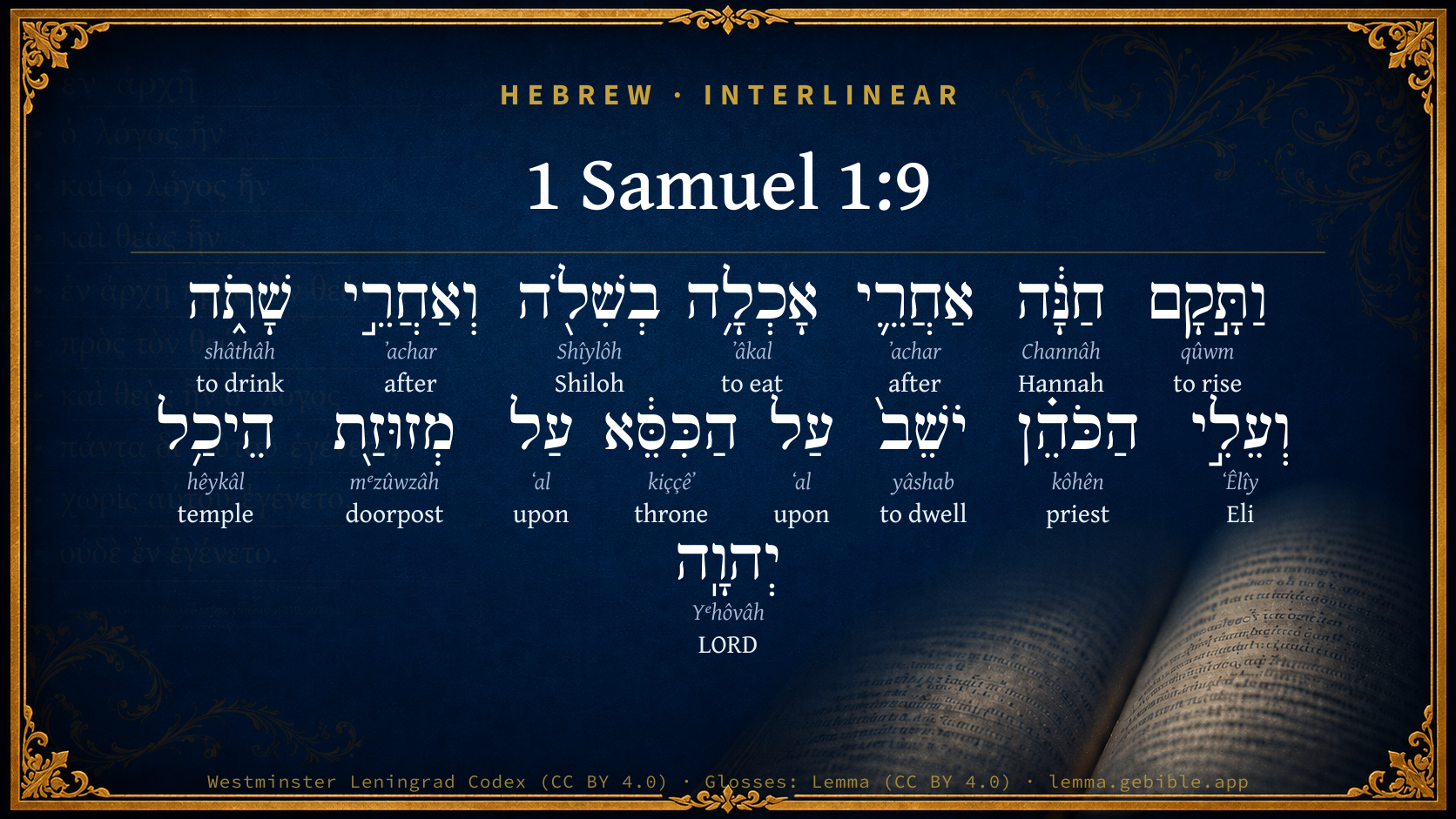
  1. וַתָּ֣קָם qûwm H6965 “and · to rise” Conjunction + Verb, Qal, Sequential Imperfect, 3rd Person, Feminine, Singular
  2. אַחֲרֵ֛י ʼachar H310 “after” Preposition
  3. אָכְלָ֥ה ʼâkal H398 “to eat” Verb, Qal, Infinitive Construct
  4. בְשִׁלֹ֖ה Shîylôh H7887 “in/at · Shiloh” Preposition + Noun, Proper
  5. וְאַחֲרֵ֣י ʼachar H310 “and · after” Conjunction + Preposition
  6. שָׁתֹ֑ה shâthâh H8354 “to drink” Verb, Qal, Infinitive Absolute
  7. וְעֵלִ֣י ʻÊlîy H5941 “and · Eli” Conjunction + Noun, Proper
  8. הַכֹּהֵ֗ן kôhên H3548 “the · priest” Particle, Definite Article + Noun, Common, Masculine, Singular, Absolute
  9. יֹשֵׁב֙ yâshab H3427 “dwelling” Verb, Qal, Participle Active, Masculine, Singular, Absolute
  10. עַל ʻal H5921 “upon” Preposition
  11. הַכִּסֵּ֔א kiççêʼ H3678 “the · throne” Particle, Definite Article + Noun, Common, Masculine, Singular, Absolute
  12. עַל ʻal H5921 “upon” Preposition
  13. מְזוּזַ֖ת mᵉzûwzâh H4201 “doorpost of” Noun, Common, Feminine, Singular, Construct
  14. הֵיכַ֥ל hêykâl H1964 “temple of” Noun, Common, Masculine, Singular, Construct
  15. יְהוָֽה Yᵉhôvâh H3068 “LORD” Noun, Proper

About this verse

These counts appear in no published source. They are computed here, from the morphology-tagged text and Lemma’s own curated glosses. What Lemma adds →

16
words
14
distinct lemmas
Historical
section

Notable vocabulary

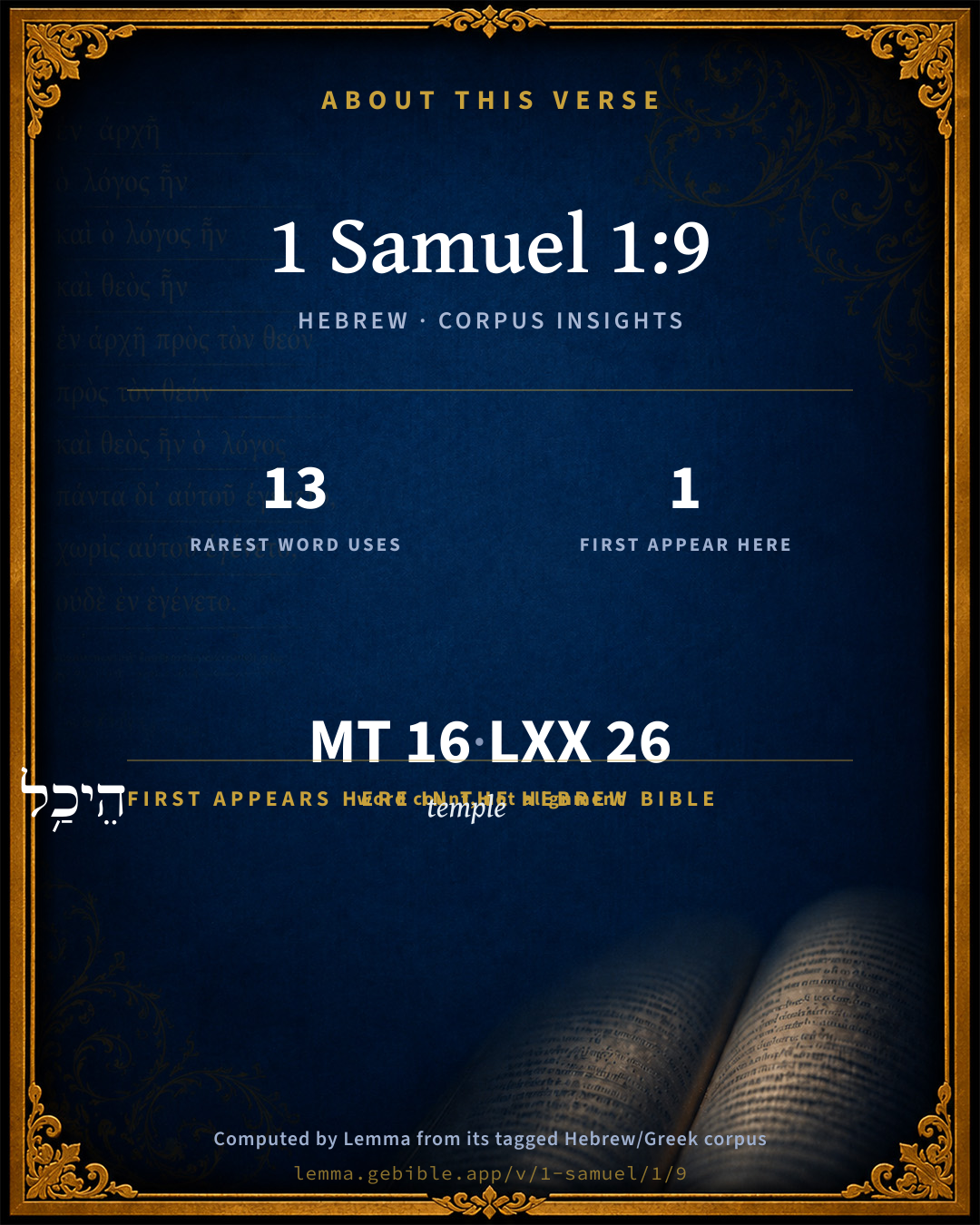
The rarest word here is חַנָּ֔ה Hannah H2584 — appearing just 13 times in the whole Hebrew Bible.

First appearance in Scripture

This word makes its first canonical appearance in the Hebrew Bible here:

  • הֵיכַ֥ל temple H1964

Shared distinctive vocabulary

חַנָּ֔ה Hannah H2584 occurs in 11 verses of the Hebrew Bible. Also found in:

Grammatical profile

  • 4 verbs
  • 8 nouns
  • 4 prepositions

Verb forms

  • וַתָּ֣קָם Qal · Sequential Imperfect
  • אָכְלָ֥ה Qal · Infinitive Construct
  • שָׁתֹ֑ה Qal · Infinitive Absolute
  • יֹשֵׁב֙ Qal · Participle Active

Repetition

Words recur within this verse — often emphatic in Hebrew:

  • אַחֲרֵ֛י after H310 ×2
  • עַל upon H5921 ×2

Hebrew & Septuagint length

In English translation the verse runs 32 words from the Hebrew and 32 from the Septuagint (LXX English) — the same length.

A rough comparison of the two English renderings, which tokenize alike — not a word-level alignment.

Word counts can differ between the Hebrew and the Greek without any difference in meaning — e.g. the Hebrew direct-object marker אֵת has no separate Greek word, and Greek often adds the article ὁ.

In the original languages it is 16 Hebrew tokens and 26 Greek tokens — but the two are counted differently (Hebrew bundles its prefixes and suffixes into one token; the Greek is in lemma form), so that isn’t a like-for-like length.

Cross-references

6

Topical passages linked to 1 Samuel 1:9 in the Treasury of Scripture Knowledge — connected by theme and wording, ordered by reader-vote popularity; previews shown in the World English Bible.

  • 1 Samuel 3:3 and the lamp of God hadn't yet gone out, and Samuel had laid down [to sleep], in the temple of Yahweh, where the ark of God was;
  • Psalms 27:4 One thing I have asked of Yahweh, that I will seek after, That I may dwell in the house of Yahweh all the days of my life, To see Yahweh's beauty, And to inquire in his temple.
  • Psalms 5:7 But as for me, in the abundance of your loving kindness I will come into your house: I will bow toward your holy temple in reverence of you.
  • 2 Samuel 7:2 that the king said to Nathan the prophet, See now, I dwell in a house of cedar, but the ark of God dwells within curtains.
  • 1 Samuel 3:15 Samuel lay until the morning, and opened the doors of the house of Yahweh. Samuel feared to show Eli the vision.
  • Psalms 29:9 Yahweh's voice makes the deer calve, And strips the forests bare. In his temple everything says, "Glory!"

Cross-references courtesy of OpenBible.info (CC BY 4.0).

Hebrew and Greek witnesses Masoretic Hebrew ↔ Greek Septuagint

The same verse in the two great witnesses to the Old Testament, shown verse-for-verse.

These are two independent witnesses, not word-aligned to each other, and the Septuagint is shown in lemma (dictionary) form.

Hebrew 1 Samuel 1:9 Masoretic · Westminster Leningrad Codex

וַתָּ֣קָם חַנָּ֔ה אַחֲרֵ֛י אָכְלָ֥ה בְשִׁלֹ֖ה וְאַחֲרֵ֣י שָׁתֹ֑ה וְעֵלִ֣י הַכֹּהֵ֗ן יֹשֵׁב֙ עַל הַכִּסֵּ֔א עַל מְזוּזַ֖ת הֵיכַ֥ל יְהוָֽה

So Hannah rose up after they had eaten in Shiloh, and after they had drunk. Now Eli the priest was sitting on his seat by the door-post of the temple of Yahweh.

World English Bible · Public Domain

Greek LXX 1 Samuel 1:9 Septuagint · lemma form

καί ἀναἵστημι αννα μετά ὁ ἐσθίω αὐτός ἐν σηλω καί καταἵστημι ἐνώπιον κύριος καί ηλι ὁ ἱερεύς κάθημαι ἐπί ὁ δίφρος ἐπί ὁ φλιά ναός κύριος

And Anna rose up after they had eaten in Selom, and stood before the Lord: and Heli the priest was on a seat by the threshold of the temple of the Lord.

LXX2012 (modern English Septuagint) · Public Domain

Hebrew: Westminster Leningrad Codex (CC BY 4.0). Greek: Septuagint (public domain); English from LXX2012 (modern English Septuagint) (Public Domain). How the Septuagint differs from the Hebrew →

Targum (Aramaic paraphrase)

1

The Targum is the ancient Jewish Aramaic paraphrase of the Hebrew Scriptures — an interpretive translation, not the Hebrew text itself. Onkelos (literal) and Pseudo-Jonathan (expansive) render the Torah, and Jonathan the Prophets. Coverage is partial: where no permissively-licensed English translation exists for a verse, only the Aramaic is shown. This is verse-level text, not a word-by-word alignment to the Hebrew.

  1. Targum Jonathan Prophets (Joshua–Malachi)
    וְקָמַת חַנָה בָּתַר דְאָכְלַת בְשִׁלֹה וּבָתַר דִשְׁתִיאַת וְעֵלִי כַהֲנָא יָתֵיב עַל כּוּרְסֵיהּ עַל מְזוּזֵי בִּסְטַר סִיפָא דְהֵיכְלָא דַיְיָ:

    (no public-domain English translation for this verse)

    Targum Jonathan — Aramaic: “Mikraot Gedolot” (public domain). English: “Sefaria Community Translation” (CC0 1.0 (public-domain dedication)); “London "Chaldee Paraphrase," 1871” (public domain). Text via Sefaria.

Commentary

Notes on 1 Samuel 1:9 from classic Christian and Jewish commentators (each source and its license shown beneath its notes). The classic Christian expositions comment on the surrounding passage and are grouped to its opening verse, so a note may address several verses; the Jewish commentaries on the Tanakh (Rashi and others) are per-verse, so they appear only where the commentator wrote on this verse.

Lemma curates 59 commentaries, every one of them public domain or Creative Commons licensed, each selected and text-cleaned for this edition rather than reprinted as found. About our sources →

Matthew Henry's Commentary

Elkanah had gently reproved Hannah for her inordinate grief, and here we find the good effect of the reproof.

I. It brought her to her meat. She ate and drank, Sa1 1:9. She did not harden herself in sorrow, nor grow sullen when she was reproved for it; but, when she perceived her husband uneasy that she did not come and eat with them, she cheered up her own spirits as well as she could, and came to table. it is as great a piece of self-denial to control our passions as it is to control our appetites.

II. It brought her to her prayers. It put her upon considering, "Do I well to be angry? Do I well to fret? What good does it do me? Instead of binding the burden thus upon my shoulders, had I not better easy myself of it, and cast it upon the Lord by prayer?" Elkanah had said, Am not I better to thee than ten sons? which perhaps occasioned her to think within herself, "Whether he be so or no, God is, and therefore to him will I apply, and before him will I pour out my complaint, and try what relief that will give me." If ever she will make a more solemn address than ordinary to the throne of grace upon this errand, now is the time. They are at Shiloh, at the door of the tabernacle, where God had promised to meet his people, and which was the house of prayer. They had recently offered their peace-offerings, to obtain the favour of God and all good and in token of their communion with him; and, taking the comfort of their being accepted of him, they had feasted upon the sacrifice; and now it was proper to put up her prayer in virtue of that sacrifice, for the peace-offerings, for by it not only atonement is made for sin, but the audience and acceptance of our prayers and an answer of peace to them are obtained for us: to that sacrifice, in all our supplications, we must have an eye. Now concerning Hannah's prayer we may observe,

1. The warm and lively devotion there was in it, which appeared in several instances, for our direction in prayer. (1.) She improved the present grief and trouble of her spirit for the exciting and quickening of her pious affections in prayer: Being in bitterness of soul, she prayed, Sa1 1:10. This good use we should make of our afflictions, they should make us the more lively in our addresses to God. Our blessed Saviour himself, being in an agony, prayed more earnestly, Luk 22:44. (2.) She mingled tears with her prayers. It was not a dry prayer: she wept sore. Like a true Israelite, she wept and made supplication (Hos 12:4), with an eye to the tender mercy of our God, who knows the troubled soul. The prayer came from her heart, as the tears from her eyes. (3.) She was very particular, and yet very modest, in her petition. She begged a child, a man-child, that it might be fit to serve in the tabernacle. God gives us leave, in prayer, not only to ask good things in general, but to mention that special good thing which we most need and desire. Yet she says not, as Rachel, Give me children, Gen 30:1. She will be very thankful for one. (4.) She made a solemn vow, or promise, that if God would give her a son she would give him up to God, Sa1 1:11. He would be by birth a Levite, and so devoted to the service of God, but he should be by her vow a Nazarite, and his very childhood should be sacred. It is probable she had acquainted Elkanah with her purpose before, and had had his consent and approbation. Note, Parents have a right to dedicate their children to God, as living sacrifices and spiritual priests; and an obligation is thereby laid upon them to serve God faithfully all the days of their life. Note further, It is very proper, when we are in pursuit of any mercy, to bind our own souls with a bond, that, if God give it us, we will devote it to his honour and cheerfully use it in his service. Not that hereby we can pretend to merit the gift, but thus we are qualified for it and for the comfort of it. In hope of mercy, let us promise duty. (5.) She spoke all this so softly that none could hear her. Her lips moved, but her voice was not heard, Sa1 1:13. Hereby she testified her belief of God's knowledge of the heart and its desires. Thoughts are words to him, nor is he one of those gods that must be cried aloud to, Kg1 18:27. It was likewise an instance of her humility and holy shamefacedness in her approach to God. She was none of those that made her voice to be heard on high, Isa 58:4. It was a secret prayer, and therefore, though made in a public place, yet was thus made secretly, and not, as the Pharisees prayed, to be seen of men. It is true prayer is not a thing we have reason to be ashamed of, but we must avoid all appearances of ostentation. Let what passes between God and our souls be kept to ourselves.

2. The hard censure she fell under for it. Eli was now high priest, and judge in Israel; he sat upon a seat in the temple, to oversee what was done there, Sa1 1:9. The tabernacle is here called the temple, because it was now fixed, and served all the purposes of a temple. There Eli sat to receive addresses and give direction, and somewhere (it is probable in a private corner) he espied Hannah at her prayers, and by her unusual manner fancied she was drunken, and spoke to her accordingly (Sa1 1:14): How long wilt thou be drunken? - the very imputation that Peter and the apostles fell under when the Holy Ghost gave them utterance, Act 2:13. Perhaps in this degenerate age it was no strange thing to see drunken women at the door of the tabernacle; for otherwise, one would think, the vile lust of Hophni and Phinehas could not have found so easy a prey there, Sa1 2:22. Eli took Hannah for one of these. It is one bad effect of the abounding of iniquity, and its becoming fashionable, that it often gives occasion to suspect the innocent. When a disease is epidemical every one is suspected to be tainted with it. Now, (1.) This was Eli's fault; and a great fault it was to pass so severe a censure without better observation or information. If his own eyes had already become dim, he should have employed those about him to enquire. Drunkards are commonly noisy and turbulent, but this poor woman was silent and composed. His fault was the worse that he was the priest of the Lord, who should have had compassion on the ignorant, Heb 5:2. Note, It ill becomes us to be rash and hasty in our censures of others, and to be forward to believe people guilty of bad things, while either the matter of fact on which the censure is grounded is doubtful and unproved or is capable of a good construction. Charity commands us to hope the best concerning all, and forbids censoriousness. Paul had very good information when he did but partly believe (Co1 11:18), hoping it was not so. Especially we ought to be cautious how we censure the devotions of others, lest we call that hypocrisy, enthusiasm, or superstition, which is really the fruit of an honest zeal, and it is accepted of God. (2.) It was Hannah's affliction; and a great affliction it was, added to all the rest, vinegar to the wounds of her spirit. She had been reproved by Elkanah because she would not eat and drink, and now to be reproached by Eli as if she had eaten and drunk too much was very hard. Note, It is no new thing for those that do well to be ill thought of, and we must not think it strange if at any time it be our lot.

3. Hannah's humble vindication of herself from this crime with which she was charged. She bore it admirably well. She did not retort the charge and upbraid him with the debauchery of his own sons, did not bid him look at home and restrain them, did not tell him how ill it became one in his place thus to abuse a poor sorrowful worshipper at the throne of grace. When we are at any time unjustly censured we have need to set a double watch before the door of our lips, that we do not recriminate, and return censure for censure. Hannah thought it enough to vindicate herself, and so must we, Sa1 1:15, Sa1 1:16. (1.) In justice to herself, she expressly denies the charge, speaks to him with all possible respect, calls him, My lord, intimates how very desirous she was to stand right in his opinion and how loth to lie under his censure. "No, my lord, it is not as you suspect; I have drunk neither wine nor strong drink, not any at all" (though it was proper enough to be given to one of such a heavy heart, Pro 31:6), "much less to any excess; therefore count not thy handmaid for a daughter of Belial." Note, Drunkards are children of Belial (women-drunkards, particularly), children of the wicked one, children of disobedience, children that will not endure the yoke (else they would not be drunk), more especially when they are actually drunk. Those that cannot govern themselves will not bear that any one else should. Hannah owns that the crime would have been very great if she had indeed been guilty of it, and he might justly have shut her out of the courts of God's house; but the very manner of her speaking in her own defence was sufficient to demonstrate that she was not drunk. (2.) In justice to him, she gives an account of her present behaviour, which had given occasion to his suspicion: "I am a woman of a sorrowful spirit, dejected and discomposed, and that is the reason I do not look as other people; the eyes are red, not with wine, but with weeping. And at this time I have not been talking to myself, as drunkards and fools do, but I have been pouring out my soul before the Lord, who hears and understands the language of the heart, and this out of the abundance of my complaint and grief." She had been more than ordinarily fervent in prayer to God, and this, she tells him, was the true reason of the transport and disorder she seemed to be in. Note, When we are unjustly censured we should endeavour, not only to clear ourselves, but to satisfy our brethren, by giving them a just and true account of that which they misapprehended.

4. The atonement Eli made for his rash unfriendly censure, by a kind and fatherly benediction, Sa1 1:17. He did not (as many are apt to do in such a case) take it for an affront to have his mistake rectified and to be convinced of his error, nor did it put him out of humour. But, on the contrary, he now encouraged Hannah's devotions as much as before he had discountenanced them; not only intimated that he was satisfied of her innocency by those words, Go in peace, but, being high priest, as one having authority he blessed her in the name of the Lord, and, though he knew not what the particular blessing was that she had been praying for, yet he puts his Amen to it, so good an opinion had he now conceived of her prudence and piety: The God of Israel grant thee thy petition, whatever it is, that thou hast asked of him. Note, By our meek and humble carriage towards those that reproach us because they do not know us, we may perhaps make them our friends, and turn their censures of us into prayers for us.

5. The great satisfaction of mind with which Hannah now went away, Sa1 1:18. She begged the continuance of Eli's good opinion of her and his good prayers for her, and then she went her way and did eat of what remained of the peace-offerings (none of which was to be left until the morning), and her countenance was no more sad, no more as it had been, giving marks of inward trouble and discomposure; but she looked pleasant and cheerful, and all was well. Why, what had happened? Whence came this sudden happy change? She had by prayer committed her case to God and left it with him, and now she was no more perplexed about it. She had prayed for herself, and Eli had prayed for her; and she believed that God would either give her the mercy she had prayed for or make up the want of it to her some other way. Note, Prayer is heart's-ease to a gracious soul; the seed of Jacob have often found it so, being confident that God will never say unto them, Seek you me in vain, see Phi 4:6, Phi 4:7. Prayer will smooth the countenance; it should do so.

Matthew Henry's Commentary on the Whole Bible (1708–1710) — public domain (CC PDM 1.0). Text via the HelloAO Bible API.

Trapp's Complete Commentary

John Trapp

1Sa 1:9 So Hannah rose up after they had eaten in Shiloh, and after they had drunk. Now Eli the priest sat upon a seat by a post of the temple of the LORD.

Ver. 9. So Hannah rose up.] Fasting as she was - not in ease to eat, because in heaviness; compare Lev 10:19, - she rose up to go to the place of worship and prayer, over against the most holy place. See 1Sa 1:15; 1Sa 1:18.

Now Eli the priest sat upon a seat.] Without the tabernacle; for within it, sacerdotibus neque edere neque sedere licebat, saith Vatablus, the priests might neither eat nor sit.

John Trapp, A Commentary or Exposition upon All the Books of the Old and New Testament (1647–1656) — public domain. Text from a community e-Sword module.

Joseph Benson's Commentary

1Sa 1:9. So Hannah rose up — The kind words of her husband in a great measure removed her sorrow, and induced her to eat and drink cheerfully. In her we have an example of a dutiful wife; who, sensible of her husband’s kindness, endeavoured to please him, by complying with his desires, and avoiding what she perceived would give pain to his mind. Eli sat upon a seat — Hebrew, הכסאhachissee, a throne, it being a seat raised up to some height, to make him conspicuous to all that entered into the house of God; at the door of which he sat, either as judge, or as high-priest, to hear and answer such as came to him for advice, and to inspect and direct the worship of God. By a post of the temple — That is, of the tabernacle, which is frequently so called; as the temple, when it was built, is called a tabernacle. See Jer 10:20; Lam 2:6.

Joseph Benson's Commentary on the Old and New Testaments (1811–1818) — public domain. Text from a community e-Sword module.

The Pulpit Commentary

CHAPTER 1:9-28

HANNAH"S PRAYER FOR A SON (vers. 9-18).

After they had eaten.... after they had drunk. The Hebrew favours the translation, "After she had eaten in Shiloh, and after she had drunk;" the somewhat forced rendering of the A.V having arisen from a supposed discrepancy between this verse and ver. 7. Really there is none. The words simply mean that Hannah took part in the sacrificial banquet, though she did so without appetite or pleasure; and thus they connect her visit to the temple and her prayer with the most solemn religious service of the year. To take part in this banquet was a duty, but as soon as she had fulfilled it she withdrew to the temple to pour out her grief before God. There Eli, the priest, i.e. the high priest, as in Num_26:1 Num_27:2, was seated upon, not a seat, but the pontifical throne, placed at the entrance leading into the inner court of the tabernacle, so that all who came to worship must pass before him. It is remarkable that the tabernacle is called the temple (so 1Sa_3:3; Psa_5:7) or, more literally, the "palace" of Jehovah, his royal residence; and it thus appears that the name had come into use before Solomon"s building was erected. The curtains (Exo_26:1) also had given place to a mezuzah, translated a post, but really a sort of porch, with doors. (as appears from 1Sa_3:15 Exo_21:6; 1Ki_7:5) As the tabernacle remained stationary at Shiloh for 300 years, naturally numerous buildings of a more solid nature grew up around it.

Vers. 9-18.

Trial sanctified.

The main facts are

1. Hannah, impelled by trouble, goes to the sanctuary and records her wishin a vow.

2. Eli misjudges her character, but hearkens to her self-defence.

3. Eli discovers therefrom her real piety, and helps to create within herheart an assurance of answer to prayer.

4. Hannah enters on a brighter path.

I IT BRINGS THE SOUL DIRECT TO GOD. It was doubtless good for Hannah to join the family worship, and derive all possible comfort from the festivals which to the devout mind told of a "mercy" which "endureth forever;" but when sorrow is of the godly sort, when the gentle or heavy hand of God has been duly recognised in trial, the soul needs more than the prayers of others. Heart and flesh then cry out for the living God. There are clearly traceable stages in trial before this result ensues. In the case of Hannah, which is typical of many others, it began with a fond hope deferred, awakening only the anxiety common to such domestic incidents. Then, as time wore on, grief was generated, wearing away the strength of the spirit. Years of silent waiting on Providence followed wonder, doubt, occasional hope, and corresponding despair filling up the experience. The weary heart would turn sometimes to God, and social worship would be valued as a means of grace, but without relief. Sadder and sadder, increasingly sensible of dependence on God, and impelled by the discovery that not even a husband"s love can enter into the deepest sorrow, a strong resolve is taken to seek refuge in God by an act of urgent appeal to him. Such is the proper issue of all trials when sanctified. There is no morose repining, no internal war against the Supreme Will, no utter abandonment to despair, no resting in the sympathy and counsel, or even prayers, of the Church; the soul wants God, and, as never before, carries its load straight to him.

II IT LEADS TO THE MERCY SEAT. There is all the difference between fleeing to God in ignorant desperation, and recognising his covenant mercies in Christ. No doubt there is compassion forevery poor dark creature who under the impulse of trouble cries out to the invisible God; but it was not without a reason that the devout Hebrew preferred to retire to the place where the ark of the covenant and the mercy seat were kept. She knew, as the most enlightened of her people knew, that there was a way to God, and drawing nigh towards the mercy seat was a distinct recognition of One in whom the troubled might expect to be blessed. Trial still leads us to God, not trusting in our righteousness, but by the "new and living way" consecrated by Christ. And though that invisible mercy seat is ever near, it is the wont of those who are being blessed by trial to seek the house of God, and there, pleading his mercy, find relief and lay off their burdens.

III IT MAKES NATURAL DESIRES FOR AN EARTHLY GOOD SUBORDINATE TO HIGH RELIGIOUS FEELING. It is not certain at what stage in the providential discipline the event occurred, but the fact is clear that there was a time in the process when a natural love of offspring, per se, became absorbed in a passion for devoting the most precious of gifts to God. It is difficult to trace the purifying process by which pure and lofty spiritual feeling emerges out of the fires, but experience in all ages attests the fact that it does. It is an evidence that trouble is blessed when one can say, "There is none on the earth that I desire beside thee." All good things are intended to be helpful to our higher spiritual life, and it is a sign of spiritual health when the possession of them is sought primarily for the furtherance of religious ends, either in self or in the world. Religion is not in antagonism with nature. It rather purifies and ennobles it. Personal endowments, reasonable desires for family, or influence, or wealth, are laid at the cross when self is lost in zeal for God. There were a few features in Hannah"s experience which correspond with the action of sanctified trial on others.

1. She learnt the vanity of life apart from God"s blessing. Unless he madelife rich with the desired good, there was no sense of joy or perfection in life. It is a great gain to learn the lesson of our need of God in order to feel life to be a daily bliss.

2. She, by the action of long trial, was being weaned from dependence onearthly good for the joy of life, and hence was more free to cherish awakening sympathy with the enduring kingdom of God. Disappointment in temporal affairs has often been blessed to a deepened interest in the unseen realities of Christ"s kingdom.

3. Her religious sensibilities, being gradually quickened and refined,rendered her increasingly sensitive to the terrible abominations of the age, and hence opened her eyes to see the need of some great reformer of the nation. Thus would the natural desire for offspring merge into the hope that she might send forth the man. It is when souls are more alive to their own spiritual condition that they long also for means by which to check prevailing sin.

IV IT ISSUES IN THE HIGHEST FORM OF PERSONAL CONSECRATION. Solemn vows are the strongest expression of self-surrender. In Hannah"s case a mother gives up her body and soul, her present powers and future possessions and influence, specifically to God. It was not possible for female service to go further. The routine service of the Levite, to be entered on at a definite age, was not enough for the now sanctified woman. Her heart was not satisfied even with the prospect of a son who should grow up in blamelessness of life. It was not the personal comfort of the presence in the house of a loving, pious child that stirred the soul to pray: a vision, given of God, of the coming Messiah imparted spiritual tone to her nature, and nothing would, therefore, give satisfaction short of the consecration from infancy, to the service of the sanctuary, of a son, to be thus prepared for holy labours among the degenerate people, and to be a faint type and useful forerunner of a still more blessed Child. Thus, the limits set by nature, the requirements of an emergency, and the prospective honour of Christ are recognised in an intelligent consecration brought about by the all-wise discipline of him who knows how to qualify for noble service. The exalted ideal of life attained to by this "sorrowful woman" bespeaks the thoroughness of the discipline through which she passed. A young life habituated to the calm and elevating influences of the sanctuary, separated from the sad and sorrow producing evils of the age, untouched by the artificial appliances of man, and nourished in health without the man created stimulants which give so much unreality to conduct a very Nazarite in spirit and in body this rose before the mind as an object of fond desire, and was laid lovingly at the throne of God; doubtless, also, in prediction of the One true and perfect life.

V IT QUALIFIES FOR RENDERING CONTINUOUSLY IMPORTANT SERVICE TO THE CHURCH. No better service can be rendered to the Church than to nurture a life in such a way as to impart to it a tone far above the average of spirituality, and while doing that to pour forth from the heart sentiments that shall act as an inspiration to the wise and good in all ages. It was worth while for Hannah to spend years of sorrow, to issue, under the blessing of God, in the superbly beautiful nurture of a son like Samuel, and in the lofty strains of her celebrated song. Sanctified affliction enriches the soul with qualities permanent in value. The invalid gains spiritual power which in daily prayer brings down blessings on those nigh and afar off. The devout mother who has quietly borne reproach for Christ"s sake, sweetens home all the rest of her days by her calm faith in God and ever present gentleness. The merchant who has endured adversity as befits a child of God, gathers from the deep sorrows of his life power to pray and live for imperishable good far in excess of his former capacity. It is good to be afflicted.

If these things be so, there arise several Practical questions deserving conscientious replies:

1. Is desire for temporal good toned and regulated by regard for spiritualusefulness?

2. Do the private unspeakable sorrows of life draw us nearer to God, orrender us sullen and bitter?

3. In our approaches to God do we sufficiently recognise the mercy seat ofthe New Testament?

4. Have we ever consecrated ourselves or our belongings to God bydeliberate vow, and as far as nature permits, and the claims of religion require?

5. Does our personal consecration, or the devotion of our offspring toGod, approach toward the Nazarite ideal consecration of perfect freedom of life from all that is artificial and unwholesome a holy simplicity?

Vers. 9-18.

Character misjudged.

I A RARE FORM OF WORSHIP. It was a rare thing for a solitary woman to be seen offering prayer without audible words and with a semblance of folly. The vicinity of the sanctuary was the scene of many strange and painful events in those days; but here was singularity combined with and expressive of the deepest piety. Prayer, though not in form of set phrase, is true worship when characterised by the features seen in that of the "sorrowful "woman: such as longing of the heart for a definite object, intense fervour of spirit, reverent submission to the will of God, profound regard in what is sought for the Divine glory, and directed to the Source of all power through the mercy seat in Christ. The question of set forms of utterance for public worship must be settled by considerations covering the range of history, and the order and welfare of the Church. The heart of the true Christian will contain petitions which no words can anticipate or express. It is not just to prescribe how individuals shall pray, for a living piety must grow according to its inner laws, which partake of our own individuality. Sometimes the Church may witness the spectacle of unusual acts of worship, and it is good for the world when they arise. Spurious worship, eccentricity in the name of religion, can be readily detected. Deviation from ordinary forms where piety is sincere may occur when intense feeling precludes or subdues utterance. Sighs, tears, groans may be prayers. Or the privacy of the request, though it be made under the eye of worshippers in the house of God, is unsuited to the public ear. Many a secret vow is made on the Sabbath in the sanctuary. And sometimes the spirit may know its want, but cannot speak to God for very awe of the Divine presence.

II A MISTAKEN JUDGMENT. Eli erred in judgment when he classed among the vile the most devout and holy of the age. Here was an instance of the guardian of the sanctuary, and the chief authority in law and religion, judging from appearance, and not from the heart. The causes of the error were probably such as frequently act among men.

1. Natural inability of man to read the real character by casual outwardappearances. The heart is too deep to be penetrated by aid of occasional signs, for the same outward action may proceed from diverse internal motions.

2. Strong tendency in some persons to estimate others by the standard oftheir own experience. The area of one man"s life may be much broader than that of another. The form, therefore, of religion in the one may be far beyond the appreciation of the other.

3. The strong hold on some good men of conventional modes of worship.Religion in some instances has been trained to find outward expression for itself by rule, and hence whatever expression deviates from the conventional type is liable to be regarded with suspicion.

4. In some cases men hold office in connection with public worship whosesympathies are not broad enough for the varieties of character and want that come under their observation.

III A NOBLE SELF-VINDICATION. The "sorrowful spirit" of the worshipper shrinks from the very thought of being counted vile and a defamer of the place she loved. The cruel pang of the accusation only developed the strength and beauty of her piety. The depth of her sorrow and the utter absorption of her spirit in the one longing of her life, coupled with a sense of her unworthiness to be used in the high service of Messiah, checked any tendency to anger and recrimination. True self-vindication can dispense with passion. Its qualities are calm self-possession even under cruel wrong, a gentleness of spirit which knows how to be firm, a respectful deference to authority when confronting it, a delicate reference to self and the private sorrows that may have occasioned the misapprehension, an abstention from all that would exasperate, and a plain and fearless assertion of innocence. The comfort of the misjudged lies much in the conviction that God knows all. Religion gains much when the injured exhibit the spirit inculcated and exemplified by Christ. It requires much grace to be a Christian indeed. The world is slow to practise what it always in its heart admires, when the misjudged vindicate themselves after the Saviour"s example.

IV A LIGHTENED HEART. It was a morn of joy after the long night of sorrow, when, giving a true interpretation to the official words of the high priest, Hannah rose from prayer and went her way. The free, joyful heart shone forth in the countenance, and gave ease to every common duty of life. When God makes us glad, new energy enters into our nature. Hence, true religion, bringing to men elasticity of spirit, increases a man"s power as a citizen, improves his capacity for business, lends lustre to the home, and, in fact, becomes an important element in the material wealth of nations. And what is most important is, the joy which God gives is real, permanent, resting on foundations which abide amid all change. In so far as the really devout are concerned, the lightened heart is the result of

1. The relief natural to true prayer. Even when specific answers are notobtained, the believer is rested and relieved by laying the burden before the mercy seat.

2. Clear indications of God"s acceptance. These vary with the age andcircumstances. The high priest was endowed under special conditions with the power of indicating the Divine approval. External channels may convey unmistakably the will of God. The immediate course of events may be seen to correspond to the request. God is at no loss to convey outward intimations that the prayer of faith is not in vain.

3. The inward witness may be given, clear and strong, when God hasimportant ends to accomplish thereby. The Spirit of God is in direct contact with the human, and can make known a truth. Christ"s people know his voice. As the Spirit moved St. Paul to go to definite places, so he moves the true heart to believe in coming answer to prayer.

Practical suggestions:

1. Much prayer may be offered when forms of worship are lacking, in thesanctuary, in the city, on the open sea, and at daily toil.

2. Encouragement may be found in remembering that God understands ourthoughts "afar off," and when words fail.

3. We should not estimate the value of prayer in others by what we canascertain of it by our observation.

4. The guardians of pure worship have much need of charity and adiscriminating spirit.

5. Errors of judgment should be freely admitted when ascertained.

6. The quiet dignity of truth befits all acts of self-defence.

7. The joy coming from God is the real strength and beautifier of life.

HOMILIES BY B. DALE. Ver. 9 (3:3). (SHILOH.)

The temple of the Lord.

Most of the religious ideas and expressions with which we are familiar had their origin far back in distant ages; and it is interesting and instructive to trace them to their source, and mark their alteration and expansion in the progressive course of Divine revelation. This is the first instance in which the expression "the temple of the Lord" occurs. Notice

I ITS SCRIPTURAL APPLICATIONS.

1. A material structure. "In the earliest ages God was worshipped without any distinction at any time and at any place, whenever and wherever the promptings of devotion moved in the hearts of his creatures; more especially, however, under the shadow of embowering trees, on hills and mountains, and in places where they had experienced some special manifestations of his favour" (Jahn). The first erection (with the exception of altars) was

(1) the tabernacle or tent, (Exo_25:8) here called the temple or (more literally) the palace of Jehovah, as the royal residence of the king of Israel. Afterwards

(2) the temple of Solomon;

(3) of Zerubbabel; and

(4) of Herod.

1. The incarnate Word (Joh_1:14 Joh_2:21; Col_2:19)

2. Christian men. The body of each. (1Co_6:19) The whole assembly (1Co_3:16; 2Co_6:16; Eph_2:20-22 1Pe_2:5) Observe the progress: God for us, with us, in us; Father, Son, Spirit.

3. The heavenly world. Although there is no temple therein, (Rev_21:22) yet heaven is altogether a temple. (Rev_7:15)

II ITS MAIN SIGNIFICANCE in all these applications. It is

1. Set apart for the Lord. Selected, separated, and consecrated as his possession, and for his use.

2. Inhabited by him. His throne is there. He dwells between the cherubim, in fellowship with the redeemed.

3. Manifests him in his holiness and love. His glory appears, his voice is heard, his will is declared (Exo_25:22; Heb_4:16)

4. In it service is rendered to him. At first it was chiefly in outward symbolical acts; afterwards of the man himself, "body, soul, and spirit" (Rom_12:1 1Pe_2:9; Rev_1:6) In each of these particulars we see the principle of progress, from the natural to the spiritual. (1Co_15:46)

III ITS SPIRITUAL SUGGESTIONS.

1. That the place in which man worships is of far less importance than man himself and his possession of a holy character. No place or building can be holy in the full sense of the word. For holiness implies intelligence, affection, freedom; and these make him unspeakably greater than all "the gorgeous palaces and solemn temples" which the earth contains. "To this man will I look," etc. (Isa_57:15 Psa_67:1, Psa_67:2; Mat_12:6) "Let more regard be paid to the promotion of religion than the decoration of churches; for although it is a good thing that churches should be beautiful edifices, yet virtue forms their best crown and ornament. It seems to us that the building of handsome churches pertains rather to the Old Testament, whilst the improvement of character and life is the more peculiar work of the Christian dispensation" (Charlemagne, Capitulary of the year 811).

2. That the pattern to which the character of man must be conformed is Jesus Christ. He is not only the Living Stone to whom every one must come that he may be built up into the "spiritual house," the Chief Cornerstone on which the whole building rests, but also the perfect Model according to which each and all must be fashioned. (Rom_8:29)

3. That the character of man is conformed to its Divine pattern by the indwelling of the Holy Ghost.

4. That only those in whom God dwells here will be fit to dwell with Godhereafter, and constitute the heavenly tabernacle and temple. (Rev_21:3) Above all things, seek to be in the building which God is rearing for his habitation, and for an everlasting monument to his praise. D.

Vers. 9-13. (SHILOH. )

Effectual prayer.

Prayer is converse with God. The general principles which are necessary that it may be acceptable and effectual were exemplified by Hannah in the prayer which she offered at the porch of the tabernacle in Shiloh, whilst other and more special principles were contained therein. She was possessed of great intelligence, sensibility, meekness, and spirituality of mind, and embodied the noblest spiritual element existing amongst her people, even as she was a type of their history (ever rising out of weakness and distress through humiliation, faith, and prayer, into strength, and joy, and triumph). Consider her prayer as

I BORN OF DEEP SORROW. "She was in bitterness of soul, and wept sore "(ver. 10). Seemingly forgotten of God, an object of reproach and scorn, without indulging feeling"s of resentment, unable to tell her trouble to any one else, she betook herself to him who is "a Refuge for the oppressed in times of trouble." Prayer is the best resource at such times; and grief of heart, together with the loneliness which it usually causes, often lead to "the pouring out of the soul before the Lord." What a beneficent power is sorrow in a world like this! And how blessed are the fruits which, through Divine grace, it produces! (Psa_55:22; Hos_2:15; 1Pe_5:7)

II UTTERED ONLY IN THE HEART (ver. 13). The first recorded instance of silent or mental prayer. The ordinary worshippers at the tabernacle prayed with audible words, and significant gestures; and in the East to this day the people pray in the same manner, and have little or no idea of praying only in the mind. They are more demonstrative than ourselves. "Mental prayer is a lifting up of the mind to God in actual or virtual supplication for what we desire." It is

1. Frequently a necessity; inasmuch as it would not be always proper to express in the presence of others the desires of the heart.

2. Presumptively sincere; inasmuch as it consists of direct intercourse with the Invisible and Omniscient One, and cannot spring from a desire to be seen or heard of men.

3. Highly beneficial; inasmuch as it serves to strengthen the spirit of prayer, and is heard of God. (Neh_2:4) Even when it does not shape itself in words within the mind, but consists of aspirations and "groanings which cannot be uttered," "he that searcheth the hearts knoweth what is the mind of the spirit" therein. (Rom_8:27)

III EXPRESSIVE OF FERVENT DESIRE. Desire is the soul of prayer. It arises from, and is proportionate to, the sense of need. Its intensity is not always manifested by audible words; for sometimes its strength is dispersed and exhausted thereby; whereas silence condenses and increases it. "Deepest waters stillest flow." Our desires cannot be too fervent, or our requests too importunate, provided they be for things which are according to the will of God (Rom_12:12; 1Jn_5:14, 1Jn_5:15)

Fervent love And lively hope with violence assail The kingdom of the heavens, and overcome The will of the Most High; not in such sort As man prevails o"er man; but conquers it Because "tis willing to be conquer"d; still, Though conquer"d by its mercy conquering." Dante, "Div. Com.," Par. 20.

IV EXHIBITING GENUINE FAITH. "O Lord of hosts,"etc. (ver. 11). Like Abraham, she "believed in the Lord"; (Gen_15:6) trusted, leant on him, as a child rests on the bosom of a parent. She had exalted conceptions of his character; believed in

(1) his living personality, supreme dominion, power, goodness, faithfulness; (Heb_11:6) relied on

(2) his promises, summed up in the assurance, "I will be your God" (Exo_6:7; Lev_26:12) and

(3) although she had no express promise of the particular blessing which she desired, yet, inwardly taught, she applied the general promise to herself, and had "confidence respecting things hoped for". (Heb_11:1) When express promises are wanting, it behoves us to seek particular blessings with the utmost dependence and submission; but, so far from being prohibited from seeking them, we are encouraged to do so by the unlimited range of such directions as this: What things soever ye desire, when ye pray," etc.. (Mar_11:24)

V DISTINGUISHED BY ENTIRE SELF-SURRENDER. Once and again she called herself the "handmaid" of the Lord, as belonging to him, and wholly devoted to his service. Her will she freely offered up in sacrifice to his, and made a fresh surrender of herself in her solemn engagement to render back to him the gift he might bestow. She sought not her own gratification, but his glory and the welfare of his people. "The vow of the Nazarite embodied the yearning of the better part of the nation for a moral and religious reformation, as the only hope of Israel. It symbolised Israel"s perfect calling of voluntary self-surrender to God" (Edersheim). When we seek not our own, but make it subservient to higher and larger good, we place ourselves in a line with the Divine purposes, and may entertain sure and steadfast hope of success.

VI OFFERED WITH STEADFAST PERSEVERANCE. "She continued praying before the Lord" (ver. 12). It was not a momentary ebullition of feeling, but the fixed direction of her whole soul (Gen_32:26; Luk_11:8 Luk_18:1; Eph_6:18)

VII FOLLOWED BY AN ABUNDANT BLESSING. The benediction of the high priest (ver. 17) was to her an oracle of God, to be in due time fulfilled; whilst the immediate effect on her heart was peace and gladness, and "she went away, and did eat, and her countenance was no more sad." "Prayer is heart"s ease to the gracious soul. D.

Lord, what a change within us one short hour, Spent in thy presence, will prevail to make; What heavy burdens from our bosoms take; What parched grounds refresh as with a shower! (Trench).

The Pulpit Commentary (1880–1919), ed. H.D.M. Spence-Jones & Joseph S. Exell — public domain. Text from a community e-Sword module.

The Preacher's Complete Homiletical Commentary

Joseph S. Exell (gen. ed.)

CRITICAL AND EXPOSITORY NOTES.—

1Sa_1:9. “Post,” or portal. “Probably a porch which had been placed before the curtain that formed the entrance into the Holy Place” (Keil). “Temple,” “or palace, so called not on account of the magnificence of the building, but as the dwelling place of the God-king of Israel as in Psa_5:8” (Keil). “I think this is the first place where the temple of Jehovah is mentioned. This confirms the opinion that the book was compiled after the building of the Temple” A. Clarke.

1Sa_1:11. “Sterile women in the East to this day perform pilgrimages to holy places, and often make a vow that, in case they should be blessed with a son, he shall become a monk (Fausset). “Vowed a Vow.” This vow contained two distinct points—

(1) That she would dedicate her son to the Lord in a life-long service, while as a Levite he was only bound from the age of 20 to 50 (Num_8:24-25), and

(2) that “no razor should come upon his head,” by which he was set apart as a Nazarite for the whole of his life. “There is no notice in the Pentateuch of a Nazarite for life; but the regulations for the vow of a Nazarite of days are given in Num_6:1-21.… Of the Nazarites for life three are mentioned in the Scriptures: Samson, Samuel, and John the Baptist. The only one actually called a Nazarite is Samson. The Rabbis raised the question whether Samuel was in reality a Nazarite. It is expressly stated that no razor shall come upon his head; but no mention is made of abstinence from wine. It is, however, worthy of notice that Philo makes a particular point of this, and seems to refer the words of Hannah, in 1Sa_1:15, to Samuel himself. We do not know whether the vow for life was ever voluntarily taken by the individual. In all the cases mentioned in sacred history, it was made by the parents before the birth of the Nazarite himself. According to the general law of vows (Num_30:8), the mother could not take the vow without the father. Hannah must therefore either have presumed on her husband’s concurrence, or secured it beforehand. The Nazarite of days might have fulfilled his vow without attracting much notice until the day came for him to make his offering in the temple. But the Nazarite for life, on the other hand, with his flowing hair and persistent refusal of strong drink, must have been a marked man. Whether in any other particular his daily life was peculiar is uncertain. He may have had some privileges which gave him something of a priestly character—there is an ancient tradition that Nazarites were permitted even to enter into the Holy of Holies. Perhaps it would not be unreasonable to suppose that the half-sacerdotal character of Samuel might have been connected with his prerogative as a Nazarite. Though not necessarily cut off from social life, when the turn of his mind was devotional, consciousness of his peculiar dedication must have influenced his habits and manner, and in some cases probably led him to retire from the world. And as the vow of the Nazarite was taken by his parents before he was conscious of it, his observance of it was a sign of filial obedience, like the vow of the Rechabites.… The meaning of the Nazarite vow has been regarded in different lights. Some deny that it involved anything of an ascetic character; others imagine that it was intended to cultivate, and bear witness for, the sovereignty of the will over the lower tendencies of human nature; while some regard it wholly in the light of a sacrifice of the person to God.… That the Nazarite vow was essentially a sacrifice of the person is obviously in accordance with the terms of the Law (Num_6:2). In the old dispensation it may have answered to that “living sacrifice, holy, acceptable to God, which the believer is now called upon to make.” (Smith’s Bible Dictionary.) That part of the vow of the Nazarite which had to do with his spiritual nature was the abstinence from strong drink. The other observances were merely ceremonial, and related only to the outward man. But strong drink can and often does influence the mind, and may be the means of moral deterioration. Even when not indulged in to excess, it may be used to such an extent as to dull the spiritual sense, and to unfit men for holding intimate communion with God. It was not a mere arbitrary statute when “The Lord spake unto Aaron, saying, Do not drink wine or strong drink, thou, nor thy sons with thee, when ye go into the tabernacle of the congregation, lest ye die” (Num_10:8-9).

MAIN HOMILETICS OF THE PARAGRAPH.—1Sa_1:9-11

THE PRAYER OF HANNAH

In this prayer we have—

I. A recognition of God’s faithful performance of His promises. When a parent promises to meet his child in a certain place at a certain time, and the child is found waiting at the appointed place at the given time, the act is a declaration of faith in the parent’s faithfulness. The child’s position and attitude denote a recognition of the truthfulness of the parent’s word. God had promised to “meet the children of Israel” in an especial manner in the tabernacle (Exo_29:43) “in the place which He should choose to place His name there” (Deu_16:11). Hannah’s choice of the house of God as the place whence she would direct her prayer—whence she would look up for help in her sorrow—is a declaration that she believed the Divine Word. Her presence there declares that she believed in another Presence there—even of Him who was known to Israel of old to “dwell between the cherubims” (Exo_25:22; 1Sa_4:4).

II. A recognition of God’s knowledge of the secrets of the human soul. “She spake in her heart, only her lips moved” (1Sa_1:13). Speech of some kind is necessary if one human being would communicate with another, and there are some thoughts and feelings which, not being capable of being put into words, must remain for ever uncommunicated to any earthly friend. In this sense the heart is compelled sometimes to “know its own bitterness,” and “no stranger” (no one outside the spirit) can “intermeddle therewith” (Pro_14:10). The human body is the means by which the human soul reveals itself, and yet it conceals often more than it reveals. So word is the body of thought—the great means of making thought known among men—yet it often hides more than it makes known. But “He that searcheth the hearts knoweth what is the mind of the spirit” (Rom_8:27). He stands face to face with the inmost feelings—the deepest emotions—of every human soul. He needs not the information conveyed by words—He sees not through them as “through a glass, darkly,” but without that veil between reads the aspirations of the burdened heart—hears the “groanings which cannot be uttered” (Rom_8:26). Hannah recognises this truth when, without words, she speaks to the Eternal God. By her silent prayer she shows she was penetrated with that sense of the Divine Omniscience which filled David’s mind when he wrote “O Lord, Thou hast searched me, and known me, Thou knowest my downsitting and mine uprising, Thou understandest my thought afar off” (Psa_139:1-2).

III. A recognition of obligation to God before the petition is granted. “Thine handmaid.” Hannah was God’s handmaid whether the blessing she craved was granted or withheld. A servant (while he acknowledges the relation) is bound to obey his master’s commands—to acquiesce in his will, whether that will always coincides with his own or not. While the relationship is acknowledged the obligation continues. Hannah, by her own acknowledgment, was a servant of the God of Israel. She was under an obligation to serve Him, whether He fulfilled her heart’s desire or not. She recognises the fact that she was already God’s debtor—bound to obey His commands and acquiesce in His will, whatever might be the issue of her prayer. She admits that her obligation will be increased if God grants the desire of her heart: “If Thou wilt look upon Thine handmaid,” etc.; but she does not make her obligation to God depend upon her prayer being answered.

IV. A recognition of God’s care for the individual. That system of government and that code of laws are most perfect which take cognisance, not only of a nation as a whole, but of the special need of the individual—when it meets the need, not of men in a mass merely, but of each man. This can be done but imperfectly in human systems. Laws which are generally beneficial press hard in particular cases, or overlook particular exigencies. But it is not so in the Divine administration. His laws take hold of the individual man, and His providence works for each one, without injury to any. Each blade of grass drinks in the sunlight and is watered by the showers, as abundantly and as sufficiently as though it was alone upon the earth, instead of being a unit amid countless millions. And so each soul is as much the object of God’s care as though He had no other creature to care for. “Are not two sparrows sold for a farthing? And one of them shall not fall on the ground without your Father. But the very hairs of your head are all numbered” (Mat_10:29-30). Hannah’s prayer—a personal statement of her own personal sorrows and desires—shows that she recognised the fact that the God of Israel not only “knew the sorrows” of the nation as a whole, and was “willing to come down to deliver them” (Exo_3:8), but that He had regard to the heart-grief of a single sorrowful woman among the thousands of Israel.

V. A very specific statement of her desire. “If Thou wilt give unto Thy handmaid a man-child.” All successful pleading is specific. If it begins with generalities it does not end with them. When a barrister pleads for his client he does not content himself with general appeals—he puts definitely before the jury and the judge what he wants them to do. The widow made a definite statement of her want to the unjust judge—she told him exactly what she wanted him to do—“Avenge me of mine adversary” (Luk_18:3). It has been said that “Generalities are the death of prayer.” Hannah’s prayer was most definite—she not only asks for a child—but for a son—and not only for a son but for one who would be in a special manner a servant of Jehovah.

VI. A recognition of the Divine working in and above natural laws. Hannah acknowledges God as the only Giver of natural life. The laws of nature, either in vegetable or animal life, are not the causes of that life, but the means by which the Creator pleases to give it. They are not the gods to whom the praise is due, but the servants of the one God who works in them and by them. Hannah’s prayer recognises the truth that life can only come into being by the fiat of the Eternal. She asks for a living child from the only Life-Giver of the universe—from Him who alone “hath life in Himself” (Joh_5:26).

VII. A dedication of the desired blessing to the service of the Giver. “If Thou wilt give unto Thine handmaid a man-child, then I will give him unto the Lord all the days of his life.” The precious gift should be returned to the Giver. God’s gift to her should be her gift to God. “The way to obtain any benefit,” says Bishop Hall, “is to devote it, in our hearts, to the glory of that God of whom we ask it: by this means shall God both pleasure His servant and honour Himself; whereas, if the scope of our desires be carnal, we may be sure either to fail of our suit, or of a blessing.”

In all the points we have noticed—in its faith in the Divine Word—in its recognition of Divine Omniscience—in its acknowledgment of the Divine claim to service—in its confidence in the Divine care for the individual—in its definiteness—in its discernment of a Divine power in all the laws of nature—and in its purpose to devote to the service of God the boon craved for at His hands—this prayer of the Hebrew matron may serve as a model for all prayers in all circumstances and in all ages. It is especially worthy of the study of those who are pleading with God, not for the gift of children—but for the spiritual life of children already given—of mothers whose daily and fervent prayer is put up to God that those whom He has given to them may be, in a spiritual sense, “sons and daughters of the Lord God Almighty.”

OUTLINES AND SUGGESTIVE COMMENTS

1Sa_1:10. “If a woman has prayed with so much importunity,” says St. Gregory, “to obtain a son from God, how ought we to pray to be made His children.”—De Sacy.

The “hand of God in history” might be the appropriate title of many of the books of Scripture, for the sacred records largely illustrate the agency of God in the affairs of men.… That simple Hannah on her knees, with her face toward the tabernacle and the mercy seat, and her lips trembling with her prayer, became the link of a chain in the revival of piety and patriotism in the promised land. Her day of small things was to be succeeded by a life which would shed its blessings upon the chosen people, and illuminate a chapter of Hebrew history.—Steele.

Herein she took a right course to get comfort. So did David (Psa_109:4) and Paul (1Co_4:13), “Being defamed we pray.” If she should have rendered to Peninnah railing for railing, there would have been somewhat to do. Prayer and patience are the best antidotes against contumelies and contempt; the one hot, the other cold; the one quickening, the other quenching. Prayers and tears are the saints’ best weapons; their “great guns and their scaling ladders,” saith Luther.—Trapp.

A mid vexations and assaults, what should impel us to prayer?

1. The certainty that if men do us hurt, it does not occur without the Divine permission.

2. The feeling that even the best human consolation cannot satisfy the heart which is thirsting to be consoled.

3. Firm confidence in the help of the Lord, who in His faithfulness will help and in His power can help, when men will not help or cannot.—Lange’s Commentary.

1Sa_1:11. She thrice calls herself the Lord’s handmaid, out of a profound sense of her meanness and His majesty, and desires a man-child because only such could wait upon the Lord in the service of the tabernacle.—Patrick.

It may be asked whether Hannah or whether any parents have the right thus to consecrate their children, and so, without their consent, to interfere with their personal liberty? I answer, here was no vow of perpetual celibacy or of religious poverty. He had the liberty of marriage, for the Scripture speaks of his sons, and he preserved the possession and use of all his property. The engagement into which Hannah entered on behalf of Samuel simply consisted in his being attached to the tabernacle service for some years longer than an ordinary Levite, which was an honour, and in being brought up in the centre of religious influences. It was a precaution against the moral contagion of the times, and tended to promote a natural growth of piety in him—to make the love of God within him grow and strengthen with his years. It is true Hannah destined her son for a Nazarite, but this was only under the condition that God made him willing to accept the vow. She knew that He who inspired her to vow would inspire her child—if he were granted—with a willingness to perform his part of it; that, if God granted her the son, he would perfect his gift in inspiring him with a desire to be devoted to His service.… The human spirit, as it is since the fall, would never have established the custom of vows. Such an engaging of Providence would have appeared unworthy of the Supreme Majesty. The institution could only have come through a revelation. The universal usage, diffused among all nations, proves that the tradition descended from the family of Noah. God has condescended by this religious commerce, to bind us to Himself more firmly by means of our wants and our desires. He desires to impress upon our minds the truth that He rules in the least events of our lives, and, by this kind of contract that He makes with us in vows, He would awaken our faith by accepting the conditions that we offer, and in accomplishing that which we expect of Him.—Le Maistre de Sacy.

A vow is to be made with prayer, and paid with thanksgiving.—Trapp.

She has received nothing as yet, and she begins her prayer with a promise. She testifies already her gratitude to God, while her hands are still empty.… “I have two pleas,” it is as if she had said, “I am Thy servant, and I am in trouble.” “And my child shall be entirely and absolutely Thy servant. I give up all my maternal rights. I desire to be his mother only so far as that he shall owe his existence to me, after that I give him up to Thee.” She does not say, “If Thou wilt give me three sons, I will give Thee two, if Thou wilt give me two, I will give Thee one,” but “If Thou wilt give me one only, I will consecrate him entirely to Thee.” … She does not name her rival in her prayer, she utters no invectives, she complains of no injury, and speaks only concerning the matters which fill her soul.… If we are wise, not only will our enemies be unable to do us the least harm, but they will be the occasion of our greatest good, if prayer is our resource from the vexations that they cause us.—Chrysostom.

The local service promised by the mother was afterwards interrupted, chiefly by the call of Samuel to higher duties as prophet. To the mother the sanctuary-service seemed the best pursuit of life; but God had something better for the son. Yet Hannah’s devout spiritual purpose is maintained in her son’s life.—Translator of Lange’s Commentary.

The Preacher's Complete Homiletical Commentary (gen. ed. Joseph S. Exell; Funk & Wagnalls, c. 1892) — public domain (pre-1929). A full-Bible homiletical/sermon-outline anthology covering 65 of 66 books (2 John is absent from the source module). Text from a community e-Sword module.

Keil & Delitzsch

C. F. Keil & F. Delitzsch

Hannah's prayer for a son. - Sa1 1:9-11. "After the eating at Shiloh, and after the drinking," i.e., after the sacrificial meal was over, Hannah rose up with a troubled heart, to pour out her grief in prayer before God, whilst Eli was sitting before the door-posts of the palace of Jehovah, and vowed this vow: "Lord of Zebaoth, if Thou regardest the distress of Thy maiden, and givest men's seed to Thy maiden, I will give him to the Lord all his life long, and no razor shall come upon his head." The choice of the infinitive absolute שׁתה instead of the infinitive construct is analogous to the combination of two nouns, the first of which is defined by a suffix, and the second written absolutely (see e.g., וזמרת עזּי, Exo 15:2; cf. Sa2 23:5, and Ewald, 339, b). The words from ועלי onwards to נפשׁ מרת form two circumstantial clauses inserted in the main sentence, to throw light upon the situation and the further progress of the affair. The tabernacle is called "the palace of Jehovah" (cf. Sa1 2:22), not on account of the magnificence and splendour of the building, but as the dwelling-place of Jehovah of hosts, the God-king of Israel, as in Psa 5:8, etc. מזוּזה is probably a porch, which had been placed before the curtain that formed the entranced into the holy place, when the tabernacle was erected permanently at Shiloh. נפשׁ מרת, troubled in soul (cf. Kg2 4:27). תבכּה וּבכה is really subordinate to תּתפּלּל, in the sense of "weeping much during her prayer." The depth of her trouble was also manifest in the crowding together of the words in which she poured out the desire of her heart before God: "If Thou wilt look upon the distress of Thine handmaid, and remember and not forget," etc. "Men's seed" (semen virorum), i.e., a male child. אנשׁים is the plural of אישׁ, a man (see Ewald, 186-7), from the root אשׁ, which combines the two ideas of fire, regarded as life, and giving life and firmness. The vow contained two points: (1) she would give the son she had prayed for to be the Lord's all the days of his life, i.e., would dedicate him to the Lord for a lifelong service, which, as we have already observed at Sa1 1:1, the Levites as such were not bound to perform; and (2) no razor should come upon his head, by which he was set apart as a Nazarite for his whole life (see at Num 6:2., and Jdg 13:5). The Nazarite, again, was neither bound to perform a lifelong service nor to remain constantly at the sanctuary, but was simply consecrated for a certain time, whilst the sacrifice offered at his release from the vow shadowed forth a complete surrender to the Lord. The second point, therefore, added a new condition to the first, and one which was not necessarily connected with it, but which first gave the true consecration to the service of the Lord at the sanctuary. At the same time, the qualification of Samuel for priestly functions, such as the offering of sacrifice, can neither be deduced from the first point in the vow, nor yet from the second. If, therefore, at a later period, when the Lord had called him to be a prophet, and had thereby placed him at the head of the nation, Samuel officiated at the presentation of sacrifice, he was not qualified to perform this service either as a Levite or as a lifelong Nazarite, but performed it solely by virtue of his prophetic calling.

Keil & Delitzsch — Biblical Commentary on the Old Testament (1861–1891) — public domain (CC PDM 1.0). Text via the HelloAO Bible API. (Old Testament only.)

Tyndale Open Study Notes

Tyndale Open Resources

1:9 the Tabernacle: Literally the Temple of the Lord. Solomon’s Temple had not yet been constructed, so the word Temple here means the Lord’s sanctuary.

Tyndale Open Study Notes — © Tyndale Open Resources, licensed CC BY-SA 4.0. Text via the HelloAO Bible API.

Geneva Bible (1599)

Geneva Bible translators

That is of the house where the Ark was.

Geneva Bible (1599) marginal notes — public domain. Text via Bolls.life.

Adam Clarke's Commentary

Verse 9. Eli - sat upon a seat] על הכסא al hakkisse, upon the throne, i.e., of judgment; for he was then judge of Israel.

By a post of the temple of the Lord.] I think this is the first place where היכל יהוה heychal Yehovah, "temple of Jehovah," is mentioned. This gives room for a strong suspicion that the books of Samuel were not compiled till the first temple was built, or after the days of Solomon. After this the word temple is frequent in the books of Kings, Chronicles, and in the prophets. Perhaps those Psalms in which this word occurs were, like many others in the Psalms, not of David's composition; some of them were evidently made long after his time.

Adam Clarke's Commentary on the Bible (1810–1826) — public domain. Text from a community e-Sword/MySword module.

Ellicott's Commentary for English Readers

(9) After they had eaten in Shiloh, and after they had drunk.—This was the solemn sacrificial meal, at which the whole family were present.

Now Eli the priest sat upon a seat.—Eli, the high priest of Israel at this time, was a descendant of Ithamar, the younger son of Aaron (see 1Ch_24:3, where it is stated that his great-grandson, Ahimelech, was of the sons of Ithamar). The circumstances which led to the transfer of the dignity from the line of Eleazar, who succeeded his father Aaron in the office, are unknown. It has been suggested that at the death of the last high priest of the line of Eleazar, Ozi, there was no son of sufficient age and experience to succeed, and so the office passed to the next of kin, Eli, a son of the house of Ithamar. (See Josephus, Antt. v., 2, § 5.)

The seat upon which Eli is represented as usually sitting (see 1Sa_4:18) was evidently a chair or throne of state, where the high-priestly judge sat at certain times to administer justice and to transact business. The Hebrew word rendered here “post,” and the expression “doors of the house” (1Sa_3:15), seem to suggest that now a permanent home had been erected for the sanctuary: something of a building, possibly of stone, surrounding the Tabernacle had been built.

The “temple of the Lord,” rather, palace of the Lord, so called not from any external magnificence but as being the earthly place where at times the visible glory of the Eternal King of Israel, the Shekinah, was pleased to manifest itself.

A Bible Commentary for English Readers, edited by Charles John Ellicott (1878–1897) — public domain. Text from a community e-Sword module.

The Cambridge Bible for Schools and Colleges

gen. ed. J. J. S. Perowne

9–20. Hannah’s Prayer and its answer

9. So Hannah rose up] Simply And. Hannah left the feast for which she had not heart, and went to pray.

Eli the priest] Eli belonged to the house of Ithamar Aaron’s fourth son, as is clear from a comparison of 1Ch_24:3 with 2Sa_8:17 and 1Ki_2:17, and from the omission of his name in the genealogy of Eleazar in 1Ch_6:4-15. The last high-priest mentioned before him was Phinehas the son of Eleazar (Jdg_20:28); but when or why the succession passed into the family of Ithamar, we are not told. The office did not return to the line of Eleazar until Solomon deposed Abiathar in fulfilment of the doom pronounced upon the house of Eli, and appointed Zadok in his place (1Ki_2:27). Eli united the offices of Priest and Judge.

upon a seat by a post of the temple] Rather, “upon the seat (or, his seat) by the doorpost of the temple.” “The sanctuary itself was so encased with buildings, as to give it the name and appearance of ‘a house’ or ‘temple.’ There was a gateway with a seat inside the doorposts or pillars which supported it. It was ‘the seat’ or ‘throne’ of the ruler or judge, as afterwards in the Palace of Solomon. Here Eli sat on days of religious or political solemnity, and surveyed the worshippers as they came up the eminence on which the sanctuary was placed.” Stanley’s Lectures on the Jewish Church, I. 321.

the temple] The Heb. word denotes a spacious and stately building: hence (a) a royal palace: (b) the temple: (c) heaven, as the true temple of Jehovah. It is applied to the tabernacle only here and in 1Sa_3:3, and possibly in Psa_5:7. Its use in the present passage may indicate that the book was written at a time when the religious nomenclature had been coloured by the construction of Solomon’s temple.

The Cambridge Bible for Schools and Colleges (gen. ed. J. J. S. Perowne; Cambridge University Press, 1878–1918) — public domain. Text from a community e-Sword module.

John Gill's Exposition

So Hannah rose up after they had eaten in Shiloh, and after they had drank,.... After dinner, after Elkanah and Peninnah, and their children, had eaten heartily, and drank freely, and made a comfortable meal, and even a feast of it, at the place where the tabernacle and altar were, and their peace offerings were offered up, part of which they had been regaling themselves with. The Targum is,"after she had eaten in Shiloh, and after she had drank;''for upon the entreaty of her husband, and to make him easy, she might be prevailed upon to eat somewhat, though it might be but little; and to drink, though it was but water; for as for wine and strong drink, she declares afterwards she had not drank, Sa1 1:15.

now Eli the priest sat upon a seat by a post of the temple of the Lord; for so the tabernacle was called, and sometimes the temple is called a tabernacle, Jer 10:20. Now at the door posts and side of the threshold of the temple of the Lord, as the Targum; at the entrance of the great court of the Israelites, Eli had a seat placed, on which he sat; this must be at the gate of the court of the tabernacle, by the pillars of it; for in the court itself none afterwards might sit but kings of the family David (n); here Eli sat as an high priest and judge, give advice in difficult cases, and to try and judge all causes that were brought before him; some say (o) that he was on this day constituted an high priest, and others say (q) he was now made a judge; but no doubt he was both high priest and judge before this time.

(n) Maimon. & Bartenora in Misn. Yoma, c. 7. sect. 1. (o) Shoched Tob apud Yalkut, par. 2. fol. 12. 4. (q) Seder Olam Rabba, c. 13. p. 37.

John Gill's Exposition of the Whole Bible (1746–1763) — public domain (CC PDM 1.0). Text via the HelloAO Bible API.

Albert Barnes' Notes on the Bible

After they had eaten ... - Rather, “after she had eaten and after she had drunk,” which is obviously right. Hannah, in the bitterness of her spirit, could not enjoy her feast, and so, after eating and drinking a little, she arose and went to the temple, leaving her husband and Peninnah and her children at table, where she still found them on her return 1Sa 1:18.

Upon a seat ... - Rather, “upon the throne,” the pontifical chair of state 1Sa 4:13, which was probably set at the gate leading into the inner court of the tabernacle.

The temple of the Lord - The application of the word temple to the tabernacle is found only here, 1Sa 3:3; and Psa 5:7; and the use of this word here is thought by some an indication of the late date of the composition of this passage.

Albert Barnes' Notes on the Bible (1834–1885) — public domain. Text from a community e-Sword/MySword module.

Haydock's Catholic Bible Commentary

Silo; either in some private house, or in the porch before the tabernacle. She complied with the entreaty of her husband. (Menochius) --- Stool. Hebrew, "Heli was sitting upon a throne, near the steps, leading to the palace of the Lord." It is also called the temple, or the house of God, though it was only a tent, Matthew xii. 4., &c. Perhaps women were not allowed to go beyond the porch.

George Leo Haydock (1774–1849), Haydock's Catholic Family Bible and Commentary, 1859 edition — public domain. Excludes Psalms (Douay-Rheims chapter numbering differs from Protestant) and Deuterocanonical books (Catholic canon only).

Matthew Poole's English Annotations

After they had eaten, i.e. Elkanah and his company, except Hannah. Or, she; for though at first she eat nothing, yet upon her husband’s invitation and encouragement she might eat afterwards; though the former may seem more probable.

Upon a seat, or throne; for it is manifest it was raised higher than ordinary, 1Sa 4:18. Here he might sit, either as the judge, or rather as high priest, to hear and answer such as came to him for advice, and to inspect and direct the worship of God as need was.

By a post of the temple, i.e. of the tabernacle, which is called the temple here, and 1Sa 3:3; 2Sa 22:7; Psa 27:6; as, on the contrary, the temple is called the tabernacle, Jer 10:20; Lam 2:6. And although this tabernacle was but a tent, yet it was supported by boards and posts, and especially at the entrance, by which Eli sat, even by the entrance into the outward court, otherwise he could not have seen Hannah. See Poole on "1Sa 3:15".

Matthew Poole's English Annotations on the Holy Bible (1683–1685) — public domain. Text from a community e-Sword/MySword module.

Whedon's Commentary on the Bible

Daniel D. Whedon

9. Hannah rose up — To go to the tabernacle to pray before the Lord. 1Sa_1:12.

Eli the priest — הכהן, the priest, made thus definite by the article, means the high priest, who was distinguished from the ordinary priests by being anointed in some peculiarly solemn manner, and therefore called the anointed priest, (Lev_4:3;) also by wearing a mitre, a breastplate, and a robe, (Exo_28:4, where see notes,) and by holding peculiar functions. Heb_9:7. Eli was a descendant of Ithamar, the younger son of Aaron. Eleazar, the elder son, had been inducted into the high priesthood on the death of his father on Mount Hor. Num_20:28. On what occasion or for what reason this honour was transferred to the line of Ithamar we are nowhere informed. Keil supposes “that at the death of the last high priest of the family of Eleazar, before the time of Eli, the remaining son was not equal to the occasion, either because he was still an infant, or too young and inexperienced to enter upon the office; and Eli, who was probably related by marriage to the high priest’s family, and a vigorous man, was compelled by the circumstances to take the oversight of the congregation.” The transfer may, however, in the lawless period of the Judges, have been brought about in a much less honourable and lawful way. Ewald supposes that Eli was in his youth a great hero and deliverer of the people, and by his remarkable prowess raised himself to the office of judge, and then “the office of high priest at Shiloh probably devolved upon him simply as a descendant of Aaron. For this office had then fallen so low, the disorganized and scattered state of the priestly class was so deep-rooted, that probably any descendant of Aaron who possessed much consideration with the people was readily acknowledged as high priest in Shiloh by all his adherents.” From 1Sa_4:18, we learn that he was also one of the Judges of Israel.

Sat upon a seat — Hebrew, upon the throne; an elevated seat near the door of the tabernacle, where, as judge, he could hear the complaints of the people and render judgment, as well as preserve proper order at the holy place.

The temple of the Lord — Called at 1Sa_1:7, the house of the Lord. This was the enclosure of boards and curtains which contained the sacred shrines, of all which a minute description is given in Exodus 25-27, where see notes. It was carried with the Israelites in all their journeys, (Num_1:50-51,) until they set it up at Shiloh, (Jos_18:1;) thence it seems to have been removed by David to Jerusalem, (2Sa_6:17,) where it was superseded by the temple of Solomon. “The sanctuary itself,” says Stanley, “was so encased with buildings as to give it the name and appearance of a house or temple.” See on chap. 1Sa_3:15.

Daniel D. Whedon (gen. ed.), Commentary on the Old and New Testaments (1874–1909) — public domain. Text from a community e-Sword module.

John Wesley's Explanatory Notes

A seat - Or, throne; for it is manifest it was raised higher than ordinary, chap. iv, 18. Here he might sit, either as the judge; or rather as high-priest, to hear and answer such as came to him for advice, and to inspect and direct the worship of God. Temple - That is, of the tabernacle, which is frequently so called.

John Wesley, Explanatory Notes Upon the Whole Bible (1754–1765) — public domain. Text via the GEBible commentary corpus.

unfoldingWord translationNotes

Door43 World Missions Community

General Information:

Hannah begins to pray to Yahweh, and Eli watches.

Hannah rose up after

Implicit information here can be made explicit. Either Hannah's tent was next to the tabernacle tent or she walked from her tent to the tabernacle to pray. AT: "Hannah rose up and went to the house of Yahweh to pray after" (See: Assumed Knowledge and Implicit Information)

Now Eli the priest

"Now" is used here to mark a break in the main story line. Here the author tells about a new person in the story. This person is the priest Eli. (See: How to Translate Names)

the temple of Yahweh

The "temple" was actually a tent, but it was where the people worshiped, so it is best to translate as "temple" here.

She was deeply distressed

Hannah was deeply troubled or grieved because of not having any children and being ridiculed regularly by Peninnah, her husband's other wife. (See: Assumed Knowledge and Implicit Information)

translationWords

raise

Shiloh

priest

house of God

Yahweh

unfoldingWord translationNotes — © Distant Shores Media and the Door43 World Missions Community, licensed CC BY-SA 4.0. Source: git.door43.org/Door43/en_tn.

Rashi

Rabbi Shlomo Yitzchaki (Rashi)

Eating in Shilo. The 'ה' is not dotted and the 'א' is voweled with a short kametz and its [meaning is] 'after eating in Shilo and after drinking,' and this expression is properly used both for masculine and feminine. After אָכְלָה is a gerund. It is constructed like, לְאָכְלָה an expression equivalent to an infinitive [i.e., לֶאֶכוֹל].

And Eili the kohen was sitting on the chair. On that day he was seated on a large chair, for he was appointed Judge over Yisroel.

Near the doorpost. [Lit. on the doorpost] meaning near the doorpost.

Rashi on the Tanakh — English translations: “The Judaica Press complete Tanach with Rashi, translated by A. J. Rosenberg” (CC BY 4.0); “Pentateuch with Rashi's commentary by M. Rosenbaum and A.M. Silbermann, 1929-1934” (public domain); “The Metsudah Tanach series, Lakewood, N.J” (CC BY 4.0); and “The Book of Joshua, Metsudah Publications, 1997” (CC BY 4.0). Text via Sefaria.

Radak

Rabbi David Kimhi (Radak)

Eating (Achlah): It is the infinitive with the addition of a hey; but the hey is not for the feminine, as it is not dotted (mapik). And likewise, drinking (shatah) is the infinitive. So its explanation is that they ate and they drank. But it is possible that Channah also ate. Even though it stated (I Shmuel 1:7), "and she wept and would not eat," it is possible that after her husband said to her, "But why don't you eat," and pleaded with her, she ate a little. And a master of homiletical teachings said (Ketuvot 65a), "'He drank (shatah),' but she did not drink (shatatah). But he was not exact.

And Eli the priest was sitting on the seat upon (al) the doorpost of (mezuzat) the chamber of the Lord: The explanation [of, "upon,"] is close to the doorposts. For the doorposts (mezuzat) are the sides of the gates, not the lintel. And likewise (Numbers 2:20), "And upon it, the tribe of Menashe," is, close to it; "and sacrifice upon it" (Exodus 20:21), is, close to it. And likewise did Yonatan translate it [in the Targum] as, "at the side of the gate of the chamber of the Lord." And there are some of our Rabbis, may their memory be blessed, who said that not even the kings of the House of David may sit in the [Temple] courtyard - only the high priest - as it is stated, "And Eli the priest was sitting on the seat upon (al) the doorpost." And the explanation of, "And [...] David came and sat before the Lord," is that he sat himself down to pray [elsewhere]. And our Rabbis expounded (Seder Olam 13) - sitting (yoshev) is lacking a [letter,] vav (making the default reading, yashav, in the past). So they said, it is written, "he sat" - teaching that they appointed him high priest that day.

Radak on the Tanakh — English translations: “Sefaria Community Translation” (CC0 1.0 (public-domain dedication)); “Eliyahu Munk, HaChut Hameshulash” (CC BY 4.0); “Rabbi Mike Feuer, Jerusalem Anthology” (CC BY 4.0); and “R. David Kimhi on the first book of Psalms, Translated by R.G. Finch, London, 1919” (public domain). Text via Sefaria.

Lesson kit

Teaching starters — assembled from the data on this page, not authored interpretation. Every prompt links to the verse data it draws on. Edit before teaching.

1 Samuel, in the Historical, opens this verse with 16 words (14 distinct Hebrew lemmas). Its most distinctive word is Channâh (“Hannah”). A historical commentator’s framing appears above. Read the whole chapter for the surrounding context.

Discussion questions

  1. The word Channâh carries the sense “Hannah.” How does it shape the verse?
  2. The word “temple” first appears here in Scripture. What is being introduced at this debut?
  3. 1 Samuel 1:2 shares the word «Hannah» with this verse. How do the two illuminate each other?
  4. “after” occurs 2× in this one verse. What is the effect of the repetition?
  5. These translations render this verse differently. What is at stake in choosing one wording over another?
  6. The verb «וַתָּ֣קָם» is Qal Sequential Imperfect. How does its form color the action?
  7. Reading how Matthew Henry's Commentary and Trapp's Complete Commentary read this verse, where do the two commentators agree and where do they part?

Things to notice

Reading settings

Reading text

Shown beneath each verse's original-language words.

Old Testament
Old Testament edition

Read the OT as the Masoretic Hebrew (MT) or the Greek Septuagint (LXX).

English shown for the Greek Septuagint (in the Hebrew ↔ Greek comparison).

Comparing translations? Open the Compare panel on any verse page to stack up to four side by side.