
Isaiah 36:16

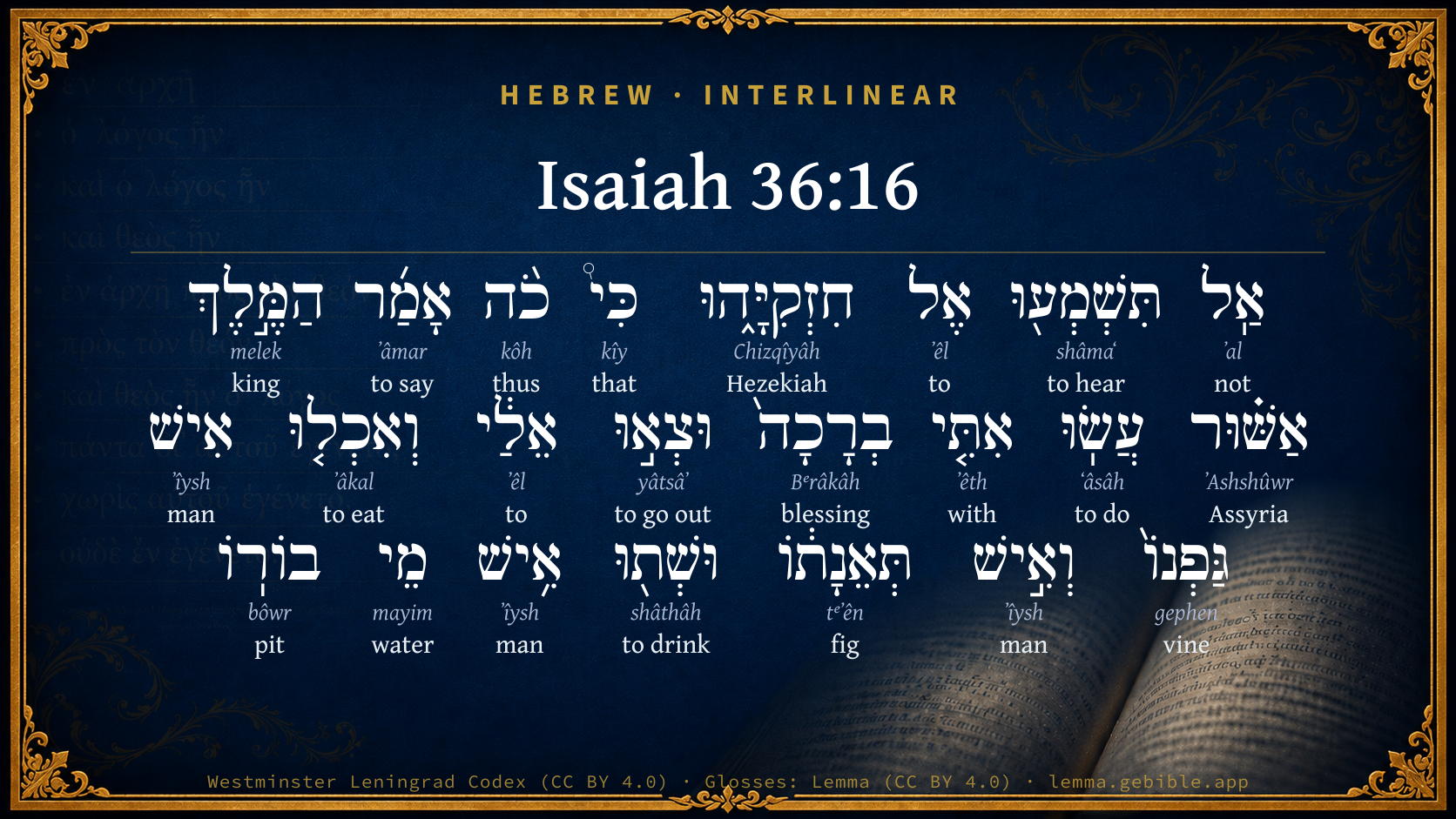
Hebrew (Westminster Leningrad Codex) Isaiah 36:16 appears in the Hebrew Old Testament. The text above is from the Westminster Leningrad Codex. Each word links to its Strong’s number, a concise gloss, and parsing drawn from the Open Scriptures Hebrew Bible morphology. Click any word for its full Brown-Driver-Briggs (BDB) entry.
Download image
Cite this verse

Isaiah 36:16 (World English Bible). Public Domain. Lemma interlinear Bible study tool, https://lemma.gebible.app/v/isaiah/36/16.

Show BibTeX & RIS
BibTeX
RIS
English Translation
Don't listen to Hezekiah: for thus says the king of Assyria, Make your peace with me, and come out to me; and eat you everyone of his vine, and everyone of his fig tree, and drink you everyone the waters of his own cistern;
World English Bible · Public Domain
Download a study sheet

One document with this verse’s original text, its word-by-word gloss line, the meaning frame, cross-references with their text, attributed commentary, and full source and license credits — printable, and it pastes into notes with its structure intact.

This verse Autodidact and up

Study sheet (.html) Plain text (.txt)

A passage Seminary Student

Up to 50 verses in one chapter. A passage sheet keeps up to 6 commentary sources and 12 cross-references per verse, in the order this page ranks them, and says so on the sheet whenever that leaves anything out. Ask for a single verse and you get the Autodidact verse sheet above.

Everything on this page stays free to read, with no account — the sheet is a download of what is already on screen, not access to it.

Want to remove ads? Support Godless Engineer
Compare translations 3

The same verse in 3 English versions, stacked beneath the original-language interlinear above. Click any original word for its lexicon entry.

Each is an independent rendering of the whole verse — the interlinear is not word-aligned to these translations.

Highlighted words mark where these versions differ — a whole-verse word diff, not a word-by-word alignment.

  • World English Bible Public Domain
    Don't listen to Hezekiah: for thus says the king of Assyria, Make your peace with me, and come out to me; and eat you everyone of his vine, and everyone of his fig tree, and drink you everyone the waters of his own cistern;
  • King James Version Public Domain
    Hearken not to Hezekiah: for thus saith the king of Assyria, Make an agreement with me by a present, and come out to me: and eat ye every one of his vine, and every one of his fig tree, and drink ye every one the waters of his own cistern;
  • unfoldingWord Literal Text CC BY-SA 4.0
    May you not listen to Hezekiah, for thus says the king of Assyria: ‘Make a blessing with me, and come out to me, and eat, a man of his vine and a man of his fig tree, and drink, a man the waters of his well,

unfoldingWord Literal Text — © unfoldingWord, licensed CC BY-SA 4.0. Word-aligned USFM3 via Door43 (git.door43.org/unfoldingWord/en_ult).

Versions to compare (up to 4)

3 of 4 selected

Show all 18 translations

Every available English version of this verse, each an independent rendering of the whole verse.

  • World English Bible Public Domain
    Don't listen to Hezekiah: for thus says the king of Assyria, Make your peace with me, and come out to me; and eat you everyone of his vine, and everyone of his fig tree, and drink you everyone the waters of his own cistern;
  • Berean Standard Bible Public Domain
    Do not listen to Hezekiah, for this is what the king of Assyria says: Make peace with me and come out to me. Then every one of you will eat from his own vine and his own fig tree, and drink water from his own cistern,
  • Majority Standard Bible Public Domain
    Do not listen to Hezekiah, for this is what the king of Assyria says: Make peace with me and come out to me. Then every one of you will eat from his own vine and his own fig tree, and drink water from his own cistern,
  • King James Version Public Domain
    Hearken not to Hezekiah: for thus saith the king of Assyria, Make an agreement with me by a present, and come out to me: and eat ye every one of his vine, and every one of his fig tree, and drink ye every one the waters of his own cistern;
  • American Standard Version (1901) Public Domain
    Hearken not to Hezekiah: for thus saith the king of Assyria, Make your peace with me, and come out to me; and eat ye every one of his vine, and every one of his fig-tree, and drink ye every one the waters of his own cistern;
  • Revised Version (1885) Public Domain
    Hearken not to Hezekiah: for thus saith the king of Assyria, Make your peace with me, and come out to me; and eat ye every one of his vine, and every one of his fig tree, and drink ye every one the waters of his own cistern:
  • Geneva Bible (1599) Public Domain
    Hearken not to Hezekiah: for thus sayth the King of Asshur, Make appointment with me, and come out to me, that euery man may eate of his owne vine, and euery man of his owne fig tree, and drinke euery man the water of his owne well,
  • Douay-Rheims (1899) Public Domain
    Do not hearken to Ezechias: for thus said the king of the Assyrians: Do with me that which is for your advantage, and come out to me, and eat ye every one of his vine, and every one of his dg tree, and drink ye every one the water of his cistern,
  • Young's Literal Translation Public Domain
    `Do not hearken unto Hezekiah, for thus said the king of Asshur, Make ye with me a blessing, and come out unto me, and eat ye each of his vine, and each of his fig-tree, and drink ye each the waters of his own well,
  • Literal Standard Version CC BY-SA 4.0
    Do not listen to Hezekiah, for thus said the king of Asshur: Make a blessing with me, and come out to me, and each of you eat of his vine, and each of his fig tree, and each drink the waters of his own well,
  • Unlocked Literal Bible CC BY-SA 4.0
    Do not listen to Hezekiah, for this is what the king of Assyria says: 'Make peace with me and come out to me. Then every one of you will eat from his own vine and from his own fig tree, and drink from the water in his own cistern.
  • unfoldingWord Literal Text CC BY-SA 4.0
    May you not listen to Hezekiah, for thus says the king of Assyria: ‘Make a blessing with me, and come out to me, and eat, a man of his vine and a man of his fig tree, and drink, a man the waters of his well,
  • Darby Bible Public Domain
    Hearken not to Hezekiah; for thus says the king of Assyria: Make peace with me and come out to me; and eat every one of his vine, and every one of his fig-tree, and drink every one the waters of his own cistern;
  • World Messianic Bible Public Domain
    Don’t listen to Hezekiah, for the king of Assyria says, ‘Make your peace with me, and come out to me; and each of you eat from his vine, and each one from his fig tree, and each one of you drink the waters of his own cistern;
  • Webster's Bible Public Domain
    Hearken not to Hezekiah: for thus saith the king of Assyria, Make an agreement with me by a present, and come out to me: and eat ye every one of his vine, and every one of his fig-tree, and drink ye every one the waters of his own cistern;
  • Free Bible Version CC BY-SA 4.0
    Don't listen to Hezekiah. This is what the king says: Make a peace treaty with me and surrender to me. That way everyone will eat from their own vine and their own fig tree, and drink water from their own well!
  • Bible in Basic English Public Domain
    Do not give ear to Hezekiah, for this is what the king of Assyria says, Make peace with me, and come out to me; and everyone will be free to take the fruit of his vine and of his fig-tree, and the water of his spring;
  • JPS Tanakh (1917) Public Domain
    Hearken not to Hezekiah; for thus saith the king of Assyria: Make your peace with me, and come out to me; and eat ye every one of his vine, and every one of his fig-tree, and drink ye every one the waters of his own cistern;

Literal Standard Version (2020), Covenant Press — licensed CC BY-SA 4.0. Text via the HelloAO Bible API (eBible.org). Unlocked Literal Bible (unfoldingWord) — licensed CC BY-SA 4.0. Text via the HelloAO Bible API (eBible.org). unfoldingWord Literal Text — © unfoldingWord, licensed CC BY-SA 4.0. Word-aligned USFM3 via Door43 (git.door43.org/unfoldingWord/en_ult). Free Bible Version, Dr. Jonathan Gallagher — licensed CC BY-SA 4.0. Text via the HelloAO Bible API (eBible.org).

Word by word

More ways to search: Search by grammar → Find every occurrence → Compare this word →

Practice this passage: Drill this verse → Learn its vocabulary →

תְּאֵנָת֔וֹ
tᵉʼên
H8384
“fig · his”
Noun, Common, Feminine, Singular, Construct + Suffix, Personal, 3rd Person, Masculine, Singular
Part of Speech
Noun
Type
Common
Gender
Feminine
Number
Singular
State
Construct
Full BDB Definition

Origin: perhaps of foreign derivation

TWOT: 2490

fig, fig tree
  1. אַֽל ʼal H408 “not” Particle, Negative
  2. תִּשְׁמְע֖וּ shâmaʻ H8085 “to hear” Verb, Qal, Jussive, 2nd Person, Masculine, Plural
  3. אֶל ʼêl H413 “to” Preposition
  4. חִזְקִיָּ֑הוּ Chizqîyâh H2396 “Hezekiah” Noun, Proper
  5. כִּי֩ kîy H3588 “that” Conjunction
  6. כֹ֨ה kôh H3541 “thus” Adverb
  7. אָמַ֜ר ʼâmar H559 “to say” Verb, Qal, Perfect, 3rd Person, Masculine, Singular
  8. הַמֶּ֣לֶךְ melek H4428 “the · king” Particle, Definite Article + Noun, Common, Masculine, Singular, Absolute
  9. אַשּׁ֗וּר ʼAshshûwr H804 “Assyria” Noun, Proper
  10. עֲשֽׂוּ ʻâsâh H6213 “do” Verb, Qal, Imperative, 2nd Person, Masculine, Plural
  11. אִתִּ֤י ʼêth H854 “with · me” Preposition + Suffix, Personal, 1st Person, Common, Singular
  12. בְרָכָה֙ Bᵉrâkâh H1293 “blessing” Noun, Common, Feminine, Singular, Absolute
  13. וּצְא֣וּ yâtsâʼ H3318 “and · go out” Conjunction + Verb, Qal, Imperative, 2nd Person, Masculine, Plural
  14. אֵלַ֔י ʼêl H413 “to · me” Preposition + Suffix, Personal, 1st Person, Common, Singular
  15. וְאִכְל֤וּ ʼâkal H398 “and · eat” Conjunction + Verb, Qal, Imperative, 2nd Person, Masculine, Plural
  16. אִישׁ ʼîysh H376 “man” Noun, Common, Masculine, Singular, Absolute
  17. גַּפְנוֹ֙ gephen H1612 “vine · his” Noun, Common, Both, Singular, Construct + Suffix, Personal, 3rd Person, Masculine, Singular
  18. וְאִ֣ישׁ ʼîysh H376 “and · man” Conjunction + Noun, Common, Masculine, Singular, Absolute
  19. וּשְׁת֖וּ shâthâh H8354 “and · drink” Conjunction + Verb, Qal, Imperative, 2nd Person, Masculine, Plural
  20. אִ֥ישׁ ʼîysh H376 “man” Noun, Common, Masculine, Singular, Absolute
  21. מֵי mayim H4325 “water(s) of” Noun, Common, Masculine, Plural, Construct
  22. בוֹרֽוֹ bôwr H953 “pit · his” Noun, Common, Masculine, Singular, Construct + Suffix, Personal, 3rd Person, Masculine, Singular

About this verse

These counts appear in no published source. They are computed here, from the morphology-tagged text and Lemma’s own curated glosses. What Lemma adds →

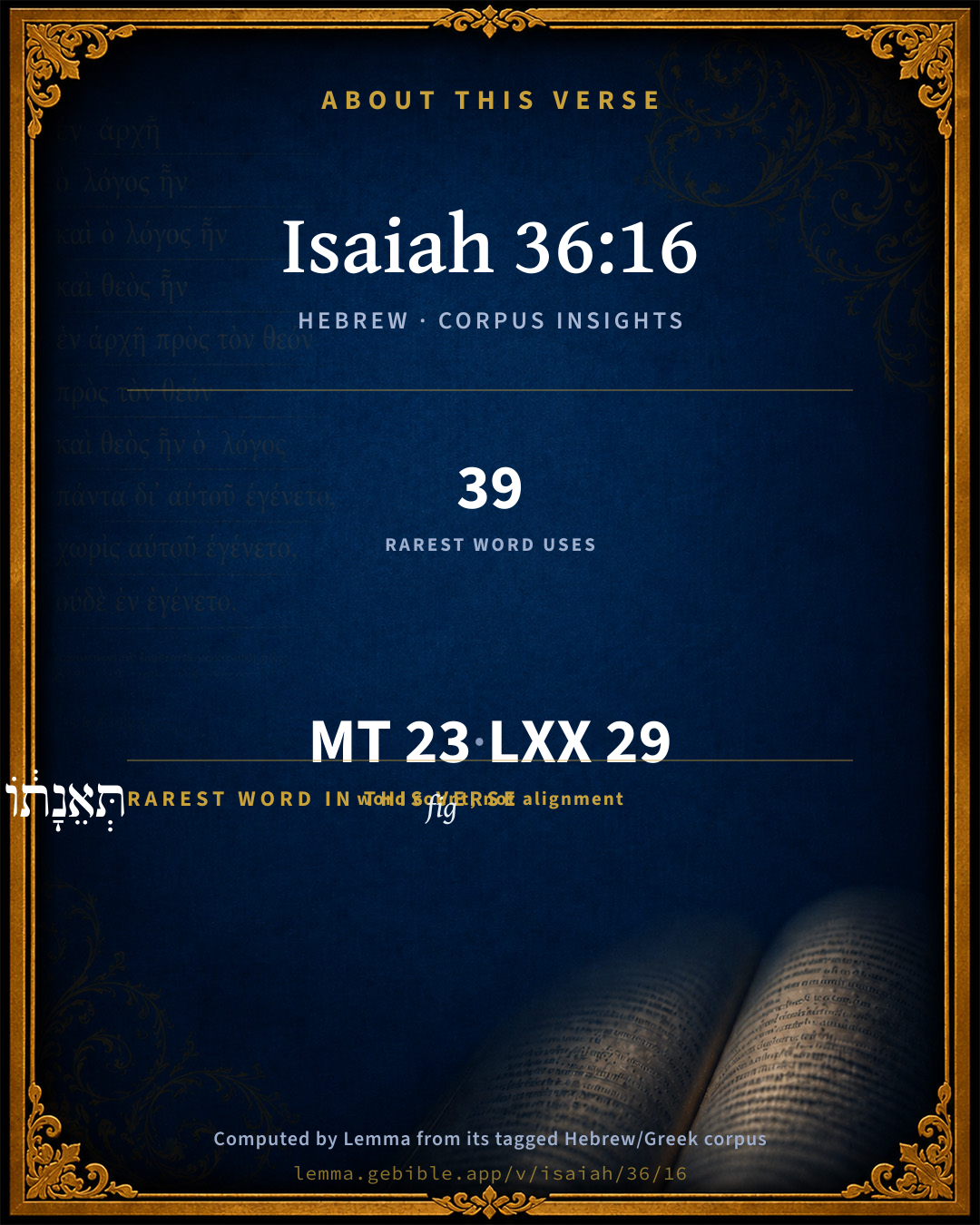
23
words
20
distinct lemmas
Prophets
section

Shared distinctive vocabulary

תְּאֵנָת֔וֹ fig H8384 occurs in 35 verses of the Hebrew Bible. Also found in:

Grammatical profile

  • 6 verbs
  • 11 nouns
  • 3 prepositions
  • 1 conjunction
  • 1 adverb
  • 1 particle

Verb forms

  • תִּשְׁמְע֖וּ Qal · Jussive
  • אָמַ֜ר Qal · Perfect
  • עֲשֽׂוּ Qal · Imperative
  • וּצְא֣וּ Qal · Imperative
  • וְאִכְל֤וּ Qal · Imperative
  • וּשְׁת֖וּ Qal · Imperative

Repetition

Words recur within this verse — often emphatic in Hebrew:

  • אִישׁ man H376 ×3
  • אֶל to H413 ×2

Hebrew & Septuagint length

In English translation the verse runs 44 words from the Hebrew and 43 from the Septuagint (LXX English) — closely comparable.

A rough comparison of the two English renderings, which tokenize alike — not a word-level alignment.

Word counts can differ between the Hebrew and the Greek without any difference in meaning — e.g. the Hebrew direct-object marker אֵת has no separate Greek word, and Greek often adds the article ὁ.

In the original languages it is 23 Hebrew tokens and 29 Greek tokens — but the two are counted differently (Hebrew bundles its prefixes and suffixes into one token; the Greek is in lemma form), so that isn’t a like-for-like length.

Cross-references

14

Topical passages linked to Isaiah 36:16 in the Treasury of Scripture Knowledge — connected by theme and wording, ordered by reader-vote popularity; previews shown in the World English Bible.

  • 1 Kings 4:25 Judah and Israel lived safely, every man under his vine and under his fig tree, from Dan even to Beersheba, all the days of Solomon.
  • Zechariah 3:10 In that day,' says Yahweh of hosts, 'you will invite every man his neighbor under the vine and under the fig tree.'"
  • Micah 4:4 But they will sit every man under his vine and under his fig tree; And no one will make them afraid: For the mouth of Yahweh of Hosts has spoken.
  • Genesis 32:20 You shall say, 'Not only that, but behold, your servant, Jacob, is behind us.'" For, he said, "I will appease him with the present that goes before me, and afterward I will see his face. Perhaps he will accept me."
  • Genesis 33:11 Please take the gift that I brought to you; because God has dealt graciously with me, and because I have enough." He urged him, and he took it.
  • 1 Samuel 11:3 The elders of Jabesh said to him, Give us seven days' respite, that we may send messengers to all the borders of Israel; and then, if there be none to save us, we will come out to you.
  • 1 Samuel 25:27 Now this present which your servant has brought to my lord, let it be given to the young men who follow my lord.
  • 2 Samuel 8:6 Then David put garrisons in Syria of Damascus; and the Syrians became servants to David, and brought tribute. Yahweh gave victory to David wherever he went.
  • 1 Kings 4:20 Judah and Israel were many as the sand which is by the sea in multitude, eating and drinking and making merry.
  • 2 Kings 5:15 He returned to the man of God, he and all his company, and came, and stood before him; and he said, See now, I know that there is no God in all the earth, but in Israel: now therefore, please take a present from your servant.
  • 2 Kings 18:31 Don't listen to Hezekiah: for thus says the king of Assyria, Make your peace with me, and come out to me; and eat you everyone of his vine, and everyone of his fig tree, and everyone drink the waters of his own cistern;
  • 2 Kings 24:12–16 and Jehoiachin the king of Judah went out to the king of Babylon, he, and his mother, and his servants, and his princes, and his officers: and the king of Babylon took him in the eighth year of his reign.
  • Proverbs 5:15 Drink water out of your own cistern, Running water out of your own well.
  • 2 Corinthians 9:5 I thought it necessary therefore to entreat the brothers that they would go before to you, and arrange ahead of time the generous gift that you promised before, that the same might be ready as a matter of generosity, and not of greediness.

Cross-references courtesy of OpenBible.info (CC BY 4.0).

Hebrew and Greek witnesses Masoretic Hebrew ↔ Greek Septuagint

The same verse in the two great witnesses to the Old Testament, shown verse-for-verse.

These are two independent witnesses, not word-aligned to each other, and the Septuagint is shown in lemma (dictionary) form.

Hebrew Isaiah 36:16 Masoretic · Westminster Leningrad Codex

אַֽל תִּשְׁמְע֖וּ אֶל חִזְקִיָּ֑הוּ כִּי֩ כֹ֨ה אָמַ֜ר הַמֶּ֣לֶךְ אַשּׁ֗וּר עֲשֽׂוּ אִתִּ֤י בְרָכָה֙ וּצְא֣וּ אֵלַ֔י וְאִכְל֤וּ אִישׁ גַּפְנוֹ֙ וְאִ֣ישׁ תְּאֵנָת֔וֹ וּשְׁת֖וּ אִ֥ישׁ מֵי בוֹרֽוֹ

Don't listen to Hezekiah: for thus says the king of Assyria, Make your peace with me, and come out to me; and eat you everyone of his vine, and everyone of his fig tree, and drink you everyone the waters of his own cistern;

World English Bible · Public Domain

Greek LXX Isaiah 36:16 Septuagint · lemma form

μή ἀκούω εζεκιας ὅδε λέγω ὁ βασιλεύς ἀσσύριος εἰ βούλομαι εὐλογέω ἐκπορεύομαι πρός ἐγώ καί ἐσθίω ἕκαστος ὁ ἄμπελος αὐτός καί ὁ συκῆ καί πίνω ὕδωρ ὁ λάκκος σύ

Listen not to Ezekias: thus says the king of the Assyrians, If you⌃ wish to be blessed, come out to me: and you⌃ shall eat every one of his vine and his fig-trees, and you⌃ shall drink water out of your own cisterns:

LXX2012 (modern English Septuagint) · Public Domain

On this verse, John Gill's Exposition discusses the Septuagint’s reading. Read the note in Commentary ↓

Hebrew: Westminster Leningrad Codex (CC BY 4.0). Greek: Septuagint (public domain); English from LXX2012 (modern English Septuagint) (Public Domain). How the Septuagint differs from the Hebrew →

Targum (Aramaic paraphrase)

1

The Targum is the ancient Jewish Aramaic paraphrase of the Hebrew Scriptures — an interpretive translation, not the Hebrew text itself. Onkelos (literal) and Pseudo-Jonathan (expansive) render the Torah, and Jonathan the Prophets. Coverage is partial: where no permissively-licensed English translation exists for a verse, only the Aramaic is shown. This is verse-level text, not a word-by-word alignment to the Hebrew.

  1. Targum Jonathan Prophets (Joshua–Malachi)
    לָא תְקַבְּלוּן מִן חִזְקִיָה אֲרֵי כִדְנַן אֲמַר מַלְכָּא דְאַתּוּר עַבִידוּ עִמִי שְׁלָמָא וּפוּקוּ לְוָתִי וֶאֱכוּלוּ גְבַר פֵּרֵי גוּפְנוֹהִי וּגְבַר פֵּרֵי תֵינוֹהִי וּשְׁתוּ גְבַר מֵי גוּבֵהּ:

    Hearken not to Hezekiah: for thus saith the king of Assyria, Make peace with me, and, come out to me: and eat ye every one of the fruit of his fig tree, and drink ye every one of the waters of his cistern;

    Targum Jonathan — Aramaic: “Mikraot Gedolot” (public domain). English: “Sefaria Community Translation” (CC0 1.0 (public-domain dedication)); “London "Chaldee Paraphrase," 1871” (public domain). Text via Sefaria.

Commentary

Notes on Isaiah 36:16 from classic Christian and Jewish commentators (each source and its license shown beneath its notes). The classic Christian expositions comment on the surrounding passage and are grouped to its opening verse, so a note may address several verses; the Jewish commentaries on the Tanakh (Rashi and others) are per-verse, so they appear only where the commentator wrote on this verse.

Lemma curates 59 commentaries, every one of them public domain or Creative Commons licensed, each selected and text-cleaned for this edition rather than reprinted as found. About our sources →

Tyndale Open Study Notes

Tyndale Open Resources

36:16-17 The Assyrian was tempting the people of Jerusalem with provisions that the Lord had promised to provide his obedient people (see 1:19; 37:30-35; Deut 8:7-9). It was a tempting offer, but a counterfeit. And it covered up the reality of exile that would have followed (Isa 36:17).

Tyndale Open Study Notes — © Tyndale Open Resources, licensed CC BY-SA 4.0. Text via the HelloAO Bible API.

Geneva Bible (1599)

Geneva Bible translators

The Hebrew word signifieth blessing, whereby this wicked captain would have persuaded the people, that their condition should be better under Sennacherib than under Hezekiah.

Geneva Bible (1599) marginal notes — public domain. Text via Bolls.life.

Jamieson, Fausset & Brown

Robert Jamieson, A. R. Fausset & David Brown

agreement . . . by . . . present--rather, "make peace with me"; literally, "blessing" so called from the mutual congratulations attending the ratification of peace. So Chaldee. Or else, "Do homage to me" [HORSLEY].

come out--surrender to me; then you may remain in quiet possession of your lands till my return from Egypt, when I will lead you away to a land fruitful as your own. Rab-shakeh tries to soften, in the eyes of the Jews, the well-known Assyrian policy of weakening the vanquished by deporting them to other lands (Gen 47:21; Kg2 17:6).

Jamieson, Fausset & Brown — Commentary Critical and Explanatory on the Whole Bible (1871) — public domain (CC PDM 1.0). Text via the HelloAO Bible API.

Adam Clarke's Commentary

Verse 16. Make an agreement] ברכה berachah, make a blessing with me; i.e., Give me a ransom for the city, and I will not destroy it; give me the yearly tribute thou hast promised.

Adam Clarke's Commentary on the Bible (1810–1826) — public domain. Text from a community e-Sword/MySword module.

The Cambridge Bible for Schools and Colleges

gen. ed. J. J. S. Perowne

16. Make an agreement with me by a present] R.V. Make peace with me. Lit. “Make to me a blessing” (see R.V. marg.). The expression does not occur elsewhere, and its exact sense is doubtful. Probably “make peaceful submission to me.”

come out to me] The ordinary phrase for the surrender of a city (1Sa_11:3; Jer_21:9, &c.). and eat] that ye may eat. If they will but yield now, they may at once resume the cultivation of their fields and orchards.

The Cambridge Bible for Schools and Colleges (gen. ed. J. J. S. Perowne; Cambridge University Press, 1878–1918) — public domain. Text from a community e-Sword module.

John Gill's Exposition

Hearken not to Hezekiah,.... To his exhortations and persuasions to trust in the Lord; nor would he have them obey him in things civil, any more than hearken to him in things sacred, though their liege lord and sovereign; for his view and endeavour were to stir them up to mutiny and rebellion; and so the Targum,

"do not obey Hezekiah:''

or receive any orders from him, or pay any regard to them:

for thus saith the king of Assyria, make an agreement with me by a present; or, "make a blessing with me" (i); either send a large and liberal gift to secure his favour, and their happiness; a most insolent and unrighteous demand this, when he had already received three hundred talents of silver, and thirty talents of gold, to withdraw his army; or make a blessed peace with me; suggesting that it would turn more to their account to give up themselves to him, than to be in the condition they were; so the Targum,

"make peace with me:''

this sense Ben Melech gives; and the Septuagint version is, "if ye would be blessed" (k), or happy,

come out to me; forsake your king, throw off your allegiance to him, surrender yourselves and city to me:

and eat ye everyone of his vine, and everyone of his fig tree: and drink ye everyone the waters of his own cistern; promising liberty and property, but does not tell them how long they should enjoy them; he signifies that they should enjoy everything that was necessary, convenient, and delightful; vines and fig trees are mentioned, because common in Judea, and all had cisterns near them for their use; unless this last clause is to be understood of everyone having their own wives; see Pro 5:15 as the other clauses may design the enjoyment of their estates and possessions, without any molestation or infringement of them; see Mic 4:4.

(i) "facit mecum benedictionem", V. L. Pagninus, Montanus. (k) , Sept.

John Gill's Exposition of the Whole Bible (1746–1763) — public domain (CC PDM 1.0). Text via the HelloAO Bible API.

Albert Barnes' Notes on the Bible

Hearken not to Hezekiah - Do not listen to his entreaties to confide in him, and in Yahweh; do not unite with him in endeavoring to make any resistance or opposition to us.

Make an agreement with me by a present - The Septuagint read this, Ει ̓ βούλεσθε εὐλογηθῆναι Ei boulesthe eulogēthēnai - ‘If you wish to be blessed, or happy, come out to me.’ The Hebrew is literally, ‘Make with me a blessing’ (ברכה berâkâh). The idea of its being done ‘by a present,’ is not in the Hebrew text. The word ‘blessing’ here probably means the same as peace. ‘Make peace with me,’ perhaps because peace was regarded as a blessing; and perhaps the word is used with a reference to one of the significations of: ברך bārak, which is to kneel down, and this word may refer to their kneeling down; that is, to their offering allegiance to the king of Assyria. The former is, however, the more probable sense, that the word means peace, because this was an evident blessing, or would be the source of rich blessings to them. It is not, however, used in this sense elsewhere in the Bible. The Chaldee renders it, ‘Make peace (שׁלמא shālâmâ') with me.’

And come out to me - Surrender yourselves to me. It is evident, however, that he did not mean that be would then remove them from their city and country, but he demanded a surrender, intending to come and remove them at some other period Isa 36:17.

And eat ye every one of his own vine - An emblem of safety, when every man might be permitted to partake of the fruit of his own labor. All that he now professed to desire was, that they should surrender the city, and give up their means of defense, and then he would leave them in security and quietness, until it should please his master to come and remove them to a land as fertile as their own.

And drink ye every one - Another emblem of security and happiness. This promise was made to induce them to surrender. On the one hand, he threatened them with the dreadful evils of famine if they refused and allowed their city to be besieged Isa 36:12; and on the other, he promised them, for a time at least, a quiet and secure residence in their own city, and then a removal to a land not inferior to their own.

Albert Barnes' Notes on the Bible (1834–1885) — public domain. Text from a community e-Sword/MySword module.

The Pulpit Commentary

Make an agreement with me by a present; literally, make a blessing with me. Delitzsch paraphrases, "Enter into a connection of mutual good wishes with me." Vance Smith translates boldly, "Make peace with me;" and Mr. Cheyne, "Make a treaty with me." There seems to be no doubt that brakah, besides its primary sense of "blessing," had two secondary senses, "present" and "treaty." Here "treaty" is no doubt intended. Come out to me; i.e. "come out of Jerusalem, and surrender yourselves". (comp 1Sa_11:3 Jer_38:17) And eat ye... drink ye. Peace being made, the Jews could leave the protection of their walled cities, and disperse themselves over their lands, where they could live in plenty and security, (comp. 1Ki_4:25) at any rate for a time. They would be safe front the terrible extremities hinted at in ver. 12, and might confidently await the great king"s ultimate disposal of them, which would be determined widen the war in these parts was over. The waters of his own cistern; rather, of his own well. All cultivators had wells in their plots of ground. Cisterns, or reservoirs, in which the rain-water was stored, were comparatively uncommon.

Vers. 16, 17. The invitation of the enemy.

The King of Assyria, by the mouth of his general, appeals to the citizens of Jerusalem to abandon their allegiance to Hezekiah. and "go out to him," promising them great advantages for their disloyalty. It is closely analogous to the invitation of our spiritual enemy to go over to him and receive the wages of sin which he offers to our souls.

I IT IS A VERY PLAUSIBLE OFFER.

1. Under the circumstances in which they then were, loyalty was threatened with decided disadvantage:

(1) with privation, for there was the probability of a long siege and its attendant scarcities;

(2) with suffering, or even death, for attacks would be made and missiles would be hurled against the city.

2. On the other hand, surrender promised material good:

(1) present exemption from exigency and assault (ver. 16); and

(2) abundance of comfort in future days (ver. 17). So is it in the spiritual realm. Our great Adversary seeks to allure us from the true citizenship, and he has a plausible proposal to make. He says

(1) that to serve God is to suffer loss; is to be shut out from many sources of wealth and joy; is to be starved and beggared; is to be exposed to the dislike, the derision, the hostile action of those who are the strongest and most numerous among men. He says also

(2) that to be on the side of evil is to be in the way of prosperity; that its land is "a land of corn and wine," of strength and joy, of material prosperity and sensual enjoyment: be selfish and unscrupulous, and the prizes of life and the pleasures of sense are yours. But in regard to each of these proposals, the historical and the existing, it must be considered that

II IT IS ESSENTIALLY FALSE.

1. Rabshakeh and his royal master were both mistaken in their calculations. Jerusalem was not to be reduced to the severe straits of a protracted siege, was not to be taken by assault; neither want nor sword was to devastate the city. And they left the most important consideration out of their account; for even if their military projects had succeeded, and if the Jews had been defeated and]lad found the plains of the Tigris as fruitful as the valley of the Jordan, yet would they have missed and mourned the liberty, the sacred services, the natural independence of their own beloved country, they would have hung their harps upon the willows, instead of making them sound the joyous strains of patriotism and piety.

2. Our spiritual enemy is also essentially wrong in his representations; he, too, leaves the principal considerations out of his reckoning.

(1) All that we lose by our loyalty to God is that which no wise man would accept iniquitous gain, injurious friendship, demoralizing pleasure, etc.; it is well, indeed, to be without these.

(2) All that we could gain by subservience to his unholy will would leave us unblessed with the true riches with the favour and friendship of God, with a sense of moral and spiritual integrity, with the power of rendering holy service to our kind, with the joy of sacred intercourse with a Divine Redeemer and with like-minded fellow-servants, with the elevating and sustaining hopes that "enter within the veil. C.

Security of stable government.

"The fig tree affords a thick shade, and is, on this account, a favourite resort of the family, where they may often be seen seated on mats, partaking of a meal or entertaining friends. The expression, "to sit under one"s own vine and fig tree," denotes at once security, domestic enjoyment, and competence." The expression is either a common Eastern, proverb, or the Rabshakeh takes up the language of the people he addresses, in his chaffing, taunting, satirical way. The sentence and figure are found also in 1Ki_4:25 Zec_3:5. Mr. Thomas Jenner, writing of a dwelling just outside Jerusalem, says, "Mr. Azam"s house is approached through a gateway of considerable width, from which to the door a broad path leads through the garden. This path is spanned by a wooden trellis, upon which a vine is trained, and at the time of our visit delicious grapes were hanging from it. As I contemplated this scene from within doors, or took the morning and evening air, sauntering between gate and door, I could but recall this striking figure of security and peace." The point before us is, that the Rabshakeh promises the people that safety which comes from the rule of a strong and stable government. He scarcely veils his taunts at the parties and political commotions which were destroying the sense of security, and making foreign complications, for the people of Judah. We too seldom realize the importance of strong, stable government in a country. It may be illustrated in the following directions.

I STABLE GOVERNMENT CHECKS PARTY FEELING. If the government be weak, its enemies are active, public opinion is kept agitated, demagogues appear and exaggerate public disabilities and public claims. Men are diverted from their proper pursuits to engage in political wrangle; the relationships of life are embittered by party divisions; and valuable national time is lost in unprofitable contentions. If the government be strong, the anarchical forces subside. Blessed is the land that is generally free from political strife.

II STABLE GOVERNMENT VIGOROUSLY REPRESSES EVILDOERS. And on this the security and prosperity of a country most directly depends. Business can only be carried on where there is security for property and security for rights. Illustrate from the condition of Israel when "there was no king in the land, and every one did that which was right in his own eyes.

III STABLE GOVERNMENT CAN ENCOURAGE THE ARTS OF PEACE AND ACCOMPLISH JUDICIOUS REFORMS. It holds foreign relations with firm band, and so preserves peace. It can crush the agitator and heed the reformer. Spared from contention, it has time and means for aiding internal development. And it can stand by and preserve the liberties of those who, in a thousand ways, would spread among the people the knowledge of the true God and the eternal life. Therefore every good Christian and good citizen should strengthen the government of his day. "The powers that be are ordained of God. R.T.

The Pulpit Commentary (1880–1919), ed. H.D.M. Spence-Jones & Joseph S. Exell — public domain. Text from a community e-Sword module.

J. A. Alexander on Isaiah

Joseph Addison Alexander

“Hearken not to Hezekiah, for thus saith the king of Assyria, make with me a blessing, and come out unto me, and eat ye (every) man his own vine and (every) man his own fig-tree, and drink ye (every) man the waters of his own cistern.” Some explain the phrase here used, ‘make me a present’ or ‘make an agreement with me by a present’. It is possible, however, to adhere more closely to the usage of the term, by taking blessing in the sense of friendly salutation, which in the east is commonly an invocation of the divine blessing. Thus the verb to bless is often used to express the act of greeting or of taking leave. To make a blessing with one then might mean to enter into amicable intercourse. To ‘come out’ is in Hebrew the common military phrase for the surrender of a besieged town. The inducements offered in the last clause are in obvious antithesis to the revolting threat or warning in the last clause of v. 12. To eat the vine and fig tree (meaning to eat their fruit) is an elliptical form of speech, which has its analogies in every language.

Joseph Addison Alexander, The Prophecies of Isaiah (1846–1847; New York: Scribner, 1870–1878) — public domain. Text from a community e-Sword module.

unfoldingWord translationNotes

Door43 World Missions Community

General Information:

The chief commander continues speaking to the people of Judah.

Make peace with me

This idiom means to agree officially to act peacefully towards one another. AT: "Let us agree to have peace" (See: Idiom)

come out to me

This idiom means to surrender. AT: "surrender to me" (See: Idiom)

until I come and take

Here the king of Assyria is referring to his army as himself. AT: "until my army comes and takes" (See: Metonymy)

a land of grain and new wine, a land of bread and vineyards

These two phrase have the same meaning and are used together to emphasize how prosperous the land will be. (See: Parallelism)

a land of grain ... a land of bread

This means that they land is full of natural resources, such as grain. AT: "a land where there is plenty of grain ... a land where there is plenty of bread" (See: Possession)

translationWords

Hezekiah

king

Assyria

peace

vine

fig

water

grain

wine

bread

vineyard

unfoldingWord translationNotes — © Distant Shores Media and the Door43 World Missions Community, licensed CC BY-SA 4.0. Source: git.door43.org/Door43/en_tn.

Rashi

Rabbi Shlomo Yitzchaki (Rashi)

Make peace with me (בְרָכָה, lit., a blessing.) Come out to me for peace and greet me and bring me a gift of peace.

בְּרָכָה is saloud in O.F., salutation. Comp. (Gen. 47:10) “And Jacob greeted Pharaoh.”

and each man will eat of his vine And I will leave you, and dwell in peace until I find a land as good as your land, and I will exile you there, for so is my wont, to transfer nations from land to land, as it is said (supra 10:13): “And I remove the boundaries of the peoples.”

Rashi on the Tanakh — English translations: “The Judaica Press complete Tanach with Rashi, translated by A. J. Rosenberg” (CC BY 4.0); “Pentateuch with Rashi's commentary by M. Rosenbaum and A.M. Silbermann, 1929-1934” (public domain); “The Metsudah Tanach series, Lakewood, N.J” (CC BY 4.0); and “The Book of Joshua, Metsudah Publications, 1997” (CC BY 4.0). Text via Sefaria.

Lesson kit

Teaching starters — assembled from the data on this page, not authored interpretation. Every prompt links to the verse data it draws on. Edit before teaching.

Isaiah, in the Prophets, opens this verse with 23 words (20 distinct Hebrew lemmas). Its most distinctive word is tᵉʼên (“fig”). A historical commentator’s framing appears above. Read the whole chapter for the surrounding context.

Discussion questions

  1. What does “fig” (tᵉʼên) contribute to the verse as a whole?
  2. How does Genesis 3:7, which shares the word «fig», read alongside this verse?
  3. What does the repetition of “man” (3× in this one verse) do in this verse?
  4. The translations on this page render this verse differently — a whole-verse word diff, not a word-by-word alignment. What might account for the different wordings?
  5. «תִּשְׁמְע֖וּ» is a Qal Jussive verb. How does that grammatical form shape the action described?
  6. Compare how Tyndale Open Study Notes and Geneva Bible (1599) read this verse. Where do they agree or differ?

Things to notice

Reading settings

Reading text

Shown beneath each verse's original-language words.

Old Testament
Old Testament edition

Read the OT as the Masoretic Hebrew (MT) or the Greek Septuagint (LXX).

English shown for the Greek Septuagint (in the Hebrew ↔ Greek comparison).

Comparing translations? Open the Compare panel on any verse page to stack up to four side by side.