
Zephaniah 1:13

Hebrew (Westminster Leningrad Codex) Zephaniah 1:13 appears in the Hebrew Old Testament. The text above is from the Westminster Leningrad Codex. Each word links to its Strong’s number, a concise gloss, and parsing drawn from the Open Scriptures Hebrew Bible morphology. Click any word for its full Brown-Driver-Briggs (BDB) entry.
Download image
Cite this verse

Zephaniah 1:13 (World English Bible). Public Domain. Lemma interlinear Bible study tool, https://lemma.gebible.app/v/zephaniah/1/13.

Show BibTeX & RIS
BibTeX
RIS
English Translation
Their wealth will become a spoil, and their houses a desolation. Yes, they will build houses, but won't inhabit them. They will plant vineyards, but won't drink their wine.
World English Bible · Public Domain
Download a study sheet

One document with this verse’s original text, its word-by-word gloss line, the meaning frame, cross-references with their text, attributed commentary, and full source and license credits — printable, and it pastes into notes with its structure intact.

This verse Autodidact and up

Study sheet (.html) Plain text (.txt)

A passage Seminary Student

Up to 50 verses in one chapter. A passage sheet keeps up to 6 commentary sources and 12 cross-references per verse, in the order this page ranks them, and says so on the sheet whenever that leaves anything out. Ask for a single verse and you get the Autodidact verse sheet above.

Everything on this page stays free to read, with no account — the sheet is a download of what is already on screen, not access to it.

Want to remove ads? Support Godless Engineer
Compare translations 3

The same verse in 3 English versions, stacked beneath the original-language interlinear above. Click any original word for its lexicon entry.

Each is an independent rendering of the whole verse — the interlinear is not word-aligned to these translations.

Highlighted words mark where these versions differ — a whole-verse word diff, not a word-by-word alignment.

  • World English Bible Public Domain
    Their wealth will become a spoil, and their houses a desolation. Yes, they will build houses, but won't inhabit them. They will plant vineyards, but won't drink their wine.
  • King James Version Public Domain
    Therefore their goods shall become a booty, and their houses a desolation: they shall also build houses, but not inhabit them; and they shall plant vineyards, but not drink the wine thereof.
  • unfoldingWord Literal Text CC BY-SA 4.0
    and their wealth will become plunder and their houses a ruin, and they will build houses, but they will not inhabit, and they will plant vineyards, but they will not drink their wine.

unfoldingWord Literal Text — © unfoldingWord, licensed CC BY-SA 4.0. Word-aligned USFM3 via Door43 (git.door43.org/unfoldingWord/en_ult).

Versions to compare (up to 4)

3 of 4 selected

Show all 18 translations

Every available English version of this verse, each an independent rendering of the whole verse.

  • World English Bible Public Domain
    Their wealth will become a spoil, and their houses a desolation. Yes, they will build houses, but won't inhabit them. They will plant vineyards, but won't drink their wine.
  • Berean Standard Bible Public Domain
    Their wealth will be plundered and their houses laid waste. They will build houses but not inhabit them, and plant vineyards but never drink their wine.
  • Majority Standard Bible Public Domain
    Their wealth will be plundered and their houses laid waste. They will build houses but not inhabit them, and plant vineyards but never drink their wine.
  • King James Version Public Domain
    Therefore their goods shall become a booty, and their houses a desolation: they shall also build houses, but not inhabit them; and they shall plant vineyards, but not drink the wine thereof.
  • American Standard Version (1901) Public Domain
    And their wealth shall become a spoil, and their houses a desolation: yea, they shall build houses, but shall not inhabit them; and they shall plant vineyards, but shall not drink the wine thereof.
  • Revised Version (1885) Public Domain
    And their wealth shall become a spoil, and their houses a desolation: yea, they shall build houses, but shall not inhabit them; and they shall plant vineyards, but shall not drink the wine thereof.
  • Geneva Bible (1599) Public Domain
    Therefore their goods shall be spoyled, and their houses waste: they shall also build houses, but not inhabite them, and they shall plant vineyards, but not drinke the wine thereof.
  • Douay-Rheims (1899) Public Domain
    And their strength shall become a booty, and their houses as a desert: and they shall build houses, and shall not dwell in them: and they shall plant vineyards, and shall not drink the wine of them.
  • Young's Literal Translation Public Domain
    And their wealth hath been for a spoil, And their houses for desolation, And they have built houses, and do not inhabit, And they have planted vineyards, And they do not drink their wine.
  • Literal Standard Version CC BY-SA 4.0
    And their wealth has been for a spoil, || And their houses for desolation, || And they have built houses, and do not inhabit, || And they have planted vineyards, || And they do not drink their wine.”
  • Unlocked Literal Bible CC BY-SA 4.0
    Their wealth will become plunder, and their houses will be an abandoned devastation! They will build houses but not live in them, and plant vineyards but not drink their wine.
  • unfoldingWord Literal Text CC BY-SA 4.0
    and their wealth will become plunder and their houses a ruin, and they will build houses, but they will not inhabit, and they will plant vineyards, but they will not drink their wine.
  • Darby Bible Public Domain
    And their wealth shall become a booty, and their houses a desolation; and they shall build houses, and not inhabit them; and they shall plant vineyards, and not drink the wine thereof.
  • World Messianic Bible Public Domain
    Their wealth will become a plunder, and their houses a desolation. Yes, they will build houses, but won’t inhabit them. They will plant vineyards, but won’t drink their wine.
  • Webster's Bible Public Domain
    Therefore their goods shall become a booty, and their houses a desolation: they shall also build houses, but not inhabit them; and they shall plant vineyards, but not drink the wine of them.
  • Free Bible Version CC BY-SA 4.0
    Their possessions will be looted; their houses will be demolished. They will build houses, but not live in them; they will plant vineyards, but not drink the wine.
  • Bible in Basic English Public Domain
    And their wealth will be violently taken away, and their houses will be made waste: they will go on building houses and never living in them, and planting vine-gardens but not drinking the wine from them.
  • JPS Tanakh (1917) Public Domain
    Therefore their wealth shall become a booty, and their houses a desolation; yea, they shall build houses, but shall not inhabit them, and they shall plant vineyards, but shall not drink the wine thereof.

Literal Standard Version (2020), Covenant Press — licensed CC BY-SA 4.0. Text via the HelloAO Bible API (eBible.org). Unlocked Literal Bible (unfoldingWord) — licensed CC BY-SA 4.0. Text via the HelloAO Bible API (eBible.org). unfoldingWord Literal Text — © unfoldingWord, licensed CC BY-SA 4.0. Word-aligned USFM3 via Door43 (git.door43.org/unfoldingWord/en_ult). Free Bible Version, Dr. Jonathan Gallagher — licensed CC BY-SA 4.0. Text via the HelloAO Bible API (eBible.org).

Word by word

More ways to search: Search by grammar → Find every occurrence → Compare this word →

Practice this passage: Drill this verse → Learn its vocabulary →

לִמְשִׁסָּ֔ה
mᵉshiççâh
H4933
“to/for · spoil”
Preposition + Noun, Common, Feminine, Singular, Absolute
Part of Speech
Preposition + Noun
Type
Common
Gender
Feminine
Number
Singular
State
Absolute
Full BDB Definition

Origin: from H8155

TWOT: 2426a

booty, spoil, plunder
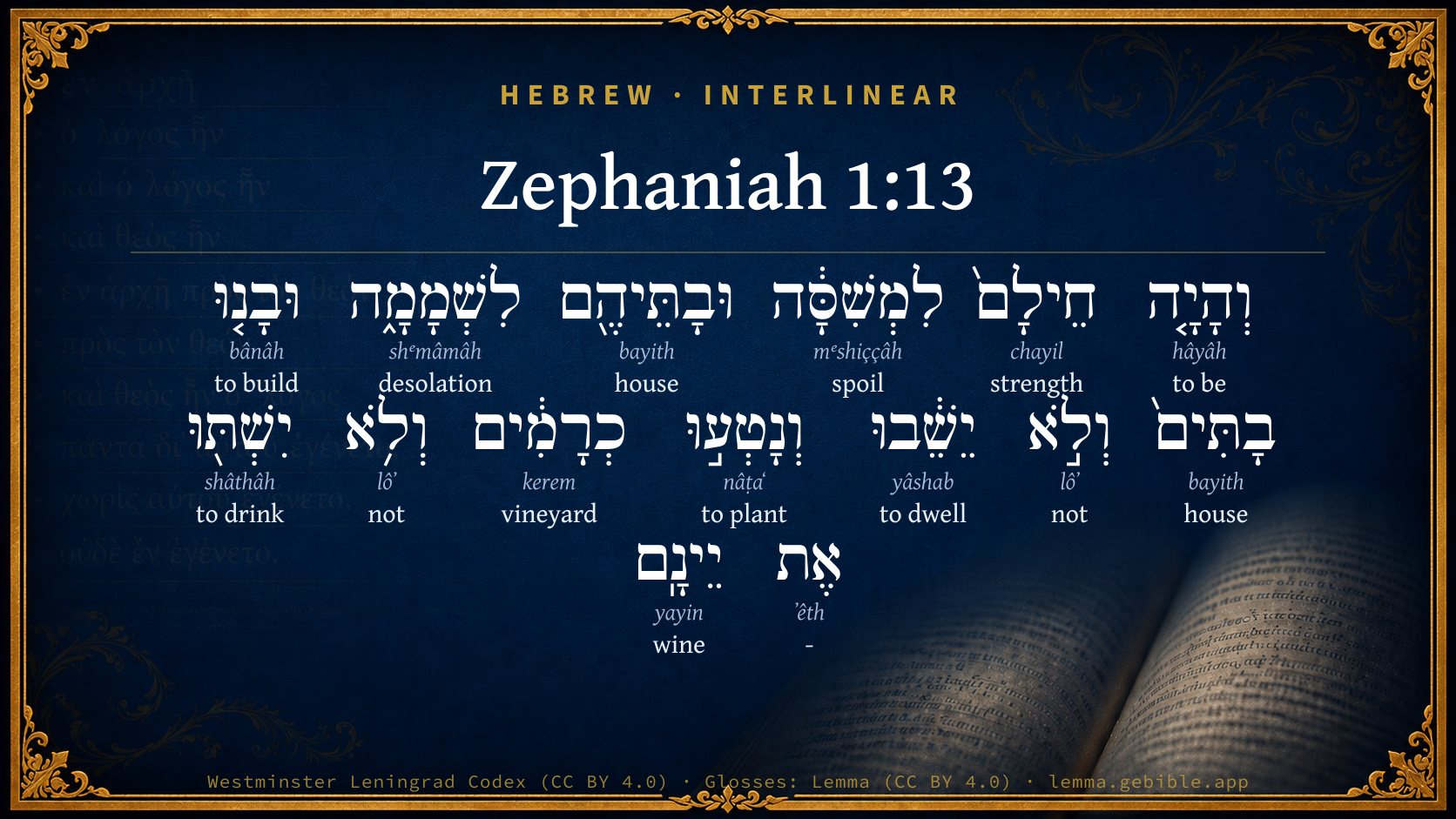
  1. וְהָיָ֤ה hâyâh H1961 “and · to be” Conjunction + Verb, Qal, Sequential Perfect, 3rd Person, Masculine, Singular
  2. חֵילָם֙ chayil H2428 “strength · their” Noun, Common, Masculine, Singular, Construct + Suffix, Personal, 3rd Person, Masculine, Plural
  3. וּבָתֵּיהֶ֖ם bayith H1004 “and · houses · their” Conjunction + Noun, Common, Masculine, Plural, Construct + Suffix, Personal, 3rd Person, Masculine, Plural
  4. לִשְׁמָמָ֑ה shᵉmâmâh H8077 “to/for · desolation” Preposition + Noun, Common, Feminine, Singular, Absolute
  5. וּבָנ֤וּ bânâh H1129 “and · to build” Conjunction + Verb, Qal, Sequential Perfect, 3rd Person, Common, Plural
  6. בָתִּים֙ bayith H1004 “houses” Noun, Common, Masculine, Plural, Absolute
  7. וְלֹ֣א lôʼ H3808 “and · not” Conjunction + Particle, Negative
  8. יֵשֵׁ֔בוּ yâshab H3427 “to dwell” Verb, Qal, Imperfect, 3rd Person, Masculine, Plural
  9. וְנָטְע֣וּ nâṭaʻ H5193 “and · to plant” Conjunction + Verb, Qal, Sequential Perfect, 3rd Person, Common, Plural
  10. כְרָמִ֔ים kerem H3754 “vineyards” Noun, Common, Both, Plural, Absolute
  11. וְלֹ֥א lôʼ H3808 “and · not” Conjunction + Particle, Negative
  12. יִשְׁתּ֖וּ shâthâh H8354 “to drink” Verb, Qal, Imperfect, 3rd Person, Masculine, Plural
  13. אֶת ʼêth H853 “-” Particle, Direct Object
  14. יֵינָֽם yayin H3196 “wine · their” Noun, Common, Masculine, Singular, Construct + Suffix, Personal, 3rd Person, Masculine, Plural

About this verse

These counts appear in no published source. They are computed here, from the morphology-tagged text and Lemma’s own curated glosses. What Lemma adds →

15
words
13
distinct lemmas
Prophets
section

Notable vocabulary

The rarest word here is לִמְשִׁסָּ֔ה spoil H4933 — appearing just 6 times in the whole Hebrew Bible.

Shared distinctive vocabulary

לִמְשִׁסָּ֔ה spoil H4933 occurs in 6 verses of the Hebrew Bible. Also found in:

Grammatical profile

  • 5 verbs
  • 7 nouns
  • 3 particles

Verb forms

  • וְהָיָ֤ה Qal · Sequential Perfect
  • וּבָנ֤וּ Qal · Sequential Perfect
  • יֵשֵׁ֔בוּ Qal · Imperfect
  • וְנָטְע֣וּ Qal · Sequential Perfect
  • יִשְׁתּ֖וּ Qal · Imperfect

Repetition

Words recur within this verse — often emphatic in Hebrew:

  • וּבָתֵּיהֶ֖ם house H1004 ×2
  • וְלֹ֣א not H3808 ×2

Hebrew & Septuagint length

In English translation the verse runs 29 words from the Hebrew and 38 from the Septuagint (LXX English) — closely comparable.

A rough comparison of the two English renderings, which tokenize alike — not a word-level alignment.

Word counts can differ between the Hebrew and the Greek without any difference in meaning — e.g. the Hebrew direct-object marker אֵת has no separate Greek word, and Greek often adds the article ὁ.

Cross-references

21

Topical passages linked to Zephaniah 1:13 in the Treasury of Scripture Knowledge — connected by theme and wording, ordered by reader-vote popularity; previews shown in the World English Bible.

  • Amos 5:11 Forasmuch therefore as you trample on the poor, And take taxes from him of wheat: You have built houses of hewn stone, But you will not dwell in them. You have planted pleasant vineyards, But you shall not drink their wine.
  • Micah 6:15 You will sow, but won't reap. You will tread the olives, but won't anoint yourself with oil; And crush grapes, but won't drink the wine.
  • Deuteronomy 28:30 You shall betroth a wife, and another man shall lie with her: you shall build a house, and you shall not dwell therein: you shall plant a vineyard, and shall not use the fruit of it.
  • Deuteronomy 28:39 You shall plant vineyards and dress them, but you shall neither drink of the wine, nor gather [the grapes]; for the worm shall eat them.
  • Jeremiah 9:19 For a voice of wailing is heard out of Zion, How are we ruined! we are greatly confounded, because we have forsaken the land, because they have cast down our dwellings.
  • Jeremiah 15:13 Your substance and your treasures will I give for a spoil without price, and that for all your sins, even in all your borders.
  • Ezekiel 7:21 I will give it into the hands of the strangers for a prey, and to the wicked of the earth for a spoil; and they shall profane it.
  • Deuteronomy 28:51 and shall eat the fruit of your cattle, and the fruit of your ground, until you are destroyed; that also shall not leave you grain, new wine, or oil, the increase of your cattle, or the young of your flock, until they have caused you to perish.
  • Isaiah 5:8–9 Woe to those who join house to house, Who lay field to field, until there is no room, And you are made to dwell alone in the midst of the land!
  • Isaiah 6:11 Then I said, "Lord, how long?" He answered, "Until cities are waste without inhabitant, And houses without man, And the land becomes utterly waste,
  • Isaiah 24:1–3 Behold, Yahweh makes the earth empty, and makes it waste, and turns it upside down, and scatters abroad the inhabitants of it.
  • Isaiah 65:21–22 They shall build houses, and inhabit them; and they shall plant vineyards, and eat the fruit of them.
  • Jeremiah 4:7 A lion is gone up from his thicket, and a destroyer of nations; he is on his way, he is gone forth from his place, to make your land desolate, that your cities be laid waste, without inhabitant.
  • Jeremiah 4:20 Destruction on destruction is cried; for the whole land is laid waste: suddenly are my tents destroyed, [and] my curtains in a moment.
  • Jeremiah 5:17 They shall eat up your harvest, and your bread, [which] your sons and your daughters should eat; they shall eat up your flocks and your herds; they shall eat up your vines and your fig trees; they shall beat down your fortified cities, in which you trust, with the sword.
  • Jeremiah 9:11 I will make Jerusalem heaps, a dwelling-place of jackals; and I will make the cities of Judah a desolation, without inhabitant.
  • Jeremiah 12:10–13 Many shepherds have destroyed my vineyard, they have trodden my portion under foot, they have made my pleasant portion a desolate wilderness.
  • Ezekiel 7:19 They shall cast their silver in the streets, and their gold shall be as an unclean thing; their silver and their gold shall not be able to deliver them in the day of the wrath of Yahweh: they shall not satisfy their souls, neither fill their bowels; because it has been the stumbling block of their iniquity.
  • Ezekiel 22:31 Therefore have I poured out my indignation on them; I have consumed them with the fire of my wrath: their own way have I brought on their heads, says the Lord Yahweh.
  • Micah 3:12 Therefore Zion for your sake will be plowed like a field, And Jerusalem will become heaps of rubble, And the mountain of the temple like the high places of a forest.
  • Zephaniah 1:9 In that day, I will punish all those who leap over the threshold, who fill their master's house with violence and deceit.

Cross-references courtesy of OpenBible.info (CC BY 4.0).

Hebrew and Greek witnesses Masoretic Hebrew ↔ Greek Septuagint

The same verse in the two great witnesses to the Old Testament, shown verse-for-verse.

These are two independent witnesses, not word-aligned to each other, and the Septuagint is shown in lemma (dictionary) form.

Hebrew Zephaniah 1:13 Masoretic · Westminster Leningrad Codex

וְהָיָ֤ה חֵילָם֙ לִמְשִׁסָּ֔ה וּבָתֵּיהֶ֖ם לִשְׁמָמָ֑ה וּבָנ֤וּ בָתִּים֙ וְלֹ֣א יֵשֵׁ֔בוּ וְנָטְע֣וּ כְרָמִ֔ים וְלֹ֥א יִשְׁתּ֖וּ אֶת יֵינָֽם

Their wealth will become a spoil, and their houses a desolation. Yes, they will build houses, but won't inhabit them. They will plant vineyards, but won't drink their wine.

World English Bible · Public Domain

Greek LXX Zephaniah 1:13 Septuagint · lemma form

καί εἰμί ὁ δύναμις αὐτός εἰς διαρπαγή καί ὁ οἶκος αὐτός εἰς ἀφανισμός καί οἰκοδομέω οἰκία καί οὐ μή καταοἰκέω ἐν αὐτός καί καταφυτεύω ἀμπελών καί οὐ μή πίνω ὁ οἶνος αὐτός

And their power shall be for a spoil, and their houses for utter desolation; and they shall build houses, but shall not dwell in them; and they shall plant vineyards, but shall not drink the wine of them.

LXX2012 (modern English Septuagint) · Public Domain

Hebrew: Westminster Leningrad Codex (CC BY 4.0). Greek: Septuagint (public domain); English from LXX2012 (modern English Septuagint) (Public Domain). How the Septuagint differs from the Hebrew →

Targum (Aramaic paraphrase)

1

The Targum is the ancient Jewish Aramaic paraphrase of the Hebrew Scriptures — an interpretive translation, not the Hebrew text itself. Onkelos (literal) and Pseudo-Jonathan (expansive) render the Torah, and Jonathan the Prophets. Coverage is partial: where no permissively-licensed English translation exists for a verse, only the Aramaic is shown. This is verse-level text, not a word-by-word alignment to the Hebrew.

  1. Targum Jonathan Prophets (Joshua–Malachi)
    וִיהוֹן נִכְסֵיהוֹן לַעֲדִי וּבָתֵּיהוֹן לְבִזָא וְיִבְנוּן בָּתִּין וְלָא יַתְבוּן וְיִצְבוּן כַּרְמִין וְלָא יִשְׁתּוּן יַת חֲמָרֵיהוֹן:

    (no public-domain English translation for this verse)

    Targum Jonathan — Aramaic: “Mikraot Gedolot” (public domain). English: “Sefaria Community Translation” (CC0 1.0 (public-domain dedication)); “London "Chaldee Paraphrase," 1871” (public domain). Text via Sefaria.

Commentary

Notes on Zephaniah 1:13 from classic Christian and Jewish commentators (each source and its license shown beneath its notes). The classic Christian expositions comment on the surrounding passage and are grouped to its opening verse, so a note may address several verses; the Jewish commentaries on the Tanakh (Rashi and others) are per-verse, so they appear only where the commentator wrote on this verse.

Lemma curates 59 commentaries, every one of them public domain or Creative Commons licensed, each selected and text-cleaned for this edition rather than reprinted as found. About our sources →

Trapp's Complete Commentary

John Trapp

Zep 1:13 Therefore their goods shall become a booty, and their houses a desolation: they shall also build houses, but not inhabit [them]; and they shall plant vineyards, but not drink the wine thereof.

Ver. 13. Therefore their goads shall become a booty] Their illgotten goods, Zep 1:9; Zep 1:11 (for a proof of my providence which they blushed not to deny), shall be carried away by the Chaldees, to their unmedicinable sorrow and heartbreak, Ecc 4:1-3.

And their houses a desolation] Because built in blood. See Nah 2:11-12.

They shall also build houses, but not inhabit them, &c.] Ex lege mutuatur minas. That they might the more regard his words, the prophet makes use of the menaces of the law, Deu 28:30; Deu 28:39, whereof the prophets were interpreters; applying, as here, the general doctrine thereof to the people of their times. To rebuke or exhort men in good words, in God’s own words, is the readiest way to prevail with them; unless they be Lucifugae scripturarum (as Tertullian saith of the Marcionites and Valentinians), which yet will take hold of them howsoever, Zec 1:6.

John Trapp, A Commentary or Exposition upon All the Books of the Old and New Testament (1647–1656) — public domain. Text from a community e-Sword module.

Tyndale Open Study Notes

Tyndale Open Resources

1:13 God would send an invading force to plunder Jerusalem. The destruction would come so quickly that those with ill-gotten gain would not survive to enjoy their wealth.

Tyndale Open Study Notes — © Tyndale Open Resources, licensed CC BY-SA 4.0. Text via the HelloAO Bible API.

Jamieson, Fausset & Brown

Robert Jamieson, A. R. Fausset & David Brown

Therefore their goods shall become a booty, &c.--Fulfilling the prophecy in Deu 28:30, Deu 28:39 (compare Amo 5:11).

Jamieson, Fausset & Brown — Commentary Critical and Explanatory on the Whole Bible (1871) — public domain (CC PDM 1.0). Text via the HelloAO Bible API.

Adam Clarke's Commentary

Verse 13. Their goods (in which they trust) shall become a booty] To the Chaldeans. They shall have no profit of all their labours. The houses they have built they shall not inhabit; of the wine of the vineyards they have planted, they shall not drink. See Am 5:11, where we find the same evils threatened.

Adam Clarke's Commentary on the Bible (1810–1826) — public domain. Text from a community e-Sword/MySword module.

John Calvin's Commentaries

Zephaniah pursues the same subject—that God, after long forbearance, would punish his rebellious and obstinate people. Hence he says, that they were now delivered, even by God himself, into the hands of their enemies. They indeed knew that many were inimical to them; but they did not consider God’s judgment, as God himself elsewhere complains—that they did not regard the hand of him who smote them. Isaiah 9:13. Our Prophet, therefore, declares now that they were given up to destruction, and that their enemies would find no trouble nor difficulty in invading the land, since all places would be open to plunder. And he recites what is found in Leviticus 26:20; for the Prophets were interpreters of the law, and the only difference between Moses and them is, that they apply his general truth to their own time. The Prophet now pursues this course, as though he had said, that God had not in vain or to no purpose threatened this evil in his law; for the Jews would find by experience that this would really be the case, and that it had been truly said, that the fruit of the land, their habitations, and other comforts of life, would be transferred to others. It now follows—

John Calvin's Commentaries (1540-1563) — public domain. Text from the Calvin Translation Society English edition (1840s-50s) via the Christian Classics Ethereal Library (ccel.org). Calvin's coverage is partial (roughly two-thirds of the Bible); uncommented books and verses are honest gaps, never fabricated. The 19th-century editor's footnotes and remarks are omitted so the notes are faithfully Calvin's own voice.

Ellicott's Commentary for English Readers

(13) Part of the curse on apostasy in Deuteronomy 28 is, “Thou shalt build an house, and thou shalt not dwell therein: thou shalt plant a vineyard, and shalt not gather the grapes thereof.”

A Bible Commentary for English Readers, edited by Charles John Ellicott (1878–1897) — public domain. Text from a community e-Sword module.

The Cambridge Bible for Schools and Colleges

gen. ed. J. J. S. Perowne

13. The verse implies that the “search” (Zep_1:12) is made by the foe under commission of the Lord; the foe is in quest of spoil, but his acts are the Lord’s “visitation” on the unbelieving.

They shall also build houses] and they shall build houses, but not inhabit them. The phrase is a common one signifying that they shall not enjoy the fruit of their labour; meaning, and the houses which they have built they shall not inhabit. Comp. Amo_5:11; Mic_6:15; Deu_28:30; Deu_28:39; Isa_65:21-22.

The Cambridge Bible for Schools and Colleges (gen. ed. J. J. S. Perowne; Cambridge University Press, 1878–1918) — public domain. Text from a community e-Sword module.

John Gill's Exposition

Therefore their goods shall become a booty To the enemy; the riches they trusted in, and thought themselves so secure of; and therefore denied divine Providence, which ought to be depended upon amidst the greatest affluence; or otherwise the Lord has various ways by which he can soon strip men of all their enjoyments, and dispose of them to others: and their houses a desolation; be pulled down by the enemy; or left uninhabited, they being killed or carried captive, even their whole families: they shall also build houses, but not inhabit [them]; not long, at least; not always, as they expected, and promised themselves when they built them: and they shall plant vineyards, and not drink the wine thereof: but before the vines planted by them bring forth grapes, and these are pressed, and wine made of them, they should fall into the hands of the enemy, who would drink it, and not they; and all this agreeably to what was threatened them in the law of Moses, which they ought to have regarded, ( Deuteronomy 28:30 ) .

John Gill's Exposition of the Whole Bible (1746–1763) — public domain (CC PDM 1.0). Text via the HelloAO Bible API.

Albert Barnes' Notes on the Bible

Therefore their goods - Literally, “And their strength.” It is the simple sequel in God’s Providence. It is a continued narrative. God will visit those who say, that God does not interfere in man’s affairs, and, it shall be seen Jer 44:28 whose words shall stand, God’s or their’s. All which God had threatened in the law shall be fulfilled. God, in the fulfillment of the punishment, which He had foretold in the law Lev 26:32-33; Deut. 28, would vindicate not only His present Providence, but His continual government of His own world. All which is strength to man, shall the rather fail, because it is strength, and they presume on it and it deceives them. Its one end is to “become a prey” of devils. Riches, learning, rule, influence, power, bodily strength, genius, eloquence, popular favor, shall all fail a man, and he, when stripped of them, shall be the more bared because he gathered them around him. “Wealth is ever a runaway and has no stability, but rather intoxicates and inclines to revolt and has unsteady feet. Exceeding folly is it to think much of it. For it will not rescue those lying under the divine displeasure, nor will it free any from guilt, when God decreeth punishment, and bringeth the judgment befitting on the transgressors. How utterly useless this eagerness after wealth is to the ungodly, he teacheth, saying, that “their strength shall be a prey” to the Chaldaean.”

And their houses a desolation - Cyril: “For they are, of whom it may be said very truly, “This is the man that took not God for his strength, but trusted unto the multitude of his riches, and strengthened himself in his wickedness” Psa 52:7. But if indeed their houses are adorned in a costly manner, they shall not be theirs, for they shall be burned, and themselves go into captivity, leaving all in their house, and deprived of all which would gladden. And this God said clearly to the king of Judah by Jeremiah, “Thou hast builded thyself a large house and wide chambers, ceiled with cedar, and painted with vermilion. Shalt thou reign because thou closest thyself with cedar!” Jer 22:14-15. Gregory (Mor. viii. 14): “As the house of the body is the bodily dwelling, so to each mind its house is that, wherein through desire it is wont to dwell,” and “desolate” shall they be, being severed forever from the things they desired, and forever deserted by God. “They shall also build houses but not inhabit them,” as the rich man said to his soul, “Soul, thou hast much goods laid up for many years .... Thou fool, this night thy soul shall be required of thee; then whose shall those things be, which thou hast provided?” Luk 12:19-20. Before the siege by the Romans, Jerusalem and the temple had been greatly beautified, only to be destroyed. “And they shall plant vineyards, but not drink the wine thereof.” This is the woe, first pronounced in the law Deu 28:39, often repeated and ever found true. Wickedness makes joy its end, yet never finds it, seeking it where it is not, out of God.

Albert Barnes' Notes on the Bible (1834–1885) — public domain. Text from a community e-Sword/MySword module.

Haydock's Catholic Bible Commentary

Strength. Children or riches. (Haydock)

George Leo Haydock (1774–1849), Haydock's Catholic Family Bible and Commentary, 1859 edition — public domain. Excludes Psalms (Douay-Rheims chapter numbering differs from Protestant) and Deuterocanonical books (Catholic canon only).

Matthew Poole's English Annotations

Therefore; as a punishment for other sins, so for this secure, atheistical denial of Providence; though they have denied, they shall feel, and confess, that the evil they suffer is both just, and from my hand too.

Their goods; stores in their shops and warehouses, furniture in their chambers, and wardrobes.

A booty; a prey divided among the Babylonish soldiers, invading, prevailing, wasting villages and cities.

Their houses a desolation; that they may remember the curse threatened in the law, executed on them, and acknowledge that he who gave the law rules by it.

Build houses, but not inhabit them, & c.; according to that Deu 28:30,39.

Matthew Poole's English Annotations on the Holy Bible (1683–1685) — public domain. Text from a community e-Sword/MySword module.

Whedon's Commentary on the Bible

Daniel D. Whedon

13. These indifferent and skeptical persons Jehovah will startle from their spiritual slumber when he manifests himself as judge and ruler of the world.

Therefore — Their disregard of Jehovah compels him to vindicate his power and supremacy.

Their goods shall become a booty — The prophet expects the judgment to take the form of a hostile invasion; the enemy will capture the city and carry off as booty the possessions of the inhabitants.

Their houses a desolation — Nothing but ruins and desolation will be left behind. 13b seems to be a sort of proverbial saying announcing that the godless will not be permitted to enjoy the results of their labors (see on Amo_5:11; compare Mic_6:15). The originality of 13b has been questioned, and not without reason. It is certainly strange that the prophet should announce the judgment as imminent (Zep_1:7; compare Zep_1:14), and then, almost in the same breath, should give the inhabitants enough time to build houses and plant vineyards before the judgment falls.

Daniel D. Whedon (gen. ed.), Commentary on the Old and New Testaments (1874–1909) — public domain. Text from a community e-Sword module.

The Pulpit Commentary

Their goods; literally, their strength; their wealth in which they trusted shall become the prey of the enemy, and thus they shall learn that God ruleth in the affairs of men. They shall also build houses, etc. They shall prove in their own case the reality of the punishment threatened in the Law. (Lev_26:32, etc.; Deu_28:30, Deu_28:39; comp. Amo_5:11 Mic_6:15)

The Pulpit Commentary (1880–1919), ed. H.D.M. Spence-Jones & Joseph S. Exell — public domain. Text from a community e-Sword module.

Lesson kit

Teaching starters — assembled from the data on this page, not authored interpretation. Every prompt links to the verse data it draws on. Edit before teaching.

Zephaniah, in the Prophets, opens this verse with 15 words (13 distinct Hebrew lemmas). Its most distinctive word is mᵉshiççâh (“spoil”). A historical commentator’s framing appears above. Read the whole chapter for the surrounding context.

Discussion questions

  1. How does “spoil” (mᵉshiççâh) shape what this verse is saying?
  2. How does 2 Kings 21:14, which shares the word «spoil», read alongside this verse?
  3. What does the repetition of “house” (2× in this one verse) do in this verse?
  4. These translations render this verse differently. What is at stake in choosing one wording over another?
  5. «וְהָיָ֤ה» is a Qal Sequential Perfect verb. How does that grammatical form shape the action described?
  6. Compare how Trapp's Complete Commentary and Tyndale Open Study Notes read this verse. Where do they agree or differ?

Things to notice

Reading settings

Reading text

Shown beneath each verse's original-language words.

Old Testament
Old Testament edition

Read the OT as the Masoretic Hebrew (MT) or the Greek Septuagint (LXX).

English shown for the Greek Septuagint (in the Hebrew ↔ Greek comparison).

Comparing translations? Open the Compare panel on any verse page to stack up to four side by side.