

Proverbs 26:6

Hebrew (Westminster Leningrad Codex) Proverbs 26:6 appears in the Hebrew Old Testament. The text above is from the Westminster Leningrad Codex. Each word links to its Strong’s number, a concise gloss, and parsing drawn from the Open Scriptures Hebrew Bible morphology. Click any word for its full Brown-Driver-Briggs (BDB) entry.
Download image
Cite this verse

Proverbs 26:6 (World English Bible). Public Domain. Lemma interlinear Bible study tool, https://lemma.gebible.app/v/proverbs/26/6.

Show BibTeX & RIS
BibTeX
RIS
English Translation
One who sends a message by the hand of a fool Is cutting off feet and drinking violence.
World English Bible · Public Domain
Download a study sheet

One document with this verse’s original text, its word-by-word gloss line, the meaning frame, cross-references with their text, attributed commentary, and full source and license credits — printable, and it pastes into notes with its structure intact.

This verse Autodidact and up

Study sheet (.html) Plain text (.txt)

A passage Seminary Student

Up to 50 verses in one chapter. A passage sheet keeps up to 6 commentary sources and 12 cross-references per verse, in the order this page ranks them, and says so on the sheet whenever that leaves anything out. Ask for a single verse and you get the Autodidact verse sheet above.

Everything on this page stays free to read, with no account — the sheet is a download of what is already on screen, not access to it.

Want to remove ads? Support Godless Engineer
Compare translations 3

The same verse in 3 English versions, stacked beneath the original-language interlinear above. Click any original word for its lexicon entry.

Each is an independent rendering of the whole verse — the interlinear is not word-aligned to these translations.

Highlighted words mark where these versions differ — a whole-verse word diff, not a word-by-word alignment.

  • World English Bible Public Domain
    One who sends a message by the hand of a fool Is cutting off feet and drinking violence.
  • King James Version Public Domain
    He that sendeth a message by the hand of a fool cutteth off the feet, and drinketh damage.
  • unfoldingWord Literal Text CC BY-SA 4.0
    One cutting off feet, one drinking violence, one sending words by the hand of a stupid.

unfoldingWord Literal Text — © unfoldingWord, licensed CC BY-SA 4.0. Word-aligned USFM3 via Door43 (git.door43.org/unfoldingWord/en_ult).

Versions to compare (up to 4)

3 of 4 selected

Show all 18 translations

Every available English version of this verse, each an independent rendering of the whole verse.

  • World English Bible Public Domain
    One who sends a message by the hand of a fool Is cutting off feet and drinking violence.
  • Berean Standard Bible Public Domain
    Like cutting off one’s own feet or drinking violence is the sending of a message by the hand of a fool.
  • Majority Standard Bible Public Domain
    Like cutting off one’s own feet or drinking violence is the sending of a message by the hand of a fool.
  • King James Version Public Domain
    He that sendeth a message by the hand of a fool cutteth off the feet, and drinketh damage.
  • American Standard Version (1901) Public Domain
    He that sendeth a message by the hand of a fool Cutteth off `his own' feet, `and' drinketh in damage.
  • Revised Version (1885) Public Domain
    He that sendeth a message by the hand of a fool cutteth off his own feet, and drinketh in damage.
  • Geneva Bible (1599) Public Domain
    He that sendeth a message by the hand of a foole, is as he that cutteth off the feete, and drinketh iniquitie.
  • Douay-Rheims (1899) Public Domain
    He that sendeth words by a foolish messenger, is lame of feet and drinketh iniquity.
  • Young's Literal Translation Public Domain
    He is cutting off feet, he is drinking injury, Who is sending things by the hand of a fool.
  • Literal Standard Version CC BY-SA 4.0
    He is cutting off feet, he is drinking injury, || Who is sending things by the hand of a fool.
  • Unlocked Literal Bible CC BY-SA 4.0
    Whoever sends a message by the hand of a fool cuts off his own feet and drinks violence.
  • unfoldingWord Literal Text CC BY-SA 4.0
    One cutting off feet, one drinking violence, one sending words by the hand of a stupid.
  • Darby Bible Public Domain
    He that sendeth a message by the hand of a fool cutteth off [his own] feet, [and] drinketh damage.
  • World Messianic Bible Public Domain
    One who sends a message by the hand of a fool is cutting off feet and drinking violence.
  • Webster's Bible Public Domain
    He that sendeth a message by the hand of a fool cutteth off the feet, and drinketh damage.
  • Free Bible Version CC BY-SA 4.0
    Trusting someone stupid to deliver a message is like cutting off your feet or drinking poison.
  • Bible in Basic English Public Domain
    He who sends news by the hand of a foolish man is cutting off his feet and drinking in damage.
  • JPS Tanakh (1917) Public Domain
    He that sendeth a message by the hand of a fool cutteth off his own feet, and drinketh damage.

Literal Standard Version (2020), Covenant Press — licensed CC BY-SA 4.0. Text via the HelloAO Bible API (eBible.org). Unlocked Literal Bible (unfoldingWord) — licensed CC BY-SA 4.0. Text via the HelloAO Bible API (eBible.org). unfoldingWord Literal Text — © unfoldingWord, licensed CC BY-SA 4.0. Word-aligned USFM3 via Door43 (git.door43.org/unfoldingWord/en_ult). Free Bible Version, Dr. Jonathan Gallagher — licensed CC BY-SA 4.0. Text via the HelloAO Bible API (eBible.org).

Word by word

More ways to search: Search by grammar → Find every occurrence → Compare this word →

Practice this passage: Drill this verse → Learn its vocabulary →

About this verse

These counts appear in no published source. They are computed here, from the morphology-tagged text and Lemma’s own curated glosses. What Lemma adds →

8
words
8
distinct lemmas
Wisdom
section

Notable vocabulary

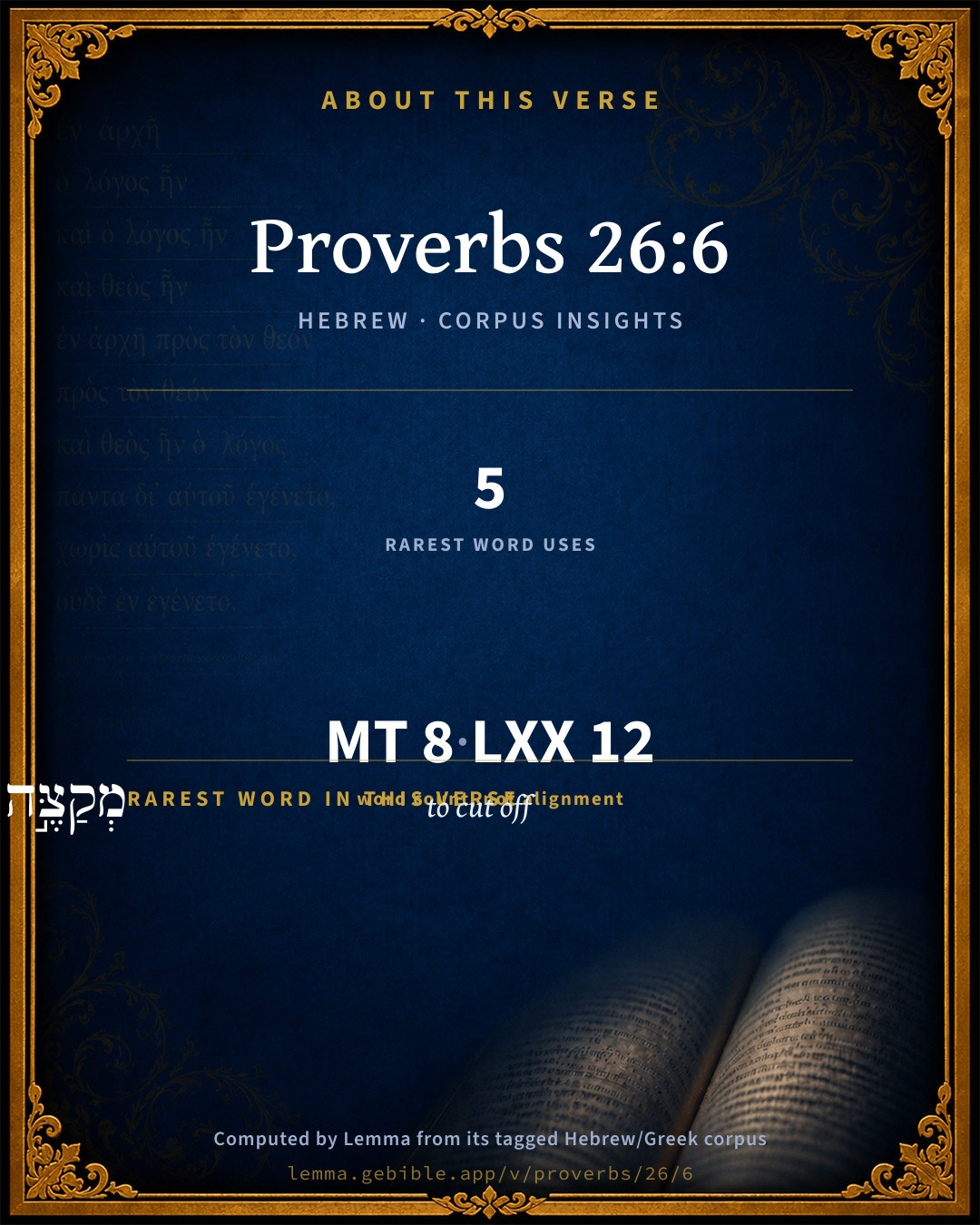
The rarest word here is מְקַצֶּ֣ה to cut off H7096 — appearing just 5 times in the whole Hebrew Bible.

Shared distinctive vocabulary

מְקַצֶּ֣ה to cut off H7096 occurs in 5 verses of the Hebrew Bible. Also found in:

Grammatical profile

  • 3 verbs
  • 4 nouns
  • 1 adjective

Verb forms

  • מְקַצֶּ֣ה Piel · Participle Active
  • שֹׁתֶ֑ה Qal · Participle Active
  • שֹׁלֵ֖חַ Qal · Participle Active

Hebrew & Septuagint length

In English translation the verse runs 18 words from the Hebrew and 18 from the Septuagint (LXX English) — the same length.

A rough comparison of the two English renderings, which tokenize alike — not a word-level alignment.

Word counts can differ between the Hebrew and the Greek without any difference in meaning — e.g. the Hebrew direct-object marker אֵת has no separate Greek word, and Greek often adds the article ὁ.

In the original languages it is 8 Hebrew tokens and 12 Greek tokens — but the two are counted differently (Hebrew bundles its prefixes and suffixes into one token; the Greek is in lemma form), so that isn’t a like-for-like length.

Cross-references

4

Topical passages linked to Proverbs 26:6 in the Treasury of Scripture Knowledge — connected by theme and wording, ordered by reader-vote popularity; previews shown in the World English Bible.

  • Proverbs 10:26 As vinegar to the teeth, and as smoke to the eyes, So is the sluggard to those who send him.
  • Proverbs 25:13 As the cold of snow in the time of harvest, So is a faithful messenger to those who send him; For he refreshes the soul of his masters.
  • Proverbs 13:17 A wicked messenger falls into trouble, But a trustworthy envoy gains healing.
  • Numbers 13:31 But the men who went up with him said, We aren't able to go up against the people; for they are stronger than we.

Cross-references courtesy of OpenBible.info (CC BY 4.0).

Hebrew and Greek witnesses Masoretic Hebrew ↔ Greek Septuagint

The same verse in the two great witnesses to the Old Testament, shown verse-for-verse.

These are two independent witnesses, not word-aligned to each other, and the Septuagint is shown in lemma (dictionary) form.

Hebrew Proverbs 26:6 Masoretic · Westminster Leningrad Codex

מְקַצֶּ֣ה רַ֭גְלַיִם חָמָ֣ס שֹׁתֶ֑ה שֹׁלֵ֖חַ דְּבָרִ֣ים בְּיַד כְּסִֽיל

One who sends a message by the hand of a fool Is cutting off feet and drinking violence.

World English Bible · Public Domain

Greek LXX Proverbs 26:6 Septuagint · lemma form

ἐκ ὁ ἑαυτοῦ πούς ὄνειδος πίνω ὁ ἀποστέλλω διά ἄγγελος ἄφρων λόγος

He that sends a message by a foolish messenger procures for himself a reproach from his own ways.

LXX2012 (modern English Septuagint) · Public Domain

On this verse, Haydock's Catholic Bible Commentary discusses the Septuagint’s reading. Read the note in Commentary ↓

Hebrew: Westminster Leningrad Codex (CC BY 4.0). Greek: Septuagint (public domain); English from LXX2012 (modern English Septuagint) (Public Domain). How the Septuagint differs from the Hebrew →

Commentary

Notes on Proverbs 26:6 from classic Christian and Jewish commentators (each source and its license shown beneath its notes). The classic Christian expositions comment on the surrounding passage and are grouped to its opening verse, so a note may address several verses; the Jewish commentaries on the Tanakh (Rashi and others) are per-verse, so they appear only where the commentator wrote on this verse.

Lemma curates 59 commentaries, every one of them public domain or Creative Commons licensed, each selected and text-cleaned for this edition rather than reprinted as found. About our sources →

Matthew Henry's Commentary

To recommend wisdom to us, and to quicken us to the diligent use of all the means for the getting of wisdom, Solomon here shows that fools are fit for nothing; they are either sottish men, who will never think and design at all, or vicious men, who will never think and design well. 1. They are not fit to be entrusted with any business, not fit to go on an errand (Pro 26:6): He that does but send a message by the hand of a fool, of a careless heedless person, one who is so full of his jests and so given to his pleasures that he cannot apply his mind to any thing that is serious, will find his message misunderstood, the one half of it forgotten, the rest awkwardly delivered, and so many blunders made about it that he might as well have cut off his legs, that is, never have sent him. Nay, he will drink damage; it will be very much to his prejudice to have employed such a one, who, instead of bringing him a good account of his affairs, will abuse him and put a trick upon him; for, in Solomon's language, a knave and a fool are of the same signification. It will turn much to a man's disgrace to make use of the service of a fool, for people will be apt to judge of the master by his messenger. 2. They are not fit to have any honour put upon them. He had said (Pro 26:1), Honour is not seemly for a fool; here he shows that it is lost and thrown away upon him, as if a man should throw a precious stone, or a stone fit to be used in weighing, into a heap of common stones, where it would be buried and of no use; it is as absurd as if a man should dress up a stone in purple (so others); nay, it is dangerous, it is like a stone bound in a sling, with which a man will be likely to do hurt. To give honour to a fool is to put a sword in a madman's hand, with which we know not what mischief he may do, even to those that put it into his hand. 3. They are not fit to deliver wise sayings, nor should they undertake to handle any matter of weight, though they should be instructed concerning it, and be able to say something to it. Wise sayings, as a foolish man delivers them and applies them (in such a manner that one may know he does not rightly understand them), lose their excellency and usefulness: A parable in the mouth of fools ceases to be a parable, and becomes a jest. If a man who lives a wicked life, yet speaks religiously and takes God's covenant into his mouth, (1.) He does but shame himself and his profession: As the legs of the lame are not equal, by reason of which their going is unseemly, so unseemly is it for a fool to pretend to speak apophthegms, and give advice, and for a man to talk devoutly whose conversation is a constant contradiction to his talk and gives him the lie. His good words raise him up, but then his bad life takes him down, and so his legs are not equal. "A wise saying," (says bishop Patrick) "doth as ill become a fool as dancing doth a cripple; for, as his lameness never so much appears as when he would seem nimble, so the other's folly is never so ridiculous as when he would seem wise." As therefore it is best for a lame man to keep his seat, so it is best for a silly man, or a bad man, to hold his tongue. (2.) He does but do mischief with it to himself and others, as a drunkard does with a thorn, or any other sharp thing which he takes in his hand, with which he tears himself and those about him, because he knows not how to manage it. Those that talk well and do not live well, their good words will aggravate their own condemnation and others will be hardened by their inconsistency with themselves. Some give this sense of it: The sharpest saying, by which a sinner, one would think, should be pricked to the heart, makes no more impression upon a fool, no, though it come out of his own mouth, than the scratch of a thorn does upon the hand of a man when he is drunk, who then feels it not nor complains of it, Pro 23:35.

Matthew Henry's Commentary on the Whole Bible (1708–1710) — public domain (CC PDM 1.0). Text via the HelloAO Bible API.

Trapp's Complete Commentary

John Trapp

Pro 26:6 He that sendeth a message by the hand of a fool cutteth off the feet, [and] drinketh damage.

Ver. 6. He that sendeth a message by the hand of a fool.] The worth of a faithful messenger he had set forth; {Pro 15:13} here, the discommodity of a foolish one - such as were the spies Moses sent. {Num 13:1-33; Num 14:1-38} So when the prophet proves a fool, and the "spiritual man is mad," {Hos 9:7} things go on as heavily as if feet were wanting to a traveller, or as if a messenger had lost his legs.

John Trapp, A Commentary or Exposition upon All the Books of the Old and New Testament (1647–1656) — public domain. Text from a community e-Sword module.

Joseph Benson's Commentary

Pro 26:6. He that sendeth a message by the hand of a fool — He that employs a fool upon any important business, which is too hard for him; cutteth off the feet — Namely, of his messenger: he bids one go that wants legs; he sends one that wants discretion, which is as necessary for that employment as legs are for running or walking; and drinketh damage — Brings upon himself abundance of loss and mischief, not only spoiling the business about which he sends him, but making himself contemptible to the person to whom he sends him, and to others with him, as if he had not common prudence to choose a fit messenger, and giving occasion, by the folly of his messenger, to further misunderstandings, jealousies, and inconveniences. Drinking, it must be observed, in the Scriptures, frequently signifies the doing or receiving of any thing plentifully, as they who multiply sins are said to drink iniquity like water, and they who are greatly afflicted are commonly said to drink the cup of sorrow.

Joseph Benson's Commentary on the Old and New Testaments (1811–1818) — public domain. Text from a community e-Sword module.

Geneva Bible (1599)

Geneva Bible translators

To wit, of the messenger whom he sendeth.

That is, receiveth damage thereby.

Geneva Bible (1599) marginal notes — public domain. Text via Bolls.life.

Jamieson, Fausset & Brown

Robert Jamieson, A. R. Fausset & David Brown

A fool fails by folly as surely as if he were maimed.

drinketh damage--that is, gets it abundantly (Job 15:16; Job 34:7).

Jamieson, Fausset & Brown — Commentary Critical and Explanatory on the Whole Bible (1871) — public domain (CC PDM 1.0). Text via the HelloAO Bible API.

Adam Clarke's Commentary

Verse 6. Cutteth off the feet] Sending by such a person is utterly useless. My old MS. Bible translates well: Halt in feet and drinking wickednesse that sendith wordis bi a foole messager. Nothing but lameness in himself can vindicate his sending it by such hands; and, after all, the expedient will be worse than the total omission, for he is likely to drink wickedness, i.e., the mischief occasioned by the fool's misconduct. Coverdale nearly hits the sense as usual: "He is lame of his fete, yee dronken is he in vanite, that committeth eny thinge to a foole."

Adam Clarke's Commentary on the Bible (1810–1826) — public domain. Text from a community e-Sword/MySword module.

Ellicott's Commentary for English Readers

(6) Cutteth off the feet.—He wants his business done, but if he sends a fool to do it, he might as well cut off his messenger’s legs, for the business will not be transacted; nay, worse than this, he will “drink damage,” i.e., suffer positive mischief from the blundering of his emissary.

A Bible Commentary for English Readers, edited by Charles John Ellicott (1878–1897) — public domain. Text from a community e-Sword module.

The Cambridge Bible for Schools and Colleges

gen. ed. J. J. S. Perowne

6. the feet] Rather his own feet, R.V.

By choosing such a messenger he robs himself by his own act of the means of attaining his end, and suffers accordingly.

The Cambridge Bible for Schools and Colleges (gen. ed. J. J. S. Perowne; Cambridge University Press, 1878–1918) — public domain. Text from a community e-Sword module.

John Gill's Exposition

He that sendeth a message by the hand of a fool,.... Who knows not how to deliver it in a proper manner, and is incapable of taking the answer, and reporting it as he should; or unfaithful in it, and brings a bad or false report, as the spies did upon the good land;

cutteth off the feet; he may as well cut off his feet before he sends him, or send a man without feet, as such an one; for prudence, diligence, and faithfulness in doing a message, and bringing back the answer, are as necessary to a messenger as his feet are;

and drinketh damage; to himself; his message not being rightly performed, and business not done well; which is a loss to the sender, as well as to his credit and reputation with the person to whom he sends him; he hereby concluding that he must be a man of no great judgment and sense to send such a fool on his errand. Such are the unskilful ambassadors of princes; and such are unfaithful ministers, the messengers of the churches; see Pro 10:26. The words in the original are three sentences, without a copulative, and stand in this order, "he that cutteth off feet; he that drinketh damage; he that sendeth a message by the hand of a fool"; that is, they are alike.

John Gill's Exposition of the Whole Bible (1746–1763) — public domain (CC PDM 1.0). Text via the HelloAO Bible API.

Albert Barnes' Notes on the Bible

Cutteth off the feet - Mutilates him, spoils the work which the messenger ought to fulfill.

Drinketh damage - i. e., “has to drink full draughts of shame and loss” (compare Job 15:16).

Albert Barnes' Notes on the Bible (1834–1885) — public domain. Text from a community e-Sword/MySword module.

Haydock's Catholic Bible Commentary

Iniquity. He is exposed to shame, (Septuagint) and must condemn his own folly. (Calmet)

George Leo Haydock (1774–1849), Haydock's Catholic Family Bible and Commentary, 1859 edition — public domain. Excludes Psalms (Douay-Rheims chapter numbering differs from Protestant) and Deuterocanonical books (Catholic canon only).

Matthew Poole's English Annotations

He that sendeth a message by the hand of a fool, he that employeth a fool upon any important errand or business which is too hard for him,

cutteth off the feet, to wit, of his messenger; he bids one go that wants legs; he sends one who wants that discretion, which is as necessary for that employment as legs are for going.

Drinketh damage; he bringeth upon himself abundance of loss and mischief, not only spoiling that business about which he sends him, but making himself contemptible to the person to whom he sends him, and to others with him, as if he had not common prudence to choose a fit messenger, and giving occasion, by the folly of his messenger, to further misunderstandings, and jealousies, and inconveniences. For the phrase, we may observe that drinking in Scripture frequently notes the plentiful doing or receiving of any thing, as they who multiply sins are said to drink iniquity like water, Job 15:16; 34:7; and they who are greatly afflicted are commonly said to drink the cup.

Matthew Poole's English Annotations on the Holy Bible (1683–1685) — public domain. Text from a community e-Sword/MySword module.

Whedon's Commentary on the Bible

Daniel D. Whedon

6. Cutteth off the feet — That is, of himself, as explained by the following clause.

Drinketh damage — A man that employs a fool in his business cripples himself. Comp. Pro_10:26; Pro_25:13.

Daniel D. Whedon (gen. ed.), Commentary on the Old and New Testaments (1874–1909) — public domain. Text from a community e-Sword module.

The Pulpit Commentary

He that sendeth a message by the hand of a fool. This clause comes in the Hebrew after the next. Cutteth off the feet, and drinketh damage. To entrust an important commission to a fool is to deprive one"s self of the means of having it properly executed, and to bring upon one"s self shame and injury. A man who is so silly as to employ such an unfit messenger, as it were, cuts off the feet which should bear him on his errand, and, instead of enjoying the satisfaction of seeing the business well performed, he will be mortified and damaged by the blunder and stupidity of his emissary. Septuagint, "He maketh for himself reproach from his own ways (odwn , ? podwn ) who sendeth a word by a foulish messenger." The Vulgate reads the first participle in a passive sense, claudus pedibus; but this is uneccessary. We have similar phrases to "drinketh damage" elsewhere; e.g. Job_15:16 "drinketh in iniquity;" Job_34:7, "drinketh up scorn;" and with a different word, Pro_19:28, "devoureth iniquity."

The Pulpit Commentary (1880–1919), ed. H.D.M. Spence-Jones & Joseph S. Exell — public domain. Text from a community e-Sword module.

John Wesley's Explanatory Notes

Cutteth off the feet - Of his messenger; bids one go that wants legs. Drinketh - Drinking, in scripture, frequently denotes the plentiful doing or receiving of any thing.

John Wesley, Explanatory Notes Upon the Whole Bible (1754–1765) — public domain. Text via the GEBible commentary corpus.

Keil & Delitzsch

C. F. Keil & F. Delitzsch

6 He cutteth off the feet, he drinketh injury,

Who transacteth business by a fool.

He cutteth off, i.e., his own feet, as we say: he breaks his neck, il se casse le cou; Lat. frangere brachium, crus, coxam; frangere navem (Fleischer). He thinks to supplement his own two legs by those of the messenger, but in reality he cuts them off; for not only is the commission not carried out, but it is even badly carried out, so that instead of being refreshed (Pro 13:17; Pro 25:13) by the quick, faithful execution of it, he has to swallow nothing but damage; cf. Job 34:7, where, however, drinking scorn is meant of another (lxx), not his own; on the contrary, חמס here refers to injury suffered (as if it were חמדו, for the suff. of חמס is for the most part objective); cf. the similar figures Pro 10:26. So שׁלח בּיד, to accomplish anything by the mediation of another, cf. Exo 4:13; with דבר (דברים), Sa2 15:36. The reading מקצּה (Jerome, Luther, claudus) is unnecessary; since, as we saw, מקצּה ,was ew includes it in the sibi. The Syr. reads, after the lxx (the original text of which was ἐκ τῶν ποδῶν ἑαυτοῦ), מקצה, for he errs, as also does the Targumist, in thinking that מקצה can be used for מקצץ; but Hitzig adopts this reading, and renders: "from the end of the legs he swallows injury who sends messages by a fool." The end of the legs are the feet, and the feet are those of the foolish messenger. The proverb in this form does not want in boldness, but the wisdom which Hitzig finds in its is certainly not mother-wit.

(Note: The Venet. translates שׁתה by ἄνους, so שׁטה (the post-bibl. designation of a fool) - one of the many indications that this translator is a Jew, and as such is not confined in his knowledge of language only to the bibl. Hebrew.)

Bttcher, on his part, also with מקצה, renders: "from the end of his feet he drinks in that which is bitter..." - that also is too artificial, and is unintelligible without the explanation of its discoverer. But that he who makes a fool his messenger becomes himself like unto one who cuts off his own legs, is a figure altogether excellent.

Keil & Delitzsch — Biblical Commentary on the Old Testament (1861–1891) — public domain (CC PDM 1.0). Text via the HelloAO Bible API. (Old Testament only.)

Bridges on Proverbs

Charles Bridges

Surely this diversified exhibition of the foolishness of folly is an incentive to the study of heavenly wisdom. The fool is utterly unfit for service. When a message is sent by his hands, he makes so many mistakes, careless or willful, that it is like bidding him go, when we have cut off his legs. Indeed we can only drink damage from his commission.†1 The employment of the unbelieving spies spread damage of discontent and rebellion throughout the whole congregation.†2 How careful should we be to entrust important business to trustworthy persons! Fools are either unqualified for their mission, or they have their own interests to serve, at whatever cost to their masters. Solomon himself drank damage, by employing an "industrious" servant, but a fool in wickedness, who "lifted up his hand against the king," and spoiled his son of ten parts of his kingdom. (1Ki 11:26-40 .) Benhadad drank damage, by sending a message by the hands of Hazael, who murdered his master, when the way was opened for his own selfish purposes. (2Ki 8:8-15 .)

See — again — how the fool exposes his shame. Never would a lame man shew his infirmity so much, as if he were to pretend to feats of agility or strength. Never does a fool appear so ridiculous, as when making a show of wisdom. It only creates disgust,†3 ’A wise saying doth as ill become a fool, as dancing does a cripple.’†4 A parable — ’an authoritative weighty saying,’†5 — in his mouth becomes a jest. "Is Saul also among the prophets? Why beholdest thou the mote, that is in thy brother’s eye; but considerest not the beam, that is in thine own eye? Physician, heal thyself. Thou therefore that teachest another, teachest thou not thyself?"†6

Place the fool in honor. The sling makes the stone bound in it an instrument of death. The honor given to the fool makes him a curse to his fellow-creatures.†7 The prime favorite of a despot, had not God restrained him, would have been the murderer of the chosen nation. (Est 3:1-5 .) Dangerous indeed is it to place unqualified persons in authority. ’It is like putting a sword or a loaded pistol into a madman’s hand’†8

But the fool does mischief also unconsciously to himself. ’It is no more fit for a fool to meddle with a wise speech, than for a drunken man to handle a thorn bush.’†9 When the thorn goes up into his hand, his insensibility only makes the wound more deadly. Thus the fool’s parable — his wise sayings, gathered he scarcely knows whence, go up into him like a thorn, sharply pricking his conscience. Yet he feels no compunction, no alarm. (Compare Sir 19:12 .) Sad indeed is the sight (should it not make us tremble for ourselves?) of the ungodly prophet, dealing out from the mouth of God, yet with hardened indifference, words enough to "make both his ears to tingle." (Numbers 23. 24.)

Such is the fool — a pest to is fellow-creatures; awfully responsible to his God! But in the sacred office how fearfully are this evil and responsibility increased! The great message, sent by the hands of ungodly servants, brings most serious damage to the Church.†10 The parable — our Divine Master’s wise and holy instruction — in the mouth of a fool is perverted and contradicted by his unholy life. "Unto the wicked God saith — What hast thou to do, to declare my statutes, or that thou shouldest take my covenant in thy mouth; seeing thou hatest instruction, and castest my words behind thee?" (Psa 50:16-17 .) ’Almighty God, who alone worketh great marvels, send down upon all Bishops and Curates the healthful spirit of thy grace;’†11 that "stewards faithful" to their trust (1Co 4:1-2 ), "workmen that need not to be ashamed" (2Ti 2:15 ), true and authorized "ambassadors for Christ," may be multiplied in the Church; and that fools — unfaithful ministers — may be rebuked and restrained.

Footnotes:

†1 Pro 10:26. Contrast Pro 13:17 ; Pro 25:13 .

†2 Num 13:32; Num 14:1-4 .

†3 Pro 17:7. Compare Sir 20:20 .

†4 Bp. Patrick.

†5 Parkhurst.

†6 1Sa 19:24 . Mat 7:3-5 . Luk 4:23 . Rom 2:21 .

†7 Jdg 9:6. 1Sa 8:1-3 .

†8 Scott in loco. Parkhurst, and other critics prefer the marg. reading — shewing that honor is lost upon a fool, like a precious stone covered up in a promiscuous heap. ’He that setteth a foole in hye dignite, that is even as yf a man dyd caste a precious stone upon the galous.’ Bp. Coverdale — alluding to the custom of throwing a stone to the heap, under which the criminal was buried. The reading of the text is however well supported both by the Vulgate and LXX.

†9 Bp. Hall.

†10 1Sa 2:17 . Jer 23:15 . Hence the solemn responsibility of the Ordination Rule. 1Ti 5:22 .

†11 Liturgy.

Charles Bridges, An Exposition of the Book of Proverbs (1846) — public domain. Text from a community e-Sword module.

Rashi

Rabbi Shlomo Yitzchaki (Rashi)

wears out legs and “drinks violence” He who sends a message by the hand of a fool wears out the legs of many messengers by repetitively sending [them] to rectify what the first one, whom he sent at the beginning, distorted. And he “drinks violence,” for his fellow is wroth with him for sending a fool.

Rashi on the Tanakh — English translations: “The Judaica Press complete Tanach with Rashi, translated by A. J. Rosenberg” (CC BY 4.0); “Pentateuch with Rashi's commentary by M. Rosenbaum and A.M. Silbermann, 1929-1934” (public domain); “The Metsudah Tanach series, Lakewood, N.J” (CC BY 4.0); and “The Book of Joshua, Metsudah Publications, 1997” (CC BY 4.0). Text via Sefaria.

Lesson kit

Teaching starters — assembled from the data on this page, not authored interpretation. Every prompt links to the verse data it draws on. Edit before teaching.

Proverbs, in the Wisdom, opens this verse with 8 words (8 distinct Hebrew lemmas). Its most distinctive word is qâtsâh (“to cut off”). A historical commentator’s framing appears above. Read the whole chapter for the surrounding context.

Discussion questions

  1. What does “to cut off” (qâtsâh) contribute to the verse as a whole?
  2. How does Leviticus 14:41, which shares the word «to cut off», read alongside this verse?
  3. The translations on this page render this verse differently — a whole-verse word diff, not a word-by-word alignment. What might account for the different wordings?
  4. «מְקַצֶּ֣ה» is a Piel Participle Active verb. How does that grammatical form shape the action described?
  5. Compare how Matthew Henry's Commentary and Trapp's Complete Commentary read this verse. Where do they agree or differ?

Things to notice

Reading settings

Reading text

Shown beneath each verse's original-language words.

Old Testament
Old Testament edition

Read the OT as the Masoretic Hebrew (MT) or the Greek Septuagint (LXX).

English shown for the Greek Septuagint (in the Hebrew ↔ Greek comparison).

Comparing translations? Open the Compare panel on any verse page to stack up to four side by side.