2 Kings 19:24

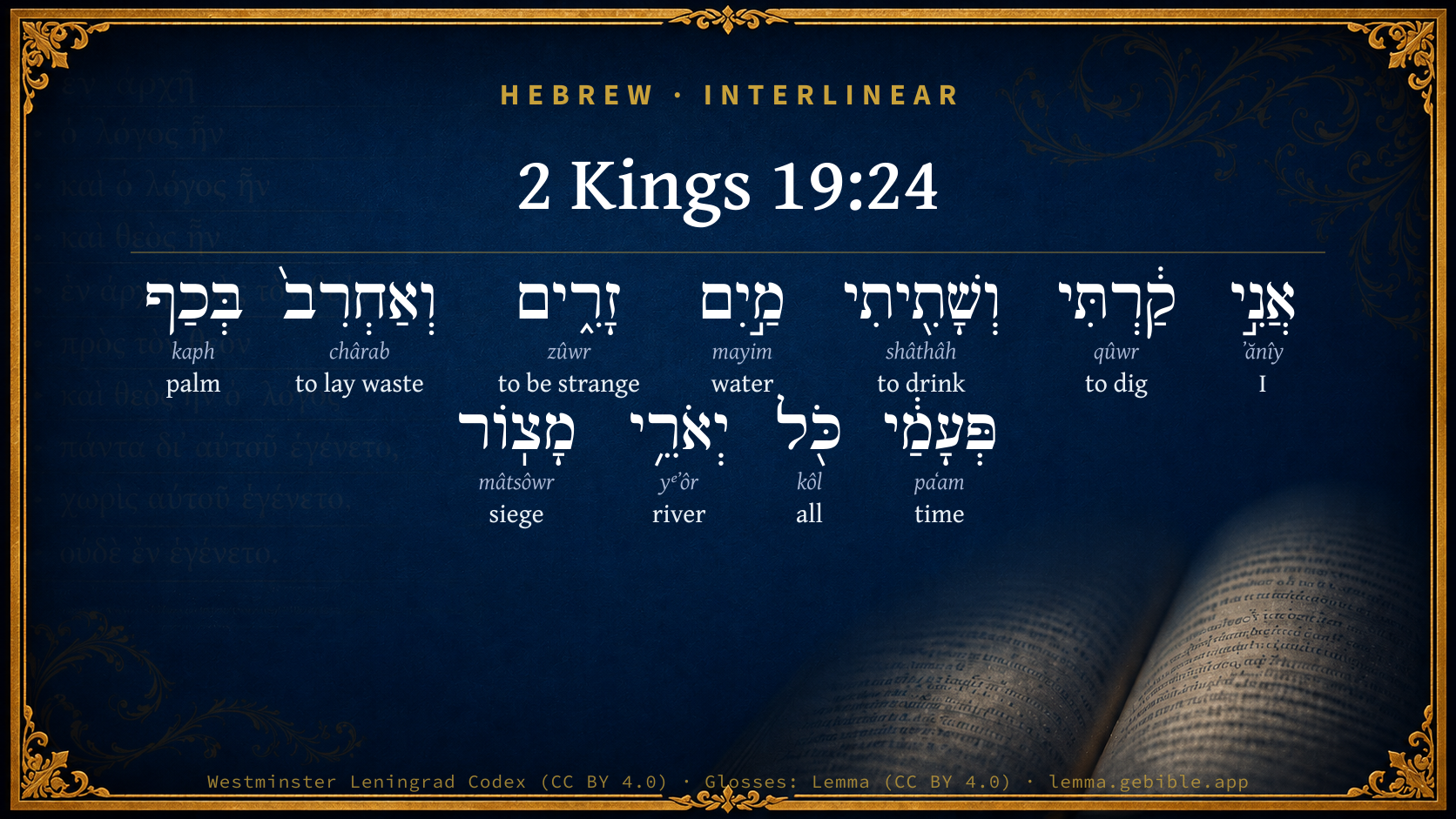
Hebrew (Westminster Leningrad Codex) 2 Kings 19:24 appears in the Hebrew Old Testament. The text above is from the Westminster Leningrad Codex. Each word links to its Strong’s number, a concise gloss, and parsing drawn from the Open Scriptures Hebrew Bible morphology. Click any word for its full Brown-Driver-Briggs (BDB) entry.
Download image
Cite this verse

2 Kings 19:24 (World English Bible). Public Domain. Lemma interlinear Bible study tool, https://lemma.gebible.app/v/2-kings/19/24.

Show BibTeX & RIS
BibTeX
RIS
English Translation
I have dug and drunk strange waters, and with the sole of my feet will I dry up all the rivers of Egypt.
World English Bible · Public Domain
Highlights
  • 1 first appearance in the Hebrew Bible
Full analysis ↓
Download a study sheet

One document with this verse’s original text, its word-by-word gloss line, the meaning frame, cross-references with their text, attributed commentary, and full source and license credits — printable, and it pastes into notes with its structure intact.

This verse Autodidact and up

Study sheet (.html) Plain text (.txt)

A passage Seminary Student

Up to 50 verses in one chapter. A passage sheet keeps up to 6 commentary sources and 12 cross-references per verse, in the order this page ranks them, and says so on the sheet whenever that leaves anything out. Ask for a single verse and you get the Autodidact verse sheet above.

Everything on this page stays free to read, with no account — the sheet is a download of what is already on screen, not access to it.

Want to remove ads? Support Godless Engineer
Compare translations 3

The same verse in 3 English versions, stacked beneath the original-language interlinear above. Click any original word for its lexicon entry.

Each is an independent rendering of the whole verse — the interlinear is not word-aligned to these translations.

Highlighted words mark where these versions differ — a whole-verse word diff, not a word-by-word alignment.

  • World English Bible Public Domain
    I have dug and drunk strange waters, and with the sole of my feet will I dry up all the rivers of Egypt.
  • King James Version Public Domain
    I have digged and drunk strange waters, and with the sole of my feet have I dried up all the rivers of besieged places.
  • unfoldingWord Literal Text CC BY-SA 4.0
    I, I dug, and I drank foreign waters. And with the sole of my feet I will dry up all of the streams of Matsor.”

unfoldingWord Literal Text — © unfoldingWord, licensed CC BY-SA 4.0. Word-aligned USFM3 via Door43 (git.door43.org/unfoldingWord/en_ult).

Versions to compare (up to 4)

3 of 4 selected

Show all 18 translations

Every available English version of this verse, each an independent rendering of the whole verse.

  • World English Bible Public Domain
    I have dug and drunk strange waters, and with the sole of my feet will I dry up all the rivers of Egypt.
  • Berean Standard Bible Public Domain
    I have dug wells and drunk foreign waters. With the soles of my feet I have dried up all the streams of Egypt.”
  • Majority Standard Bible Public Domain
    I have dug wells and drunk foreign waters. With the soles of my feet I have dried up all the streams of Egypt.”
  • King James Version Public Domain
    I have digged and drunk strange waters, and with the sole of my feet have I dried up all the rivers of besieged places.
  • American Standard Version (1901) Public Domain
    I have digged and drunk strange waters, and with the sole of my feet will I dry up all the rivers of Egypt.
  • Revised Version (1885) Public Domain
    I have digged and drunk strange waters, and with the sole of my feet will I dry up all the rivers of Egypt.
  • Geneva Bible (1599) Public Domain
    I haue digged, and drunke the waters of others, and with the plant of my feete haue I dried all the floods closed in.
  • Douay-Rheims (1899) Public Domain
    I have cut down, and I have drunk strange waters, and have dried up with the soles of my feet all the shut up waters.
  • Young's Literal Translation Public Domain
    I have digged, and drunk strange waters, And I dry up with the sole of my steps All floods of a bulwark.
  • Literal Standard Version CC BY-SA 4.0
    I have dug, and drunk strange waters, || And I dry up with the sole of my steps || All floods of a bulwark.
  • Unlocked Literal Bible CC BY-SA 4.0
    I have dug wells and have drunk foreign waters. I dried up all the rivers of Egypt under the soles of my feet.'
  • unfoldingWord Literal Text CC BY-SA 4.0
    I, I dug, and I drank foreign waters. And with the sole of my feet I will dry up all of the streams of Matsor.”
  • Darby Bible Public Domain
    I have digged, and have drunk strange waters, And with the sole of my feet have I dried up all the streams of Matsor.
  • World Messianic Bible Public Domain
    I have dug and drunk strange waters, and I will dry up all the rivers of Egypt with the sole of my feet.”
  • Webster's Bible Public Domain
    I have digged and drank strange waters, and with the sole of my feet have I dried up all the rivers of besieged places.
  • Free Bible Version CC BY-SA 4.0
    I have dug wells and drunk water in foreign lands. With the soles of my feet I dried up all the rivers in Egypt.’”
  • Bible in Basic English Public Domain
    I have made water-holes and taken their waters, and with my foot I have made all the rivers of Egypt dry.
  • JPS Tanakh (1917) Public Domain
    I have digged and drunk strange waters, and with the sole of my feet have I dried up all the rivers of Egypt.

Literal Standard Version (2020), Covenant Press — licensed CC BY-SA 4.0. Text via the HelloAO Bible API (eBible.org). Unlocked Literal Bible (unfoldingWord) — licensed CC BY-SA 4.0. Text via the HelloAO Bible API (eBible.org). unfoldingWord Literal Text — © unfoldingWord, licensed CC BY-SA 4.0. Word-aligned USFM3 via Door43 (git.door43.org/unfoldingWord/en_ult). Free Bible Version, Dr. Jonathan Gallagher — licensed CC BY-SA 4.0. Text via the HelloAO Bible API (eBible.org).

Word by word

More ways to search: Search by grammar → Find every occurrence → Compare this word →

Practice this passage: Drill this verse → Learn its vocabulary →

מָצֽוֹר
mâtsôwr
H4693
“siege”
Noun, Proper
Part of Speech
Noun
Type
Proper
Full BDB Definition

Origin: the same as H4692 in the sense of a limit

TWOT: 1898a

" Matsor" , a name for Egypt - (TWOT) siege, entrenchment
  1. אֲנִ֣י ʼănîy H589 “I” Pronoun, Personal, 1st Person, Common, Singular
  2. קַ֔רְתִּי qûwr H6979 “to dig” Verb, Qal, Perfect, 1st Person, Common, Singular
  3. וְשָׁתִ֖יתִי shâthâh H8354 “and · to drink” Conjunction + Verb, Qal, Perfect, 1st Person, Common, Singular
  4. מַ֣יִם mayim H4325 “water(s)” Noun, Common, Masculine, Plural, Absolute
  5. זָרִ֑ים zûwr H2114 “strange” Adjective, Adjective, Masculine, Plural, Absolute
  6. וְאַחְרִב֙ chârab H2717 “and · to lay waste” Conjunction + Verb, Hiphil, Imperfect, 1st Person, Common, Singular
  7. בְּכַף kaph H3709 “in/at · palm of” Preposition + Noun, Common, Feminine, Singular, Construct
  8. פְּעָמַ֔י paʻam H6471 “times · my” Noun, Common, Feminine, Plural, Construct + Suffix, Personal, 1st Person, Common, Singular
  9. כֹּ֖ל kôl H3605 “all of” Noun, Common, Masculine, Singular, Construct
  10. יְאֹרֵ֥י yᵉʼôr H2975 “rivers of” Noun, Common, Masculine, Plural, Construct

About this verse

These counts appear in no published source. They are computed here, from the morphology-tagged text and Lemma’s own curated glosses. What Lemma adds →

11
words
11
distinct lemmas
Historical
section

Notable vocabulary

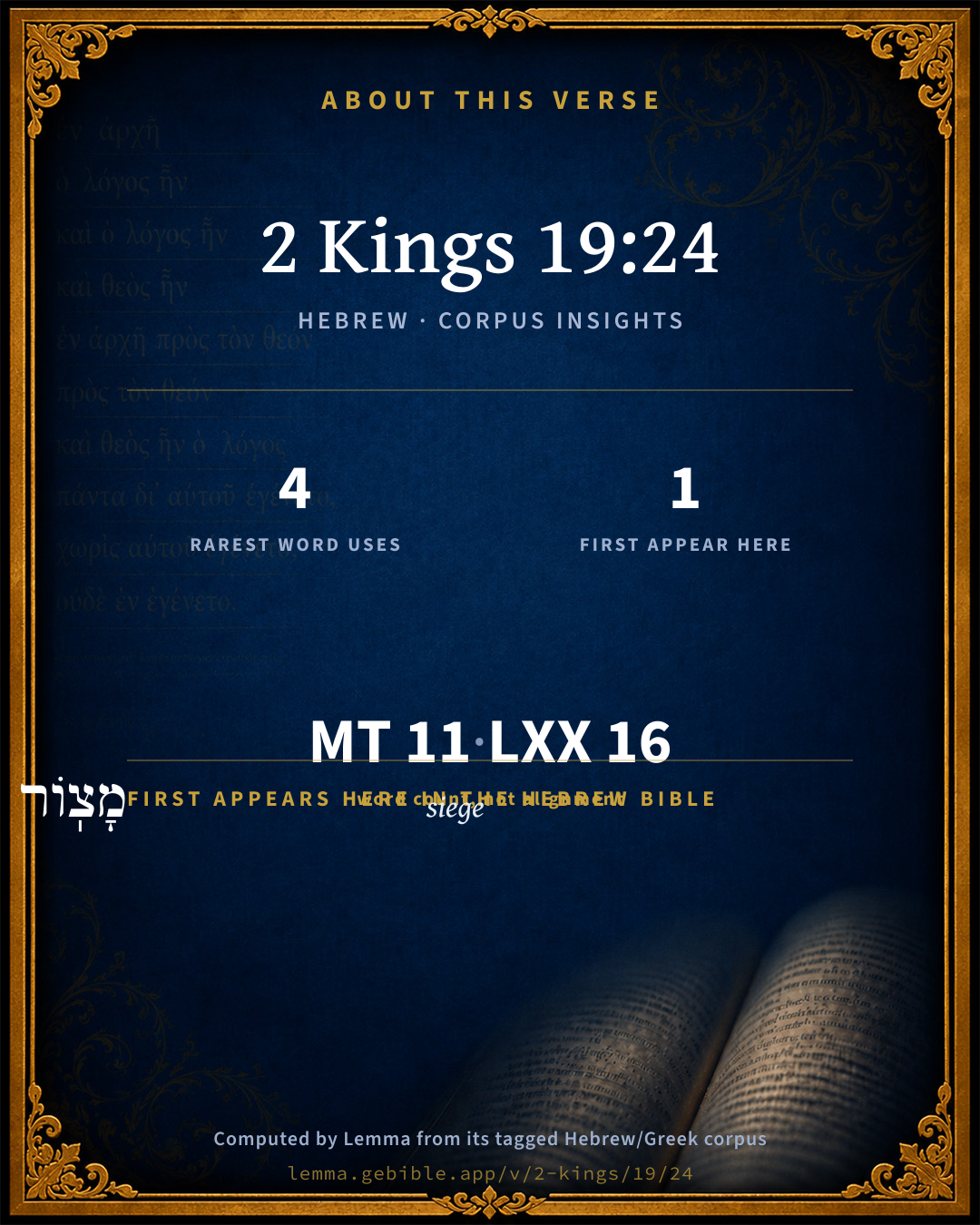
The rarest word here is מָצֽוֹר siege H4693 — appearing just 4 times in the whole Hebrew Bible.

First appearance in Scripture

This word makes its first canonical appearance in the Hebrew Bible here:

  • מָצֽוֹר siege H4693

Shared distinctive vocabulary

מָצֽוֹר siege H4693 occurs in 4 verses of the Hebrew Bible. Also found in:

Grammatical profile

  • 3 verbs
  • 6 nouns
  • 1 adjective
  • 1 pronoun

Verb forms

  • קַ֔רְתִּי Qal · Perfect
  • וְשָׁתִ֖יתִי Qal · Perfect
  • וְאַחְרִב֙ Hiphil · Imperfect

Hebrew & Septuagint length

In English translation the verse runs 23 words from the Hebrew and 26 from the Septuagint (LXX English) — closely comparable.

A rough comparison of the two English renderings, which tokenize alike — not a word-level alignment.

Word counts can differ between the Hebrew and the Greek without any difference in meaning — e.g. the Hebrew direct-object marker אֵת has no separate Greek word, and Greek often adds the article ὁ.

In the original languages it is 11 Hebrew tokens and 16 Greek tokens — but the two are counted differently (Hebrew bundles its prefixes and suffixes into one token; the Greek is in lemma form), so that isn’t a like-for-like length.

Cross-references

5

Topical passages linked to 2 Kings 19:24 in the Treasury of Scripture Knowledge — connected by theme and wording, ordered by reader-vote popularity; previews shown in the World English Bible.

  • Exodus 15:9 The enemy said, 'I will pursue, I will overtake, I will divide the spoil. My desire shall be satisfied on them. I will draw my sword, my hand shall destroy them.'
  • 2 Samuel 17:13 Moreover, if he be gotten into a city, then shall all Israel bring ropes to that city, and we will draw it into the river, until there not be one small stone found there.
  • 1 Kings 20:10 Ben Hadad sent to him, and said, The gods do so to me, and more also, if the dust of Samaria shall suffice for handfuls for all the people who follow me.
  • Isaiah 19:6 The rivers shall become foul; the streams of Egypt shall be diminished and dried up; the reeds and flags shall wither away.
  • Daniel 4:30 The king spoke and said, Is not this great Babylon, which I have built for the royal dwelling-place, by the might of my power and for the glory of my majesty?

Cross-references courtesy of OpenBible.info (CC BY 4.0).

Hebrew and Greek witnesses Masoretic Hebrew ↔ Greek Septuagint

The same verse in the two great witnesses to the Old Testament, shown verse-for-verse.

These are two independent witnesses, not word-aligned to each other, and the Septuagint is shown in lemma (dictionary) form.

Hebrew 2 Kings 19:24 Masoretic · Westminster Leningrad Codex

אֲנִ֣י קַ֔רְתִּי וְשָׁתִ֖יתִי מַ֣יִם זָרִ֑ים וְאַחְרִב֙ בְּכַף פְּעָמַ֔י כֹּ֖ל יְאֹרֵ֥י מָצֽוֹר

I have dug and drunk strange waters, and with the sole of my feet will I dry up all the rivers of Egypt.

World English Bible · Public Domain

Greek LXX 2 Kings 19:24 Septuagint · lemma form

ἐγώ ψύχω καί πίνω ὕδωρ ἀλλότριος καί ἐκἐρημόω ὁ ἴχνος ὁ πούς ἐγώ πᾶς ποταμός περιοχή

I have refreshed myself, and have drunk strange waters, and I have dried up with the sole of my foot all the rivers of fortified places.

LXX2012 (modern English Septuagint) · Public Domain

Hebrew: Westminster Leningrad Codex (CC BY 4.0). Greek: Septuagint (public domain); English from LXX2012 (modern English Septuagint) (Public Domain). How the Septuagint differs from the Hebrew →

Targum (Aramaic paraphrase)

1

The Targum is the ancient Jewish Aramaic paraphrase of the Hebrew Scriptures — an interpretive translation, not the Hebrew text itself. Onkelos (literal) and Pseudo-Jonathan (expansive) render the Torah, and Jonathan the Prophets. Coverage is partial: where no permissively-licensed English translation exists for a verse, only the Aramaic is shown. This is verse-level text, not a word-by-word alignment to the Hebrew.

  1. Targum Jonathan Prophets (Joshua–Malachi)
    אֲנָא הֲוֵיתִי חָפֵיר גוּבִין וְשָׁתֵי מַיְן נוּכְרָאִין וּטְפָחִית בְּפַרְסַת רִגְלֵי עַמָא דְעִמַי כֹּל מֵי נַהֲרִין עֲמִיקִין:

    (no public-domain English translation for this verse)

    Targum Jonathan — Aramaic: “Mikraot Gedolot” (public domain). English: “Sefaria Community Translation” (CC0 1.0 (public-domain dedication)); “London "Chaldee Paraphrase," 1871” (public domain). Text via Sefaria.

Commentary

Notes on 2 Kings 19:24 from classic Christian and Jewish commentators (each source and its license shown beneath its notes). The classic Christian expositions comment on the surrounding passage and are grouped to its opening verse, so a note may address several verses; the Jewish commentaries on the Tanakh (Rashi and others) are per-verse, so they appear only where the commentator wrote on this verse.

Lemma curates 59 commentaries, every one of them public domain or Creative Commons licensed, each selected and text-cleaned for this edition rather than reprinted as found. About our sources →

Trapp's Complete Commentary

John Trapp

2Ki 19:24 I have digged and drunk strange waters, and with the sole of my feet have I dried up all the rivers of besieged places.

Ver. 24. I have digged and drunk strange waters,] {a} i.e., Newly found waters, though thou hast endeavoured to stop from me and mine army the waters of the fountains. {2Ch 32:3-4}

And with the sole of my feet.] Thrasonica hyperbole; he proudly boasteth of his numerous army, and that with the trampling of his horse and horsemen he could dry up the pools about Jerusalem.

{a} Nihil est mihi impossibile. - Vat.

John Trapp, A Commentary or Exposition upon All the Books of the Old and New Testament (1647–1656) — public domain. Text from a community e-Sword module.

Joseph Benson's Commentary

2Ki 19:24. I have digged and drunk strange waters — That is, says Vitringa, “I have hitherto possessed all my desires; whatever I have vehemently thirsted after, I have attained.” Others understand this and the following clause more literally, thus: “I have marched through deserts, where it was expected my army would have perished with thirst; and yet even there have I digged and found water: and I have rendered rivers fordable by turning their streams from their ancient beds, and have deprived the besieged of the benefit of those waters.” Vitringa, however, renders the last clause, with the sole of my feet will I dry up all the rivers of Egypt. The prophet is thought to allude to a custom of the Egyptians, who commonly made use of machines, which were worked by the foot, to draw water from rivers, for whatever purpose it might be wanted; and the meaning, according to Vitringa, is, that the Assyrian, by the assistance of his very numerous army, the sole of his foot, would dry up all the rivers of Egypt, so that they should not delay the success of his expedition. The expression is of the hyperbolic kind, and well suits this haughty monarch, whose mind was at this time full of his expedition into Judea and Egypt. — See Dr. Dodd.

Joseph Benson's Commentary on the Old and New Testaments (1811–1818) — public domain. Text from a community e-Sword module.

Geneva Bible (1599)

Geneva Bible translators

Or, the waters of cities besieged.

Geneva Bible (1599) marginal notes — public domain. Text via Bolls.life.

Adam Clarke's Commentary

Verse 24. I have dipped and drunk strange waters] I have conquered strange countries, in which I have digged wells for my army; or, I have gained the wealth of strange countries.

With the sole of my feet] My infantry have been so numerous that they alone have been sufficient to drink up the rivers of the places I have besieged.

Adam Clarke's Commentary on the Bible (1810–1826) — public domain. Text from a community e-Sword/MySword module.

Ellicott's Commentary for English Readers

(24) I have digged and drunk strange waters.—Scarcity of water has hitherto been no bar to my advance. In foreign and hostile lands, where the fountains and cisterns have been stopped and covered in (2Ch_32:3), I have digged new wells.

And with the sole . . . places.—Rather, and I will dry up with the sole of my feet all the Nile arms of Mâçôr—i.e., Lower Egypt. (Comp. Isa_19:5 seq.) Neither mountains nor rivers avail to stop my progress. As the style is poetical, perhaps it would be correct to take the perfects, which in 2Ki_19:23-24 alternate with imperfects, in a future sense: “I—I will ascend lofty mountains . . . I will dig and drink strange waters” the latter in the arid desert that lies between Egypt and Palestine (the Et-Tîh). Otherwise, both perfects and imperfects may mark what is habitual: “I ascend . . . I dig.”

A Bible Commentary for English Readers, edited by Charles John Ellicott (1878–1897) — public domain. Text from a community e-Sword module.

The Cambridge Bible for Schools and Colleges

gen. ed. J. J. S. Perowne

24. I have digged and drunk strange waters] Probably there is some allusion in this boast which is put into the mouth of Sennacherib to the attempts made by Hezekiah (2Ch_32:3-4) to deprive the Assyrians of a supply of water. Sennacherib means to say: ‘Do what you may I am able by digging wells wherever I go to get water for my host, even where none had been found before’. This is most likely the sense of ‘strange’, which word does not appear in the corresponding verse of Isaiah.

And with the sole of my feet have I dried] [R.V. will I dry] up all the rivers of besieged places] R.V. of Egypt. This is a boast of the opposite nature. In Judæa the trouble might be that there was too little water. In Egypt there would be too much. But as in the former case the Assyrian could surmount all difficulties, so he had but to march into Egypt, and at his approach the Nile should be dried up and make a way for his troops to pass. The change of tense in the verb is necessary from the Hebrew, and the language is the proud king’s way of saying ‘As soon as I have reduced Jerusalem, I will pass on to Egypt and win that land too’.

The word translated ‘rivers’ is the Heb. ‘Yeor’ and is a proper name of the Nile. See R.V. Gen_41:1 margin. It is translated ‘Nile’ in R.V. of Isa_19:7, three times over. Also the word rendered ‘besieged places’ is the Hebrew ‘Mazor’ another form for ‘Mizraim’ the common word for ‘Egypt’, ‘Mazor’ is translated ‘Egypt’ in R.V. both here and in Isa_19:6, and Mic_7:12.

The Cambridge Bible for Schools and Colleges (gen. ed. J. J. S. Perowne; Cambridge University Press, 1878–1918) — public domain. Text from a community e-Sword module.

Albert Barnes' Notes on the Bible

Have digged and drunk ... and dried up - The meaning seems to be - “Mountains do not stop me - I cross them even in my chariots. Deserts do not stop me - I dig wells there, and drink the water. Rivers do not stop me - I pass them as easily as if they were dry land.”

The rivers of besieged places - Rather, “the rivers of Egypt.” The singular form, Mazor (compare the modern Misr and the Assyrian Muzr), is here used instead of the ordinary dual form, Mizraim, perhaps because “Lower Egypt” only is intended. This was so cut up with canals and branches of the Nile, natural and artificial, that it was regarded as impassable for chariots and horses. Sennacherib, however, thought that these many streams would prove no impediments to him; he would advance as fast as if they were “dried up.”

Albert Barnes' Notes on the Bible (1834–1885) — public domain. Text from a community e-Sword/MySword module.

Haydock's Catholic Bible Commentary

Strange waters, which did not run in my original dominions, (Haydock) or which were found by opening springs before unknown. --- Shut-up, with mounds of earth, or in the banks of rivers. The army of Xerxes is said to have drunk whole rivers dry. We might also translate, "I have dried up the waters, which served as ramparts for cities." Thus Cyrus diverted the streams of the Gnidus, and of the Euphrates. Hebrew also, perhaps most literally, "I will dry up the rivulets of Egypt." See Isaias xix. 6., and xxxvii. 25. (Calmet) --- Protestants, "all the rivers of besieged places." (Haydock)

George Leo Haydock (1774–1849), Haydock's Catholic Family Bible and Commentary, 1859 edition — public domain. Excludes Psalms (Douay-Rheims chapter numbering differs from Protestant) and Deuterocanonical books (Catholic canon only).

Matthew Poole's English Annotations

Strange waters; such as were never discovered nor used by others. And therefore all thy endeavours to deprive me of water for my army, 2Ch 32:3, are idle and fruitless.

With the sole of my feet have I dried up all the rivers of besieged places; and as I can furnish my army with water digged out of the earth, by their labour, and my art; so I can deprive my enemies of their water, and can dry up their rivers, and that with the sole of my feet, i.e. with the march of my vast and numerous army, who will easily do this, either by marching through them, and each carrying part away with them; or by drinking every one a little of them; or by their pains making many new channels, and driving the waters of the river into them, as Cyrus dried up Euphrates, and thereby took Babylon.

Matthew Poole's English Annotations on the Holy Bible (1683–1685) — public domain. Text from a community e-Sword/MySword module.

Whedon's Commentary on the Bible

Daniel D. Whedon

24. Strange waters — That is, waters of foreign countries; waters strange to a native Assyrian. He boasts that he enters strange lands, and digs and drinks their waters.

With the sole of my feet — As though I were a god, and able to dry up rivers by merely setting my foot upon their waters.

All the rivers of besieged places — Better, all the canals of Matzor; commonly rendered, all the streams of Egypt. מצור, Matzor, is a poetical name for Egypt, (compare Isa_19:6,) and the rivers would naturally refer to the arms or canals of the Nile. So this verse contains Sennacherib’s boast of what he intends to do to Egypt. “Just as Lebanon could not stop the expeditions of the Assyrians, or keep them back from the conquest of the land of Canaan, so the desert which separated Egypt from Asia, notwithstanding its want of water, could not prevent his forcing his way through it and laying Egypt waste. The digging of water is not merely ‘a reopening of the wells that had been choked up with rubbish, and the cisterns that had been covered up before the approaching enemy,’ (Thenius,) but the digging of wells in the waterless desert. Strange water is not merely water belonging to others, but water not belonging to this soil, that is, water supplied by a region which had none at other times. By the perfects [I have digged, etc.] the thing is represented as already done — as exposed to no doubt whatever. The drying up of the rivers with the soles of the feet is an hyperbolical expression denoting the omnipotence with which the Assyrian rules over the earth. Just as he digs water in the desert where no water is to be had, so does he annihilate it where mighty rivers exist.” — Keil.

Daniel D. Whedon (gen. ed.), Commentary on the Old and New Testaments (1874–1909) — public domain. Text from a community e-Sword module.

The Pulpit Commentary

I have digged and drunk strange waters; rather, perhaps, I dig, and drink... and dry up the preterit having again a present sense. Sennacherib means that this is what he is wont to do. As mountains do not stop him (ver. 23), so deserts do not stop him he digs wells in them, and drinks water "strange" to the soil never before seen there. And with the sole of my feet have I dried up all the rivers of besieged places; rather, will I dry up all the rivers of Egypt. (compare the Revised Version. "Mazor" is used for "Egypt" in Isa_19:6 and Mic_7:12) It is the old singular from which was formed the dual Mizraim. Whether it meant "land of strength" (Pusey), or "land of distress" (Ewald), may be doubted, since we have no right to assume a Hebrew derivation. There was probably a native word, from which the Hebrew Mazor, the Assyrian Muzr, and the Arabic Misr were taken. Sennacherib"s beast is that, as he makes deserts traversable by digging wells, so, if rivers try to stop him, he will find a way of drying them up. Compare the boasts of Alaric in Claudian ("Bell. Get.," pp. 525-532), who had probably this passage of Kings in his thoughts

To patior suadente fugam, cum cesserit omnis Obsequiis natura meis? Subsidere nostris Sub pedibus montes, arescere vidimus amnes Fregi Alpes, galeisque Padum victricibus hausi.

The Pulpit Commentary (1880–1919), ed. H.D.M. Spence-Jones & Joseph S. Exell — public domain. Text from a community e-Sword module.

John Wesley's Explanatory Notes

Strange waters - Such as were never discovered by others. Dried up - And as I can furnish my army with water digged out of the earth; so I can deprive my enemies of their water, and can dry up their rivers, and that with the sole of my feet; with the march of my vast and numerous army, who will easily do this, either by marching through them, and each carrying away part with them: or by making new channels, and driving the waters of the river into them.

John Wesley, Explanatory Notes Upon the Whole Bible (1754–1765) — public domain. Text via the GEBible commentary corpus.

Rashi

Rabbi Shlomo Yitzchaki (Rashi)

I dug and drank strange water. I.e., I started all my deeds and completed [them], as one who digs a hole and finds flowing water and drinks it. Flowing water he calls “זרים [=strange],” because until now no one knew of them.

And I dry up with the soles of my feet. If I besiege a city that depends upon its rivers, I bring many troops upon it who dry up its rivers with their drinking and the drinking of their cattle and by the treading of their feet.

And I dry up. This is in the present tense [because] this is always my way.

Rashi on the Tanakh — English translations: “The Judaica Press complete Tanach with Rashi, translated by A. J. Rosenberg” (CC BY 4.0); “Pentateuch with Rashi's commentary by M. Rosenbaum and A.M. Silbermann, 1929-1934” (public domain); “The Metsudah Tanach series, Lakewood, N.J” (CC BY 4.0); and “The Book of Joshua, Metsudah Publications, 1997” (CC BY 4.0). Text via Sefaria.

Lesson kit

Teaching starters — assembled from the data on this page, not authored interpretation. Every prompt links to the verse data it draws on. Edit before teaching.

2 Kings, in the Historical, opens this verse with 11 words (11 distinct Hebrew lemmas). Its most distinctive word is mâtsôwr (“siege”). A historical commentator’s framing appears above. Read the whole chapter for the surrounding context.

Discussion questions

  1. The word mâtsôwr carries the sense “siege.” How does it shape the verse?
  2. The word “siege” first appears here in Scripture. What is being introduced at this debut?
  3. Isaiah 19:6 shares the word «siege» with this verse. How do the two illuminate each other?
  4. These translations render this verse differently. What is at stake in choosing one wording over another?
  5. The verb «קַ֔רְתִּי» is Qal Perfect. How does its form color the action?
  6. Reading how Trapp's Complete Commentary and Joseph Benson's Commentary read this verse, where do the two commentators agree and where do they part?

Things to notice

Reading settings

Reading text

Shown beneath each verse's original-language words.

Old Testament
Old Testament edition

Read the OT as the Masoretic Hebrew (MT) or the Greek Septuagint (LXX).

English shown for the Greek Septuagint (in the Hebrew ↔ Greek comparison).

Comparing translations? Open the Compare panel on any verse page to stack up to four side by side.