Isaiah 21:5

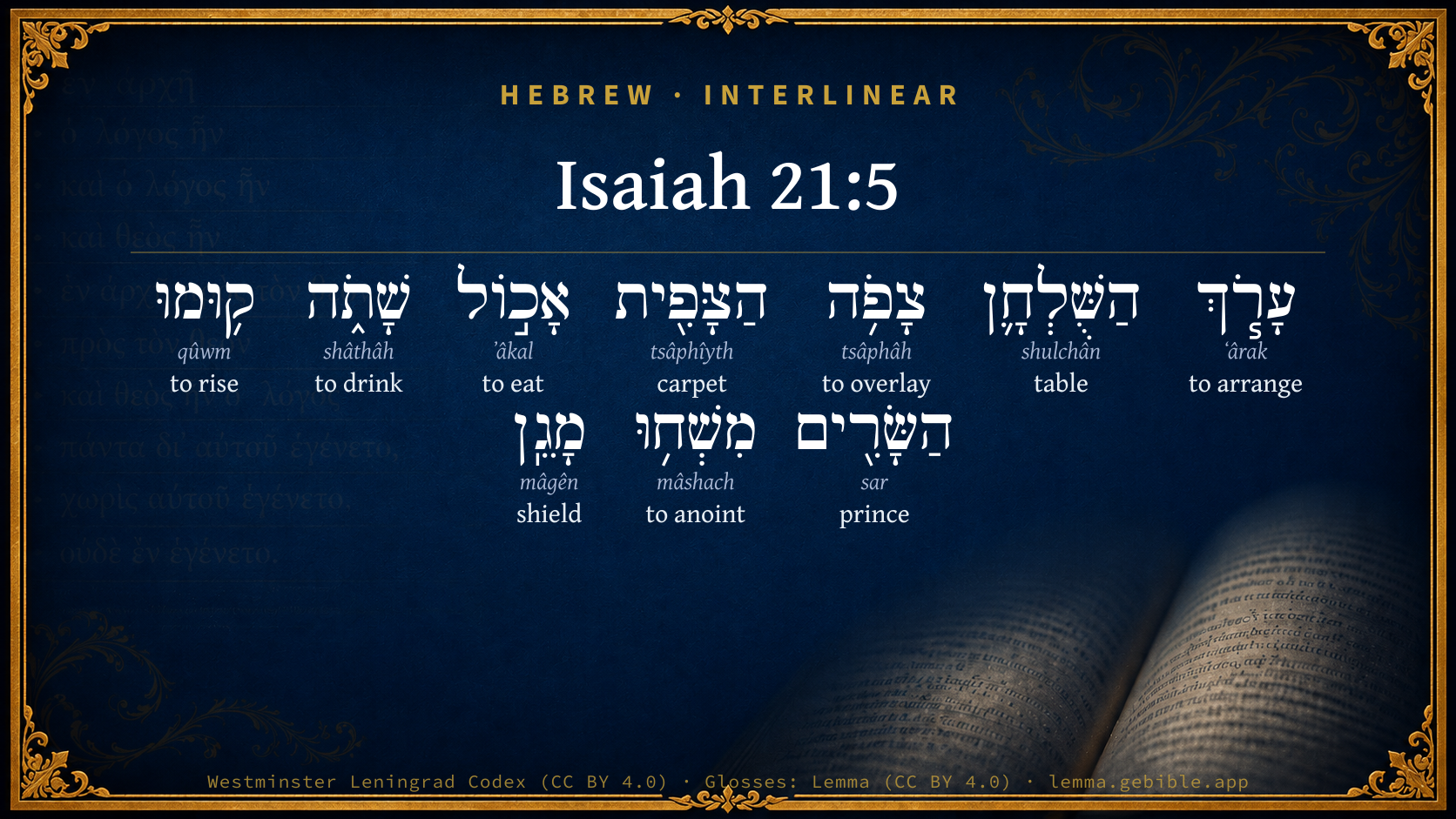
Hebrew (Westminster Leningrad Codex) Isaiah 21:5 appears in the Hebrew Old Testament. The text above is from the Westminster Leningrad Codex. Each word links to its Strong’s number, a concise gloss, and parsing drawn from the Open Scriptures Hebrew Bible morphology. Click any word for its full Brown-Driver-Briggs (BDB) entry.
Download image
Cite this verse

Isaiah 21:5 (World English Bible). Public Domain. Lemma interlinear Bible study tool, https://lemma.gebible.app/v/isaiah/21/5.

Show BibTeX & RIS
BibTeX
RIS
English Translation
They prepare the table, they set the watch, they eat, they drink: rise up, you princes, anoint the shield.
World English Bible · Public Domain
Highlights Full analysis ↓
Download a study sheet

One document with this verse’s original text, its word-by-word gloss line, the meaning frame, cross-references with their text, attributed commentary, and full source and license credits — printable, and it pastes into notes with its structure intact.

This verse Autodidact and up

Study sheet (.html) Plain text (.txt)

A passage Seminary Student

Up to 50 verses in one chapter. A passage sheet keeps up to 6 commentary sources and 12 cross-references per verse, in the order this page ranks them, and says so on the sheet whenever that leaves anything out. Ask for a single verse and you get the Autodidact verse sheet above.

Everything on this page stays free to read, with no account — the sheet is a download of what is already on screen, not access to it.

Want to remove ads? Support Godless Engineer
Compare translations 3

The same verse in 3 English versions, stacked beneath the original-language interlinear above. Click any original word for its lexicon entry.

Each is an independent rendering of the whole verse — the interlinear is not word-aligned to these translations.

Highlighted words mark where these versions differ — a whole-verse word diff, not a word-by-word alignment.

  • World English Bible Public Domain
    They prepare the table, they set the watch, they eat, they drink: rise up, you princes, anoint the shield.
  • King James Version Public Domain
    Prepare the table, watch in the watchtower, eat, drink: arise, ye princes, and anoint the shield.
  • unfoldingWord Literal Text CC BY-SA 4.0
    “Arrange the table, spread the carpet, eat, drink.” “Arise, princes, anoint the shield!”

unfoldingWord Literal Text — © unfoldingWord, licensed CC BY-SA 4.0. Word-aligned USFM3 via Door43 (git.door43.org/unfoldingWord/en_ult).

Versions to compare (up to 4)

3 of 4 selected

Show all 18 translations

Every available English version of this verse, each an independent rendering of the whole verse.

  • World English Bible Public Domain
    They prepare the table, they set the watch, they eat, they drink: rise up, you princes, anoint the shield.
  • Berean Standard Bible Public Domain
    They prepare a table, they lay out a carpet, they eat, they drink! Rise up, O princes, oil the shields!
  • Majority Standard Bible Public Domain
    They prepare a table, they lay out a carpet, they eat, they drink! Rise up, O princes, oil the shields!
  • King James Version Public Domain
    Prepare the table, watch in the watchtower, eat, drink: arise, ye princes, and anoint the shield.
  • American Standard Version (1901) Public Domain
    They prepare the table, they set the watch, they eat, they drink: rise up, ye princes, anoint the shield.
  • Revised Version (1885) Public Domain
    They prepare the table, they set the watch, they eat, they drink: rise up, ye princes, anoint the shield.
  • Geneva Bible (1599) Public Domain
    Prepare thou the table: watch in the watch towre: eate, drinke: arise, ye princes, anoynt the shielde.
  • Douay-Rheims (1899) Public Domain
    Prepare the table, behold in the watchtower them that eat and drink: arise, ye princes, take up the shield.
  • Young's Literal Translation Public Domain
    Arrange the table, watch in the watch-tower, Eat, drink, rise, ye heads, anoint the shield,
  • Literal Standard Version CC BY-SA 4.0
    Arrange the table, watch in the watchtower, || Eat, drink, rise, you heads, anoint the shield,
  • Unlocked Literal Bible CC BY-SA 4.0
    They prepare the table, they spread rugs and eat and drink; arise, princes, anoint your shields with oil.
  • unfoldingWord Literal Text CC BY-SA 4.0
    “Arrange the table, spread the carpet, eat, drink.” “Arise, princes, anoint the shield!”
  • Darby Bible Public Domain
    Prepare the table, appoint the watch; eat, drink: arise, ye princes, anoint the shield.
  • World Messianic Bible Public Domain
    They prepare the table. They set the watch. They eat. They drink. Rise up, you princes, oil the shield!
  • Webster's Bible Public Domain
    Prepare the table, watch in the watch-tower, eat, drink: arise, ye princes, and anoint the shield.
  • Free Bible Version CC BY-SA 4.0
    They set the table, they spread out the rugs, they eat and drink… “Get up, officers! Prepare your shields for battle!”
  • Bible in Basic English Public Domain
    They make ready the table, they put down the covers, they take food and drink. Up! you captains; put oil on your breastplates.
  • JPS Tanakh (1917) Public Domain
    They prepare the table, they light the lamps, they eat, they drink — 'Rise up, ye princes, anoint the shield.'

Literal Standard Version (2020), Covenant Press — licensed CC BY-SA 4.0. Text via the HelloAO Bible API (eBible.org). Unlocked Literal Bible (unfoldingWord) — licensed CC BY-SA 4.0. Text via the HelloAO Bible API (eBible.org). unfoldingWord Literal Text — © unfoldingWord, licensed CC BY-SA 4.0. Word-aligned USFM3 via Door43 (git.door43.org/unfoldingWord/en_ult). Free Bible Version, Dr. Jonathan Gallagher — licensed CC BY-SA 4.0. Text via the HelloAO Bible API (eBible.org).

Word by word

More ways to search: Search by grammar → Find every occurrence → Compare this word →

Practice this passage: Drill this verse → Learn its vocabulary →

הַצָּפִ֖ית
tsâphîyth
H6844
“the · carpet”
Particle, Definite Article + Noun, Common, Feminine, Singular, Absolute
Part of Speech
Particle + Noun
Type
Common
Gender
Feminine
Number
Singular
State
Absolute
Full BDB Definition

Origin: from H6822

TWOT: 1951b

rug, carpet - (CLBL) watch
  1. עָרֹ֧ךְ ʻârak H6186 “to arrange” Verb, Qal, Infinitive Absolute
  2. הַשֻּׁלְחָ֛ן shulchân H7979 “the · table” Particle, Definite Article + Noun, Common, Masculine, Singular, Absolute
  3. צָפֹ֥ה tsâphâh H6823 “to overlay” Verb, Qal, Infinitive Absolute
  4. אָכ֣וֹל ʼâkal H398 “to eat” Verb, Qal, Infinitive Absolute
  5. שָׁתֹ֑ה shâthâh H8354 “to drink” Verb, Qal, Infinitive Absolute
  6. ק֥וּמוּ qûwm H6965 “rise” Verb, Qal, Imperative, 2nd Person, Masculine, Plural
  7. הַשָּׂרִ֖ים sar H8269 “the · princes” Particle, Definite Article + Noun, Common, Masculine, Plural, Absolute
  8. מִשְׁח֥וּ mâshach H4886 “anoint” Verb, Qal, Imperative, 2nd Person, Masculine, Plural
  9. מָגֵֽן mâgên H4043 “shield” Noun, Common, Both, Singular, Absolute

About this verse

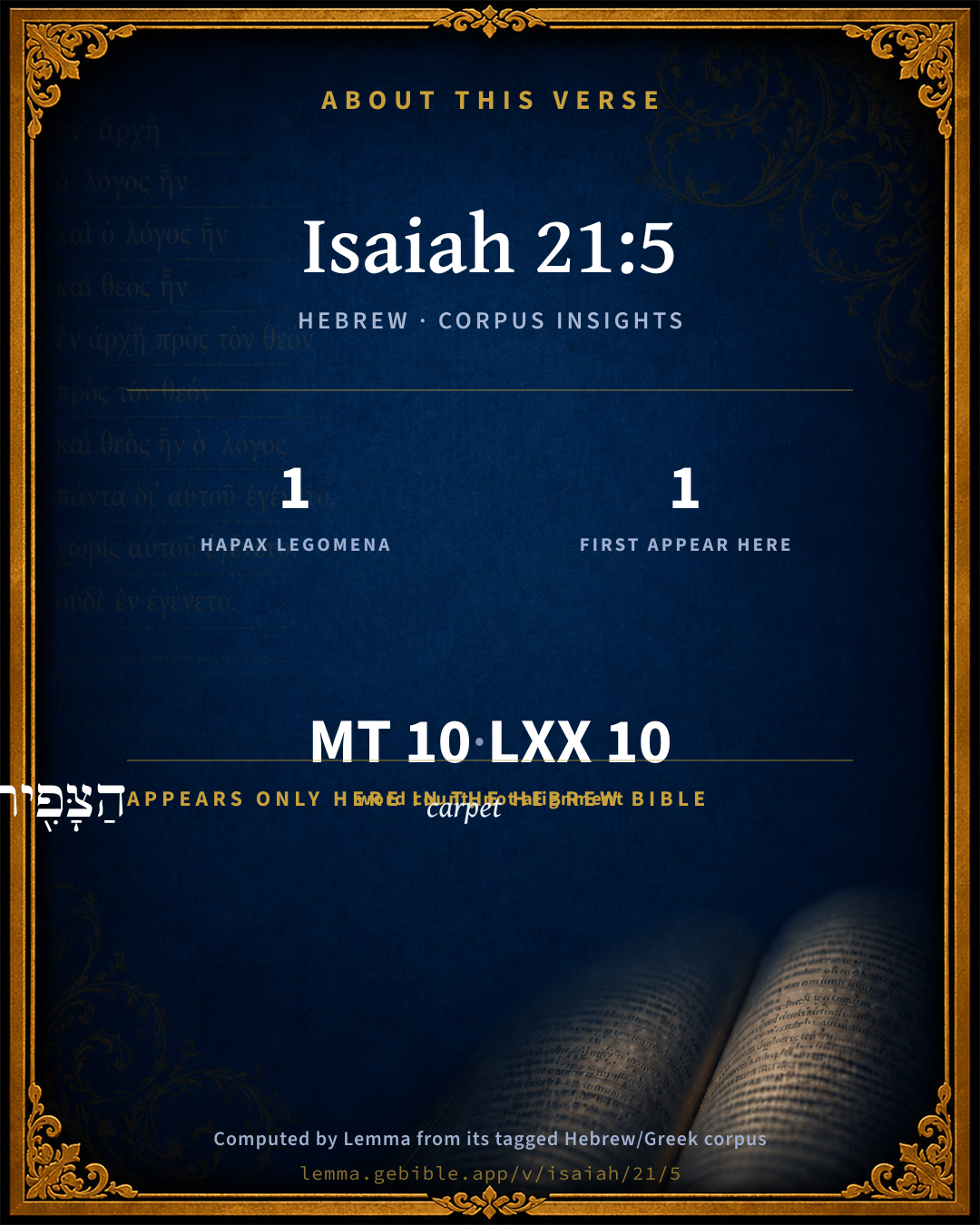
These counts appear in no published source. They are computed here, from the morphology-tagged text and Lemma’s own curated glosses. What Lemma adds →

10
words
10
distinct lemmas
Prophets
section

Notable vocabulary

1 hapax legomenon — a word that appears only here in the entire Hebrew Bible:

  • הַצָּפִ֖ית carpet H6844

First appearance in Scripture

This word makes its first canonical appearance in the Hebrew Bible here:

  • הַצָּפִ֖ית carpet H6844

Shared distinctive vocabulary

צָפֹ֥ה to overlay H6823 occurs in 40 verses of the Hebrew Bible. Also found in:

Grammatical profile

  • 6 verbs
  • 4 nouns

Verb forms

  • עָרֹ֧ךְ Qal · Infinitive Absolute
  • צָפֹ֥ה Qal · Infinitive Absolute
  • אָכ֣וֹל Qal · Infinitive Absolute
  • שָׁתֹ֑ה Qal · Infinitive Absolute
  • ק֥וּמוּ Qal · Imperative
  • מִשְׁח֥וּ Qal · Imperative

Hebrew & Septuagint length

In English translation the verse runs 19 words from the Hebrew and 12 from the Septuagint (LXX English) — the Septuagint runs noticeably shorter here. See the side-by-side →

A rough comparison of the two English renderings, which tokenize alike — not a word-level alignment.

Word counts can differ between the Hebrew and the Greek without any difference in meaning — e.g. the Hebrew direct-object marker אֵת has no separate Greek word, and Greek often adds the article ὁ.

In the original languages it is 10 Hebrew tokens and 10 Greek tokens — but the two are counted differently (Hebrew bundles its prefixes and suffixes into one token; the Greek is in lemma form), so that isn’t a like-for-like length.

Cross-references

10

Topical passages linked to Isaiah 21:5 in the Treasury of Scripture Knowledge — connected by theme and wording, ordered by reader-vote popularity; previews shown in the World English Bible.

  • Jeremiah 51:11 Make sharp the arrows; hold firm the shields: Yahweh has stirred up the spirit of the kings of the Medes; because his purpose is against Babylon, to destroy it: for it is the vengeance of Yahweh, the vengeance of his temple.
  • Jeremiah 51:39 When they are heated, I will make their feast, and I will make them drunken, that they may rejoice, and sleep a perpetual sleep, and not wake, says Yahweh.
  • Jeremiah 51:57 I will make drunk her princes and her wise men, her governors and her deputies, and her mighty men; and they shall sleep a perpetual sleep, and not wake up, says the King, whose name is Yahweh of Hosts.
  • Daniel 5:1–5 Belshazzar the king made a great feast to a thousand of his lords, and drank wine before the thousand.
  • Isaiah 13:2 Set up an ensign on the bare mountain, lift up the voice to them, wave the hand, that they may go into the gates of the nobles.
  • Isaiah 13:17–18 Behold, I will stir up the Medes against them, who shall not regard silver, and as for gold, they shall not delight in it.
  • Isaiah 22:13–14 and behold, joy and gladness, killing oxen and killing sheep, eating flesh and drinking wine: let us eat and drink, for tomorrow we shall die.
  • Isaiah 45:1–3 Thus says Yahweh to his anointed, to Cyrus, whose right hand I have held, to subdue nations before him, and I will loose the loins of kings; to open the doors before him, and the gates shall not be shut:
  • Jeremiah 51:27–28 Set up a standard in the land, blow the trumpet among the nations, prepare the nations against her, call together against her the kingdoms of Ararat, Minni, and Ashkenaz: appoint a marshal against her; cause the horses to come up as the rough canker-worm.
  • 1 Corinthians 15:32 If I fought with animals at Ephesus for human purposes, what does it profit me? If the dead are not raised, then "let us eat and drink, for tomorrow we die."

Cross-references courtesy of OpenBible.info (CC BY 4.0).

Hebrew and Greek witnesses Masoretic Hebrew ↔ Greek Septuagint

The same verse in the two great witnesses to the Old Testament, shown verse-for-verse.

Here the Septuagint runs noticeably shorter than the Hebrew — LXX2012 (modern English Septuagint) 12 words vs World English Bible 19. A rough length comparison of the two English translations, not a word-level alignment — read both below.

These are two independent witnesses, not word-aligned to each other, and the Septuagint is shown in lemma (dictionary) form.

Hebrew Isaiah 21:5 Masoretic · Westminster Leningrad Codex

עָרֹ֧ךְ הַשֻּׁלְחָ֛ן צָפֹ֥ה הַצָּפִ֖ית אָכ֣וֹל שָׁתֹ֑ה ק֥וּמוּ הַשָּׂרִ֖ים מִשְׁח֥וּ מָגֵֽן

They prepare the table, they set the watch, they eat, they drink: rise up, you princes, anoint the shield.

World English Bible · Public Domain

Greek LXX Isaiah 21:5 Septuagint · lemma form

ἑτοιμάζω ὁ τράπεζα πίνω ἐσθίω ἀναἵστημι ὁ ἄρχων ἑτοιμάζω θυρέος

Prepare the table, eat, drink: arise, you⌃ princes, and prepare your shields.

LXX2012 (modern English Septuagint) · Public Domain

On this verse, Albert Barnes' Notes on the Bible discusses the Septuagint’s reading. Read the note in Commentary ↓

Hebrew: Westminster Leningrad Codex (CC BY 4.0). Greek: Septuagint (public domain); English from LXX2012 (modern English Septuagint) (Public Domain). How the Septuagint differs from the Hebrew →

Targum (Aramaic paraphrase)

1

The Targum is the ancient Jewish Aramaic paraphrase of the Hebrew Scriptures — an interpretive translation, not the Hebrew text itself. Onkelos (literal) and Pseudo-Jonathan (expansive) render the Torah, and Jonathan the Prophets. Coverage is partial: where no permissively-licensed English translation exists for a verse, only the Aramaic is shown. This is verse-level text, not a word-by-word alignment to the Hebrew.

  1. Targum Jonathan Prophets (Joshua–Malachi)
    סַדַרוּ פָּתוֹרִין אֲקִימוּ סַכְוָאִין אֲכוֹלוּ שְׁתוּ קוּמוּ רַבְרְבַיָא מְרִיקוּ וְצַחְצַחוּ זְיָנָא:

    Prepare the table, place the watchmen, eat ye, drink ye; rise, ye princes, polish, and make bright the arms!

    Targum Jonathan — Aramaic: “Mikraot Gedolot” (public domain). English: “Sefaria Community Translation” (CC0 1.0 (public-domain dedication)); “London "Chaldee Paraphrase," 1871” (public domain). Text via Sefaria.

Commentary

Notes on Isaiah 21:5 from classic Christian and Jewish commentators (each source and its license shown beneath its notes). The classic Christian expositions comment on the surrounding passage and are grouped to its opening verse, so a note may address several verses; the Jewish commentaries on the Tanakh (Rashi and others) are per-verse, so they appear only where the commentator wrote on this verse.

Lemma curates 59 commentaries, every one of them public domain or Creative Commons licensed, each selected and text-cleaned for this edition rather than reprinted as found. About our sources →

Trapp's Complete Commentary

John Trapp

Isa 21:5 Prepare the table, watch in the watchtower, eat, drink: arise, ye princes, [and] anoint the shield.

Ver. 5. Prepare the table.] Insultat regi Balthasari, ac irridendo voces illius memorat. {a} Prepare the table, said Belshazzar. But more need he had to have said, Prepare the battle; set the army in array, &c. But this secure sot thought of no such matter. His destruction, though at hand, was hid from his eyes by the Lord, who

“ Auferre mentem talibus primum solet,

Caliginemque, affundit, ut ruant suas

Furenter in clades, sibi quas noxii

Accersierunt ultro, consiliis malis. ”

Watch in the watchtower.] That we may revel the more securely.

Eat, drink.] Etiamsi Hannibal sit ad portas; Even if Hannabal is by the gates. Feed without fear, notwithstanding the siege.

Arise, ye princes, anoint the shield,] q.d., It would better become you, O Babylonian princes, so to do - viz., to stand to your arms - to furbish your shields, for your better defence against the Medes and Persians. {b} Some make these words to be the watchman’s warning, given upon the Persians entering the city.

{a} Zeged.

{b} Non convivandi sed pugnandi tempus est. - A Lapide.

John Trapp, A Commentary or Exposition upon All the Books of the Old and New Testament (1647–1656) — public domain. Text from a community e-Sword module.

The Biblical Illustrator

Joseph S. Exell

Isa_21:5

Anoint the shield

Anoint the shield

The ancient shields being mostly of stout leather stretched over a frame or rim of metal or wood, it was necessary to rub them with oil, lest they should become hard and crack, or lest they should become so rigid that an arrow or spear might easily penetrate them.

Shields of this kind are still much in use, and still require the same treatment, in Western Asia; and we have ourselves frequently seen them on sale in the bazaars, and in use among the Arabs, the Kurds, and the Caucasians. (J. Kitto, D. D.)

Things that did not happen

What is a shield? It is a very peculiar part of Gods armour. It is not a strength in calamity; it is something which prevents calamity from coming. My strength is my power to bear; but my shield is my escape from bearing. My strength lifts me when the blow falls; my shield catches the blow before it falls. My strength supports what is; my shield wards off what might have been. I have often praised God for the strength; but I have seldom anointed the shield. I have recognised a thousand times His songs in the night; but I have not sufficiently thanked Him that the night itch has not been deeper. (G. Matheson, D. D.)

The Biblical Illustrator, edited by Joseph S. Exell (c. 1880s–1900s) — public domain. Text from a community e-Sword module.

Joseph Benson's Commentary

Isa 21:5. Prepare the table — Furnish it with meats and drinks, as it follows. The prophet foretels what the Babylonians would be doing when their enemies were upon the point of entering their city: Watch in the watch-tower — To give us notice of any approaching danger, that we may more securely indulge ourselves in mirth and pleasures. Arise, ye princes — Either, 1st, Ye princes of Babylon. Arise from the table, and run to your arms: which sudden alarm was the consequence of tidings from the watch- tower. Or, 2d, Ye Medes and Persians; as if he had said, While your enemies, the Babylonians, are feasting securely, prepare and make your assault. Most commentators understand the clause in this latter sense. Dr. Waterland, after Vitringa, renders it, The table is spread: the watchman stands upon the watch; they eat, they drink: Arise now, ye princes, &c. The words paint in lively colours the security and revelling of the Babylonians, at the very time when the divine command is given to the Medes and Persians to seize this proper moment to make the assault. See Jer 51:11; Jer 51:28, &c. The expression, Anoint the shield, means, Prepare your arms: make ready for the battle. The shield is put for all their weapons, offensive and defensive. They used to anoint their shields with oil to preserve and polish them, and make them slippery, that their enemies’ darts might not fix in and penetrate, but slide off from them.

Joseph Benson's Commentary on the Old and New Testaments (1811–1818) — public domain. Text from a community e-Sword module.

Keil & Delitzsch

C. F. Keil & F. Delitzsch

On the other hand, what Xenophon so elaborately relates, and what is also in all probability described in Dan 5:30 (compare Jer 51:39, Jer 51:57), is referred to in Isa 21:5 : "They cover the table, watch the watch, eat, drink. Rise up, ye princes! Anoint the shield!" This is not a scene from the hostile camp, where they are strengthening themselves for an attack upon Babylon: for the express allusion to the covering of the table is intended to create the impression of confident and careless good living; and the exclamation "anoint the shield" (cf., Jer 51:11) presupposes that they have first of all to prepare themselves for battle, and therefore that they have been taken by surprise. What the prophet sees, therefore, is a banquet in Babylon. The only thing that does not seem quite to square with this is one of the infinitives with which the picture is so vividly described (Ges. 131, 4, b), namely tzâpōh hatztzâphith. Hitzig's explanation, "they spread carpets" (from tzâphâh, expandere, obducere, compare the Talmudic tziphâh, tziphtâh, a mat, storea), commends itself thoroughly; but it is without any support in biblical usage, so that we prefer to follow the Targum, Peshito, and Vulgate (the Sept. does not give any translation of the words at all), and understand the hap. leg. tzâphith as referring to the watch: "they set the watch." They content themselves with this one precautionary measure, and give themselves up with all the greater recklessness to their night's debauch (cf., Isa 22:13). The prophet mentions this, because (as Meier acknowledges) it is by the watch that the cry, "Rise up, ye princes," etc., is addressed to the feasters. The shield-leather was generally oiled, to make it shine and protect it from wet, and, more than all, to cause the strokes it might receive to glide off (compare the laeves clypeos in Virg. Aen. vii. 626). The infatuated self-confidence of the chief men of Babylon was proved by the fact that they had to be aroused. They fancied that they were hidden behind the walls and waters of the city, and therefore they had not even got their weapons ready for use.

Keil & Delitzsch — Biblical Commentary on the Old Testament (1861–1891) — public domain (CC PDM 1.0). Text via the HelloAO Bible API. (Old Testament only.)

Geneva Bible (1599)

Geneva Bible translators

While they are eating and drinking, they shall be commanded to run to their weapons.

Geneva Bible (1599) marginal notes — public domain. Text via Bolls.life.

Jamieson, Fausset & Brown

Robert Jamieson, A. R. Fausset & David Brown

Prepare the table--namely, the feast in Babylon; during which Cyrus opened the dykes made by Semiramis to confine the Euphrates to one channel and suffered them to overflow the country, so that he could enter Babylon by the channel of the river. Isaiah first represents the king ordering the feast to be got ready. The suddenness of the irruption of the foe is graphically expressed by the rapid turn in the language to an alarm addressed to the Babylonian princes, "Arise," &c. (compare Isa 22:13). MAURER translates, "They prepare the table," &c. But see Isa 8:9.

watch in . . . watchtower--rather, "set the watch." This done, they thought they might feast in entire security. Babylon had many watchtowers on its walls.

anoint . . . shield--This was done to prevent the leather of the shield becoming hard and liable to crack. "Make ready for defense"; the mention of the "shield" alone implies that it is the Babylonian revellers who are called on to prepare for instant self-defense. HORSLEY translates, "Grip the oiled shield."

Jamieson, Fausset & Brown — Commentary Critical and Explanatory on the Whole Bible (1871) — public domain (CC PDM 1.0). Text via the HelloAO Bible API.

Adam Clarke's Commentary

Verse 5. Prepare the table - "The table is prepared"] In Hebrew the verbs are in the infinitive mood absolute, as in Eze 1:14: "And the animals ran and returned, רצוא ושוב ratso veshob, like the appearance of the lightning;" just as the Latins say, currere et reverti, for currebant et revertebantur. See Isa 32:11, and the note there.

Arise, ye princes, and anoint the shield.] Kimchi observes that several of the rabbins understood this of Belshazzar's impious feast and death. The king of a people is termed the shield, because he is their defense. The command, Anoint the shield, is the same with Anoint a new king. Belshazzar being now suddenly slain, while they were all eating and drinking, he advises the princes, whose business it was, to make speed and anoint another in his stead.

Adam Clarke's Commentary on the Bible (1810–1826) — public domain. Text from a community e-Sword/MySword module.

Ellicott's Commentary for English Readers

(5) Prepare the table, watch in the watch-tower.—The words (historical infinitive) are better taken as indicative: They prepare . . . they watch. The last clause has been variously rendered, they spread the coverlet; i.e., for the couches of the revellers (Amo_6:4); and they take a horoscopes (Ewald). Here, with hardly a shadow of a doubt, there is a reference to the temper of reckless revel such as was the immediate forerunner of the capture of Babylon. The prophet had, perhaps, an analogue of such blind security before his eyes at the very time he wrote (Isa_22:13), which led him to anticipate a like state of things in Babylon.

Anoint the shield . . .—The summons is one which in the prophet’s vision breaks in on the songs and music of the revel. The shields thought of were those covered with leather, which was oiled, partly to protect it from wet, partly to make the stroke of the sword glide off from it. The call implies that even this precaution had been neglected by the revellers.

A Bible Commentary for English Readers, edited by Charles John Ellicott (1878–1897) — public domain. Text from a community e-Sword module.

The Cambridge Bible for Schools and Colleges

gen. ed. J. J. S. Perowne

5. The prophet contrasts his own lonely vigils with the careless security of the Babylonian revellers (cf. Daniel 5; Jer_51:39; Isa_14:11).

Prepare the table, &c.] Render as in R.V. They prepare the table, they set the watch (the only measure of precaution adopted by the revellers), they eat, they drink.

arise, ye princes] The banquet breaks up in confusion, for the foe is at the gates.

anoint the shield] Shields were oiled (2Sa_1:21), probably to make the blows glide off them.

The Cambridge Bible for Schools and Colleges (gen. ed. J. J. S. Perowne; Cambridge University Press, 1878–1918) — public domain. Text from a community e-Sword module.

John Gill's Exposition

Prepare the table,.... Set it, spread it, furnish it with all kind of provisions, as at a feast; and such an one Belshazzar made, the night the city was taken: these words are directed to him by his courtiers or queen, as represented by the prophet, in order to remove his fears; see Dan 5:10,

watch in the watchtower; this is said to his servants, his soldiers, or sentinels, that were placed on watchtowers to observe the motions of the enemy, who were ordered on duty, and to be on guard, that he and his nobles might feast the more securely; and all this being done, a table furnished, and a guard set, he, his nobles, and all his guests, are encouraged to "eat" and "drink" liberally and cheerfully, without any fear of the Medes and Persians, who were now besieging the city; when, at the same time, by the Lord it would be said,

arise, ye princes; not, ye nobles of Babylon, from your table, quit it, and your feasting and mirth:

and anoint the shield; prepare your arms, see that they are in good order, get them in readiness, and defend your king, yourselves, and your city, as some; but the princes of the Medes and Persians, Cyrus and his generals, are bid to take their arms, and enter the city while indulging themselves at their feast: it was usual to anoint shields, and other pieces of armour, partly that they might be smooth and slippery, as Jarchi, that so the darts of the enemy might easily slide off; and partly for the polishing and brightening of them, being of metal, especially of brass; so the Targum,

"polish and make the arms bright;''

see Sa2 1:21. Aben Ezra understands the words as an exhortation to the princes, to arise and anoint Darius king, in the room of Belshazzar slain; the word "shield" sometimes signifying a king, for which he mentions Psa 84:9 so Ben Melech; but they are a call of the prophet, or of the Lord, to the princes of the Medes and Persians, to take the opportunity, while the Babylonians were feasting, to fall upon them; and the words may be rendered thus (u),

"in or while preparing the table, watching in the watchtower, eating and drinking, arise, ye princes, and anoint the shield;''

which was done by their servants, though they are called upon.

(u) "disponendo, mensam, speculando speculam, comedendo, bibendo, surgite principes, ungite clypeum", Montanus; and to the same sense Grotius.

John Gill's Exposition of the Whole Bible (1746–1763) — public domain (CC PDM 1.0). Text via the HelloAO Bible API.

Albert Barnes' Notes on the Bible

Prepare the table - This verse is one of the most striking and remarkable that occurs in this prophecy, or indeed in any part of Isaiah. It is language supposed to be spoken in Babylon. The first direction - perhaps supposed to be that of the king - is to prepare the table for the feast. Then follows a direction to set a watch - to make the city safe, so that they might revel without fear. Then a command to eat and drink: and then immediately a sudden order, as if alarmed at an unexpected attack, to arise and anoint the shield, and to prepare for a defense. The “table” here refers to a feast - that impious feast mentioned in Dan. 5 in the night in which Babylon was taken, and Belshazzar slain. Herodotus (i. 195), Xenophon (“Cyr.” 7, 5), and Daniel Dan. 5 all agree in the account that Babylon was taken in the night in which the king and his nobles were engaged in feasting and revelry. The words of Xenophon are, ‘But Cyrus, when he heard that there was to be such a feast in Babylon, in which all the Babylonians would drink and revel through the whole night, on that night, as soon as it began to grow dark, taking many people, opened the dams into the river;’ that is, he opened the dykes which had been made by Semiramis and her successors to confine the waters of the Euphrates to one channel, and suffered the waters of the Euphrates again to flow over the country so that he could enter Babylon beneath its wall in the channel of the river. Xenophon has also given the address of Cyrus to the soldiers. ‘Now,’ says he, ‘let us go against them. Many of them are asleep; many of them are intoxicated; and all of them are unfit for battle (ἀσὺντακτοι asuntaktoi).’ Herodotus says (i. 191), ‘It was a day of festivity among them, and while the citizens were engaged in dance and merriment, Babylon was, for the first time, thus taken.’ Compare the account in Dan. 5.

Watch in the watch-tower - place a guard so that the city shall be secure. Babylon had on its walls many “towers,” placed at convenient distances (see the notes at Isa. 13), in which guards were stationed to defend the city, and to give the alarm on any approach of an enemy. Xenophon has given a similar account of the taking of the city: ‘They having arranged their guards, drank until light.’ The oriental watch-towers are introduced in the book for the purpose of illustrating a general subject often referred to in the Scriptures.

Eat, drink - Give yourselves to revelry during the night (see Dan. 5)

Arise, ye princes - This language indicates sudden alarm. It is the language either of the prophet, or more probably of the king of Babylon, alarmed at the sudden approach of the enemy, and calling upon his nobles to arm themselves and make, a defense. The army of Cyrus entered Babylon by two divisions - one on the north where the waters of the Euphrates entered the city, and the other by the channel of the Euphrates on the south. Knowing that the city was given up to revelry on that night, they had agreed to imitate the sound of the revellers until they should assemble around the royal palace in the center of the city. They did so. When the king heard the noise, supposing that it was the sound of a drunken mob, he ordered the gates of the palace to be opened to ascertain the cause of the disturbance. When they were thus opened, the army of Cyrus rushed in, and made an immediate attack on all who were within. It is to this moment that we may suppose the prophet here refers, when the king, aroused and alarmed, would call on his nobles to arm themselves for battle (see Jahn’s “Hebrew Commonwealth,” p. 153, Ed. Andover, 1828).

Anoint the shield - That is, prepare for battle. Gesenius supposes that this means to rub over the shield with oil to make the leather more supple and impenetrable (compare 2Sa 1:21). The Chaldee renders it, ‘Fit, and polish your arms.’ The Septuagint, ‘Prepare shields.’ Shields were instruments of defense prepared to ward off the spears and arrows of an enemy in battle. They were usually made of a rim of brass or wood, and over this was drawn a covering of the skin of an ox or other animal in the manner of a drum-head with us. Occasionally the hide of a rhinoceros or an elephant was used. Burckhardt (“Travels in Nubia”) says that the Nubians use the hide of the hippopotamus for the making of shields. But whatever skin might be used, it was necessary occasionally to rub it over with oil lest it should become hard, and crack, or lest it should become so rigid that an arrow or a sword would easily break through it. Jarchi says, that ‘shields were made of skin, and that they anointed them with the oil of olive.’ The sense is, ‘Prepare your arms! Make ready for battle!’

Albert Barnes' Notes on the Bible (1834–1885) — public domain. Text from a community e-Sword/MySword module.

Haydock's Catholic Bible Commentary

CHAPTER XXI.

Drink. Persians refresh yourselves. --- Take up. Hebrew, "anoint." He may also allude to the Babylonians, who were feasting.

George Leo Haydock (1774–1849), Haydock's Catholic Family Bible and Commentary, 1859 edition — public domain. Excludes Psalms (Douay-Rheims chapter numbering differs from Protestant) and Deuterocanonical books (Catholic canon only).

Matthew Poole's English Annotations

Prepare the table; furnish it with meats and drinks, as it follows. The prophet foretells what the Babylonians would be doing when their’ enemies were at their doors, that they would give up themselves to feasting and security.

Watch in the watch-tower, to give us notice of any approaching danger, that in the mean time we may more securely indulge ourselves in mirth and pleasures.

Arise, ye princes; either,

1. Ye Medes and Persians; whilst your enemies the Babylonians are feasting securely, prepare to make your assault. Or,

2. Ye princes of Babylon; arise from the table and run to your arms. Which sudden alarm and change of their posture proceeded from tidings out of the watch-tower, as may be gathered from the former clause,

and is more fully expressed in the following verses.

Annoint the shield; prepare yourselves and your arms for the battle approaching: The shield is put for all their weapons of offence and defence. They used to anoint their shields with oil, partly to preserve ahd polish them, and partly to make them slippery, that their enemies’ darts might not fasten in them, but slide off from them.

Matthew Poole's English Annotations on the Holy Bible (1683–1685) — public domain. Text from a community e-Sword/MySword module.

Whedon's Commentary on the Bible

Daniel D. Whedon

5. The scene of the wildest agitation continues, but it is not unsystematic and insane. There is brevity, rapidity, life, and system in the description.

Prepare the table, watch in the watchtower, eat, drink — This is addressed to the Babylonians. The phrase “watch,” etc., is better rendered, Spread the carpets. It describes a banquet scene. However, the usual guard is probably around, and an alarm may have been sounded.

Arise, ye princes — Princes of Persia and Media — address, as it were, of the prophet.

Anoint the shield — Besmear the “shield,” a practice among the ancients, to aid the glancing off of lances and arrows. See VIRGIL’S Eneid, 7.626: “Pars leves clypeos… arvina pingui” — shields smooth with fat oil.

This was practiced, some say, for the preservation of the leather.

Daniel D. Whedon (gen. ed.), Commentary on the Old and New Testaments (1874–1909) — public domain. Text from a community e-Sword module.

The Pulpit Commentary

Prepare the table, etc. With lyrical abruptness, the prophet turns from his own feelings to draw a picture of Babylon at the time when she is attacked. tie uses historical infinitives, the most lively form of narrative. Translate, They deck the table, set the watch, eat, drink; i.e. having decked the table, they commit the task of watching to a few, and then give themselves up to feasting and reveling, as if there were no danger. It is impossible not to think of Belshazzar"s feast, and the descriptions of the Greek historians (Herod., 1:191; Xen., "Cyrop.," 7:23), which mark at any rate the strength of the tradition that, when Babylon was taken, its inhabitants were engaged in revelry. Arise, ye princes, and anoint the shield. In the midst of the feast there enters to the revellers one from the outside, with these words, "Rise, quit the banquet; get your shields; anoint them; arm yourselves." That shields were greased with fat or oil before being used in battle appears from Virg., "AEneid," 7:625, and other places. It was thought that the enemy"s weapons would more readily glance off an oiled surface.

The Pulpit Commentary (1880–1919), ed. H.D.M. Spence-Jones & Joseph S. Exell — public domain. Text from a community e-Sword module.

John Wesley's Explanatory Notes

Prepare - Furnish it with meats and drinks. The prophet foretells what the Babylonians would be doing when their enemies were at their doors. Watch - To give us notice of any approaching danger, that in the meantime we may more securely indulge ourselves. Princes - Of Babylon: arise from the table and run to your arms. Shield - Prepare yourselves and your arms for the approaching battle. The shield is put for all their weapons of offense and defense. They used to anoint their shields with oil, to preserve and polish them, and to make them slippery.

John Wesley, Explanatory Notes Upon the Whole Bible (1754–1765) — public domain. Text via the GEBible commentary corpus.

J. A. Alexander on Isaiah

Joseph Addison Alexander

“Set the table, spread the cloth, eat, drink, arise ye chiefs, anoint the shield!” The Hebrew verbs are not imperatives but infinitives, here used in the first clause for the historical tense in order to give brevity, rapidity, and life to the description. For the same purpose the English imperative may be employed, as the simplest form of the verb and unencumbered with the personal pronouns. The sense, however, is that while the table is set etc. the alarm is given. The anointing of the shield is supposed by some to be a means of preserving it or of repelling missiles from its surface, by others simply a means of cleansing and perhaps adorning it. Both agree that it is here poetically used to express the idea of arming or preparing for battle. There are two interpretations of the last clause. One makes it an address by Jehovah or the Prophet to the Medes and Persians, as in the last clause of v. 2; the other a sudden alarm to the Babylonians at their feast. Both explanations, but especially the last, seem to present a further allusion to the surprise of the king and court by Cyrus.

Joseph Addison Alexander, The Prophecies of Isaiah (1846–1847; New York: Scribner, 1870–1878) — public domain. Text from a community e-Sword module.

unfoldingWord translationNotes

Door43 World Missions Community

They prepare

Here "They" refers to the leaders of Babylon.

prepare the table

Here "table" represents the food that people will eat at the feast. (See: Metonymy)

arise, princes

Here "princes" refers in general to men with authority and not necessarily to sons of kings.

anoint your shields with oil

Soldiers would put oil on their leather shields so they would stay soft and not crack during battle. (See: Assumed Knowledge and Implicit Information)

translationWords

prince

anoint

shield

oil

unfoldingWord translationNotes — © Distant Shores Media and the Door43 World Missions Community, licensed CC BY-SA 4.0. Source: git.door43.org/Door43/en_tn.

Rashi

Rabbi Shlomo Yitzchaki (Rashi)

setting up the lamp (הַצָּפִית), Set up the lamp. In Gen. Rabbah (63:14) we learn that people call a lamp צָפִיתָא.

eating, drinking And in the midst of the eating and the drinking, they cried, “Arise, princes!”

anoint a shield They were shields of boiled leather, and they would anoint them with oil so that the weapons would glide off. The same is mentioned concerning Saul (II Sam. 1:21): “For there the shield of the mighty was rejected.” It rejected its anointing and did not absorb it, and Saul’s shield became as though it was not anointed with oil.

Rashi on the Tanakh — English translations: “The Judaica Press complete Tanach with Rashi, translated by A. J. Rosenberg” (CC BY 4.0); “Pentateuch with Rashi's commentary by M. Rosenbaum and A.M. Silbermann, 1929-1934” (public domain); “The Metsudah Tanach series, Lakewood, N.J” (CC BY 4.0); and “The Book of Joshua, Metsudah Publications, 1997” (CC BY 4.0). Text via Sefaria.

Ibn Ezra

Rabbi Abraham ibn Ezra

צפה הצפית I think that these words are hap. leg., and that the phrase means sing the song.

Arise ye princes, and anoint the shield. For Belshazzar was killed that same night, and Darius, the old, was anointed king. The king is called shield, מָגֵז, because he protects the people; comp. Behold, O Lord, our shield (Ps. 84:10)

Ibn Ezra on the Tanakh — English translations: “Sefaria Community Translation” (CC0 1.0 (public-domain dedication)); “Yalkut, Sifsei Chachomim Chumash, Metsudah Publications, 2009” (CC BY 4.0); and “Commentary of Ibn Ezra on Isaiah - trans. by M. Friedlander, 1873” (public domain). Text via Sefaria.

Lesson kit

Teaching starters — assembled from the data on this page, not authored interpretation. Every prompt links to the verse data it draws on. Edit before teaching.

Isaiah, in the Prophets, opens this verse with 10 words (10 distinct Hebrew lemmas). Its most distinctive word is tsâphîyth (“carpet”). The Greek Septuagint runs shorter here. A historical commentator’s framing appears above. Read the whole chapter for the surrounding context.

Discussion questions

  1. What does “carpet” (tsâphîyth) contribute to the verse as a whole?
  2. 1 word here appears nowhere else in the Hebrew Bible. Why might the author reach for such rare wording?
  3. This is the first place “carpet” appears in Scripture (first appears here). What does its debut here establish?
  4. How does Exodus 25:11, which shares the word «to overlay», read alongside this verse?
  5. The Septuagint runs shorter here than the Hebrew. What might account for the difference?
  6. These translations render this verse differently. What is at stake in choosing one wording over another?
  7. «עָרֹ֧ךְ» is a Qal Infinitive Absolute verb. How does that grammatical form shape the action described?
  8. Compare how Trapp's Complete Commentary and The Biblical Illustrator read this verse. Where do they agree or differ?

Things to notice

Reading settings

Reading text

Shown beneath each verse's original-language words.

Old Testament
Old Testament edition

Read the OT as the Masoretic Hebrew (MT) or the Greek Septuagint (LXX).

English shown for the Greek Septuagint (in the Hebrew ↔ Greek comparison).

Comparing translations? Open the Compare panel on any verse page to stack up to four side by side.