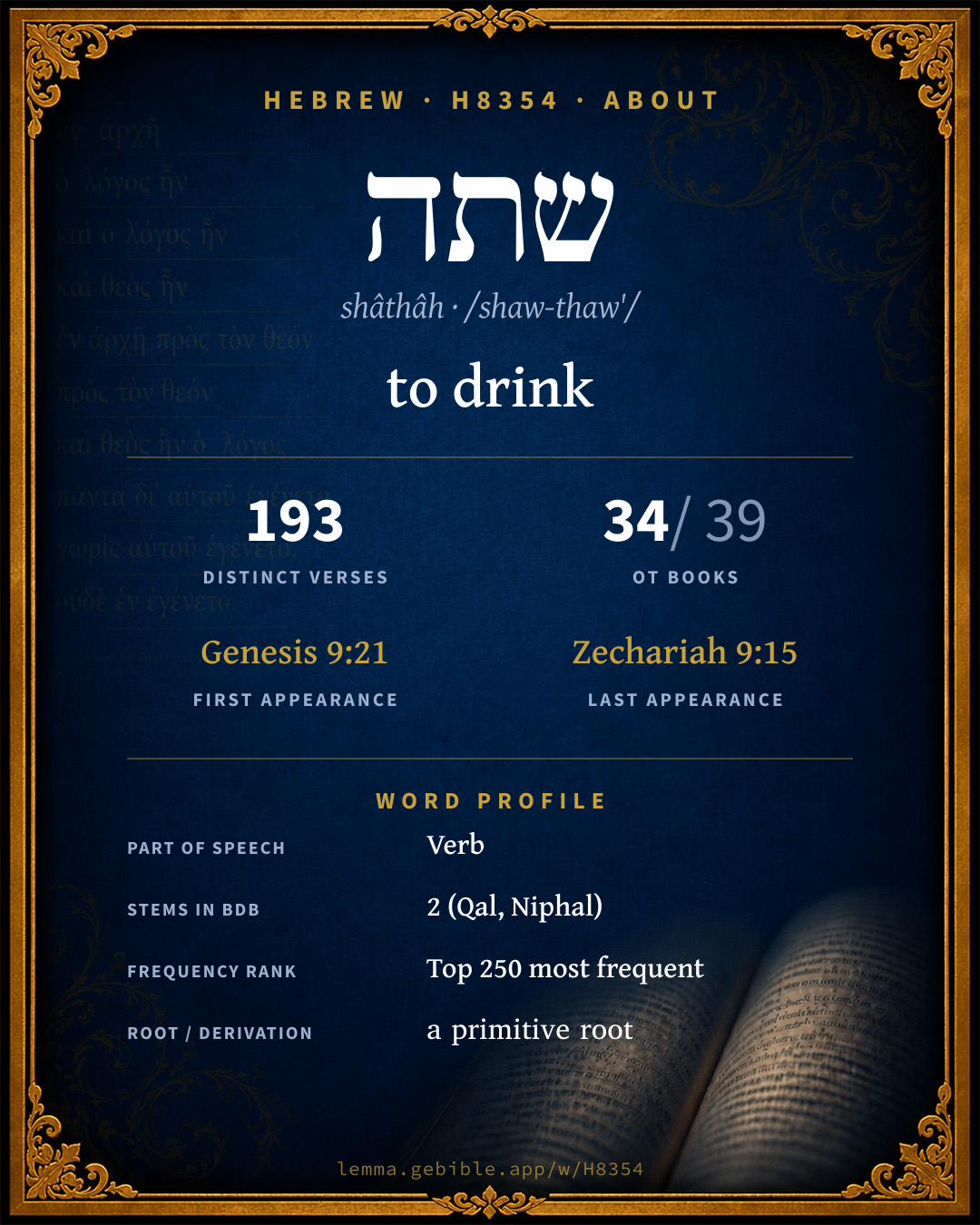
שָׁתָה
to drink
‘to drink’ is one of 2 main senses fuller range ↓
Full lexicon entry — Brown-Driver-Briggs (BDB)
From Brown-Driver-Briggs (BDB)
Where this word appears
Grammar key — what these labels mean
Part of speech
- Verb
- An action or state-of-being word.
Stem
- Qal
- The basic, simple active stem — the plain form of the verb (“he wrote”). Here: ‘of man’
- Niphal
- Usually the simple passive or reflexive of the Qal (“he was written”).
Form
- Infinitive Construct
- A bound verbal noun, frequently with prepositions (“to write / in writing”).
- Imperfect
- An incomplete, ongoing, or future action (“he will / would write”).
- Sequential Imperfect
- An imperfect with prefixed waw — the standard past-narrative form (waw-consecutive imperfect).
- Participle Active
- A verbal adjective expressing ongoing or characteristic action (“writing / one who writes”).
- Infinitive Absolute
- An unbound verbal noun, often intensifying or standing in for a finite verb.
- Imperative
- A direct command (“write!”).
- Sequential Perfect
- A perfect with prefixed waw continuing a preceding imperfect or command (waw-consecutive perfect).
- Perfect
- A completed action or state — Hebrew marks aspect (completeness) more than strict tense (“he wrote”).
- Jussive
- A third- or second-person volitional form expressing wish or command (“let him write”).
- Cohortative
- A first-person volitional form expressing wish or resolve (“let me / let us write”).
State
- Absolute
- The independent form of a noun, not bound to a following word.
- Construct
- A noun bound to a following noun in a possessive / “of” relationship (the construct chain).
Person
- 3rd Person
- The one spoken about (“he / she / it / they”).
- 2nd Person
- The one addressed (“you”).
- 1st Person
- The speaker (“I / we”).
Gender
- Masculine
- Grammatically masculine.
- Common
- Either gender — not distinguished for this form.
- Feminine
- Grammatically feminine.
Number
- Plural
- More than one (in Hebrew, generally three or more).
- Singular
- One.
Every verse where H8354 appears in the Book of 1 Kings — 20 distinct verses. Click any verse to open its interlinear word-by-word view. Verse text shown in the World English Bible for context — . Each verse’s Hebrew form is shown with its reference; the English is not keyword-highlighted, since the data carries no word-level English alignment. Use “Compare translations” on any verse to read it across multiple English versions. This concordance covers the Hebrew Bible; Septuagint (Greek Old Testament) occurrences are not indexed here.
1 Kings
- 1 Kings 1:25 וְ/שֹׁתִ֖ים conj + Qal ptcp.act mp For he is gone down this day, and has slain oxen and fatlings and sheep in abundance, and has called all the king's sons, and the captains of the host, and Abiathar the priest; and, behold, they are eating and drinking before him, and say, [Long] live king Adonijah.
- 1 Kings 4:20 וְ/שֹׁתִ֖ים conj + Qal ptcp.act mp Judah and Israel were many as the sand which is by the sea in multitude, eating and drinking and making merry.
- 1 Kings 13:8 אֶשְׁתֶּה Qal impf 1cs The man of God said to the king, If you will give me half your house, I will not go in with you, neither will I eat bread nor drink water in this place;
- 1 Kings 13:9 תִשְׁתֶּה Qal impf 2ms for so was it charged me by the word of Yahweh, saying, You shall eat no bread, nor drink water, neither return by the way that you came.
- 1 Kings 13:16 אֶשְׁתֶּ֤ה Qal impf 1cs He said, I may not return with you, nor go in with you; neither will I eat bread nor drink water with you in this place:
- 1 Kings 13:17 תִשְׁתֶּ֥ה Qal impf 2ms for it was said to me by the word of Yahweh, You shall eat no bread nor drink water there, nor turn again to go by the way that you came.
- 1 Kings 13:18 וְ/יֵ֣שְׁתְּ conj + Qal impf 3ms He said to him, I also am a prophet as you are; and an angel spoke to me by the word of Yahweh, saying, Bring him back with you into your house, that he may eat bread and drink water. [But] he lied to him.
- 1 Kings 13:19 וַ/יֵּ֥שְׁתְּ conj + Qal wimpf 3ms So he went back with him, and ate bread in his house, and drank water.
- 1 Kings 13:22 וַ/תֵּ֣שְׁתְּ תֵּ֣שְׁתְּ conj + Qal wimpf 2ms Qal juss 3ms but came back, and have eaten bread and drunk water in the place of which he said to you, Eat no bread, and drink no water; your body shall not come to the tomb of your fathers.
- 1 Kings 13:23 שְׁתוֹת֑/וֹ Qal inf.cs + sfx pers 3ms It happened, after he had eaten bread, and after he had drunk, that he saddled for him the donkey, [to wit], for the prophet whom he had brought back.
- 1 Kings 16:9 שֹׁתֶ֣ה Qal ptcp.act ms His servant Zimri, captain of half his chariots, conspired against him. Now he was in Tirzah, drinking himself drunk in the house of Arza, who was over the household in Tirzah:
- 1 Kings 17:4 תִּשְׁתֶּ֑ה Qal impf 2ms It shall be, that you shall drink of the brook; and I have commanded the ravens to feed you there.
- 1 Kings 17:6 יִשְׁתֶּֽה Qal impf 3ms The ravens brought him bread and flesh in the morning, and bread and flesh in the evening; and he drank of the brook.
- 1 Kings 17:10 וְ/אֶשְׁתֶּֽה conj + Qal coh 1cs So he arose and went to Zarephath; and when he came to the gate of the city, behold, a widow was there gathering sticks: and he called to her, and said, Please get me a little water in a vessel, that I may drink.
- 1 Kings 18:41 וּ/שְׁתֵ֑ה conj + Qal impv 2ms Elijah said to Ahab, Get you up, eat and drink; for there is the sound of abundance of rain.
- 1 Kings 18:42 וְ/לִ/שְׁתּ֑וֹת conj + prep + Qal inf.cs So Ahab went up to eat and to drink. Elijah went up to the top of Carmel; and he bowed himself down on the earth, and put his face between his knees.
- 1 Kings 19:6 וַ/יֵּ֔שְׁתְּ conj + Qal wimpf 3ms He looked, and, behold, there was at his head a cake baked on the coals, and a jar of water. He ate and drink, and laid him down again.
- 1 Kings 19:8 וַ/יִּשְׁתֶּ֑ה conj + Qal wimpf 3ms He arose, and ate and drink, and went in the strength of that food forty days and forty nights to Horeb the Mount of God.
- 1 Kings 20:12 שֹׁתֶ֛ה Qal ptcp.act ms It happened, when [Ben Hadad] heard this message, as he was drinking, he and the kings, in the pavilions, that he said to his servants, Set [yourselves in array]. They set [themselves in array] against the city.
- 1 Kings 20:16 שֹׁתֶ֨ה Qal ptcp.act ms They went out at noon. But Ben Hadad was drinking himself drunk in the pavilions, he and the kings, the thirty-two kings who helped him.
About this entry
At a glance — auto-summarized from this page’s data, not written by a person. Every figure links to its source below. This summary describes the numbers; it doesn’t interpret them.
שתה — transliterated shâthâh — is a Hebrew verb carrying the sense “to drink.” Debuting at Genesis 9:21, it then recurs through the corpus. Spanning 193 verses in 34 books, it ranks among the common words of the Hebrew Bible. Different stems carry different senses — BDB groups them under 2 stems, among them Qal and Niphal. From the same root come משתה, שתה and שתי. Each statement above links to its evidence; the full detail follows below.
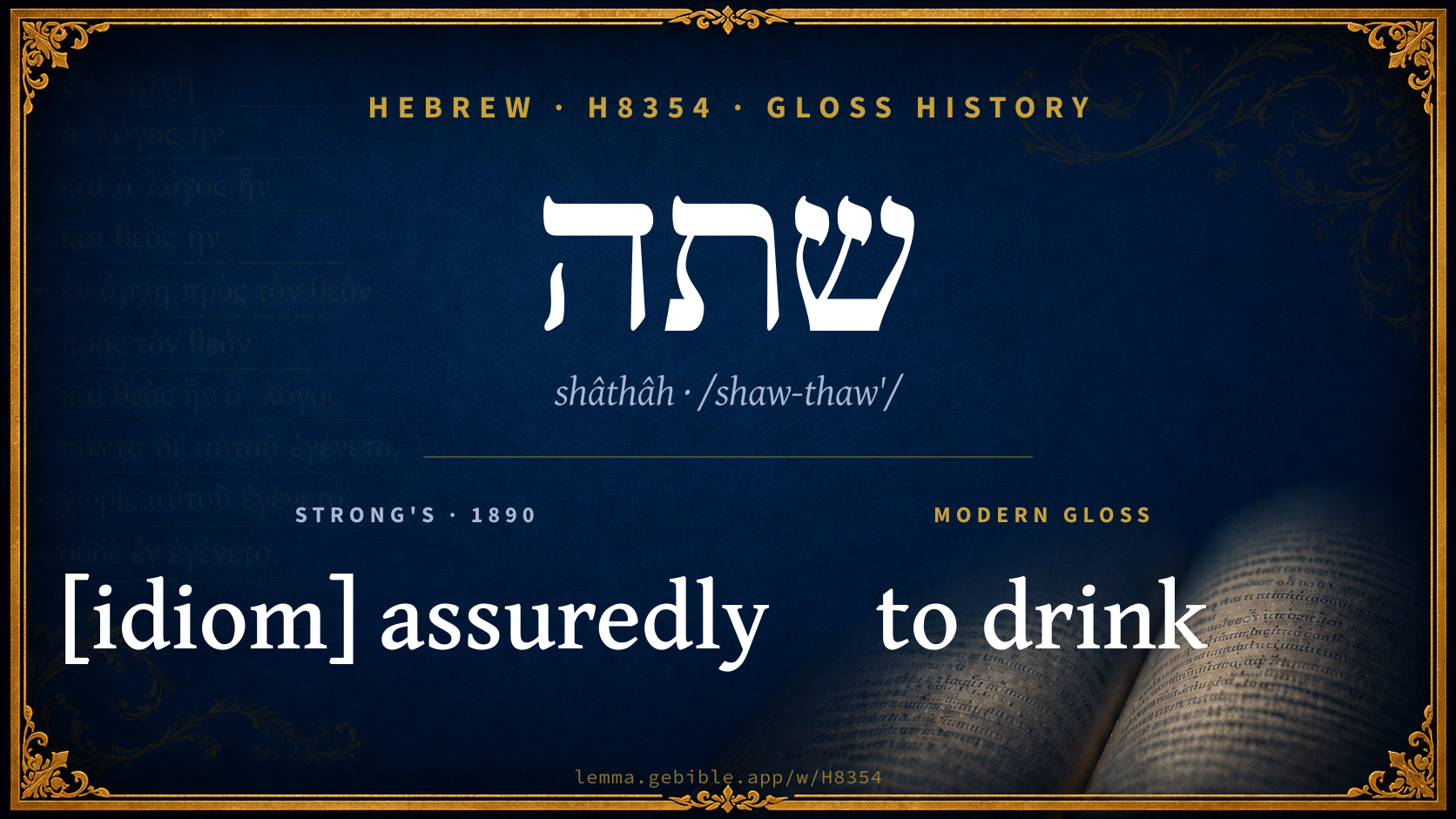
Gloss history
Strong's 1890 vs modern scholarship
About this word
Strong's H8354 catalogs a Hebrew word from the Hebrew Old Testament.
These counts are not copied from any lexicon or concordance. They are computed here, from the morphology-tagged Hebrew Old Testament. What Lemma adds →
- 193
- distinct verses
- The word appears in 193 distinct verses.
- 34 / 39
- OT books
- The word appears in 34 of 39 Old Testament books.
- #219
- by frequency
- Top 250 most frequent Hebrew words (rank 219 of 8,640 Hebrew words by occurrence).
View all 193 occurrences in the concordance →
By section of the Old Testament
By traditional corpus
Conventional, traditional groupings — biblical authorship is debated, so this is a traditional corpus grouping, not an authorship claim. Each share is this word’s portion of its verses in that division of the Hebrew canon. Each figure is a share of the word’s 193 distinct verses.
- Prophets (Nevi'im) 107 verses · 55%
- Torah (Pentateuch) 45 verses · 23%
- Writings (Ketuvim) 41 verses · 21%
How translations render this word
Counts come from each version’s own published word-to-Strong’s tagging or interlinear alignment — an approximate guide to how each version renders this word, not a word-level alignment the data otherwise carries. Because each total is that version’s own tagged count, the per-version totals vary from one another and need not match the appearance or distinct-verse counts above. These counts may also differ from a printed concordance because Lemma counts each distinctly tagged rendering and does not collapse phrase taggings into a single head-word total. This is a fixed set of word-tagged versions (KJV, ASV, BSB, ULT) and does not change with the reading translation you choose elsewhere. Each version’s license is shown beside its name below (and on Sources).
- King James Version: Drink 102×, Drinking 10×, Drunk 6×
- American Standard Version: Drink 88×, Drinking 8×, Drunk 5×
- Berean Standard Bible: Drink 91×, Drank 19×, Drinking 16×
- unfoldingWord Literal Text: Drink 88×, Drinking 17×, Drank 15×
King James Version Public Domain
Renders H8354 across 217 tagged occurrences — most commonly:
Plus other, less common renderings. Plus 62 renderings that appear only once — usually multi-word phrases or single function words the recovered tagging swept in, not distinct renderings.
American Standard Version Public Domain
Renders H8354 across 219 tagged occurrences — most commonly:
Plus other, less common renderings. Plus 73 renderings that appear only once — usually multi-word phrases or single function words the recovered tagging swept in, not distinct renderings.
Berean Standard Bible Public Domain
Renders H8354 across 212 tagged occurrences — most commonly:
Plus other, less common renderings. Plus 40 renderings that appear only once — usually multi-word phrases or single function words the recovered tagging swept in, not distinct renderings. Not rendered by a distinct English word in 5 further occurrences.
unfoldingWord Literal Text CC BY-SA 4.0
Renders H8354 across 233 tagged occurrences — most commonly:
Plus other, less common renderings. Plus 37 renderings that appear only once — usually multi-word phrases or single function words the recovered tagging swept in, not distinct renderings.
10 senses and sub-senses in the full BDB
Hebrew verbs can shift meaning by stem (binyan): Qal is the basic action, Niphal is often passive or reflexive, Piel often intensifies or makes it factitive, and Hiphil is typically causative. The senses below are grouped under the stem BDB assigns to each.
What do BDB’s symbols mean?
BDB uses these scholarly abbreviations:
| Symbol | Meaning |
|---|---|
| 𝔊 | the Septuagint (the ancient Greek translation, LXX) |
| 𝔙 | the Vulgate (the Latin translation) |
| 𝔖 | the Syriac version (the Peshitta) |
| 𝔗 | the Targum (the Aramaic translation) |
| ψ | the Psalms |
| √ | root (the underlying root or stem) |
| ‖ | parallel passage (a synonymous or contrasted parallel) |
| † | the dagger: every passage where the word occurs is cited |
The 10 senses and sub-senses the full Brown-Driver-Briggs lexicon distinguishes for this word, in lexicon order (not ranked by frequency), with BDB’s own verbatim wording and sub-sense lettering. Shown in Hebrew script with BDB’s own scholarly abbreviations. The condensed entry is in the Lexicon Entry tab. See also the Forms in the corpus table below.
Qal
- Pf. 3 ms. שׁ׳ Ex 34:28 +, 1 s. שָׁתִ֫יתִי 1 S 15 +, etc.; Impf. 3 ms. יִשְׁתֶּה Gn 44:5 +, וַיִּשְׁתֶּה 1 K 19:8, usually וַיֵּשְׁתְּ Gn 9:21 +; juss. וְיֵשְׁתְּ 1 K 13:18; 3 fs. וַתֵּשְׁתְּ Nu 20:11; 2 ms. apoc. תֵּשְׁתְּ Ju 13:14 +, וַתֵּשְׁתְּ 1 K 13:22; 1 s. וָאֵשְׁתְּ Gn 24:46; 3 mpl. יִשְׁתָּי֑וּן ψ 78:44, etc.; Imv. ms. שְׁתֵה Gn 24:14 +, etc.; Inf. abs. שָׁתֹה Is 21:5; Je 49:12 (in 1 S 1:9 after prep., anom., Ges§ 113 e, om. 𝔊 Th We Dr and mod.), שָׁתוֹ Je 25:28 +, שָׁתוֹת Is 22:13 (Ges§ 75 n); cstr. שְׁתוֹ †Pr 31:4, שְׁתוֹת Je 35:8, 14, לִשְׁתֹּת Gn 24:19 +, sf. שְׁתוֹתוֹ 1 K 13:33, לִשְׁתּוֹתָהּ Is 51:22 etc.; Pt. act. שֹׁתֶה Is 29:8 +, f. שֹׁתָה Jb 6:4, etc.;— e.g. Exodus 34:28
- 1.
- a. of man: drink, water, wine, etc., Ex 34:28 (JE), cf. 15:24 (J), 1 S 30:12 Am 2:8; 4:8; 5:11; Is 5:22; 62:8, 9; Pr 31:4, Ju 13:4, 7, 14 + often (2 times JE; 6 times D); by measure (short allowance) Ez 4:11, 16; milk †Ez 25:4, cf. Ct 5:1; blood 1 Ch 11:19 (fig. of water gained by hazard); fig. חֲמָתָם שֹׁתָה רוּחִי Jb 6:4 whose venom [of arrows of י׳] my spirit drinks up; acc. + מִן of source †Ex 7:18 (J), v 21 (E), 15:23 (J), Pr 5:15 (fig.); acc. (of wine, water, etc.) om. Gn 24:14(×2); 27:25; 43:34 (all J) + 11 times J, Ex 7:24; 17:6 (E), Nu 20:5 (JE), v 11; 33:14 (P), Ju 15:19 + often; acc. שׁין †2 K 18:27 = Is 36:12; מַמְתַקִּים Ne 8:10; abs. Ec 2:24 +; + מִן of source 1 K 17:4, 6 ψ 110:7, מִכֹּסוֹ 2 S 12:3; שׁ׳ בְּמִזְרְקֵי יַיִן † Am 6:6, cf. Gn 44:5; שׁ׳ בְּיַיִן †Pr 9:5; c. מִן partit. Gn 9:21; Ex 7:24; Ru 2:9, also (fig.) Je 51:7 (and Jb 21:20 infra). e.g. Exodus 34:28
- b. pt. as subst. שֹׁתֵי מַיִם Ez 31:14, 16, שֹׁתֵי יַיִן Jo 1:5; שׁוֹתֵי שֵׁכָר ψ 69:13. e.g. Ezekiel 31:14
- c. drink wine in sacrificial feast Dt 32:38 (poem); blood of sacrificial victim ψ 50:13 (fig. of י׳). e.g. Deuteronomy 32:38
- d. subj. animals Nu 20:19; Jon 3:7 (both + men), also (fig.) Ez 34:18, 19; acc. (water) om. Gn 24:19, 22; 30:38(×2). e.g. Numbers 20:19
- e. fig. of drinking cup of י׳’s wrath, שׁ׳ אֶת־כּוֹס חֲמָתוֹ Is 51:17 (+ מִיַּד י׳), cf. v 17, v 22, v. also Ez 23:32, 34 and (acc. om.) Je 25:16, 26, 27 + 8 times Je, Hb 2:16; abs. Ob 16(×3); acc. שְׁמָרִים ψ 75:9; שׁ׳ מֵחֲמַת שַׁדַּי Jb 21:20. e.g. Isaiah 51:17
- f. drink blood, fig. of slaughter, Nu 23:24 (JE; of lion, metaph. of Isr.), Zc 9:15 (read דָּמָם for הָמוּ 𝔊 Codd. Sta Now Marti); so (blood of י׳’s sacrifice) Ez 39:17, 18, 19. e.g. Numbers 23:24
- g. fig. of wicked deeds: יֵין חֲמָסִים יִשְׁתּוּ Pr 4:17 (‖ לָֽחֲמוּ לֶחֶם רֶשַׁע; these are their food and drink), cf. Jb 15:16; 34:7, but Pr 26:6 appar. = suffers violence (cf. De Toy). e.g. Proverbs 4:17
- 2. late, = feast Est 3:15; 7:1 (cf. מִשְׁתֶּה). e.g. Esther 3:15
Niphal
- Impf. 3 ms. יִשָּׁתֶה Lv 11:34 (P) all which is (may be) drunk, c. ב of vessel.—נִשְׁתָּ֑וָה Pr 27:15 v. I. שׁוה ad fin. For cause, give, to drink v. שׁקה. e.g. Leviticus 11:34
Senses from the full Brown-Driver-Briggs lexicon (Brown, Driver, Briggs; Oxford 1906 — public domain), digitized via Sefaria, supplemented by the OpenScriptures HebrewLexicon (CC BY 4.0). Full attribution on Sources.
Word origin
vb. drink (NH id.; Assyrian šatû, Ethiopic ሰትየ Old Aramaic שתה, Aramaic שְׁתָא, אִשְׁתִּי, [ܫܬܐ], ܐܶܫܬܻܝ]; Sab. שתי DHMZMG xxxvii (1883), 403 HomChr 124);—
— Brown-Driver-Briggs (Oxford 1906, public domain), digitized via Sefaria, supplemented by the OpenScriptures HebrewLexicon (CC BY 4.0). See Sources.
Origin: a primitive root
Jastrow Dictionary
A second Hebrew/Aramaic lexicon for comparison, covering Aramaic and post-biblical (Talmudic, Targumic, Midrashic) usage that the biblical-Hebrew BDB does not. Matched by lemma rather than by Strong’s number, so a lemma may carry more than one Jastrow headword (shown separately below), and the entries cover usage well beyond the Bible.
שָׁתָה
- , v. שתי
שתי
- (b. h.) [to be settled, satisfied,] to drink. Pes. 86ᵇ השׁוֹתֶה כוסו וכ׳ he who drinks his cupful at one draught is called greedy (גַּרְגְּרָן). Ber. 51ᵃ מקבלו … ושׁוֹתֵהוּ בשמאל he must receive it (the medicine, v. אִסְפַּרְגּוֹס) with his right hand, and drink it (take it to his lips) with his left hand. Ib.ᵇ השותה כפלים he who drinks an even number of cups (v. זוּג). Tosef. Sot. XV, 11; B. Bath. 60ᵇ כשחרב … ושלא לִשְׁתּוֹת יין when the Temple was destroyed, … there were many scrupulous persons (פרושים, determined) not to eat meat nor drink wine. Ib. נִשְׁתֶּה יין וכ׳ should we drink wine, of which libations were offered on the altar? Ib. מים לא נשתה וכ׳ then let us drink no water, because water libation has ceased. Keth. 8ᵇ רבים שָׁתוּ רבים יִשְׁתּוּ many have drank (the cup of mourning), many shall drink, v. מִשְׁתֶּה. Nidd. 24ᵇ כמה … שָׁתַת אמו וכ׳ how much unmixed wine the mother of this embryo must have drunk!; a. fr.—Part. pass. שָׁתוּי being under the influence of drink. Erub. 64ᵃ שְׁתוּי יין אל וכ׳ Ms. M. (ed. only שָׁ׳) one feeling the wine must not pray, contrad. to שִׁכּוֹר, q. v. Lev. R. s. 12 שנכנסו שְׁתוּיֵי יין וכ׳ they (Nadab and Abihu) entered the Tabernacle while under the influence of wine; a. fr.—[Hif. from שָׁקָה q. v.]
שתי ²
- [to settle,]
- 1. to lay the foundation of; v. שָׁתַת II.
- 2. to fix the warp, start the loom, v. שְׁתִי.
- 1. to found, establish, v. שָׁתַת II.
- 2. to weave. Midr. Sam. ch. XIX (ref. to נסכתי, Ps. II, 6) הִשְׁתֵּיתִיו I have woven him (established him, ref. to מסכת, Jud. XVI, 14); Yalk. Is. 338; Yalk. Ps. 620 השיתיו (corr. acc.). e.g. Psalms 2:6
- to be established, started. Y. Yoma V, 42ᶜ, v. שְׁתִיָּה II; a. e.
- same. Tosef. Yoma III (II), 6 ed. Zuck. (Var. נשתת), v. שָׁתַת II
A Dictionary of the Targumim, the Talmud Babli and Yerushalmi, and the Midrashic Literature (Marcus Jastrow; London, Luzac, 1903) — Public Domain. Digitized via Sefaria. Digitized via Sefaria. Full attribution on Sources.
Forms in the corpus
The 155 distinct written forms H8354 takes in the Hebrew Bible, most frequent first — each parse links to that stem’s occurrences in the concordance. Hebrew forms include their vowel points and cantillation, so a single lemma takes many written forms.
The 60 most common forms are shown; 95 rarer forms follow in the full concordance.
Same root — word family
Other BDB entries built from the same root as H8354, grouped by Strong’s listed origin. These share a root / origin per the lexicon — not necessarily a shared meaning. Each links to that word’s own entry.
Derived from this word
Compare all same-root words → They share a root, not necessarily a meaning.
Septuagint verse parallels
This word appears in 185 verses that also exist in the Greek Old Testament (Septuagint), out of the 193 Hebrew verses it occurs in. You can read those verses in Greek by switching the Old Testament edition to the Septuagint.
Read these verses in the Septuagint
- Genesis 9:21
- Exodus 7:18
- Leviticus 10:9
- Numbers 6:3
- Deuteronomy 2:6
- Judges 7:5
- Ruth 2:9
- 1 Samuel 1:9
- 2 Samuel 11:11
- 1 Kings 1:25
- 2 Kings 3:17
- 1 Chronicles 11:18
This is a verse-level parallel only — the same verses exist in both the Hebrew and Greek Old Testaments. No word-level Hebrew↔Greek correspondence is claimed: the data carries no such alignment, so no Greek word is shown as this Hebrew word’s translation. Coverage is not total — the Septuagint omits the deuterocanon and renumbers the Psalms, so some Hebrew verses have no direct Greek parallel.