
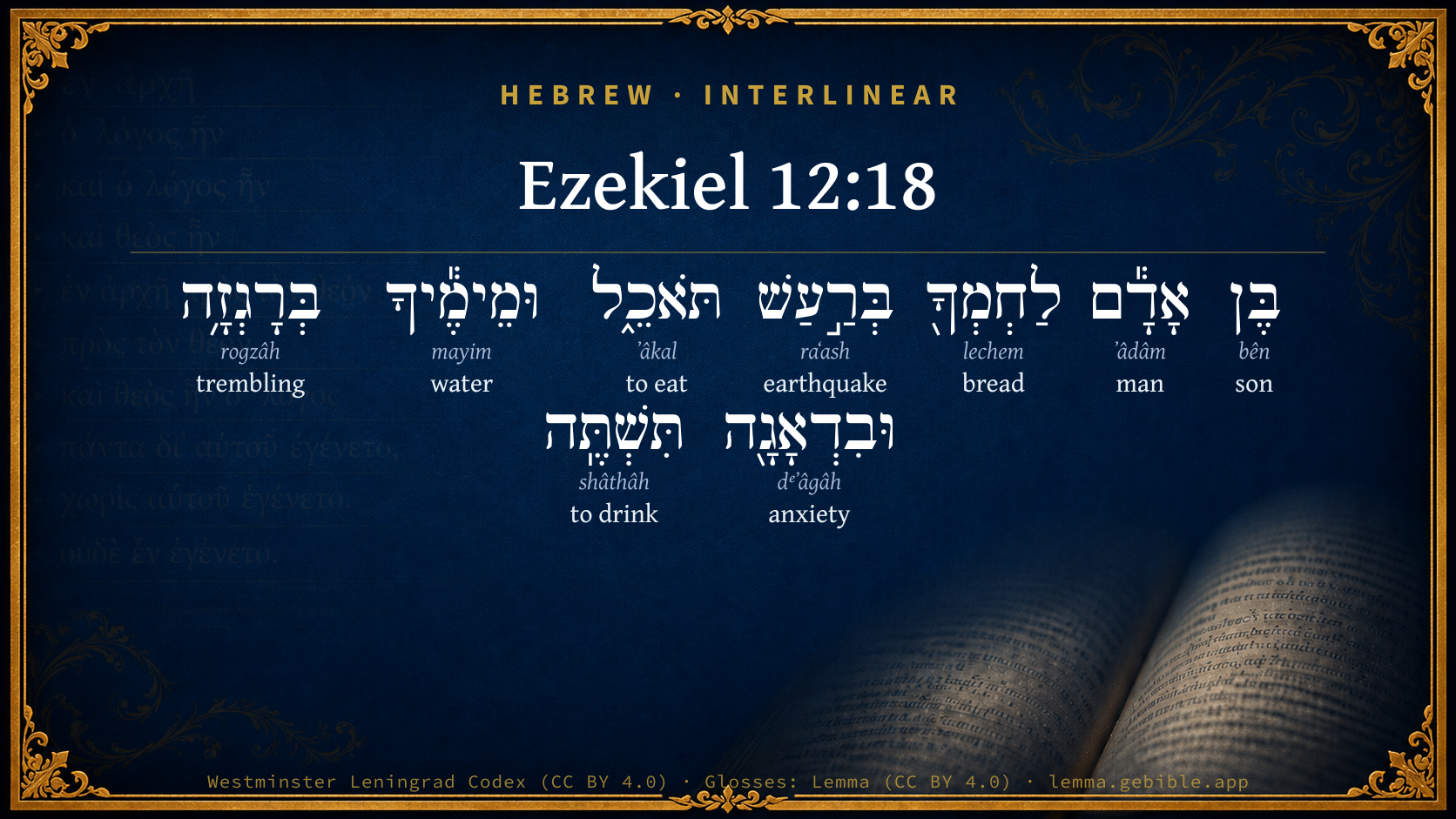
Ezekiel 12:18

Hebrew (Westminster Leningrad Codex) Ezekiel 12:18 appears in the Hebrew Old Testament. The text above is from the Westminster Leningrad Codex. Each word links to its Strong’s number, a concise gloss, and parsing drawn from the Open Scriptures Hebrew Bible morphology. Click any word for its full Brown-Driver-Briggs (BDB) entry.
Download image
Cite this verse

Ezekiel 12:18 (World English Bible). Public Domain. Lemma interlinear Bible study tool, https://lemma.gebible.app/v/ezekiel/12/18.

Show BibTeX & RIS
BibTeX
RIS
English Translation
Son of man, eat your bread with quaking, and drink your water with trembling and with fearfulness;
World English Bible · Public Domain
Highlights
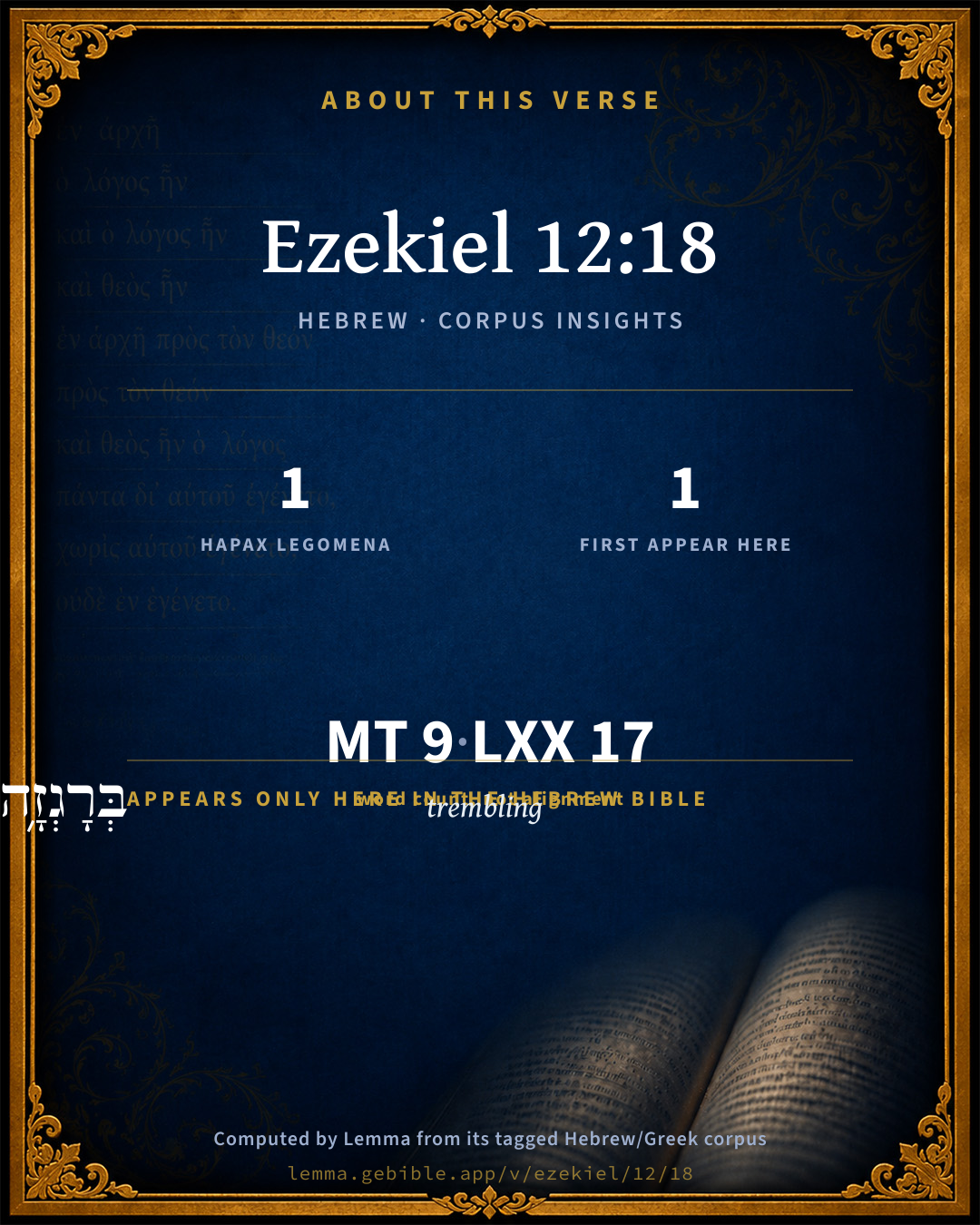
  • 1 hapax legomenon — only here in the Hebrew Bible
  • 1 first appearance in the Hebrew Bible
Full analysis ↓
Download a study sheet

One document with this verse’s original text, its word-by-word gloss line, the meaning frame, cross-references with their text, attributed commentary, and full source and license credits — printable, and it pastes into notes with its structure intact.

This verse Autodidact and up

Study sheet (.html) Plain text (.txt)

A passage Seminary Student

Up to 50 verses in one chapter. A passage sheet keeps up to 6 commentary sources and 12 cross-references per verse, in the order this page ranks them, and says so on the sheet whenever that leaves anything out. Ask for a single verse and you get the Autodidact verse sheet above.

Everything on this page stays free to read, with no account — the sheet is a download of what is already on screen, not access to it.

Want to remove ads? Support Godless Engineer
Compare translations 3

The same verse in 3 English versions, stacked beneath the original-language interlinear above. Click any original word for its lexicon entry.

Each is an independent rendering of the whole verse — the interlinear is not word-aligned to these translations.

Highlighted words mark where these versions differ — a whole-verse word diff, not a word-by-word alignment.

  • World English Bible Public Domain
    Son of man, eat your bread with quaking, and drink your water with trembling and with fearfulness;
  • King James Version Public Domain
    Son of man, eat thy bread with quaking, and drink thy water with trembling and with carefulness;
  • unfoldingWord Literal Text CC BY-SA 4.0
    “Son of man, eat your bread with trembling, and drink your water with shaking and worry.

unfoldingWord Literal Text — © unfoldingWord, licensed CC BY-SA 4.0. Word-aligned USFM3 via Door43 (git.door43.org/unfoldingWord/en_ult).

Versions to compare (up to 4)

3 of 4 selected

Show all 18 translations

Every available English version of this verse, each an independent rendering of the whole verse.

  • World English Bible Public Domain
    Son of man, eat your bread with quaking, and drink your water with trembling and with fearfulness;
  • Berean Standard Bible Public Domain
    “Son of man, eat your bread with trembling, and drink your water with quivering and anxiety.
  • Majority Standard Bible Public Domain
    “Son of man, eat your bread with trembling, and drink your water with quivering and anxiety.
  • King James Version Public Domain
    Son of man, eat thy bread with quaking, and drink thy water with trembling and with carefulness;
  • American Standard Version (1901) Public Domain
    Son of man, eat thy bread with quaking, and drink thy water with trembling and with fearfulness;
  • Revised Version (1885) Public Domain
    Son of man, eat thy bread with quaking, and drink thy water with trembling and with carefulness;
  • Geneva Bible (1599) Public Domain
    Sonne of man, eate thy bread with trembling and drinke thy water with trouble, and with carefulnesse,
  • Douay-Rheims (1899) Public Domain
    Son of man, eat thy bread in trouble: and drink thy water in hurry and sorrow.
  • Young's Literal Translation Public Domain
    `Son of man, thy bread in haste thou dost eat, and thy water with trembling and with fear thou dost drink;
  • Literal Standard Version CC BY-SA 4.0
    “Son of man, eat your bread in haste, and drink your water with trembling and with fear;
  • Unlocked Literal Bible CC BY-SA 4.0
    “Son of man, eat your bread with trembling, and drink your water with shaking and worry.
  • unfoldingWord Literal Text CC BY-SA 4.0
    “Son of man, eat your bread with trembling, and drink your water with shaking and worry.
  • Darby Bible Public Domain
    Son of man, eat thy bread with quaking, and drink thy water with trembling and with anxiety;
  • World Messianic Bible Public Domain
    “Son of man, eat your bread with quaking, and drink your water with trembling and with fearfulness.
  • Webster's Bible Public Domain
    Son of man, eat thy bread with quaking, and drink thy water with trembling and with solicitude.
  • Free Bible Version CC BY-SA 4.0
    “Son of man, tremble as you eat your bread; shake with worry as you drink your water.
  • Bible in Basic English Public Domain
    Son of man, take your food with shaking fear, and your water with trouble and care;
  • JPS Tanakh (1917) Public Domain
    'Son of man, eat thy bread with quaking, and drink thy water with trembling and with anxiety;

Literal Standard Version (2020), Covenant Press — licensed CC BY-SA 4.0. Text via the HelloAO Bible API (eBible.org). Unlocked Literal Bible (unfoldingWord) — licensed CC BY-SA 4.0. Text via the HelloAO Bible API (eBible.org). unfoldingWord Literal Text — © unfoldingWord, licensed CC BY-SA 4.0. Word-aligned USFM3 via Door43 (git.door43.org/unfoldingWord/en_ult). Free Bible Version, Dr. Jonathan Gallagher — licensed CC BY-SA 4.0. Text via the HelloAO Bible API (eBible.org).

Word by word

More ways to search: Search by grammar → Find every occurrence → Compare this word →

Practice this passage: Drill this verse → Learn its vocabulary →

בְּרָגְזָ֥ה
rogzâh
H7269
“in/at · trembling”
Preposition + Noun, Common, Feminine, Singular, Absolute
Part of Speech
Preposition + Noun
Type
Common
Gender
Feminine
Number
Singular
State
Absolute
Full BDB Definition

Origin: from H7267

TWOT: 2112b

trembling, quivering, quaking
  1. בֶּן bên H1121 “son of” Noun, Common, Masculine, Singular, Construct
  2. אָדָ֕ם ʼâdâm H120 “man” Noun, Common, Masculine, Singular, Absolute
  3. לַחְמְךָ֖ lechem H3899 “bread · your” Noun, Common, Both, Singular, Construct + Suffix, Personal, 2nd Person, Masculine, Singular
  4. בְּרַ֣עַשׁ raʻash H7494 “in/at · earthquake” Preposition + Noun, Common, Masculine, Singular, Absolute
  5. תֹּאכֵ֑ל ʼâkal H398 “to eat” Verb, Qal, Imperfect, 2nd Person, Masculine, Singular
  6. וּמֵימֶ֕יךָ mayim H4325 “and · water(s) · your” Conjunction + Noun, Common, Masculine, Plural, Construct + Suffix, Personal, 2nd Person, Masculine, Singular
  7. וּבִדְאָגָ֖ה dᵉʼâgâh H1674 “and · in/at · anxiety” Conjunction + Preposition + Noun, Common, Feminine, Singular, Absolute
  8. תִּשְׁתֶּֽה shâthâh H8354 “to drink” Verb, Qal, Imperfect, 2nd Person, Masculine, Singular

About this verse

These counts appear in no published source. They are computed here, from the morphology-tagged text and Lemma’s own curated glosses. What Lemma adds →

9
words
9
distinct lemmas
Prophets
section

Notable vocabulary

1 hapax legomenon — a word that appears only here in the entire Hebrew Bible:

  • בְּרָגְזָ֥ה trembling H7269

First appearance in Scripture

This word makes its first canonical appearance in the Hebrew Bible here:

  • בְּרָגְזָ֥ה trembling H7269

Shared distinctive vocabulary

וּבִדְאָגָ֖ה anxiety H1674 occurs in 6 verses of the Hebrew Bible. Also found in:

Grammatical profile

  • 2 verbs
  • 7 nouns

Verb forms

  • תֹּאכֵ֑ל Qal · Imperfect
  • תִּשְׁתֶּֽה Qal · Imperfect

Hebrew & Septuagint length

In English translation the verse runs 17 words from the Hebrew and 16 from the Septuagint (LXX English) — closely comparable.

A rough comparison of the two English renderings, which tokenize alike — not a word-level alignment.

Word counts can differ between the Hebrew and the Greek without any difference in meaning — e.g. the Hebrew direct-object marker אֵת has no separate Greek word, and Greek often adds the article ὁ.

In the original languages it is 9 Hebrew tokens and 17 Greek tokens — but the two are counted differently (Hebrew bundles its prefixes and suffixes into one token; the Greek is in lemma form), so that isn’t a like-for-like length.

Cross-references

11

Topical passages linked to Ezekiel 12:18 in the Treasury of Scripture Knowledge — connected by theme and wording, ordered by reader-vote popularity; previews shown in the World English Bible.

  • Lamentations 5:9 We get our bread at the peril of our lives, Because of the sword of the wilderness.
  • Leviticus 26:26 When I break your staff of bread, ten women shall bake your bread in one oven, and they shall deliver your bread again by weight: and you shall eat, and not be satisfied.
  • Leviticus 26:36 "'As for those of you who are left, I will send a faintness into their hearts in the lands of their enemies: and the sound of a driven leaf will put them to flight; and they shall flee, as one flees from the sword; and they will fall when no one pursues.
  • Deuteronomy 28:48 therefore shall you serve your enemies whom Yahweh shall send against you, in hunger, and in thirst, and in nakedness, and in want of all things: and he shall put a yoke of iron on your neck, until he have destroyed you.
  • Deuteronomy 28:65 Among these nations shall you find no ease, and there shall be no rest for the sole of your foot: but Yahweh will give you there a trembling heart, and failing of eyes, and pining of soul;
  • Job 3:24 For my sighing comes before I eat, My groanings are poured out like water.
  • Psalms 60:2–3 You have made the land tremble. You have torn it. Mend its fractures, For it quakes.
  • Psalms 80:5 You have fed them with the bread of tears, And given them tears to drink in large measure.
  • Psalms 102:4–9 My heart is blighted like grass, and withered, For I forget to eat my bread.
  • Ezekiel 4:16–17 Moreover he said to me, Son of man, behold, I will break the staff of bread in Jerusalem: and they shall eat bread by weight, and with fearfulness; and they shall drink water by measure, and in dismay:
  • Ezekiel 23:33 You shall be filled with drunkenness and sorrow, with the cup of astonishment and desolation, with the cup of your sister Samaria.

Cross-references courtesy of OpenBible.info (CC BY 4.0).

Hebrew and Greek witnesses Masoretic Hebrew ↔ Greek Septuagint

The same verse in the two great witnesses to the Old Testament, shown verse-for-verse.

These are two independent witnesses, not word-aligned to each other, and the Septuagint is shown in lemma (dictionary) form.

Hebrew Ezekiel 12:18 Masoretic · Westminster Leningrad Codex

בֶּן אָדָ֕ם לַחְמְךָ֖ בְּרַ֣עַשׁ תֹּאכֵ֑ל וּמֵימֶ֕יךָ בְּרָגְזָ֥ה וּבִדְאָגָ֖ה תִּשְׁתֶּֽה

Son of man, eat your bread with quaking, and drink your water with trembling and with fearfulness;

World English Bible · Public Domain

Greek LXX Ezekiel 12:18 Septuagint · lemma form

υἱός ἄνθρωπος ὁ ἄρτος σύ μετά ὀδύνη ἐσθίω καί ὁ ὕδωρ σύ μετά βάσανος καί θλῖψις πίνω

Son of man, eat your bread with sorrow, and drink your water with torment and affliction.

LXX2012 (modern English Septuagint) · Public Domain

Hebrew: Westminster Leningrad Codex (CC BY 4.0). Greek: Septuagint (public domain); English from LXX2012 (modern English Septuagint) (Public Domain). How the Septuagint differs from the Hebrew →

Targum (Aramaic paraphrase)

1

The Targum is the ancient Jewish Aramaic paraphrase of the Hebrew Scriptures — an interpretive translation, not the Hebrew text itself. Onkelos (literal) and Pseudo-Jonathan (expansive) render the Torah, and Jonathan the Prophets. Coverage is partial: where no permissively-licensed English translation exists for a verse, only the Aramaic is shown. This is verse-level text, not a word-by-word alignment to the Hebrew.

  1. Targum Jonathan Prophets (Joshua–Malachi)
    בַּר אָדָם מֵיכְלָךְ בְּזֵיעַ תֵּיכוֹל וּמִשְׁתָּךְ בְּצָדוּ וּבְאִשְׁתְּמָמוּ תִּשְׁתֵּי:

    (no public-domain English translation for this verse)

    Targum Jonathan — Aramaic: “Mikraot Gedolot” (public domain). English: “Sefaria Community Translation” (CC0 1.0 (public-domain dedication)); “London "Chaldee Paraphrase," 1871” (public domain). Text via Sefaria.

Commentary

Notes on Ezekiel 12:18 from classic Christian and Jewish commentators (each source and its license shown beneath its notes). The classic Christian expositions comment on the surrounding passage and are grouped to its opening verse, so a note may address several verses; the Jewish commentaries on the Tanakh (Rashi and others) are per-verse, so they appear only where the commentator wrote on this verse.

Lemma curates 59 commentaries, every one of them public domain or Creative Commons licensed, each selected and text-cleaned for this edition rather than reprinted as found. About our sources →

Trapp's Complete Commentary

John Trapp

Eze 12:18 Son of man, eat thy bread with quaking, and drink thy water with trembling and with carefulness;

Ver. 18. Eat thy bread with quaking.] With tumult and trepidation, as a frightened and perplexed person that eateth his bread in peril of his life.

John Trapp, A Commentary or Exposition upon All the Books of the Old and New Testament (1647–1656) — public domain. Text from a community e-Sword module.

Jamieson, Fausset & Brown

Robert Jamieson, A. R. Fausset & David Brown

Symbolical representation of the famine and fear with which they should eat their scanty morsel, in their exile, and especially at the siege.

Jamieson, Fausset & Brown — Commentary Critical and Explanatory on the Whole Bible (1871) — public domain (CC PDM 1.0). Text via the HelloAO Bible API.

Adam Clarke's Commentary

Verse 18. Eat thy bread with quaking] Assume the manner of a person who is every moment afraid of his life, who has nothing but a morsel of bread to eat, and a little water to drink. Thus signifying the siege, and the straits to which they should be reduced. See this explained, Eze 12:19.

Adam Clarke's Commentary on the Bible (1810–1826) — public domain. Text from a community e-Sword/MySword module.

Ellicott's Commentary for English Readers

(18) Eat thy bread with quaking.—This is another symbolical action, the meaning of which is immediately explained. The prophet is to eat and drink as men in the terror and distress of a siege.

A Bible Commentary for English Readers, edited by Charles John Ellicott (1878–1897) — public domain. Text from a community e-Sword module.

The Cambridge Bible for Schools and Colleges

gen. ed. J. J. S. Perowne

18. It is obvious that this symbol could not have been actually performed. Cf. ch. Eze_4:16.

The Cambridge Bible for Schools and Colleges (gen. ed. J. J. S. Perowne; Cambridge University Press, 1878–1918) — public domain. Text from a community e-Sword module.

John Gill's Exposition

And the word of the Lord came unto me, saying. After he had been a sign unto the people, in the two instances above mentioned; and they had hardened themselves against the belief of the things signified by them, because the time of their accomplishment was not yet.

And the word of the Lord came unto me, saying. After he had been a sign unto the people, in the two instances above mentioned; and they had hardened themselves against the belief of the things signified by them, because the time of their accomplishment was not yet.

Ezekiel 12:22

eze 12:22

eze 12:22

eze 12:22Son of man, what is that proverb that ye have in the land of Israel,.... Which question is put, as ignorant of it, but as filled with indignation at the impiety and boldness of those that used it, and in order to expose the wickedness and folly of it:

saying, the days are prolonged; the days of affliction and distress; the time of Jerusalem's destruction, and of the Babylonish captivity, these were not to be of a long time; and therefore they were ready to flatter themselves they would never be, at least in their days; and hence, because judgment was not immediately executed, their hearts were set in them to do evil; and thus they abused the patience and long suffering of God, and they used this and the following expression so often, and so long, that they became proverbial to them:

and every vision faileth? or "perishes" (b); every prophecy comes to nothing; no one is fulfilled; at least because not at, once, therefore they concluded it never would, or, however, hoped it never would; and so pleased themselves, and continued in their impenitence and unbelief, and contempt of prophecy.

(b) "peribit", Munster, Montanus, Tigurine version, Junius & Tremellius, Polanus, Piscator; "periit", Starckius.

John Gill's Exposition of the Whole Bible (1746–1763) — public domain (CC PDM 1.0). Text via the HelloAO Bible API.

Albert Barnes' Notes on the Bible

Here the sign is the exhibition of such terror as the danger of a siege creates.

Albert Barnes' Notes on the Bible (1834–1885) — public domain. Text from a community e-Sword/MySword module.

Haydock's Catholic Bible Commentary

Sorrow. Act like one under great anxiety and distress. (Calmet)

George Leo Haydock (1774–1849), Haydock's Catholic Family Bible and Commentary, 1859 edition — public domain. Excludes Psalms (Douay-Rheims chapter numbering differs from Protestant) and Deuterocanonical books (Catholic canon only).

Matthew Poole's English Annotations

With quaking; with commotion or shakings, as one whose apprehension of danger brings as it were an earthquake upon him; and this trembling is the same thing, but in other words. Thy water: here is no mention of delicious and generous wines, but water; so low should they be reduced, and yet not enjoy this very little, because of the great inward fears that shake them.

Matthew Poole's English Annotations on the Holy Bible (1683–1685) — public domain. Text from a community e-Sword/MySword module.

The Pulpit Commentary

Eat thy bread with quaking, etc. No special stress is to be laid on the fact that only bread and water are named. The prophet is not dwelling now on the scarcity of food in the besieged city, as he had done in Eze_4:9-17, but on the fear and terror which should haunt the lives of the besieged. Here again we can scarcely doubt that, as in ver. 11, Ezekiel was a sign to those among whom he lived. Outwardly and visibly he was seen after his strange flitting, cowering in a corner, as one hunted down and dreading pursuit, with every look and gesture of extremest terror. This was to be the portion of those who escaped and whose life was "given them for a prey." The strange act was to be explained to "the people of the land," i.e. the exiles among whom Ezekiel lived. The short prediction ends with the usual formula. There is another interval, and then another inspiration.

Fear.

Ezekiel, in conformity with his new, desperate method of rousing the heedless Jews, is now to dramatize Fear in his own person and action, as a sign of the terror that will seize upon the inhabitants of Jerusalem in the days of its overthrow.

I FEAR ARISES FROM EVIL CAUSES. The sound and innocent soul in healthy circumstances should not know fear. Observe some of the causes of fear.

1. Ignorance. "Fear always springs from ignorance," says Emerson. There is a sense of the mysterious and uncertain about it. When we perceive an approaching calamity, we may shrink from it and feel the keenest distress; but the peculiar agony of fear ties in the darkness of futurity. This, of course, implies nothing morally defective, for we are necessarily limited. Childish fears naturally haunt childish ignorance. But though not morally wrong, except in the careless and wilful, ignorance is an evil circumstance to be conquered.

2. Weakness. There is a weakness of nerve which belongs to one"s bodily condition, and so some are constitutionally timorous. But the worst fear springs from cowardice, i.e. from a culpable laxity of moral fibre.

3. Guilt. Fear followed the Fall. "The wicked flee when no man pursueth." We know that we deserve ill; therefore we cannot be surprised if we are to receive it. This is an intellectual conception; but the moral effect of sin is stronger. The man who is conscious of his sin feels ashamed, smitten with helplessness; and the heavens gather up black thunderclouds over his head.

II FEAR IS HURTFUL.

1. It is one of the most painful elements of punishment. The murderer suffers infinitely more agony in the condemned cell than he can ever feel on the gallows. "There is but one thing of which I am afraid," says Montaigne, "and that is fear.

2. Fear is a cause of disaster. "The direst foe of courage," says George Macdonald, "is the fear itself, not the object of it; and the man who can overcome his own terror is a hero and more." We are paralyzed by fear. As in dreams the limbs are heavy, like lead, when a terror is approaching, so in waking life we find that the terror which threatens fascinates us into helplessness.

3. Worse than all this, fear is morally degrading. "Fear is cruel and mean," says Emerson. It is a selfish passion, and it lowers our whole tone and character.

III FEAR MAY BE CONQUERED BY FAITH. Constitutional bravery will exclude the possibility of fear. "Fear!" exclaimed the hero Nelson, when only a boy, to his grandmother, who had asked if he had not met fear when he had lost his way, "what is it like? I have never seen it." Such incapacity for fear is a splendid natural endowment, but it has not the moral character of victory over fear in those who are capable of its pangs. The true antidote to fear is faith. We cannot know everything, and so dispel the ignorance out of which fear springs; nor can we create in ourselves the strength of a hero by a sheer act of will; nor can we deny or repudiate our guilt. But we may trust God"s protection in the darkness, lean upon his strength in the hour of need, and rely upon his pardon when we repent of sin and turn to the grace of Christ. So the feeblest can say, "When I am weak, then am I strong;" "I will go in the strength of the Lord God." Moreover, the work of faith will be completed by love, for "perfect love casteth out fear.

Trembling anticipations.

Frequently was the ministry of Ezekiel a ministry of symbolism as well as of language. Very pictorial and effective must some of the prescribed actions of the prophet have appeared to those who witnessed them. On the occasion referred to in this passage he ate his bread and drank his water with trembling, carefulness, and astonishment. Now, in ordinary cases, the daily meals are partaken by good men with cheerfulness and gratitude. The change from Ezekiel"s usual demeanour to that evident upon this occasion must certainly have awakened on the part of his companions not a little curiosity and inquiry. There was a typical signification in it, which he himself was ready to explain. There are times when anticipation of evil is justified, when its absence is unreasonable. The terrors, privations, and sufferings of the approaching siege of Jerusalem were pictured beforehand by the figurative, symbolical actium of the prophet.

I THE OCCASION OF THESE TREMBLING FOREBODINGS. It was the inhabitants of Jerusalem and the land of Israel who were about to suffer. And their sufferings were the just reward of their unfaithfulness and rebelliousness. Threats and warnings had not been spared. The prophet at least believed that these threats were not empty and vain, that the day was approaching when they should be fulfilled. The siege of the rebellious city was at hand.

II THE SYMPATHETIC CHARACTER OF THESE TREMBLING FOREBODINGS. lake a true minister of God, Ezekiel thought and felt less for himself than for his people. He had personally no special reason for alarm. So far as his own safety was concerned, there was no reason why he should cherish anticipations of evil. But in his own mind he identified himself with Jerusalem, with Israel. He could not separate and isolate himself from those to whom he was bound by ties of kindred and of common indebtedness to the God of Abraham, of Isaac, and of Jacob. If his people suffered, he would suffer with them. Even if they showed a sinful indifference to their state and prospects, he would cherish a just sensitiveness. If disaster were approaching, he would not be content to secure his own safety and to regard their fate with heartless unconcern.

III THE INTENTION OF THESE TREMBLING FOREBODINGS. Ezekiel was no mere prophet of evil. He did not conceive himself to have accomplished his mission in predicting the coming evil, and then abandoning the people to the consequences of their sin. He warned them in the hope that they would profit by his warning, turn from their evil ways, and seek that national disaster might be averted, or, at all events, in the hope that individuals might repent and flee from the wrath to come. His mission was one of benevolence.

IV THE JUSTIFICATION FOR THESE TREMBLING FOREBODINGS. The siege which Ezekiel foretold came to pass; the people, in the famine which ensued, ate their bread with carefulness, and drank their water with astonishment; the cities were laid waste, and the land became a desolation. All the predictions of the Lord"s prophet were verified. The false security of the people was proved to be false and baseless; their hope of immunity from judgment was frustrated. The righteous judgment of God was vindicated, and that in a most awful manner.

V THE ULTIMATE ISSUE OF THESE TREMBLING FOREBODINGS. The fear of the prophet, the calamity and terror which overtook the people, had a moral, a religious end, which in large measure was secured. The authority of the God of Israel was asserted. The vanity of rebellion against him was demonstrate. The attention of all concerned was directed to the principles of true religion as the foundation alike of national and of individual well being. "Ye shall know that I am the Lord. T.

The Pulpit Commentary (1880–1919), ed. H.D.M. Spence-Jones & Joseph S. Exell — public domain. Text from a community e-Sword module.

Lesson kit

Teaching starters — assembled from the data on this page, not authored interpretation. Every prompt links to the verse data it draws on. Edit before teaching.

Ezekiel, in the Prophets, opens this verse with 9 words (9 distinct Hebrew lemmas). Its most distinctive word is rogzâh (“trembling”). A historical commentator’s framing appears above. Read the whole chapter for the surrounding context.

Discussion questions

  1. The word rogzâh carries the sense “trembling.” How does it shape the verse?
  2. 1 word here appears nowhere else in the Hebrew Bible. Why might the author reach for such rare wording?
  3. This is the first place “trembling” appears in Scripture (first appears here). What does its debut here establish?
  4. How does Joshua 22:24, which shares the word «anxiety», read alongside this verse?
  5. These translations render this verse differently; the difference is in the English rendering, not the original. What questions does that raise?
  6. «תֹּאכֵ֑ל» is a Qal Imperfect verb. How does that grammatical form shape the action described?
  7. Compare how Trapp's Complete Commentary and Jamieson, Fausset & Brown read this verse. Where do they agree or differ?

Things to notice

Reading settings

Reading text

Shown beneath each verse's original-language words.

Old Testament
Old Testament edition

Read the OT as the Masoretic Hebrew (MT) or the Greek Septuagint (LXX).

English shown for the Greek Septuagint (in the Hebrew ↔ Greek comparison).

Comparing translations? Open the Compare panel on any verse page to stack up to four side by side.