
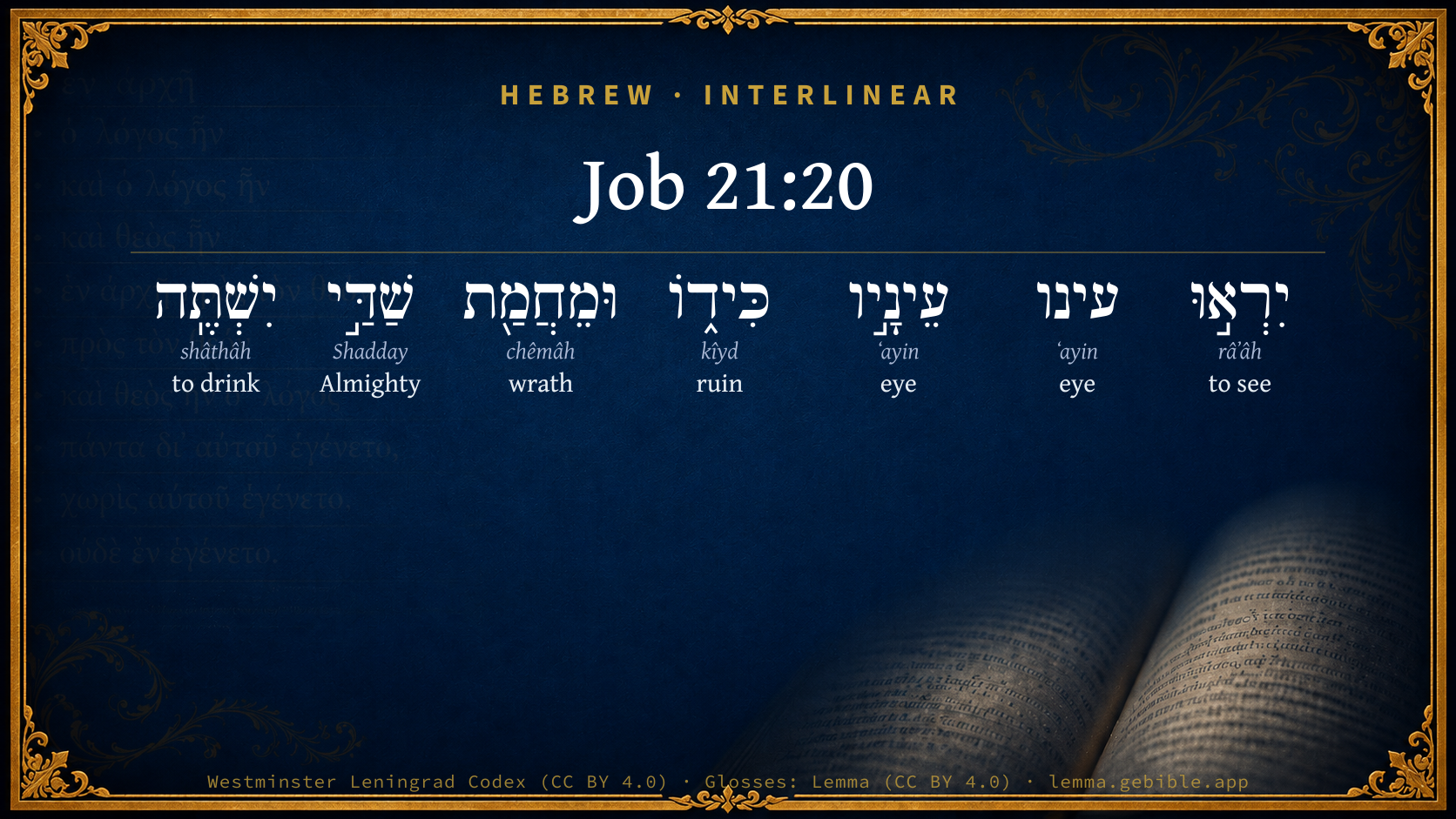
Job 21:20

Hebrew (Westminster Leningrad Codex) Job 21:20 appears in the Hebrew Old Testament. The text above is from the Westminster Leningrad Codex. Each word links to its Strong’s number, a concise gloss, and parsing drawn from the Open Scriptures Hebrew Bible morphology. Click any word for its full Brown-Driver-Briggs (BDB) entry.
Download image
Cite this verse

Job 21:20 (World English Bible). Public Domain. Lemma interlinear Bible study tool, https://lemma.gebible.app/v/job/21/20.

Show BibTeX & RIS
BibTeX
RIS
English Translation
Let his own eyes see his destruction. Let him drink of the wrath of the Almighty.
World English Bible · Public Domain
Highlights
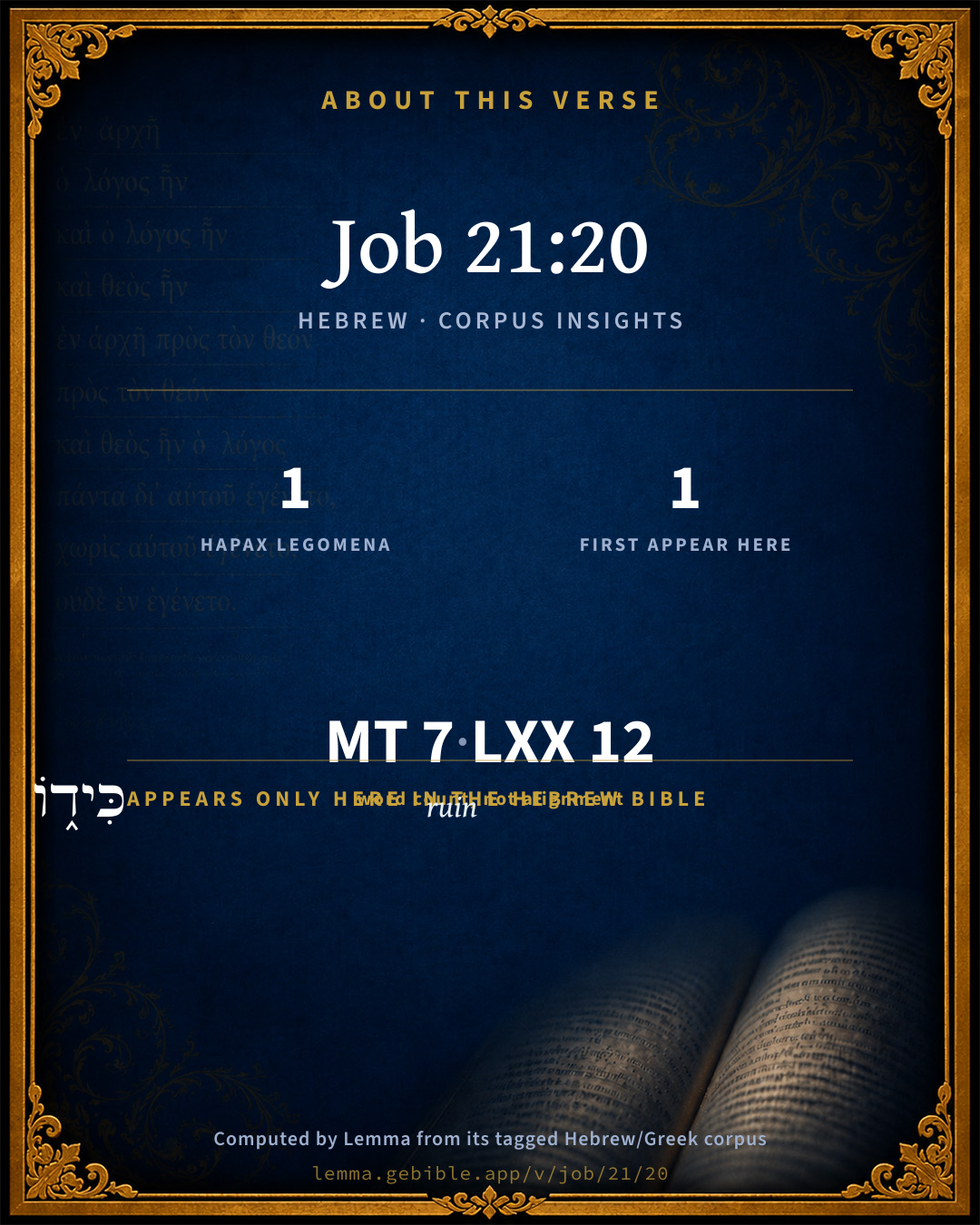
  • 1 hapax legomenon — only here in the Hebrew Bible
  • 1 first appearance in the Hebrew Bible
Full analysis ↓
Download a study sheet

One document with this verse’s original text, its word-by-word gloss line, the meaning frame, cross-references with their text, attributed commentary, and full source and license credits — printable, and it pastes into notes with its structure intact.

This verse Autodidact and up

Study sheet (.html) Plain text (.txt)

A passage Seminary Student

Up to 50 verses in one chapter. A passage sheet keeps up to 6 commentary sources and 12 cross-references per verse, in the order this page ranks them, and says so on the sheet whenever that leaves anything out. Ask for a single verse and you get the Autodidact verse sheet above.

Everything on this page stays free to read, with no account — the sheet is a download of what is already on screen, not access to it.

Want to remove ads? Support Godless Engineer
Compare translations 3

The same verse in 3 English versions, stacked beneath the original-language interlinear above. Click any original word for its lexicon entry.

Each is an independent rendering of the whole verse — the interlinear is not word-aligned to these translations.

Highlighted words mark where these versions differ — a whole-verse word diff, not a word-by-word alignment.

  • World English Bible Public Domain
    Let his own eyes see his destruction. Let him drink of the wrath of the Almighty.
  • King James Version Public Domain
    His eyes shall see his destruction, and he shall drink of the wrath of the Almighty.
  • unfoldingWord Literal Text CC BY-SA 4.0
    Let his eyes see his destruction, and from the wrath of the Almighty let him drink.

unfoldingWord Literal Text — © unfoldingWord, licensed CC BY-SA 4.0. Word-aligned USFM3 via Door43 (git.door43.org/unfoldingWord/en_ult).

Versions to compare (up to 4)

3 of 4 selected

Show all 18 translations

Every available English version of this verse, each an independent rendering of the whole verse.

  • World English Bible Public Domain
    Let his own eyes see his destruction. Let him drink of the wrath of the Almighty.
  • Berean Standard Bible Public Domain
    Let his eyes see his own destruction; let him drink for himself the wrath of the Almighty.
  • Majority Standard Bible Public Domain
    Let his eyes see his own destruction; let him drink for himself the wrath of the Almighty.
  • King James Version Public Domain
    His eyes shall see his destruction, and he shall drink of the wrath of the Almighty.
  • American Standard Version (1901) Public Domain
    Let his own eyes see his destruction, And let him drink of the wrath of the Almighty.
  • Revised Version (1885) Public Domain
    Let his own eyes see his destruction, and let him drink of the wrath of the Almighty.
  • Geneva Bible (1599) Public Domain
    His eyes shall see his destruction, and he shall drinke of the wrath of the Almightie.
  • Douay-Rheims (1899) Public Domain
    His eyes shall see his own destruction, and he shall drink of the wrath of the Almighty.
  • Young's Literal Translation Public Domain
    His own eyes see his destruction, And of the wrath of the Mighty he drinketh.
  • Literal Standard Version CC BY-SA 4.0
    His own eyes see his destruction, || And he drinks of the wrath of the Mighty.
  • Unlocked Literal Bible CC BY-SA 4.0
    Let his eyes see his own destruction, and let him drink of the wrath of the Almighty.
  • unfoldingWord Literal Text CC BY-SA 4.0
    Let his eyes see his destruction, and from the wrath of the Almighty let him drink.
  • Darby Bible Public Domain
    His eyes shall see his destruction, and he shall drink of the fury of the Almighty.
  • World Messianic Bible Public Domain
    Let his own eyes see his destruction. Let him drink of the wrath of the Almighty.
  • Webster's Bible Public Domain
    His eyes shall see his destruction, and he shall drink of the wrath of the Almighty.
  • Free Bible Version CC BY-SA 4.0
    Let them see their destruction themselves, and drink deeply from God's anger.
  • Bible in Basic English Public Domain
    Let his eyes see his trouble, and let him be full of the wrath of the Ruler of all!
  • JPS Tanakh (1917) Public Domain
    Let his own eyes see his destruction, and let him drink of the wrath of the Almighty.

Literal Standard Version (2020), Covenant Press — licensed CC BY-SA 4.0. Text via the HelloAO Bible API (eBible.org). Unlocked Literal Bible (unfoldingWord) — licensed CC BY-SA 4.0. Text via the HelloAO Bible API (eBible.org). unfoldingWord Literal Text — © unfoldingWord, licensed CC BY-SA 4.0. Word-aligned USFM3 via Door43 (git.door43.org/unfoldingWord/en_ult). Free Bible Version, Dr. Jonathan Gallagher — licensed CC BY-SA 4.0. Text via the HelloAO Bible API (eBible.org).

Word by word

More ways to search: Search by grammar → Find every occurrence → Compare this word →

Practice this passage: Drill this verse → Learn its vocabulary →

About this verse

These counts appear in no published source. They are computed here, from the morphology-tagged text and Lemma’s own curated glosses. What Lemma adds →

7
words
6
distinct lemmas
Wisdom
section

Notable vocabulary

1 hapax legomenon — a word that appears only here in the entire Hebrew Bible:

  • כִּיד֑וֹ ruin H3589

First appearance in Scripture

This word makes its first canonical appearance in the Hebrew Bible here:

  • כִּיד֑וֹ ruin H3589

Shared distinctive vocabulary

שַׁדַּ֣י Almighty H7706 occurs in 48 verses of the Hebrew Bible. Also found in:

Grammatical profile

  • 2 verbs
  • 5 nouns

Verb forms

  • יִרְא֣וּ Qal · Imperfect
  • יִשְׁתֶּֽה Qal · Imperfect

Repetition

A word recurs within this verse — often emphatic in Hebrew:

Hebrew & Septuagint length

In English translation the verse runs 16 words from the Hebrew and 16 from the Septuagint (LXX English) — the same length.

A rough comparison of the two English renderings, which tokenize alike — not a word-level alignment.

Word counts can differ between the Hebrew and the Greek without any difference in meaning — e.g. the Hebrew direct-object marker אֵת has no separate Greek word, and Greek often adds the article ὁ.

In the original languages it is 7 Hebrew tokens and 12 Greek tokens — but the two are counted differently (Hebrew bundles its prefixes and suffixes into one token; the Greek is in lemma form), so that isn’t a like-for-like length.

Cross-references

9

Topical passages linked to Job 21:20 in the Treasury of Scripture Knowledge — connected by theme and wording, ordered by reader-vote popularity; previews shown in the World English Bible.

  • Psalms 75:8 For in the hand of Yahweh there is a cup, Full of foaming wine mixed with spices. He pours it out. Indeed the wicked of the earth drink and drink it to its very dregs.
  • Isaiah 51:17 Awake, awake, stand up, Jerusalem, that have drunk at the hand of Yahweh the cup of his wrath; you have drunken the bowl of the cup of staggering, and drained it.
  • Revelation 14:10 he also will drink of the wine of the wrath of God, which is prepared unmixed in the cup of his anger. He will be tormented with fire and sulfur in the presence of the holy angels, and in the presence of the Lamb.
  • Job 27:19 He lies down rich, but he shall not do so again. He opens his eyes, and he is not.
  • Psalms 60:3 You have shown your people hard things. You have made us drink the wine that makes us stagger.
  • Jeremiah 25:15–16 For thus says Yahweh, the God of Israel, to me: take this cup of the wine of wrath at my hand, and cause all the nations, to whom I send you, to drink it.
  • Jeremiah 51:7 Babylon has been a golden cup in Yahweh's hand, who made all the earth drunken: the nations have drunk of her wine; therefore the nations are mad.
  • Luke 16:23 In Hades, he lifted up his eyes, being in torment, and saw Abraham far off, and Lazarus at his bosom.
  • Revelation 19:15 Out of his mouth proceeds a sharp, double-edged sword, that with it he should strike the nations. He will rule them with a rod of iron. He treads the winepress of the fierceness of the wrath of God, the Almighty.

Cross-references courtesy of OpenBible.info (CC BY 4.0).

Hebrew and Greek witnesses Masoretic Hebrew ↔ Greek Septuagint

The same verse in the two great witnesses to the Old Testament, shown verse-for-verse.

These are two independent witnesses, not word-aligned to each other, and the Septuagint is shown in lemma (dictionary) form.

Hebrew Job 21:20 Masoretic · Westminster Leningrad Codex

יִרְא֣וּ עינו עֵינָ֣יו כִּיד֑וֹ וּמֵחֲמַ֖ת שַׁדַּ֣י יִשְׁתֶּֽה

Let his own eyes see his destruction. Let him drink of the wrath of the Almighty.

World English Bible · Public Domain

Greek LXX Job 21:20 Septuagint · lemma form

ὁράω ὁ ὀφθαλμός αὐτός ὁ ἑαυτοῦ σφαγή ἀπό δέ κύριος μή διασώζω

Let his eyes see his own destruction, and let him not be saved by the Lord.

LXX2012 (modern English Septuagint) · Public Domain

Hebrew: Westminster Leningrad Codex (CC BY 4.0). Greek: Septuagint (public domain); English from LXX2012 (modern English Septuagint) (Public Domain). How the Septuagint differs from the Hebrew →

Commentary

Notes on Job 21:20 from classic Christian and Jewish commentators (each source and its license shown beneath its notes). The classic Christian expositions comment on the surrounding passage and are grouped to its opening verse, so a note may address several verses; the Jewish commentaries on the Tanakh (Rashi and others) are per-verse, so they appear only where the commentator wrote on this verse.

Lemma curates 59 commentaries, every one of them public domain or Creative Commons licensed, each selected and text-cleaned for this edition rather than reprinted as found. About our sources →

Trapp's Complete Commentary

John Trapp

Job 21:20 His eyes shall see his destruction, and he shall drink of the wrath of the Almighty.

Ver. 20. His eyes shall see his destruction] His slaughter, saith the Greek; his breaking to pieces, saith the Chaldee; this he shall see with his eyes, the destruction of his person, and ruin of his family. The sight of evil is a grief to see as well as the feeling of it is a pain; and that is complete destruction which is not only felt but seen. Zedekiah first saw all his children slain, and then had his eyes put out. Maurichus had the like woeful sight, and then was stewed in his own broth by the traitor Phocas.

And he shall drink of the wrath of the Almighty] Heb. The scalding hot wrath, worse than that cup of boiling lead turned down the throat of a certain drunken man, by the command of the Turkish bashaw. Jerusalem drank wrath to drunkenness, and had none to guide her; as a drunken man had need to have, Isa 51:17. The nations were to drink it to madness, Jer 25:10. Babylon’s brats shall drink of the wine of God’s wrath, Rev 14:10 (poison in wine works more furiously than in water); their irreparable ruin is set forth to the eye, as it were, when, Rev 18:21, an angel, a mighty angel, taketh a stone, a great stone, even a millstone, which he casteth and with impetuous force thrusteth into the bottom of the sea, whence it cannot be buoyed up. Now what is a mighty angel to the Almighty God, who hath his name, Shaddai, from destroying, as some are of opinion?

John Trapp, A Commentary or Exposition upon All the Books of the Old and New Testament (1647–1656) — public domain. Text from a community e-Sword module.

Geneva Bible (1599)

Geneva Bible translators

When God recompenseth his wickedness, he shall know that his prosperity was but vanity.

Geneva Bible (1599) marginal notes — public domain. Text via Bolls.life.

Jamieson, Fausset & Brown

Robert Jamieson, A. R. Fausset & David Brown

Another questionable assertion of the friends, that the sinner sees his own and his children's destruction in his lifetime.

drink-- (Psa 11:6; Isa 51:17; Lam 4:21).

Jamieson, Fausset & Brown — Commentary Critical and Explanatory on the Whole Bible (1871) — public domain (CC PDM 1.0). Text via the HelloAO Bible API.

Adam Clarke's Commentary

Verse 20. His eyes shall see his destruction] He shall perceive its approach, and have the double punishment of fearing and feeling; feeling a THOUSAND deaths in fearing ONE.

He shall drink of the wrath] The cup of God's wrath, the cup of trembling, c., is frequently expressed or referred to in the sacred writings, De 32:33 Isa 51:17-22; Jer 25:15; Re 14:8. It appears to be a metaphor taken from those cups of poison which certain criminals were obliged to drink. A cup of the juice of hemlock was the wrath or punishment assigned by the Athenian magistrates to the philosopher Socrates.

Adam Clarke's Commentary on the Bible (1810–1826) — public domain. Text from a community e-Sword/MySword module.

Ellicott's Commentary for English Readers

(20) His eyes shall see his destruction.—This may be understood as the continuation of Job’s suggested amendment of the Divine government. “His own eyes should see his destruction, and he should drink of the wrath, &c. For what concern or interest hath he in his house after him when the number of his months is cut off, &c. “

A Bible Commentary for English Readers, edited by Charles John Ellicott (1878–1897) — public domain. Text from a community e-Sword module.

John Gill's Exposition

For what pleasure hath he in his house after him,.... As, on the one hand, the prosperity of his children after his decease gives him no pleasure and delight, so, on the other hand, the calamities and distresses of his family for his sins and theirs give him no pain or uneasiness; he knows nothing that befalls them, and it is no part of his concern; and let what will befall them, he cares not for it; he feels it not, he is not sensible of it; and therefore to object that signifies nothing; see Job 14:21; or, "what business has he with his house after death?" the affairs (d) of his family do not at all concern him, one way or another; he is not affected with them; he can neither consider their happiness as a blessing nor their calamities as a punishment to him:

when the number of his months is cut off in the midst? the years, the months, and the days of the lives of men, are numbered and determined by the Lord, Job 14:5; which, when finished, the thread of life is cut off in the midst, from the rest of the months, which a man or his friends might have expected he would have lived; or rather, "when his number of the months is fully up" (e); when the calculation of them is complete, and the full number of them is perfected; the sense is, what cares a wicked man for what befalls his family after his death, when he has lived out the full term of life in great outward happiness and prosperity; has lived to be full of days, of months, and years, to a full age, even to an age that may be truly called old age?

(d) So Schultens. (e) "integro numero calculis ducti sunt", Cocceius; "cumulatam sortem habuerint", Schultens.

John Gill's Exposition of the Whole Bible (1746–1763) — public domain (CC PDM 1.0). Text via the HelloAO Bible API.

Albert Barnes' Notes on the Bible

His eyes shall see his destruction - That is, his own eyes shall see his destruction, or the calamities that shall come upon him. That is, “You maintain that, or this is the position which you defend.” Job designs to meet this, and to show that it is not always so.

And he shall drink of the wrath of the Almighty - Wrath is often represented as a cup which the wicked are compelled to drink. See the notes, Isa 51:17.

Albert Barnes' Notes on the Bible (1834–1885) — public domain. Text from a community e-Sword/MySword module.

Matthew Poole's English Annotations

His eyes shall see his destruction, i.e. he shall be destroyed;

as to see death, is to die, Psa 89:48; Heb 11:5; and to see affliction, or any kind of evil, is to feel it Psa 90:15; Lam 3:1; and to see good, is to enjoy it, Job 7:7; 9:25; Psa 34:12. Or this phrase may be emphatical, he shall foresee his ruin hastening towards him, and not be able to prevent or avoid it; he shall sensibly feel himself sinking and perishing; which aggravates his misery.

He shall drink; not sip or taste, but drink; which word commonly notes the abundance of the thing spoken of.

Matthew Poole's English Annotations on the Holy Bible (1683–1685) — public domain. Text from a community e-Sword/MySword module.

Whedon's Commentary on the Bible

Daniel D. Whedon

20. His eyes shall see — Better, His eyes should see… and he should drink, etc. Job is still answering the insufficient theory of substitution. It is right that the parent, not the child should see destruction.

Daniel D. Whedon (gen. ed.), Commentary on the Old and New Testaments (1874–1909) — public domain. Text from a community e-Sword module.

The Pulpit Commentary

His eyes shall see his destruction (or, let his own eyes see his destruction), and he shall drink (or, let him drink) of the wrath of the Almighty. It will impress him far more with a sense of his wickedness, and of his guilt in God"s sight, if he receives punishment in his own person, than if he merely suffers vicariously through his children.

The Pulpit Commentary (1880–1919), ed. H.D.M. Spence-Jones & Joseph S. Exell — public domain. Text from a community e-Sword module.

John Wesley's Explanatory Notes

See - He shall be destroyed; as to see death, is to die.

John Wesley, Explanatory Notes Upon the Whole Bible (1754–1765) — public domain. Text via the GEBible commentary corpus.

Rashi

Rabbi Shlomo Yitzchaki (Rashi)

Let his eyes see his ruin Heb. כידו, his ruin, but I cannot find a comparison in the Bible. However, according to the context of the verse, it appears to mean ruin, and so, many did not find a comparison to it. (כידו An expression of אֵידוֹ, his ruin. The “aleph” is substituted by a “chaff.”)

Rashi on the Tanakh — English translations: “The Judaica Press complete Tanach with Rashi, translated by A. J. Rosenberg” (CC BY 4.0); “Pentateuch with Rashi's commentary by M. Rosenbaum and A.M. Silbermann, 1929-1934” (public domain); “The Metsudah Tanach series, Lakewood, N.J” (CC BY 4.0); and “The Book of Joshua, Metsudah Publications, 1997” (CC BY 4.0). Text via Sefaria.

Lesson kit

Teaching starters — assembled from the data on this page, not authored interpretation. Every prompt links to the verse data it draws on. Edit before teaching.

Job, in the Wisdom, opens this verse with 7 words (6 distinct Hebrew lemmas). Its most distinctive word is kîyd (“ruin”). A historical commentator’s framing appears above. Read the whole chapter for the surrounding context.

Discussion questions

  1. What does “ruin” (kîyd) contribute to the verse as a whole?
  2. This verse holds 1 word here found nowhere else in the Hebrew Bible. What might the rare word draw attention to?
  3. The word “ruin” first appears here in Scripture. What is being introduced at this debut?
  4. Genesis 17:1 shares the word «Almighty» with this verse. How do the two illuminate each other?
  5. “eye” occurs 2× in this one verse. What is the effect of the repetition?
  6. These translations render this verse differently. What is at stake in choosing one wording over another?
  7. The verb «יִרְא֣וּ» is Qal Imperfect. How does its form color the action?
  8. Reading how Trapp's Complete Commentary and Geneva Bible (1599) read this verse, where do the two commentators agree and where do they part?

Things to notice

  • 1 word in this verse appears nowhere else in the Hebrew Bible.
  • 1 word makes its first canonical appearance in Scripture here.
  • This verse counts 7 Hebrew ↔ 12 Greek words.
  • These translations choose different wording for 4 words in this verse.
  • “eye” occurs 2× in this single verse.

Reading settings

Reading text

Shown beneath each verse's original-language words.

Old Testament
Old Testament edition

Read the OT as the Masoretic Hebrew (MT) or the Greek Septuagint (LXX).

English shown for the Greek Septuagint (in the Hebrew ↔ Greek comparison).

Comparing translations? Open the Compare panel on any verse page to stack up to four side by side.