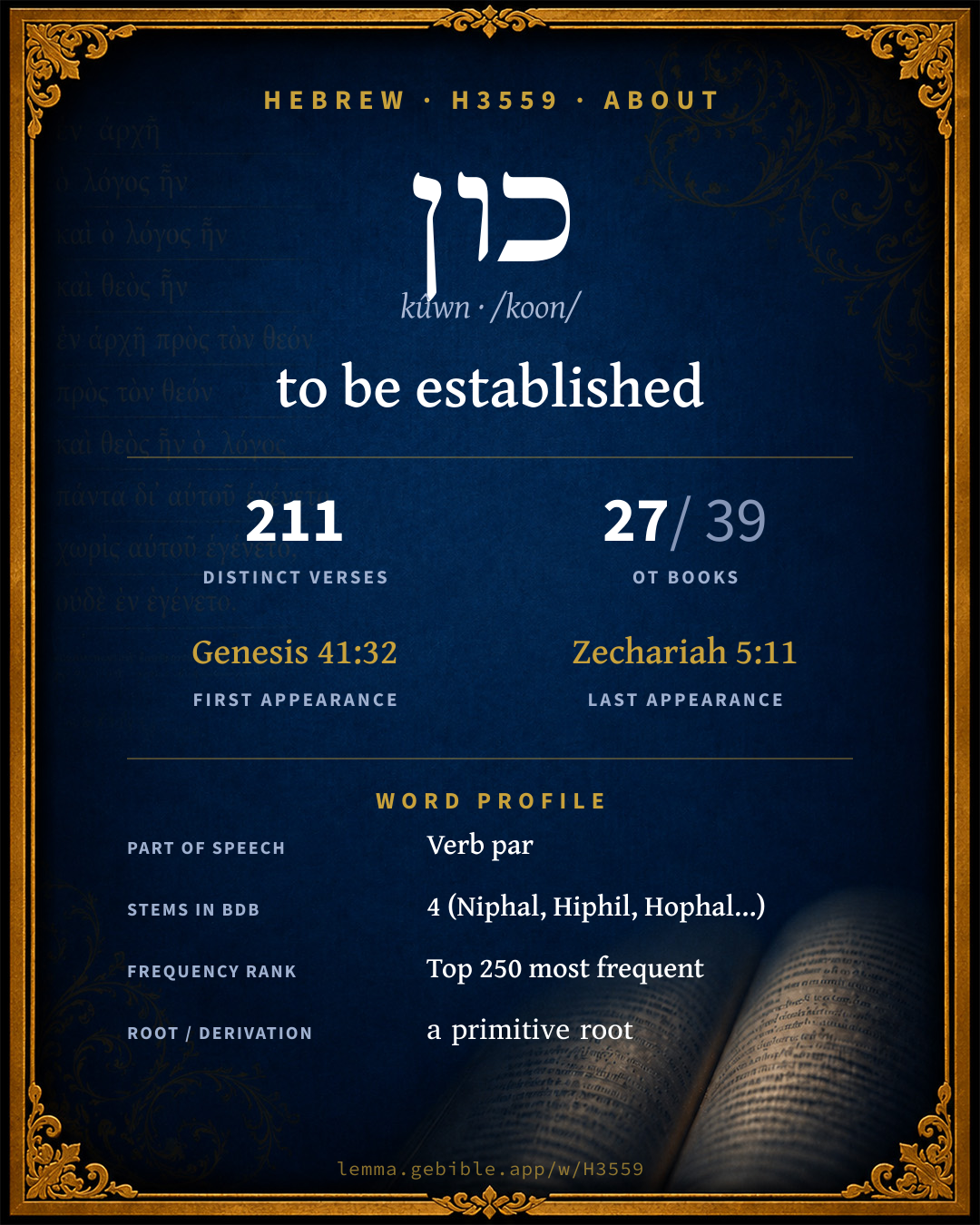
כּוּן
to be established
‘to be established’ is one of 3 main senses fuller range ↓
Full lexicon entry — Brown-Driver-Briggs (BDB)
From Brown-Driver-Briggs (BDB)
Where this word appears
See every Hiphil verb in the Hebrew Bible →
Grammar key — what these labels mean
Part of speech
- Verb
- An action or state-of-being word.
- Noun
- A naming word — a person, place, thing, or idea.
Noun type
- Common
- A common noun — a general class of person, place, or thing (“king,” “city,” “water”), not a specific name.
Stem
- Niphal
- Usually the simple passive or reflexive of the Qal (“he was written”). Here: ‘be set up’
- Hiphil
- The causative active stem (“he caused / brought about”). Here: ‘establish’
- Polel
- A stem of hollow/geminate roots functioning like the Piel — intensive active. Here: ‘set up’
- Hophal
- The passive counterpart of the Hiphil (“he was caused to…”). Here: ‘be established’
- Polal
- The passive counterpart of the Polel. Here: ‘set up’
- Hithpolel
- The reflexive counterpart of the Polel. Here: ‘set up’
Form
- Participle Active
- A verbal adjective expressing ongoing or characteristic action (“writing / one who writes”).
- Perfect
- A completed action or state — Hebrew marks aspect (completeness) more than strict tense (“he wrote”).
- Imperfect
- An incomplete, ongoing, or future action (“he will / would write”).
- Imperative
- A direct command (“write!”).
- Sequential Imperfect
- An imperfect with prefixed waw — the standard past-narrative form (waw-consecutive imperfect).
- Infinitive Construct
- A bound verbal noun, frequently with prepositions (“to write / in writing”).
- Sequential Perfect
- A perfect with prefixed waw continuing a preceding imperfect or command (waw-consecutive perfect).
- Jussive
- A third- or second-person volitional form expressing wish or command (“let him write”).
- Participle Passive
- A verbal adjective expressing action received (“written”).
- Infinitive Absolute
- An unbound verbal noun, often intensifying or standing in for a finite verb.
- Cohortative
- A first-person volitional form expressing wish or resolve (“let me / let us write”).
State
- Absolute
- The independent form of a noun, not bound to a following word.
- Construct
- A noun bound to a following noun in a possessive / “of” relationship (the construct chain).
Person
- 3rd Person
- The one spoken about (“he / she / it / they”).
- 1st Person
- The speaker (“I / we”).
- 2nd Person
- The one addressed (“you”).
Gender
- Masculine
- Grammatically masculine.
- Feminine
- Grammatically feminine.
- Common
- Either gender — not distinguished for this form.
Number
- Singular
- One.
- Plural
- More than one (in Hebrew, generally three or more).
Grammatical forms 55 distinct
- Verb, Niphal, Participle Active, Masculine, Singular, Absolute 29 times (13%)
- Verb, Hiphil, Perfect, 3rd Person, Masculine, Singular 24 times (11%)
- Verb, Hiphil, Infinitive Construct 12 times (5%)
- Verb, Niphal, Imperfect, 3rd Person, Feminine, Singular 8 times (4%)
- Verb, Niphal, Imperfect, 3rd Person, Masculine, Singular 8 times (4%)
- Verb, Hiphil, Perfect, 1st Person, Common, Singular 8 times (4%)
- Verb, Hiphil, Imperative, 2nd Person, Masculine, Singular 8 times (4%)
- Verb, Hiphil, Imperfect, 3rd Person, Masculine, Singular 7 times (3%)
+47 more forms (115 occurrences)
Parsed forms decoded from the imported morphology (morphhb / Westminster Leningrad Codex — WLC text public domain, morphhb tagging CC BY 4.0), counted across 219 parsed occurrences — not distinct verses.
Page 1 of 2 — showing verses 1–200 of 211 distinct verses where H3559 appears, across 27 books. Click any verse to open its interlinear word-by-word view. Verse text shown in the World English Bible for context — . Each verse’s Hebrew form is shown with its reference; the English is not keyword-highlighted, since the data carries no word-level English alignment. Use “Compare translations” on any verse to read it across multiple English versions. This concordance covers the Hebrew Bible; Septuagint (Greek Old Testament) occurrences are not indexed here.
Genesis 3 verses
- Genesis 41:32 נָכ֤וֹן Niphal ptcp.act ms The dream was doubled to Pharaoh, because the thing is established by God, and God will shortly bring it to pass.
- Genesis 43:16 וְ/הָכֵ֔ן conj + Hiphil impv 2ms When Joseph saw Benjamin with them, he said to the steward of his house, "Bring the men into the house, and butcher an animal, and make ready; for the men will dine with me at noon."
- Genesis 43:25 וַ/יָּכִ֨ינוּ֙ conj + Hiphil wimpf 3mp They made ready the present for Joseph's coming at noon, for they heard that they should eat bread there.
Exodus 7 verses
- Exodus 8:26 נָכוֹן֙ Niphal ptcp.act ms Moses said, "It isn't appropriate to do so; for we shall sacrifice the abomination of the Egyptians to Yahweh our God. Behold, shall we sacrifice the abomination of the Egyptians before their eyes, and won't they stone us?
- Exodus 15:17 כּוֹנְנ֥וּ Polel pf 3cp You shall bring them in, and plant them in the mountain of your inheritance, The place, Yahweh, which you have made for yourself to dwell in; The sanctuary, Lord, which your hands have established.
- Exodus 16:5 וְ/הֵכִ֖ינוּ conj + Hiphil pf 3cp It shall come to pass on the sixth day, that they shall prepare that which they bring in, and it shall be twice as much as they gather daily."
- Exodus 19:11 נְכֹנִ֖ים Niphal ptcp.act mp and be ready against the third day; for on the third day Yahweh will come down in the sight of all the people on Mount Sinai.
- Exodus 19:15 נְכֹנִ֖ים Niphal ptcp.act mp He said to the people, "Be ready by the third day. Don't have sexual relations with a woman."
- Exodus 23:20 הֲכִנֹֽתִי Hiphil pf 1cs "Behold, I send an angel before you, to keep you by the way, and to bring you into the place which I have prepared.
- Exodus 34:2 נָכ֖וֹן Niphal ptcp.act ms Be ready by the morning, and come up in the morning to Mount Sinai, and present yourself there to me on the top of the mountain.
Numbers 3 verses
- Numbers 21:27 וְ/תִכּוֹנֵ֖ן conj + Hithpolel juss 3fs Therefore those who speak in proverbs say, Come you to Heshbon; Let the city of Sihon be built and established:
- Numbers 23:1 וְ/הָכֵ֥ן conj + Hiphil impv 2ms Balaam said to Balak, Build me here seven altars, and prepare me here seven bulls and seven rams.
- Numbers 23:29 וְ/הָכֵ֥ן conj + Hiphil impv 2ms Balaam said to Balak, Build me here seven altars, and prepare me here seven bulls and seven rams.
Deuteronomy 4 verses
- Deuteronomy 13:14 נָכ֣וֹן Niphal ptcp.act ms then shall you inquire, and make search, and ask diligently; and, behold, if it be truth, and the thing certain, that such abomination is done in the midst of you,
- Deuteronomy 17:4 נָכ֣וֹן Niphal ptcp.act ms and it be told you, and you have heard of it, then shall you inquire diligently; and, behold, if it be true, and the thing certain, that such abomination is done in Israel,
- Deuteronomy 19:3 תָּכִ֣ין Hiphil impf 2ms You shall prepare you the way, and divide the borders of your land, which Yahweh your God causes you to inherit, into three parts, that every manslayer may flee there.
- Deuteronomy 32:6 וַֽ/יְכֹנְנֶֽ/ךָ conj + Polel wimpf 3ms + sfx pers 2ms Do you thus requite Yahweh, Foolish people and unwise? Isn't he your father who has bought you? He has made you, and established you.
Joshua 5 verses
- Joshua 1:11 הָכִ֥ינוּ Hiphil impv 2mp Pass through the midst of the camp, and command the people, saying, Prepare food; for within three days you are to pass over this Jordan, to go in to possess the land, which Yahweh your God gives you to possess it.
- Joshua 3:17 הָכֵ֑ן Hiphil inf.abs The priests who bore the ark of the covenant of Yahweh stood firm on dry ground in the midst of the Jordan; and all Israel passed over on dry ground, until all the nation were passed clean over the Jordan.
- Joshua 4:3 הָכִ֖ין Hiphil inf.cs and command you them, saying, Take hence out of the midst of the Jordan, out of the place where the priests' feet stood firm, twelve stones, and carry them over with you, and lay them down in the lodging-place, where you shall lodge this night.
- Joshua 4:4 הֵכִ֖ין Hiphil pf 3ms Then Joshua called the twelve men, whom he had prepared of the children of Israel, out of every tribe a man:
- Joshua 8:4 נְכֹנִֽים Niphal ptcp.act mp He commanded them, saying, Behold, you shall lie in ambush against the city, behind the city; don't go very far from the city, but be all ready:
Judges 3 verses
- Judges 12:6 יָכִין֙ Hiphil impf 3ms then said they to him, Say now Shibboleth; and he said Sibboleth; for he couldn't manage to pronounce it right: then they laid hold on him, and killed him at the fords of the Jordan. There fell at that time of Ephraim forty-two thousand.
- Judges 16:26 נָכ֣וֹן Niphal ptcp.act ms and Samson said to the boy who held him by the hand, Allow me that I may feel the pillars whereupon the house rests, that I may lean on them.
- Judges 16:29 נָכ֣וֹן Niphal ptcp.act ms Samson took hold of the two middle pillars on which the house rested, and leaned on them, the one with his right hand, and the other with his left.
1 Samuel 6 verses
- 1 Samuel 7:3 וְ/הָכִ֨ינוּ conj + Hiphil impv 2mp Samuel spoke to all the house of Israel, saying, If you do return to Yahweh with all your heart, then put away the foreign gods and the Ashtaroth from among you, and direct your hearts to Yahweh, and serve him only; and he will deliver you out of the hand of the Philistines.
- 1 Samuel 13:13 הֵכִ֨ין Hiphil pf 3ms Samuel said to Saul, You have done foolishly; you have not kept the commandment of Yahweh your God, which he commanded you: for now would Yahweh have established your kingdom on Israel forever.
- 1 Samuel 20:31 תִכּ֖וֹן Niphal impf 2ms For as long as the son of Jesse lives on the earth, you shall not be established, nor your kingdom. Therefore now send and bring him to me, for he shall surely die.
- 1 Samuel 23:22 הָכִ֣ינוּ Hiphil impv 2mp Please go make yet more sure, and know and see his place where his haunt is, [and] who has seen him there; for it is told me that he deals very subtly.
- 1 Samuel 23:23 נָכ֔וֹן Niphal ptcp.act ms See therefore, and take knowledge of all the lurking-places where he hides himself, and come you again to me of a certainty, and I will go with you: and it shall happen, if he be in the land, that I will search him out among all the thousands of Judah.
- 1 Samuel 26:4 נָכֽוֹן Niphal ptcp.act ms David therefore sent out spies, and understood that Saul was come of a certainty.
2 Samuel 6 verses
- 2 Samuel 5:12 הֱכִינ֧/וֹ Hiphil pf 3ms + sfx pers 3ms David perceived that Yahweh had established him king over Israel, and that he had exalted his kingdom for his people Israel's sake.
- 2 Samuel 7:12 וַ/הֲכִינֹתִ֖י conj + Hiphil wpf 1cs When your days are fulfilled, and you shall sleep with your fathers, I will set up your seed after you, who shall proceed out of your bowels, and I will establish his kingdom.
- 2 Samuel 7:13 וְ/כֹנַנְתִּ֛י conj + Polel wpf 1cs He shall build a house for my name, and I will establish the throne of his kingdom forever.
- 2 Samuel 7:16 נָכ֖וֹן Niphal ptcp.act ms Your house and your kingdom shall be made sure for ever before you: your throne shall be established forever.
- 2 Samuel 7:24 וַ/תְּכ֣וֹנֵֽן conj + Polel wimpf 2ms You did establish to yourself your people Israel to be a people to you forever; and you, Yahweh, became their God.
- 2 Samuel 7:26 נָכ֖וֹן Niphal ptcp.act ms Let your name be magnified forever, saying, Yahweh of hosts is God over Israel; and the house of your servant David shall be established before you.
1 Kings 6 verses
- 1 Kings 2:12 וַ/תִּכֹּ֥ן conj + Niphal wimpf 3fs Solomon sat on the throne of David his father; and his kingdom was established greatly.
- 1 Kings 2:24 הֱכִינַ֗/נִי Hiphil pf 3ms + sfx pers 1cs Now therefore as Yahweh lives, who has established me, and set me on the throne of David my father, and who has made me a house, as he promised, surely Adonijah shall be put to death this day.
- 1 Kings 2:45 נָכ֛וֹן Niphal ptcp.act ms But king Solomon shall be blessed, and the throne of David shall be established before Yahweh forever.
- 1 Kings 2:46 נָכ֖וֹנָה Niphal pf 3fs So the king commanded Benaiah the son of Jehoiada; and he went out, and fell on him, so that he died. The kingdom was established in the hand of Solomon.
- 1 Kings 5:18 וַ/יָּכִ֛ינוּ conj + Hiphil wimpf 3mp Solomon's builders and Hiram's builders and the Gebalites did fashion them, and prepared the timber and the stones to build the house.
- 1 Kings 6:19 הֵכִ֑ין Hiphil pf 3ms He prepared an oracle in the midst of the house within, to set there the ark of the covenant of Yahweh.
1 Chronicles 22 verses
- 1 Chronicles 9:32 לְ/הָכִ֖ין prep + Hiphil inf.cs Some of their brothers, of the sons of the Kohathites, were over the show bread, to prepare it every Sabbath.
- 1 Chronicles 12:39 הֵכִ֥ינוּ Hiphil pf 3cp They were there with David three days, eating and drinking; for their brothers had made preparation for them.
- 1 Chronicles 14:2 הֱכִינ֧/וֹ Hiphil pf 3ms + sfx pers 3ms David perceived that Yahweh had established him king over Israel; for his kingdom was exalted on high, for his people Israel's sake.
- 1 Chronicles 15:1 וַ/יָּ֤כֶן conj + Hiphil wimpf 3ms [David] made him houses in the city of David; and he prepared a place for the ark of God, and pitched for it a tent.
- 1 Chronicles 15:3 הֵכִ֥ין Hiphil pf 3ms David assembled all Israel at Jerusalem, to bring up the ark of Yahweh to its place, which he had prepared for it.
- 1 Chronicles 15:12 הֲכִינ֖וֹתִי Hiphil pf 1cs and said to them, You are the heads of the fathers' [houses] of the Levites: sanctify yourselves, both you and your brothers, that you may bring up the ark of Yahweh, the God of Israel, to [the place] that I have prepared for it.
- 1 Chronicles 16:30 תִּכּ֥וֹן Niphal impf 3fs Tremble before him, all the earth: The world also is established that it can't be moved.
- 1 Chronicles 17:11 וַ/הֲכִינוֹתִ֖י conj + Hiphil wpf 1cs It shall happen, when your days are fulfilled that you must go to be with your fathers, that I will set up your seed after you, who shall be of your sons; and I will establish his kingdom.
- 1 Chronicles 17:12 וְ/כֹנַנְתִּ֥י conj + Polel wpf 1cs He shall build me a house, and I will establish his throne forever.
- 1 Chronicles 17:14 נָכ֖וֹן Niphal ptcp.act ms but I will settle him in my house and in my kingdom forever; and his throne shall be established forever.
- 1 Chronicles 17:24 נָכ֥וֹן Niphal ptcp.act ms Let your name be established and magnified forever, saying, Yahweh of Hosts is the God of Israel, even a God to Israel: and the house of David your servant is established before you.
- 1 Chronicles 22:3 הֵכִ֣ין Hiphil pf 3ms David prepared iron in abundance for the nails for the doors of the gates, and for the couplings; and brass in abundance without weight;
- 1 Chronicles 22:5 אָכִ֥ינָה וַ/יָּ֧כֶן Hiphil coh 1cs conj + Hiphil wimpf 3ms David said, Solomon my son is young and tender, and the house that is to be built for Yahweh must be exceedingly magnificent, of fame and of glory throughout all countries: I will therefore make preparation for it. So David prepared abundantly before his death.
- 1 Chronicles 22:10 וַ/הֲכִ֨ינוֹתִ֜י conj + Hiphil wpf 1cs he shall build a house for my name; and he shall be my son, and I will be his father; and I will establish the throne of his kingdom over Israel for ever.
- 1 Chronicles 22:14 הֲכִינ֣וֹתִי הֲכִינ֔וֹתִי Hiphil pf 1cs Hiphil pf 1cs Now, behold, in my affliction I have prepared for the house of Yahweh one hundred thousand talents of gold, and one thousand thousand talents of silver, and of brass and iron without weight; for it is in abundance: timber also and stone have I prepared; and you may add to them.
- 1 Chronicles 28:2 וַ/הֲכִינ֖וֹתִי conj + Hiphil pf 1cs Then David the king stood up on his feet, and said, Hear me, my brothers, and my people: as for me, it was in my heart to build a house of rest for the ark of the covenant of Yahweh, and for the footstool of our God; and I had made ready for the building.
- 1 Chronicles 28:7 וַ/הֲכִינוֹתִ֥י conj + Hiphil wpf 1cs I will establish his kingdom forever, if he be constant to do my commandments and my ordinances, as at this day.
- 1 Chronicles 29:2 הֲכִינ֣וֹתִי Hiphil pf 1cs Now I have prepared with all my might for the house of my God the gold for the [things of] gold, and the silver for the [things of] silver, and the brass for the [things of] brass, the iron for the [things of] iron, and wood for the [things of] wood; onyx stones, and [stones] to be set, stones for inlaid work, and of various colors, and all manner of precious stones, and marble stones in abundance.
- 1 Chronicles 29:3 הֲכִינ֖וֹתִי Hiphil pf 1cs In addition, because I have set my affection on the house of my God, seeing that I have a treasure of my own of gold and silver, I give it to the house of my God, over and above all that I have prepared for the holy house,
- 1 Chronicles 29:16 הֲכִינֹ֔נוּ Hiphil pf 1cp Yahweh our God, all this store that we have prepared to build you a house for your holy name comes of your hand, and is all your own.
- 1 Chronicles 29:18 וְ/הָכֵ֥ן conj + Hiphil impv 2ms Yahweh, the God of Abraham, of Isaac, and of Israel, our fathers, keep this forever in the imagination of the thoughts of the heart of your people, and prepare their heart to you;
- 1 Chronicles 29:19 הֲכִינֽוֹתִי Hiphil pf 1cs and give to Solomon my son a perfect heart, to keep your commandments, your testimonies, and your statutes, and to do all these things, and to build the palace, for which I have made provision.
2 Chronicles 25 verses
- 2 Chronicles 1:4 בַּֽ/הֵכִ֥ין prep det + Hiphil pf 3ms But David had brought the ark of God up from Kiriath Jearim to [the place] that David had prepared for it; for he had pitched a tent for it at Jerusalem.
- 2 Chronicles 2:7 הֵכִ֖ין Hiphil pf 3ms Now therefore send me a man skillful to work in gold, and in silver, and in brass, and in iron, and in purple, and crimson, and blue, and who knows how to engrave [all manner of] engravings, [to be] with the skillful men who are with me in Judah and in Jerusalem, whom David my father did provide.
- 2 Chronicles 2:9 וּ/לְ/הָכִ֥ין conj + prep + Hiphil inf.cs even to prepare me timber in abundance; for the house which I am about to build shall be great and wonderful.
- 2 Chronicles 3:1 הֵכִין֙ Hiphil pf 3ms Then Solomon began to build the house of Yahweh at Jerusalem on Mount Moriah, where [Yahweh] appeared to David his father, which he made ready in the place that David had appointed, in the threshing floor of Ornan the Jebusite.
- 2 Chronicles 8:16 וַ/תִּכֹּן֙ conj + Niphal wimpf 3fs Now all the work of Solomon was prepared to the day of the foundation of the house of Yahweh, and until it was finished. [So] the house of Yahweh was completed.
- 2 Chronicles 12:1 כְּ/הָכִ֞ין prep + Hiphil inf.cs It happened, when the kingdom of Rehoboam was established, and he was strong, that he forsook the law of Yahweh, and all Israel with him.
- 2 Chronicles 12:14 הֵכִין֙ Hiphil pf 3ms He did that which was evil, because he didn't set his heart to seek Yahweh.
- 2 Chronicles 17:5 וַ/יָּ֨כֶן conj + Hiphil wimpf 3ms Therefore Yahweh established the kingdom in his hand; and all Judah brought to Jehoshaphat tribute; and he had riches and honor in abundance.
- 2 Chronicles 19:3 וַ/הֲכִינ֥וֹתָ conj + Hiphil pf 2ms Nevertheless there are good things found in you, in that you have put away the Asheroth out of the land, and have set your heart to seek God.
- 2 Chronicles 20:33 הֵכִ֣ינוּ Hiphil pf 3cp However the high places were not taken away; neither as yet had the people set their hearts to the God of their fathers.
- 2 Chronicles 26:14 וַ/יָּכֶן֩ conj + Hiphil wimpf 3ms Uzziah prepared for them, even for all the host, shields, and spears, and helmets, and coats of mail, and bows, and stones for slinging.
- 2 Chronicles 27:6 הֵכִ֣ין Hiphil pf 3ms So Jotham became mighty, because he ordered his ways before Yahweh his God.
- 2 Chronicles 29:19 הֵכַ֣נּוּ Hiphil pf 1cp Moreover all the vessels, which king Ahaz in his reign did cast away when he trespassed, have we prepared and sanctified; and, behold, they are before the altar of Yahweh.
- 2 Chronicles 29:35 וַ/תִּכּ֖וֹן conj + Niphal wimpf 3fs Also the burnt offerings were in abundance, with the fat of the peace-offerings, and with the drink-offerings for every burnt offering. So the service of the house of Yahweh was set in order.
- 2 Chronicles 29:36 הַ/הֵכִ֥ין ptcl rel + Hiphil pf 3ms Hezekiah rejoiced, and all the people, because of that which God had prepared for the people: for the thing was done suddenly.
- 2 Chronicles 30:19 הֵכִ֔ין Hiphil pf 3ms who sets his heart to seek God, Yahweh, the God of his fathers, though not [cleansed] according to the purification of the sanctuary.
- 2 Chronicles 31:11 לְ/הָכִ֧ין וַ/יָּכִֽינוּ prep + Hiphil inf.cs conj + Hiphil wimpf 3mp Then Hezekiah commanded to prepare chambers in the house of Yahweh; and they prepared them.
- 2 Chronicles 33:16 ו/יכן conj + Hiphil wimpf 3ms He built up the altar of Yahweh, and offered thereon sacrifices of peace-offerings and of thanksgiving, and commanded Judah to serve Yahweh, the God of Israel.
- 2 Chronicles 35:4 וְ/הָכִ֥ונוּ conj + Hiphil impv 2mp Prepare yourselves after your fathers' houses by your divisions, according to the writing of David king of Israel, and according to the writing of Solomon his son.
- 2 Chronicles 35:6 וְ/הָכִ֣ינוּ conj + Hiphil impv 2mp Kill the Passover, and sanctify yourselves, and prepare for your brothers, to do according to the word of Yahweh by Moses.
- 2 Chronicles 35:10 וַ/תִּכּ֖וֹן conj + Niphal wimpf 3fs So the service was prepared, and the priests stood in their place, and the Levites by their divisions, according to the king's commandment.
- 2 Chronicles 35:14 הֵכִ֤ינוּ הֵכִ֣ינוּ Hiphil pf 3cp Hiphil pf 3cp Afterward they prepared for themselves, and for the priests, because the priests the sons of Aaron [were busied] in offering the burnt offerings and the fat until night: therefore the Levites prepared for themselves, and for the priests the sons of Aaron.
- 2 Chronicles 35:15 הֵכִ֥ינוּ Hiphil pf 3cp The singers the sons of Asaph were in their place, according to the commandment of David, and Asaph, and Heman, and Jeduthun the king's seer; and the porters were at every gate: they didn't need to depart from their service; for their brothers the Levites prepared for them.
- 2 Chronicles 35:16 וַ֠/תִּכּוֹן conj + Niphal wimpf 3fs So all the service of Yahweh was prepared the same day, to keep the Passover, and to offer burnt-offerings on the altar of Yahweh, according to the commandment of king Josiah.
- 2 Chronicles 35:20 הֵכִ֤ין Hiphil pf 3ms After all this, when Josiah had prepared the temple, Neco king of Egypt went up to fight against Carchemish by the Euphrates: and Josiah went out against him.
Ezra 2 verses
- Ezra 3:3 וַ/יָּכִ֤ינוּ conj + Hiphil wimpf 3mp They set the altar on its base; for fear was on them because of the peoples of the countries: and they offered burnt offerings thereon to Yahweh, even burnt offerings morning and evening.
- Ezra 7:10 הֵכִ֣ין Hiphil pf 3ms For Ezra had set his heart to seek the law of Yahweh, and to do it, and to teach in Israel statutes and ordinances.
Nehemiah 1 verse
Esther 2 verses
- Esther 6:4 הֵכִ֥ין Hiphil pf 3ms The king said, "Who is in the court?" Now Haman was come into the outward court of the king's house, to speak to the king to hang Mordecai on the gallows that he had prepared for him.
- Esther 7:10 הֵכִ֣ין Hiphil pf 3ms So they hanged Haman on the gallows that he had prepared for Mordecai. Then was the king's wrath pacified.
Job 15 verses
- Job 8:8 וְ֝/כוֹנֵ֗ן conj + Polel impv 2ms "Please inquire of past generations, Find out about the learning of their fathers.
- Job 11:13 הֲכִינ֣וֹתָ Hiphil pf 2ms "If you set your heart aright, Stretch out your hands toward him.
- Job 12:5 נָ֝כ֗וֹן n c ms In the thought of him who is at ease there is contempt for misfortune, It is ready for them whose foot slips.
- Job 15:23 נָכ֖וֹן Niphal ptcp.act ms He wanders abroad for bread, saying, 'Where is it?' He knows that the day of darkness is ready at his hand.
- Job 15:35 תָּכִ֥ין Hiphil impf 3fs They conceive mischief, and bring forth iniquity. Their heart prepares deceit."
- Job 18:12 נָכ֥וֹן Niphal ptcp.act ms His strength shall be famished, Calamity shall be ready at his side.
- Job 21:8 נָכ֣וֹן Niphal ptcp.act ms Their child is established with them in their sight, Their offspring before their eyes.
- Job 27:16 יָכִ֥ין Hiphil impf 3ms Though he heap up silver as the dust, And prepare clothing as the clay;
- Job 27:17 יָ֭כִין Hiphil impf 3ms He may prepare it, but the just shall put it on, And the innocent shall divide the silver.
- Job 28:27 הֱ֝כִינָ֗/הּ Hiphil pf 3ms + sfx pers 3fs Then did he see it, and declare it. He established it, yes, and searched it out.
- Job 29:7 אָכִ֥ין Hiphil impf 1cs When I went forth to the city gate, When I prepared my seat in the street,
- Job 31:15 וַ֝/יְכֻנֶ֗/נּוּ conj + Polel wimpf 3ms + sfx pers 1cp Didn't he who made me in the womb make him? Didn't one fashion us in the womb?
- Job 38:41 יָכִ֥ין Hiphil impf 3ms Who provides for the raven his prey, When his young ones cry to God, And wander for lack of food?
- Job 42:7 נְכוֹנָ֖ה Niphal ptcp.act fs It was so, that after Yahweh had spoken these words to Job, Yahweh said to Eliphaz the Temanite, "My wrath is kindled against you, and against your two friends; for you have not spoken of me the thing that is right, as my servant Job has.
- Job 42:8 נְכוֹנָ֖ה Niphal ptcp.act fs Now therefore, take to yourselves seven bulls and seven rams, and go to my servant Job, and offer up for yourselves a burnt offering; and my servant Job shall pray for you, for I will accept him, that I not deal with you according to your folly. For you have not spoken of me the thing that is right, as my servant Job has."
Psalms 49 verses
- Psalms 5:9 נְכוֹנָה֮ Niphal ptcp.act fs For there is no faithfulness in their mouth. Their heart is destruction. Their throat is an open tomb. They flatter with their tongue.
- Psalms 7:9 וּ/תְכוֹנֵ֪ן conj + Polel impf 2ms Oh let the wickedness of the wicked come to an end, But establish the righteous; Their minds and hearts are searched by the righteous God.
- Psalms 7:12 וַֽ/יְכוֹנְנֶֽ/הָ conj + Polel wimpf 3ms + sfx pers 3fs If a man doesn't relent, he will sharpen his sword; He has bent and strung his bow.
- Psalms 7:13 הֵכִ֣ין Hiphil pf 3ms He has also prepared for himself the instruments of death. He makes ready his flaming arrows.
- Psalms 8:3 כּוֹנָֽנְתָּה Polel pf 2ms When I consider your heavens, the work of your fingers, The moon and the stars, which you have ordained;
- Psalms 9:7 כּוֹנֵ֖ן Polel pf 3ms But Yahweh reigns forever. He has prepared his throne for judgment.
- Psalms 10:17 תָּכִ֥ין Hiphil impf 2ms Yahweh, you have heard the desire of the humble. You will prepare their heart. You will cause your ear to hear,
- Psalms 11:2 כּוֹנְנ֣וּ Polel pf 3cp For, behold, the wicked bend their bows. They set their arrows on the strings, That they may shoot in darkness at the upright in heart.
- Psalms 21:12 תְּכוֹנֵ֥ן Polel impf 2ms For you will make them turn their back, When you aim drawn bows at their face.
- Psalms 24:2 יְכוֹנְנֶֽ/הָ Polel impf 3ms + sfx pers 3fs For he has founded it on the seas, And established it on the floods.
- Psalms 37:23 כּוֹנָ֗נוּ Polal pf 3cp A man's goings are established by Yahweh. He delights in his way.
- Psalms 38:17 נָכ֑וֹן Niphal ptcp.act ms For I am ready to fall. My pain is continually before me.
- Psalms 40:2 כּוֹנֵ֥ן Polel pf 3ms He brought me up also out of a horrible pit, Out of the miry clay. He set my feet on a rock, And gave me a firm place to stand.
- Psalms 48:8 יְכוֹנְנֶ֖/הָ Polel impf 3ms + sfx pers 3fs As we have heard, so we have seen, In the city of Yahweh of Hosts, in the city of our God. God will establish it forever. Selah.
- Psalms 51:10 נָ֝כ֗וֹן Niphal ptcp.act ms Create in me a clean heart, O God. Renew a right spirit within me.
- Psalms 57:6 הֵכִ֣ינוּ Hiphil pf 3cp They have prepared a net for my steps. My soul is bowed down. They dig a pit before me. They fall into the midst of it themselves. Selah.
- Psalms 57:7 נָ֘כ֤וֹן נָכ֣וֹן Niphal ptcp.act ms Niphal ptcp.act ms My heart is steadfast, God, my heart is steadfast. I will sing, yes, I will sing praises.
- Psalms 59:4 וְ/יִכּוֹנָ֑נוּ conj + Hithpolel impf 3mp I have done no wrong, yet they are ready to attack me. Rise up, behold, and help me!
- Psalms 65:6 מֵכִ֣ין Hiphil ptcp.act ms Who by his power forms the mountains, Having armed yourself with strength;
- Psalms 65:9 תָּכִ֥ין תְּכִינֶֽ/הָ Hiphil impf 2ms Hiphil impf 2ms + sfx pers 3fs You visit the earth, and water it. You greatly enrich it. The river of God is full of water. You provide them grain, for so you have ordained it.
- Psalms 68:9 כֽוֹנַנְתָּֽ/הּ Polel pf 2ms + sfx pers 3fs You, God, sent a plentiful rain. You confirmed your inheritance, when it was weary.
- Psalms 68:10 תָּ֤כִ֥ין Hiphil impf 2ms Your congregation lived therein. You, God, prepared your goodness for the poor.
- Psalms 74:16 הֲ֝כִינ֗וֹתָ Hiphil pf 2ms The day is yours, the night is also yours. You have prepared the light and the sun.
- Psalms 78:8 הֵכִ֣ין Hiphil pf 3ms And might not be as their fathers, A stubborn and rebellious generation, A generation that didn't make their hearts loyal, Whose spirit was not steadfast with God.
- Psalms 78:20 יָכִ֖ין Hiphil impf 3ms Behold, he struck the rock, so that waters gushed out, Streams overflowed. Can he give bread also? Will he provide flesh for his people?"
- Psalms 78:37 נָכ֣וֹן Niphal ptcp.act ms For their heart was not right with him, Neither were they faithful in his covenant.
- Psalms 87:5 יְכוֹנְנֶ֣/הָ Polel impf 3ms + sfx pers 3fs Yes, of Zion it will be said, "This one and that one was born in her;" The Most High himself will establish her.
- Psalms 89:2 תָּכִ֖ן Hiphil impf 2ms I indeed declare, "Love stands firm forever. You established the heavens. Your faithfulness is in them."
- Psalms 89:4 אָכִ֣ין Hiphil impf 1cs 'I will establish your seed forever, And build up your throne to all generations.'" Selah.
- Psalms 89:21 תִּכּ֣וֹן Niphal impf 3fs With whom my hand shall be established. My arm will also strengthen him.
- Psalms 89:37 יִכּ֣וֹן Niphal impf 3ms It will be established forever like the moon, The faithful witness in the sky." Selah.
- Psalms 90:17 כּוֹנְנָ֥/ה כּוֹנְנֵֽ/הוּ Polel impv 2ms + sfx h Polel impv 2ms + sfx pers 3ms Let the favor of the Lord our God be on us; Establish the work of our hands for us; Yes, establish the work of our hands.
- Psalms 93:1 תִּכּ֥וֹן Niphal impf 3fs Yahweh reigns! He is clothed with majesty! Yahweh is armed with strength. The world also is established. It can't be moved.
- Psalms 93:2 נָכ֣וֹן Niphal ptcp.act ms Your throne is established from long ago. You are from everlasting.
- Psalms 96:10 תִּכּ֣וֹן Niphal impf 3fs Say among the nations, "Yahweh reigns." The world is also established. It can't be moved. He will judge the peoples with equity.
- Psalms 99:4 כּוֹנַ֣נְתָּ Polel pf 2ms The King's strength also loves justice. You do establish equity. You execute justice and righteousness in Jacob.
- Psalms 101:7 יִ֝כּ֗וֹן Niphal impf 3ms He who practices deceit won't dwell within my house. He who speaks falsehood won't be established before my eyes.
- Psalms 102:28 יִכּֽוֹן Niphal impf 3ms The children of your servants will continue. Their seed will be established before you."
- Psalms 103:19 הֵכִ֣ין Hiphil pf 3ms Yahweh has established his throne in the heavens. His kingdom rules over all.
- Psalms 107:36 וַ֝/יְכוֹנְנ֗וּ conj + Polel wimpf 3mp There he makes the hungry live, That they may prepare a city to live in,
- Psalms 108:1 נָכ֣וֹן Niphal ptcp.act ms My heart is steadfast, God. I will sing and I will make music with my soul.
- Psalms 112:7 נָכ֥וֹן Niphal ptcp.act ms He will not be afraid of evil news. His heart is steadfast, trusting in Yahweh.
- Psalms 119:5 יִכֹּ֥נוּ Niphal impf 3mp Oh that my ways were steadfast To obey your statutes!
- Psalms 119:73 וַֽ/יְכוֹנְנ֑וּ/נִי conj + Polel impf 3mp + sfx pers 1cs Your hands have made me and formed me. Give me understanding, that I may learn your commandments.
- Psalms 119:90 כּוֹנַ֥נְתָּ Polel pf 2ms Your faithfulness is to all generations. You have established the earth, and it remains.
- Psalms 119:133 הָכֵ֣ן Hiphil impv 2ms Establish my footsteps in your word. Don't let any iniquity have dominion over me.
- Psalms 140:11 יִכּ֪וֹן Niphal impf 3ms An evil speaker won't be established in the earth. Evil will hunt the violent man to overthrow him.
- Psalms 141:2 תִּכּ֤וֹן Niphal impf 3fs Let my prayer be set before you like incense; The lifting up of my hands like the evening sacrifice.
- Psalms 147:8 הַ/מֵּכִ֣ין ptcl def.art + Hiphil ptcp.act ms Who covers the sky with clouds, Who prepares rain for the earth, Who makes grass grow on the mountains.
Proverbs 20 verses
- Proverbs 3:19 כּוֹנֵ֥ן Polel pf 3ms By wisdom Yahweh founded the earth. By understanding, he established the heavens.
- Proverbs 4:18 נְכ֥וֹן Niphal ptcp.act ms cs But the path of the righteous is like the dawning light, That shines more and more until the perfect day.
- Proverbs 4:26 יִכֹּֽנוּ Niphal impf 3mp Make the path of your feet level. Let all of your ways be established.
- Proverbs 6:8 תָּכִ֣ין Hiphil impf 3fs Provides her bread in the summer, And gathers her food in the harvest.
- Proverbs 8:27 בַּ/הֲכִינ֣/וֹ prep + Hiphil inf.cs + sfx pers 3ms When he established the heavens, I was there; When he set a circle on the surface of the deep,
- Proverbs 12:3 יִכּ֣וֹן Niphal impf 3ms A man shall not be established by wickedness, But the root of the righteous shall not be moved.
- Proverbs 12:19 תִּכּ֣וֹן Niphal impf 3fs Truth's lips will be established forever, But a lying tongue is only momentary.
- Proverbs 16:3 וְ֝/יִכֹּ֗נוּ conj + Niphal juss 3mp Commit your deeds to Yahweh, And your plans shall succeed.
- Proverbs 16:9 יָכִ֥ין Hiphil impf 3ms A man's heart plans his course, But Yahweh directs his steps.
- Proverbs 16:12 יִכּ֥וֹן Niphal impf 3ms It is an abomination for kings to do wrong, For the throne is established by righteousness.
- Proverbs 19:29 נָכ֣וֹנוּ Niphal pf 3cp Penalties are prepared for scoffers, And beatings for the backs of fools.
- Proverbs 20:18 תִכּ֑וֹן Niphal impf 3fs Plans are established by advice; By wise guidance you wage war!
- Proverbs 21:29 יכין Hiphil impf 3ms A wicked man hardens his face; But as for the upright, he establishes his ways.
- Proverbs 21:31 מ֭וּכָן Hophal ptcp.pass ms The horse is prepared for the day of battle; But victory is with Yahweh.
- Proverbs 22:18 יִכֹּ֥נוּ Niphal impf 3mp For it is a pleasant thing if you keep them within you, If all of them are ready on your lips.
- Proverbs 24:3 יִתְכּוֹנָֽן Hithpolel impf 3ms Through wisdom a house is built; By understanding it is established;
- Proverbs 24:27 הָ֘כֵ֤ן Hiphil impv 2ms Prepare your work outside, And get your fields ready. Afterwards, build your house.
- Proverbs 25:5 וְ/יִכּ֖וֹן conj + Niphal impf 3ms Take away the wicked from the king's presence, And his throne will be established in righteousness.
- Proverbs 29:14 יִכּֽוֹן Niphal impf 3ms The king who fairly judges the poor, His throne shall be established forever.
- Proverbs 30:25 וַ/יָּכִ֖ינוּ conj + Hiphil wimpf 3mp The ants are not a strong people, Yet they provide their food in the summer;
Isaiah 10 verses
- Isaiah 2:2 נָכ֨וֹן Niphal ptcp.act ms It shall happen in the latter days, that the mountain of Yahweh's house shall be established on the top of the mountains, And shall be raised above the hills; And all nations shall flow to it.
- Isaiah 9:7 לְ/הָכִ֤ין prep + Hiphil inf.cs Of the increase of his government and of peace there shall be no end, on the throne of David, and on his kingdom, to establish it, and to uphold it with justice and with righteousness from henceforth even forever. The zeal of Yahweh of Hosts will perform this.
- Isaiah 14:21 הָכִ֧ינוּ Hiphil impv 2mp Prepare slaughter for his children for the iniquity of their fathers, that they not rise up, and possess the earth, and fill the surface of the world with cities.
- Isaiah 16:5 וְ/הוּכַ֤ן conj + Hophal wpf 3ms A throne shall be established in loving kindness; and one shall sit thereon in truth, in the tent of David, judging, and seeking justice, and swift to do righteousness.
- Isaiah 30:33 הוּכָ֖ן Hophal pf 3ms For a Topheth is prepared of old; yes, for the king it is made ready; he has made it deep and large; the pile of it is fire and much wood; the breath of Yahweh, like a stream of sulfur, does kindle it.
- Isaiah 40:20 לְ/הָכִ֥ין prep + Hiphil inf.cs He who is too impoverished for [such] an offering chooses a tree that will not rot; he seeks to him a skillful workman to set up an engraved image, that shall not be moved.
- Isaiah 45:18 כֽוֹנְנָ֔/הּ Polel pf 3ms + sfx pers 3fs For thus says Yahweh who created the heavens, the God who formed the earth and made it, who established it and didn't create it a waste, who formed it to be inhabited: I am Yahweh; and there is no one else.
- Isaiah 51:13 כּוֹנֵ֖ן Polel pf 3ms and have forgotten Yahweh your Maker, who stretched forth the heavens, and laid the foundations of the earth; and fear continually all the day because of the fury of the oppressor, when he makes ready to destroy? and where is the fury of the oppressor?
- Isaiah 54:14 תִּכּוֹנָ֑נִי Hithpolel impf 2fs In righteousness shall you be established: you shall be far from oppression, for you shall not be afraid; and from terror, for it shall not come near you.
- Isaiah 62:7 יְכוֹנֵ֞ן Polel impf 3ms and give him no rest, until he establish, and until he make Jerusalem a praise in the earth.
Jeremiah 7 verses
- Jeremiah 10:12 מֵכִ֥ין Hiphil ptcp.act ms He has made the earth by his power, he has established the world by his wisdom, and by his understanding has he stretched out the heavens:
- Jeremiah 10:23 וְ/הָכִ֖ין conj + Hiphil inf.cs Yahweh, I know that the way of man is not in himself: it is not in man who walks to direct his steps.
- Jeremiah 30:20 תִּכּ֑וֹן Niphal impf 3fs Their children also shall be as before, and their congregation shall be established before me; and I will punish all who oppress them.
- Jeremiah 33:2 לַ/הֲכִינָ֖/הּ prep + Hiphil inf.cs + sfx pers 3fs Thus says Yahweh who does it, Yahweh who forms it to establish it; Yahweh is his name:
- Jeremiah 46:14 וְ/הָכֵ֣ן conj + Hiphil impv 2ms Declare you in Egypt, and publish in Migdol, and publish in Memphis and in Tahpanhes: say you, Stand forth, and prepare you; for the sword has devoured round about you.
- Jeremiah 51:12 הָכִ֖ינוּ Hiphil impv 2mp Set up a standard against the walls of Babylon, make the watch strong, set the watchmen, prepare the ambushes; for Yahweh has both purposed and done that which he spoke concerning the inhabitants of Babylon.
- Jeremiah 51:15 מֵכִ֥ין Hiphil ptcp.act ms cs He has made the earth by his power, he has established the world by his wisdom, and by his understanding has he stretched out the heavens:
Ezekiel 7 verses
- Ezekiel 4:3 וַ/הֲכִינֹתָה֩ conj + Hiphil wpf 2ms Take for yourself an iron pan, and set it for a wall of iron between you and the city: and set your face toward it, and it shall be besieged, and you shall lay siege against it. This shall be a sign to the house of Israel.
- Ezekiel 4:7 תָּכִ֣ין Hiphil impf 2ms You shall set your face toward the siege of Jerusalem, with your arm uncovered; and you shall prophesy against it.
- Ezekiel 7:14 וְ/הָכִ֣ין conj + Hiphil inf.cs They have blown the trumpet, and have made all ready; but none goes to the battle; for my wrath is on all the multitude of it.
- Ezekiel 16:7 נָכֹ֨נוּ֙ Niphal pf 3cp I caused you to multiply as that which grows in the field, and you increased and grew great, and you attained to excellent ornament; your breasts were fashioned, and your hair was grown; yet you were naked and bare.
About this entry
At a glance — auto-summarized from this page’s data, not written by a person. Every figure links to its source below. This summary describes the numbers; it doesn’t interpret them.
The Hebrew verb כון centers on the idea of “to be established.” Older and newer Bibles part ways — “prepare” in the King James Version, “and” (unfoldingWord Literal Text) in modern versions. See the renderings breakdown. It turns up in 211 verses across 27 books, a common footprint. Its earliest occurrence is Genesis 41:32. Across 4 stems, its meaning turns on the binyan (Niphal, Hiphil). Dig into 211-verse concordance and the renderings breakdown below.
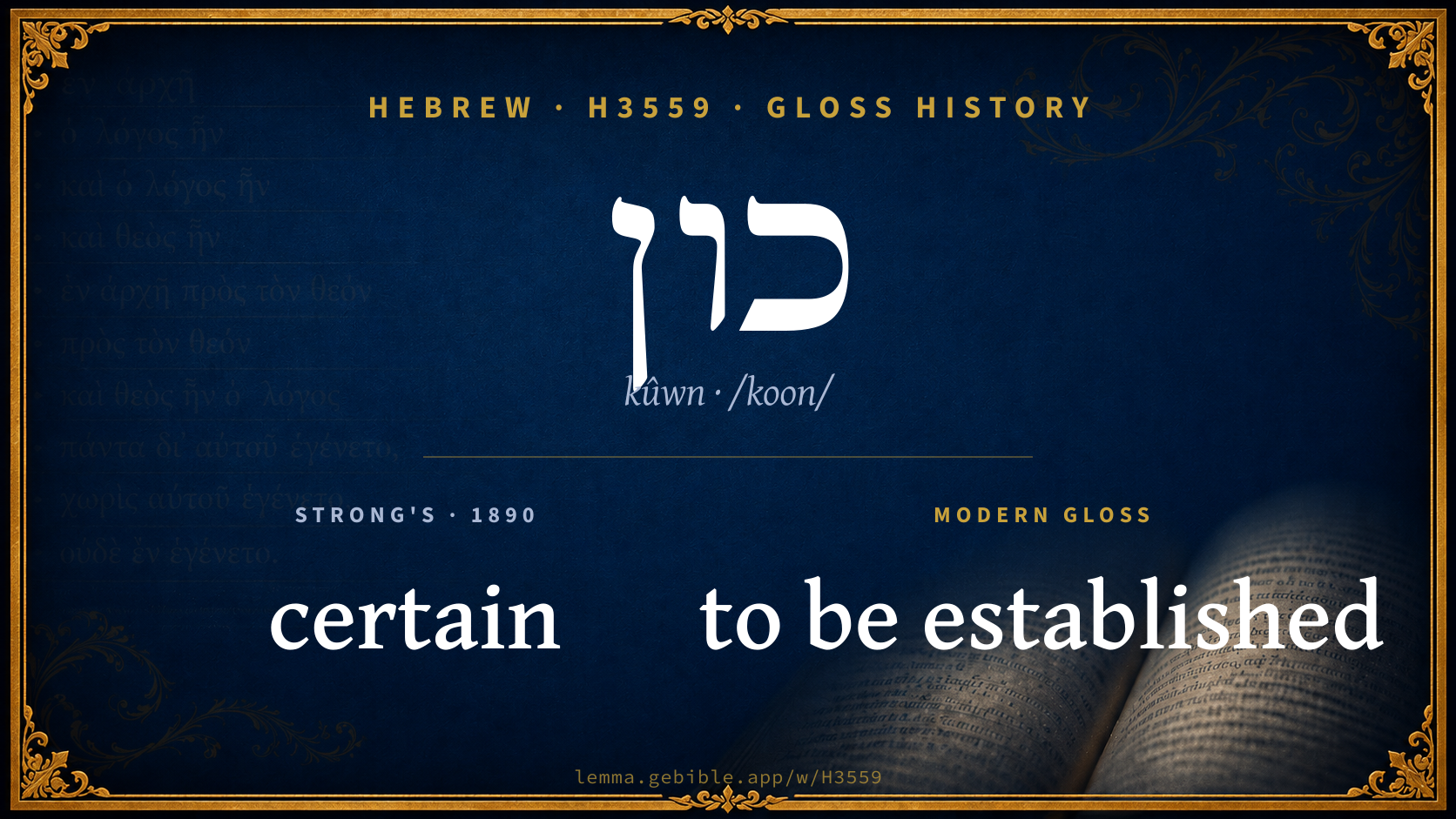
Gloss history
Strong's 1890 vs modern scholarship
About this word
Strong's H3559 catalogs a Hebrew word from the Hebrew Old Testament.
These counts are not copied from any lexicon or concordance. They are computed here, from the morphology-tagged Hebrew Old Testament. What Lemma adds →
- 211
- distinct verses
- The word appears in 211 distinct verses.
- 27 / 39
- OT books
- The word appears in 27 of 39 Old Testament books.
- #216
- by frequency
- Top 250 most frequent Hebrew words (rank 216 of 8,640 Hebrew words by occurrence).
View all 211 occurrences in the concordance →
Most concentrated in
- Psalms 49 verses 23%
- 2 Chronicles 25 verses 12%
- 1 Chronicles 22 verses 10%
By section of the Old Testament
By traditional corpus
Conventional, traditional groupings — biblical authorship is debated, so this is a traditional corpus grouping, not an authorship claim. Each share is this word’s portion of its verses in that division of the Hebrew canon. Each figure is a share of the word’s 211 distinct verses.
- Writings (Ketuvim) 136 verses · 64%
- Prophets (Nevi'im) 58 verses · 27%
- Torah (Pentateuch) 17 verses · 8%
How translations render this word
Counts come from each version’s own published word-to-Strong’s tagging or interlinear alignment — an approximate guide to how each version renders this word, not a word-level alignment the data otherwise carries. Because each total is that version’s own tagged count, the per-version totals vary from one another and need not match the appearance or distinct-verse counts above. These counts may also differ from a printed concordance because Lemma counts each distinctly tagged rendering and does not collapse phrase taggings into a single head-word total. This is a fixed set of word-tagged versions (KJV, ASV, BSB, ULT) and does not change with the reading translation you choose elsewhere. Each version’s license is shown beside its name below (and on Sources).
BDB lists this Strong’s number as 5 distinct words (homographs). Each count above pools all of them and is not split by sense — see the Senses section below. A low-frequency rendering may belong to a different one of those words, not the primary meaning.
- King James Version†: Prepare 17×, Shall be established 15×, Prepared 7×
- American Standard Version†: Shall be established 14×, Prepare 13×, Is established 9×
- Berean Standard Bible†: Prepare 13×, Established 11×, I will establish 7×
- unfoldingWord Literal Text†: And 13×, Prepare 13×, Prepared 13×
King James Version Public Domain
Renders H3559 across 219† tagged occurrences — most commonly:
Plus other, less common renderings. Plus 97 renderings that appear only once — usually multi-word phrases or single function words the recovered tagging swept in, not distinct renderings. Not rendered by a distinct English word in 2 further occurrences.
American Standard Version Public Domain
Renders H3559 across 220† tagged occurrences — most commonly:
Plus other, less common renderings. Plus 116 renderings that appear only once — usually multi-word phrases or single function words the recovered tagging swept in, not distinct renderings.
Berean Standard Bible Public Domain
Renders H3559 across 212† tagged occurrences — most commonly:
Plus other, less common renderings. Plus 111 renderings that appear only once — usually multi-word phrases or single function words the recovered tagging swept in, not distinct renderings. Not rendered by a distinct English word in 7 further occurrences.
unfoldingWord Literal Text CC BY-SA 4.0
Renders H3559 across 252† tagged occurrences — most commonly:
Plus other, less common renderings. Plus 94 renderings that appear only once — usually multi-word phrases or single function words the recovered tagging swept in, not distinct renderings.
29 senses and sub-senses in the full BDB
Hebrew verbs can shift meaning by stem (binyan): Qal is the basic action, Niphal is often passive or reflexive, Piel often intensifies or makes it factitive, and Hiphil is typically causative. The senses below are grouped under the stem BDB assigns to each. This entry also uses Hophal (the passive of Hiphil) and one or more reduplicated stems (the Pōlēl/Pilpēl type), which for hollow or geminate roots behave much like Piel — often intensive or iterative.
What do BDB’s symbols mean?
BDB uses these scholarly abbreviations:
| Symbol | Meaning |
|---|---|
| 𝔊 | the Septuagint (the ancient Greek translation, LXX) |
| 𝔙 | the Vulgate (the Latin translation) |
| 𝔖 | the Syriac version (the Peshitta) |
| 𝔗 | the Targum (the Aramaic translation) |
| ψ | the Psalms |
| √ | root (the underlying root or stem) |
| ‖ | parallel passage (a synonymous or contrasted parallel) |
| † | the dagger: every passage where the word occurs is cited |
The 29 senses and sub-senses the full Brown-Driver-Briggs lexicon distinguishes for this word, in lexicon order (not ranked by frequency), with BDB’s own verbatim wording and sub-sense lettering. Shown in Hebrew script with BDB’s own scholarly abbreviations. The condensed entry is in the Lexicon Entry tab. See also the Forms in the corpus table below.
כון I ob. be firm, only in der. conj. (NH Aramaic כּוּן, in der. conj., כִּיוֵּן arrange, direct
Niphal
- Pf. (on 3 ms. v. Pt. infr.), 2 fs. נָכ֫וֹנָה 1 K 2:46; 3 pl. נָכ֫וֹנוּ Pr 19:29; נָכֹ֫נוּ Ez 16:7; Impf. יִכּוֹן Pr 12:3 +; 3 fs. תִּכּוֹן Je 30:20 +; וַתִּכֹּן 1 K 2:12 2 Ch 8:16, etc.; Imv. חִכּוֹן Am 4:12; הִכֹּן Ez 38:7; pl. הכונוּ 2 Ch 35:4 Kt (Qr הָכִינוּ Hiph.); Pt. נָכוֹן Gn 41:32 + (in ψ 93:2 and perhaps elsewhere the Pf. would be poss.); cstr. נְכוֹן Pr 4:18; f. נְכוֹנָה ψ 5:10 + 2 times; pl. נְכֹנִים Ex 19:11 + 2 times; pass. or neut., and (less often) reflex.:— e.g. 1 Kings 2:46
- 1. be set up, established, fixed:
- a. lit., of house upon (עַל) pillars Ju 16:26, 29, so, in metaph., of temple-mt. Is 2:2 = Mi 4:1, עֲדָתוֹ Je 30:20; be firm, of breasts at puberty Ez 16:7; firmly established, of תֵּבֵל ψ 93:1 = 96:10 = 1 Ch 16:30; firm, i.e. a strong support, of י׳’s hand יָדִי תִּכּוֹן עִמּוֹ ψ 89:22 (‖ זְרוֹעִי תְאַמְּצֶנּוּ). e.g. Judges 16:26
- b. fig., of throne 2 S 7:16 = 1 Ch 17:14, 1 K 2:45 ψ 89:38; 93:2 Pr 16:12; 25:5; 29:14; of king, royal family, kingdom 1 S 20:31 1 K 2:12, 46 2 S 7:26 = 1 Ch 17:24. e.g. 2 Samuel 7:16
- c. of any persons, be established, stable, secure, enduring Jb 21:8 (c. לִפְנֵי) Pr 12:3, also v 19 (subj. שְׂפַת אֱמֶת), ψ 101:7 (c. לְנֶגֶד עֵינָ֑י), 102:29 (c. לְפָנֶיךָ), 140:12 (c. בָּאָרֶץ); of plans Pr 16:3; 20:18; נְכוֹן הַיּוֹם 4:18 the established, stable, (part) of the day, i.e. mid-day, when the sun seems motionless in mid-heaven.—2 S 6:6 v. נָכוֹן n.pr. infr. e.g. Job 21:8
- d. fixed, securely determined נ׳ הַדָּבָר מֵעִם הָאֱלֹהִים (‖ אֱמֶת) Gn 41:32 (E); so כְּשַׁחַר נָכוֹן מֹצָאוֹ Ho 6:3 MT, but read כְּשַׁחֲרֵנוּ כֵּן נִמְצָאֵהוּ Gie Beiträge 208 Wead loc.; substantiated, certain, of an allegation Dt 13:15 = 17:4; אֶל־נָכוֹן according to (what is) certain, = certainly, assuredly 1 S 23:23; 26:4 (v. Dr). e.g. Genesis 41:32
- 2. in moral sense, be directed aright, of ways Pr 4:26 ψ 119:5 (cf. Hiph. 3); be fixed aright, stedfast נָכוֹן לִבִּי ψ 57:8(×2); 108:2, so 112:7; לִבָּם לֹא נָכוֹן עִמּוֹ 78:37; רוּחַ נָכוֹן 51:12 (‖ לֵב טָהוֹר); לא נָכוֹן לעשׂות כן Ex 8:22 (J) is is not right, proper, etc.; pt. f. נְכוֹנָה as subst. = what is right, the right Jb 42:7, 8; = uprightness ψ 5:10. e.g. Proverbs 4:26
- 3. prepare, be ready, pers. Am 4:12 (c. ל inf.); words Pr 22:18; הִכֹּן וְהָכֵן לְךָ Ez 38:7; 2 Ch 35:4 Kt (Qr Hiph.); pt. as adj. = prepared, ready, often c. הָיָה, of persons Ex 19:11, 15; 34:2 Jos 8:4 (all JE); of things, sq. ל pers. Jb 12:5 Ne 8:10, ל loc. Jb 18:12, ל nom. act. ψ 38:18; ב loc. Jb 15:23; e.g. Amos 4:12
- 4. pass. be prepared, of judgments Pr 19:29 (ל pers.); of work be arranged, settled 2 Ch 8:16; fig. of prayer ψ 141:2 be arranged, set in order, as incense before thee (> present itself as incense); be arranged, ordered, of temple service 2 Ch 29:35; 35:10, 16. e.g. Proverbs 19:29
Hiphil
- Pf. הֵכִין Jos 4:4 +; sf. הֱכִינַנִי 1 K 2:24; הֱכִינוֹ 2 S 5:12 1 Ch 14:2; הֱכִינָהּ Jb 28:27; 2 ms. הֲכִינוֹתָ Jb 11:13 +; 3 pl. הֵכִינוּ 1 Ch 12:39 +; וְהֵכִינוּ consec. Ex 16:5; 1 pl. הֲכִינוֹנוּ 1 Ch 29:16; הֵכַנּוּ (Ges§ 72, R. 6) 2 Ch 29:19, etc. Impf. יָכִין Ju 12:6 +; וַיָּ֫כֶן 1 Ch 15:1 + 3 times etc.; Imv. הָכֵן Gn 43:16 +; pl. הָכִינוּ Jos 1:11 +; Inf. abs. הָכֵן Jos 3:17, so הָכִין 4:3 (read הָכֵרו, v. Di), Je 10:23 (v. Gie), Ez 7:14 (v. Sm Co and infr.; see on all Köni. 468); cstr. הָכִין Is 9:6 +; sf. הֲכִינוֹ Na 2:4 Pr 8:27; הֲכִינָתּ Je 33:2; Pt. מֵכִין Je 10:12 + 4 times;—(favourite word in Ch., in various applications) e.g. Joshua 4:4
- 1. establish, set up:
- a. king (or, one as king) 2 S 5:12 1 K 2:24 1 Ch 14:2, royal seed ψ 89:5, kingdom 1 S 13:13 2 S 7:12 = 1 Ch 17:11, 1 Ch 28:7 2 Ch 12:1; 17:5, throne ψ 103:19 1 Ch 22:10; the world תֵּבֵל Je 10:12 = 51:15; mts. ψ 65:7; heavens Pr 8:27; an altar upon (עַל) its base Ezr 3:3. e.g. 2 Samuel 5:12
- b. God’s faithfulness ψ 89:3; heart of humble 10:17. e.g. Psalms 89:3
- c. = accomplish, do Je 33:2 (‖ עשׂה), = make Is 40:20 Jb 28:27. e.g. Jeremiah 33:2
- d. make firm, only inf. abs., as adv. = firmly הָכֵן Jos 3:17; הָכִין 4:3 (v. supr.) e.g. Joshua 3:17
- 2.
- a. fix, so as to be ready, make ready, prepare, a gift Gn 43:25 (J), place Ex 23:20 (JE), 2 Ch 3:1; c. לְ rei 1 Ch 15:1, 3, also (obj. om.) v 12 (vid. Be, and DaSynt. § 144), 2 Ch 1:4 (בַּהֵכִין), v. Ges§ 138 i); often prepare food, acc. + לְ pers. Jos 1:11 (D), ψ 78:20; לְ om. Pr 6:8; 30:25; obj. om. 1 Ch 12:39 2 Ch 35:14(×2), 15; both om. Gn 43:16 (J), 1 Ch 9:32; prepare a road Dt 19:3, a sacrifice Zp 1:7, ambuscades Je 51:12, one’s work Pr 24:27, materials for (לְ) temple 1 Ch 22:3, 14, also v 14b (no לְ), 29:2, 3; weapons (c. לְ pers.) 2 Ch 26:14 and (hostile purpose) ψ 7:14, cf. 57:7, Is 14:21 prepare slaughter-place for (לְ) his children; store-rooms 2 Ch 31:11a, also v 11b (obj. om.); gallows (c. לְ pers.) Est 6:4; 7:10; corn (produce of land) ψ 65:10; land v 10, so (= restore) 68:11; persons (ל) 2 Ch 35:6; fig. of belly preparing deceit Jb 15:35; make preparation (for, לְ rei) 1 Ch 22:5, and v 5 (לְ om.); sq. לִבְנוֹת 1 Ch 28:2, c. acc. material + לִבְנוֹת 1 K 5:32 1 Ch 29:16; without לְ, make ready 1 S 23:22 Na 2:4; Ez 7:14 (read הָכִינוּ הָכֵן Co, for ה׳ הַכֹּל MT) = make full preparation! make thee ready! Je 46:14 (לְ dat. ethiopic), Ez 38:7 (id.), 2 Ch 35:4. e.g. Genesis 43:25
- b. provide for, provide, furnish Nu 23:1, 29; 29:7 Jos 4:4 (all JE), Jb 27:16, 17, food for (לְ) raven Jb 38:41, rain for (לְ) earth ψ 147:8; 1 Ch 29:19 2 Ch 2:6 ψ 74:16. e.g. Numbers 23:1
- 3. direct one’s face towards (אֶל־) Ez 4:3, 7; in moral and spiritual sense, direct one’s step (צַעֲדוֹ) = order aright, Je 10:23 (v. supr.), Pr 16:9, so (פְּעָמַי) ψ 119:133; הֵכִין דְּרָכָיו לִפְנֵי י׳ אֱלֹהָיו 2 Ch 27:6, also (sq. דרכיו only) Pr 21:29 Kt (Qr יָבִין); עַל הַהֵכִין הָאֱלֹהִים לָעָם 2 Ch 29:36 that which God had ordered aright for the people (on art. = pron. rel. v. Ges§ 138, 3, b); sq. לֵב Jb 11:13 ψ 78:8; + לְ, לֹא הֵכִין לִבּוֹ לִדְרוֹשׁ אֶת־י׳ 2 Ch 12:14, so 19:3; 30:19; + לִדְרוֹשׁ אֶת־תּוֹרַת י׳ Ezr 7:10; הכין לבב אֶל־י׳ 1 S 7:3 direct the heart towards י׳, 1 Ch 29:18 (י׳ subj.), so (c. לֵאלֹהִים) 2 Ch 20:33; hence (no obj. expr.) = give attention, sq. inf. Ju 12:6. e.g. Ezekiel 4:3
- 4. arrange, order 2 Ch 29:19 (of sacred vessels; + הִקְדַּשְׁנוּ), 35:20 (of temple). e.g. 2 Chronicles 29:19
Hophal
- Pf. הוּכַן Is 30:33, וְהוּכַן consec. Is 16:5 Zc 5:11; וְהֻכַן Na 2:6; Pt. מוּכָן Pr 21:31, pl. מוּכָנִים Ez 40:43;— e.g. Isaiah 30:33
- 1. be established, of throne Is 16:5; be fastened, of hooks Ez 40:43. e.g. Isaiah 16:5
- 2. be prepared for (לְ pers.) Is 30:33 and (לְ temp.) Pr 21:31; abs. Na 2:6; be ready Zc 5:11. e.g. Isaiah 30:33
Poʿlēl
- Pf. 3 ms. כּוֹנֵן ψ 9:8 + 3 times, וְכוֹנֵן consec. Hb 2:12; sf. כּוֹנְנָהּ Is 45:18; 2 ms. כּוֹנֲנְתָּ ψ 99:4; 119:90, כּוֹנָ֑נְתָּה ψ 8:4, etc.; Impf. 3 ms. יְכוֹנֵן Is 62:7; sf. וַיְכֹנְנֶ֑ךָ Dt 32:6, יְכוֹנְנֶהָ ψ 24:2 +, sf. 1 pl. וַיְכֻנֶנּוּ Jb 31:15 (וַיְכוּנֶּנוּ van d. H.); 2 ms. תְּכוֹנֵן ψ 7:10; 21:13, etc.; Imv. כּוֹנֵן Jb 8:8 (but on text v. infra), כּוֹנְנָה ψ 90:17, sf. כּוֹנְנֵהוּ ψ 90:17;—orig. make firm;— e.g. Psalms 9:8
- 1. set up, establish:
- a. of men, found, a city Hb 2:12 (‖ בנה), ψ 107:36. e.g. Habakkuk 2:12
- b. of God, establish, king’s throne 2 S 7:13 = 1 Ch 17:12, his own throne ψ 9:8 (לְמִשְׁפָּט), sanctuary Ex 15:17 (song), a nation Dt 32:6 (poem; ‖ קנה, עשׂה), a city ψ 48:9; 87:5 Is 62:7, תֵּבֵל ψ 24:2 (c. עַל, ‖ יָסַד), אֶרֶץ 119:90, cf. Is 45:18, also ψ 68:10 (obj. om., read perhaps אֶרֶץ צִיָּה Bi Che), heavens Pr 3:19 (‖ יָסַד־אָ֑רֶץ), moon and stars ψ 8:4; fig., steps of men 40:3, work of men’s hands 90:17(×2), justice 99:4; establish, i.e. vindicate and make secure to righteous (צַדִּיק) 7:10. e.g. 2 Samuel 7:13
- 2. constitute, make, a man (in womb) Jb 31:15 (‖ עשׂה), cf. ψ 119:73 (‖ id.); c. acc. + לְ rei + לְ pers. reflex. 2 S 7:24 thou hast made for thyself (לְךָ), thy people (אֶת־עַמְּךָ) Israel for thyself (לְךָ) into a people (לְעָם) for ever. e.g. Job 31:15
- 3. fix, so as to be ready, arrow upon (עַל) string ψ 11:2 so (חֵץ om.) ψ 21:13 (c. עַל־פְּנֵיהֶם), and poss. (חֵץ om.) Is 51:13 (Di Che al.; but dub., cf. Du; verse corrupt according to CheIntr. Is. 427), a bow ψ 7:13. e.g. Psalms 11:2
- 4. direct (sc. לֵב), sq. לְחֵקֶר Jb 8:8, i.e. give attention to (but no ‖ in Poʿl.; read perhaps בּוֹנֵן, cf. Dt 32:10 v. Ol Di). Poʿlal. Pf. be established: מי׳ מִצְעֲדֵי־גֶבֶר כּוֹנָ֑נוּ ψ 37:23 from י׳ are a man’s steps established; = be prepared כּוֹנָנ֑וּ Ez 28:13 but del. Co Da after A B 𝔖 al. Hithpoʿl. Impf.; be established, of house, 3 ms. יִתְכּוֹנָ֑ן Pr 24:3 (‖ יִבָּנֶה), of nation, 2 fs. תִּכּוֹנָ֑נִי (Ges§ 54. 2. b) Is 54:14; 3 fs. תִּכּוֹנֵן = be restored, of city Nu 21:27 (JE; ‖ תִּבָּנֶה); set oneself, take one’s stand 3 mpl. יִכּוֹנָ֑נוּ ψ 59:5. e.g. Job 8:8
כון II loc. city of Hadarezer (מִטִּבְחַת) וּמִכּוּן עָרֵי ה׳ 1 Ch 18
כון III m. only in גֹּרֶן נ׳ 2 S 6
כון IV [m.] = blow Jb 12
כון V m. v. sub כון, and v. כִּידֹן.
Senses from the full Brown-Driver-Briggs lexicon (Brown, Driver, Briggs; Oxford 1906 — public domain), digitized via Sefaria, supplemented by the OpenScriptures HebrewLexicon (CC BY 4.0). Full attribution on Sources.
Word origin
I. vb. prob. be firm, only in der. conj. (NH Aramaic כּוּן, in der. conj., כִּיוֵּן arrange, direct; ܟܰܘܶܢ put right, correct; Assyrian kânu, be firm, right DlHWB 321; Arabic كَانَ (med. و) exist, occur, be; so Ethiopic ኮነ Sab. כון DHM ZMG 1875, 599, Ph. כון be (often));—
II. n.pr.loc. city of Hadarezer (מִטִּבְחַת) וּמִכּוּן עָרֵי ה׳ 1 Ch 18:8, 𝔊 ἐκ τῶν ἐκλεκτῶν πολέ(μ)ων (= בֵּרֹתַי 2 S 8:8); = mod. Kuna, near Bereitan (betw. Laodicea and Heliopolis), according to FurrerZPV viii, 34, v. בֵּרוֹתָה p. 92 supr., and Thes.
I. n.pr.m. only in גֹּרֶן נ׳ 2 S 6:6; 𝔊 Νωδαβ, A Ναχων, 𝔊L Ορνα τοῦ Ἰεβουσαίου;=כִּידֹן 1 Ch 13:9.
II. n.[m.] = blow Jb 12:5 according to Schult Di Bu, but precarious; כון q.v.
III. n.pr.m. v. sub כון, and v. כִּידֹן.
— Brown-Driver-Briggs (Oxford 1906, public domain), digitized via Sefaria, supplemented by the OpenScriptures HebrewLexicon (CC BY 4.0). See Sources.
Origin: a primitive root
Jastrow Dictionary
A second Hebrew/Aramaic lexicon for comparison, covering Aramaic and post-biblical (Talmudic, Targumic, Midrashic) usage that the biblical-Hebrew BDB does not. Matched by lemma rather than by Strong’s number, so a lemma may carry more than one Jastrow headword (shown separately below), and the entries cover usage well beyond the Bible.
כּוּן
- (b. h.) to stand, exist, be firm.
- 1. to straighten. Sifré Deut. 308 מְכַוְּונוֹ במעגילה he tries to straighten the wood in a press; Yalk. Deut. 942 (not מכינן); Pesik. Zutr. Haăz. (ed. Bub. V, p. 111) נתנו לאומן שיְכַוְּונוֹ he gave it to a mechanic to straighten it.
- 2. to place in a line, direct. Macc. II, 5 (9ᵇ) מְכַוְּונִין להן דרך וכ׳ Ms. M. (ed. ומְכוּוָּנוֹת להן דרכים, v. infra) we make for them direct roads from one place of refuge to the other.
- 3. to determine exactly (place, time &c.). Y. Erub. V, 22ᶜ לְכַוֵּין את הרוחות how to determine exactly the four cardinal points (v. רָבַע). Ib. bot. הארון היה מְכַוֵּין וכ׳ the Ark indicated for them the points of the compass. Gen. R. s. 15, beg., v. כִּוּוּן. M. Kat. 10ᵃ אין יכול לכַוֵּין אימרא וכ׳ is unable to sew the fringe accurately on the bosom of the shirt. Ber. 7ᵃ לכַוֵּין אותה שעה to seize the opportunity of just that moment; a. fr.
- 4. (with לב or sub. לב) to direct or prepare one’s mind, to pay attention, to do a thing with an intention. Ber. II, 1 אם כ׳ לבו if he (while reading in the Law) had his mind directed (to the Sh’ma); ib. 13ᵃ אם כ׳ לבו לקרות it means, he read with attention (to the sense, not merely like one going over the text for correction). R. Hash. 28ᵇ כ׳ לבו לצאת he had the intention of complying with the law (v. יָצָא); opp. (כ׳) לשמוע he directed his attention to listening, i.e. heard the sound with consciousness (but without devotion); v. כַּוָּונָה. Ber. V, 1 היו שוהין … כדי שיְכַוְּונוּ לבם וכ׳ tarried a while before prayer, in order to direct their hearts to their Father in heaven. Y. ib. II, 5ᵃ חזקה כִּוֵּין the presumption is that he read with attention; a. fr.—Part. pass. מְכוּוָּן, f. מְכוּוָּנָה, מְכוּוֶּנֶת; pl. מְכוּוָּנִים, … נִין; מְכוּוָּנוֹת a) in a line, corresponding. Y. Kil. V, beg. 30ᵇ עריס המכ׳ a straight bed of vines, opp. מעוקם. Ib. מכ׳ הן they (the vines) are in a straight line. Y. Ber. IV, 8ᶜ top בית … מ׳ כנגד … של מעלן the situation of the earthly Holy of Holies corresponds with that of the heavenly &c. Macc. II, 5 ומכוונות להן דרכים (not … נת), v. supra. Ib. 9ᵇ ומכוונות היו כמין וכ׳ (Ms. M. ומכוונין הן) and they (the three towns on this side and those on the other side of the Jordan respectively) were in straight parallel lines like two rows in a vineyard; a. fr.—b) exact, precise. Toh. III, 1 sq. כביצה מ׳ exactly the quantity of an egg. Mikv. VII, 6; Ḥag. 19ᵃ; Gitt. 16ᵃ
- to put in proper position, to prepare; to hold ready, to designate. Bets. 2ᵇ (ref. to Ex. XVI, 5) חול מֵכִין לשבתוכ׳ a week day prepares for the Sabbath (that which has become ready for use on a week day may be used on the Sabbath), but a Holy Day does not prepare for the succeeding Sabbath, ואין שבת מֵכִינָה ליו"ט nor can the Sabbath prepare for a succeeding Holy Day, v. הֲכָנָה.—Meg. 12ᵇ (play on ממוכן, Esth. I, 14) כלום הֵכִינוּ וכ׳ have they (the Persians) arranged a table before thee?; Esth. R. to l. c. מי מֵכִין וכ׳ who arranges an altar &c.?; a. fr.—[Tosef. Maasr. I, 4 משיכינו ed. Zuck., Var. משייבינו, read: משיניצו.]—Part. pass. מוּכָן prepared, designated, ready. Bets. I, 2 עפר מ׳ מבעוד יום dust (for covering the blood) made ready a day before. Ib. אפר כירה מ׳ הוא ashes of the stove are considered ready (destined to be used for the purpose). Ib. III, 4 אין זה מן המ׳ this is not among the things designated for use on the Holy Day. Ib. IV, 6.—Meg. l. c. (play on ממוכן, v. supra) שמ׳ לפורענות he was ready for evil; a. fr. e.g. Exodus 16:5
- 1. to be made straight, to be remedied (cmp. תכן). Pesik. Zutr. l. c. אין אתם מִתְכַּוְּונִים אלא באור you (your crookedness) can be remedied only through fire; Sifré Deut. l. c. אין אתם הולכים אלא לאור; Yalk. Deut. l. c. הולכין אלא לאחור (corr. acc.).
- 2. to prepare one’s self. Y. Meg. I, 71ᶜ (ref. to הִכּוֹן, Am. IV, 12) הִתְכַּוֵּון לקראת וכ׳ put thyself in proper condition to meet thy God. e.g. Amos 4:12
- 3. to intend, propose. B. Kam. VIII, 1 עד שיהא מִתְכַּ יֵן unless he did it with malicious intent. Tosef. Naz. III, 10 לא נִתְכַּוַּונְתִּי אלא כמותה my intention was to be exactly like her (as to her vow). Ib. 14 מי שנ׳ לעלות וכ׳ if he who had the intention to eat the flesh of swine &c.; v. עָלָה. Sabb. 22ᵃ ובלבד שלא יִתְכַּוֵּין וכ׳ provided he has not the intention of making a groove.—Bets. 23ᵃ, a. fr. דבר שאינו מִתְכַּ׳ a forbidden act which was produced without intent, i.e. an unintended but unavoidable effect of a permitted act. R. Hash. 28ᵇ. Pes. 53ᵇ, a. fr. שניהם … נִתְכַּוְּונוּ both meant the same thing; a. fr.
- to establish, base firmly. Ex. R. s. 15 מבקש לְכוֹנֵן עולמים wanted to establish worlds. Ib. על אלו אני מְכוֹנֵן וכ׳ upon those (the patriarchs) I will establish the world.—Part. pass. מְכוֹנָן, f. מְבוֹנֶנֶת. Midr. Sam. ch. XVI (ref. to הכינני, I Kings II, 24) בזכות התורה המ׳ בארון (the world exists) for the sake of the Law that is put up straight in the holy Ark. e.g. 1 Kings 2:24
כּוּן ²
- ; Pa. כַּוֵּון
- 1. to direct, aim, draw a direct line. Targ. Y. Num. XXII, 23. Targ. Num. XXXIV, 7, sq. (h. text תאה). Targ. Y. Deut. X, 5 וכוונית (h. text פנה). Ib. XIX, 3 (h. text תכין, v. preced.); a. e.
- 2. to draw a parallel, compare. Targ. Is. XLVI, 5 (h. text תמשילני).
- 3. (with דעתא, or sub. דעתא) to direct the mind, to pay attention; to do a thing intentionally. Targ. Y. Num. XI, 1 מכ׳ והגיאן ביש intentionally speaking evil.—Ber. 17ᵇ לא מצי לְכַוּוּנֵי דעתיה he cannot collect his mind (for prayer). Ib. 30ᵇ מעיקרא לא כ׳ וכ׳ the first time he read without attention. Ḥull. 31ᵃ דלא קָמְכַוֵּין (or קָמִכַּוֵּין Ithpa.) when he had no intention whatever (to cut); a. fr.—Part. pass. מְכַוַּון a) directed towards, corresponding. Targ. Ez. I, 9. Targ. Ex. XXVI, 5; a. fr.—b) straight, firm, upright. Targ. Job XXI, 8 מְכַוְּונִין Bxt. (Ms. מְכַוְּונַן; ed. מכוין, מְכַוַּון, corr. acc.; h. text נכון). Targ. Ps. LI, 12. Ib. LVII, 8 (ed. Wil. מכוֵן, corr. acc.); a. fr.—Yoma 28ᵇ לא מְכַוְּונֵי Ms. M. (ed. לא מ׳ טובא) the Temple walls were not exactly straight (the lower portions being thicker than the upper); [Ms. M. 2 משום דמכווני because the walls were exactly built in correspondence with the points of the compass]. Y. Snh. IV, beg. 22ᵃ; III, 21ᶜ top [read:] כד הוא חמי סהדו מכַוְּונָא … הכן והכן מְכַוֵּון when he found evidences (of two) exactly corresponding, he cross-examined; but when he found them turning hither and thither (differing in details), he tried to harmonize (allowing for errors in time &c., v. חֲקִירָה).
- , כַּוֵּין …
- 1. to place one’s self, to stand. Targ. Ps. CI, 7.
- 2. to be precise in doing. Ib. XC, 12 מן יִתְכַּ׳ להודע ed. Lag. (oth. ed. כן, corr. acc.) who can exactly make known? (h. text כן הודע). Targ. Y. Lev. XIII, 12.
- 3. to be trained, to be in the habit of. Targ. Y. Num. XXII, 30 (h. text הסכן).
- 4. to intend, mean. Ib. XXX, 5 ויתכ׳ וישתוק and keeps silence intentionally. Targ. Y. Deut. XIX, 4; a. e.—Ḥull. 95ᵃ דאיכ׳ לצעורי׳ וכ׳ who meant to vex his neighbor. Ib. 31ᵃ מִיכַּוֵּין לשום חתיכה had the intention merely to cut (not to slaughter according to the ritual, v. זְבִיחָה). Ib. מה כלים דלא מִיכַּוְּונֵי וכ׳ as vessels (lifeless things) which have no thought &c.; a. e.
- to be prepared, ready (מוּכָן, v. preced.). Ib. 14ᵃ כיון דלא א׳ וכ׳ because it was not prepared (designated for use) yesterday.—V. תכן.
כֵּוָן
- , v. sub כֵּיוָ׳.
A Dictionary of the Targumim, the Talmud Babli and Yerushalmi, and the Midrashic Literature (Marcus Jastrow; London, Luzac, 1903) — Public Domain. Digitized via Sefaria. Digitized via Sefaria. Full attribution on Sources.
Forms in the corpus
The 165 distinct written forms H3559 takes in the Hebrew Bible, most frequent first — each parse links to that stem’s occurrences in the concordance. Hebrew forms include their vowel points and cantillation, so a single lemma takes many written forms.
The 60 most common forms are shown; 105 rarer forms follow in the full concordance.
Same root — word family
Other BDB entries built from the same root as H3559, grouped by Strong’s listed origin. These share a root / origin per the lexicon — not necessarily a shared meaning. Each links to that word’s own entry.
Derived from this word
Proper names from this root
People and places named from this root — a name, not an additional meaning of the word.
- יכין Yâkîyn H3199 Jachin
- יכניה Yᵉkonyâh H3204 Jeconiah
- כון Kûwn H3560 Chun
- כונניהו Kôwnanyâhûw H3562 Cononiah
- כיון Kîyûwn H3594 Chiun
- נכון Nâkôwn H5225 Nachon
Compare all same-root words → Showing 4 of 11 — not the complete family. 6 of the same-root words are proper names (people or places). They share a root, not necessarily a meaning.
Septuagint verse parallels
This word appears in 195 verses that also exist in the Greek Old Testament (Septuagint), out of the 211 Hebrew verses it occurs in. You can read those verses in Greek by switching the Old Testament edition to the Septuagint.
Read these verses in the Septuagint
- Genesis 41:32
- Exodus 8:26
- Numbers 21:27
- Deuteronomy 13:14
- Joshua 1:11
- Judges 12:6
- 1 Samuel 7:3
- 2 Samuel 5:12
- 1 Kings 2:12
- 1 Chronicles 9:32
- 2 Chronicles 1:4
- Ezra 3:3
This is a verse-level parallel only — the same verses exist in both the Hebrew and Greek Old Testaments. No word-level Hebrew↔Greek correspondence is claimed: the data carries no such alignment, so no Greek word is shown as this Hebrew word’s translation. Coverage is not total — the Septuagint omits the deuterocanon and renumbers the Psalms, so some Hebrew verses have no direct Greek parallel.