1 Chronicles 17:14

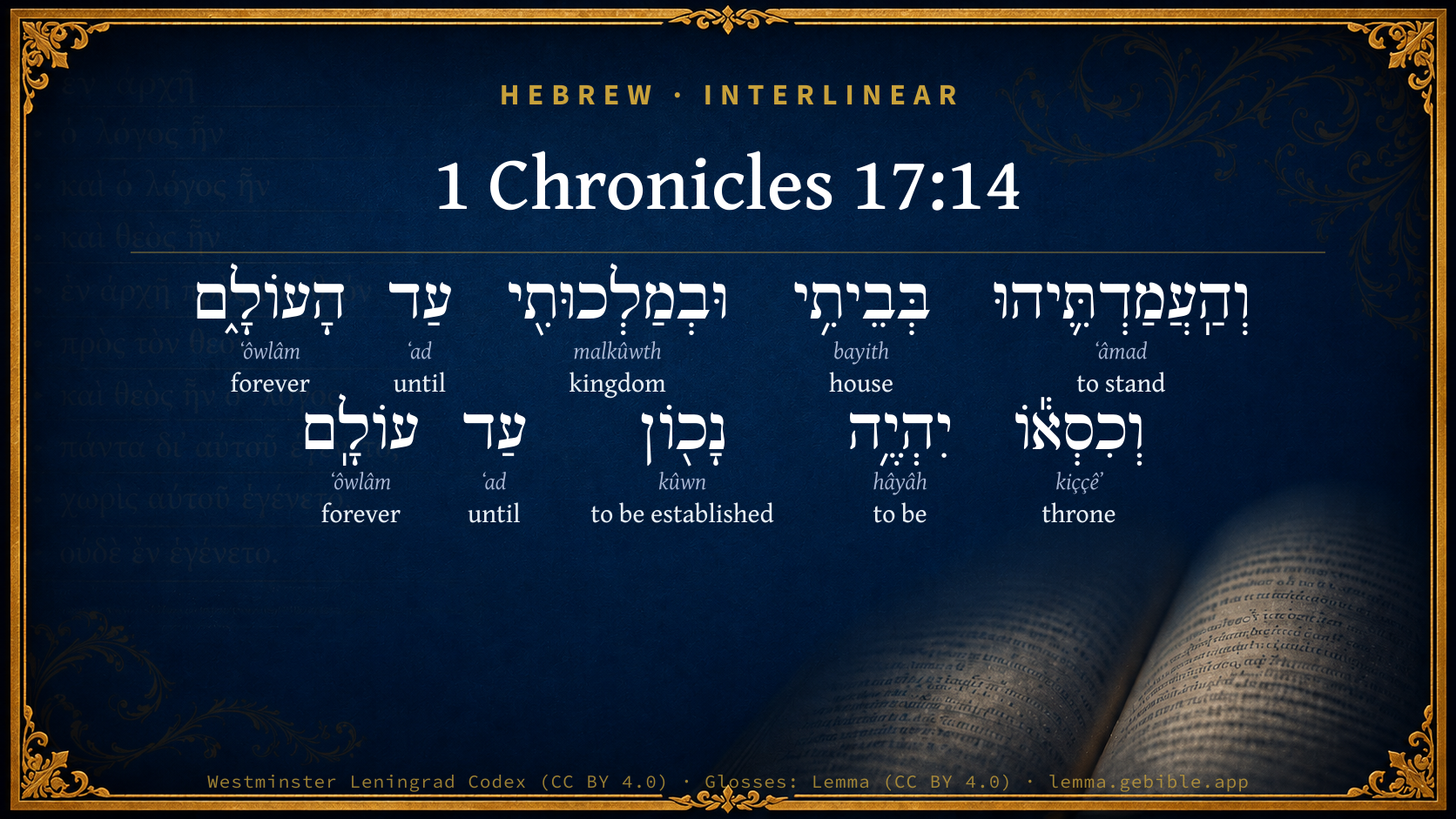
Hebrew (Westminster Leningrad Codex) 1 Chronicles 17:14 appears in the Hebrew Old Testament. The text above is from the Westminster Leningrad Codex. Each word links to its Strong’s number, a concise gloss, and parsing drawn from the Open Scriptures Hebrew Bible morphology. Click any word for its full Brown-Driver-Briggs (BDB) entry.
Download image
Cite this verse

1 Chronicles 17:14 (World English Bible). Public Domain. Lemma interlinear Bible study tool, https://lemma.gebible.app/v/1-chronicles/17/14.

Show BibTeX & RIS
BibTeX
RIS
English Translation
but I will settle him in my house and in my kingdom forever; and his throne shall be established forever.
World English Bible · Public Domain
Download a study sheet

One document with this verse’s original text, its word-by-word gloss line, the meaning frame, cross-references with their text, attributed commentary, and full source and license credits — printable, and it pastes into notes with its structure intact.

This verse Autodidact and up

Study sheet (.html) Plain text (.txt)

A passage Seminary Student

Up to 50 verses in one chapter. A passage sheet keeps up to 6 commentary sources and 12 cross-references per verse, in the order this page ranks them, and says so on the sheet whenever that leaves anything out. Ask for a single verse and you get the Autodidact verse sheet above.

Everything on this page stays free to read, with no account — the sheet is a download of what is already on screen, not access to it.

Want to remove ads? Support Godless Engineer
Compare translations 3

The same verse in 3 English versions, stacked beneath the original-language interlinear above. Click any original word for its lexicon entry.

Each is an independent rendering of the whole verse — the interlinear is not word-aligned to these translations.

Highlighted words mark where these versions differ — a whole-verse word diff, not a word-by-word alignment.

  • World English Bible Public Domain
    but I will settle him in my house and in my kingdom forever; and his throne shall be established forever.
  • King James Version Public Domain
    But I will settle him in mine house and in my kingdom for ever: and his throne shall be established for evermore.
  • unfoldingWord Literal Text CC BY-SA 4.0
    And I will station him in my house and in my kingdom to forever, and his throne will be established to forever.’”

unfoldingWord Literal Text — © unfoldingWord, licensed CC BY-SA 4.0. Word-aligned USFM3 via Door43 (git.door43.org/unfoldingWord/en_ult).

Versions to compare (up to 4)

3 of 4 selected

Show all 18 translations

Every available English version of this verse, each an independent rendering of the whole verse.

  • World English Bible Public Domain
    but I will settle him in my house and in my kingdom forever; and his throne shall be established forever.
  • Berean Standard Bible Public Domain
    But I will set him over My house and My kingdom forever, and his throne will be established forever.”
  • Majority Standard Bible Public Domain
    But I will set him over My house and My kingdom forever, and his throne will be established forever.”
  • King James Version Public Domain
    But I will settle him in mine house and in my kingdom for ever: and his throne shall be established for evermore.
  • American Standard Version (1901) Public Domain
    but I will settle him in my house and in my kingdom for ever; and his throne shall be established for ever.
  • Revised Version (1885) Public Domain
    but I will settle him in mine house and in my kingdom for ever: and his throne shall be established for ever.
  • Geneva Bible (1599) Public Domain
    But I wil establish him in mine house, and in my kingdome for euer, and his throne shalbe stablished for euer,
  • Douay-Rheims (1899) Public Domain
    But I will settle him in my house, and in my kingdom for ever: and his throne shall be most firm for ever.
  • Young's Literal Translation Public Domain
    and I have established him in My house, and in My kingdom unto the age, and his throne is established unto the age.'
  • Literal Standard Version CC BY-SA 4.0
    and I have established him in My house, and in My kingdom for all time, and his throne is established for all time.”
  • Unlocked Literal Bible CC BY-SA 4.0
    I will set him over my house and in my kingdom forever, and his throne will be established forever.'”
  • unfoldingWord Literal Text CC BY-SA 4.0
    And I will station him in my house and in my kingdom to forever, and his throne will be established to forever.’”
  • Darby Bible Public Domain
    and I will settle him in my house and in my kingdom for ever; and his throne shall be established for ever.
  • World Messianic Bible Public Domain
    but I will settle him in my house and in my kingdom forever. His throne will be established forever.”’”
  • Webster's Bible Public Domain
    But I will settle him in my house and in my kingdom for ever: and his throne shall be established for evermore.
  • Free Bible Version CC BY-SA 4.0
    I will put him in charge of my house and my kingdom forever, and his dynasty will last forever.”
  • Bible in Basic English Public Domain
    But I will make his place in my house and in my kingdom certain for ever; and the seat of his authority will never be overturned.
  • JPS Tanakh (1917) Public Domain
    but I will settle him in My house and in My kingdom for ever; and his throne shall be established for ever.'

Literal Standard Version (2020), Covenant Press — licensed CC BY-SA 4.0. Text via the HelloAO Bible API (eBible.org). Unlocked Literal Bible (unfoldingWord) — licensed CC BY-SA 4.0. Text via the HelloAO Bible API (eBible.org). unfoldingWord Literal Text — © unfoldingWord, licensed CC BY-SA 4.0. Word-aligned USFM3 via Door43 (git.door43.org/unfoldingWord/en_ult). Free Bible Version, Dr. Jonathan Gallagher — licensed CC BY-SA 4.0. Text via the HelloAO Bible API (eBible.org).

Word by word

More ways to search: Search by grammar → Find every occurrence → Compare this word →

Practice this passage: Drill this verse → Learn its vocabulary →

וּבְמַלְכוּתִ֖י
malkûwth
H4438
“and · in/at · kingdom · my”
Conjunction + Preposition + Noun, Common, Feminine, Singular, Construct + Suffix, Personal, 1st Person, Common, Singular
Part of Speech
Conjunction + Preposition + Noun
Type
Common
Gender
Feminine
Number
Singular
State
Construct
Full BDB Definition

Origin: from H4427

TWOT: 1199e

royalty, royal power, reign, kingdom, sovereign power - royal power, dominion - reign - kingdom, realm
  1. וְהַֽעֲמַדְתִּ֛יהוּ ʻâmad H5975 “and · to stand · him” Conjunction + Verb, Hiphil, Sequential Perfect, 1st Person, Common, Singular + Suffix, Personal, 3rd Person, Masculine, Singular
  2. בְּבֵיתִ֥י bayith H1004 “in/at · house · my” Preposition + Noun, Common, Masculine, Singular, Construct + Suffix, Personal, 1st Person, Common, Singular
  3. עַד ʻad H5704 “until” Preposition
  4. הָעוֹלָ֑ם ʻôwlâm H5769 “the · forever” Particle, Definite Article + Noun, Common, Masculine, Singular, Absolute
  5. וְכִסְא֕וֹ kiççêʼ H3678 “and · throne · his” Conjunction + Noun, Common, Masculine, Singular, Construct + Suffix, Personal, 3rd Person, Masculine, Singular
  6. יִהְיֶ֥ה hâyâh H1961 “to be” Verb, Qal, Imperfect, 3rd Person, Masculine, Singular
  7. נָכ֖וֹן kûwn H3559 “being established” Verb, Niphal, Participle Active, Masculine, Singular, Absolute
  8. עַד ʻad H5704 “until” Preposition
  9. עוֹלָֽם ʻôwlâm H5769 “forever” Noun, Common, Masculine, Singular, Absolute

About this verse

These counts appear in no published source. They are computed here, from the morphology-tagged text and Lemma’s own curated glosses. What Lemma adds →

10
words
8
distinct lemmas
Historical
section

Grammatical profile

  • 3 verbs
  • 5 nouns
  • 2 prepositions

Verb forms

  • וְהַֽעֲמַדְתִּ֛יהוּ Hiphil · Sequential Perfect
  • יִהְיֶ֥ה Qal · Imperfect
  • נָכ֖וֹן Niphal · Participle Active

Repetition

Words recur within this verse — often emphatic in Hebrew:

  • עַד until H5704 ×2
  • הָעוֹלָ֑ם forever H5769 ×2

Hebrew & Septuagint length

In English translation the verse runs 20 words from the Hebrew and 23 from the Septuagint (LXX English) — closely comparable.

A rough comparison of the two English renderings, which tokenize alike — not a word-level alignment.

Word counts can differ between the Hebrew and the Greek without any difference in meaning — e.g. the Hebrew direct-object marker אֵת has no separate Greek word, and Greek often adds the article ὁ.

Cross-references

5

Topical passages linked to 1 Chronicles 17:14 in the Treasury of Scripture Knowledge — connected by theme and wording, ordered by reader-vote popularity; previews shown in the World English Bible.

  • Psalms 89:36 His seed will endure forever, His throne like the sun before me.
  • Psalms 72:17 His name endures forever. His name continues as long as the sun. Men shall be blessed by him. All nations will call him blessed.
  • Luke 1:32–33 He will be great, and will be called the Son of the Most High. The Lord God will give him the throne of his father, David,
  • Hebrews 3:6 but Christ is faithful as a Son over his house; whose house we are, if we hold fast our confidence and the glorying of our hope firm to the end.
  • Psalms 2:6 "Yet I have set my king on my holy hill of Zion."

Cross-references courtesy of OpenBible.info (CC BY 4.0).

Hebrew and Greek witnesses Masoretic Hebrew ↔ Greek Septuagint

The same verse in the two great witnesses to the Old Testament, shown verse-for-verse.

These are two independent witnesses, not word-aligned to each other, and the Septuagint is shown in lemma (dictionary) form.

Hebrew 1 Chronicles 17:14 Masoretic · Westminster Leningrad Codex

וְהַֽעֲמַדְתִּ֛יהוּ בְּבֵיתִ֥י וּבְמַלְכוּתִ֖י עַד הָעוֹלָ֑ם וְכִסְא֕וֹ יִהְיֶ֥ה נָכ֖וֹן עַד עוֹלָֽם

but I will settle him in my house and in my kingdom forever; and his throne shall be established forever.

World English Bible · Public Domain

Greek LXX 1 Chronicles 17:14 Septuagint · lemma form

καί πιστόω αὐτός ἐν οἶκος ἐγώ καί ἐν βασιλεία αὐτός ἕως αἰών καί ὁ θρόνος αὐτός εἰμί ἀναὀρθόω ἕως αἰών

And I will establish him in my house and in his kingdom for ever; and his throne shall be set up for ever.

LXX2012 (modern English Septuagint) · Public Domain

On this verse, Ellicott's Commentary for English Readers discusses the Septuagint’s reading. Read the note in Commentary ↓

Hebrew: Westminster Leningrad Codex (CC BY 4.0). Greek: Septuagint (public domain); English from LXX2012 (modern English Septuagint) (Public Domain). How the Septuagint differs from the Hebrew →

Commentary

Notes on 1 Chronicles 17:14 from classic Christian and Jewish commentators (each source and its license shown beneath its notes). The classic Christian expositions comment on the surrounding passage and are grouped to its opening verse, so a note may address several verses; the Jewish commentaries on the Tanakh (Rashi and others) are per-verse, so they appear only where the commentator wrote on this verse.

Lemma curates 59 commentaries, every one of them public domain or Creative Commons licensed, each selected and text-cleaned for this edition rather than reprinted as found. About our sources →

The Biblical Illustrator

Joseph S. Exell

1Ch_17:14

But I will settle him in Mine house and in My kingdom for ever.

The everlasting establishment

I. First of all, let us offer a word or two upon the kingdom. Much is written in Scripture about kingdoms and empires.

1. That the house or the kingdom which Jehovah claims as His own is a kingdom which originated with the Lord. It rose not up in the mind of mortals first. It grew not up of Natures materials. It was not brought forth, and set up, and established, by the arm of man, or by the conquests of warriors, as many other kingdoms are. It originated in the wisdom, grace, and power of the Most High. Moreover, not only does this kingdom originate with Him, but it is so formed and constituted as to glorify the Lord. My glory, saith Jehovah, will I not give to another, neither My praise to graven images. In the formation and constitution of the kingdom which God calls His own--Mine house and My kingdom--the subjects are a royal seed; of royal blood; of royal birth; kings and priests unto God. My hearer, of what kingdom art thou? If thou art not of the kingdom of Gods grace, thou art of the kingdom of darkness, a slave of Satan, and on the highroad to destruction.

2. Yet further observe, the laws are immutable.

3. Then further, I notice the privileges, the high spiritual privileges of the kingdom. Pardon, peace, joy in the Holy Ghost.

II. I come to the investiture of the king.

I will settle him in Mine house and in My kingdom. Solomon was settled for a time, and reigned long and peacefully over Israel; but he is not reigning now. A greater than Solomon is here. He is invested with sovereignty, absolute and universal: I will settle Him in My kingdom. He is invested with sovereignty, absolute and universal. I have set My King upon My holy hill of Zion. I will declare the decree: the Lord has said unto Me, Thou art My Son, this day have I begotten Thee. Ask of Me, and I shall give Thee the heathen for Thine inheritance and uttermost parts of the earth for Thy possession. Moreover, if we speak of His absolute sovereignty for a moment, you know it is written expressly, that none can stay His hand, or say unto Him, What doest Thou?

III. This national establishment; for there is that word in my text--establish. There is a great deal said in Scripture about establishment. Immutable decrees are the basis of the establishment. Oh! I could bring out some twenty or thirty instances under my own notice in which all the schemes and powers and efforts of men have passed by; and God, in a moment and by a word, through some of His sent servants, has accomplished it all.

IV. The glorious perpetuity--I will settle Him in Mine house and in My kingdom for ever; and His throne shall be established for evermore. (Joseph Irons.)

The Biblical Illustrator, edited by Joseph S. Exell (c. 1880s–1900s) — public domain. Text from a community e-Sword module.

Joseph Benson's Commentary

1Ch 17:14. I will settle him in my house — In my dwelling-place, 1st, In Jerusalem, the place where God had put his name for ever; or, 2d, In the temple, which is more properly and constantly called God’s house; and so this expression agrees but very imperfectly with Solomon or his successors; who might, indeed, be said to be settled in God’s house, because they dwelt near it, and, in some sort, were set over it; and because they were to take care that the priests and others should perform their offices, and God’s service in it; but, strictly and properly, it agrees only to Christ, to whom alone that promise also of an everlasting establishment in this kingdom belongs, as was observed on 2Sa 7:16. And this expression seems to be most emphatically added to signify that the person in whom all those promises should be fully and perfectly accomplished, namely, the Messiah, should be settled not only in the king’s throne, as others of David’s successors were, but also in God’s house or temple; and consequently that he should be a priest as well as a king; which mystery was clearly revealed to David, Psa 110:1-2; Psa 110:4, and may be intimated, though obscurely, in these words. And in my kingdom — Either, 1st, In the kingdom of Israel, which God calls his kingdom, because he was, in a special manner, the king and governor of it, having raised them up and formed them into a kingdom, and given them that protection and assistance which kings owe to their kingdoms; and because he expected and required from them what kings do from their people, that they should be wholly governed by his laws, and devoted to his service. Or, 2d, In God’s kingdom, in a more large and general sense. And this, as well as the former phrase, may seem singularly to belong to the Messiah, who was not only to be the king of Israel, but also of all nations, as was foretold even in the Old Testament, in sundry passages; and, thus understood, this may be an intimation of that great mystery, which is more fully revealed in the New Testament, namely, that Christ is the head, king, or governor of all God’s church, consisting of Jews and Gentiles, and of all nations, and indeed of all creatures, the angels not excepted; all which is God’s kingdom, and by him given to his Son, our blessed Lord Jesus Christ.

Joseph Benson's Commentary on the Old and New Testaments (1811–1818) — public domain. Text from a community e-Sword module.

Tyndale Open Study Notes

Tyndale Open Resources

17:14 In the parallel at 2 Sam 7:16, God promises to establish David’s house, kingdom, and throne, whereas here it is Solomon’s. While the books of Samuel and Kings cast David as Israel’s ideal king, the Chronicler views Solomon as David’s equal. David made all the preparations for building the Temple, but God designated Solomon as the Temple builder. The promise to Israel was secured in the combined reigns of David and Solomon.

Tyndale Open Study Notes — © Tyndale Open Resources, licensed CC BY-SA 4.0. Text via the HelloAO Bible API.

Jamieson, Fausset & Brown

Robert Jamieson, A. R. Fausset & David Brown

I will settle him in my house--over My people Israel.

and in my kingdom for ever--God here asserts His right of supreme sovereignty in Israel. David and Solomon, with their successors, were only the vicegerents whom He nominated, or, in His providence, permitted.

his throne shall be established for evermore--The posterity of David inherited the throne in a long succession--but not always. In such a connection as this, the phrase "for evermore" is employed in a restricted sense (see on Lam 3:31). We naturally expect the prophet to revert to David before concluding, after having spoken (Ch1 17:12) of the building of Solomon's temple. The promise that his house should be blessed was intended as a compensation for the disappointment of his wish to build the temple, and hence this assurance is appropriately repeated at the conclusion of the prophet's address [BERTHEAU].

Jamieson, Fausset & Brown — Commentary Critical and Explanatory on the Whole Bible (1871) — public domain (CC PDM 1.0). Text via the HelloAO Bible API.

Ellicott's Commentary for English Readers

(14) But I will settle him (Heb., make him stand) in mine house and in my kingdom.—Samuel, “and thine house and thy kingdom shall be maintained for ever before thee; thy throne,” &c.; where, however, the LXX. and Syriac have “before me,” which agrees. better with our text. The change of persons in our verse brings out more clearly the theocratic nature of the Davidic kingdom. Solomon and his successors were to reign as vicegerents of Jehovah.

A Bible Commentary for English Readers, edited by Charles John Ellicott (1878–1897) — public domain. Text from a community e-Sword module.

The Cambridge Bible for Schools and Colleges

gen. ed. J. J. S. Perowne

14. I will settle him in mine house and in my kingdom for ever] Sam. And thine house and thy kingdom shall be established for ever before thee.

in mine house] Num_12:7; cp. 1Ti_3:15.

The Cambridge Bible for Schools and Colleges (gen. ed. J. J. S. Perowne; Cambridge University Press, 1878–1918) — public domain. Text from a community e-Sword module.

Matthew Poole's English Annotations

In mine house; in my dwelling-place; either,

1. In Jerusalem, the place where God had put his name for ever, 2Ki 21:4,7; 2Ch 6:5,6; compare 1Ki 11:36; 15:4. Or,

2. In the temple, which is more properly and constantly called God’s house; and so this expression agrees but very imperfectly with Solomon, or his successors, who might be said to be settled in God’s house, because they were settled near it, and in some sort set over it, because they were to take care that the priests and others should perform their offices and God’s service in it; but strictly and properly agrees only to Christ, to whom alone that promise also of an everlasting establishment in this kingdom belongs, as was noted on 2Sa 7. And this expression seems to be most emphatically added, to signify that that person in whom all those promises should be fully and perfectly accomplished, to wit, the Messias, should be settled not only in the king’s throne, as others of David’s successors were, but also in God’s house or temple; and consequently, that he should be a Priest as well as a King; which mystery was more clearly revealed to David, Psa 110:1,2,4, and may be intimated, though obscurely, (as was fit and usual in that state of the church,) in these words.

In my kingdom; either,

1. In the kingdom of Israel, which God calls his kingdom, because he was in a special manner their King and Governor, having raised them up and formed them into a kingdom, and given them that protection and assistance which kings owe to their kingdoms; and because he expected and required from them what kings do from their people, that they should be wholly governed by his laws, and devoted to his service. Or,

2. In God’s kingdom in a more large and general sense. And this, as well as the former phrase, may seem singularly to belong to the Messiah, who was not only to be the King of Israel, but also of all nations, as was foretold even in the Old Testament, as Psa 2:6-12; 22:27,28; 72:11; Isa 2:4; Hag 2:7; and so this may be an intimation of that great mystery which is more fully revealed in the New Testament, to wit, that Christ is the Head, or King, or Governor of all God’s church, consisting of Jews and Gentiles, and of all nations, and indeed of all creatures, the angels not excepted; all which is God’s kingdom, and by him given to his Son, our blessed Lord Christ. And for the signification of these great things, there is so great and remarkable an alteration of the phrase here from what it is in 2Sa 7, where, speaking to David, he constantly calls it his (i.e. David’s) kingdom, and his house, 2Sa 7:12,13, 2Sa 7:16,19,25,27, for which he here saith my house, and my kingdom, which also he distinguisheth from his throne, which is mentioned in the next clause of this verse, and in 1Sa 7:11,12. But these things I submit to the judicious reader.

Matthew Poole's English Annotations on the Holy Bible (1683–1685) — public domain. Text from a community e-Sword/MySword module.

John Wesley's Explanatory Notes

Settle him - In the temple, this expression agrees but imperfectly with Solomon, or his successors, but strictly and properly with Christ, to whom alone that promise also of an everlasting establishment in this kingdom belongs. Kingdom - In God's kingdom in a large and general sense. And this, as well as the former phrase, singularly belongs to the Messiah, who was not only to be the king of Israel, but also of all nations. This is an intimation of that great mystery which is more fully revealed in the new testament, namely, that Christ, is the head, or king of all God's church, consisting of Jews and Gentiles, and of all nations, and indeed of all creatures, all which is God's kingdom, and by him given to his son our blessed Lord.

John Wesley, Explanatory Notes Upon the Whole Bible (1754–1765) — public domain. Text via the GEBible commentary corpus.

Lesson kit

Teaching starters — assembled from the data on this page, not authored interpretation. Every prompt links to the verse data it draws on. Edit before teaching.

1 Chronicles, in the Historical, opens this verse with 10 words (8 distinct Hebrew lemmas). Its most distinctive word is malkûwth (“kingdom”). A historical commentator’s framing appears above. Read the whole chapter for the surrounding context.

Discussion questions

  1. How does “kingdom” (malkûwth) shape what this verse is saying?
  2. Psalms 89:36 shares this passage’s theme. How do the two illuminate each other?
  3. “until” occurs 2× in this one verse. What is the effect of the repetition?
  4. These translations render this verse differently. What is at stake in choosing one wording over another?
  5. The verb «וְהַֽעֲמַדְתִּ֛יהוּ» is Hiphil Sequential Perfect. How does its form color the action?
  6. Reading how The Biblical Illustrator and Joseph Benson's Commentary read this verse, where do the two commentators agree and where do they part?

Things to notice

  • These translations choose different wording for 7 words in this verse.
  • “until” occurs 2× in this single verse.
  • 8 distinct Hebrew lemmas span 10 words in this verse.

Reading settings

Reading text

Shown beneath each verse's original-language words.

Old Testament
Old Testament edition

Read the OT as the Masoretic Hebrew (MT) or the Greek Septuagint (LXX).

English shown for the Greek Septuagint (in the Hebrew ↔ Greek comparison).

Comparing translations? Open the Compare panel on any verse page to stack up to four side by side.