
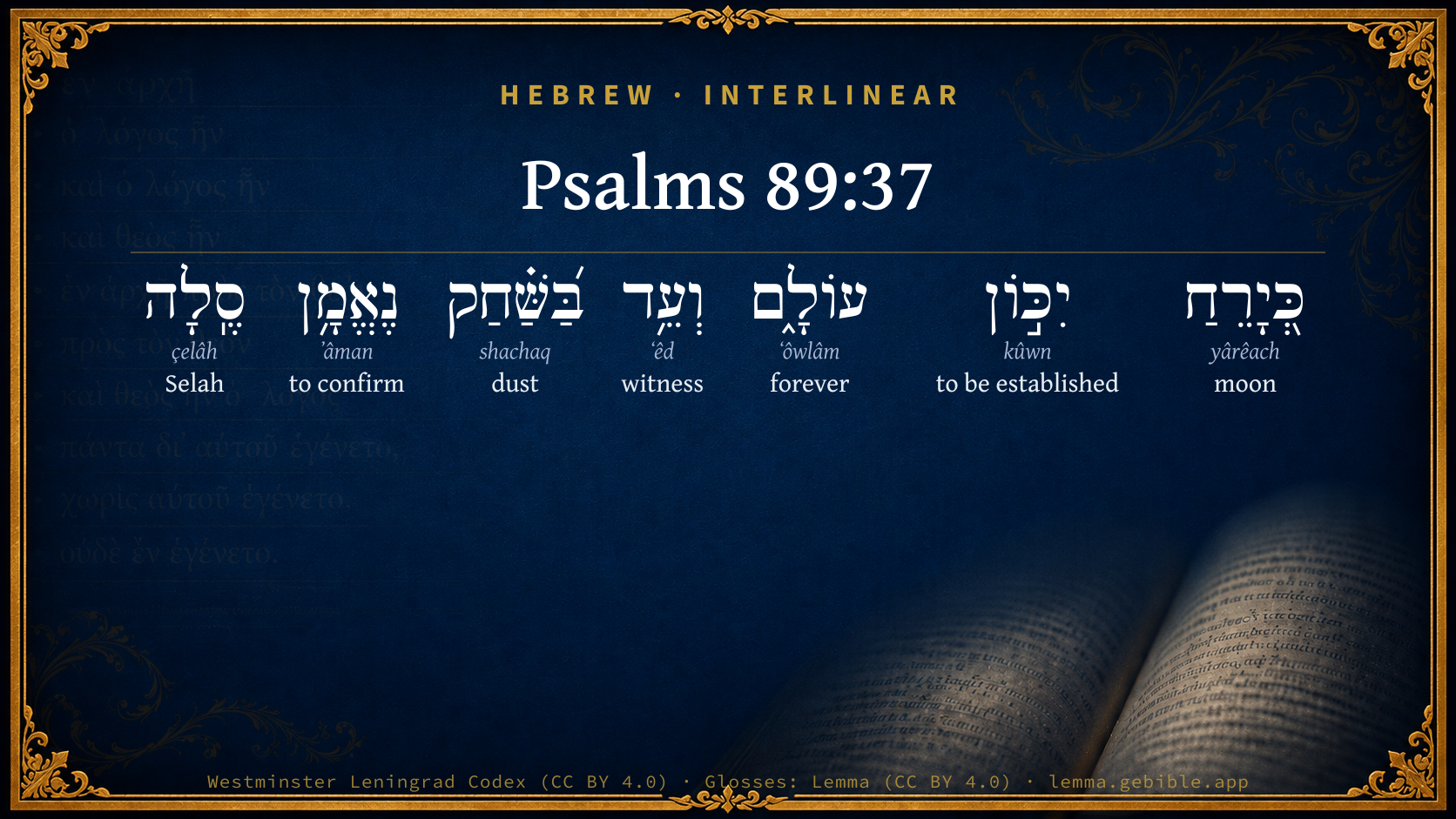
Psalms 89:37

Hebrew (Westminster Leningrad Codex) Psalms 89:37 appears in the Hebrew Old Testament. The text above is from the Westminster Leningrad Codex. Each word links to its Strong’s number, a concise gloss, and parsing drawn from the Open Scriptures Hebrew Bible morphology. Click any word for its full Brown-Driver-Briggs (BDB) entry.
Download image
Cite this verse

Psalms 89:37 (World English Bible). Public Domain. Lemma interlinear Bible study tool, https://lemma.gebible.app/v/psalms/89/37.

Show BibTeX & RIS
BibTeX
RIS
English Translation
It will be established forever like the moon, The faithful witness in the sky." Selah.
World English Bible · Public Domain
Download a study sheet

One document with this verse’s original text, its word-by-word gloss line, the meaning frame, cross-references with their text, attributed commentary, and full source and license credits — printable, and it pastes into notes with its structure intact.

This verse Autodidact and up

Study sheet (.html) Plain text (.txt)

A passage Seminary Student

Up to 50 verses in one chapter. A passage sheet keeps up to 6 commentary sources and 12 cross-references per verse, in the order this page ranks them, and says so on the sheet whenever that leaves anything out. Ask for a single verse and you get the Autodidact verse sheet above.

Everything on this page stays free to read, with no account — the sheet is a download of what is already on screen, not access to it.

Want to remove ads? Support Godless Engineer
Compare translations 3

The same verse in 3 English versions, stacked beneath the original-language interlinear above. Click any original word for its lexicon entry.

Each is an independent rendering of the whole verse — the interlinear is not word-aligned to these translations.

Highlighted words mark where these versions differ — a whole-verse word diff, not a word-by-word alignment.

  • World English Bible Public Domain
    It will be established forever like the moon, The faithful witness in the sky." Selah.
  • King James Version Public Domain
    It shall be established for ever as the moon, and as a faithful witness in heaven. Selah.
  • unfoldingWord Literal Text CC BY-SA 4.0
    It will be established forever like the moon, yes, the attested witness in the sky.’” Selah

unfoldingWord Literal Text — © unfoldingWord, licensed CC BY-SA 4.0. Word-aligned USFM3 via Door43 (git.door43.org/unfoldingWord/en_ult).

Versions to compare (up to 4)

3 of 4 selected

Show all 18 translations

Every available English version of this verse, each an independent rendering of the whole verse.

  • World English Bible Public Domain
    It will be established forever like the moon, The faithful witness in the sky." Selah.
  • Berean Standard Bible Public Domain
    like the moon, established forever, a faithful witness in the sky.” Selah
  • Majority Standard Bible Public Domain
    like the moon, established forever, a faithful witness in the sky.” Selah
  • King James Version Public Domain
    It shall be established for ever as the moon, and as a faithful witness in heaven. Selah.
  • American Standard Version (1901) Public Domain
    It shall be established for ever as the moon, And `as' the faithful witness in the sky. Selah
  • Revised Version (1885) Public Domain
    It shall be established for ever as the moon, and as the faithful witness in the sky. Selah
  • Geneva Bible (1599) Public Domain
    He shalbe established for euermore as the moone, and as a faythfull witnes in the heauen. Selah.
  • Douay-Rheims (1899) Public Domain
    his seed shall endure for ever.
  • Young's Literal Translation Public Domain
    As the moon it is established -- to the age, And the witness in the sky is stedfast. Selah.
  • Literal Standard Version CC BY-SA 4.0
    It is established as the moon for all time, || And the witness in the sky is steadfast. Selah.
  • Unlocked Literal Bible CC BY-SA 4.0
    It will be established forever like the moon, the faithful witness in the sky.” Selah
  • unfoldingWord Literal Text CC BY-SA 4.0
    It will be established forever like the moon, yes, the attested witness in the sky.’” Selah
  • Darby Bible Public Domain
    It shall be established for ever as the moon, and the witness in the sky is firm. Selah.
  • World Messianic Bible Public Domain
    It will be established forever like the moon, the faithful witness in the sky.” Selah.
  • Webster's Bible Public Domain
    \\89:36\\His seed shall endure for ever, and his throne as the sun before me.
  • Free Bible Version CC BY-SA 4.0
    It will continue forever like the moon, an enduring witness in the heavens.” Selah.
  • Bible in Basic English Public Domain
    It will be fixed for ever like the moon; and the witness in heaven is true. (Selah.)
  • JPS Tanakh (1917) Public Domain
    (89-38) It shall be established for ever as the moon; and be stedfast as the witness in sky.' Selah

Literal Standard Version (2020), Covenant Press — licensed CC BY-SA 4.0. Text via the HelloAO Bible API (eBible.org). Unlocked Literal Bible (unfoldingWord) — licensed CC BY-SA 4.0. Text via the HelloAO Bible API (eBible.org). unfoldingWord Literal Text — © unfoldingWord, licensed CC BY-SA 4.0. Word-aligned USFM3 via Door43 (git.door43.org/unfoldingWord/en_ult). Free Bible Version, Dr. Jonathan Gallagher — licensed CC BY-SA 4.0. Text via the HelloAO Bible API (eBible.org).

Word by word

More ways to search: Search by grammar → Find every occurrence → Compare this word →

Practice this passage: Drill this verse → Learn its vocabulary →

About this verse

These counts appear in no published source. They are computed here, from the morphology-tagged text and Lemma’s own curated glosses. What Lemma adds →

7
words
7
distinct lemmas
Wisdom
section

Notable vocabulary

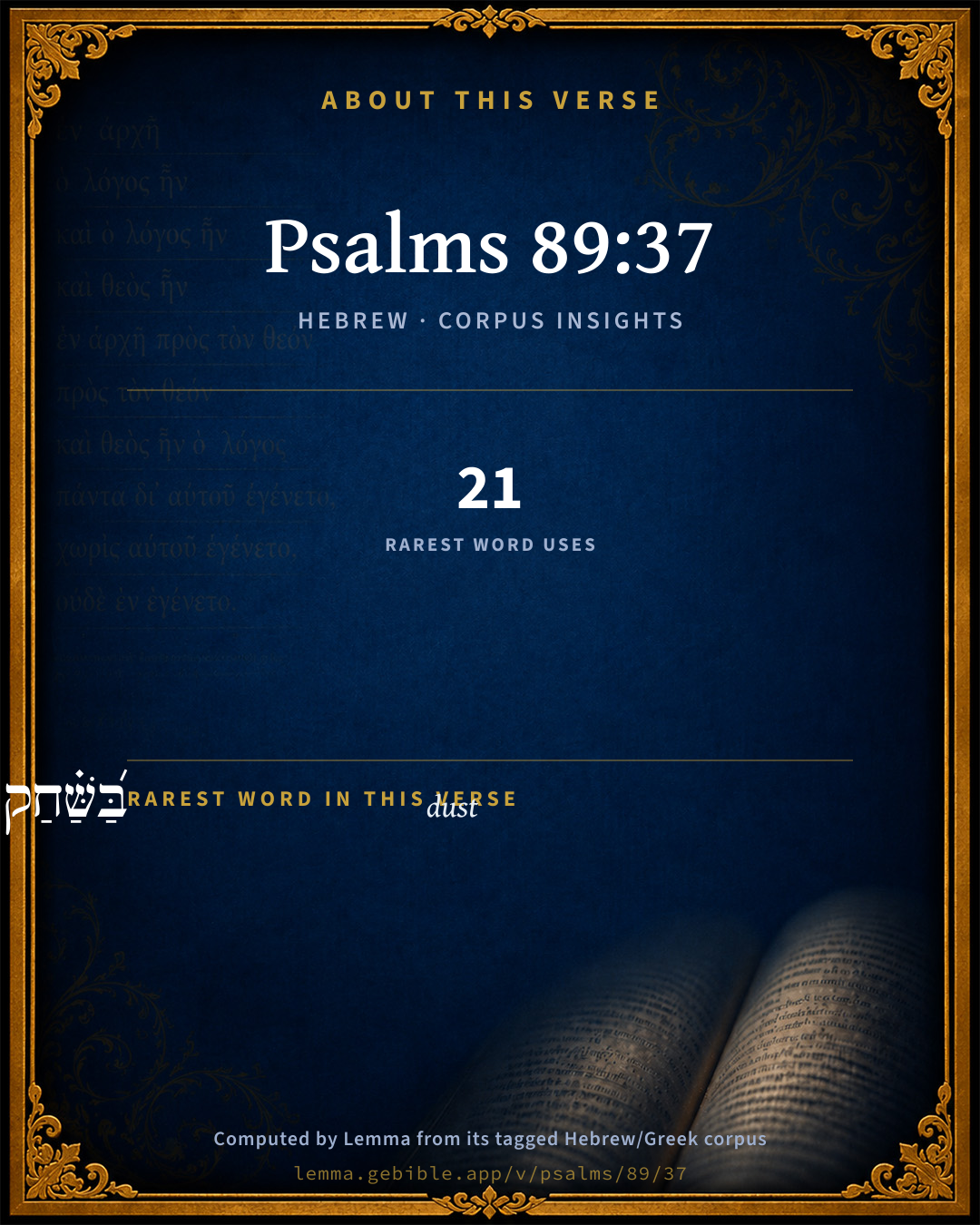
The rarest word here is בַּ֝שַּׁ֗חַק dust H7834 — appearing just 21 times in the whole Hebrew Bible.

Shared distinctive vocabulary

בַּ֝שַּׁ֗חַק dust H7834 occurs in 21 verses of the Hebrew Bible. Also found in:

Grammatical profile

  • 2 verbs
  • 4 nouns
  • 1 particle

Verb forms

  • יִכּ֣וֹן Niphal · Imperfect
  • נֶאֱמָ֥ן Niphal · Participle Active

Hebrew & Septuagint length

In English translation the verse runs 15 words from the Hebrew and 17 from the Septuagint (LXX English) — closely comparable.

A rough comparison of the two English renderings, which tokenize alike — not a word-level alignment.

Word counts can differ between the Hebrew and the Greek without any difference in meaning — e.g. the Hebrew direct-object marker אֵת has no separate Greek word, and Greek often adds the article ὁ.

Cross-references

6

Topical passages linked to Psalms 89:37 in the Treasury of Scripture Knowledge — connected by theme and wording, ordered by reader-vote popularity; previews shown in the World English Bible.

  • Jeremiah 31:35–36 Thus says Yahweh, who gives the sun for a light by day, and the ordinances of the moon and of the stars for a light by night, who stirs up the sea, so that the waves of it roar; Yahweh of hosts is his name:
  • Genesis 1:14–18 God said, "Let there be lights in the expanse of sky to divide the day from the night; and let them be for signs, and for seasons, and for days and years;
  • Psalms 104:19 He appointed the moon for seasons. The sun knows when to set.
  • Genesis 9:13–16 I set my rainbow in the cloud, and it will be for a sign of a covenant between me and the earth.
  • Isaiah 54:9–10 For this is [as] the waters of Noah to me; for as I have sworn that the waters of Noah shall no more go over the earth, so have I sworn that I will not be angry with you, nor rebuke you.
  • Psalms 72:7 In his days, the righteous shall flourish, And abundance of peace, until the moon is no more.

Cross-references courtesy of OpenBible.info (CC BY 4.0).

Hebrew and Greek witnesses Masoretic Hebrew ↔ Greek Septuagint

The same verse in the two great witnesses to the Old Testament, shown verse-for-verse.

You’re reading Greek Psalm 88 (Hebrew Psalm 89). The Septuagint counts the superscription, so verse numbers can differ from the Hebrew — chapter-level alignment, not verse-by-verse. Numbering follows Rahlfs.

These are two independent witnesses, not word-aligned to each other, and the Septuagint is shown in lemma (dictionary) form.

Hebrew Psalms 89:37 Masoretic · Westminster Leningrad Codex

כְּ֭יָרֵחַ יִכּ֣וֹן עוֹלָ֑ם וְעֵ֥ד בַּ֝שַּׁ֗חַק נֶאֱמָ֥ן סֶֽלָה

It will be established forever like the moon, The faithful witness in the sky." Selah.

World English Bible · Public Domain

Greek LXX Greek Psalm 88:37 Septuagint · lemma form

ὁ σπέρμα αὐτός εἰς ὁ αἰών μένω καί ὁ θρόνος αὐτός ὡς ὁ ἥλιος ἐναντίον ἐγώ

and as the moon that is established for ever, and as the faithful witness in heaven. Pause.

LXX2012 (modern English Septuagint) · Public Domain

Hebrew: Westminster Leningrad Codex (CC BY 4.0). Greek: Septuagint (public domain); English from LXX2012 (modern English Septuagint) (Public Domain). How the Septuagint differs from the Hebrew →

Commentary

Notes on Psalms 89:37 from classic Christian and Jewish commentators (each source and its license shown beneath its notes). The classic Christian expositions comment on the surrounding passage and are grouped to its opening verse, so a note may address several verses; the Jewish commentaries on the Tanakh (Rashi and others) are per-verse, so they appear only where the commentator wrote on this verse.

Lemma curates 59 commentaries, every one of them public domain or Creative Commons licensed, each selected and text-cleaned for this edition rather than reprinted as found. About our sources →

Trapp's Complete Commentary

John Trapp

Psa 89:37 It shall be established for ever as the moon, and [as] a faithful witness in heaven. Selah.

Ver. 37. It shall be established for ever as the moon] If his sons be good they shall shine as the sun in his strength, saith Kimchi; as, if they be not, yet they shall be as the moon that shineth, though for a time obscured or eclipsed. A fit resemblance, saith Ainsworth, of the throne or Church of Christ, which hath not always one face or appearance in the world, though it be perpetual. The Papists would have this moon always in the full; and if she show but little light to us they will not yield she is the moon. And yet, except in the eclipse, astronomers demonstrate that the moon hath at all times as much light as she hath in the full; but oftentimes a great part of the bright side is turned to heaven, and a lesser part to the earth: and so the Church is ever conspicuous to God’s eye, though it appear not always so to us.

And as a faithful witness in heaven] As oft, then, as we see the sun and moon in heaven let us think of the constance of God’s covenant, and the perpetuity of Christ’s kingdom. By this "faithful witness" some understand the rainbow, Gen 9:13-17.

John Trapp, A Commentary or Exposition upon All the Books of the Old and New Testament (1647–1656) — public domain. Text from a community e-Sword module.

The Biblical Illustrator

Joseph S. Exell

Psa_89:37

It shall be established for ever as the moon, and as a faithful witness in heaven.

The character of the Church of Christ upon earth as symbolized by the moon in our solar system

In the history of the creation it is written (Gen_1:14). How the sun and the moon in our solar system come to be for seasons and for days and years, the astronomer is able to inform us; but why, and of what they were intended to be the signs, revelation alone can explain. Accordingly, if we look into the Word of God, we find that the heavenly bodies are held forth as emblems of certain things, and of certain principles bearing upon the Church and people of God. Thus Jesus Christ is represented by the sun (Mal_4:2; Luk_1:78), and we are permitted to trace certain points in their analogy (Joh_14:6; Joh_11:25; Joh_5:24; Gal_2:20; 1Jn_5:11). The ministers of Christ are symbolized by the stars of heaven (Rev_1:20). In like manner, the moon in our solar system is more than once introduced as representing the Church of God in the world. In the Book of the Revelation (Rev_12:1), this luminary represents the Church of God under the law elected for the especial guardianship of the original revelation, which declared the one true God. In the Song of Solomon (Son_6:10) the same symbol is applied to the Church of God under the Gospel elected for the especial guardianship of the second revelation which declares the one true Mediator. It is in this latter sense--as representing the Church of God under the Gospel--that the words of the text are to be understood.

I. It will be my endeavour to sketch the character of the Church of God under the Gospel, by cautiously tracing certain points of analogy between her and the moon in our solar system.

1. The moon was ordained to rule the night--to furnish us with light in the absence of the sun. Visible she may be at times after the morning dawn, but if visible she gives no light--she wanes beneath the light of the superior orb. Were the sun always to shine upon our shores, there would be no night here: the moon would have no place in our firmament; or, if she appeared at all, she would shed no light.. And so it is with the Church of Christ in this lower world: the absence of her Divine Head in the heavens, whither He has gone to perform an essential part of that work of redemption which He covenanted with God the Father to perfect for the salvation of mankind--renders necessary the existence of a Church in the world, which is ordained to exist and to be visible until His coming again. He is the Sun, she is the moon.

2. The moon has no light of her own. The purpose for which the moon was at first, and still is, set in the heavens is to reflect upon us and for our benefit the light of the sun during his absence from the part of the world we inhabits--or, to speak more correctly, during our absence from him. In this peculiarity the moon is cited in Scripture to symbolize the Church of Christ upon earth. The latter was ordained to reflect upon the world the light of the Sun of righteousness during his absence in the heavens. In herself she has no light at all; without her Sun she has virtually no existence; severed from Him she is nothing worth. The Church has nothing whatever in herself whence can radiate those beams of light and life and love, without which all is darkness within--yea, a darkness that may be felt. No doctrine will fully enlighten the mind but the doctrine of Christ (Heb_6:1; Joh_2:9). No truth will dissipate the error of fallen natures teaching but the truth as it is in Jesus (Eph_4:21).

3. As the moon has no light, so neither has she any heat of her own. Did not the sun arise upon the land, and daily cheer us with his rays, as well as benefit us by his light, in vain should we seek a substitute in the transparent brightness of the moon. She is set in the heavens simply and solely to reflect his light. In this respect also does the moon symbolize the Church of God upon earth. It is not from the Church herself, separated from her Divine Head, that we are to look for that quickening power, that holy enthusiasm, that heavenly glow of joy and peace in believing which cheers the heart of every child of God. The ordained purpose of God is that the Church upon earth should not dispense the heat of her absent Sun, but continually and extensively reflect His light. For this, and this alone, was the Church ordained to exist in the world.

II. I close with a remark of a practical character. From what has now been said, we infer the necessity of an outward witness for Christ to satisfy the candid inquirer, and to silence a gainsaying world. Let me add, there must also be an inward witness for Christ (1Jn_5:10), for the satisfaction and the comfort and the security of the believer himself. If grafted into the body of Christs Church, by the Lords own ordinance of baptism rightly received, we are doubtless to be numbered with those symbolized by the moon. But beyond this, for the comfort of the believer, and to discriminate between a dead profession and a living faith (Rom_8:13; 1Co_7:19; Gal_5:6; Gal_6:15; Act_8:37; Mar_16:16; Acts if. 38; Jam_2:17-26), there is another and an inward witness to be superadded to the visible testimony. When the soul becomes quickened (Joh_5:25; Eph_2:1) into spiritual action; when the mind (Eph_1:17-18) becomes enlightened, the heart cheered, the affections warmed, the whole man, body, soul, and spirit, affected and moved by the constraining love of Christ (2Co_5:14), the blessed experience of that peace of God which passeth all understanding (Php_4:7); this is the inward witness, not seen by those that are without, but more convincing far to the individual soul, because he inherits thereby a well-grounded hope of an entrance into the everlasting kingdom of Christ (2Pe_1:11)--if he do but retain and exhibit the evidences of his renewed life (Joh_15:8). (W. J. Kidd.)

The Biblical Illustrator, edited by Joseph S. Exell (c. 1880s–1900s) — public domain. Text from a community e-Sword module.

J. A. Alexander on Psalms

Joseph Addison Alexander

38. (Psa 89:37) As the moon is fixed eternally, and the witness in the sky is sure. The verse thus translated, does not repeat the promise in the one before it, but merely confirms it by a further reference to the course of nature, as the customary standard of duration. It is equally grammatical, however, to translate, as the moon it (the throne) shall be fixed for ever, and (as) the witness in heaven is sure. In either case the witness is the moon. See above, on Psa 89:6; Psa 89:28, and compare Psa 72:5.

Joseph Addison Alexander, The Psalms Translated and Explained (1850) — public domain. Text from a community e-Sword module.

Geneva Bible (1599)

Geneva Bible translators

As long as the Sun and Moon endure, they shall be witnesses to me of this promise.

Geneva Bible (1599) marginal notes — public domain. Text via Bolls.life.

Adam Clarke's Commentary

Verse 37. As the moon, and as a faithful witness in heaven.] That is, as long as the sun and moon shall endure, as long as time shall last, his kingdom shall last among men. The moon appears to be termed a faithful witness here, because by her particularly time is measured. Her decrease and increase are especially observed by every nation, and by these time is generally estimated, especially among the eastern nations. So many moons is a man old; so many moons since such an event happened; and even their years are reckoned by lunations. This is the case with the Mohammedans to the present day. Or the rainbow may be intended; that sign which God has established in the cloud; that faithful witness of his that the earth shall no more be destroyed by water. As long therefore as the sun, the moon, and the rainbow appear in the heavens, so long shall the spiritual David reign, and his seed prosper and increase.

Selah.] It is confirmed; it shall not fail.

Adam Clarke's Commentary on the Bible (1810–1826) — public domain. Text from a community e-Sword/MySword module.

Ellicott's Commentary for English Readers

(37) And as a faithful witness in heaven.—Rather, and there is a faithful witness in heaven, which the parallelism shows to be the moon, just mentioned. The moon (see Psa_81:3) was to the Jews—as to the ancients generally—the “arbiter of festivals,” and the festivals were signs of the covenant, consequently that luminary might well be called “a witness in heaven.”

A Bible Commentary for English Readers, edited by Charles John Ellicott (1878–1897) — public domain. Text from a community e-Sword module.

The Cambridge Bible for Schools and Colleges

gen. ed. J. J. S. Perowne

37. Construction and meaning are doubtful. (1) The original passage in 2Sa_7:16 is in favour of making his throne the subject to shall be established, and against the marginal alternatives of R.V., As the moon which is established for ever, and as the faithful witness in the sky: or, and is a faithful witness in the sky.

(2) The A.V., with which substantially agrees the R.V., And (as) the faithful witness in the sky, raises the question what is meant by ‘the faithful witness in the sky.’ Is it the sun, or the moon, or the rainbow? Or is it the fixed laws of nature which are appealed to in Jer_31:35-36; Jer_33:20 f., 25f., as a symbol of the permanence of God’s covenant with Israel and with David? This last explanation is the best, but it seems somewhat far-fetched; and the omission of the particle of comparison as points (3) to another rendering: And the witness in the sky is faithful. The witness is God Himself, Who thus confirms His promise with a final attestation. Cp. Jer_42:5, “Jehovah be a true and faithful witness against us”: Job_16:19, “my witness is in heaven.”

The Cambridge Bible for Schools and Colleges (gen. ed. J. J. S. Perowne; Cambridge University Press, 1878–1918) — public domain. Text from a community e-Sword module.

John Gill's Exposition

But thou hast cast off,.... Here begin objections to what is before said, and swore to; even to the everlasting love of God, to Christ, and to his seed, to the unchangeableness and unalterableness of the covenant, and to the continuance and perpetuity of the kingdom and church of Christ, taken from the dealings of the Lord with the Messiah and his people; which were made either by the psalmist, under a spirit of prophecy, foreseeing what would come to pass; or by the apostles and church of Christ, about the time of his sufferings and death, and after; when he seemed to be "cast off", and rejected by the Lord, particularly when he forsook him, and hid his face from him, Mat 27:46, as when he hides his face from his people, it is interpreted by them a casting them off; see Psa 44:22,

and abhorred; not that he abhorred the person of Christ, who was his own Son, his beloved Son; nor his afflictions and sufferings, which were a sacrifice of a sweet smelling savour to him; see Psa 22:24, though these might be interpreted by others as if the Lord abhorred or rejected him; because he suffered him to be used in the manner he was, and particularly to be abhorred by the Jews, even by the nation in general, Isa 49:7, though the sins of his people, which he had upon him, and for which he suffered, were an abhorring to the Lord; and when he was made sin, he was made a curse:

thou hast been wroth with thine Anointed; with thy Messiah; not Rehoboam, from whom the ten tribes were rent; nor Josiah, who was killed by Pharaohnecho; nor Zedekiah, carried captive into Babylon; but the true Messiah, the son of David, before said to be found by the Lord, and anointed with his holy oil, Psa 89:20, which is to be understood of him, not as his own son, who was always the object of his love, but as the sinner's surety, bearing the sins of his people, and all the wrath and punishment due unto them; and so is reconcilable to the promise, that lovingkindness should not be taken from him, Psa 89:33 and is no objection to it, though made one.

John Gill's Exposition of the Whole Bible (1746–1763) — public domain (CC PDM 1.0). Text via the HelloAO Bible API.

Albert Barnes' Notes on the Bible

It shall be established forever as the moon - As long as the moon shall endure. The heavenly bodies are the most permanent objects that we know of; and they, therefore, became the emblems of stability and perpetuity. Compare the notes at Psa 72:7.

And as a faithful witness in heaven - As the witness in heaven, or in the sky, is sure. The reference is to the moon, regarded as a witness for God. What is said here of the moon as an index of his faithfulness, might be said also of the sun and the stars; but the beauty of the image is increased by the attention being fixed to a single object. As the moon is fixed, regular, enduring - so are the promises and purposes of God. Such were the promises made to David; such was the oath which had been taken by God; such the covenant which he had made. The psalmist now proceeds Psa 89:38-45 to show that this oath and these promises seemed to be disregarded; that there were things occurring which appeared as if God had forgotten them; that there was not that manifest prosperity and favor which was implied in the promise; but that a series of calamities had occurred which it was difficult to reconcile with these solemn pledges. On the ground of this he prays Psa 89:46-52 that God would return, and would remember his covenant, and would bless David and his people.

Albert Barnes' Notes on the Bible (1834–1885) — public domain. Text from a community e-Sword/MySword module.

Matthew Poole's English Annotations

Whereby he understands, either, first, The moon, last mentioned, to which this clause may be added rather than to the sun, to imply that as the moon, though subject to eclipses and frequent and manifold changes, yet doth constantly and perpetually remain in heaven, as a witness of my covenant of the night, as it is called, Jer 33:20; so shall the house and kingdom of David continue for ever, not withstanding all the changes and calamities which it may undergo. Or, secondly, The rainbow, which though in itself it be unstable and transient, and doth but seldom appear, which learned men object against this opinion, yet in Scripture is mentioned as God’s faithful and perpetual witness, being called a token of God’s everlasting covenant between God and every living creature for perpetual generations, Gen 9:12,16. And although it do not always appear to us, neither do the sun or moon do so, yet its appearances are doubtless very frequent in one or other part of the world, and will be repeated from time to time to the end of the world. Add to this, that the word here rendered heaven, may as well be rendered the cloud or clouds, as it is used Deu 33:26; Job 35:5; 36:28; Psa 18:12; 77:17; 78:23; Pro 3:20; Isa 45:8. And so the place being thus translated, and as the faithful witness in the cloud or clouds, doth plainly point us to the rainbow.

Matthew Poole's English Annotations on the Holy Bible (1683–1685) — public domain. Text from a community e-Sword/MySword module.

The Treasury of David

Charles H. Spurgeon

Ver. 37. It shall be established for ever as the moon. The kingdom may wax and wane to mortal eyes, but it shall still abide as long as the moon walks in her silver beauty.

And as a faithful witness in heavens. The most stable part of the universe is selected as a type of Messiah's kingdom, and both sun and moon are made to be symbols of its long endurance. Whatever else there is in the sky which faithfully witnesses to the unbending course of nature is also called upon to be a sign of the Lord's truth. When heaven and earth witness, and the Lord himself swears, there remains no excuse for doubting, and faith joyfully reposes in confident expectation.

Ver. 37. It shall be established for ever as the moon. This clause Kimchi expounds not only of the perpetuity, but of the quality and condition of David's Kingdom, after this fashion: If his children be good, they shall be like the moon, when full and shining; if bad, like the moon waning and obscure. Nevertheless the kingdom itself shall not cease, just as the moon does not go out of existence, whilst it is obscure, but lasts perpetually. Musculus.

Ver. 37. And as a faithful witness in heaven. (New Translation) And as the rainbow's faithful sign. The rainbow is not expressly mentioned in the original, which speaks only of "the faithful witness in heaven." Some commentators understand the "witness" thus mentioned to be no other than the moon itself. I prefer, however, the interpretation that fixes it on the rainbow, which God after the deluge appointed as a "sign" or "witness" of his mercy in Christ. Ge 9:12-17. Conformably to this appointment, the Jews, when they behold the rainbow, are said to bless God, who remembers his covenant and is faithful to his promise. And the tradition of this its designation to proclaim comfort to mankind was strong among the heathens: for, according to the mythology of the Greeks, the "rainbow" was the daughter of "wonder", "a sign to mortal men", and regarded, upon its appearance, as a messenger of the celestial deities. Thus Homer with remarkable conformity to the Scripture account speaks of the "rainbow", which "Jove hath set in the cloud, a sign to men." Richard Mant.

Psalms 89:38*

Charles H. Spurgeon's The Treasury of David (1869–1885) — public domain. Psalms only. Text from a community e-Sword/MySword module.

Whedon's Commentary on the Bible

Daniel D. Whedon

37. In heaven—In the clouds, as the word often means. Job_36:28; Psa_78:23. In this sense the allusion is to Gen_9:13 : “I do set my bow in the clouds.” But if שׁהק, shahak, be understood of the starry heavens, (comp. Job_16:19; Jer_33:20-26,) language and metaphor can go no further in setting forth the immutability of the covenant which, in its higher sense, is realized only and fully in Christ.

What blessings would have come to the Hebrew nation, and to the world through them, had they and the house of David been faithful to the covenant! The backslidings of the Church have, in all ages, been the chief obstacle to her success.

Daniel D. Whedon (gen. ed.), Commentary on the Old and New Testaments (1874–1909) — public domain. Text from a community e-Sword module.

The Pulpit Commentary

It shall be established forever as the moon. (comp. Psa_72:7) And as a faithful witness in heaven. Some understand this expression of the moon; but, as Professor Cheyne comments, "Who could witness (or declare) that such great things were true but Jehovah?" (So too Delitzsch, Kay, and Canon Cook.) If this be regarded as the true meaning, it will be better to translate, "the true witness." Job"s citation of God as his witness (Job_16:19) is scarcely parallel.

The Pulpit Commentary (1880–1919), ed. H.D.M. Spence-Jones & Joseph S. Exell — public domain. Text from a community e-Sword module.

John Wesley's Explanatory Notes

A witness - The rainbow, which is God's faithful witness, a token of God's everlasting covenant between God and every living creature for perpetual generations, Gen. ix, 12, 16.

John Wesley, Explanatory Notes Upon the Whole Bible (1754–1765) — public domain. Text via the GEBible commentary corpus.

Lesson kit

Teaching starters — assembled from the data on this page, not authored interpretation. Every prompt links to the verse data it draws on. Edit before teaching.

Psalms, in the Wisdom, opens this verse with 7 words (7 distinct Hebrew lemmas). Its most distinctive word is shachaq (“dust”). A historical commentator’s framing appears above. Read the whole chapter for the surrounding context.

Discussion questions

  1. The word shachaq carries the sense “dust.” How does it shape the verse?
  2. How does Deuteronomy 33:26, which shares the word «dust», read alongside this verse?
  3. These translations render this verse differently; the difference is in the English rendering, not the original. What questions does that raise?
  4. «יִכּ֣וֹן» is a Niphal Imperfect verb. How does that grammatical form shape the action described?
  5. Compare how Trapp's Complete Commentary and The Biblical Illustrator read this verse. Where do they agree or differ?

Things to notice

Reading settings

Reading text

Shown beneath each verse's original-language words.

Old Testament
Old Testament edition

Read the OT as the Masoretic Hebrew (MT) or the Greek Septuagint (LXX).

English shown for the Greek Septuagint (in the Hebrew ↔ Greek comparison).

Comparing translations? Open the Compare panel on any verse page to stack up to four side by side.