
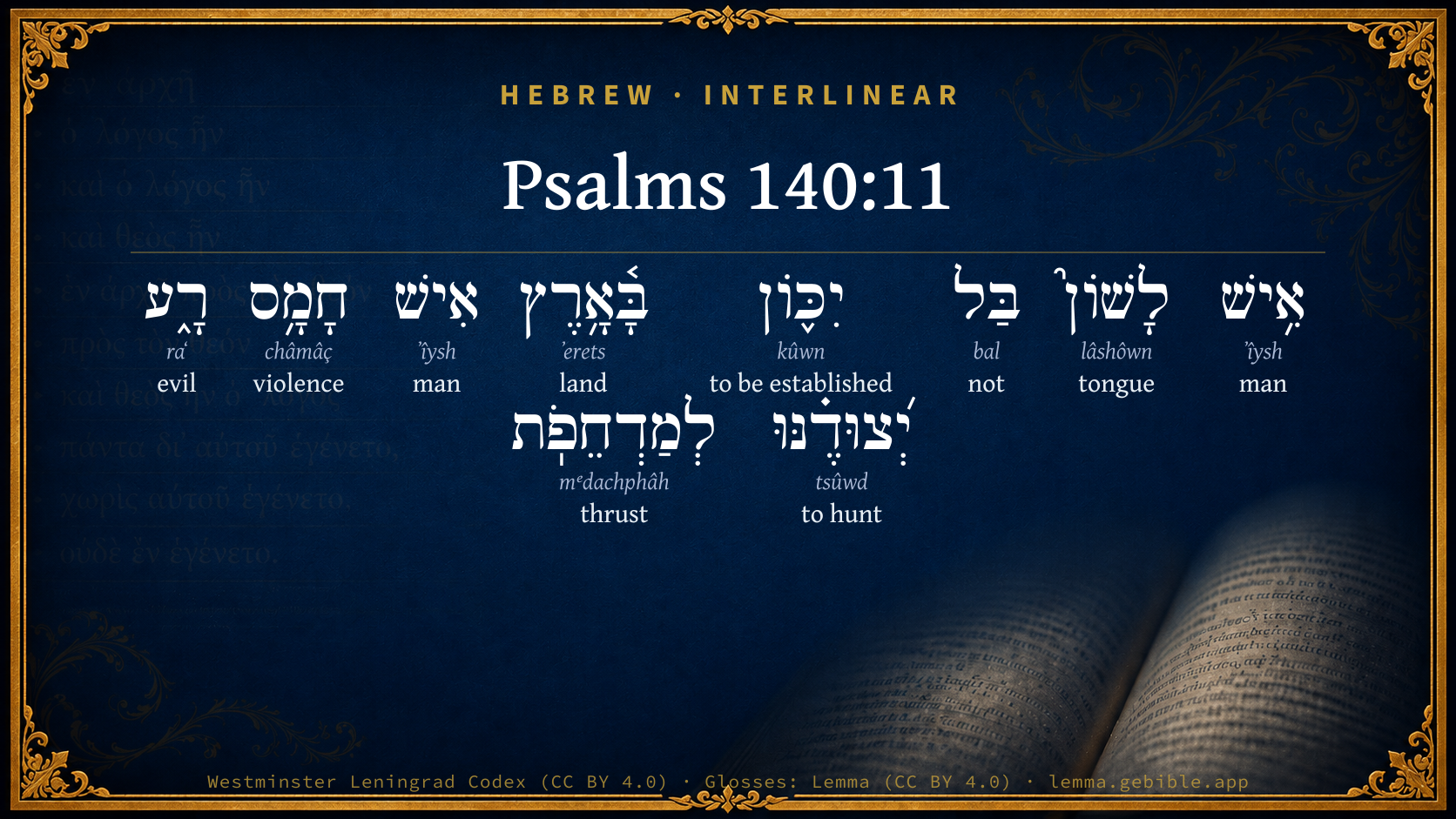

Psalms 140:11

Hebrew (Westminster Leningrad Codex) Psalms 140:11 appears in the Hebrew Old Testament. The text above is from the Westminster Leningrad Codex. Each word links to its Strong’s number, a concise gloss, and parsing drawn from the Open Scriptures Hebrew Bible morphology. Click any word for its full Brown-Driver-Briggs (BDB) entry.
Download image
Cite this verse

Psalms 140:11 (World English Bible). Public Domain. Lemma interlinear Bible study tool, https://lemma.gebible.app/v/psalms/140/11.

Show BibTeX & RIS
BibTeX
RIS
English Translation
An evil speaker won't be established in the earth. Evil will hunt the violent man to overthrow him.
World English Bible · Public Domain
Highlights
  • 1 hapax legomenon — only here in the Hebrew Bible
  • 1 first appearance in the Hebrew Bible
Full analysis ↓
Download a study sheet

One document with this verse’s original text, its word-by-word gloss line, the meaning frame, cross-references with their text, attributed commentary, and full source and license credits — printable, and it pastes into notes with its structure intact.

This verse Autodidact and up

Study sheet (.html) Plain text (.txt)

A passage Seminary Student

Up to 50 verses in one chapter. A passage sheet keeps up to 6 commentary sources and 12 cross-references per verse, in the order this page ranks them, and says so on the sheet whenever that leaves anything out. Ask for a single verse and you get the Autodidact verse sheet above.

Everything on this page stays free to read, with no account — the sheet is a download of what is already on screen, not access to it.

Want to remove ads? Support Godless Engineer
Compare translations 3

The same verse in 3 English versions, stacked beneath the original-language interlinear above. Click any original word for its lexicon entry.

Each is an independent rendering of the whole verse — the interlinear is not word-aligned to these translations.

Highlighted words mark where these versions differ — a whole-verse word diff, not a word-by-word alignment.

  • World English Bible Public Domain
    An evil speaker won't be established in the earth. Evil will hunt the violent man to overthrow him.
  • King James Version Public Domain
    Let not an evil speaker be established in the earth: evil shall hunt the violent man to overthrow him.
  • unfoldingWord Literal Text CC BY-SA 4.0
    Let not a man of tongue be established in the land; a man of violence—let evil hunt him with blows. ts\*

unfoldingWord Literal Text — © unfoldingWord, licensed CC BY-SA 4.0. Word-aligned USFM3 via Door43 (git.door43.org/unfoldingWord/en_ult).

Versions to compare (up to 4)

3 of 4 selected

Show all 18 translations

Every available English version of this verse, each an independent rendering of the whole verse.

  • World English Bible Public Domain
    An evil speaker won't be established in the earth. Evil will hunt the violent man to overthrow him.
  • Berean Standard Bible Public Domain
    May no slanderer be established in the land; may calamity hunt down the man of violence.
  • Majority Standard Bible Public Domain
    May no slanderer be established in the land; may calamity hunt down the man of violence.
  • King James Version Public Domain
    Let not an evil speaker be established in the earth: evil shall hunt the violent man to overthrow him.
  • American Standard Version (1901) Public Domain
    An evil speaker shall not be established in the earth: Evil shall hunt the violent man to overthrow him.
  • Revised Version (1885) Public Domain
    An evil speaker shall not be established in the earth: evil shall hunt the violent man to overthrow him.
  • Geneva Bible (1599) Public Domain
    For the backbiter shall not be established vpon the earth: euill shall hunt the cruell man to destruction.
  • Douay-Rheims (1899) Public Domain
    And I said: Perhaps darkness shall cover me: and night shall be my light in my pleasures.
  • Young's Literal Translation Public Domain
    A talkative man is not established in the earth, One of violence -- evil hunteth to overflowing.
  • Literal Standard Version CC BY-SA 4.0
    A talkative man is not established in the earth, || One of violence—evil hunts to overflowing.
  • Unlocked Literal Bible CC BY-SA 4.0
    May men of tongues not be made secure on the earth; may evil hunt down the violent man to strike him dead.
  • unfoldingWord Literal Text CC BY-SA 4.0
    Let not a man of tongue be established in the land; a man of violence—let evil hunt him with blows. ts\*
  • Darby Bible Public Domain
    Let not the man of [evil] tongue be established in the earth: evil shall hunt the man of violence to [his] ruin.
  • World Messianic Bible Public Domain
    An evil speaker won’t be established in the earth. Evil will hunt the violent man to overthrow him.
  • Webster's Bible Public Domain
    \\140:10\\Let burning coals fall upon them: let them be cast into the fire; into deep pits, that they rise not again.
  • Free Bible Version CC BY-SA 4.0
    Don't let people who slander others live in our land. May disaster strike down violent people.
  • Bible in Basic English Public Domain
    Let not a man of evil tongue be safe on earth: let destruction overtake the violent man with blow on blow.
  • JPS Tanakh (1917) Public Domain
    (140-12) A slanderer shall not be established in the earth; the violent and evil man shall be hunted with thrust upon thrust.

Literal Standard Version (2020), Covenant Press — licensed CC BY-SA 4.0. Text via the HelloAO Bible API (eBible.org). Unlocked Literal Bible (unfoldingWord) — licensed CC BY-SA 4.0. Text via the HelloAO Bible API (eBible.org). unfoldingWord Literal Text — © unfoldingWord, licensed CC BY-SA 4.0. Word-aligned USFM3 via Door43 (git.door43.org/unfoldingWord/en_ult). Free Bible Version, Dr. Jonathan Gallagher — licensed CC BY-SA 4.0. Text via the HelloAO Bible API (eBible.org).

Word by word

More ways to search: Search by grammar → Find every occurrence → Compare this word →

Practice this passage: Drill this verse → Learn its vocabulary →

לְמַדְחֵפֹֽת
mᵉdachphâh
H4073
“to/for · thrusts”
Preposition + Noun, Common, Feminine, Plural, Absolute
Part of Speech
Preposition + Noun
Type
Common
Gender
Feminine
Number
Plural
State
Absolute
Full BDB Definition

Origin: from H1765

TWOT: 423a

push, thrust
  1. אִ֥ישׁ ʼîysh H376 “man of” Noun, Common, Masculine, Singular, Construct
  2. לָשׁוֹן֮ lâshôwn H3956 “tongue” Noun, Common, Both, Singular, Absolute
  3. בַּל bal H1077 “not” Particle, Negative
  4. יִכּ֪וֹן kûwn H3559 “to be established” Verb, Niphal, Imperfect, 3rd Person, Masculine, Singular
  5. בָּ֫אָ֥רֶץ ʼerets H776 “in/at the · land” Preposition, Determined + Noun, Common, Both, Singular, Absolute
  6. אִישׁ ʼîysh H376 “man of” Noun, Common, Masculine, Singular, Construct
  7. חָמָ֥ס châmâç H2555 “violence” Noun, Common, Masculine, Singular, Absolute
  8. רָ֑ע raʻ H7451 “evil” Adjective, Adjective, Masculine, Singular, Absolute
  9. יְ֝צוּדֶ֗נּוּ tsûwd H6679 “to hunt · him” Verb, Qal, Jussive, 3rd Person, Masculine, Singular + Suffix, Personal, 3rd Person, Masculine, Singular

About this verse

These counts appear in no published source. They are computed here, from the morphology-tagged text and Lemma’s own curated glosses. What Lemma adds →

10
words
9
distinct lemmas
Wisdom
section

Notable vocabulary

1 hapax legomenon — a word that appears only here in the entire Hebrew Bible:

  • לְמַדְחֵפֹֽת thrust H4073

First appearance in Scripture

This word makes its first canonical appearance in the Hebrew Bible here:

  • לְמַדְחֵפֹֽת thrust H4073

Shared distinctive vocabulary

יְ֝צוּדֶ֗נּוּ to hunt H6679 occurs in 15 verses of the Hebrew Bible. Also found in:

Grammatical profile

  • 2 verbs
  • 6 nouns
  • 1 adjective
  • 1 particle

Verb forms

  • יִכּ֪וֹן Niphal · Imperfect
  • יְ֝צוּדֶ֗נּוּ Qal · Jussive

Repetition

A word recurs within this verse — often emphatic in Hebrew:

  • אִ֥ישׁ man H376 ×2

Hebrew & Septuagint length

In English translation the verse runs 18 words from the Hebrew and 17 from the Septuagint (LXX English) — closely comparable.

A rough comparison of the two English renderings, which tokenize alike — not a word-level alignment.

Word counts can differ between the Hebrew and the Greek without any difference in meaning — e.g. the Hebrew direct-object marker אֵת has no separate Greek word, and Greek often adds the article ὁ.

In the original languages it is 10 Hebrew tokens and 13 Greek tokens — but the two are counted differently (Hebrew bundles its prefixes and suffixes into one token; the Greek is in lemma form), so that isn’t a like-for-like length.

Cross-references

10

Topical passages linked to Psalms 140:11 in the Treasury of Scripture Knowledge — connected by theme and wording, ordered by reader-vote popularity; previews shown in the World English Bible.

  • Psalms 34:21 Evil shall kill the wicked. Those who hate the righteous shall be condemned.
  • Proverbs 18:21 Death and life are in the power of the tongue; Those who love it will eat its fruit.
  • Proverbs 13:21 Misfortune pursues sinners, But prosperity rewards the righteous.
  • Proverbs 17:20 One who has a perverse heart doesn't find prosperity, And one who has a deceitful tongue falls into trouble.
  • Isaiah 3:11 Woe to the wicked! Disaster is upon them; For the deeds of his hands will be paid back to him.
  • Psalms 7:14–16 Behold, he travails with iniquity; Yes, he has conceived mischief, And brought forth falsehood.
  • Psalms 9:16 Yahweh has made himself known. He has executed judgment. The wicked is snared by the work of his own hands. Meditation. Selah.
  • Psalms 12:3–4 May Yahweh cut off all flattering lips, And the tongue that boasts,
  • Proverbs 6:17 Haughty eyes, a lying tongue, Hands that shed innocent blood;
  • Proverbs 12:13 An evil man is trapped by sinfulness of lips, But the righteous shall come out of trouble.

Cross-references courtesy of OpenBible.info (CC BY 4.0).

Hebrew and Greek witnesses Masoretic Hebrew ↔ Greek Septuagint

The same verse in the two great witnesses to the Old Testament, shown verse-for-verse.

You’re reading Greek Psalm 139 (Hebrew Psalm 140). The Septuagint counts the superscription, so verse numbers can differ from the Hebrew — chapter-level alignment, not verse-by-verse. Numbering follows Rahlfs.

These are two independent witnesses, not word-aligned to each other, and the Septuagint is shown in lemma (dictionary) form.

Hebrew Psalms 140:11 Masoretic · Westminster Leningrad Codex

אִ֥ישׁ לָשׁוֹן֮ בַּל יִכּ֪וֹן בָּ֫אָ֥רֶץ אִישׁ חָמָ֥ס רָ֑ע יְ֝צוּדֶ֗נּוּ לְמַדְחֵפֹֽת

An evil speaker won't be established in the earth. Evil will hunt the violent man to overthrow him.

World English Bible · Public Domain

Greek LXX Greek Psalm 139:11 Septuagint · lemma form

πίπτω ἐπί αὐτός ἄνθραξ ἐν πῦρ καταβάλλω αὐτός ἐν ταλαιπωρία οὐ μή ὑποἵστημι

A talkative man shall not prosper on the earth: evils shall hunt the unrighteous man to destruction.

LXX2012 (modern English Septuagint) · Public Domain

On this verse, Ellicott's Commentary for English Readers discusses the Septuagint’s reading. Read the note in Commentary ↓

Hebrew: Westminster Leningrad Codex (CC BY 4.0). Greek: Septuagint (public domain); English from LXX2012 (modern English Septuagint) (Public Domain). How the Septuagint differs from the Hebrew →

Commentary

Notes on Psalms 140:11 from classic Christian and Jewish commentators (each source and its license shown beneath its notes). The classic Christian expositions comment on the surrounding passage and are grouped to its opening verse, so a note may address several verses; the Jewish commentaries on the Tanakh (Rashi and others) are per-verse, so they appear only where the commentator wrote on this verse.

Lemma curates 59 commentaries, every one of them public domain or Creative Commons licensed, each selected and text-cleaned for this edition rather than reprinted as found. About our sources →

Trapp's Complete Commentary

John Trapp

Psa 140:11 Let not an evil speaker be established in the earth: evil shall hunt the violent man to overthrow [him].

Ver. 11. Let not an evil speaker] Heb. a man of tongue, whereof Geraldus reckoneth up twenty-four several sins; a world of wickedness, St James calleth it, Jas 3:6

Evil shall hunt the violent man] The angel of death shall hunt him into hell, saith the Chaldee. Of the blackbird’s excrements is made bird lime, to catch him. Gaius Marius was slain with the sword he made when he was a cutler. Propiis pennis perire grave est, was Julian’s motto. God’s judgments against sinners are feathered from themselves, as a fowl shot with an arrow feathered from her own body.

John Trapp, A Commentary or Exposition upon All the Books of the Old and New Testament (1647–1656) — public domain. Text from a community e-Sword module.

J. A. Alexander on Psalms

Joseph Addison Alexander

12. (Psa 140:11) A man of tongue shall not be established in the land, (nor) a man of violence, a bad (man)—he shall hunt him to destruction. A man of a calumnious unbridled tongue (Jas 1:26) shall not be permanently seated in a prosperous condition. See above, on Psa 101:7; Psa 102:28. The next words may be variously construed; a man of wicked violence, or, disregarding the accents, a man of violence, evil shall hunt him, etc. According to the other constructions, God is the subject of the verb, as of the second in Psa 140:10. To destructions, the plural form denoting fulness and completeness. Others render it by strokes, i.e. successive strokes; others again, in haste, which agrees well with the usage of the verbal root. See 2Ch 26:20, Est 3:15; Est 6:12; Est 8:14.

Joseph Addison Alexander, The Psalms Translated and Explained (1850) — public domain. Text from a community e-Sword module.

Geneva Bible (1599)

Geneva Bible translators

God’s plagues shall light upon him in such sort, that he shall not escape.

Geneva Bible (1599) marginal notes — public domain. Text via Bolls.life.

Adam Clarke's Commentary

Verse 11. Let not an evil speaker be established] איש לשון ish lashon, "a man of tongue." There is much force in the rendering of this clause in the Chaldee גבר דמשתעי לישן תליתי gebar demishtai lishan telithai, "The man of detraction, or inflammation, with the three-forked tongue." He whose tongue is set on fire from hell; the tale-bearer, slanderer, and dealer in scandal: with the three-forked tongue; wounding three at once: his neighbour whom he slanders; the person who receives the slander; and himself who deals in it. What a just description of a character which God, angels, and good men must detest! Let not such a one be established in the land; let him be unmasked; let no person trust him; and let all join together to hoot him out of society. "He shall be hunted by the angel of death, and thrust into hell." - CHALDEE.

Adam Clarke's Commentary on the Bible (1810–1826) — public domain. Text from a community e-Sword/MySword module.

John Calvin's Commentaries

11. The man of tongue, “A man, of tongue, i.e., of evil tongue; a slanderer or detractor.” — Phillips. The Bible translation renders the phrase “an evil speaker;” and the Chaldee Paraphrase has “the man of detraction, with a three-forked tongue;” because such a man wounds three at once — the receiver, the sufferer, and himself.

John Calvin's Commentaries (1540-1563) — public domain. Text from the Calvin Translation Society English edition (1840s-50s) via the Christian Classics Ethereal Library (ccel.org). Calvin's coverage is partial (roughly two-thirds of the Bible); uncommented books and verses are honest gaps, never fabricated. The 19th-century editor's footnotes and remarks are omitted so the notes are faithfully Calvin's own voice.

Ellicott's Commentary for English Readers

(11) An evil speaker.—Literally, as in LXX. and Vulg., a man of tongue; (Comp. Sir_8:3; Job_11:2.) margin,” man of lips.” It is hardly possible to resist the suggestion that some particular person, noted for the loudness or violence of his speech, was intended.

Evil shall hunt . . .—Comp. Pro_13:21 and Horace, Odes iii. 2, Conington’s translation:

“Though vengeance halt, she seldom leaves

The wretch whose flying step she hounds.’

To overthrow.—The Hebrew is a noun, formed from a root meaning “to thrust,” and literally means either to destruction or with hasty pursuit. Some render “with successive thrusts;” but this is hardly a hunting figure.

A Bible Commentary for English Readers, edited by Charles John Ellicott (1878–1897) — public domain. Text from a community e-Sword module.

The Cambridge Bible for Schools and Colleges

gen. ed. J. J. S. Perowne

11. A slanderer shall not be established in the land] Cp. Psa_101:5.

to overthrow him] Again the idea is that of the evil which he devises for others relentlessly pursuing him, lit. with thrust upon thrust. Cp. Psa_35:5-6; Pro_13:21. The Targ. paraphrases, “misfortune shall hunt the violent man; the angel of death shall drive him down to hell.”

The Cambridge Bible for Schools and Colleges (gen. ed. J. J. S. Perowne; Cambridge University Press, 1878–1918) — public domain. Text from a community e-Sword module.

John Gill's Exposition

Let not an evil speaker be established in the earth,.... One that sets his mouth against the heavens, and speaks evil of God; of his being, perfections, purposes, and providences: whose tongue walks through the earth, and speaks evil of all men, even of dignities; and especially of the saints of the most High, and of the Gospel and ways of Christ. Or, "a men of tongue" (q); that uses his tongue in an ill way, in detractions and slanders (r); in blaspheming God, his name and tabernacle, and those that dwell therein, as antichrist, Rev 13:5; a man that calumniates with a triple tongue, so the Targum; like a serpent, whose tongue seems to be so sometimes. Kimchi applies this to Doeg, and Jarchi to Esau. The request is, that such an one might not be established in the earth; in the land of the living, as the Targum; might not increase and flourish in worldly substance, or be continued in his posterity; but be rooted out of the earth, and he and his be no more; see Psa 3:4;

evil shall hunt the violent man to overthrow him; or "to impulsions" (s): to drive him from evil to evil, as Kimchi. The sense is, that the evil of punishment shall hunt him, as a beast of prey is hunted; it shall closely pursue him and overtake him, and seize on him, and thrust him down to utter ruin and destruction. The Targum is,

"the injurious wicked man, let the angel of death hunt, and drive into hell.''

Of the violent man, see Psa 140:1; he who purposed to overthrow David, he was persuaded would be overthrown himself. This clause teaches us how to understand the rest; for though they are delivered out as wishes and imprecations, yet are prophetic, and are strongly expressive of the certainty of the things imprecated.

(q) "vir linguae", Pagninus, Montanus, Cocceius, Gejerus, Michaelis. (r) So the word "tongue" is used in Cicero, "Si linguas minus facila possimus", Epist. l. 9. 2. (s) "ad impulsiones", Montanus.

John Gill's Exposition of the Whole Bible (1746–1763) — public domain (CC PDM 1.0). Text via the HelloAO Bible API.

Albert Barnes' Notes on the Bible

Let not an evil speaker - literally, “A man of tongue.” That is, a man whom the tongue rules; a man of an unbridled tongue; a man who does not control his tongue. See the notes at Jam 3:2-12.

Be established in the earth - Be successful or prosperous; let him not carry out his designs. It is not desirable that a man should prosper in such purposes; and therefore, this is not a prayer of malignity, but of benevolence.

Evil shall hunt the violent man ... - More literally, “A man of violence - a bad man - they shall hunt him down speedily;” or, “let him be hunted down speedily. Let him who forms a project of violence and wrong - a bad man - be hunted as the beasts of prey are, and let his destruction come quickly.” Margin, “Let him be hunted to his overthrow.” But the explanation now given suits the connection, and is a literal expression of the sense of the original.

Albert Barnes' Notes on the Bible (1834–1885) — public domain. Text from a community e-Sword/MySword module.

Matthew Poole's English Annotations

An evil speaker; such as slander me and other innocent persons, to exasperate princes against us.

Evil; either the evil of punishment; or, which comes to the same thing, the evil of sin, their own wickedness, which shall recoil upon themselves.

Matthew Poole's English Annotations on the Holy Bible (1683–1685) — public domain. Text from a community e-Sword/MySword module.

The Treasury of David

Charles H. Spurgeon

Ver. 11. Let not an evil speaker be established in the earth. For that would be an established plague, a perpetual curse. Men of false and cruel tongues are of most use when they go to fatten the soil in which they rot as carcases: while they are alive they are the terror of the good, and the torment of the poor. God will not allow the specious orators of falsehood to retain the power they temporarily obtain by their deceitful speaking. They may become prominent, but they cannot become permanent. They shall be disendowed and disestablished in spite of all that they can say to the contrary. All evil bears the element of decay within itself; for what is it but corruption? Hence the utmost powers of oratory are insufficient to settle upon a sure foundation the cause which bears a lie within it. Evil shall hunt the violent man to overthrow him. He hunted the good, and now his own evil shall hunt him. He tried to overthrow the goings of the righteous, and now his own unrighteousness shall prove his overthrow. As he was violent, so shall he be violently assaulted and hunted down. Sin is its own punishment; a violent man will need no direr doom than to reap what he has sown. It is horrible for a huntsman to be devoured by Iris own hounds; yet this is the sure fate of the persecutor.

Ver. 11. Let not an evil speaker a man full of tongue be established, etc. The man given to talk, the liar, the flatterer, the detractor, the scold, the brawler, "shall not be established in the earth", for such people are abhorred by the wicked as well as by the good. Robert Bellarmine.

Ver. 11. Let not an evil speaker be established, etc. The positions laid down in this verse will find abundant illustration in every age of the church. "An evil speaker", who takes delight in wounding the reputation of others, is seldom established or prospered in the earth. Providence fights against such an unhappy wretch. "The violent man", the ishmaelite whose hand is against every man, is in general overthrown by the very same weapons which he wields against others. John Morison.

Ver. 11. An evil speaker. By "a man of the tongue", as the original has it, the Hebrews express a detractor or sycophant; one who gives his tongue the liberty to vent what mischief lie pleases. The Chaldee here expresses it by a delator or vile informer with a threefold or three forked tongue;because such a man wounds three at once; the receiver, the sufferer, and himself. Thomas Fenton.

Ver. 11. Evil shall hunt the violent man to overthrow him. 'Tis an allusion to hounds that are of a quick scent, and pursue the game with pleasure; they do not see the deer or the hare, yet they follow upon the scent; and though they have sometimes a very cold and dead scent, yet they will follow and work it out. Thus "evil shall hunt the violent man to overthrow him"; and though sometimes he hath, as it were, got out of the view or sight of evil, and thinks himself under covert, yet these evils, like a company of greedy hounds, will pursue till they have overtaken and overthrown him. Joseph Caryl.

Ver. 11. (first clause.)

1. Notice a few varieties of evil speakers.

a) Liars; the common liar, the trade liar, the stock exchange liar, the political liar, etc.

b) Scandal mongers.

c) Blasphemers and swearers.

d) Libertines and seducers.

e) Sceptics and new theology inventors.

2. The propriety of the prayer.

a) Because evil speaking is intrinsically an evil thing.

b) It is an extensively injurious thing.

c) He who would have God's truth established must needs desire that evil speaking must fail.

3. The limitation of the prayer: "In the earth."

a) It is certain an evil speaker cannot be established in heaven, nor in hell.

b) The earth is the only sphere of his influence; but, alas! men on the earth are too prone to be influenced by him.

c) Then, become righteous and true, by faith in the Righteous One and the "Truth." J. F.

Ver. 11. (second clause.) The Cruel Hunter pursued by his own Dogs.

Ver. 11. (second clause.) ThemeSins committed, and not repented of, pursue men to their ruin.

1. Illustrate.

a) They may raise a force of opposition from men. Tarquin, Napoleon, etc.

b) They may precipitate ruin, as Haman was hunted by his own sin to the gallows.

c) They may arouse destructive remorse, as in Judas.

d) Certainly they will pursue to the judgment seat, and hunt the soul into hell.

2. Apply.

a) How fearful a thing must sin be.

b) The mole terrible because self created.

c) Flee from the avenging pursuers to Christ, the only and safe refuge. J. F.

Ver. 11. (second clause.) The hunt and pursuit of the violent sinner.

1. The progress of the chase.

a) At first the victim is ignorant of it.

b) But ere long he finds Scripture, conscience, God, Death, at his heels.

c) His own sins cry loudest after him.

2. The issue of the hunt. Hemmed in, overthrown, lost for ever, unless he repent.

3. Another Huntsman. "The Son of man is come to seek and save that which was lost." W. B. H.

Psalms 140:12*

Charles H. Spurgeon's The Treasury of David (1869–1885) — public domain. Psalms only. Text from a community e-Sword/MySword module.

Whedon's Commentary on the Bible

Daniel D. Whedon

11. An evil speaker—Hebrew, A man of tongue. An idle tattler, a slanderer. In Ecc_10:11, “babbler,” is lord of the tongue—one who subjects his tongue to no restraint. Later in life David enacted, in regard to his house and court, “He that telleth lies shall not be established in my sight,” Psa_101:7. The sharp Athnach, after “evil,” terminating the line at that word, connects it with violence as an adjective, and makes the sentence parallel to the preceding. The whole verse would then read: “The man of tongue shall not be established in the earth; nor the man of evil violence; he [God] shall hunt him,” etc. But ancient and modern authority generally sets aside the present pointing, ending the line at the preceding word, and makes “evil” the subject of the verb, as in the English version.

Hunt… to overthrow—Chase to headlong ruin. The idea of the word rendered “overthrow” is that of precipitate ruin.

Evil—The consequences of their evil doing—shall pursue them to speedy, down-rushing destruction. Bythner: To precipices. Hengstenberg: Pursue him, thrust upon thrust.

Daniel D. Whedon (gen. ed.), Commentary on the Old and New Testaments (1874–1909) — public domain. Text from a community e-Sword module.

The Pulpit Commentary

Let not an evil speaker be established in the earth; literally, a man of tongue shall not be established is the land a man, i.e., of pretence and seeming, who talks grandly, but effects nothing. Such a one shall not obtain permanent establishment as a power in the land. Evil shall hunt the violent man to overthrow him; literally, to destructions a plural of completeness.

The Pulpit Commentary (1880–1919), ed. H.D.M. Spence-Jones & Joseph S. Exell — public domain. Text from a community e-Sword module.

Rashi

Rabbi Shlomo Yitzchaki (Rashi)

descend May the coals descend on them. Let them lie upon them until they sink and become extinguished by themselves. The body will thus disintegrate and disappear.

He will cast them into fire He Who casts and avenges [will cast them] into the fire of Gehinnom. in wars He will cast them so that they will no longer rise.

in wars Heb. במהמרות, in wars and strife, an expression of (Deut. 9: 4): “You have been rebellious (ממרים).”

Rashi on the Tanakh — English translations: “The Judaica Press complete Tanach with Rashi, translated by A. J. Rosenberg” (CC BY 4.0); “Pentateuch with Rashi's commentary by M. Rosenbaum and A.M. Silbermann, 1929-1934” (public domain); “The Metsudah Tanach series, Lakewood, N.J” (CC BY 4.0); and “The Book of Joshua, Metsudah Publications, 1997” (CC BY 4.0). Text via Sefaria.

Lesson kit

Teaching starters — assembled from the data on this page, not authored interpretation. Every prompt links to the verse data it draws on. Edit before teaching.

Psalms, in the Wisdom, opens this verse with 10 words (9 distinct Hebrew lemmas). Its most distinctive word is mᵉdachphâh (“thrust”). A historical commentator’s framing appears above. Read the whole chapter for the surrounding context.

Discussion questions

  1. What does “thrust” (mᵉdachphâh) contribute to the verse as a whole?
  2. 1 word here appears nowhere else in the Hebrew Bible. Why might the author reach for such rare wording?
  3. This is the first place “thrust” appears in Scripture (first appears here). What does its debut here establish?
  4. How does Genesis 27:3, which shares the word «to hunt», read alongside this verse?
  5. What does the repetition of “man” (2× in this one verse) do in this verse?
  6. The translations on this page render this verse differently — a whole-verse word diff, not a word-by-word alignment. What might account for the different wordings?
  7. «יִכּ֪וֹן» is a Niphal Imperfect verb. How does that grammatical form shape the action described?
  8. Compare how Trapp's Complete Commentary and J. A. Alexander on Psalms read this verse. Where do they agree or differ?

Things to notice

  • 1 word in this verse appears nowhere else in the Hebrew Bible.
  • 1 word makes its first canonical appearance in Scripture here.
  • This verse counts 10 Hebrew ↔ 13 Greek words.
  • These translations choose different wording for 13 words in this verse.
  • “man” occurs 2× in this single verse.

Reading settings

Reading text

Shown beneath each verse's original-language words.

Old Testament
Old Testament edition

Read the OT as the Masoretic Hebrew (MT) or the Greek Septuagint (LXX).

English shown for the Greek Septuagint (in the Hebrew ↔ Greek comparison).

Comparing translations? Open the Compare panel on any verse page to stack up to four side by side.