

Psalms 37:23

Hebrew (Westminster Leningrad Codex) Psalms 37:23 appears in the Hebrew Old Testament. The text above is from the Westminster Leningrad Codex. Each word links to its Strong’s number, a concise gloss, and parsing drawn from the Open Scriptures Hebrew Bible morphology. Click any word for its full Brown-Driver-Briggs (BDB) entry.
Download image
Cite this verse

Psalms 37:23 (World English Bible). Public Domain. Lemma interlinear Bible study tool, https://lemma.gebible.app/v/psalms/37/23.

Show BibTeX & RIS
BibTeX
RIS
English Translation
A man's goings are established by Yahweh. He delights in his way.
World English Bible · Public Domain
Highlights
  • 1 first appearance in the Hebrew Bible
Full analysis ↓
Download a study sheet

One document with this verse’s original text, its word-by-word gloss line, the meaning frame, cross-references with their text, attributed commentary, and full source and license credits — printable, and it pastes into notes with its structure intact.

This verse Autodidact and up

Study sheet (.html) Plain text (.txt)

A passage Seminary Student

Up to 50 verses in one chapter. A passage sheet keeps up to 6 commentary sources and 12 cross-references per verse, in the order this page ranks them, and says so on the sheet whenever that leaves anything out. Ask for a single verse and you get the Autodidact verse sheet above.

Everything on this page stays free to read, with no account — the sheet is a download of what is already on screen, not access to it.

Want to remove ads? Support Godless Engineer
Compare translations 3

The same verse in 3 English versions, stacked beneath the original-language interlinear above. Click any original word for its lexicon entry.

Each is an independent rendering of the whole verse — the interlinear is not word-aligned to these translations.

Highlighted words mark where these versions differ — a whole-verse word diff, not a word-by-word alignment.

  • World English Bible Public Domain
    A man's goings are established by Yahweh. He delights in his way.
  • King James Version Public Domain
    The steps of a good man are ordered by the LORD: and he delighteth in his way.
  • unfoldingWord Literal Text CC BY-SA 4.0
    From Yahweh the steps of a man are established, and he delights in his way.

unfoldingWord Literal Text — © unfoldingWord, licensed CC BY-SA 4.0. Word-aligned USFM3 via Door43 (git.door43.org/unfoldingWord/en_ult).

Versions to compare (up to 4)

3 of 4 selected

Show all 18 translations

Every available English version of this verse, each an independent rendering of the whole verse.

  • World English Bible Public Domain
    A man's goings are established by Yahweh. He delights in his way.
  • Berean Standard Bible Public Domain
    The steps of a man are ordered by the LORD who takes delight in his journey.
  • Majority Standard Bible Public Domain
    The steps of a man are ordered by the LORD who takes delight in his journey.
  • King James Version Public Domain
    The steps of a good man are ordered by the LORD: and he delighteth in his way.
  • American Standard Version (1901) Public Domain
    A man's goings are established of Jehovah; And he delighteth in his way.
  • Revised Version (1885) Public Domain
    A man’s goings are established of the LORD; and he delighteth in his way.
  • Geneva Bible (1599) Public Domain
    The pathes of man are directed by the Lord: for he loueth his way.
  • Douay-Rheims (1899) Public Domain
    With the Lord shall the steps of a man be directed, and he shall like well his way.
  • Young's Literal Translation Public Domain
    From Jehovah `are' the steps of a man, They have been prepared, And his way he desireth.
  • Literal Standard Version CC BY-SA 4.0
    The steps of a man [are] from YHWH, || They have been prepared, || And He desires his way.
  • Unlocked Literal Bible CC BY-SA 4.0
    It is by Yahweh that a man's steps are established, the man whose way is commendable in God's sight.
  • unfoldingWord Literal Text CC BY-SA 4.0
    From Yahweh the steps of a man are established, and he delights in his way.
  • Darby Bible Public Domain
    The steps of a man are established by Jehovah, and he delighteth in his way:
  • World Messianic Bible Public Domain
    A man’s steps are established by the LORD. He delights in his way.
  • Webster's Bible Public Domain
    The steps of a good man are ordered by the LORD: and he delighteth in his way.
  • Free Bible Version CC BY-SA 4.0
    The Lord shows the right path to those who follow him, and is happy with the way they live.
  • Bible in Basic English Public Domain
    The steps of a good man are ordered by the Lord, and he takes delight in his way.
  • JPS Tanakh (1917) Public Domain
    It is of the LORD that a man's goings are established; and He delighted in his way.

Literal Standard Version (2020), Covenant Press — licensed CC BY-SA 4.0. Text via the HelloAO Bible API (eBible.org). Unlocked Literal Bible (unfoldingWord) — licensed CC BY-SA 4.0. Text via the HelloAO Bible API (eBible.org). unfoldingWord Literal Text — © unfoldingWord, licensed CC BY-SA 4.0. Word-aligned USFM3 via Door43 (git.door43.org/unfoldingWord/en_ult). Free Bible Version, Dr. Jonathan Gallagher — licensed CC BY-SA 4.0. Text via the HelloAO Bible API (eBible.org).

Word by word

More ways to search: Search by grammar → Find every occurrence → Compare this word →

Practice this passage: Drill this verse → Learn its vocabulary →

About this verse

These counts appear in no published source. They are computed here, from the morphology-tagged text and Lemma’s own curated glosses. What Lemma adds →

6
words
6
distinct lemmas
Wisdom
section

Notable vocabulary

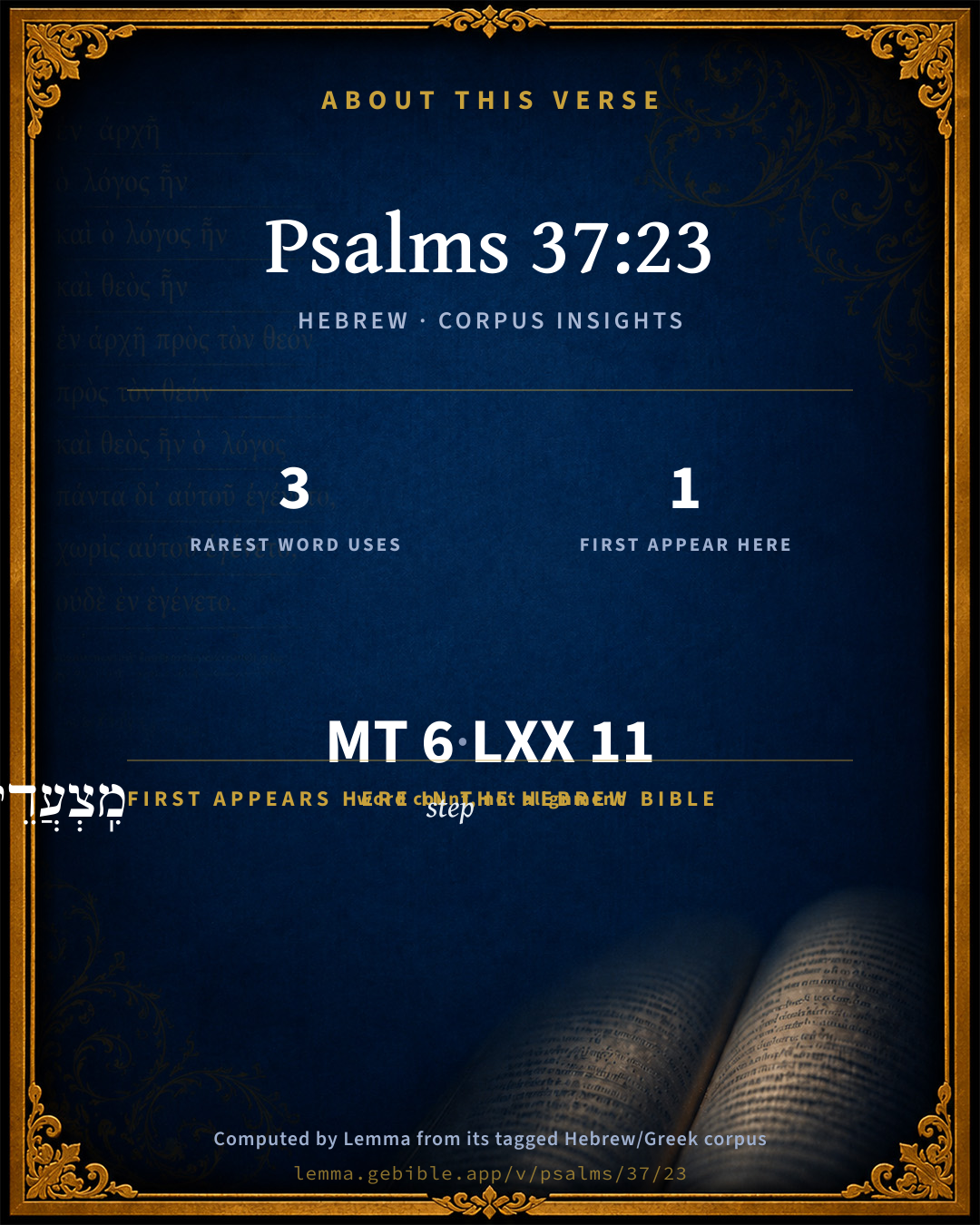
The rarest word here is מִֽצְעֲדֵי step H4703 — appearing just 3 times in the whole Hebrew Bible.

First appearance in Scripture

This word makes its first canonical appearance in the Hebrew Bible here:

  • מִֽצְעֲדֵי step H4703

Shared distinctive vocabulary

מִֽצְעֲדֵי step H4703 occurs in 3 verses of the Hebrew Bible. Also found in:

Grammatical profile

  • 2 verbs
  • 4 nouns

Verb forms

  • כּוֹנָ֗נוּ Polal · Perfect
  • יֶחְפָּֽץ Qal · Imperfect

Hebrew & Septuagint length

In English translation the verse runs 12 words from the Hebrew and 19 from the Septuagint (LXX English) — closely comparable.

A rough comparison of the two English renderings, which tokenize alike — not a word-level alignment.

Word counts can differ between the Hebrew and the Greek without any difference in meaning — e.g. the Hebrew direct-object marker אֵת has no separate Greek word, and Greek often adds the article ὁ.

In the original languages it is 6 Hebrew tokens and 11 Greek tokens — but the two are counted differently (Hebrew bundles its prefixes and suffixes into one token; the Greek is in lemma form), so that isn’t a like-for-like length.

Cross-references

17

Topical passages linked to Psalms 37:23 in the Treasury of Scripture Knowledge — connected by theme and wording, ordered by reader-vote popularity; previews shown in the World English Bible.

  • Proverbs 16:9 A man's heart plans his course, But Yahweh directs his steps.
  • Psalms 119:133 Establish my footsteps in your word. Don't let any iniquity have dominion over me.
  • Proverbs 4:26 Make the path of your feet level. Let all of your ways be established.
  • 1 Samuel 2:9 He will keep the feet of his holy ones; But the wicked shall be put to silence in darkness; For by strength shall no man prevail.
  • Psalms 40:2 He brought me up also out of a horrible pit, Out of the miry clay. He set my feet on a rock, And gave me a firm place to stand.
  • Psalms 121:8 Yahweh will keep your going out and your coming in, From this time forth, and forevermore.
  • Psalms 85:13 Righteousness goes before him, And prepares the way for his steps.
  • Jeremiah 10:23 Yahweh, I know that the way of man is not in himself: it is not in man who walks to direct his steps.
  • Psalms 121:3 He will not allow your foot to be moved. He who keeps you will not slumber.
  • Psalms 147:10–11 He doesn't delight in the strength of the horse. He takes no pleasure in the legs of a man.
  • Job 23:11–12 My foot has held fast to his steps. His way have I kept, and not turned aside.
  • Psalms 17:5 My steps have held fast to your paths, My feet have not slipped.
  • Psalms 119:5 Oh that my ways were steadfast To obey your statutes!
  • Jeremiah 9:24 but let him who glories glory in this, that he has understanding, and knows me, that I am Yahweh who exercises loving kindness, justice, and righteousness, in the earth: for in these things I delight, says Yahweh.
  • Proverbs 11:1 A false balance is an abomination to Yahweh, But accurate weights are his delight.
  • Proverbs 11:20 Those who are perverse in heart are an abomination to Yahweh, But those whose ways are blameless are his delight.
  • Hebrews 13:16 But don't forget to be doing good and sharing, for with such sacrifices God is well pleased.

Cross-references courtesy of OpenBible.info (CC BY 4.0).

Hebrew and Greek witnesses Masoretic Hebrew ↔ Greek Septuagint

The same verse in the two great witnesses to the Old Testament, shown verse-for-verse.

You’re reading Greek Psalm 36 (Hebrew Psalm 37). The Septuagint counts the superscription, so verse numbers can differ from the Hebrew — chapter-level alignment, not verse-by-verse. Numbering follows Rahlfs.

These are two independent witnesses, not word-aligned to each other, and the Septuagint is shown in lemma (dictionary) form.

Hebrew Psalms 37:23 Masoretic · Westminster Leningrad Codex

מֵ֭יְהוָה מִֽצְעֲדֵי גֶ֥בֶר כּוֹנָ֗נוּ וְדַרְכּ֥וֹ יֶחְפָּֽץ

A man's goings are established by Yahweh. He delights in his way.

World English Bible · Public Domain

Greek LXX Greek Psalm 36:23 Septuagint · lemma form

παρά κύριος ὁ διάβημα ἄνθρωπος καταεὐθύνω καί ὁ ὁδός αὐτός θέλω

The steps of a man are rightly ordered by the Lord: and he will take pleasure in his way.

LXX2012 (modern English Septuagint) · Public Domain

On this verse, Keil & Delitzsch discusses the Septuagint’s reading. Read the note in Commentary ↓

Hebrew: Westminster Leningrad Codex (CC BY 4.0). Greek: Septuagint (public domain); English from LXX2012 (modern English Septuagint) (Public Domain). How the Septuagint differs from the Hebrew →

Commentary

Notes on Psalms 37:23 from classic Christian and Jewish commentators (each source and its license shown beneath its notes). The classic Christian expositions comment on the surrounding passage and are grouped to its opening verse, so a note may address several verses; the Jewish commentaries on the Tanakh (Rashi and others) are per-verse, so they appear only where the commentator wrote on this verse.

Lemma curates 59 commentaries, every one of them public domain or Creative Commons licensed, each selected and text-cleaned for this edition rather than reprinted as found. About our sources →

The Cambridge Bible for Schools and Colleges

gen. ed. J. J. S. Perowne

23. It seems best to take Psa_37:23 in close connexion with Psa_37:24, as (virtually) the condition of the promise:

When a man’s goings are established of Jehovah,

And he delighteth in his way;

Though he fall &c.

The second line may be understood of Jehovah’s satisfaction in the good man’s life (He delighteth in his way: cp. Psa_18:19; Psa_22:8); or of the good man’s willing acceptance of Jehovah’s guidance (he delighteth in His way). The latter explanation is supported by Pro_10:29, which occurs in a context parallel to this Psalm. Cp. Psa_37:34; Psa_119:35.

23, 24. Stanza of Mem. God’s directing and upholding care.

The Cambridge Bible for Schools and Colleges (gen. ed. J. J. S. Perowne; Cambridge University Press, 1878–1918) — public domain. Text from a community e-Sword module.

Trapp's Complete Commentary

John Trapp

Psa 37:23 The steps of a [good] man are ordered by the LORD: and he delighteth in his way.

Ver. 23. The steps of a good man are ordered by the Lord] Heb. The steps of a man; for good men only are reckoned of by God, Jer 5:1. So a wife is put for a good wife, Pro 18:22. A bad wife is but (according to Lamech’s second wife’s name) Zillah, that is, the shadow of a wife. Now, as God chose out the Israelites’ way for them all along the wilderness; so he doth still for those that are good, not always the shortest way, but the safest; not always the straightest way, but that which most conduceth to their journey’s end. As therefore Israel in the wilderness, so must we follow God, though he seem to lead us in and out, backward and forward, as if we were treading a maze.

And he delighteth in his way] His way it is called, for encouragement sake, though it be God alone who chooseth and chalketh out his way, yea, causeth him to keep his commandments, Ezek. xxvi. Certum est nos facere quod facimus; sed ille facit ut faciamus. God doth all our works for us.

John Trapp, A Commentary or Exposition upon All the Books of the Old and New Testament (1647–1656) — public domain. Text from a community e-Sword module.

The Biblical Illustrator

Joseph S. Exell

Psa_37:23

The steps of a good man are ordered by the Lord: and He deligteth in his way.

The ordered steps

That first step of your little child--what an event it is! Never again will single steps have such interest for you. And yet why not? In manhood, no less than in infancy, single steps are significant. You find it out sometimes in disagreeable ways. One step in the dark carries you off firm footing into an open trap, or down a bank. The first step down a wrong road is the beginning of troublesome, and possibly dangerous, wanderings. The first step to honour or fortune-how much meaning!

I. God orders and establishes the details of his childrens lives. Details are of immense importance everywhere. Step by step is the law of all progress. God moves masses through details. A man is what the details of his life are. In the Bible we see God busied not alone with great things, but He is constantly dealing with details. He is explaining a servants dream; He is providing for a little castaway babe in a bulrush basket. And so it was in the life of Christ. His work was full of detail, of small incidents of little duties daily done. The same thing appears in Christs preaching. He tells men how to live; but He says nothing about great, far-reaching plans of life. His talk is rather of living by the day, and letting the morrow take thought for the things of itself. He comes to reveal God to us: but His speech is not about the God of vast designs and transcendent power; rather of one who paints each lily of the fields, and feeds the birds, and marks the sparrows fall, and numbers the hairs of our head. Thus you see one law--the law of the steps--running through physical and moral nature alike. Gravitation and Providence observe the same principle. God regulates the mass through the particles; society, through the individual; the individual, through the details of his life.

II. And there is design and plan in all though we often fail to perceive this. Our little daily duties appear to have so slight relation to each other. But as one illustration that the truth is other than it seems, look at the familiar history of the life of Joseph. The steps of a good man, then, are ordered. He does not walk at random. And really you and I, in our measure, are familiar with the same fact, and act it out. You see in a son of yours promise of intellectual and moral power; and you set yourself to shape that boys career, and you do shape it, and that by attending to its successive steps. Is there, then, anything strange in our heavenly Fathers ordering the steps of His children? For a free will may choose to obey another will. If God has prepared tracks for my life, surely my very freedom of choice empowers me to keep to those tracks: and, to the obedient, loving soul, it is an immense comfort and relief to know that his life moves on prepared lines. I sat one evening in a window looking out on Charing Cross railway-station, with its trains arriving, and departing every few minutes, and its cross-tides of thronging people. A train stood on the track, and the bell rang for starting. In front, through the great archways, I looked out into the misty night. A few stray gleams of light revealed a labyrinth of rails, curving and crossing: above was a signal-stand--a great hieroglyph of green, red, and white lights, shifting every moment; and into this darkness and confusion the engine moved. What was it that made that engineer so quiet and confident? Why was he not disturbed and anxious at the chaos of rails and lights and the thick night beyond? Simply because everything was laid down for him. He had only to obey the signals, and drive his engine: the track was laid. Other minds had the care and responsibility of the switches and signal-lights: he had only to go forward, and to stop when bidden. I do not like the picture, some one will perhaps say. It leaves me little to say about my life. Well, change the picture if you will. Let the engineer go forth from the station on an engine not fitted to a track. Let him move out into the night, in the consciousness of independence and free choice, to avoid collision and wreck as he can. Have you bettered the matter any? Our own way means ruin; Gods way is, and alone is, salvation.

III. God is pleased with him who lets his steps be ordered. Literally the words read, From Jehovah is it that a mans steps are established, so that He hath pleasure in his way. We do God a great wrong when we picture Him as a creditor whose interest in his debtors begins and ends with their paying their debts. God merges the relation of debtor and creditor in that of father and child. It is a very small part of your interest in your child, that he should repay you for your care of him. In fact, payment is impossible. On the contrary, everything the child does or says is interesting to you because he is your child. Now, possibly, we find it hard to transfer just that feeling to God; and yet that is the true view of his feeling towards His children. But we find it difficult to believe, though we would like to, that we are Gods children. We are so faulty and wrong: it seems a cruel satire to tell me that the Lord delighteth in my way. Here, then, the third truth of the text comes in.

IV. Infirmity is recognized as an element of the good mans walk. Though he fall--then it is looked upon as more than possible that he may fall. We may go back to the picture of the babes first walk. There is none which better suits the case. You do not despise that babys attempts at walking, because he falls over now and then. You would rather have him fall a hundred times--yes, and hurt himself too--than not have him walk at all. Let us face the fact squarely. There is falling along the path by which God orders a mans steps. It is not that God ordains sin. He does not. But the path which God ordains for a good man lies through this world: and sin is in the world, no matter why or how; and a good mans walk with God consists very largely in a fight with sin. What God pledges is not that he shall walk to heaved a perfect, sinless man all the way. The psalmist prays, Order my steps in Thy Word: and let not any iniquity have dominion over me; and, when we turn from the psalmist to Paul, we find the answer to that prayer: Sin shall not have dominion over you, for ye are not under the law, but under grace. The promise is for victory in the fight, but not for escape from the fight. Establishment does not exclude conflict or fall. One has said of David after his moral fall, He is not what he was before, but he is far nobler and greater than many a just man who never fell and never repented. Let us beware of thinking repentance a sentiment of a lower grade, or degrading to the man who drops its bitter tears. There is something heroic in the man who looks up to Gods ideal of manhood far, far above him, and at himself, lamed and wounded by his fall, and says, By Gods grace I will mount to it. Learn then--

1. If God has ordained a way for men to walk in, it is the height of folly to walk in any other way.

2. If God, as we have seen, orders our ways step by step, it becomes us to take heed to the details of our lives.

3. And ought we not to get great comfort out of this Divine ordering of each step? When a traveller in the Alps is ascending an ice-slope where he has to cut steps as he mounts, he thinks of little besides the step he is at that moment cutting. He has a point to reach, a space to traverse; but all that is lost sight of in the danger and difficulty which wait on every step he knows he will escape destruction only as each step shall be rightly cut, and his foot firmly planted each time. It is a good deal so in this life. It is not a safe journey by any means; but there is this assurance for a child of God who walks it, that each step shall be sure if he only commits his way unto the Lord. The separate steps! Sometimes each one seems to sink into a quagmire, or to strike a stone. It is hard to walk on in strong faith that they are ordered by the Lord. But they are so. Remember this, and that if He be for me, who can be against me? (Marvin R. Vincent, D. D.)

The Lords ordering of a good mans steps

I. The life of a good man is divinely planned.

1. If you will examine this psalm, you will have no difficulty in ascertaining what the writer means by a good man. He trusts in the Lord and does good; he delights himself also in the Lord; commits his way unto the Lord; trusts also in Him; rests in the Lord; and waits patiently for Him.

2. The steps of a good man are ordered by the Lord. Many persons never think of this; some deny it altogether; and perhaps most of us often forget it, and thus lose the comfort of it (Pro_16:9; Pro_20:24).

(1) This plan is individual. There is not an item in our daily life which is not comprehended. Our joys, our sorrows, our associates, our connections, our wanderings, our acts, our thoughts; my life, your life, is Divinely ordered.

(2) It is special as it is comprehensive, The good man is Divinely directed in his everyday procedure, in his going out and coming in, his lying down and rising up, his successes and failures, his joys and sorrows, his trials and triumphs, his birth and death.

(3) It is benevolent. God overrules all agents and all events for the well-being of His people. Gods plan is great in its conception, great in the Divine skill by which it is shaped and worked out; above all, great in the momentous issues it prepares. But remember it is good as it is great. What a thought is this for us to cherish! What instigations does it add to send us onward in everything that constitutes our excellence!

II. The life of a good man is divinely approved. He delighteth in his way. This is understood by some to mean that the good man delights in the way of the Lord. I think the words mean that the Lord delights in the way of the good man. The good man delights himself in the Lord, and the Lord delights in him.

1. He delighteth in his way, because it is formed and fashioned according to the will of God, and is directed by His own Spirit.

2. He delighteth in his way, because it manifests His glory. The heavens declare the glory of God. But more of God and His glory may be seen in the life of a good mail than can be seen in the material universe. You see in him all that can be seen in the material creation, but you see in him what cannot be soon in it; and, moreover, you see more clearly what can.

III. The life of a good man is divinely protected.

1. The possibility implied. Though he fall. A good man, in this world of changes and reverse, may get prostrated by misfortune and distress; he may sink very low as to worldly circumstances; he may, like Job, be stripped of everything, or, like Joseph, put in prison. In this life disasters are to be expected, and it forms no part of Gods plan to prevent them. They are intended for the benefit of the good man; they are the refiners fire.

2. The truth expressed. He shall not be utterly cast down. He may fall; he may be cast down; but he shall not be prostrated wholly, not be thrown down for ever. The good man must expect to suffer, but not perish (verses 9, 10, 13, 15, 17, 20).

3. The reason. The Lord upholdeth his hand, or, is holding him up by his hand, or, upholdeth him with His hand. Thou hast holden me by my right hand. God not only sustains the good man in particular emergencies, but He is his constant and habitual upholder (verses 12, 18, 21). He has always a hold on his hand. He never lets it go. (P. Griffiths.)

Human evolution: from the involution of the Divine Spirit

A mans way is strictly the original Divine-human life more and more rooting and opening itself in him: the glory of God shed abroad in the inner world of his soul, as the solar glory is shed abroad in the earth, developing, transfiguring, and preparing him for his ascension, God delighteth in the way; because it is loves way, and unspeakably delightful. It is lifes way to mans completeness and complete blessedness; and grander than any man can think or imagine. It is evolution and evolution, not from non-intelligent matter, but from the living incorruptible substance in which God is involved as the working power. The steps which the Infinite Father has ordered for His sons and daughters are a series of surprises. Love delights to surpass expectation, and to have greater and greater surprises in reserve.

1. The whole round of nature is a ceaseless wonder, and ceaselessly changing its aspect. It feasts our affections, gratifies our love of the beautiful, exhilarates and enlarges the mind, cultivates the imagination, and is an endless source of poetic symbolism and illustration. It lives and breathes; and therefore demonstrates the nearness of God. It is never old, for it renews itself, and grows before our eyes. There ere always untrodden districts, and unvisited worlds awaiting our opportunity. Then Gods sons and daughters are themselves all that nature is, and much more. They are the crown of nature: they are nature, plus divinity.

2. Another beautiful surprise comes within the scope of our earthly existence: the home and family-surprise. New spirits from God actually arrive: they come secretly into our very blood, and clothe themselves with our nature; they come to stay with us and grow up in our homes. Their vivacity and novelty add a wonderful charm and enlargement to our life.

3. The stealing on of natures great eclipse and midnight is the dawn of Gods new life--full morning for the inner man. Death is new birth; when the sweetest surprise of all breaks into view. Natures children die; but Gods never. His children live, and breathe, and hold their being in the bosom of His Almighty Livingness. The way of God is from the first a living way. Thou wilt show me the path of life; and His path of life becomes more and more living; and most living, in, and through natures death. The last enemy that shall be destroyed is death. The ascent from the cold gloom of the valley is swift, for the guardian angels meet us there, and God is in them. (John Pulsford, D. D.)

Special providence

God exercises a special control over His chosen people.

I. God has a special design in their preservation and government.

1. He has a plan for the life of each one (Isa_30:21).

2. He knows the temperament peculiar to each one (Psa_139:3).

3. He suits His providence to the temperament of each one so as to accomplish His design (Mat_12:20; Eph_1:5-6).

II. God employs means to work out his designs. Sin is to be mortified and expelled, whilst character is to be refined and perfected. For this purpose trials and temptations, persecutions and afflictions, calamities and bereavements, are apportioned to each.

1. These are permissive (Job_1:12).

2. They are decretive (Gen_22:2; 1Pe_1:3-9).

3. They are afflictive and corrective (Psa_119:67; Psa_119:71; Jer_31:18-19; Heb_12:6-11).

III. The nature of these providences.

1. They are minute and exact (Mat_10:30).

2. They relate to food and raiment (Psa_37:25; Mat_6:25-34).

3. They extend to the whole of life (Job_14:5; Psa_37:23; Psa_139:14-16).

IV. Application.

1. Let us trust God more implicitly in all the events of life.

2. Let us take comfort from this doctrine. All things work together for good (Rom_8:28); they do so now. Whatever else may fail us, God will not (Psa_97:1). (L. O. Thompson.)

The Biblical Illustrator, edited by Joseph S. Exell (c. 1880s–1900s) — public domain. Text from a community e-Sword module.

The Treasury of David

Charles H. Spurgeon

Ver. 23. The steps of a good man are ordered by the Lord. All his course of life is graciously ordained, and in lovingkindness all is fixed, settled, and maintained. No reckless fate, no fickle chance rules us; our every step is the subject of divine decree. He delighteth in his way. As parents are pleased with the tottering footsteps of their babes. All that concerns a saint is interesting to his heavenly Father. God loves to view the holy strivings of a soul pressing forward to the skies. In the trials and the joys of the faithful, Jesus has fellowship with them, and delights to be their sympathising companion.

Ver. 23. The steps of a good man are ordered by the Lord. When this Pilot undertakes to steer their course, their vessel shall never split upon the rock, run upon the sands, or spring a leak, so as to sink in the seas. To be sure he will see them safe in their harbour. He was no Christian, yet I suppose none will deny but he spake good divinity, who said, "If a man will choose God for his Friend, he shall travel securely through a wilderness that hath many beasts of prey in it; he shall pass safely through this world; for he only is safe that hath God for his guide." (Ar. Epist. 27) Doth he not speak a little like David himself Ps 37:23, who never expected to come to glory except he were guided by his counsel? Now, if a poor heathen could say thus, and see good reason to trust God, and admire his faithfulness as he doth frequently (and so doth Seneca, justifying God's faithfulness in all his dealings with the best men in all their sufferings, and the prosperity of the wicked); what then shall the heavenly Christian say, who hath experienced so much of God's faithfulness in answering his prayers, in fulfilling his promises, and supplying all his exigencies? James Janeway.

Ver. 23. He delighteth in his way. Note that in verse four, we are bidden to delight in the Lord, and here he delights in us, and as here our way is his delight, so in verse thirty-four we are to "keep his way." These antitheses are instructive. C. H. S.

Ver. 23-24. Strange words to us! the very steps all ordered, and that by an Almighty One, who "delights" in the goodness of the good man's way. And yet the inference so distinctly to be drawn is that the good man may fall, and that his God and Guide may stand by and behold and permit! Let us add to the suggestion of these verses, one or two references which may help us to establish the principle in our hearts, that the child of God may fall and still remain the child of God; and also to explain somewhat of the reason why this is part of their lot, whether ordered, or only permitted, at all events, a step of the "right way, "by which God leads them to a "city of habitation." Ps 107:7. It is observed near the close of Hezekiah's good and prosperous life that, "in the business of the ambassadors of the princes of Babylon...God left him to try him, that he might know all that was in his heart, " 2Ch 32:31. And again, in Daniel's prophecy regarding the latter days, we find Da 11:35, "And some of them of understanding shall fall, to try them, and to purge, and make them white." In the two preceding verses, we have also some valuable details regarding such falls, such as the help with which God will uphold them, the flatteries with which the world will still beset, and hinder them from rising again; the outward troubles into which their fall shall lead them, as through a furnace; the high position (instructors of many) which yet shall not save them from their needed ordealthe time appointedand the end in view. So here. The acknowledgment of the possibility of the good man's fall is accompanied with the precious assurance that he shall not be utterly cast down. Mary B. M. Duncan, in "Under the Shadow, 1867."

Ver. 23-24.

1. The divine predestination.

2. The divine delight.

3. The divine support.

Psalms 37:24*

Ver. 23-24.

1. The divine predestination.

2. The divine delight.

3. The divine support.

Charles H. Spurgeon's The Treasury of David (1869–1885) — public domain. Psalms only. Text from a community e-Sword/MySword module.

Joseph Benson's Commentary

Psa 37:23-24. The steps of a good man — Hebrew, of man, namely, of the righteous, or blessed man, mentioned Psa 37:21-22; are ordered by the Lord — Or, directed, or disposed, that is, so governed as to attain the end at which he aims; or strengthened, or established, so as he shall not stumble and fall into mischief. For he seems still to be describing, not their virtue, but their prosperity. And he delighteth in his way — Hebrew, ודרכו יחפצ, vedarcho jechpats, he favoureth his way, that is, succeeds and prospers his counsels and enterprises. Though he fall — Into distress or trouble, as Mic 7:8; he shall not be utterly cast down — Not totally, or irrecoverably ruined.

Joseph Benson's Commentary on the Old and New Testaments (1811–1818) — public domain. Text from a community e-Sword module.

Keil & Delitzsch

C. F. Keil & F. Delitzsch

By Jahve (מן, ἀπό, almost equivalent to ὑπό with the passive, as in Job 24:1; Ecc 12:11, and in a few other passages) are a man's steps made firm, established; not: ordered or directed (lxx, Jerome, κατευθύνεται), which, according to the extant usage of the language, would be הוּכנוּ (passive of הכין, Pro 16:9; Jer 10:23; Ch2 27:6), whereas כּוננוּ, the Pulal of כּונן, is to be understood according to Psa 40:3. By גּבר is meant man in an emphatic sense (Job 38:3), and in fact in an ethical sense; compare, on the other hand, the expression of the more general saying, "Man proposes, and God disposes," Pro 16:9; Pro 20:24; Jer 10:23. Psa 37:23 shows that it is the upright man that is meant in Psa 37:23: to the way, i.e., course of life, of such an one God turns with pleasure (יחפּץ pausal change of vowel for יחפּץ): supposing he should fall, whether it be a fall arising from misfortune or from error, or both together, he is not prostrated, but Jahve upholds his hand, affords it a firm point of support or fulcrum (cf. תּמך בּ, Psa 63:9, and frequently), so that he can raise himself again, rise up again.

Keil & Delitzsch — Biblical Commentary on the Old Testament (1861–1891) — public domain (CC PDM 1.0). Text via the HelloAO Bible API. (Old Testament only.)

J. A. Alexander on Psalms

Joseph Addison Alexander

23. (Psa 37:23) From Jehovah, by him, or by a power proceeding from him, the steps of a man, his course of life, all that befalls him, have been settled, fixed, or ordered, and in his way, a parallel expression to his steps, will he delight, i. e. he will delight to execute the plan thus formed. Although this is in form a general proposition, it is obviously meant to be applied specifically to the righteous as the objects of God's favour, and to account for their superior prosperity, if not at present, yet hereafter.

Joseph Addison Alexander, The Psalms Translated and Explained (1850) — public domain. Text from a community e-Sword module.

Tyndale Open Study Notes

Tyndale Open Resources

37:23-24 The rectitude and strength of a godly person’s life comes from the Lord (see Prov 4:12; 14:15; 16:9; 20:24).

Tyndale Open Study Notes — © Tyndale Open Resources, licensed CC BY-SA 4.0. Text via the HelloAO Bible API.

Geneva Bible (1599)

Geneva Bible translators

God prospereth the faithful, because they walk in his ways with an upright conscience.

Geneva Bible (1599) marginal notes — public domain. Text via Bolls.life.

Jamieson, Fausset & Brown

Robert Jamieson, A. R. Fausset & David Brown

steps--way, or, "course of life"; as ordered by God, failures will not be permanent.

Jamieson, Fausset & Brown — Commentary Critical and Explanatory on the Whole Bible (1871) — public domain (CC PDM 1.0). Text via the HelloAO Bible API.

Adam Clarke's Commentary

Verse 23. The steps of a good man are ordered by the Lord] There is nothing for good in the text. גבר geber is the original word, and it properly signifies a strong man, a conqueror or hero; and it appears to be used here to show, that even the most powerful must be supported by the Lord, otherwise their strength and courage will be of little avail.

And he delighteth in his way.] When his steps are ordered by the Lord, he delighteth in his way, because it is that into which his own good Spirit has directed him. Or, the man delights in God's way-in the law and testimonies of his Maker.

Adam Clarke's Commentary on the Bible (1810–1826) — public domain. Text from a community e-Sword/MySword module.

John Calvin's Commentaries

23 The footsteps of a man are directed by Jehovah Some join together these two things, first, that the footsteps of the godly are ordered by the grace of God, since men do not in their own strength follow what is just and right, but only in so far as the Spirit of God directs them; and hence the second follows, namely, that God favors and approves what is his own. But David simply continues his commendation of the divine blessing towards the faithful, of whom this is especially worthy of being remembered, that whatever they undertake always has a favorable and happy result. At the same time, the reason why God crowns with prosperity and success all our efforts throughout the course of our life is to be observed, namely, because we attempt nothing which is not pleasing to him. For I consider the copula and, in the second clause of the verse, to be used instead of the causal particle because, and resolve the whole verse in this way: Because the way of the godly is acceptable to God, he directs their footsteps to a happy issue; so that the meaning is, As God sees that the faithful act conscientiously, and do not turn aside from the way which he has appointed, he blesses their efforts. And, certainly, since the prophet speaks generally — and yet it is certain that the faithful only are here spoken of — the second clause must necessarily be considered as spoken by way of exposition. Accordingly, the term way denotes their manner and course of living; as if he had said, that the godly have no other object in view but to frame their lives agreeably to the will of God, and to obey what he commands. The term footsteps I consider as referring to external success.

John Calvin's Commentaries (1540-1563) — public domain. Text from the Calvin Translation Society English edition (1840s-50s) via the Christian Classics Ethereal Library (ccel.org). Calvin's coverage is partial (roughly two-thirds of the Bible); uncommented books and verses are honest gaps, never fabricated. The 19th-century editor's footnotes and remarks are omitted so the notes are faithfully Calvin's own voice.

Ellicott's Commentary for English Readers

(23) The steps.—Comp. Pro_20:24; Pro_16:9, passages which are in favour of a general interpretation here, not confined to the good man. Render, man’s steps are established by Jehovah, i.e., all the stability in human conduct comes from His guidance.

A Bible Commentary for English Readers, edited by Charles John Ellicott (1878–1897) — public domain. Text from a community e-Sword module.

John Gill's Exposition

Though he fall,.... Into temptation, and by it into sins, and these very great ones; from a lively and comfortable exercise of grace, and a degree of steadfastness in the doctrine of grace:

he shall not be utterly cast down; because he is in the arms of everlasting love, and in the hands of Christ Jesus; is on him as the sure foundation, and is kept by the power of God through faith unto salvation, and so shall not perish, but have everlasting life;

for the Lord upholdeth him with his hand; with the right hand of his righteousness, and keeps him from falling finally and totally; see Isa 41:10; and See Gill on Psa 37:17.

John Gill's Exposition of the Whole Bible (1746–1763) — public domain (CC PDM 1.0). Text via the HelloAO Bible API.

Albert Barnes' Notes on the Bible

The steps of a good man are ordered by the Lord - Margin, “established.” The word rendered “ordered” means to stand erect; to set up; to found; to adjust, fit, direct. The idea here is, that all which pertains to the journey of a good man through life is directed, ordered, fitted, or arranged by the Lord. That is, his course of life is under the divine guidance and control. The word “good” has been supplied here by our translators, and there is nothing corresponding to it in the original. It is simply there, “the steps of man are ordered,” etc. Yet there can be no doubt that a good or pious man is particularly referred to, for the connection demands this interpretation. The word “steps” here means his course of life; the way in which he goes.

And he delighteth in his way - In his course of life; and, therefore, he blesses him. The general idea is that he is the object of the divine favor, and is under the care of God.

Albert Barnes' Notes on the Bible (1834–1885) — public domain. Text from a community e-Sword/MySword module.

Matthew Poole's English Annotations

Of a good man, or, of that man, to wit, the righteous or blessed man, expressed Psa 37:21,22.

Ordered, or directed, or disposed, i.e. so governed as to attain the end and happy issue at which he aims. Or, strengthened, or established, so as he shall not stumble nor fall into mischief; for still he seems to be describing, not their virtue, but their felicity.

And he delighteth in his way; or, and he favoureth his way, i.e. succeeds and prospers his counsels and enterprises.

Matthew Poole's English Annotations on the Holy Bible (1683–1685) — public domain. Text from a community e-Sword/MySword module.

Whedon's Commentary on the Bible

Daniel D. Whedon

23. Steps of a good man—The word “good” is not in the original, and the word “man” denotes a mighty man; one who by physical strength and skill, or by wealth, office, or position, wields a power over others. Even such a man is dependent on God to order his steps; that is, to establish, make firm, the successive processes of his unfolding schemes of life. The admonition lies against the self-trust and self-boasting of the prosperous wicked, and for the encouragement of faith. This sense is confirmed by the absence of the article, and by the parallel passages. Pro_16:9; Pro_20:24.

He delighteth in his way—That is, when thus ordered conformably to his righteous character, and established by Jehovah.

Daniel D. Whedon (gen. ed.), Commentary on the Old and New Testaments (1874–1909) — public domain. Text from a community e-Sword module.

The Pulpit Commentary

The steps of a good man are ordered by the Lord; rather, established; i.e. upheld, and made firm. It is not the general superintendence of men"s steps and goings by God (Pro_16:9 Pro_20:24) which is here spoken of; but the special strengthening and supporting of the steps of the pious. The wont rbg must be understood, not of the ordinary man, but of the good man. ("rbg, viri, scilicet justi, et Jova benedicti," Roseumuller). And he delighteth in his way. He "knows" it, (Psa_1:6) and looks upon it with favour, and even "has pleasure" in it. (Psa_35:27)

Vindication of God"s supreme and gracious providence.

"The steps," etc. (see Revised Version). The theme of this noble psalm is the vindication of God"s supreme and gracious providence, and the confirmation of faith tried by the vicissitudes of life, the prosperity of evildoers, and trials of the righteous.

I IN THE WIDEST SENSE HUMAN LIFE steps of each man," the path in which he treads IS UNDER GOD"S GUIDANCE; upheld by his power, directed by his counsel. (Pro_20:24) As a journey is made up of single steps, and one false step may be fatal; so life, of momentary experiences and acts of choice, of which the greatest may hinge on the least. Life or death may hang on a pair of damp sheets or wet shoes, or a whiff of poisoned air. The fate of an empire may turn on the flight of a bullet. A spider"s web spun across a dark opening has saved a fugitive from his persecutors. A successful career or a happy home may be owing to a chance meeting. If, therefore, God rules human affairs, he must foresee and control their most minute and secret causes.

II GOD BESTOWS SPECIAL GUIDANCE ON HIS CHILDREN. "The steps of a good man, etc. (Authorized Version). "Established, is the proper meaning of the Hebrew word; not only directed, but made firm, planted evenly and safely. This word" good," inserted by our old translators, seems a bold interpolation; but, in fact, it does but express the spirit of the whole passage. It is of the "meek," the "righteous," the "upright," the man who delights in the Lord, rests in him, waits on him, the psalm speaks (vers. 3, 4, 7, 11, 16, 18). Such phrases as "special providence are sometimes ignorantly used, sometimes as ignorantly found fault with. Wrongly used, if it be supposed that God"s control is occasional, not perpetual and universal; wrongly objected to, if it is forgotten that at any moment God"s guidance may have some special end in view, some immediate result. There are three reasons why God"s children namely, those who are living the life of faith obtain this special guidance and may count on it.

(1) They ask for it.

(2) They follow and yield to it.

(3) It is possible in their case, as it is not in the case of an ungodly life.

They have the teaching of God"s Word, which the ungodly person neglects; and the teaching of God"s Spirit, which he does not believe in or desire. (Rom_8:14) Further, God has a different end in view for them. (Rom_2:7, Rom_2:8)

PRACTICAL CONCLUSION.

1. If we desire God to guard and guide and prosper our whole life-journey, we must ask him to guide every step. We are warranted in asking and expecting his leading in the least matters as truly as in the greatest. We should not willingly move a step without him. We must be prepared at every step to let him choose, remembering Psa_106:15.

2. What shall we say to those who have never yet taken the one first step into the right and safe path? (Joh_5:40 Pro_16:25) "There is but a step between" you "and death." But also, one God-guided step will bring you to the feet of the Saviour, who is pledged to turn none away. (Joh_6:37)

Vers. 23, 24. God orders the good life.

"The steps of a good man," etc.

I GOD ORDERS THE LIFE OF A GOOD MAN.

1. By means of outward law. "His delight is in the Law of the Lord, and in his Law doth he meditate day and night." "But what the Law could not do in that it was weak through the flesh," etc. Christ is the outward law for the Christian.

2. By means of an inward influence. His Spirit exerting, directing, and ruling the thoughts, the desires, and the will, teaching him how to choose and how to walk. He "orders" consistently with our freedom.

II GOD TAKES PLEASURE IN THE WAY OF GOOD MEN.

1. Because all his work is good. A good man"s life is his production. All God"s work is good, none evil.

2. Because he delights in the rectitude and welfare of his children. As an earthly father delights in the true prosperity of his children.

III GOD GIVES EVERY HELP FOR THE RECOVERY OF THOSE WHO FALL. He upholds him, helps him to rise, by taking hold of his hand.

1. He promises abundant forgiveness to the repentant. "Let the wicked forsake his way," etc. The parable of the prodigal son.

2. He searches and tries and shows the evil way in men, and leads them to repentance. By the revealing work of his Spirit. "Like as a father pitieth his children," etc. S.

The Pulpit Commentary (1880–1919), ed. H.D.M. Spence-Jones & Joseph S. Exell — public domain. Text from a community e-Sword module.

John Wesley's Explanatory Notes

Established - So that he shall not fall into mischief.

John Wesley, Explanatory Notes Upon the Whole Bible (1754–1765) — public domain. Text via the GEBible commentary corpus.

Rashi

Rabbi Shlomo Yitzchaki (Rashi)

a mighty man’s steps He who is mighty in the fear of the Holy One, blessed be He; les pas du fort in French, the steps of the strong one.

are established Fureut afettetes in French, are prepared for reality.

Rashi on the Tanakh — English translations: “The Judaica Press complete Tanach with Rashi, translated by A. J. Rosenberg” (CC BY 4.0); “Pentateuch with Rashi's commentary by M. Rosenbaum and A.M. Silbermann, 1929-1934” (public domain); “The Metsudah Tanach series, Lakewood, N.J” (CC BY 4.0); and “The Book of Joshua, Metsudah Publications, 1997” (CC BY 4.0). Text via Sefaria.

Lesson kit

Teaching starters — assembled from the data on this page, not authored interpretation. Every prompt links to the verse data it draws on. Edit before teaching.

Psalms, in the Wisdom, opens this verse with 6 words (6 distinct Hebrew lemmas). Its most distinctive word is mitsʻâd (“step”). A historical commentator’s framing appears above. Read the whole chapter for the surrounding context.

Discussion questions

  1. The word mitsʻâd carries the sense “step.” How does it shape the verse?
  2. This is the first place “step” appears in Scripture (first appears here). What does its debut here establish?
  3. How does Proverbs 20:24, which shares the word «step», read alongside this verse?
  4. These translations render this verse differently; the difference is in the English rendering, not the original. What questions does that raise?
  5. «כּוֹנָ֗נוּ» is a Polal Perfect verb. How does that grammatical form shape the action described?
  6. Compare how The Cambridge Bible for Schools and Colleges and Trapp's Complete Commentary read this verse. Where do they agree or differ?

Things to notice

Reading settings

Reading text

Shown beneath each verse's original-language words.

Old Testament
Old Testament edition

Read the OT as the Masoretic Hebrew (MT) or the Greek Septuagint (LXX).

English shown for the Greek Septuagint (in the Hebrew ↔ Greek comparison).

Comparing translations? Open the Compare panel on any verse page to stack up to four side by side.