
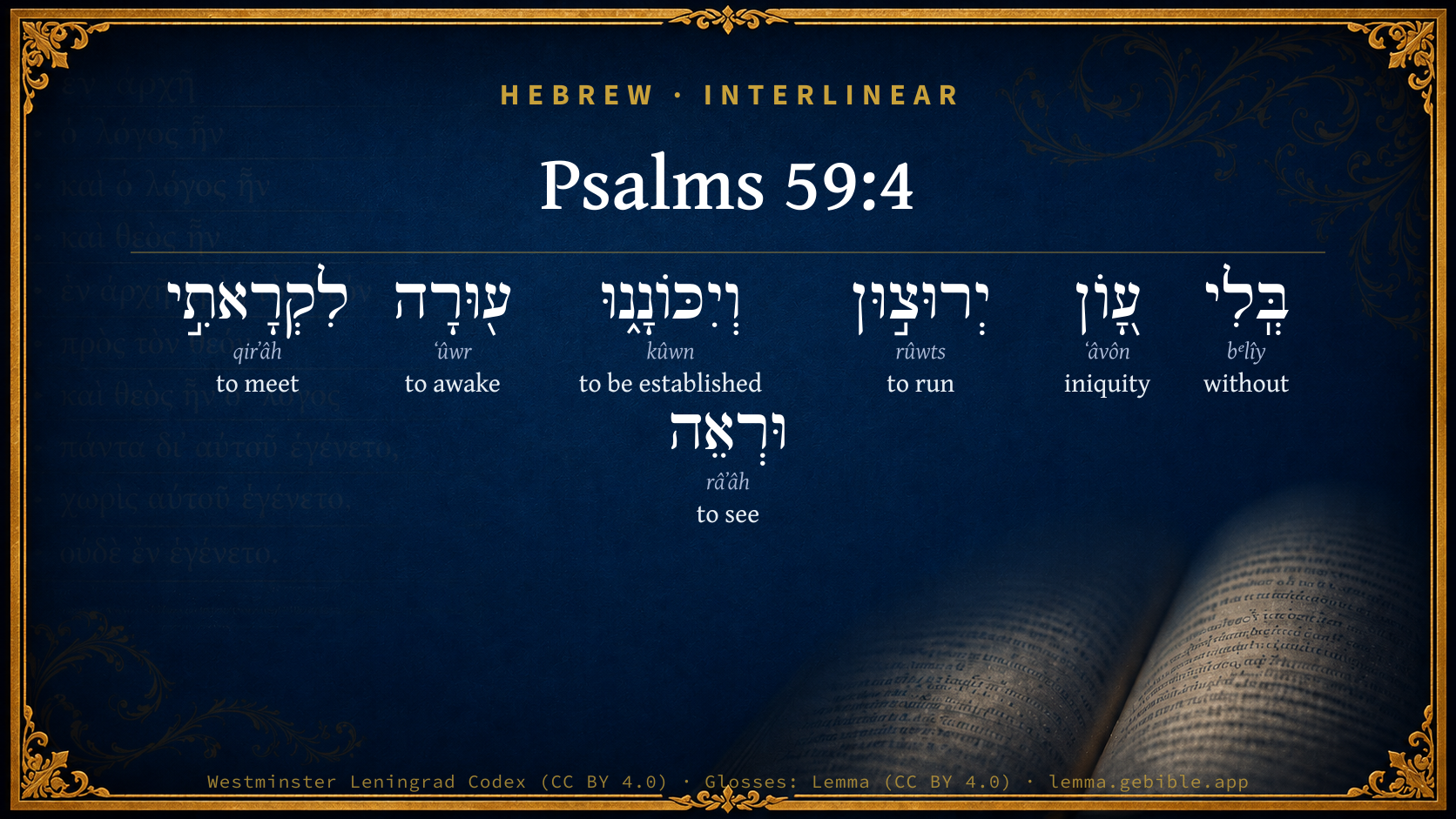
Psalms 59:4

Hebrew (Westminster Leningrad Codex) Psalms 59:4 appears in the Hebrew Old Testament. The text above is from the Westminster Leningrad Codex. Each word links to its Strong’s number, a concise gloss, and parsing drawn from the Open Scriptures Hebrew Bible morphology. Click any word for its full Brown-Driver-Briggs (BDB) entry.
Download image
Cite this verse

Psalms 59:4 (World English Bible). Public Domain. Lemma interlinear Bible study tool, https://lemma.gebible.app/v/psalms/59/4.

Show BibTeX & RIS
BibTeX
RIS
English Translation
I have done no wrong, yet they are ready to attack me. Rise up, behold, and help me!
World English Bible · Public Domain
Download a study sheet

One document with this verse’s original text, its word-by-word gloss line, the meaning frame, cross-references with their text, attributed commentary, and full source and license credits — printable, and it pastes into notes with its structure intact.

This verse Autodidact and up

Study sheet (.html) Plain text (.txt)

A passage Seminary Student

Up to 50 verses in one chapter. A passage sheet keeps up to 6 commentary sources and 12 cross-references per verse, in the order this page ranks them, and says so on the sheet whenever that leaves anything out. Ask for a single verse and you get the Autodidact verse sheet above.

Everything on this page stays free to read, with no account — the sheet is a download of what is already on screen, not access to it.

Want to remove ads? Support Godless Engineer
Compare translations 3

The same verse in 3 English versions, stacked beneath the original-language interlinear above. Click any original word for its lexicon entry.

Each is an independent rendering of the whole verse — the interlinear is not word-aligned to these translations.

Highlighted words mark where these versions differ — a whole-verse word diff, not a word-by-word alignment.

  • World English Bible Public Domain
    I have done no wrong, yet they are ready to attack me. Rise up, behold, and help me!
  • King James Version Public Domain
    They run and prepare themselves without my fault: awake to help me, and behold.
  • unfoldingWord Literal Text CC BY-SA 4.0
    without iniquity, they run and prepare themselves. Awake to meet me, and see!

unfoldingWord Literal Text — © unfoldingWord, licensed CC BY-SA 4.0. Word-aligned USFM3 via Door43 (git.door43.org/unfoldingWord/en_ult).

Versions to compare (up to 4)

3 of 4 selected

Show all 18 translations

Every available English version of this verse, each an independent rendering of the whole verse.

  • World English Bible Public Domain
    I have done no wrong, yet they are ready to attack me. Rise up, behold, and help me!
  • Berean Standard Bible Public Domain
    For no fault of my own, they move swiftly to attack me. Arise to help me, and take notice.
  • Majority Standard Bible Public Domain
    For no fault of my own, they move swiftly to attack me. Arise to help me, and take notice.
  • King James Version Public Domain
    They run and prepare themselves without my fault: awake to help me, and behold.
  • American Standard Version (1901) Public Domain
    They run and prepare themselves without `my' fault: Awake thou to help me, and behold.
  • Revised Version (1885) Public Domain
    They run and prepare themselves without my fault: awake thou to help me, and behold.
  • Geneva Bible (1599) Public Domain
    They runne and prepare themselues without a fault on my part: arise therefore to assist me, and beholde.
  • Douay-Rheims (1899) Public Domain
    For behold they have caught my soul: the mighty have rushed in upon me:
  • Young's Literal Translation Public Domain
    Without punishment they run and prepare themselves, Stir up to meet me, and see.
  • Literal Standard Version CC BY-SA 4.0
    Without punishment they run and prepare themselves, || Stir up to meet me, and see.
  • Unlocked Literal Bible CC BY-SA 4.0
    They prepare to run at me although I am without fault; awake and help me and see.
  • unfoldingWord Literal Text CC BY-SA 4.0
    without iniquity, they run and prepare themselves. Awake to meet me, and see!
  • Darby Bible Public Domain
    They run and prepare themselves without [my] fault: awake to meet me, and behold.
  • World Messianic Bible Public Domain
    I have done no wrong, yet they are ready to attack me. Rise up, behold, and help me!
  • Webster's Bible Public Domain
    \\59:3\\For lo, they lie in wait for my soul: the mighty are gathered against me; not for my transgression, nor for my sin, O LORD.
  • Free Bible Version CC BY-SA 4.0
    Even though I'm not guilty they hurry to prepare an attack on me. Please stand up, come and help me, and see what's going on.
  • Bible in Basic English Public Domain
    For no sin of mine they go quickly and get themselves ready; be awake and come to my help, and see.
  • JPS Tanakh (1917) Public Domain
    (59-5) Without my fault, they run and prepare themselves; awake Thou to help me, and behold.

Literal Standard Version (2020), Covenant Press — licensed CC BY-SA 4.0. Text via the HelloAO Bible API (eBible.org). Unlocked Literal Bible (unfoldingWord) — licensed CC BY-SA 4.0. Text via the HelloAO Bible API (eBible.org). unfoldingWord Literal Text — © unfoldingWord, licensed CC BY-SA 4.0. Word-aligned USFM3 via Door43 (git.door43.org/unfoldingWord/en_ult). Free Bible Version, Dr. Jonathan Gallagher — licensed CC BY-SA 4.0. Text via the HelloAO Bible API (eBible.org).

Word by word

More ways to search: Search by grammar → Find every occurrence → Compare this word →

Practice this passage: Drill this verse → Learn its vocabulary →

About this verse

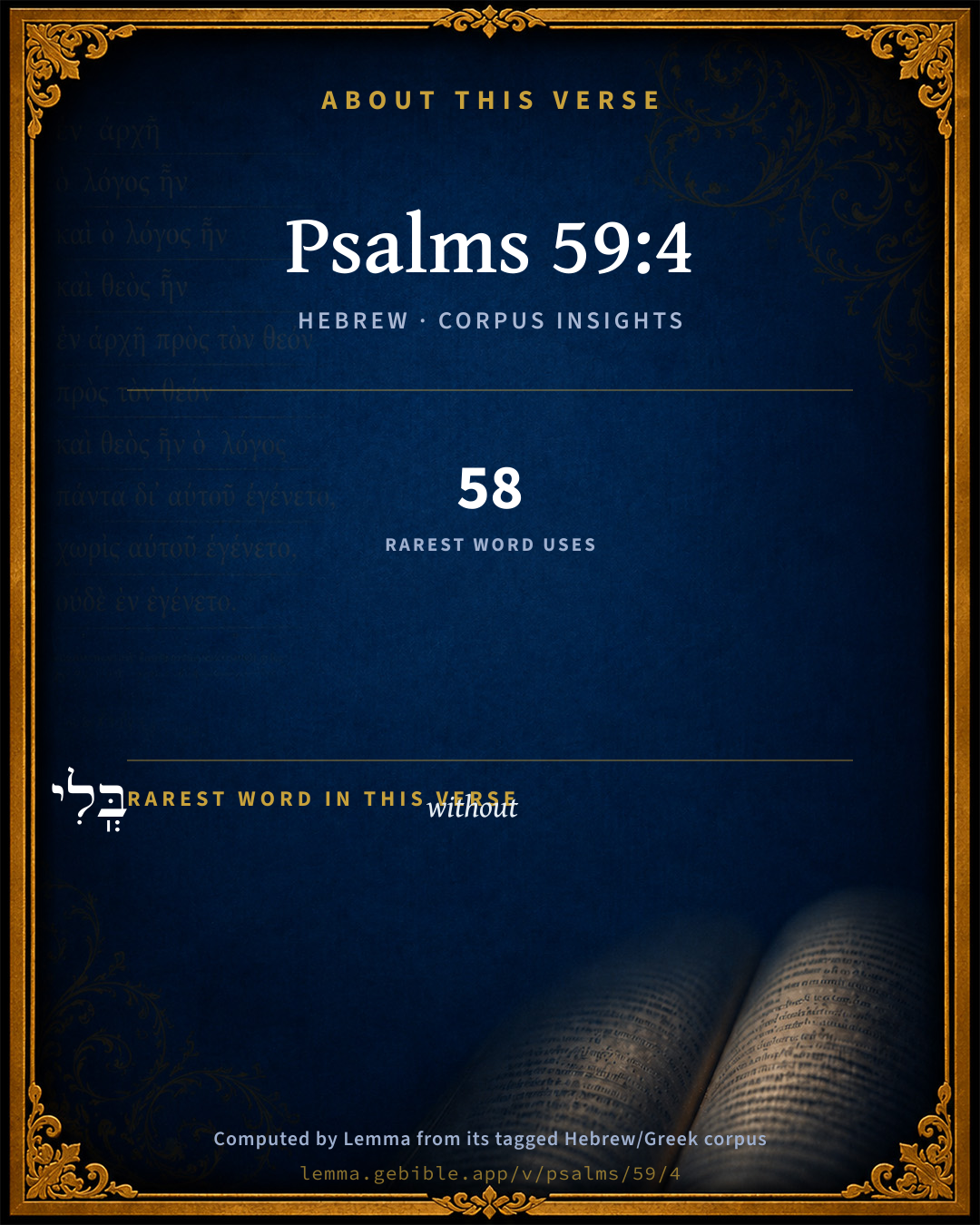
These counts appear in no published source. They are computed here, from the morphology-tagged text and Lemma’s own curated glosses. What Lemma adds →

7
words
7
distinct lemmas
Wisdom
section

Shared distinctive vocabulary

בְּֽלִי without H1097 occurs in 57 verses of the Hebrew Bible. Also found in:

Grammatical profile

  • 5 verbs
  • 1 noun
  • 1 particle

Verb forms

  • יְרוּצ֣וּן Qal · Imperfect
  • וְיִכּוֹנָ֑נוּ Hithpolel · Imperfect
  • ע֖וּרָה Qal · Imperative
  • לִקְרָאתִ֣י Qal · Infinitive Construct
  • וּרְאֵה Qal · Imperative

Hebrew & Septuagint length

In English translation the verse runs 18 words from the Hebrew and 15 from the Septuagint (LXX English) — closely comparable.

A rough comparison of the two English renderings, which tokenize alike — not a word-level alignment.

Word counts can differ between the Hebrew and the Greek without any difference in meaning — e.g. the Hebrew direct-object marker אֵת has no separate Greek word, and Greek often adds the article ὁ.

Cross-references

10

Topical passages linked to Psalms 59:4 in the Treasury of Scripture Knowledge — connected by theme and wording, ordered by reader-vote popularity; previews shown in the World English Bible.

  • Psalms 35:23 Wake up! Rise up to defend me, my God! My Lord, contend for me!
  • 1 Samuel 19:12–24 So Michal let David down through the window: and he went, and fled, and escaped.
  • Psalms 5:6 You will destroy those who speak lies. Yahweh abhors the blood-thirsty and deceitful man.
  • Psalms 35:19 Don't let those who are my enemies wrongfully rejoice over me; Neither let them wink with the eye who hate me without a cause.
  • Psalms 44:23 Wake up! Why do you sleep, Lord? Arise! Don't reject us forever.
  • Proverbs 1:16 For their feet run to evil. They hurry to shed blood.
  • Isaiah 51:9 Awake, awake, put on strength, arm of Yahweh; awake, as in the days of old, the generations of ancient times. Isn't it you who did cut Rahab in pieces, who pierced the monster?
  • Isaiah 59:7 Their feet run to evil, and they make haste to shed innocent blood: their thoughts are thoughts of iniquity; desolation and destruction are in their paths.
  • Acts 23:15 Now therefore, you with the council inform the commanding officer that he should bring him down to you tomorrow, as though you were going to judge his case more exactly. We are ready to kill him before he comes near."
  • Romans 3:15 "Their feet are swift to shed blood.

Cross-references courtesy of OpenBible.info (CC BY 4.0).

Hebrew and Greek witnesses Masoretic Hebrew ↔ Greek Septuagint

The same verse in the two great witnesses to the Old Testament, shown verse-for-verse.

You’re reading Greek Psalm 58 (Hebrew Psalm 59). The Septuagint counts the superscription, so verse numbers can differ from the Hebrew — chapter-level alignment, not verse-by-verse. Numbering follows Rahlfs.

These are two independent witnesses, not word-aligned to each other, and the Septuagint is shown in lemma (dictionary) form.

Hebrew Psalms 59:4 Masoretic · Westminster Leningrad Codex

בְּֽלִי עָ֭וֺן יְרוּצ֣וּן וְיִכּוֹנָ֑נוּ ע֖וּרָה לִקְרָאתִ֣י וּרְאֵה

I have done no wrong, yet they are ready to attack me. Rise up, behold, and help me!

World English Bible · Public Domain

Greek LXX Greek Psalm 58:4 Septuagint · lemma form

ὅτι ἰδού θηρεύω ὁ ψυχή ἐγώ ἐπιτίθημι ἐπί ἐγώ κραταιός οὔτε ὁ ἀνομία ἐγώ οὔτε ὁ ἁμαρτία ἐγώ κύριος

Without iniquity I ran and directed my course aright: awake to help me, and behold.

LXX2012 (modern English Septuagint) · Public Domain

Hebrew: Westminster Leningrad Codex (CC BY 4.0). Greek: Septuagint (public domain); English from LXX2012 (modern English Septuagint) (Public Domain). How the Septuagint differs from the Hebrew →

Commentary

Notes on Psalms 59:4 from classic Christian and Jewish commentators (each source and its license shown beneath its notes). The classic Christian expositions comment on the surrounding passage and are grouped to its opening verse, so a note may address several verses; the Jewish commentaries on the Tanakh (Rashi and others) are per-verse, so they appear only where the commentator wrote on this verse.

Lemma curates 59 commentaries, every one of them public domain or Creative Commons licensed, each selected and text-cleaned for this edition rather than reprinted as found. About our sources →

Trapp's Complete Commentary

John Trapp

Psa 59:4 They run and prepare themselves without [my] fault: awake to help me, and behold.

Ver. 4. They run and prepare themselves] At Saul’s command, never inquiring into the cause, right or wrong; but taking his will for warrant good enough.

Awake to help me] Heb. to meet me, sc. in mercy, Ut occurras et succurras mihi, or, at my calling, as some render it.

And behold] {See Trapp on "Psa 34:15"}

John Trapp, A Commentary or Exposition upon All the Books of the Old and New Testament (1647–1656) — public domain. Text from a community e-Sword module.

Joseph Benson's Commentary

Psa 59:4. They run — To and fro, first to receive Saul’s commands, and then to execute them with all diligence; and prepare themselves — With the utmost speed and fury, to do me a mischief; or, they dispose themselves, as יכוננו, jeconanu, may be properly rendered. They place themselves here and there about my house, that they may catch me when I go out of it. Awake to my help — Hebrew, לקראתי, likraati, to meet me, as I come abroad, and to conduct me away with safety. And behold — With an eye of pity; take cognizance of my case, and exert thy power for my relief.

Joseph Benson's Commentary on the Old and New Testaments (1811–1818) — public domain. Text from a community e-Sword module.

J. A. Alexander on Psalms

Joseph Addison Alexander

5. (Psa 59:4). Without iniquity (on my part, to excuse or even to provoke them) they run and set themselves (against me). Both these are military terms, and seem to denote strictly the scaling of a wall. See above, on Psa 18:29. Awake (arouse thyself from this apparent inactivity) to meet me (to respond to my petition), and see (my danger, and the malice of my enemies).

Joseph Addison Alexander, The Psalms Translated and Explained (1850) — public domain. Text from a community e-Sword module.

Tyndale Open Study Notes

Tyndale Open Resources

59:4-5 The psalmist asks God to show the treacherous, deceptive, and wicked traitors no mercy (see 25:2).

Tyndale Open Study Notes — © Tyndale Open Resources, licensed CC BY-SA 4.0. Text via the HelloAO Bible API.

Jamieson, Fausset & Brown

Robert Jamieson, A. R. Fausset & David Brown

prepare, &c.--literally, "set themselves as in array."

awake--(Compare Psa 3:7; Psa 7:6), appeals to God in His covenant relation to His people (Psa 9:18).

Jamieson, Fausset & Brown — Commentary Critical and Explanatory on the Whole Bible (1871) — public domain (CC PDM 1.0). Text via the HelloAO Bible API.

Adam Clarke's Commentary

Verse 4. They run and prepare themselves] They leave no stone unturned that they may effect my destruction and prevent the building.

Adam Clarke's Commentary on the Bible (1810–1826) — public domain. Text from a community e-Sword/MySword module.

John Calvin's Commentaries

4. Awake to hasten for my help, and behold. In using this language, he glances at the eagerness with which his enemies, as he had already said, were pressing upon him, and states his desire that God would show the same haste in extending help as they did in seeking his destruction. With the view of conciliating the divine favor, he once more calls upon God to be the witness and judge of his cause, adding, and behold The expression is one which savours at once of faith and of the infirmity of the flesh. In speaking of God, as if his eyes had been hitherto shut to the wrongs which he had suffered, and needed now for the first time to be opened for the discovery of them, he expresses himself according to the weakness of our human apprehension. On the other hand, in calling upon God to behold his cause, he shows his faith by virtually acknowledging that nothing was hid from his providential cognisance. Though David may use language of this description, suited to the infirmity of sense, we must not suppose him to have doubted before this time that his afflictions, his innocence, and his wrongs, were known to God. Now, however, he lays the whole before God for examination and decision.

He prosecutes the same prayer with still greater vehemency in the verse which succeeds. He addresses God under new titles, calling him Jehovah, God of Hosts, and the God of Israel, the first of which appellations denotes the immensity of his power, and the second the special care which he exerts over the Church, and over all his people. The manner in which the pronoun is introduced, and Thou, etc., is emphatical, denoting that it was as impossible for God to lay aside the office of a judge as to deny himself, or divest himself of his being. He calls upon him to visit all the nations: for although the cause which he now submitted was of no such universal concernment, the wider exercise of judgment would necessarily include the lesser; and on the supposition of heathens and foreigners being subjected to the judgment of God, it followed that a still more certain and heavy doom would be awarded to enemies within the pale of the Church, who persecuted the saints under the guise of brethren, and overthrew those laws which were of divine appointment. The opposition which David encountered might not embrace all nations; but if these were judicially visited by God, it was absurd to imagine that those within the Church would be the only enemies who should escape with impunity. In using these words, it is probable also that he may have been struggling with a temptation with which he was severely assailed, connected with the number of his enemies, for these did not consist merely of three or four abandoned individuals. They formed a great multitude; and he rises above them all by reflecting that God claims it as his prerogative, not only to reduce a few refractory persons to submission, but to punish the wickedness of the whole world. If the judgments of God extended to the uttermost parts of the earth, there was no reason why he should be afraid of his enemies, who, however numerous, formed but a small section of the human race. We shall shortly see, however, that the expression admits of being applied without impropriety to the Israelites, divided, as they were, into so many tribes or peoples. In the words which follow, when he deprecates the extension of God’s mercy to wicked transgressors, we must understand him as referring to the reprobate, whose sin was of a desperate character. We must also remember, what has been already observed, that in such prayers he was not influenced by mere private feelings, and these of a rancorous, distempered, and inordinate description. Not only did he know well that those of whom he speaks with such severity were already doomed to destruction, but he is here pleading the common cause of the Church, and this under the influence of the pure and well-regulated zeal of the Spirit. He therefore affords no precedent to such as resent private injuries by vending curses on those who have inflicted them.

John Calvin's Commentaries (1540-1563) — public domain. Text from the Calvin Translation Society English edition (1840s-50s) via the Christian Classics Ethereal Library (ccel.org). Calvin's coverage is partial (roughly two-thirds of the Bible); uncommented books and verses are honest gaps, never fabricated. The 19th-century editor's footnotes and remarks are omitted so the notes are faithfully Calvin's own voice.

Ellicott's Commentary for English Readers

(4) They run and prepare.—These words might both be taken in a military sense. For “run,” see Psa_18:29; Job_15:26; Job_16:14.

Help me.—Literally, as in margin, meet. It is found in a hostile sense, and never in the sense of helping. A suggested emendation, “Awake to my calling, and behold,” removes the difficulty.

A Bible Commentary for English Readers, edited by Charles John Ellicott (1878–1897) — public domain. Text from a community e-Sword module.

John Gill's Exposition

They run and prepare themselves without my fault,.... Or, "without sin in me"; or "without punishment in them"; so the same word is rendered, Sa1 28:10. "They run", in an hostile manner, "against me", as the Syriac version adds; or like dogs up and down, about the city, to find him and kill him; see Psa 59:7. Or this may denote their readiness and swiftness to shed blood, Pro 1:16; "and prepare themselves" with weapon, with instruments of death, as the men did that were sent to kill him; and as the band of men that came with Judas to take Christ prepared themselves with swords and staves. The Targum is,

"they order or ordain war;''

which they prosecuted without any occasion of it from him, and wilt, impunity in them. Wherefore it follows,

awake to help me; or "to meet me" (n); see Gen 46:29; with succour and supplies, and to deliver out of the hands of enemies. The Lord, though he neither slumbers nor sleeps, yet seems to be asleep when he does not arise to help his people, but suffers the enemy to prevail; and when he seems to take no notice of their case, but hides his eyes, and shuts them as a man asleep. Hence the following petition,

and behold; the distress the psalmist was in, and the wickedness and malice of his enemies against him.

(n) "in occursum meum", V. L. Pagninus, Montanus, Gejerus, Michaelis.

John Gill's Exposition of the Whole Bible (1746–1763) — public domain (CC PDM 1.0). Text via the HelloAO Bible API.

Albert Barnes' Notes on the Bible

They run and prepare themselves - That is, they “hasten” to accomplish this; they are quick to obey the command of Saul requiring them to slay me. The word “prepare” refers to whatever was deemed necessary to enable them to accomplish what they had been commanded to do - arming themselves, making provision for their journey, etc.

Without my fault - That is, without anything on my part to deserve this, or to justify Saul and those employed by him in what they attempt to do. David, in all this, was conscious of innocence. In his own feelings toward Saul, and in all his public acts, he knew that he had sought only the king’s welfare, and that he had been obedient to the laws.

Awake to help me - That is, “arouse,” as one does from sleep. See the notes at Psa 7:6. Compare Psa 35:23. The word rendered “to help me,” is rendered in the margin, “to meet me.” This is the meaning of the Hebrew. It is a prayer that God would meet him, or come to him, and aid him.

Albert Barnes' Notes on the Bible (1834–1885) — public domain. Text from a community e-Sword/MySword module.

Matthew Poole's English Annotations

They run to and fro, first to receive Saul’s commands and then to execute them with all speed and diligence.

Prepare themselves; or, dispose themselves, here and there round about my house, that they may catch me when I go out of it.

To help me, Heb. to meet me, as I come abroad and to conduct me away with safety.

Matthew Poole's English Annotations on the Holy Bible (1683–1685) — public domain. Text from a community e-Sword/MySword module.

The Treasury of David

Charles H. Spurgeon

Ver. 4. They run and prepare themselves without my fault. They are all alive and active, they are swift to shed blood. They prepare and use their best tactics; they besiege me in my house, and lay their ambuscades as for some notable enemy. They come up fully armed to the attack, and assail me with all the vigour and skill of a host about to storm a castle; and all for no cause, but out of gratuitous malice. So quick are they to obey their cruel master, that they never stay to consider whether their errand is a good one or not; they run at once, and buckle on their harness as they run. To be thus gratuitously attacked is a great grief. To a brave man the danger causes little distress of mind compared with the injustice to which he is subjected. It was a cruel and crying shame that such a hero as David should be hounded down as if he were a monster, and beset in his house like a wild beast in its den.

Awake to help me, and behold. When others go to sleep, keep thou watch, O God. Put forth thy might. Arouse thee from thy inaction. Only look at thy servant's sad condition and thy hand will be sure to deliver me. We see how thorough was the psalmist's faith in the mercy of his Lord, for he is satisfied that if the Lord do but look on his case it will move his active compassion.

Ver. 4. They run, as armed warriors rushing to the assault (Ps 18:29). The Hebrew for "prepare themselves, "(Heb.) means also "they establish themselves; "they make firm their footing, like forces assaulting a city. Job 30:14. A. R. Fausset.

Ver. 4. They run and prepare. The zeal and diligence of the wicked in the cause of unrighteousness might well reprove the languor and tardiness of saints in the work of faith and labour of love. In the church of God nothing is the source of more mischief than the want of true zeal and liveliness. It is only when "many run to and fro" that "knowledge shall be increased." William S. Plumer.

Ver. 4. Without fault. As it respected Saul, he was a faithful subject and an obedient son-in-law. Benjamin Boothroyd.

Ver. 4. Awake to help me, literally, Awake to meet me. In time of temptation the Lord seems to be absent from us, and not to observe our distress--to be, as it were, as Jesus, in the storm, is described as having been "asleep in the hinder part of the ship." Mr 4:38. But it is only an appearance; the Lord neither slumbers nor sleeps (Ps 121:4); he is always ready to come to our help when we call upon him. O. Prescott Hiller.

Ver. 4. And behold. The expression is one which savours at once of faith and of the infirmity of the flesh. In speaking of God, as if his eyes had been hitherto shut to the wrongs which he had suffered, and needed now for the first time to be opened for the discovery of them, he expresses himself according to the weakness of our human apprehension. On the other hand, in calling upon God to behold his cause, he shows his faith by virtually acknowledging that nothing was hid from his providential cognisance. John Calvin.

Ver. 4. The activity of the evil a rebuke for the good.

I. Their activity, run.

II. Unanimity--they run.

III. Their care--prepare themselves.

IV. Their readiness--without my fault.

Psalms 59:5*

Charles H. Spurgeon's The Treasury of David (1869–1885) — public domain. Psalms only. Text from a community e-Sword/MySword module.

Whedon's Commentary on the Bible

Daniel D. Whedon

4. They run and prepare themselves—Military terms to denote the rapidity and order of their movements, and their eagerness for the combat.

Awake to help me—Hebrew, to meet me. He prays that God’s movement to meet him as a protector may be more expeditious than theirs to destroy him.

Daniel D. Whedon (gen. ed.), Commentary on the Old and New Testaments (1874–1909) — public domain. Text from a community e-Sword module.

The Pulpit Commentary

They run and prepare themselves without my fault; or, "establish themselves up their position" (so Hengstenberg, Kay, and Professor Cheyne). Awake to help me. (see the comment on Psa_44:23) And behold; i.e. "see how things are how innocent I am; how unjust and cruel are my enemies!"

The Pulpit Commentary (1880–1919), ed. H.D.M. Spence-Jones & Joseph S. Exell — public domain. Text from a community e-Sword module.

John Wesley's Explanatory Notes

Run - To and fro, to receive Saul's commands, and to execute them with all speed.

John Wesley, Explanatory Notes Upon the Whole Bible (1754–1765) — public domain. Text via the GEBible commentary corpus.

Rashi

Rabbi Shlomo Yitzchaki (Rashi)

[they] lodge against me to enter my house, to guard me.

Rashi on the Tanakh — English translations: “The Judaica Press complete Tanach with Rashi, translated by A. J. Rosenberg” (CC BY 4.0); “Pentateuch with Rashi's commentary by M. Rosenbaum and A.M. Silbermann, 1929-1934” (public domain); “The Metsudah Tanach series, Lakewood, N.J” (CC BY 4.0); and “The Book of Joshua, Metsudah Publications, 1997” (CC BY 4.0). Text via Sefaria.

Lesson kit

Teaching starters — assembled from the data on this page, not authored interpretation. Every prompt links to the verse data it draws on. Edit before teaching.

Psalms, in the Wisdom, opens this verse with 7 words (7 distinct Hebrew lemmas). Its most distinctive word is bᵉlîy (“without”). A historical commentator’s framing appears above. Read the whole chapter for the surrounding context.

Discussion questions

  1. The word bᵉlîy carries the sense “without.” How does it shape the verse?
  2. Genesis 31:20 shares the word «without» with this verse. How do the two illuminate each other?
  3. The translations on this page render this verse differently — a whole-verse word diff, not a word-by-word alignment. What might account for the different wordings?
  4. The verb «יְרוּצ֣וּן» is Qal Imperfect. How does its form color the action?
  5. Reading how Trapp's Complete Commentary and Joseph Benson's Commentary read this verse, where do the two commentators agree and where do they part?

Things to notice

Reading settings

Reading text

Shown beneath each verse's original-language words.

Old Testament
Old Testament edition

Read the OT as the Masoretic Hebrew (MT) or the Greek Septuagint (LXX).

English shown for the Greek Septuagint (in the Hebrew ↔ Greek comparison).

Comparing translations? Open the Compare panel on any verse page to stack up to four side by side.