
Job 21:8

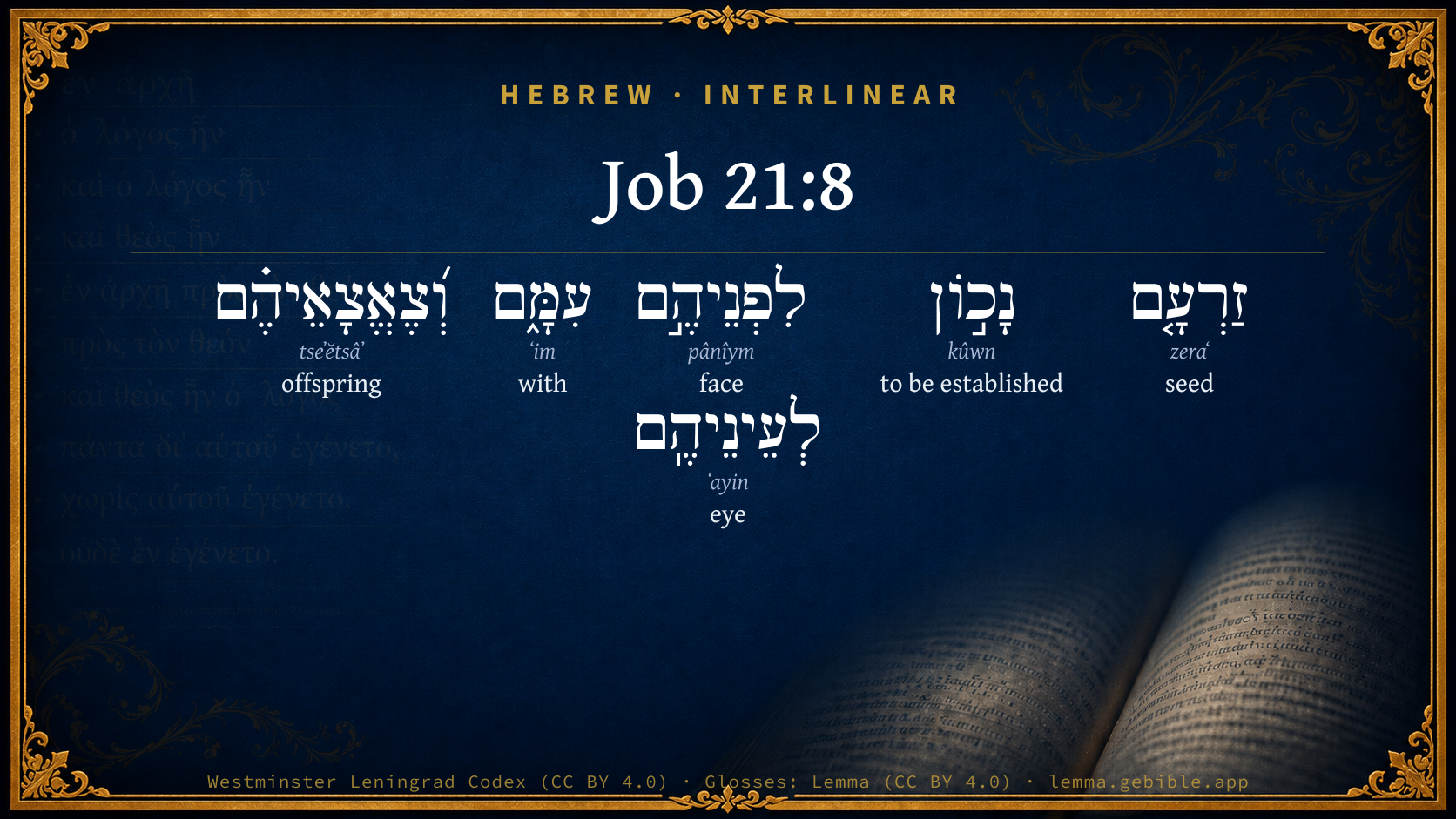
Hebrew (Westminster Leningrad Codex) Job 21:8 appears in the Hebrew Old Testament. The text above is from the Westminster Leningrad Codex. Each word links to its Strong’s number, a concise gloss, and parsing drawn from the Open Scriptures Hebrew Bible morphology. Click any word for its full Brown-Driver-Briggs (BDB) entry.
Download image
Cite this verse

Job 21:8 (World English Bible). Public Domain. Lemma interlinear Bible study tool, https://lemma.gebible.app/v/job/21/8.

Show BibTeX & RIS
BibTeX
RIS
English Translation
Their child is established with them in their sight, Their offspring before their eyes.
World English Bible · Public Domain
Download a study sheet

One document with this verse’s original text, its word-by-word gloss line, the meaning frame, cross-references with their text, attributed commentary, and full source and license credits — printable, and it pastes into notes with its structure intact.

This verse Autodidact and up

Study sheet (.html) Plain text (.txt)

A passage Seminary Student

Up to 50 verses in one chapter. A passage sheet keeps up to 6 commentary sources and 12 cross-references per verse, in the order this page ranks them, and says so on the sheet whenever that leaves anything out. Ask for a single verse and you get the Autodidact verse sheet above.

Everything on this page stays free to read, with no account — the sheet is a download of what is already on screen, not access to it.

Want to remove ads? Support Godless Engineer
Compare translations 3

The same verse in 3 English versions, stacked beneath the original-language interlinear above. Click any original word for its lexicon entry.

Each is an independent rendering of the whole verse — the interlinear is not word-aligned to these translations.

Highlighted words mark where these versions differ — a whole-verse word diff, not a word-by-word alignment.

  • World English Bible Public Domain
    Their child is established with them in their sight, Their offspring before their eyes.
  • King James Version Public Domain
    Their seed is established in their sight with them, and their offspring before their eyes.
  • unfoldingWord Literal Text CC BY-SA 4.0
    Their seed is established with them to their faces, and their descendants to their eyes.

unfoldingWord Literal Text — © unfoldingWord, licensed CC BY-SA 4.0. Word-aligned USFM3 via Door43 (git.door43.org/unfoldingWord/en_ult).

Versions to compare (up to 4)

3 of 4 selected

Show all 18 translations

Every available English version of this verse, each an independent rendering of the whole verse.

  • World English Bible Public Domain
    Their child is established with them in their sight, Their offspring before their eyes.
  • Berean Standard Bible Public Domain
    Their descendants are established around them, and their offspring before their eyes.
  • Majority Standard Bible Public Domain
    Their descendants are established around them, and their offspring before their eyes.
  • King James Version Public Domain
    Their seed is established in their sight with them, and their offspring before their eyes.
  • American Standard Version (1901) Public Domain
    Their seed is established with them in their sight, And their offspring before their eyes.
  • Revised Version (1885) Public Domain
    Their seed is established with them in their sight, and their offspring before their eyes.
  • Geneva Bible (1599) Public Domain
    Their seede is established in their sight with them, and their generation before their eyes.
  • Douay-Rheims (1899) Public Domain
    Their seed continueth before them, a multitude of kinsmen, and of children's children in their sight.
  • Young's Literal Translation Public Domain
    Their seed is established, Before their face with them, And their offspring before their eyes.
  • Literal Standard Version CC BY-SA 4.0
    Their seed is established, || Before their face with them, || And their offspring before their eyes.
  • Unlocked Literal Bible CC BY-SA 4.0
    Their descendants are established with them in their sight, and their offspring are established before their eyes.
  • unfoldingWord Literal Text CC BY-SA 4.0
    Their seed is established with them to their faces, and their descendants to their eyes.
  • Darby Bible Public Domain
    Their seed is established with them in their sight, and their offspring before their eyes.
  • World Messianic Bible Public Domain
    Their child is established with them in their sight, their offspring before their eyes.
  • Webster's Bible Public Domain
    Their seed is established in their sight with them, and their offspring before their eyes.
  • Free Bible Version CC BY-SA 4.0
    Their children are with them; they watch their grandchildren grow up.
  • Bible in Basic English Public Domain
    Their children are ever with them, and their offspring before their eyes.
  • JPS Tanakh (1917) Public Domain
    Their seed is established in their sight with them, and their offspring before their eyes.

Literal Standard Version (2020), Covenant Press — licensed CC BY-SA 4.0. Text via the HelloAO Bible API (eBible.org). Unlocked Literal Bible (unfoldingWord) — licensed CC BY-SA 4.0. Text via the HelloAO Bible API (eBible.org). unfoldingWord Literal Text — © unfoldingWord, licensed CC BY-SA 4.0. Word-aligned USFM3 via Door43 (git.door43.org/unfoldingWord/en_ult). Free Bible Version, Dr. Jonathan Gallagher — licensed CC BY-SA 4.0. Text via the HelloAO Bible API (eBible.org).

Word by word

More ways to search: Search by grammar → Find every occurrence → Compare this word →

Practice this passage: Drill this verse → Learn its vocabulary →

וְ֝צֶאֱצָאֵיהֶ֗ם
tseʼĕtsâʼ
H6631
“and · offspring · their”
Conjunction + Noun, Common, Masculine, Plural, Construct + Suffix, Personal, 3rd Person, Masculine, Plural
Part of Speech
Conjunction + Noun
Type
Common
Gender
Masculine
Number
Plural
State
Construct
Full BDB Definition

Origin: from H3318

TWOT: 893b

offspring, produce, issue - offspring (of men) - produce (of earth) - descendants (metaphorical)
  1. זַרְעָ֤ם zeraʻ H2233 “seed · their” Noun, Common, Masculine, Singular, Construct + Suffix, Personal, 3rd Person, Masculine, Plural
  2. נָכ֣וֹן kûwn H3559 “being established” Verb, Niphal, Participle Active, Masculine, Singular, Absolute
  3. לִפְנֵיהֶ֣ם pânîym H6440 “to/for · face(s) · their” Preposition + Noun, Common, Both, Plural, Construct + Suffix, Personal, 3rd Person, Masculine, Plural
  4. עִמָּ֑ם ʻim H5973 “with · them” Preposition + Suffix, Personal, 3rd Person, Masculine, Plural
  5. לְעֵינֵיהֶֽם ʻayin H5869 “to/for · eyes · their” Preposition + Noun, Common, Both, Dual, Construct + Suffix, Personal, 3rd Person, Masculine, Plural

About this verse

These counts appear in no published source. They are computed here, from the morphology-tagged text and Lemma’s own curated glosses. What Lemma adds →

6
words
6
distinct lemmas
Wisdom
section

Notable vocabulary

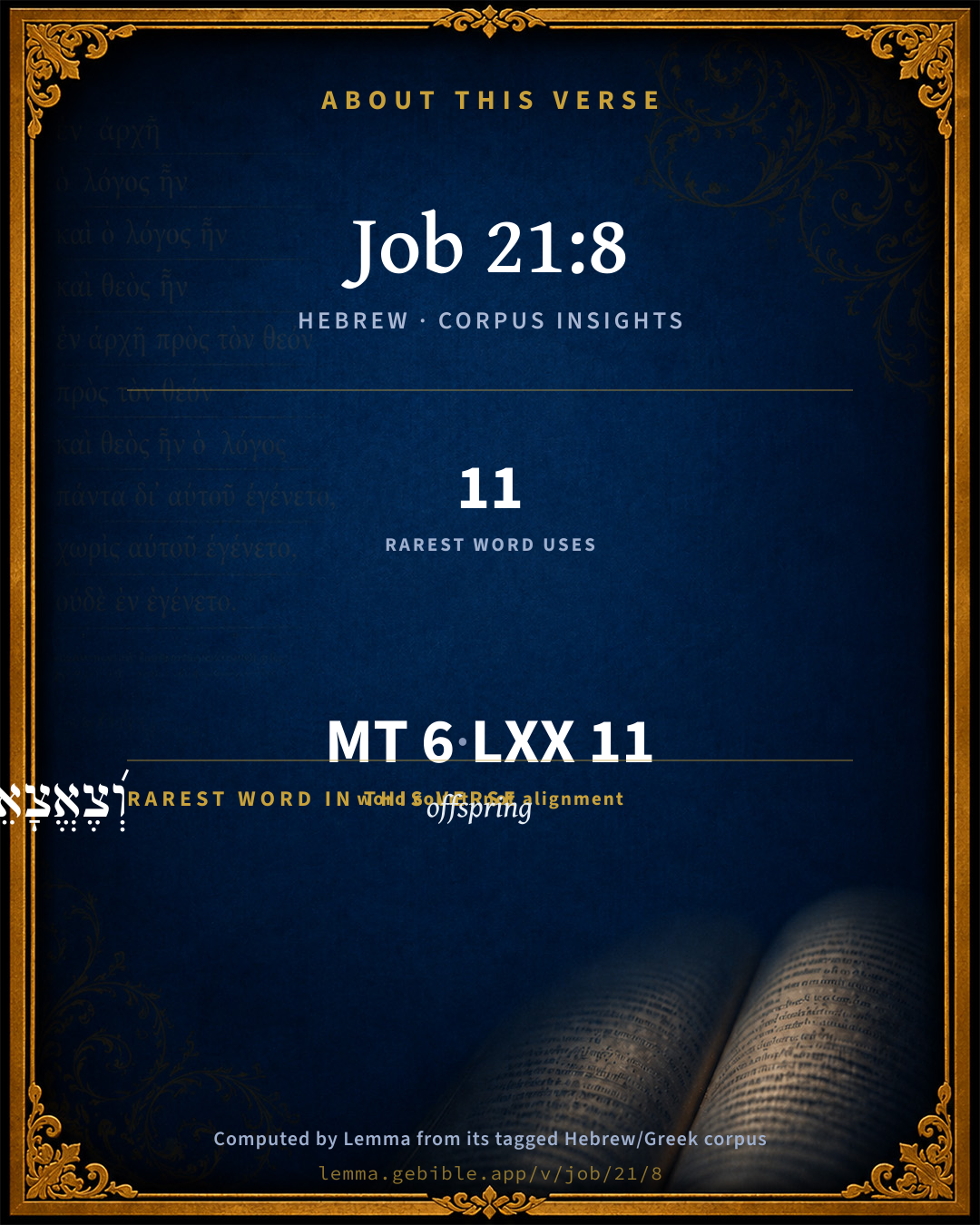
The rarest word here is וְ֝צֶאֱצָאֵיהֶ֗ם offspring H6631 — appearing just 11 times in the whole Hebrew Bible.

Shared distinctive vocabulary

וְ֝צֶאֱצָאֵיהֶ֗ם offspring H6631 occurs in 11 verses of the Hebrew Bible. Also found in:

Grammatical profile

  • 1 verb
  • 4 nouns
  • 1 preposition

Verb forms

  • נָכ֣וֹן Niphal · Participle Active

Hebrew & Septuagint length

In English translation the verse runs 14 words from the Hebrew and 14 from the Septuagint (LXX English) — the same length.

A rough comparison of the two English renderings, which tokenize alike — not a word-level alignment.

Word counts can differ between the Hebrew and the Greek without any difference in meaning — e.g. the Hebrew direct-object marker אֵת has no separate Greek word, and Greek often adds the article ὁ.

In the original languages it is 6 Hebrew tokens and 11 Greek tokens — but the two are counted differently (Hebrew bundles its prefixes and suffixes into one token; the Greek is in lemma form), so that isn’t a like-for-like length.

Cross-references

6

Topical passages linked to Job 21:8 in the Treasury of Scripture Knowledge — connected by theme and wording, ordered by reader-vote popularity; previews shown in the World English Bible.

  • Proverbs 17:6 Children's children are the crown of old men; The glory of children are their parents.
  • Job 5:3–4 I have seen the foolish taking root, But suddenly I cursed his habitation.
  • Job 18:19 He shall have neither son nor grandson among his people, Nor any remaining where he sojourned.
  • Job 20:10 His children shall seek the favor of the poor. His hands shall give back his wealth.
  • Job 20:28 The increase of his house shall depart; They shall rush away in the day of his wrath.
  • Psalms 17:14 From men by your hand, Yahweh, From men of the world, whose portion is in this life. You fill the belly of your cherished ones. Your sons have plenty, And they store up wealth for their children.

Cross-references courtesy of OpenBible.info (CC BY 4.0).

Hebrew and Greek witnesses Masoretic Hebrew ↔ Greek Septuagint

The same verse in the two great witnesses to the Old Testament, shown verse-for-verse.

These are two independent witnesses, not word-aligned to each other, and the Septuagint is shown in lemma (dictionary) form.

Hebrew Job 21:8 Masoretic · Westminster Leningrad Codex

זַרְעָ֤ם נָכ֣וֹן לִפְנֵיהֶ֣ם עִמָּ֑ם וְ֝צֶאֱצָאֵיהֶ֗ם לְעֵינֵיהֶֽם

Their child is established with them in their sight, Their offspring before their eyes.

World English Bible · Public Domain

Greek LXX Job 21:8 Septuagint · lemma form

ὁ σπόρος αὐτός κατά ψυχή ὁ δέ τέκνον αὐτός ἐν ὀφθαλμός

Their seed is according to their desire, and their children are in their sight.

LXX2012 (modern English Septuagint) · Public Domain

Hebrew: Westminster Leningrad Codex (CC BY 4.0). Greek: Septuagint (public domain); English from LXX2012 (modern English Septuagint) (Public Domain). How the Septuagint differs from the Hebrew →

Commentary

Notes on Job 21:8 from classic Christian and Jewish commentators (each source and its license shown beneath its notes). The classic Christian expositions comment on the surrounding passage and are grouped to its opening verse, so a note may address several verses; the Jewish commentaries on the Tanakh (Rashi and others) are per-verse, so they appear only where the commentator wrote on this verse.

Lemma curates 59 commentaries, every one of them public domain or Creative Commons licensed, each selected and text-cleaned for this edition rather than reprinted as found. About our sources →

Trapp's Complete Commentary

John Trapp

Job 21:8 Their seed is established in their sight with them, and their offspring before their eyes.

Ver. 8. Their seed is established in their sight with them] Some understand it of their seed sown in the fields, nor blasted nor wasted, but timely gathered into their barns and granaries; and so by offspring, Germina, they, taking it literally, conceive to be meant their plants, trees, flowers, fruits, all which come kindly, and grow to their minds. But better interpret it of their children and nephews, whom they have many, healthy, lusty, and lively, Multos, sanos, vegetos, et viraces, and not unfitly compared to seed; as if the parents were but only the husks; and to branches or sprigs, because they may be, and must be, bent betime to the best things, before they be aged and crooked in their evil practices, refusing to be rectified.

And their offspring before their eyes] This is the same with that before, and is repeated, because a singular happiness, to see their children prosper as much as themselves. This is a third time instanced, Job 21:11.

John Trapp, A Commentary or Exposition upon All the Books of the Old and New Testament (1647–1656) — public domain. Text from a community e-Sword module.

Tyndale Open Study Notes

Tyndale Open Resources

21:8 In spite of assertions by Eliphaz (5:4), Bildad (18:19), and Zophar (20:10), Job noted that the wicked enjoy children and grandchildren, which should be the reward of the righteous (Prov 17:6) but was apparently not going to be his own reward (Job 1:18-19; but see 42:13-16).

Tyndale Open Study Notes — © Tyndale Open Resources, licensed CC BY-SA 4.0. Text via the HelloAO Bible API.

Jamieson, Fausset & Brown

Robert Jamieson, A. R. Fausset & David Brown

In opposition to Job 18:19; Job 5:4.

Jamieson, Fausset & Brown — Commentary Critical and Explanatory on the Whole Bible (1871) — public domain (CC PDM 1.0). Text via the HelloAO Bible API.

Adam Clarke's Commentary

Verse 8. Their seed is established] They see their own children grow up, and become settled in the land; and behold their children's children also; so that their generations are not cut off. Even the posterity of the wicked continue.

Adam Clarke's Commentary on the Bible (1810–1826) — public domain. Text from a community e-Sword/MySword module.

Ellicott's Commentary for English Readers

(8) Their seed is established in their sight.—Not only are they mighty in power themselves, but they leave their power to their children after them (comp. Psa_17:14). This contradicts what Eliphaz had said (Job_15:34), what Bildad had said (Job_18:19), and what Zophar had said (Job_20:10).

A Bible Commentary for English Readers, edited by Charles John Ellicott (1878–1897) — public domain. Text from a community e-Sword module.

The Cambridge Bible for Schools and Colleges

gen. ed. J. J. S. Perowne

8. They have the additional felicity of seeing their children grow up beside them—a pathetic touch from the hand of the man whose sons had been taken from him.

The Cambridge Bible for Schools and Colleges (gen. ed. J. J. S. Perowne; Cambridge University Press, 1878–1918) — public domain. Text from a community e-Sword module.

John Gill's Exposition

Their houses are safe from fear,.... Of enemies besetting them, entering into them, and pillaging and plundering them; of thieves and robbers breaking into them, and carrying off their substance: or "their houses are peace" (o); their families live in peace among themselves, or enjoy all prosperity, which the word peace frequently signifies; they have peace and prosperity within doors and are free "from fear", or devoid of fear, from anything without;

neither is the rod of God upon them; neither his rod of chastisement, which is upon his own people, and with which he scourges every son, though in love for their good, and which was now upon Job, Job 9:34; nor any sore judgment, as famine, plague, sword, or any other; no, not even the common afflictions and troubles that men are exercised with.

(o) "pax", Montanus, Junius & Tremellius, Schultens.

John Gill's Exposition of the Whole Bible (1746–1763) — public domain (CC PDM 1.0). Text via the HelloAO Bible API.

Albert Barnes' Notes on the Bible

Their seed - Their children - their posterity.

Is established in their sight - Around them, where they may often see them - where they may enjoy their society. The friends of Job had maintained, with great positiveness and earnestness, that the children of wicked people would be cut off. See Job 18:19; Job 20:28. This position Job now directly controverts, and says that it is a fact, that so far from being cut off, they are often established in the very presence of their ungodly parents, and live and prosper. How, he asks, is this consistent with the position, that God deals with people in this life according to their character?

Albert Barnes' Notes on the Bible (1834–1885) — public domain. Text from a community e-Sword/MySword module.

Haydock's Catholic Bible Commentary

Sight. The Jews esteemed this as the greatest blessing and mark of God’s favour. Yet it was also equivocal, as it was often possessed by the wicked. (Calmet)

George Leo Haydock (1774–1849), Haydock's Catholic Family Bible and Commentary, 1859 edition — public domain. Excludes Psalms (Douay-Rheims chapter numbering differs from Protestant) and Deuterocanonical books (Catholic canon only).

Matthew Poole's English Annotations

Their seed; either,

1. The fruits of their ground; or rather,

2. Their children; as it is explained in the next branch of the verse, the words both here and there used being commonly so understood.

Their seed is established, i.e. they multiply and prosper greatly. In their sight; which is a great addition to their happiness.

Matthew Poole's English Annotations on the Holy Bible (1683–1685) — public domain. Text from a community e-Sword/MySword module.

Whedon's Commentary on the Bible

Daniel D. Whedon

8. Their offspring — The children of the wicked live on, while his own are dead. The thought which he twice repeats in this verse, and which he resumes in the 11th, by contrast points most pathetically to the darkest phase of his inexpressible calamity, of which it is to be remarked he never directly speaks. This very silence, more eloquent than words, is the natural outgrowth of untold calamity, (Job_6:3.) The naturalness of the book, seemingly beyond the power of invention, must impress the reader at every step.

Daniel D. Whedon (gen. ed.), Commentary on the Old and New Testaments (1874–1909) — public domain. Text from a community e-Sword module.

The Pulpit Commentary

Their seed is established in their sight with them. (comp. Psa_17:14; and see below, Job_27:14) It could scarcely be doubted that the wicked had as many children as the righteous, and often established them in posts of honour and emolument. And their offspring before their eyes. A pleonastic repetition.

The Pulpit Commentary (1880–1919), ed. H.D.M. Spence-Jones & Joseph S. Exell — public domain. Text from a community e-Sword module.

Lesson kit

Teaching starters — assembled from the data on this page, not authored interpretation. Every prompt links to the verse data it draws on. Edit before teaching.

Job, in the Wisdom, opens this verse with 6 words (6 distinct Hebrew lemmas). Its most distinctive word is tseʼĕtsâʼ (“offspring”). A historical commentator’s framing appears above. Read the whole chapter for the surrounding context.

Discussion questions

  1. What does “offspring” (tseʼĕtsâʼ) contribute to the verse as a whole?
  2. Job 5:25 shares the word «offspring» with this verse. How do the two illuminate each other?
  3. These translations render this verse differently; the difference is in the English rendering, not the original. What questions does that raise?
  4. The verb «נָכ֣וֹן» is Niphal Participle Active. How does its form color the action?
  5. Reading how Trapp's Complete Commentary and Tyndale Open Study Notes read this verse, where do the two commentators agree and where do they part?

Things to notice

Reading settings

Reading text

Shown beneath each verse's original-language words.

Old Testament
Old Testament edition

Read the OT as the Masoretic Hebrew (MT) or the Greek Septuagint (LXX).

English shown for the Greek Septuagint (in the Hebrew ↔ Greek comparison).

Comparing translations? Open the Compare panel on any verse page to stack up to four side by side.