
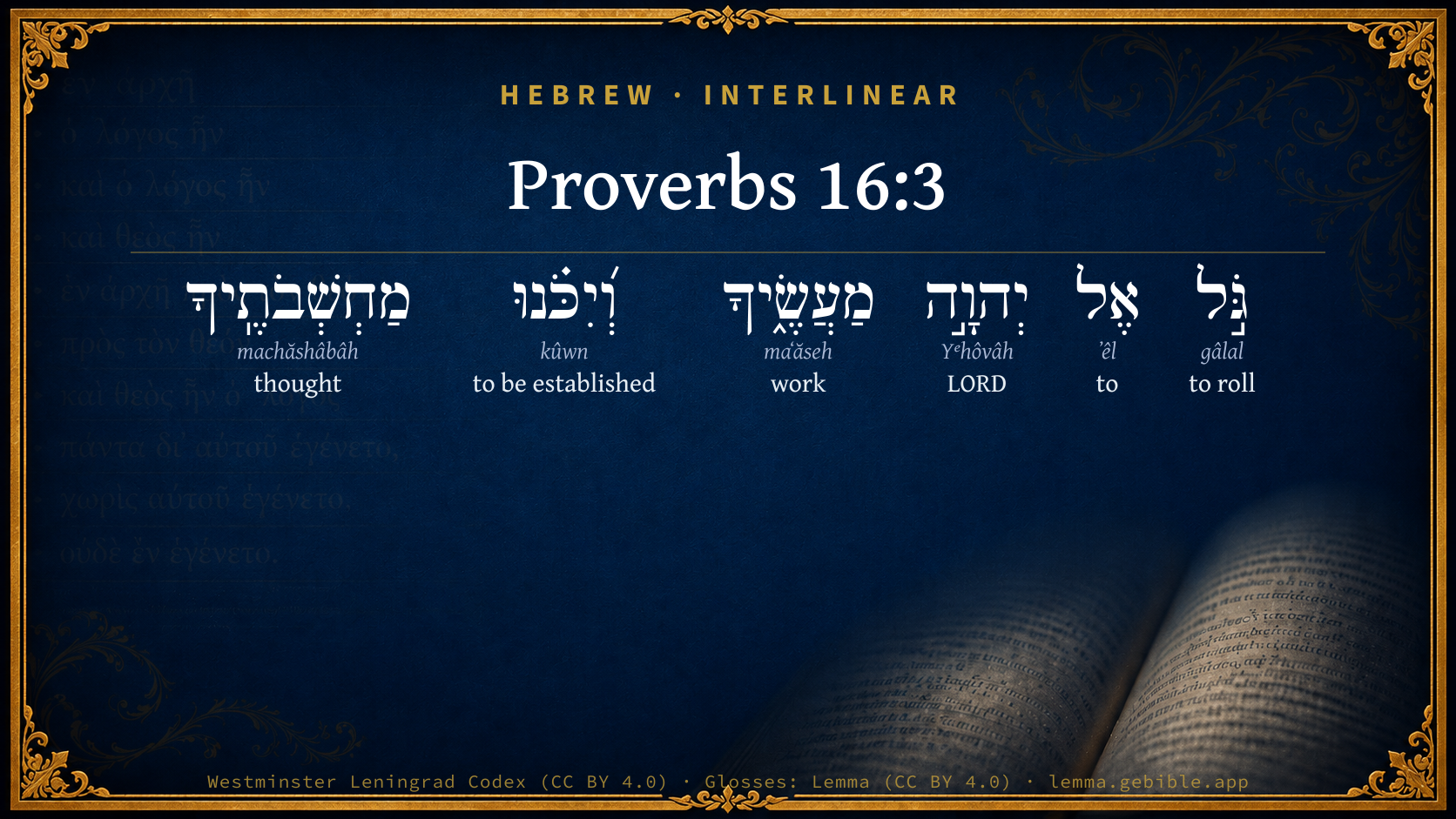
Proverbs 16:3

Hebrew (Westminster Leningrad Codex) Proverbs 16:3 appears in the Hebrew Old Testament. The text above is from the Westminster Leningrad Codex. Each word links to its Strong’s number, a concise gloss, and parsing drawn from the Open Scriptures Hebrew Bible morphology. Click any word for its full Brown-Driver-Briggs (BDB) entry.
Download image
Cite this verse

Proverbs 16:3 (World English Bible). Public Domain. Lemma interlinear Bible study tool, https://lemma.gebible.app/v/proverbs/16/3.

Show BibTeX & RIS
BibTeX
RIS
English Translation
Commit your deeds to Yahweh, And your plans shall succeed.
World English Bible · Public Domain
Download a study sheet

One document with this verse’s original text, its word-by-word gloss line, the meaning frame, cross-references with their text, attributed commentary, and full source and license credits — printable, and it pastes into notes with its structure intact.

This verse Autodidact and up

Study sheet (.html) Plain text (.txt)

A passage Seminary Student

Up to 50 verses in one chapter. A passage sheet keeps up to 6 commentary sources and 12 cross-references per verse, in the order this page ranks them, and says so on the sheet whenever that leaves anything out. Ask for a single verse and you get the Autodidact verse sheet above.

Everything on this page stays free to read, with no account — the sheet is a download of what is already on screen, not access to it.

Want to remove ads? Support Godless Engineer
Compare translations 3

The same verse in 3 English versions, stacked beneath the original-language interlinear above. Click any original word for its lexicon entry.

Each is an independent rendering of the whole verse — the interlinear is not word-aligned to these translations.

Highlighted words mark where these versions differ — a whole-verse word diff, not a word-by-word alignment.

  • World English Bible Public Domain
    Commit your deeds to Yahweh, And your plans shall succeed.
  • King James Version Public Domain
    Commit thy works unto the LORD, and thy thoughts shall be established.
  • unfoldingWord Literal Text CC BY-SA 4.0
    Roll to Yahweh your works, and your plans will be established.

unfoldingWord Literal Text — © unfoldingWord, licensed CC BY-SA 4.0. Word-aligned USFM3 via Door43 (git.door43.org/unfoldingWord/en_ult).

Versions to compare (up to 4)

3 of 4 selected

Show all 18 translations

Every available English version of this verse, each an independent rendering of the whole verse.

  • World English Bible Public Domain
    Commit your deeds to Yahweh, And your plans shall succeed.
  • Berean Standard Bible Public Domain
    Commit your works to the LORD and your plans will be achieved.
  • Majority Standard Bible Public Domain
    Commit your works to the LORD and your plans will be achieved.
  • King James Version Public Domain
    Commit thy works unto the LORD, and thy thoughts shall be established.
  • American Standard Version (1901) Public Domain
    Commit thy works unto Jehovah, And thy purposes shall be established.
  • Revised Version (1885) Public Domain
    Commit thy works unto the LORD, and thy thoughts shall be established.
  • Geneva Bible (1599) Public Domain
    Commit thy workes vnto the Lord, and thy thoughts shalbe directed.
  • Douay-Rheims (1899) Public Domain
    Lay open thy works to the Lord: and thy thoughts shall be directed.
  • Young's Literal Translation Public Domain
    Roll unto Jehovah thy works, And established are thy purposes,
  • Literal Standard Version CC BY-SA 4.0
    Roll your works to YHWH, || And your purposes are established,
  • Unlocked Literal Bible CC BY-SA 4.0
    Commit your works to Yahweh and your plans will succeed.
  • unfoldingWord Literal Text CC BY-SA 4.0
    Roll to Yahweh your works, and your plans will be established.
  • Darby Bible Public Domain
    Commit thy works unto Jehovah, and thy thoughts shall be established.
  • World Messianic Bible Public Domain
    Commit your deeds to the LORD, and your plans shall succeed.
  • Webster's Bible Public Domain
    Commit thy works to the LORD, and thy thoughts shall be established.
  • Free Bible Version CC BY-SA 4.0
    Trust whatever you do to the Lord, and your plans will be successful.
  • Bible in Basic English Public Domain
    Put your works into the hands of the Lord, and your purposes will be made certain.
  • JPS Tanakh (1917) Public Domain
    Commit thy works unto the LORD, and thy thoughts shall be established.

Literal Standard Version (2020), Covenant Press — licensed CC BY-SA 4.0. Text via the HelloAO Bible API (eBible.org). Unlocked Literal Bible (unfoldingWord) — licensed CC BY-SA 4.0. Text via the HelloAO Bible API (eBible.org). unfoldingWord Literal Text — © unfoldingWord, licensed CC BY-SA 4.0. Word-aligned USFM3 via Door43 (git.door43.org/unfoldingWord/en_ult). Free Bible Version, Dr. Jonathan Gallagher — licensed CC BY-SA 4.0. Text via the HelloAO Bible API (eBible.org).

Word by word

More ways to search: Search by grammar → Find every occurrence → Compare this word →

Practice this passage: Drill this verse → Learn its vocabulary →

About this verse

These counts appear in no published source. They are computed here, from the morphology-tagged text and Lemma’s own curated glosses. What Lemma adds →

6
words
6
distinct lemmas
Wisdom
section

Notable vocabulary

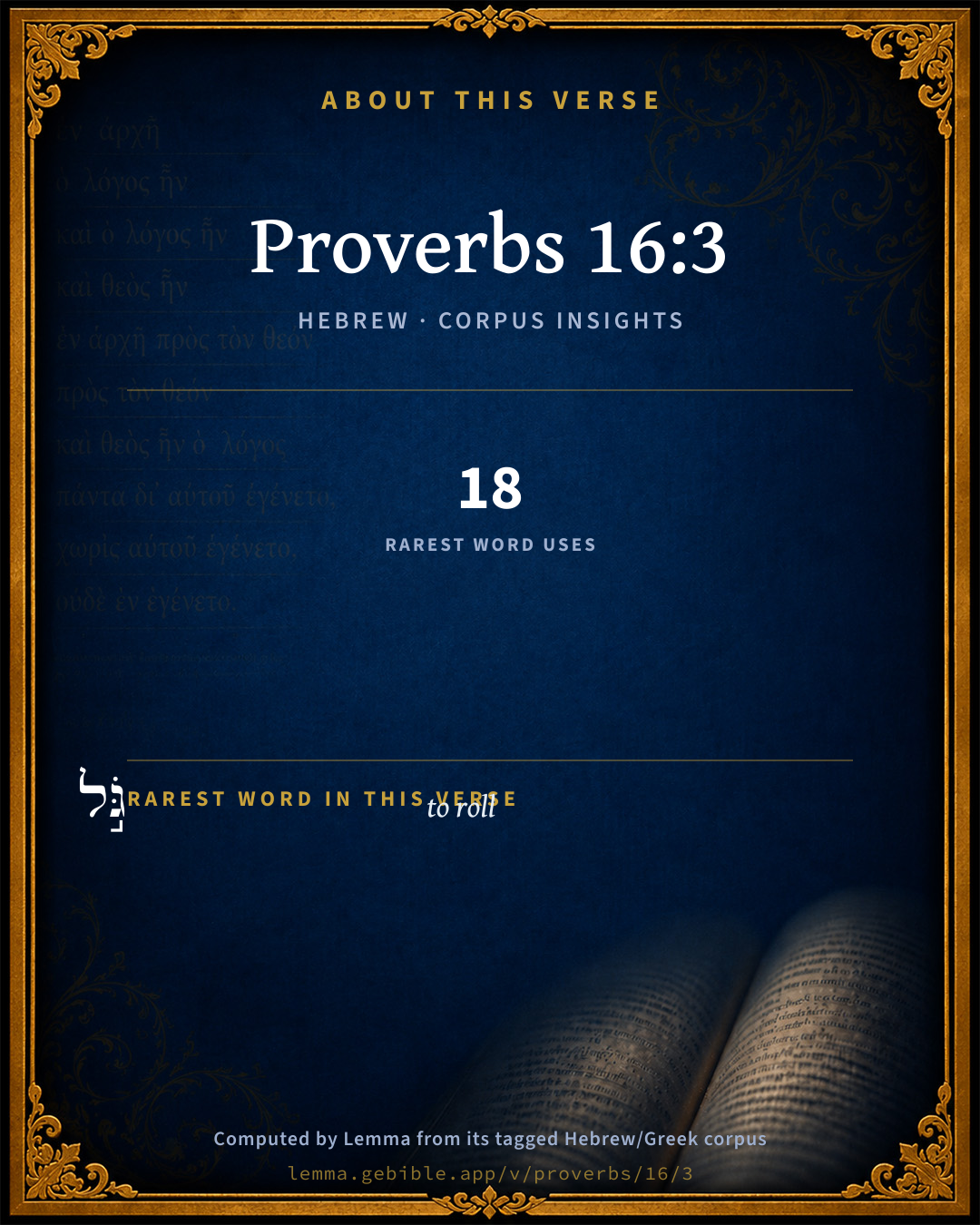
The rarest word here is גֹּ֣ל to roll H1556 — appearing just 18 times in the whole Hebrew Bible.

Shared distinctive vocabulary

גֹּ֣ל to roll H1556 occurs in 18 verses of the Hebrew Bible. Also found in:

Grammatical profile

  • 2 verbs
  • 3 nouns
  • 1 preposition

Verb forms

  • גֹּ֣ל Qal · Imperative
  • וְ֝יִכֹּ֗נוּ Niphal · Jussive

Cross-references

10

Topical passages linked to Proverbs 16:3 in the Treasury of Scripture Knowledge — connected by theme and wording, ordered by reader-vote popularity; previews shown in the World English Bible.

  • Psalms 37:4–5 Also delight yourself in Yahweh, And he will give you the desires of your heart.
  • Proverbs 3:6 In all your ways acknowledge him, And he will direct your paths.
  • Psalms 55:22 Cast your burden on Yahweh, and he will sustain you. He will never allow the righteous to be moved.
  • Philippians 4:6 In nothing be anxious, but in everything, by prayer and petition with thanksgiving, let your requests be made known to God.
  • 1 Peter 5:7 casting all your worries on him, because he cares for you.
  • Job 22:28 You shall also decree a thing, and it shall be established to you. Light shall shine on your ways.
  • Job 5:8 "But as for me, I would seek God, To God would I commit my cause;
  • Luke 12:22 He said to his disciples, "Therefore I tell you, don't be anxious for your life, what you will eat, nor yet for your body, what you will wear.
  • Matthew 6:25–34 Therefore, I tell you, don't be anxious for your life: what you will eat, or what you will drink; nor yet for your body, what you will wear. Isn't life more than food, and the body more than clothing?
  • Isaiah 7:5–7 Because Syria, Ephraim, and the son of Remaliah, have plotted evil against you, saying,

Cross-references courtesy of OpenBible.info (CC BY 4.0).

Hebrew and Greek witnesses Masoretic Hebrew ↔ Greek Septuagint

The same verse in the two great witnesses to the Old Testament, shown verse-for-verse.

These are two independent witnesses, not word-aligned to each other, and the Septuagint is shown in lemma (dictionary) form.

Hebrew Proverbs 16:3 Masoretic · Westminster Leningrad Codex

גֹּ֣ל אֶל יְהוָ֣ה מַעֲשֶׂ֑יךָ וְ֝יִכֹּ֗נוּ מַחְשְׁבֹתֶֽיךָ

Commit your deeds to Yahweh, And your plans shall succeed.

World English Bible · Public Domain

Greek LXX Proverbs 16:3 Septuagint · lemma form

ἀρχή ὁδός ἀγαθός ὁ ποιέω ὁ δίκαιος δεκτός δέ παρά θεός μᾶλλον ἤ θύω θυσία

No English rendering of this Greek verse — the small residue in the structurally divergent books.

On this verse, The Pulpit Commentary discusses the Septuagint’s reading. Read the note in Commentary ↓

Hebrew: Westminster Leningrad Codex (CC BY 4.0). Greek: Septuagint (public domain); English from a public-domain English Septuagint. How the Septuagint differs from the Hebrew →

Commentary

Notes on Proverbs 16:3 from classic Christian and Jewish commentators (each source and its license shown beneath its notes). The classic Christian expositions comment on the surrounding passage and are grouped to its opening verse, so a note may address several verses; the Jewish commentaries on the Tanakh (Rashi and others) are per-verse, so they appear only where the commentator wrote on this verse.

Lemma curates 59 commentaries, every one of them public domain or Creative Commons licensed, each selected and text-cleaned for this edition rather than reprinted as found. About our sources →

Trapp's Complete Commentary

John Trapp

Pro 16:3 Commit thy works unto the LORD, and thy thoughts shall be established.

Ver. 3. Commit thy works unto the Lord.] Depend upon him alone for direction and success; this is the readiest way to a holy security and sound settlement. Hang not in doubtful suspense, as meteors do in the air. Neither make discourses in the air, so one renders it, as those use to do, whose hearts are haunted with carking cares. Let not your thoughts be distracted about these things; so the Syriac hath it. But "cast your burden upon the Lord," {Psa 55:22} by a writ of remove, as it were. Yea, "cast all your care upon God, for he careth for you." {1Pe 5:7} I will be "careless" according to my name, said John Careless, martyr. "Commit the matter to God, and he will effect it." {Psa 37:5}

And thy thoughts shall be established.] Never is the heart at rest till it repose upon God; till then it flickers up and down, as Noah’s dove did upon the face of the flood, and found no footing till she returned to the ark. This is certain, saith a reverend divine, {a} yet living, so far as a soul can stay on and trust in God, so far it enjoys a sweet settlement and tranquillity of spirit. Perfect trust is blessed with a perfect peace. A famous instance for this we have in our Saviour, "Now is my soul troubled, and what shall I say? Father, save me from this hour; but for this cause came I to this hour. Father, glorify thy name." {Joh 12:27-28} All the while the eye of his humanity was fixed upon deliverance from the hour of temptation; there was no peace nor rest in his soul, because there he found not only uncertainty, but impossibility; "For this cause came I to this hour." But when he could come to this, "Father, glorify thy name" - when he could wait on, acquiesce in, and resign to the will of his Father - we never hear of any more objection, fear, or trouble. Thus he.

{a} Mr Case.

John Trapp, A Commentary or Exposition upon All the Books of the Old and New Testament (1647–1656) — public domain. Text from a community e-Sword module.

The Biblical Illustrator

Joseph S. Exell

Pro_16:3

Commit thy works unto the Lord, and thy thoughts shall be established.

Doing our duty is committing our way to God

There is no instrinsic value in things. They only possess a relative value. All things depend upon seasonableness. The Scripture speaks of a word in season. If there can be words in season, there can be words out of season. A word not in season is merely a right thing in a wrong place. Therefore it is not the value of the thing in itself; there is no such thing; values are all from without. The idlest dream a man has is that a bit of gold has an intrinsic value. But a thing that is worthless to-day is not therefore worthless at another time. The word for to-day, in this text, is one of rest. Many people say that committing your ways to the Lord, is to tell them to Him when you pray. But that is only saying something. A large part of the piety of the people consists in saying feelings instead of doing. When we say Commit thy works unto Him, it is with a view to put down fret, fever, and distress, and to learn a lesson of the holiday of the soul, rather than of the work-day and mammon. Committing your burden unto the Lord is getting Him to carry it. It does not mean sit still and do no work. There is always something left for man to do, even when God takes the matters up. Commit thy ways must mean something in the spirit by which, while a man goes on in life, he gets the fret, and the burdens and the gall, and the weariness off his shoulders. There are two difficult and painful businesses. One is, to fit your circumstances to yourself; and the other is, to fit yourself to your circumstances. Ambition is seldom desirable. A profound sense of duty will do all that ambition can do, and leave nothing of the bitterness behind. Suit thyself to thy circumstances; do thy duty; and so commit thy way unto the Lord. Committing your ways is just the absence of ambition: it is to do thy work, and leave it to the great laws of God. He commits his ways unto the Lord who does his duty simply in the state in which he is. As to the results. The text notes the establishment of the thoughts--not always the success of the work--but the establishment of the man. Quietness--uprightness--Slow gains and few shames. Commit thyself, with all thy way, and work, and soul, to Him. Say thy prayers, confess thy sins, do thy little piece of work, and do it honestly; God will redeem thee, atone for thee, regenerate thee, be the guardian of thy tomb, fashion for thee a new body, weave for thee an eternal dress, and provide for thee a house not made with hands. Think of the blessed result. Be at rest in the Lord, wait patiently for Him; He shall establish thy thought; He shall save thy soul; He shall crown thee with eternal peace. (George Dawson, M.A.)

Works and thoughts

I. The precept or counsel.

1. The object, or thing itself, which is committed: our works. Either the works done by us, or the works done to, or upon us. Our affairs and businesses. Whatever action we go about, we are to commit ourselves to the Lord, and to refer ourselves still to Him for the disposing of it. We are to commit our works to the Lord in regard to our performance of them; to the acceptance of them; and to their success. Our conditions; those things which in any way concern us, we are also to commit unto the Lord.

2. The act: committing. In a way of simple commendation: presenting them, and laying them open before Him. This is required in order that God may direct and assist us; and also as a piece of respect to God Himself. In a way of humble resignation. Implying that we have some sense of the difficulty and burdensomeness of those works that are upon us. This is necessary, that we may labour the more for strength and ability to the discharge of them; that we may be the more humbled for our failings and neglects in it, as coming short of that exactness and perfection that was required of us; and in reference to others, in a way of compassion; to pity those in the same condition: in a way of assistance, and concurrence with them, for easing their burden; and in a way of thankfulness and acceptance, by acknowledging that labour and pains which hath been taken by them. Committing our works to God must not be taken as allowing us to omit the doing of them. In a way of faithful improvement. Order, dispose, and direct all thine actions unto Him. Roll our works to Him as we would roll a bowl to the mark. Make Him the scope and end and aim of all our endeavours. In a way of thankful acknowledgment.

3. The person to whom the deposition is committed. Consider His wisdom and knowledge; His strength and power; His faithfulness and truth; His willingness to undertake our burden. We are to commit our burden to Him, and to no one else: to the Lord, not to self; not to other men; not to fortune or chance.

II. The promise, or argument to enforce it. Something implied in this sentence: thy thoughts shall be established. Where there are works there will be thoughts. Our chiefest business is composing and settling our minds. Establishing of our thoughts is a very great happiness and mercy. Something expressed. Thou shalt have a mind free from any other trouble and distraction when thou hast practised this counsel in the text. (T. Horton, D.D.)

Dependence on God

The counsel implies--

1. That all our purposes and all our doings should be according to Gods will.

2. That none of our works can prosper without God.

3. That it is therefore the imperative duty of intelligent creatures to own their independence, and to seek, on all occasions, the Divine countenance and blessing.

4. That what is our duty is, at the same time, our interest.

5. A general truth is expressed, that God will graciously smile on the efforts, and accomplish the purposes and wishes of him who, in all that he does, piously and humbly acknowledges Him and seeks His blessing. (R. Wardlaw, D.D.)

The Biblical Illustrator, edited by Joseph S. Exell (c. 1880s–1900s) — public domain. Text from a community e-Sword module.

Joseph Benson's Commentary

Pro 16:3. Commit thy works unto the Lord — Hebrew, גל אל יהוה, literally, Roll unto the Lord, &c., namely, as a man rolls to another a burden, which is too heavy for himself, imploring his help. Refer all thy actions and concerns to God, and to his glory, as the end of them; and, in the discharge of thy duty, depend upon God’s providence and grace for assistance and success; and thy thoughts shall be established — Thy honest desires and designs shall be brought to a happy issue one way or other.

Joseph Benson's Commentary on the Old and New Testaments (1811–1818) — public domain. Text from a community e-Sword module.

Tyndale Open Study Notes

Tyndale Open Resources

16:3 God must affirm our plans (16:1), so it makes sense to ask his help in accomplishing our goals (see Jas 4:13-16).

Tyndale Open Study Notes — © Tyndale Open Resources, licensed CC BY-SA 4.0. Text via the HelloAO Bible API.

Geneva Bible (1599)

Geneva Bible translators

Hebrew, role.

Geneva Bible (1599) marginal notes — public domain. Text via Bolls.life.

Matthew Henry's Commentary

Note, 1. It is a very desirable thing to have our thoughts established, and not tossed, and put into a hurry, by disquieting cares and fears, - to go on in an even steady course of honesty and piety, not disturbed, or put out of frame, by any event or change, - to be satisfied that all shall work for good and issue well at last, and therefore to be always easy and sedate. 2. The only way to have our thoughts established is to commit our works to the Lord. The great concerns of our souls must be committed to the grace of God, with a dependence upon and submission to the conduct of that grace (Ti2 1:12); all our outward concerns must be committed to the providence of God, and to the sovereign, wise, and gracious disposal of that providence. Roll thy works upon the Lord (so the word is); roll the burden of thy care from thyself upon God. Lay the matter before him by prayer. Make known thy works unto the Lord (so some read it), not only the works of thy hand, but the workings of thy heart; and then leave it with him, by faith and dependence upon him, submission and resignation to him. The will of the Lord be done. We may then be easy when we resolve that whatever pleases God shall please us.

Matthew Henry's Commentary on the Whole Bible (1708–1710) — public domain (CC PDM 1.0). Text via the HelloAO Bible API.

Jamieson, Fausset & Brown

Robert Jamieson, A. R. Fausset & David Brown

(Compare Margin). Rely on God for success to your lawful purposes.

Jamieson, Fausset & Brown — Commentary Critical and Explanatory on the Whole Bible (1871) — public domain (CC PDM 1.0). Text via the HelloAO Bible API.

Adam Clarke's Commentary

Verse 3. Commit thy works unto the Lord] See that what thou doest is commanded; and then begin, continue, and end all in his name. And thy thoughts shall be established - these schemes or arrangements, though formed in the heart, are agreeable to the Divine will, and therefore shall be established. His thoughts - his meditations - are right; and he begins and ends his work in the Lord; and therefore all issues well.

Adam Clarke's Commentary on the Bible (1810–1826) — public domain. Text from a community e-Sword/MySword module.

Ellicott's Commentary for English Readers

(3) Commit thy works unto the Lord.—Literally, roll them upon Him, as a burden too heavy to be borne by thyself. “Thy works” signify all that thou hast to do. (Comp. Psa_37:5.) God provides such works for us. (Comp. Eph_2:10.)

And thy thoughts shall be established.—Thy plans shall prosper, for they will be undertaken according to the will of God, and carried out by His aid. (Comp. 1Co_3:9; 2Co_6:1.)

A Bible Commentary for English Readers, edited by Charles John Ellicott (1878–1897) — public domain. Text from a community e-Sword module.

The Cambridge Bible for Schools and Colleges

gen. ed. J. J. S. Perowne

3. Commit … unto] Lit. Roll … upon. Comp. Psa_22:8 [Hebrews 9], Psa_37:5, and notes there in this Series.

thoughts] or, purposes, R.V. marg. The precept is germane to that in Pro_16:1. Commit to Jehovah the execution in works (as in Pro_16:1, the explanation in words) of thy plans and purposes, and they shall prosper.

In each of the seven opening proverbs of this chapter the name Jehovah is introduced, and in each of them His work is made prominent.

The Cambridge Bible for Schools and Colleges (gen. ed. J. J. S. Perowne; Cambridge University Press, 1878–1918) — public domain. Text from a community e-Sword module.

John Gill's Exposition

Commit thy works unto the Lord,.... Natural, civil, or religious; seek to him for strength and assistance in all, and leave the success of all with him: or "roll thy works on" or "unto the Lord" (b); devolve all upon him, cast all care upon him and his providence for supply, support, and sustenance in life; and commit the business of the salvation of thy soul, and the important affairs of it, wholly to him, who is able, willing, and faithful, to keep what is committed to him; and, having so done, may sit down easy and satisfied, as one that is rid of a burden by casting it on another, better able to bear it, or more equal to the work committed to him: the Targum is, "reveal thy works to God"; and so the Syriac and Vulgate Latin versions, "reveal thy works to the Lord"; thy case, condition, and circumstances; thy wants and necessities; seek and ask for a supply of him, make known thy requests to him; for though he is not ignorant of the affairs of his people, yet he will be sought unto to do the things for them he intends to do, and they stand in need of;

and thy thoughts shall be established; when a man has, by faith and in prayer, committed himself, his case, his ways and works, to the Lord, his mind is made easy, his thoughts are composed and settled, and he quietly waits the issues of things; he says, the will of the Lord be done; he knows that he causes all things to work together for good; and whatever is for his good and God's glory shall be brought to pass; and this makes him calm, sedate, and easy; and he is in a fair way of having his designs, desires, and endeavours accomplished; see Psa 37:5.

(b) "devolve in Jehovam facta tua", Junius & Tremellius; "negotia tua", Piscator; "volve in Dominum quae tibi facieuda sunt", Michaelis; "volve ad Jehovam opera tua", Pagninus, Montanus, Cocceius; so Mercerus, Gejerus, Schultens, Tigurine version.

John Gill's Exposition of the Whole Bible (1746–1763) — public domain (CC PDM 1.0). Text via the HelloAO Bible API.

Albert Barnes' Notes on the Bible

Commit - literally, as in the margin, as a man transfers a burden from his own back to one stronger and better able to bear it. Compare the margin reference.

Thy thoughts - i. e., The plans or counsels out of which the works spring.

Albert Barnes' Notes on the Bible (1834–1885) — public domain. Text from a community e-Sword/MySword module.

Haydock's Catholic Bible Commentary

Open. Hebrew, "roll on," and refer all to God’s glory. (Menochius) (Psalm xxxvi. 5.)

George Leo Haydock (1774–1849), Haydock's Catholic Family Bible and Commentary, 1859 edition — public domain. Excludes Psalms (Douay-Rheims chapter numbering differs from Protestant) and Deuterocanonical books (Catholic canon only).

Matthew Poole's English Annotations

Commit thy works unto the Lord, Heb. Roll, &c., as a man rolls a burden to another, which is too heavy for himself, imploring his help. Refer all thy actions and concerns to God, and to his glory, as the end of them, and in the discharge of thy own duty depend upon God’s providence for assistance and success.

Thy thoughts shall be established; thy honest desires and designs shall be brought to a happy issue one way or other.

Matthew Poole's English Annotations on the Holy Bible (1683–1685) — public domain. Text from a community e-Sword/MySword module.

Whedon's Commentary on the Bible

Daniel D. Whedon

3. Commit… to the Lord — To Jehovah; or, as we say, “Cast upon the Lord” thy works, undertakings, enterprises.

Thy thoughts (plans, purposes) shall be established — This is the surest way to have honest designs accomplished. Compare Pro_19:21; Psa_22:8; Psa_37:5; Psa_90:17.

Daniel D. Whedon (gen. ed.), Commentary on the Old and New Testaments (1874–1909) — public domain. Text from a community e-Sword module.

The Pulpit Commentary

Commit thy works unto the Lord. "Commit" (gol) is literally "roll" (kulison , Theodotion), as in Psa_22:8 and Psa_37:5; and the injunction means, "Transfer thy burden to the Lord, cast upon him all that thou hast to do; do all as in his sight, and as an act of duty to him." Thus Tobit says to his son, "Bless the Lord thy God alway, and desire of him that thy ways may be directed, and that all thy paths and counsels may prosper". (RAPC Tob 4:19) The Vulgate, using a different punctuation (gal), renders, "Reveal to the Lord thy works?" As a child opens its heart to a tender parent, so do thou show to God thy desires and intentions, trusting to his care and providence. And thy thoughts shall be established. The plans and deliberations out of which the "works" sprang shall meet with a happy fulfilment, because they are undertaken according to the will of God, and directed to the end by his guidance. (comp. Pro_19:21 Psa_90:17 1Co_3:9) This verse is not in the Septuagint.

The Pulpit Commentary (1880–1919), ed. H.D.M. Spence-Jones & Joseph S. Exell — public domain. Text from a community e-Sword module.

John Wesley's Explanatory Notes

Commit - Refer all thy actions and concerns to God, as the end of them, and depend upon God's providence for success. Established - Thy designs shall be brought to an happy issue.

John Wesley, Explanatory Notes Upon the Whole Bible (1754–1765) — public domain. Text via the GEBible commentary corpus.

Keil & Delitzsch

C. F. Keil & F. Delitzsch

3 Roll on Jahve thy works,

So thy thoughts shall prosper.

The proverbs Pro 16:1-3 are wanting in the lxx; their absence is compensated for by three others, but only externally, not according to their worth. Instead of גּל, the Syr., Targ., and Jerome read גּל, revela, with which the על, Psa 37:5, cf. Psa 55:23, interchanging with אל (here and at Psa 22:9), does not agree; rightly Theodotion, κύλισον ἐπὶ κύριον, and Luther, "commend to the Lord thy works." The works are here, not those that are executed, Exo 23:16, but those to be executed, as Psa 90:17, where כּונן, here the active to ויכּונוּ, which at Pro 4:26 as jussive meant to be placed right, here with ו of the consequence in the apodosis imperativi: to be brought about, and to have continuance, or briefly: to stand (cf. Pro 12:3) as the contrast of disappointment or ruin. We should roll on God all matters which, as obligations, burden us, and on account of their weight and difficulty cause us great anxiety, for nothing is too heavy or too hard for Him who can overcome all difficulties and dissolve all perplexities; then will our thoughts, viz., those about the future of our duty and our life-course, be happy, nothing will remain entangled and be a failure, but will be accomplished, and the end and aim be realized.

Keil & Delitzsch — Biblical Commentary on the Old Testament (1861–1891) — public domain (CC PDM 1.0). Text via the HelloAO Bible API. (Old Testament only.)

Bridges on Proverbs

Charles Bridges

An unsettled mind is a serious evil - a canker to Christian peace. Every faculty is thrown into disorder. The memory is confused, the judgment undecided, the will unsteady. No moral rules can discipline the tossing exercise. Faith is the only principle of solid establishment. (Psa 112:7 . Isa 26:3 .) Here was our original happiness and security. Independence was the destruction of our well-being. (Gen 3:5 .) The return to this humble simplicity is the privilege of the gospel. "In all thy ways acknowledge him" (Pro 3:6 ) - is the rule of peace. Eliezer’s thoughts were established in committing his work to the LORD. (Genesis 24.) This confidence was the stay of our beloved Lord in his great work. (Isa 49:4 ; Isa 50:7-9 .) Prayer was the exercise of his faith. Establishment was the issue. (Joh 17:4 .) Has the fretting spirit ever tried this true remedy? Actively engage the two hands of faith and prayer in making over our burdens to our Father. To have a sanctuary to flee to - a God, on whom to roll our cares;†1 to lean to his wisdom, and rest on his faithfulness - Here is a chamber of quietness in the most distracting anxieties - "So he giveth his beloved sleep." (Psa 127:2 .)

Commit then all thy works to him. Seek to him for strength and guidance in all. Look to him for success in all. Roll on him the great work of thy soul’s salvation. Be satisfied with his management of thy concerns. Put thy works, as thou wouldest put thy children, with confidence into the hands of God. Christian self-possession will be the result. Let thy heart habitually turn to the throne of grace; so that in a crisis of trouble instant faith, instant - perhaps speechless (Neh 2:4 ) - prayer, may bring instant composure and resolution. This active energy of faith will enable us to collect our thoughts, establish them in the peace of God, and keep our souls in fortified security.†2 Indeed a great part of our worship is to commit our works to him "without carefulness;" not in a general dependence on his goodness or wisdom, but in a particular dependence for our special need. The burden being now cast upon one who is better able to bear it (1Pe 5:7 ), the mind is easy, the thoughts composed, quietly waiting the issue of things; knowing that all, that is for our good, and the glory of our God, shall be brought to pass. (Psa 112:7 .) Thus "we which have believed do enter into rest." (Heb 4:3 .) But if we will not believe - so speaks the solemn warning - "surely we shall not be established."†3

Footnotes:

†1 M.R. ’Volve in Dominum quae tibi facienda sunt.’ - Michaelis, Psa 37:5 . Marginal Rendering = {1) Heb Roll thy way upon Jehovah}

†2 Php 4:6-7, frourhsei. ()

†3 2Ch 20:26 . Isa 7:7-9 . ’Nothing can be more erroneous than for those who fear God, to suppose themselves as liable as ever to "the changes and chances of this mortal life." Change, if God see good, they may experience; but the sincerely religious have done with chance. Having once cordially committed themselves to God’s paternal care, they can meet nothing in their course, which is not the result of Divine adjustment, of wisdom which cannot err, of love, to which the tenderness of the tenderest parent bears no comparison . . . . Under such a management what can we rationally fear? Let us, through Divine grace, only keep within the circle where these movements are carried on, and we need not doubt, that, though we see nothing remarkable in our course, an unseen hand is directing every circumstance, so as, in the most effectual manner, to avert what might hurt us, to ensure what will benefit us, and to direct all our concerns to the best possible issue’ - Alexander Knox’s Remains, vol. ii. ’Divine Providence,’ - a work full of instructive thought, but deeply tinctured with unsound principles.

Charles Bridges, An Exposition of the Book of Proverbs (1846) — public domain. Text from a community e-Sword module.

Kretzmann's Popular Commentary

Paul E. Kretzmann

v. 3. Commit thy works unto the Lord, rolling them in His direction, for Him to take care of, Psa 37:5, and thy thoughts shall be established, He Himself will give the proper and blessed direction to the believer’s plans and purposes.

Paul E. Kretzmann, Popular Commentary of the Bible (1921–1924) — public domain. Text from a community e-Sword module.

unfoldingWord translationNotes

Door43 World Missions Community

even the wicked for the day of trouble

The verbal phrase may be supplied from the previous phrase. AT: "he has made even the wicked for the day of trouble" (See: Ellipsis)

translationWords

works

Yahweh

evil

trouble

unfoldingWord translationNotes — © Distant Shores Media and the Door43 World Missions Community, licensed CC BY-SA 4.0. Source: git.door43.org/Door43/en_tn.

Rashi

Rabbi Shlomo Yitzchaki (Rashi)

Commit your affairs to the Lord גל. Roll and cast your necessities upon Him, and your plans will be established. Another explanation: Commit your affairs to the Lord pray to Him for all your necessities.

will be established Will be founded and will endure.

Rashi on the Tanakh — English translations: “The Judaica Press complete Tanach with Rashi, translated by A. J. Rosenberg” (CC BY 4.0); “Pentateuch with Rashi's commentary by M. Rosenbaum and A.M. Silbermann, 1929-1934” (public domain); “The Metsudah Tanach series, Lakewood, N.J” (CC BY 4.0); and “The Book of Joshua, Metsudah Publications, 1997” (CC BY 4.0). Text via Sefaria.

Lesson kit

Teaching starters — assembled from the data on this page, not authored interpretation. Every prompt links to the verse data it draws on. Edit before teaching.

Proverbs, in the Wisdom, opens this verse with 6 words (6 distinct Hebrew lemmas). Its most distinctive word is gâlal (“to roll”). A historical commentator’s framing appears above. Read the whole chapter for the surrounding context.

Discussion questions

  1. The word gâlal carries the sense “to roll.” How does it shape the verse?
  2. How does Genesis 29:3, which shares the word «to roll», read alongside this verse?
  3. These translations render this verse differently; the difference is in the English rendering, not the original. What questions does that raise?
  4. «גֹּ֣ל» is a Qal Imperative verb. How does that grammatical form shape the action described?
  5. Compare how Trapp's Complete Commentary and The Biblical Illustrator read this verse. Where do they agree or differ?

Things to notice

Reading settings

Reading text

Shown beneath each verse's original-language words.

Old Testament
Old Testament edition

Read the OT as the Masoretic Hebrew (MT) or the Greek Septuagint (LXX).

English shown for the Greek Septuagint (in the Hebrew ↔ Greek comparison).

Comparing translations? Open the Compare panel on any verse page to stack up to four side by side.