
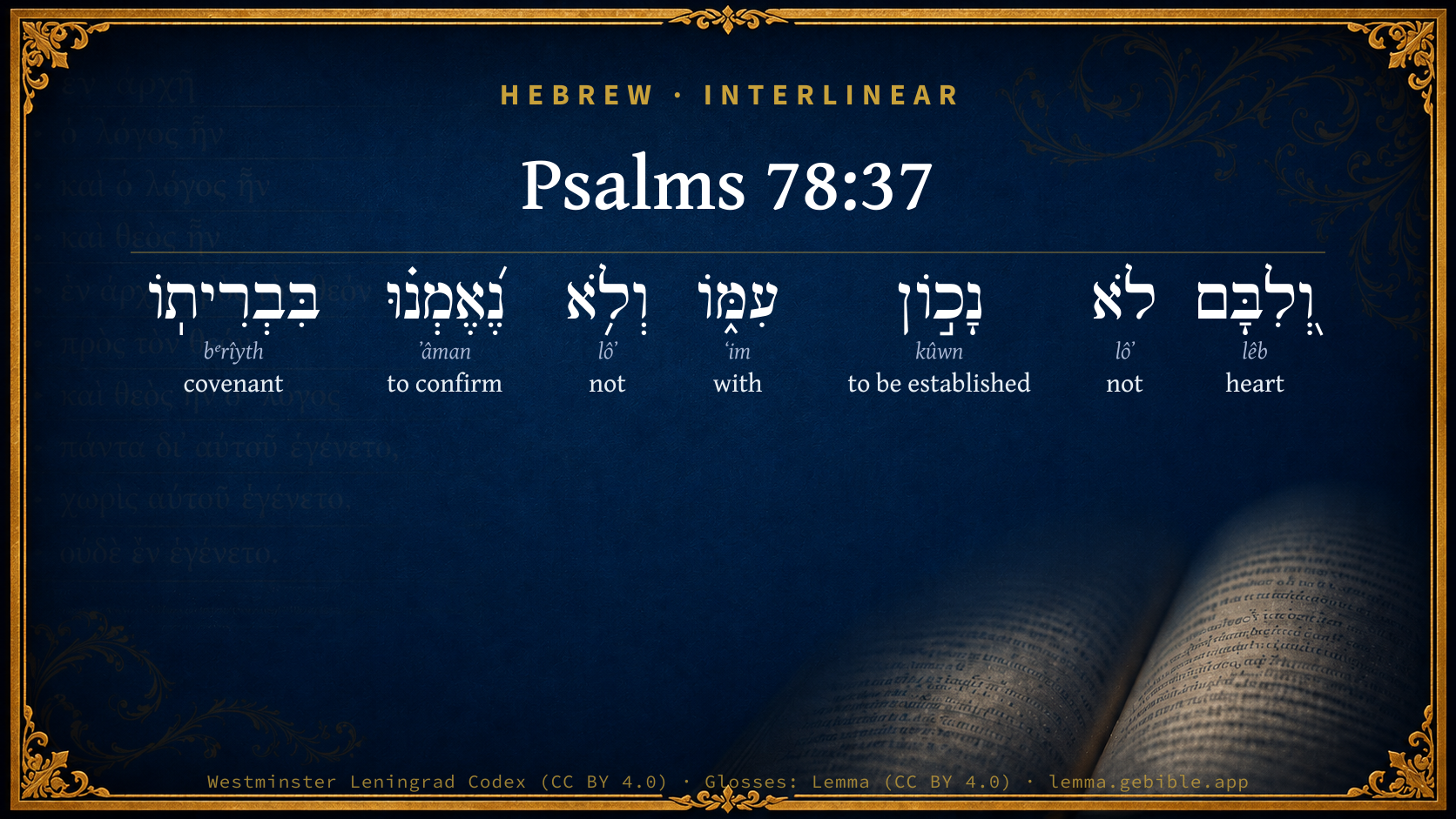
Psalms 78:37

Hebrew (Westminster Leningrad Codex) Psalms 78:37 appears in the Hebrew Old Testament. The text above is from the Westminster Leningrad Codex. Each word links to its Strong’s number, a concise gloss, and parsing drawn from the Open Scriptures Hebrew Bible morphology. Click any word for its full Brown-Driver-Briggs (BDB) entry.
Download image
Cite this verse

Psalms 78:37 (World English Bible). Public Domain. Lemma interlinear Bible study tool, https://lemma.gebible.app/v/psalms/78/37.

Show BibTeX & RIS
BibTeX
RIS
English Translation
For their heart was not right with him, Neither were they faithful in his covenant.
World English Bible · Public Domain
Download a study sheet

One document with this verse’s original text, its word-by-word gloss line, the meaning frame, cross-references with their text, attributed commentary, and full source and license credits — printable, and it pastes into notes with its structure intact.

This verse Autodidact and up

Study sheet (.html) Plain text (.txt)

A passage Seminary Student

Up to 50 verses in one chapter. A passage sheet keeps up to 6 commentary sources and 12 cross-references per verse, in the order this page ranks them, and says so on the sheet whenever that leaves anything out. Ask for a single verse and you get the Autodidact verse sheet above.

Everything on this page stays free to read, with no account — the sheet is a download of what is already on screen, not access to it.

Want to remove ads? Support Godless Engineer
Compare translations 3

The same verse in 3 English versions, stacked beneath the original-language interlinear above. Click any original word for its lexicon entry.

Each is an independent rendering of the whole verse — the interlinear is not word-aligned to these translations.

Highlighted words mark where these versions differ — a whole-verse word diff, not a word-by-word alignment.

  • World English Bible Public Domain
    For their heart was not right with him, Neither were they faithful in his covenant.
  • King James Version Public Domain
    For their heart was not right with him, neither were they stedfast in his covenant.
  • unfoldingWord Literal Text CC BY-SA 4.0
    And their hearts were not steadfast with him, and they were not faithful in his covenant.

unfoldingWord Literal Text — © unfoldingWord, licensed CC BY-SA 4.0. Word-aligned USFM3 via Door43 (git.door43.org/unfoldingWord/en_ult).

Versions to compare (up to 4)

3 of 4 selected

Show all 18 translations

Every available English version of this verse, each an independent rendering of the whole verse.

  • World English Bible Public Domain
    For their heart was not right with him, Neither were they faithful in his covenant.
  • Berean Standard Bible Public Domain
    Their hearts were disloyal to Him, and they were unfaithful to His covenant.
  • Majority Standard Bible Public Domain
    Their hearts were disloyal to Him, and they were unfaithful to His covenant.
  • King James Version Public Domain
    For their heart was not right with him, neither were they stedfast in his covenant.
  • American Standard Version (1901) Public Domain
    For their heart was not right with him, Neither were they faithful in his covenant.
  • Revised Version (1885) Public Domain
    For their heart was not right with him, neither were they faithful in his covenant.
  • Geneva Bible (1599) Public Domain
    For their heart was not vpright with him: neither were they faithfull in his couenant.
  • Douay-Rheims (1899) Public Domain
    But their heart was not right with him: nor were they counted faithful in his covenant.
  • Young's Literal Translation Public Domain
    And their heart hath not been right with Him, And they have not been stedfast in His covenant.
  • Literal Standard Version CC BY-SA 4.0
    And their heart has not been right with Him, || And they have not been steadfast in His covenant.
  • Unlocked Literal Bible CC BY-SA 4.0
    For their hearts were not firmly fixed on him, and they were not faithful to his covenant.
  • unfoldingWord Literal Text CC BY-SA 4.0
    And their hearts were not steadfast with him, and they were not faithful in his covenant.
  • Darby Bible Public Domain
    For their heart was not firm toward him, neither were they stedfast in his covenant.
  • World Messianic Bible Public Domain
    For their heart was not right with him, neither were they faithful in his covenant.
  • Webster's Bible Public Domain
    For their heart was not right with him, neither were they steadfast in his covenant.
  • Free Bible Version CC BY-SA 4.0
    Deep down they were not sincere, and did not keep the agreement they had with him.
  • Bible in Basic English Public Domain
    And their hearts were not right with him, and they did not keep their agreement with him.
  • JPS Tanakh (1917) Public Domain
    For their heart was not stedfast with Him, neither were they faithful in His covenant.

Literal Standard Version (2020), Covenant Press — licensed CC BY-SA 4.0. Text via the HelloAO Bible API (eBible.org). Unlocked Literal Bible (unfoldingWord) — licensed CC BY-SA 4.0. Text via the HelloAO Bible API (eBible.org). unfoldingWord Literal Text — © unfoldingWord, licensed CC BY-SA 4.0. Word-aligned USFM3 via Door43 (git.door43.org/unfoldingWord/en_ult). Free Bible Version, Dr. Jonathan Gallagher — licensed CC BY-SA 4.0. Text via the HelloAO Bible API (eBible.org).

Word by word

More ways to search: Search by grammar → Find every occurrence → Compare this word →

Practice this passage: Drill this verse → Learn its vocabulary →

נֶ֝אֶמְנ֗וּ
ʼâman
H539
“to confirm”
Verb, Niphal, Perfect, 3rd Person, Common, Plural
Part of Speech
Verb
Stem
Niphal
Form
Perfect
Person
3rd Person
Gender
Common
Number
Plural
Full BDB Definition

Origin: a primitive root

TWOT: 116

to support, confirm, be faithful - (Qal) - to support, confirm, be faithful, uphold, nourish - foster-father (substantive) - foster-mother, nurse - pillars, supporters of the door - (Niphal) - to be established, be faithful, be carried, make firm - to be carried by a nurse - made firm, sure, lasting - confirmed, established, sure - verified, confirmed - reliable, faithful, trusty - (Hiphil) - to stand firm, to trust, to be certain, to believe in - stand firm - trust, believe
  1. וְ֭לִבָּם lêb H3820 “and · heart · their” Conjunction + Noun, Common, Masculine, Singular, Construct + Suffix, Personal, 3rd Person, Masculine, Plural
  2. לֹא lôʼ H3808 “not” Particle, Negative
  3. נָכ֣וֹן kûwn H3559 “being established” Verb, Niphal, Participle Active, Masculine, Singular, Absolute
  4. עִמּ֑וֹ ʻim H5973 “with · him” Preposition + Suffix, Personal, 3rd Person, Masculine, Singular
  5. וְלֹ֥א lôʼ H3808 “and · not” Conjunction + Particle, Negative
  6. בִּבְרִיתֽוֹ bᵉrîyth H1285 “in/at · covenant · his” Preposition + Noun, Common, Feminine, Singular, Construct + Suffix, Personal, 3rd Person, Masculine, Singular

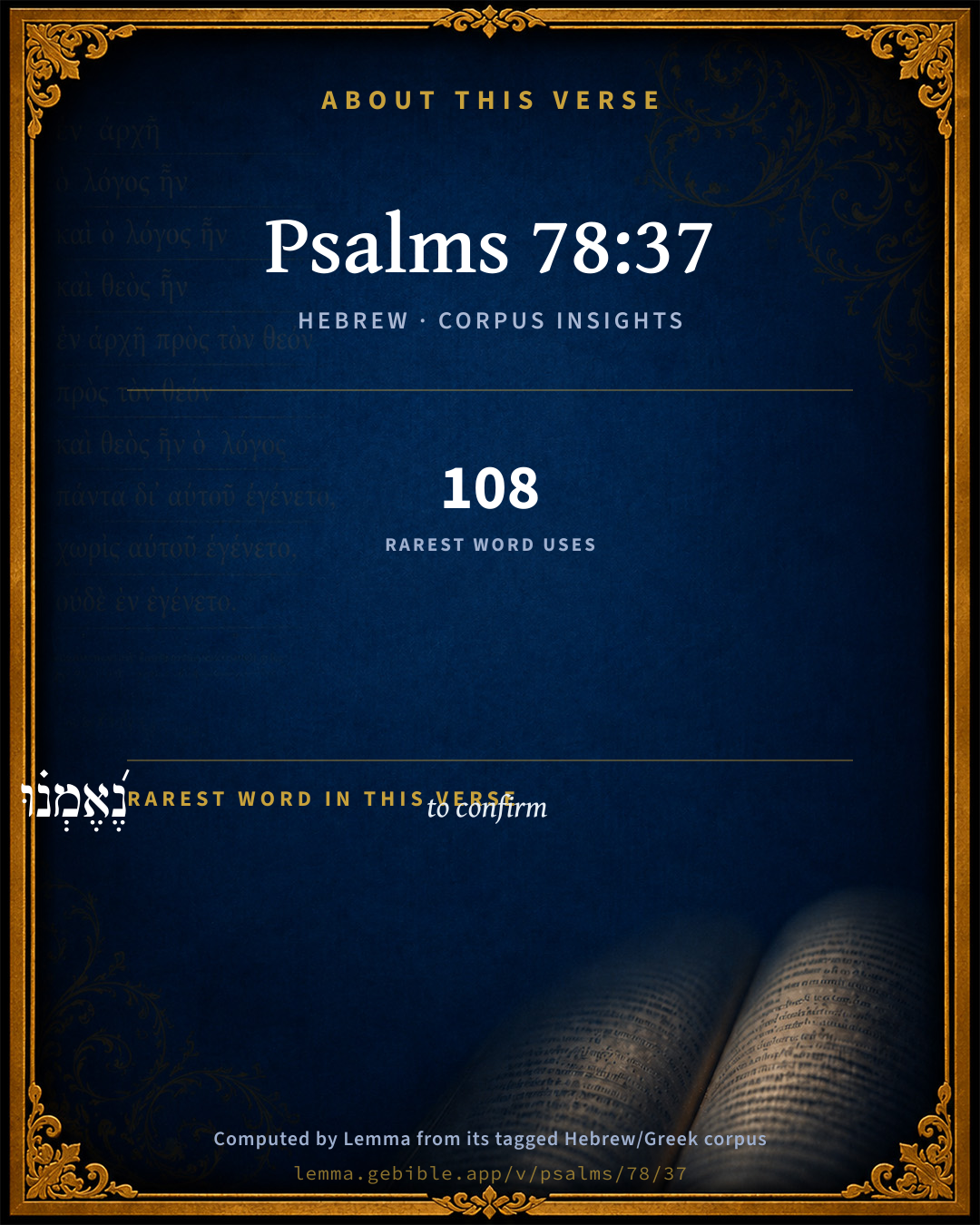
About this verse

These counts appear in no published source. They are computed here, from the morphology-tagged text and Lemma’s own curated glosses. What Lemma adds →

7
words
6
distinct lemmas
Wisdom
section

Grammatical profile

  • 2 verbs
  • 2 nouns
  • 1 preposition
  • 2 particles

Verb forms

  • נָכ֣וֹן Niphal · Participle Active
  • נֶ֝אֶמְנ֗וּ Niphal · Perfect

Repetition

A word recurs within this verse — often emphatic in Hebrew:

Hebrew & Septuagint length

In English translation the verse runs 15 words from the Hebrew and 15 from the Septuagint (LXX English) — the same length.

A rough comparison of the two English renderings, which tokenize alike — not a word-level alignment.

Word counts can differ between the Hebrew and the Greek without any difference in meaning — e.g. the Hebrew direct-object marker אֵת has no separate Greek word, and Greek often adds the article ὁ.

Cross-references

9

Topical passages linked to Psalms 78:37 in the Treasury of Scripture Knowledge — connected by theme and wording, ordered by reader-vote popularity; previews shown in the World English Bible.

  • Psalms 78:8 And might not be as their fathers, A stubborn and rebellious generation, A generation that didn't make their hearts loyal, Whose spirit was not steadfast with God.
  • Acts 8:21 You have neither part nor lot in this matter, for your heart isn't right before God.
  • Psalms 51:10 Create in me a clean heart, O God. Renew a right spirit within me.
  • Psalms 119:80 Let my heart be blameless toward your decrees, That I may not be disappointed.
  • Hosea 7:14 They haven't cried to me with their heart, But they howl on their beds. They assemble themselves for grain and new wine. They turn away from me.
  • Hosea 7:16–8:1 They return, but not to the Most High. They are like a faulty bow. Their princes will fall by the sword for the rage of their tongue. This will be their derision in the land of Egypt.
  • Hosea 10:2 Their heart is divided. Now they will be found guilty. He will demolish their altars. He will destroy their sacred stones.
  • Deuteronomy 31:20 For when I shall have brought them into the land which I swore to their fathers, flowing with milk and honey, and they shall have eaten and filled themselves, and grown fat; then will they turn to other gods, and serve them, and despise me, and break my covenant.
  • Psalms 44:17–18 All this has come on us, Yet have we not forgotten you, Neither have we been false to your covenant.

Cross-references courtesy of OpenBible.info (CC BY 4.0).

Hebrew and Greek witnesses Masoretic Hebrew ↔ Greek Septuagint

The same verse in the two great witnesses to the Old Testament, shown verse-for-verse.

You’re reading Greek Psalm 77 (Hebrew Psalm 78). The Septuagint counts the superscription, so verse numbers can differ from the Hebrew — chapter-level alignment, not verse-by-verse. Numbering follows Rahlfs.

These are two independent witnesses, not word-aligned to each other, and the Septuagint is shown in lemma (dictionary) form.

Hebrew Psalms 78:37 Masoretic · Westminster Leningrad Codex

וְ֭לִבָּם לֹא נָכ֣וֹן עִמּ֑וֹ וְלֹ֥א נֶ֝אֶמְנ֗וּ בִּבְרִיתֽוֹ

For their heart was not right with him, Neither were they faithful in his covenant.

World English Bible · Public Domain

Greek LXX Greek Psalm 77:37 Septuagint · lemma form

ὁ δέ καρδία αὐτός οὐ εὐθύς μετά αὐτός οὐδέ πιστόω ἐν ὁ διαθήκη αὐτός

For their heart was not right with him, neither were they steadfast in his covenant.

LXX2012 (modern English Septuagint) · Public Domain

Hebrew: Westminster Leningrad Codex (CC BY 4.0). Greek: Septuagint (public domain); English from LXX2012 (modern English Septuagint) (Public Domain). How the Septuagint differs from the Hebrew →

Commentary

Notes on Psalms 78:37 from classic Christian and Jewish commentators (each source and its license shown beneath its notes). The classic Christian expositions comment on the surrounding passage and are grouped to its opening verse, so a note may address several verses; the Jewish commentaries on the Tanakh (Rashi and others) are per-verse, so they appear only where the commentator wrote on this verse.

Lemma curates 59 commentaries, every one of them public domain or Creative Commons licensed, each selected and text-cleaned for this edition rather than reprinted as found. About our sources →

Trapp's Complete Commentary

John Trapp

Psa 78:37 For their heart was not right with him, neither were they stedfast in his covenant.

Ver. 37. For their heart was not right with him] It was still the old heart, without any sincere change, and that can never hold out the hardships of holiness, but will deviate and falsify; the rack may make it roar, the rod flutter, but all is in hypocrisy. A hypocrite would cozen God of heaven if he could tell how.

Neither were they steadfast] See Psa 78:8.

John Trapp, A Commentary or Exposition upon All the Books of the Old and New Testament (1647–1656) — public domain. Text from a community e-Sword module.

J. A. Alexander on Psalms

Joseph Addison Alexander

37. (Psa 78:37) And their heart was not fixed (or constant) with him, and they were not true to (or faithful in) his covenant. Their obedience was capricious and imperfect, and proceeded from no settled principle or genuine devotion to his service. They were false to the very end for which they existed as a nation. For the meaning of a fixed or settled heart, see above, on Psa 51:10, and compare Psa 57:7.

Joseph Addison Alexander, The Psalms Translated and Explained (1850) — public domain. Text from a community e-Sword module.

Geneva Bible (1599)

Geneva Bible translators

Whatsoever cometh not from the pure fountain of the heart, is hypocrisy.

Geneva Bible (1599) marginal notes — public domain. Text via Bolls.life.

Adam Clarke's Commentary

Verse 37. Their heart was not right] When the heart is wrong, the life is wrong; and because their heart was not right with God, therefore they were not faithful in his covenant.

Adam Clarke's Commentary on the Bible (1810–1826) — public domain. Text from a community e-Sword/MySword module.

The Cambridge Bible for Schools and Colleges

gen. ed. J. J. S. Perowne

37. right … stedfast] Or, stedfast … faithful. Cp. Psa_78:8, where the same words are used. The heart is the organ of thought and will, which determines the moral and religious character, the seat of true repentance and amendment of life (Psa_51:10; Psa_57:7).

The Cambridge Bible for Schools and Colleges (gen. ed. J. J. S. Perowne; Cambridge University Press, 1878–1918) — public domain. Text from a community e-Sword module.

John Gill's Exposition

But he, being full of compassion,.... Or merciful; having bowels of mercy, as a tender mother to the son of her womb; a word from the same root as this signifies the womb: the mercies of God are tender and abundant; there is a multitude of them; he is rich and plenteous in mercy, and so ready to forgive; hence it follows,

forgave their iniquity; forgiveness of sin flows from the tender mercy of God; it is according to the multitude of his mercies, and the riches of his grace; yet is through the blood and attoning sacrifice of his Son; and the word (c) that is here used signifies to expiate or atone; God never intended to pardon sinners, but through the propitiation of his Son, whom he set forth in his purpose, and sent forth in the fulness of time to be the propitiatory sacrifice for sin; he forgave the sins of Old Testament saints with a view to that; and it is for Christ's sake he forgives any; for without shedding of blood there is no remission; though perhaps, since these persons were impenitent, unbelievers and hypocrites, no more may be meant here by the forgiveness of their sins than averting a threatened judgment, or a removing of one, and putting a stop to the further execution of it, which is sometimes meant by forgiving sin; see Num 14:19, Kg1 8:30 which sense the following words incline to:

and destroyed them not; though they deserved it, and he was able to do it, he did not destroy them immediately and at once, nor all of them, at least not their seed and posterity, who were preserved and brought into the land of Canaan:

yea, many a time turned he his anger away; he does not retain it for ever, or always carry on a resentment, or the appearance of it; though he causes grief, he has and shows compassion; he is said to turn away his anger from his own people when he forgives their sins, and comforts their souls, Psa 85:2, so when he causes the effects of his displeasure to cease, or stays a plague, or stops a judgment, by means of any of his servants; see Num 25:8,

and did not stir up all his wrath; which their sins deserved, and was laid up among his treasures: the wrath of a temporal king is as the roaring of a lion, Pro 19:12 much more that of the King of kings; and the allusion here seems to be to the arousing of some fierce creature; the wrath of God is intolerable, and, even when it is kindled but a little, it cannot be endured; and much less should it be all stirred up; but here in wrath he remembered mercy.

(c) "propitiabitur", Montanus; "propitiatus est", Pagninus, Museulus; "propitius fuit", Tigurine version; "expiabat", Junius & Tremellius, Piscator, Cocceius, Gejerus, Michaelis.

John Gill's Exposition of the Whole Bible (1746–1763) — public domain (CC PDM 1.0). Text via the HelloAO Bible API.

Albert Barnes' Notes on the Bible

For their heart was not right with him - Luther renders this, “Not fast with him.” The Hebrew word means “to fit, to prepare;” and the idea is, that the heart was not “adjusted” to such a profession, or did not “accord” with such a promise or pledge. It was a mere profession made by the lips, while the heart remained unaffected. See the notes at Psa 78:8.

Neither were they stedfast in his covenant - In maintaining his covenant, or in adhering to it. Compare Psa 25:14; Psa 44:17. See also Psa 78:8.

Albert Barnes' Notes on the Bible (1834–1885) — public domain. Text from a community e-Sword/MySword module.

Matthew Poole's English Annotations

All their confessions and petitions were but hypocritical and forced, and did not proceed from an upright heart truly grieved for their former offences, and firmly resolved to turn unto the Lord. They discovered their hypocrisy by their apostacy from God as soon as their danger was past.

Matthew Poole's English Annotations on the Holy Bible (1683–1685) — public domain. Text from a community e-Sword/MySword module.

The Treasury of David

Charles H. Spurgeon

Ver. 37. For their heart was not right with him. There was no depth in their repentance, it was not heart work. They were fickle as a weathercock, every wind turned them, their mind was not settled upon God.

Neither were they stedfast in his covenant. Their promises were no sooner made than broken, as if only made in mockery. Good resolutions called at their hearts as men do at inns; they tarried awhile, and then took their leave. They were hot today for holiness, but cold towards it tomorrow. Variable as the hues of the dolphin, they changed from reverence to rebellion, from thankfulness to murmuring. One day they gave their gold to build a tabernacle for Jehovah, and the next they plucked off their earrings to make a golden calf. Surely the heart is a chameleon. Proteus had not so many changes. As in the ague we both burn and freeze, so do inconstant natures in their religion.

Ver. 37. Their heart was not right with him. God pleases them when he replenishes themselves with food, not their heart with his graces; therefore they repay him with the mouth, and not with the heart. They are altogether mouth and tongue: but God is all heart and breast. They give words; God gives milk and perfect love. Love does not reach the inner nature of many men, it sticks in the entrance. Thomas Le Blanc.

Ver. 37. Their heart was not right with him, neither were they steadfast, etc. This is the ever repeated complain, see Ps 78:8, 22. There is no permanence, no stability in the reformation which has been produced. Compare Ho 6:4. J. J. Stewart Perowne.

Charles H. Spurgeon's The Treasury of David (1869–1885) — public domain. Psalms only. Text from a community e-Sword/MySword module.

The Pulpit Commentary

For their heart was not right with him. It is the worship of the heart alone which God values. (see Deu_10:12 Pro_3:1 Pro_23:26, etc.) If the heart be not "right with God," our worship is an offence to him. Neither were they steadfast in his covenant (comp. ver. 8).

The grievous sin of insincerity.

"For their heart was not right with him;" Prayer book Version, "not whole with him;" Perowne, "not steadfast with him." An accusation is brought against God"s people by Hoses to this effect, "Their heart is divided; now shall they be found faulty." Some are said to have "feared the Lord, and served other gods." But it is a more searching view of insincerity, or double mindedness, if we see that a man may keep up his open and outward relations with God, and all the time be really serving himself, "following the devices and desires of his own heart." This is the kind of insincerity to which, in subtle ways, we are all exposed; and it is a supreme offence in the sight of God, who wants act and motive, doing and feeling, to match. Our Lord Jesus Christ represented the feeling of God in his stern words concerning the insincere, the hypocrite. To the wicked he was ever tender and gracious; but to the wicked who cloaked his wickedness, to the man who came hiding with fawning words his malicious purpose, the Lord Jesus was most severe. The point of insincerity that comes out in connection with the text, is the show of reformation that men will make in order just to get out of their calamities. "When he slew them, then they inquired after him;" but there was no serious purpose in their inquiries. "Yea, they turned again, and sought God." They did but "flatter him with their mouth, and they lied unto him with their tongue.

I INSINCERITY IS OFFENSIVE IN THE SIGHT OF GOD. The infinitely True One loves truth. The infinitely Pure One loves sincerity. Insincerity never deceives him, who "searcheth the heart and trieth the reins," and "needeth not that any should testify of man, for he knows what is in man." The clothes of a man should genuinely express the man. Much more should the words of a man, and the ways of a man, express the man.

II INSINCERITY IS AN ANXIETY IN THE MIND OF GOD. Because it is the most effective hindrance to his work in men"s souls. The man puts a false front on, to prevent God"s dealing with him as he is. Because it reveals a depraved condition. And because cherished insincerity exercises a most debasing influence on character. A man cannot become noble who keeps up a sham. The inevitable result is the formation of a habit of mind and thought which makes a serious and truthful life impossible. R.T.

The Pulpit Commentary (1880–1919), ed. H.D.M. Spence-Jones & Joseph S. Exell — public domain. Text from a community e-Sword module.

Rashi

Rabbi Shlomo Yitzchaki (Rashi)

Their heart was not sincere as with their mouth.

Rashi on the Tanakh — English translations: “The Judaica Press complete Tanach with Rashi, translated by A. J. Rosenberg” (CC BY 4.0); “Pentateuch with Rashi's commentary by M. Rosenbaum and A.M. Silbermann, 1929-1934” (public domain); “The Metsudah Tanach series, Lakewood, N.J” (CC BY 4.0); and “The Book of Joshua, Metsudah Publications, 1997” (CC BY 4.0). Text via Sefaria.

Lesson kit

Teaching starters — assembled from the data on this page, not authored interpretation. Every prompt links to the verse data it draws on. Edit before teaching.

Psalms, in the Wisdom, opens this verse with 7 words (6 distinct Hebrew lemmas). Its most distinctive word is ʼâman (“to confirm”). A historical commentator’s framing appears above. Read the whole chapter for the surrounding context.

Discussion questions

  1. What does “to confirm” (ʼâman) contribute to the verse as a whole?
  2. How does Psalms 78:8, which shares this passage’s theme, read alongside this verse?
  3. What does the repetition of “not” (2× in this one verse) do in this verse?
  4. These translations render this verse differently; the difference is in the English rendering, not the original. What questions does that raise?
  5. «נָכ֣וֹן» is a Niphal Participle Active verb. How does that grammatical form shape the action described?
  6. Compare how Trapp's Complete Commentary and J. A. Alexander on Psalms read this verse. Where do they agree or differ?

Things to notice

Reading settings

Reading text

Shown beneath each verse's original-language words.

Old Testament
Old Testament edition

Read the OT as the Masoretic Hebrew (MT) or the Greek Septuagint (LXX).

English shown for the Greek Septuagint (in the Hebrew ↔ Greek comparison).

Comparing translations? Open the Compare panel on any verse page to stack up to four side by side.