
Proverbs 12:19

Hebrew (Westminster Leningrad Codex) Proverbs 12:19 appears in the Hebrew Old Testament. The text above is from the Westminster Leningrad Codex. Each word links to its Strong’s number, a concise gloss, and parsing drawn from the Open Scriptures Hebrew Bible morphology. Click any word for its full Brown-Driver-Briggs (BDB) entry.
Download image
Cite this verse

Proverbs 12:19 (World English Bible). Public Domain. Lemma interlinear Bible study tool, https://lemma.gebible.app/v/proverbs/12/19.

Show BibTeX & RIS
BibTeX
RIS
English Translation
Truth's lips will be established forever, But a lying tongue is only momentary.
World English Bible · Public Domain
Download a study sheet

One document with this verse’s original text, its word-by-word gloss line, the meaning frame, cross-references with their text, attributed commentary, and full source and license credits — printable, and it pastes into notes with its structure intact.

This verse Autodidact and up

Study sheet (.html) Plain text (.txt)

A passage Seminary Student

Up to 50 verses in one chapter. A passage sheet keeps up to 6 commentary sources and 12 cross-references per verse, in the order this page ranks them, and says so on the sheet whenever that leaves anything out. Ask for a single verse and you get the Autodidact verse sheet above.

Everything on this page stays free to read, with no account — the sheet is a download of what is already on screen, not access to it.

Want to remove ads? Support Godless Engineer
Compare translations 3

The same verse in 3 English versions, stacked beneath the original-language interlinear above. Click any original word for its lexicon entry.

Each is an independent rendering of the whole verse — the interlinear is not word-aligned to these translations.

Highlighted words mark where these versions differ — a whole-verse word diff, not a word-by-word alignment.

  • World English Bible Public Domain
    Truth's lips will be established forever, But a lying tongue is only momentary.
  • King James Version Public Domain
    The lip of truth shall be established for ever: but a lying tongue is but for a moment.
  • unfoldingWord Literal Text CC BY-SA 4.0
    A lip of truth will be established to perpetuity, but a tongue of falsehood as long as I would blink.

unfoldingWord Literal Text — © unfoldingWord, licensed CC BY-SA 4.0. Word-aligned USFM3 via Door43 (git.door43.org/unfoldingWord/en_ult).

Versions to compare (up to 4)

3 of 4 selected

Show all 18 translations

Every available English version of this verse, each an independent rendering of the whole verse.

  • World English Bible Public Domain
    Truth's lips will be established forever, But a lying tongue is only momentary.
  • Berean Standard Bible Public Domain
    Truthful lips endure forever, but a lying tongue lasts only a moment.
  • Majority Standard Bible Public Domain
    Truthful lips endure forever, but a lying tongue lasts only a moment.
  • King James Version Public Domain
    The lip of truth shall be established for ever: but a lying tongue is but for a moment.
  • American Standard Version (1901) Public Domain
    The lip of truth shall be established for ever; But a lying tongue is but for a moment.
  • Revised Version (1885) Public Domain
    The lip of truth shall be established for ever: but a lying tongue is but for a moment.
  • Geneva Bible (1599) Public Domain
    The lip of trueth shall be stable for euer: but a lying tongue varieth incontinently.
  • Douay-Rheims (1899) Public Domain
    The lip of truth shall be steadfast for ever: but he that is a hasty witness, frameth a lying tongue.
  • Young's Literal Translation Public Domain
    The lip of truth is established for ever, And for a moment -- a tongue of falsehood.
  • Literal Standard Version CC BY-SA 4.0
    The lip of truth is established forever, || And a tongue of falsehood for a moment.
  • Unlocked Literal Bible CC BY-SA 4.0
    Truthful lips last forever, but a lying tongue is only for a moment.
  • unfoldingWord Literal Text CC BY-SA 4.0
    A lip of truth will be established to perpetuity, but a tongue of falsehood as long as I would blink.
  • Darby Bible Public Domain
    The lip of truth shall be established for ever; but a lying tongue is but for a moment.
  • World Messianic Bible Public Domain
    Truth’s lips will be established forever, but a lying tongue is only momentary.
  • Webster's Bible Public Domain
    The lip of truth shall be established for ever: but a lying tongue is but for a moment.
  • Free Bible Version CC BY-SA 4.0
    Words of truth last forever, but lies are gone in a moment.
  • Bible in Basic English Public Domain
    True lips are certain for ever, but a false tongue is only for a minute.
  • JPS Tanakh (1917) Public Domain
    The lip of truth shall be established for ever; but a lying tongue is but for a moment.

Literal Standard Version (2020), Covenant Press — licensed CC BY-SA 4.0. Text via the HelloAO Bible API (eBible.org). Unlocked Literal Bible (unfoldingWord) — licensed CC BY-SA 4.0. Text via the HelloAO Bible API (eBible.org). unfoldingWord Literal Text — © unfoldingWord, licensed CC BY-SA 4.0. Word-aligned USFM3 via Door43 (git.door43.org/unfoldingWord/en_ult). Free Bible Version, Dr. Jonathan Gallagher — licensed CC BY-SA 4.0. Text via the HelloAO Bible API (eBible.org).

Word by word

More ways to search: Search by grammar → Find every occurrence → Compare this word →

Practice this passage: Drill this verse → Learn its vocabulary →

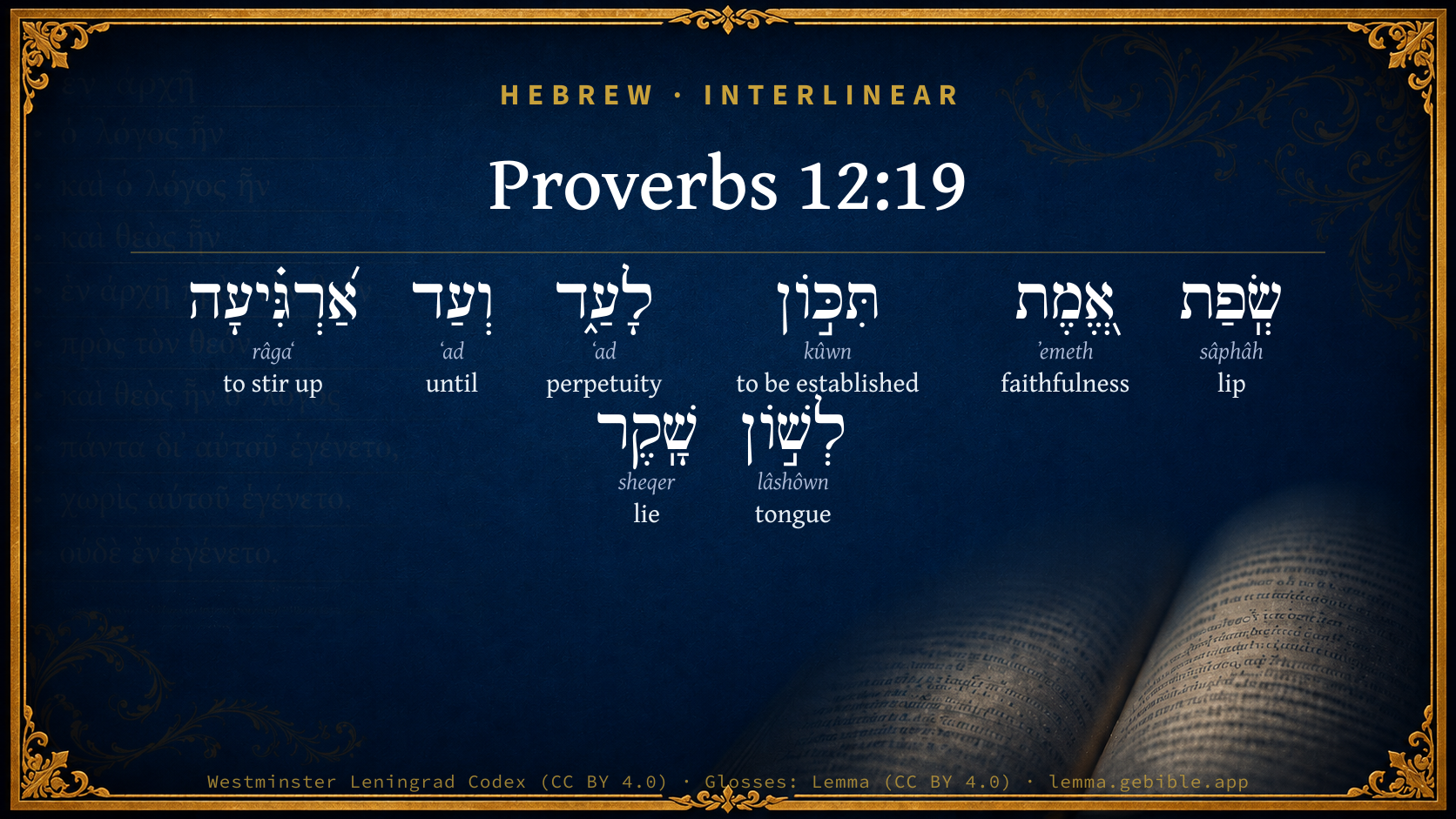
אַ֝רְגִּ֗יעָה
râgaʻ
H7280
“to stir up”
Verb, Hiphil, Cohortative, 1st Person, Common, Singular
Part of Speech
Verb
Stem
Hiphil
Form
Cohortative
Person
1st Person
Gender
Common
Number
Singular
Full BDB Definition

Origin: a primitive root

TWOT: 2116 , 2117 , 2118

to act in an instant, stir up, disturb - (Qal) to stir up, disturb - (Hiphil) to make a twinkling - to rest or repose, be at rest or repose, settle, quiet, give rest - (Niphal) - to cause to rest (of sword, of the sea) - to wink (with preposition) - (Hiphil) - to give rest to - to rest, repose - to harden
  1. שְֽׂפַת sâphâh H8193 “lip of” Noun, Common, Feminine, Singular, Construct
  2. אֱ֭מֶת ʼemeth H571 “faithfulness” Noun, Common, Feminine, Singular, Absolute
  3. תִּכּ֣וֹן kûwn H3559 “to be established” Verb, Niphal, Imperfect, 3rd Person, Feminine, Singular
  4. לָעַ֑ד ʻad H5703 “to/for · perpetuity” Preposition + Noun, Common, Masculine, Singular, Absolute
  5. וְעַד ʻad H5704 “and · until” Conjunction + Preposition
  6. לְשׁ֣וֹן lâshôwn H3956 “tongue of” Noun, Common, Both, Singular, Construct
  7. שָֽׁקֶר sheqer H8267 “lie” Noun, Common, Masculine, Singular, Absolute

About this verse

These counts appear in no published source. They are computed here, from the morphology-tagged text and Lemma’s own curated glosses. What Lemma adds →

8
words
8
distinct lemmas
Wisdom
section

Notable vocabulary

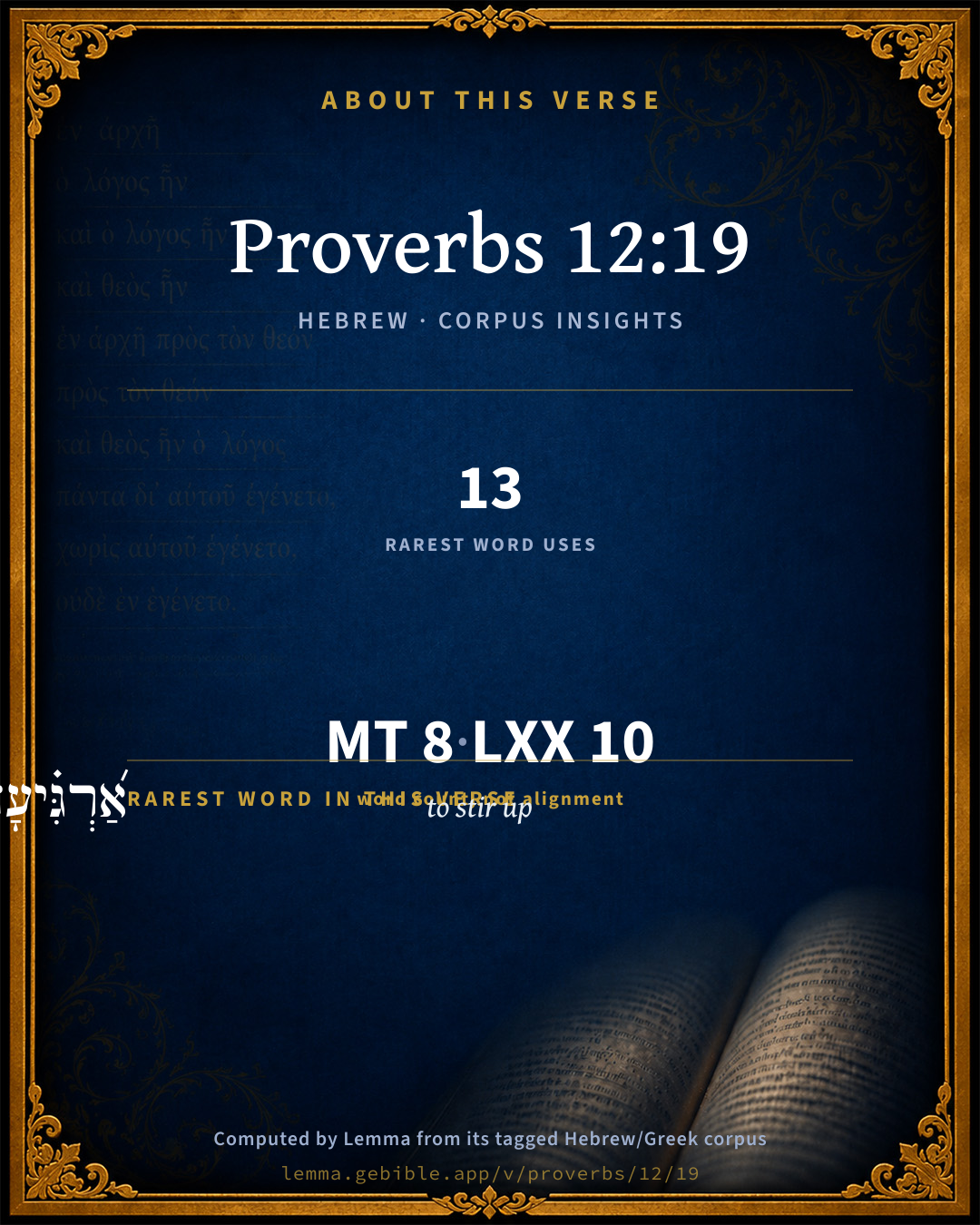
The rarest word here is אַ֝רְגִּ֗יעָה to stir up H7280 — appearing just 13 times in the whole Hebrew Bible.

Shared distinctive vocabulary

אַ֝רְגִּ֗יעָה to stir up H7280 occurs in 13 verses of the Hebrew Bible. Also found in:

Grammatical profile

  • 2 verbs
  • 5 nouns
  • 1 preposition

Verb forms

  • תִּכּ֣וֹן Niphal · Imperfect
  • אַ֝רְגִּ֗יעָה Hiphil · Cohortative

Hebrew & Septuagint length

In English translation the verse runs 13 words from the Hebrew and 12 from the Septuagint (LXX English) — closely comparable.

A rough comparison of the two English renderings, which tokenize alike — not a word-level alignment.

Word counts can differ between the Hebrew and the Greek without any difference in meaning — e.g. the Hebrew direct-object marker אֵת has no separate Greek word, and Greek often adds the article ὁ.

In the original languages it is 8 Hebrew tokens and 10 Greek tokens — but the two are counted differently (Hebrew bundles its prefixes and suffixes into one token; the Greek is in lemma form), so that isn’t a like-for-like length.

Cross-references

6

Topical passages linked to Proverbs 12:19 in the Treasury of Scripture Knowledge — connected by theme and wording, ordered by reader-vote popularity; previews shown in the World English Bible.

  • Proverbs 19:9 A false witness shall not be unpunished. He who utters lies shall perish.
  • Psalms 52:4–5 You love all devouring words, You deceitful tongue.
  • Job 20:5 That the triumphing of the wicked is short, The joy of the godless but for a moment?
  • Zechariah 1:4–6 Don't you be like your fathers, to whom the former prophets proclaimed, saying: Thus says Yahweh of hosts, 'Return now from your evil ways, and from your evil doings;' but they did not hear, nor listen to me, says Yahweh.
  • Matthew 24:35 Heaven and earth will pass away, but my words will not pass away.
  • Acts 5:3–10 But Peter said, "Ananias, why has Satan filled your heart to lie to the Holy Spirit, and to keep back part of the price of the land?

Cross-references courtesy of OpenBible.info (CC BY 4.0).

Hebrew and Greek witnesses Masoretic Hebrew ↔ Greek Septuagint

The same verse in the two great witnesses to the Old Testament, shown verse-for-verse.

These are two independent witnesses, not word-aligned to each other, and the Septuagint is shown in lemma (dictionary) form.

Hebrew Proverbs 12:19 Masoretic · Westminster Leningrad Codex

שְֽׂפַת אֱ֭מֶת תִּכּ֣וֹן לָעַ֑ד וְעַד אַ֝רְגִּ֗יעָה לְשׁ֣וֹן שָֽׁקֶר

Truth's lips will be established forever, But a lying tongue is only momentary.

World English Bible · Public Domain

Greek LXX Proverbs 12:19 Septuagint · lemma form

χεῖλος ἀληθινός καταὀρθόω μαρτυρία μάρτυς δέ ταχύς γλῶσσα ἔχω ἄδικος

True lips establish testimony; but a hasty witness has an unjust tongue.

LXX2012 (modern English Septuagint) · Public Domain

On this verse, The Pulpit Commentary discusses the Septuagint’s reading. Read the note in Commentary ↓

Hebrew: Westminster Leningrad Codex (CC BY 4.0). Greek: Septuagint (public domain); English from LXX2012 (modern English Septuagint) (Public Domain). How the Septuagint differs from the Hebrew →

Commentary

Notes on Proverbs 12:19 from classic Christian and Jewish commentators (each source and its license shown beneath its notes). The classic Christian expositions comment on the surrounding passage and are grouped to its opening verse, so a note may address several verses; the Jewish commentaries on the Tanakh (Rashi and others) are per-verse, so they appear only where the commentator wrote on this verse.

Lemma curates 59 commentaries, every one of them public domain or Creative Commons licensed, each selected and text-cleaned for this edition rather than reprinted as found. About our sources →

Trapp's Complete Commentary

John Trapp

Pro 12:19 The lip of truth shall be established for ever: but a lying tongue [is] but for a moment.

Ver. 19. The lips of truth shall be established for ever.] Veritas odium parit: Truth breeds hatred: a good mistress she is, but he that follows her too close at heels, may hap have his teeth struck out. He that prizeth truth, shall never prosper by the possession or profession thereof, saith Sir Walter Raleigh. {a} This is most true, for the most part, of "the truth of the gospel," {Gal 2:5} "the doctrine according to godliness" {1Ti 6:3} - "sweet in the mouth, but bitter in the belly"; {Rev 10:9} very pleasant in itself, but the publishing of it, whereby the fruit of it might come to the rest of the members, is full of trouble and anguish. How many faithful witnesses of the truth have lost their lives in the defence of it! All which notwithstanding, "the lips of truth shall be established," saith the Spirit here. ‘Great is the truth, and shall prevail.’ He that loseth his life in Christ’s cause, shall find it in heaven; "his name" also "shall be famous upon earth; the generation of the upright shall be blessed."

The lying tongue is but for a moment.] As is to be seen in Gehazi, in Ananias and Sapphira, in Doeg, and others; - "God {Psa 52:5} shall likewise destroy thee for ever, and root thee out of the land of the living." Did he not deal so by Julian, Ecebolius, Latomus, Bomelius, Pendleton, Harding, and others, both ancient and modern, renegades and apostates? "How are they brought into desolation as in a moment! they are utterly consumed with terror." {Psa 73:19}

{a} Hist., lib. i. c. 1.

John Trapp, A Commentary or Exposition upon All the Books of the Old and New Testament (1647–1656) — public domain. Text from a community e-Sword module.

The Biblical Illustrator

Joseph S. Exell

Pro_12:19

The lip of truth shall be established for ever.

Truthfulness

I. The righteousness of truth (Pro_12:17). The highest and only proper use of speech is to show the right. It may be used to set forth--

1. Right views of God (Psa_11:2; Joh_17:25-26; Rom_3:21-22).

2. Right views of personal experience (Psa_66:16).

3. Right estimates of character. Testimonials should be given with great caution.

4. Right statements as to the value of articles of merchandise.

5. Right expositions of Scripture. Some wrest the Scriptures (2Pe_3:16); others make them void by their traditions (Mar_7:13); others handle them deceitfully (2Co_4:2); but the God-taught expositor aims at the manifestation of the truth.

II. The wholesomeness of truth (Pro_12:18). Foolish speech often wounds, but in the word of wisdom is healing. Healthy doctrine produces healthy living, and thus it becomes its own advocate.

III. The stability of truth (Pro_12:19). Truth, like cork, will be uppermost one time or other, though an effort be made to keep it under water. Time is on the side of truth, and so is eternity. There has been an abundant establishment of--

1. The testimony of prophets.

2. Words spoken by the opponents of error. Lies often die hard, but sooner or later they die surely.

IV. The safety of truth. We may be afraid to be wrong, but should never be afraid to be right.

V. The reward of truth (Pro_12:22.) (H. Thorne.)

The lip of truth

There was once a little boy named Duncan. The boys used to call him True Duncan because he would never tell a lie. One day he was playing with an axe in the schoolyard. The axe was used for cutting wood for the schoolroom fire in winter. While Duncan was chopping a stick, the teachers cat, Old Tabby, came and leaped on to the log of wood where Duncan was at work. He had raised the axe to cut the wood, but it fell on the cat and killed her. What to do he knew not. She was the masters pet cat, and used to sit on a cushion at his side while he was hearing the boys lessons. Duncan stood looking at poor Tabby. His face grew red and the tears stood in his eyes. All the boys came running up, and every one had something to say. One of them was heard whispering to the others, Now, boys, let us see if Duncan cant make up a fib as well as the rest of us. Not he, said Tom Brown, who was Duncans friend, not he, Ill warrant. Duncan will be as true as gold. John Jones stepped up and said, Come, boys, let us fling the cat into the lane, and we can tell Mr. Cole that the butchers dog killed her. You know that he worried her last week. Some of them thought that would do very well. But Duncan looked quite angry; his cheek swelled and his face grew redder than before. No, no, said he. Do you think I would say that? It would be a lie--a lie! Each time he used the word his voice grew louder. Then he took up the poor thing and carried her into the masters room. The boys followed to see what would happen. The master looked up and said, What? is this my poor Tabby killed? Who could have done me such an injury? All were silent for a little while. As soon as Duncan could get his voice he said, Mr. Cole, I am very sorry I killed poor Tabby. Indeed, sir, I am very sorry, I ought to have been more careful, for I saw her rubbing herself against the log. I am more sorry than I can tell, sir. Every one expected to see Mr. Cole get very angry, take down his cane and give Duncan a sound thrashing. But instead of that he put on a pleasant smile and said, Duncan, you are a brave boy. I saw and heard all that passed in the yard from my window above. I am glad to see such an example of truth and honour in my school. Duncan took out his handkerchief and wiped his eyes. The boys could not keep silence any longer, and when Tom Brown cried, Three cheers for True Duncan! they all joined and made the schoolhouse ring with a mighty hurrah. The teacher then said, My boys, I am glad you know what is right and that you approve it, though I am afraid some of you could not have done it. Learn from this time that nothing can make a lie necessary. Suppose Duncan had taken your evil advice and come to me with a lie, it would have been instantly detected, and instead of the honour of truth he would have had only the shame of falsehood. (Sunday School.)

But a lying tongue is but for a moment.--

The doomed life of a lie

It is but for a moment. Dean Swift complains that the influence of a lie is often mischievously lasting; so often does it happen that if a lie be believed, only for an hour, it has done its work, and there is no further occasion for it. But the inherent mortality of whatever is false is recognised in other proverbs than those of Solomon, e.g., the English proverb, A lie has no legs. A lie, in that it is a lie, always carries within itself the germs of its own dissolution. It is sure to destroy itself at last. Carlyle says, There is no lie in the long run successful. The hour of all windbags does arrive; every windbag is at length ripped, and collapses. Lies exist only to be extinguished; they wait and cry earnestly for extinction. Ruin is the great sea of darkness whither all falsehoods, winding or direct, continually flow. Nothing, affirms a political philosopher, of an earlier and quite another school, can give stability and durable uniformity to error. Indolence or ignorance may keep it floating, as it were, on the surface of the mind, and sometimes hinder truth from penetrating; or force may maintain it in possession, while the mind assents to it no longer. But such opinions, like human bodies, tend to dissolution from their birth . . . Men are dragged into them, and held down in them, by chains of circumstances. Break but these chains, and the mind returns with a kind of intellectual elasticity to its proper object--truth. (Francis Jacox, B.A.)

Skill in telling lies

The lying tongue succeeds indeed, but its success is momentary; it flashes and expires; it has a clear, straightforward story to tell, but events come, and cross-examine that story, and set it in proper distance and perspective; alliances to which the story owed its consistency are broken up, and evil men begin to divulge secrets regarding one another; piece by piece the story falls asunder, and at the end it is found that it was the fabrication of a malignant genius. Be sure you are true yourselves, and have a true purpose in view, and all discrepancies, inconsistencies, and difficulties will ultimately be smoothed down, and men will be brought to acknowledge the integrity of your heart. Be as skilful as you please in the way of telling lies, arrange everything with consummate cunning, hire all your allies, bribe your spies, and make your way clear by abundance of gold, and yet in the long run your confederates will turn against you, and they to whom you have given most money will be glad to expose your cupidity and falsehood. (J. Parker, D.D.)

Truth more enduring than falsehood

Truth wears well. Time tests it, but it right well endures the trial. If, then, I have spoken the truth, and have for the present to suffer for it, I must be content to wait. If also I believe the truth of God, and endeavour to declare it, I may meet with much opposition, but I need not fear, for ultimately the truth must prevail. What a poor thing is the temporary triumph of falsehood! A lying lip is but for a moment! It is a mere gourd, which comes up in a night, and perishes in a night; and the greater its development, the more manifest its decay. On the other hand, how worthy of an immortal being is the avowal and defence of that truth which can never change; the everlasting gospel, which is established in the immutable truth of an unchanging God! An old proverb says, He that speaks truth shames the devil. Assuredly he that speaks the truth of God will put to shame all the devils in hell, and confound all the seed of the serpent which now hiss out their falsehoods. Oh, my heart, take care that thou be in all things on the side of truth, both in small things and great; but specially on the side of Him by whom grace and truth have come among men! (C. H. Spurgeon.)

The Biblical Illustrator, edited by Joseph S. Exell (c. 1880s–1900s) — public domain. Text from a community e-Sword module.

Matthew Henry's Commentary

Be it observed, to the honour of truth, that sacred thing, 1. That, if truth be spoken, it will hold good, and, whoever may be disobliged by it and angry at it, yet it will keep its ground. Great is the truth and will prevail. What is true will be always true; we may abide by it, and need not fear being disproved and put to shame. 2. That, if truth be denied, yet in time it will transpire. A lying tongue, that puts false colours upon things, is but for a moment. The lie will be disproved. The liar, when he comes to be examined, will be found in several stories, and not consistent with himself as he is that speaks truth; and, when he is found in a lie, he cannot gain his point, nor will he afterwards be credited. Truth may be eclipsed, but it will come to light. Those therefore that make a lie their refuge will find it a refuge of lies.

Matthew Henry's Commentary on the Whole Bible (1708–1710) — public domain (CC PDM 1.0). Text via the HelloAO Bible API.

Jamieson, Fausset & Brown

Robert Jamieson, A. R. Fausset & David Brown

Words of truth are consistent, and stand all tests, while lies are soon discovered and exposed.

Jamieson, Fausset & Brown — Commentary Critical and Explanatory on the Whole Bible (1871) — public domain (CC PDM 1.0). Text via the HelloAO Bible API.

Adam Clarke's Commentary

Verse 19. A lying tongue is but for a moment.] Truth stands for ever; because its foundation is indestructible: but falsehood may soon be detected; and, though it gain credit for a while, it had that credit because it was supposed to be truth.

Adam Clarke's Commentary on the Bible (1810–1826) — public domain. Text from a community e-Sword/MySword module.

Ellicott's Commentary for English Readers

(19) A lying tongue is but for a moment.—Being detected and silenced by the providence of God, (Comp. Psa_64:7-8.)

A Bible Commentary for English Readers, edited by Charles John Ellicott (1878–1897) — public domain. Text from a community e-Sword module.

The Cambridge Bible for Schools and Colleges

gen. ed. J. J. S. Perowne

19. but for a moment] Lit. while I wink. Comp. Jer_49:19, where the word is rendered, suddenly.

The Cambridge Bible for Schools and Colleges (gen. ed. J. J. S. Perowne; Cambridge University Press, 1878–1918) — public domain. Text from a community e-Sword module.

John Gill's Exposition

The lip of truth shall be established for ever,.... The man that speaks truth is and will be established in his credit and reputation among men; he is uniform and all of a piece, and what he says is believed; truth, though it may be opposed, will prevail against lies and falsehood; the word of truth, the Gospel of Christ, will stand for ever; the ministers of truth and righteousness will be continued to the end of the world; Christ, who is truth itself, abides the same to day, yesterday, and for ever;

but a lying tongue is but for a moment; if a liar speaks truth for once, he does not continue in it long, but quickly returns to his former course; or rather the lie he tells is very short lived, it is soon discovered, and he comes into contempt and disgrace, and loses all his credit and reputation among men of honour and honesty, and is sometimes suddenly snatched away by death, as Ananias and Sapphira; all error and heresy in a short time will cease and be no more; and antichrist, whose coming is with lying wonders, the direct opposite of the lip of truth, will be brought to ruin in a moment. Aben Ezra, Kimchi, and Ben Melech, who are followed by some Christian interpreters, as Montanus, and some in Vatablus, render it, "but", or "for ever, I will cause the lying tongue to cease", or "be at rest" from speaking; as if they were the words of God, threatening to cut off the lying tongue; but Jarchi and Gersom render it "for a moment", or a very short time, as we and others do; or, "whilst one winks" (f), in the twinkling of an eye; so soon is such a person removed.

(f) "at dum nictem", Schultens.

John Gill's Exposition of the Whole Bible (1746–1763) — public domain (CC PDM 1.0). Text via the HelloAO Bible API.

Haydock's Catholic Bible Commentary

Frameth. He studies how to escape detection. Hebrew, "a lying tongue is but for a moment;" it is presently discovered.

George Leo Haydock (1774–1849), Haydock's Catholic Family Bible and Commentary, 1859 edition — public domain. Excludes Psalms (Douay-Rheims chapter numbering differs from Protestant) and Deuterocanonical books (Catholic canon only).

Matthew Poole's English Annotations

The speaker of truth is constant, and always agreeable to himself, and his words, the more and longer they are tried, the more doth the truth of them appear; whereas liars, though they may make a fair show for a season, yet are easily and quickly convicted of falsehood.

Matthew Poole's English Annotations on the Holy Bible (1683–1685) — public domain. Text from a community e-Sword/MySword module.

Whedon's Commentary on the Bible

Daniel D. Whedon

19. Lying tongue… for a moment — Hebrew, until I can wink; the twinkling of an eye. The sense is: He that speaks truth is safe, but a liar shall quickly perish. On first clause compare Zec_1:5-6; Mat_24:35.

Daniel D. Whedon (gen. ed.), Commentary on the Old and New Testaments (1874–1909) — public domain. Text from a community e-Sword module.

The Pulpit Commentary

The lip of truth shall be established forever. Truth is consistent, invincible, enduring; and the fact belongs not only to Divine truth, (Psa_117:2 Mat_24:35) but to human, in its measure. Septuagint, "True lips establish testimony," pointing the last word ad as ed. Is but for a moment; literally, while I wink the eye. (Jer_49:19 Jer_50:44) Lying never answers in the end; it is soon found out and punished. (Pro_19:9 Psa_52:5) Septuagint, "But a hasty (tacuv ; repentinus, Vulgate) witness hath an unjust tongue." One who gives his testimony without due consideration, or influenced by evil motives, readily fails into lying and injustice. With the latter half of the verse we may compare the gnome All oudenou . "Unto old age no lie doth ever live. "A lie has no legs," is a maxim of wide nationality; and "Truth may be blamed, but shall ne"er be shamed."

The Pulpit Commentary (1880–1919), ed. H.D.M. Spence-Jones & Joseph S. Exell — public domain. Text from a community e-Sword module.

John Wesley's Explanatory Notes

A moment - Liars, though they may make a fair shew for a season, yet are quickly convicted.

John Wesley, Explanatory Notes Upon the Whole Bible (1754–1765) — public domain. Text via the GEBible commentary corpus.

Keil & Delitzsch

C. F. Keil & F. Delitzsch

19 The lip of truth endures for ever,

But the lying tongue only while I wink with the eye.

None of the old translators understood the phrase ועד־ארגּיעה; the Venet. also, which follows Kimchi's first explanation, is incorrect: ἕως ῥήξεως, till I split (shatter) it (the tongue). Abulwald is nearer the correct rendering when he takes ארגיעה as a noun = רגע with He parag. Ahron b. Joseph is better in rendering the phrase by: until I make a רגע, and quite correct if רגע (from רגע = Arab. raj', which is used of the swinging of the balance) is taken in the sense of a twinkling of the eye (Schultens: vibramen); cf. Orelli's Die hebr. Synonyme der Zeit und Ewigkeit, p. 27f., where the synonyms for a twinkling of the eye, a moment, are placed together. עד (properly progress) has in this phrase the meaning, while, so long as, and the cohortative signifies, in contradistinction to ארגיע, which may also denote an unwilling movement of the eyelids, a movement proceeding from a free determination, serving for the measurement of a short space of time, Ewald, 228a. ארגיעה, Jer 49:19; Jer 50:44, where Ewald takes כי ארגיעה (when I...) in the same sense as אד־ארגיעה here, which is more appropriate than the explanation of Hitzig, who regards כי as opening the principal clause, and attaches to הרגיע the quite too pregnant signification "to need (for an action) only a moment." The lip of truth, i.e., the lip which speaketh truth, endures for ever (for truth, אמת = אמנתּ, is just the enduring); but the tongue of falsehood is only for a moment, or a wink of the eye, for it is soon convicted, and with disgrace brings to silence; for a post-bibl. Aram. proverb says: קוּשׁטא קאי שׁקרא לא קאי, the truth endures, the lie endures not (Schabbath 104a), and a Hebrew proverb: השּׁקר אין לו רגלים, the lie has no feet (on which it can stand).

(Note: Vid., Duke's Rabbin. Blumenlese (1844), p. 231.)

Keil & Delitzsch — Biblical Commentary on the Old Testament (1861–1891) — public domain (CC PDM 1.0). Text via the HelloAO Bible API. (Old Testament only.)

Bridges on Proverbs

Charles Bridges

How important is it to eye eternity in all our words! Truth would then be seen in its permanent value and results. The profession may bring us into present trouble. (Mat 10:32-39 .) But its lip shall be established for ever. Who will gainsay the martyr’s testimony — ’Be of good comfort, Master Ridley; play the man. We shall this day light such a candle by God’s grace in England, as, I trust, shall never be put out’?†1 The lip also of the faithful minister of God is established for ever. For "whatsoever he binds and looses on earth, shall be bound and loosed in heaven." (Mat 18:18 . Joh 20:23 .)

Truth then is eternal. Lying, even if it suits our purpose as an easy escape from difficulty (a miserable — short-lived policy!) is but for a moment. (Psa 52:4-5 .) Nay — should it escape detection for a whole life; yet with eternity before us, what a moment is that! And what will be the relief of this short moment under the tremendous wrath of God? (Rev 21:8 ; Rev 22:15 .) God’s own people have always found this momentary escape from trouble to be followed by shame and confusion.†2 The lie of the Gibeonites ended in their confusion (Joshua 9.) The fruit of Gehazi’s lie was the pleasure for a moment. The shame endured unto the end. (2Ki 5:25-27 .) Under the same withering curse, the lying tongue of false teachers passes away (2Ti 3:6-9 ); while truth remains constant. ’None are so visibly blasted as those who make no conscience of a lie.’†3 Children! ponder it well — Eternity is at once the gain of truth, and the cost of a lie. (Psa 15:1-2 . Rev 21:8 .) But oh! the infinite difference between heaven and hell!

Footnotes:

†1 Foxe, vii. 550.

†2 Abraham, Gen 20:1-16 . Isaac, Gen 26:7-10. Peter, Mat 26:69-75 .

†3 Matthew Henry’s Life, Chapter xiii.

Charles Bridges, An Exposition of the Book of Proverbs (1846) — public domain. Text from a community e-Sword module.

Kretzmann's Popular Commentary

Paul E. Kretzmann

v. 19. The lip of truth shall be established forever, for truth, although trodden to the earth, will ever rise again; but a lying tongue is but for a moment, the falsehood being readily exposed and therefore losing its power.

Paul E. Kretzmann, Popular Commentary of the Bible (1921–1924) — public domain. Text from a community e-Sword module.

unfoldingWord translationNotes

Door43 World Missions Community

Truthful lips last forever

"Lips" represents what a person says. AT: "A truthful person endures forever" (See: Metonymy)

a lying tongue is only for a moment

"Tongue" represents what a person says. AT: "the one who lies lasts only for a moment" (See: Metonymy)

advisors

those who give recommendations as a guide to action; counselors

translationWords

true

eternity

tongue

deceive

heart

evil

joy

peace

unfoldingWord translationNotes — © Distant Shores Media and the Door43 World Missions Community, licensed CC BY-SA 4.0. Source: git.door43.org/Door43/en_tn.

Rashi

Rabbi Shlomo Yitzchaki (Rashi)

A true tongue will be established forever It will be established and will endure.

just for a moment In a fleeting moment, it perishes and leaves, for falsehood has no feet.

Rashi on the Tanakh — English translations: “The Judaica Press complete Tanach with Rashi, translated by A. J. Rosenberg” (CC BY 4.0); “Pentateuch with Rashi's commentary by M. Rosenbaum and A.M. Silbermann, 1929-1934” (public domain); “The Metsudah Tanach series, Lakewood, N.J” (CC BY 4.0); and “The Book of Joshua, Metsudah Publications, 1997” (CC BY 4.0). Text via Sefaria.

Lesson kit

Teaching starters — assembled from the data on this page, not authored interpretation. Every prompt links to the verse data it draws on. Edit before teaching.

Proverbs, in the Wisdom, opens this verse with 8 words (8 distinct Hebrew lemmas). Its most distinctive word is râgaʻ (“to stir up”). A historical commentator’s framing appears above. Read the whole chapter for the surrounding context.

Discussion questions

  1. How does “to stir up” (râgaʻ) shape what this verse is saying?
  2. Deuteronomy 28:65 shares the word «to stir up» with this verse. How do the two illuminate each other?
  3. These translations render this verse differently. What is at stake in choosing one wording over another?
  4. The verb «תִּכּ֣וֹן» is Niphal Imperfect. How does its form color the action?
  5. Reading how Trapp's Complete Commentary and The Biblical Illustrator read this verse, where do the two commentators agree and where do they part?

Things to notice

Reading settings

Reading text

Shown beneath each verse's original-language words.

Old Testament
Old Testament edition

Read the OT as the Masoretic Hebrew (MT) or the Greek Septuagint (LXX).

English shown for the Greek Septuagint (in the Hebrew ↔ Greek comparison).

Comparing translations? Open the Compare panel on any verse page to stack up to four side by side.