
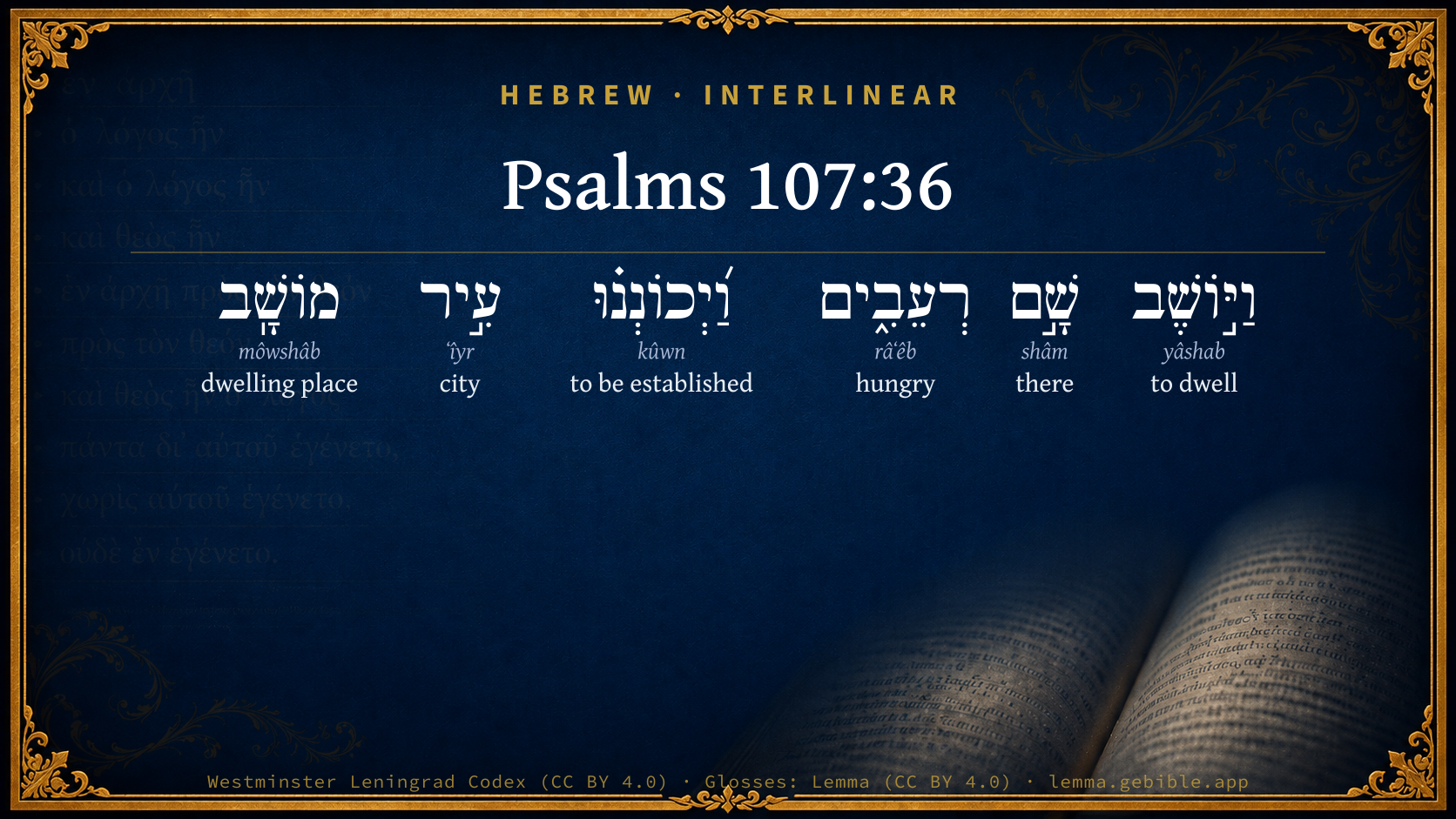
Psalms 107:36

Hebrew (Westminster Leningrad Codex) Psalms 107:36 appears in the Hebrew Old Testament. The text above is from the Westminster Leningrad Codex. Each word links to its Strong’s number, a concise gloss, and parsing drawn from the Open Scriptures Hebrew Bible morphology. Click any word for its full Brown-Driver-Briggs (BDB) entry.
Download image
Cite this verse

Psalms 107:36 (World English Bible). Public Domain. Lemma interlinear Bible study tool, https://lemma.gebible.app/v/psalms/107/36.

Show BibTeX & RIS
BibTeX
RIS
English Translation
There he makes the hungry live, That they may prepare a city to live in,
World English Bible · Public Domain
Download a study sheet

One document with this verse’s original text, its word-by-word gloss line, the meaning frame, cross-references with their text, attributed commentary, and full source and license credits — printable, and it pastes into notes with its structure intact.

This verse Autodidact and up

Study sheet (.html) Plain text (.txt)

A passage Seminary Student

Up to 50 verses in one chapter. A passage sheet keeps up to 6 commentary sources and 12 cross-references per verse, in the order this page ranks them, and says so on the sheet whenever that leaves anything out. Ask for a single verse and you get the Autodidact verse sheet above.

Everything on this page stays free to read, with no account — the sheet is a download of what is already on screen, not access to it.

Want to remove ads? Support Godless Engineer
Compare translations 3

The same verse in 3 English versions, stacked beneath the original-language interlinear above. Click any original word for its lexicon entry.

Each is an independent rendering of the whole verse — the interlinear is not word-aligned to these translations.

Highlighted words mark where these versions differ — a whole-verse word diff, not a word-by-word alignment.

  • World English Bible Public Domain
    There he makes the hungry live, That they may prepare a city to live in,
  • King James Version Public Domain
    And there he maketh the hungry to dwell, that they may prepare a city for habitation;
  • unfoldingWord Literal Text CC BY-SA 4.0
    He settles the hungry there, and they build a city of dwelling.

unfoldingWord Literal Text — © unfoldingWord, licensed CC BY-SA 4.0. Word-aligned USFM3 via Door43 (git.door43.org/unfoldingWord/en_ult).

Versions to compare (up to 4)

3 of 4 selected

Show all 18 translations

Every available English version of this verse, each an independent rendering of the whole verse.

  • World English Bible Public Domain
    There he makes the hungry live, That they may prepare a city to live in,
  • Berean Standard Bible Public Domain
    He causes the hungry to settle there, that they may establish a city in which to dwell.
  • Majority Standard Bible Public Domain
    He causes the hungry to settle there, that they may establish a city in which to dwell.
  • King James Version Public Domain
    And there he maketh the hungry to dwell, that they may prepare a city for habitation;
  • American Standard Version (1901) Public Domain
    And there he maketh the hungry to dwell, That they may prepare a city of habitation,
  • Revised Version (1885) Public Domain
    And there he maketh the hungry to dwell, that they may prepare a city of habitation;
  • Geneva Bible (1599) Public Domain
    And there he placeth the hungrie, and they builde a citie to dwell in,
  • Douay-Rheims (1899) Public Domain
    And hath placed there the hungry; and they made a city for their habitation.
  • Young's Literal Translation Public Domain
    And He causeth the hungry to dwell there, And they prepare a city of habitation.
  • Literal Standard Version CC BY-SA 4.0
    And He causes the hungry to dwell there, || And they prepare a city of habitation.
  • Unlocked Literal Bible CC BY-SA 4.0
    He settles the hungry there, and they build a city to live in.
  • unfoldingWord Literal Text CC BY-SA 4.0
    He settles the hungry there, and they build a city of dwelling.
  • Darby Bible Public Domain
    And there he maketh the hungry to dwell, and they establish a city of habitation;
  • World Messianic Bible Public Domain
    There he makes the hungry live, that they may prepare a city to live in,
  • Webster's Bible Public Domain
    And there he maketh the hungry to dwell, that they may prepare a city for habitation;
  • Free Bible Version CC BY-SA 4.0
    He brings hungry people to live there—a place they can build their cities.
  • Bible in Basic English Public Domain
    And there he gives the poor a resting-place, so that they may make themselves a town;
  • JPS Tanakh (1917) Public Domain
    And there He maketh the hungry to dwell, and they establish a city of habitation;

Literal Standard Version (2020), Covenant Press — licensed CC BY-SA 4.0. Text via the HelloAO Bible API (eBible.org). Unlocked Literal Bible (unfoldingWord) — licensed CC BY-SA 4.0. Text via the HelloAO Bible API (eBible.org). unfoldingWord Literal Text — © unfoldingWord, licensed CC BY-SA 4.0. Word-aligned USFM3 via Door43 (git.door43.org/unfoldingWord/en_ult). Free Bible Version, Dr. Jonathan Gallagher — licensed CC BY-SA 4.0. Text via the HelloAO Bible API (eBible.org).

Word by word

More ways to search: Search by grammar → Find every occurrence → Compare this word →

Practice this passage: Drill this verse → Learn its vocabulary →

About this verse

These counts appear in no published source. They are computed here, from the morphology-tagged text and Lemma’s own curated glosses. What Lemma adds →

6
words
6
distinct lemmas
Wisdom
section

Notable vocabulary

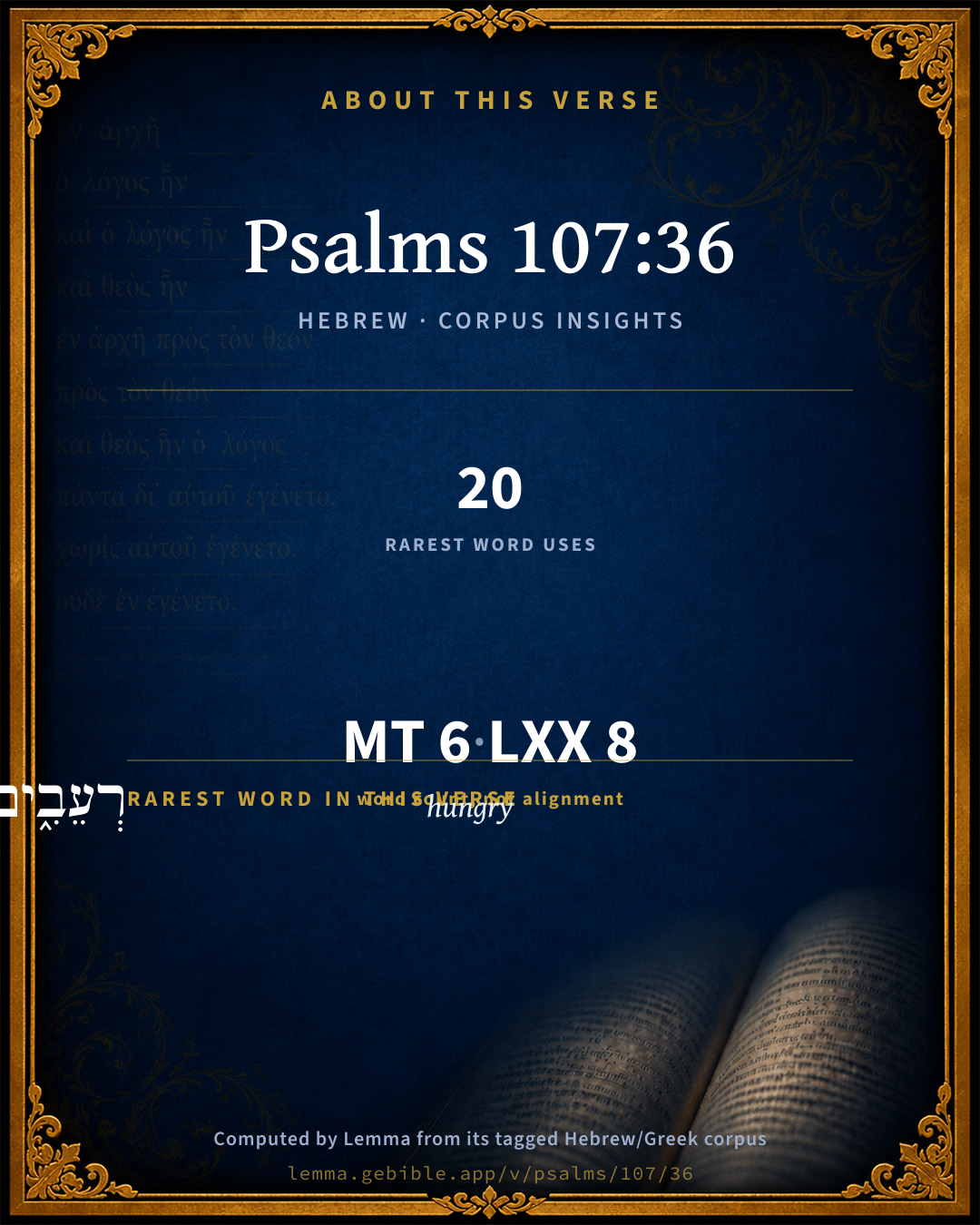
The rarest word here is רְעֵבִ֑ים hungry H7457 — appearing just 20 times in the whole Hebrew Bible.

Shared distinctive vocabulary

רְעֵבִ֑ים hungry H7457 occurs in 20 verses of the Hebrew Bible. Also found in:

Grammatical profile

  • 2 verbs
  • 2 nouns
  • 1 adjective
  • 1 adverb

Verb forms

  • וַיּ֣וֹשֶׁב Hiphil · Sequential Imperfect
  • וַ֝יְכוֹנְנ֗וּ Polel · Sequential Imperfect

Hebrew & Septuagint length

In English translation the verse runs 15 words from the Hebrew and 16 from the Septuagint (LXX English) — closely comparable.

A rough comparison of the two English renderings, which tokenize alike — not a word-level alignment.

Word counts can differ between the Hebrew and the Greek without any difference in meaning — e.g. the Hebrew direct-object marker אֵת has no separate Greek word, and Greek often adds the article ὁ.

In the original languages it is 6 Hebrew tokens and 8 Greek tokens — but the two are counted differently (Hebrew bundles its prefixes and suffixes into one token; the Greek is in lemma form), so that isn’t a like-for-like length.

Cross-references

4

Topical passages linked to Psalms 107:36 in the Treasury of Scripture Knowledge — connected by theme and wording, ordered by reader-vote popularity; previews shown in the World English Bible.

  • Psalms 107:7 He led them also by a straight way, That they might go to a city to live in.
  • Luke 1:53 He has filled the hungry with good things. He has sent the rich away empty.
  • Acts 17:26 He made from one blood every nation of men to dwell on all the surface of the earth, having determined appointed seasons, and the boundaries of their dwellings,
  • Psalms 146:7 Who executes justice for the oppressed; Who gives food to the hungry. Yahweh frees the prisoners.

Cross-references courtesy of OpenBible.info (CC BY 4.0).

Hebrew and Greek witnesses Masoretic Hebrew ↔ Greek Septuagint

The same verse in the two great witnesses to the Old Testament, shown verse-for-verse.

You’re reading Greek Psalm 106 (Hebrew Psalm 107). The Septuagint counts the superscription, so verse numbers can differ from the Hebrew — chapter-level alignment, not verse-by-verse. Numbering follows Rahlfs.

These are two independent witnesses, not word-aligned to each other, and the Septuagint is shown in lemma (dictionary) form.

Hebrew Psalms 107:36 Masoretic · Westminster Leningrad Codex

וַיּ֣וֹשֶׁב שָׁ֣ם רְעֵבִ֑ים וַ֝יְכוֹנְנ֗וּ עִ֣יר מוֹשָֽׁב

There he makes the hungry live, That they may prepare a city to live in,

World English Bible · Public Domain

Greek LXX Greek Psalm 106:36 Septuagint · lemma form

καί καταοἰκίζω ἐκεῖ πεινάω καί συνἵστημι πόλις κατοικεσία

And there he causes the hungry to dwell, and they establish for themselves cities of habitation.

LXX2012 (modern English Septuagint) · Public Domain

Hebrew: Westminster Leningrad Codex (CC BY 4.0). Greek: Septuagint (public domain); English from LXX2012 (modern English Septuagint) (Public Domain). How the Septuagint differs from the Hebrew →

Commentary

Notes on Psalms 107:36 from classic Christian and Jewish commentators (each source and its license shown beneath its notes). The classic Christian expositions comment on the surrounding passage and are grouped to its opening verse, so a note may address several verses; the Jewish commentaries on the Tanakh (Rashi and others) are per-verse, so they appear only where the commentator wrote on this verse.

Lemma curates 59 commentaries, every one of them public domain or Creative Commons licensed, each selected and text-cleaned for this edition rather than reprinted as found. About our sources →

Trapp's Complete Commentary

John Trapp

Psa 107:36 And there he maketh the hungry to dwell, that they may prepare a city for habitation;

Ver. 36. And there he maketh the hungry to dwell] As our English, and other plantations in America, where sundry poor people get fair estates.

That they may prepare a city] The building of cities is of God, and so is their conservation.

John Trapp, A Commentary or Exposition upon All the Books of the Old and New Testament (1647–1656) — public domain. Text from a community e-Sword module.

J. A. Alexander on Psalms

Joseph Addison Alexander

36. (Psa 107:36) And has settled there famished (men), and they have established a city to dwell in. There is no need of assuming, that the desert thus transformed is Palestine or Canaan. It is better to adhere to the general import of the figures, which is change for the better. Settled, literally caused to dwell. The primary meaning of the last clause is that those once homeless have a home; but there is of course a reference to the repossession and rebuilding of Jerusalem. The last phrase in Hebrew is the same with that translated city of habitation in Psa 107:4.

Joseph Addison Alexander, The Psalms Translated and Explained (1850) — public domain. Text from a community e-Sword module.

Adam Clarke's Commentary

Verse 36. And there he maketh the hungry to dwell] All this seems to apply admirably to the first colonists of any place. They flee from a land of want, an ingrata terra that did not repay their toil, and they seek the wilderness where the land wants only cultivation to make it produce all the necessaries of life. He, by his providence, so guides their steps as to lead them to rivers which they can navigate, and from which they can procure plenty of fish, and shows them wells or springs which they have not digged. The hungry dwell there; and jointly agree, for convenience and defence, to build them a city for habitation. They sow the fields which they have cleared; and plant vineyards, and orchards which yield them in creasing fruits, Ps 107:37, and he multiplies their cattle greatly, and does not suffer them to decrease, Ps 107:38. What a fine picture is this of the first peopling and planting of America, and of the multiplication and extension of that people; of the Divine blessing on their industry, and the general and astonishing prosperity of their country! May they never again know what is spoken in the following verse:

Adam Clarke's Commentary on the Bible (1810–1826) — public domain. Text from a community e-Sword/MySword module.

The Cambridge Bible for Schools and Colleges

gen. ed. J. J. S. Perowne

36. And there he hath made the hungry to dwell,

And they have founded an inhabited city,

The Cambridge Bible for Schools and Colleges (gen. ed. J. J. S. Perowne; Cambridge University Press, 1878–1918) — public domain. Text from a community e-Sword module.

John Gill's Exposition

Again they are minished,.... Or "lessened", in their families, cattle, and substance; either the same persons as before, or others. The Targum paraphrases it,

"but when they sin, they are lessened:''

for sin is the cause of it, as follows:

and brought low through oppression, affliction and sorrow; either because of their oppression of the poor, the evil they do to them, and the sorrow they bring upon them; or they are brought into a low estate through the tyranny and oppression of others, and by the afflictions and sorrows they are brought into by them. This may be applied to the Jews, at their destruction by the Romans, when they were greatly lessened and brought low by their oppression of them: or rather to the Christians; not under the Heathen persecutions, for then they increased more and more; but under antichristian tyranny, when the beast had power over them, and overcame and slew them; and their numbers were so reduced, that the whole world is said to wonder after the beast, Rev 13:3, and which will be the case again, when the witnesses will be slain: the number of Christians is greatly lessening now; there are but a few names in Sardis; Jacob is small, but will be smaller and fewer still.

John Gill's Exposition of the Whole Bible (1746–1763) — public domain (CC PDM 1.0). Text via the HelloAO Bible API.

Albert Barnes' Notes on the Bible

And there he maketh the hungry to dwell - Those who were in want; those who would have perished. It is not necessary to refer this to any particular case. It is a general statement, pertaining to changes which God makes upon the earth, as great as if he “should” thus convert a desert into a fruitful field - a barren waste into a land abounding in springs of water; as if he should conduct there a company of famished men, and provide for them food in abundance.

That they may prepare a city for habitation - A permanent dwelling-place for man.

Albert Barnes' Notes on the Bible (1834–1885) — public domain. Text from a community e-Sword/MySword module.

Matthew Poole's English Annotations

The hungry; poor people; who could not provide for themselves, or were banished from their own land by potent oppressors, and were driven into wildernesses, like them Job 30:3, which God in pity to them made fruitful.

Matthew Poole's English Annotations on the Holy Bible (1683–1685) — public domain. Text from a community e-Sword/MySword module.

The Treasury of David

Charles H. Spurgeon

Ver. 36. And there he maketh the hungry to dwell, where none could dwell before. They will appreciate the change and prize his grace; as the barrenness of the land caused their hunger so will its fertility banish it for ever, and they will settle down a happy and thankful people to bless God for every handful of corn which the land yields to them. None are so ready to return a revenue of praise to God for great mercies as those who have known the lack of them. Hungry souls make sweet music when the Lord fills them with his gracious gifts. Are we hungry? Or are we satisfied with the husks of this poor, swinish world?

That they may prepare a city for habitation. When the earth is watered and men cultivate it, cities spring up and teem with inhabitants; when grace abounds where sin formerly reigned, hearts find peace and dwell in God's love as in a strong city. The church is built up where once all was a waste when the Lord causes the broad rivers and streams of gospel grace to flow forth.

Psalms 107:37*

Charles H. Spurgeon's The Treasury of David (1869–1885) — public domain. Psalms only. Text from a community e-Sword/MySword module.

The Pulpit Commentary

And there he maketh the hungry to dwell. God gives the laud, which he has thus blessed, to some previously famishing people; as he did Canaan to Israel after they had had but scant fare in the wilderness. That they may prepare a city for habitation; literally, and they prepare. It is naturally their first thought to prepare themselves a settled dwelling-place. (comp. Gen_4:17 Gen_11:4 Gen_25:16, etc.)

The Pulpit Commentary (1880–1919), ed. H.D.M. Spence-Jones & Joseph S. Exell — public domain. Text from a community e-Sword module.

John Wesley's Explanatory Notes

Hungry - Poor people who could not provide for themselves.

John Wesley, Explanatory Notes Upon the Whole Bible (1754–1765) — public domain. Text via the GEBible commentary corpus.

unfoldingWord translationNotes

Door43 World Missions Community

He settles the hungry there

The word "there" refers to the places where Yahweh made springs and lakes appear. Also, the phrase "the hungry" refers to people who are hungry. AT: "Yahweh makes people who are hungry live there" (See: Nominal Adjectives)

to plant vineyards

"to plant vineyards in"

and to bring in an abundant harvest

"so that they can produce a plentiful harvest"

so they are very numerous

"so that their people are very numerous"

He does not let their cattle decrease in number

This can be stated in positive form. AT: "He keeps their cattle very numerous" (See: Litotes)

translationWords

vineyard

harvest

bless

unfoldingWord translationNotes — © Distant Shores Media and the Door43 World Missions Community, licensed CC BY-SA 4.0. Source: git.door43.org/Door43/en_tn.

Lesson kit

Teaching starters — assembled from the data on this page, not authored interpretation. Every prompt links to the verse data it draws on. Edit before teaching.

Psalms, in the Wisdom, opens this verse with 6 words (6 distinct Hebrew lemmas). Its most distinctive word is râʻêb (“hungry”). A historical commentator’s framing appears above. Read the whole chapter for the surrounding context.

Discussion questions

  1. The word râʻêb carries the sense “hungry.” How does it shape the verse?
  2. How does 1 Samuel 2:5, which shares the word «hungry», read alongside this verse?
  3. These translations render this verse differently. What is at stake in choosing one wording over another?
  4. «וַיּ֣וֹשֶׁב» is a Hiphil Sequential Imperfect verb. How does that grammatical form shape the action described?
  5. Compare how Trapp's Complete Commentary and J. A. Alexander on Psalms read this verse. Where do they agree or differ?

Things to notice

Reading settings

Reading text

Shown beneath each verse's original-language words.

Old Testament
Old Testament edition

Read the OT as the Masoretic Hebrew (MT) or the Greek Septuagint (LXX).

English shown for the Greek Septuagint (in the Hebrew ↔ Greek comparison).

Comparing translations? Open the Compare panel on any verse page to stack up to four side by side.