
Job 28:27

Hebrew (Westminster Leningrad Codex) Job 28:27 appears in the Hebrew Old Testament. The text above is from the Westminster Leningrad Codex. Each word links to its Strong’s number, a concise gloss, and parsing drawn from the Open Scriptures Hebrew Bible morphology. Click any word for its full Brown-Driver-Briggs (BDB) entry.
Download image
Cite this verse

Job 28:27 (World English Bible). Public Domain. Lemma interlinear Bible study tool, https://lemma.gebible.app/v/job/28/27.

Show BibTeX & RIS
BibTeX
RIS
English Translation
Then did he see it, and declare it. He established it, yes, and searched it out.
World English Bible · Public Domain
Download a study sheet

One document with this verse’s original text, its word-by-word gloss line, the meaning frame, cross-references with their text, attributed commentary, and full source and license credits — printable, and it pastes into notes with its structure intact.

This verse Autodidact and up

Study sheet (.html) Plain text (.txt)

A passage Seminary Student

Up to 50 verses in one chapter. A passage sheet keeps up to 6 commentary sources and 12 cross-references per verse, in the order this page ranks them, and says so on the sheet whenever that leaves anything out. Ask for a single verse and you get the Autodidact verse sheet above.

Everything on this page stays free to read, with no account — the sheet is a download of what is already on screen, not access to it.

Want to remove ads? Support Godless Engineer
Compare translations 3

The same verse in 3 English versions, stacked beneath the original-language interlinear above. Click any original word for its lexicon entry.

Each is an independent rendering of the whole verse — the interlinear is not word-aligned to these translations.

Highlighted words mark where these versions differ — a whole-verse word diff, not a word-by-word alignment.

  • World English Bible Public Domain
    Then did he see it, and declare it. He established it, yes, and searched it out.
  • King James Version Public Domain
    Then did he see it, and declare it; he prepared it, yea, and searched it out.
  • unfoldingWord Literal Text CC BY-SA 4.0
    then he saw it and recounted it; he established it and also explored it.

unfoldingWord Literal Text — © unfoldingWord, licensed CC BY-SA 4.0. Word-aligned USFM3 via Door43 (git.door43.org/unfoldingWord/en_ult).

Versions to compare (up to 4)

3 of 4 selected

Show all 18 translations

Every available English version of this verse, each an independent rendering of the whole verse.

  • World English Bible Public Domain
    Then did he see it, and declare it. He established it, yes, and searched it out.
  • Berean Standard Bible Public Domain
    then He looked at wisdom and appraised it; He established it and searched it out.
  • Majority Standard Bible Public Domain
    then He looked at wisdom and appraised it; He established it and searched it out.
  • King James Version Public Domain
    Then did he see it, and declare it; he prepared it, yea, and searched it out.
  • American Standard Version (1901) Public Domain
    Then did he see it, and declare it; He established it, yea, and searched it out.
  • Revised Version (1885) Public Domain
    Then did he see it, and declare it; he established it, yea, and searched it out.
  • Geneva Bible (1599) Public Domain
    Then did he see it, and counted it: he prepared it and also considered it.
  • Douay-Rheims (1899) Public Domain
    Then he saw it, and declared, and prepared, and searched it.
  • Young's Literal Translation Public Domain
    Then He hath seen and declareth it, He hath prepared it, and also searched it out,
  • Literal Standard Version CC BY-SA 4.0
    Then He has seen and declares it, || He has prepared it, and also searched it out,
  • Unlocked Literal Bible CC BY-SA 4.0
    Then he saw wisdom and announced it; he established it, indeed, and he examined it.
  • unfoldingWord Literal Text CC BY-SA 4.0
    then he saw it and recounted it; he established it and also explored it.
  • Darby Bible Public Domain
    Then did he see it, and declare it; he established it, yea, and searched it out;
  • World Messianic Bible Public Domain
    then he saw it, and declared it. He established it, yes, and searched it out.
  • Webster's Bible Public Domain
    Then did he see it, and declare it; he prepared it, yea, and searched it out.
  • Free Bible Version CC BY-SA 4.0
    Then he considered wisdom. He examined it, gave it his approval, and declared it good.
  • Bible in Basic English Public Domain
    Then he saw it, and put it on record; he gave it its fixed form, searching it out completely.
  • JPS Tanakh (1917) Public Domain
    Then did He see it, and declare it; He established it, yea, and searched it out.

Literal Standard Version (2020), Covenant Press — licensed CC BY-SA 4.0. Text via the HelloAO Bible API (eBible.org). Unlocked Literal Bible (unfoldingWord) — licensed CC BY-SA 4.0. Text via the HelloAO Bible API (eBible.org). unfoldingWord Literal Text — © unfoldingWord, licensed CC BY-SA 4.0. Word-aligned USFM3 via Door43 (git.door43.org/unfoldingWord/en_ult). Free Bible Version, Dr. Jonathan Gallagher — licensed CC BY-SA 4.0. Text via the HelloAO Bible API (eBible.org).

Word by word

More ways to search: Search by grammar → Find every occurrence → Compare this word →

Practice this passage: Drill this verse → Learn its vocabulary →

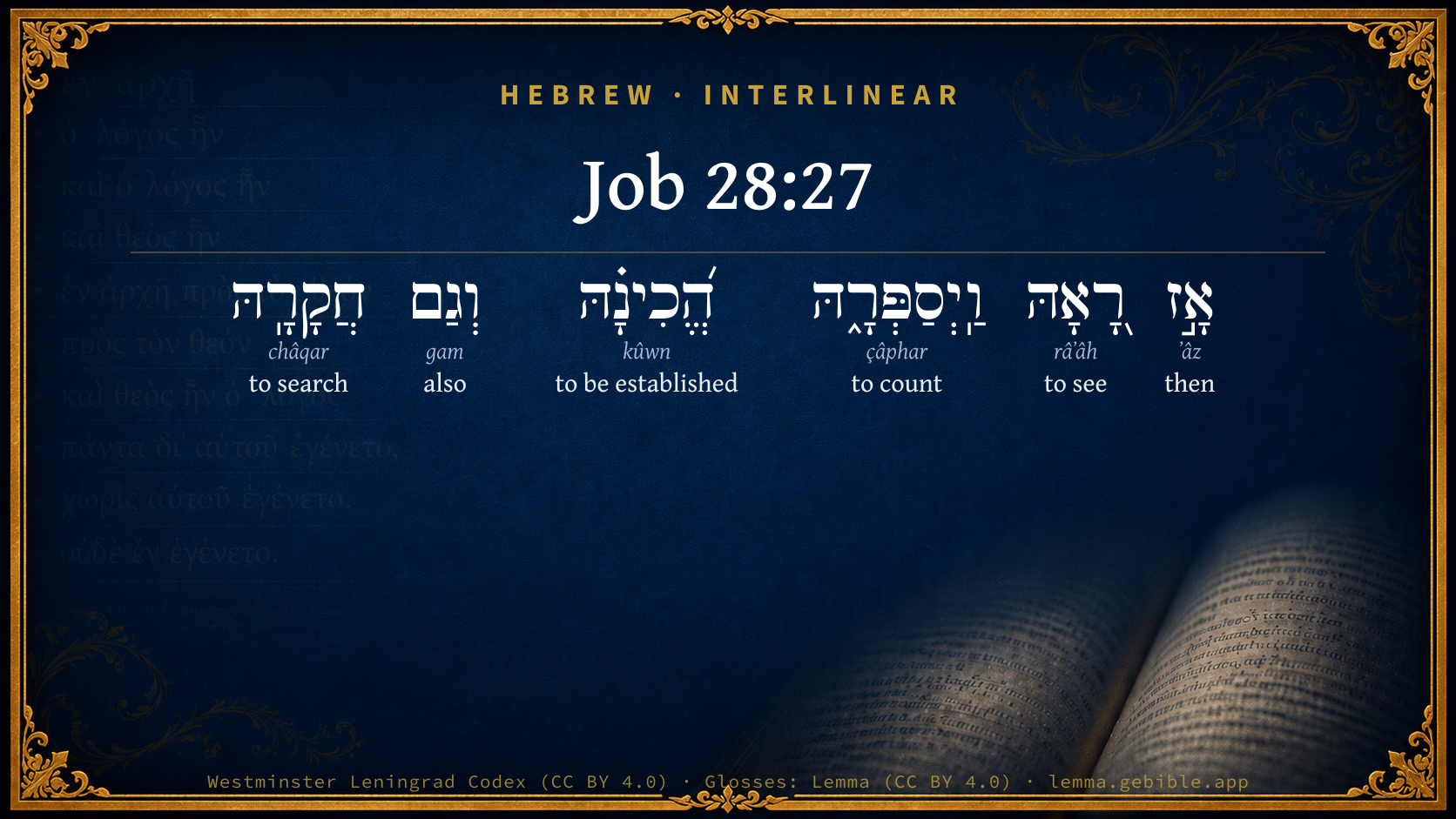
חֲקָרָֽהּ
châqar
H2713
“to search · her”
Verb, Qal, Perfect, 3rd Person, Masculine, Singular + Suffix, Personal, 3rd Person, Feminine, Singular
Part of Speech
Verb
Stem
Qal
Form
Perfect
Person
3rd Person
Gender
Masculine
Number
Singular
Full BDB Definition

Origin: a primitive root

TWOT: 729

to search, search for, search out, examine, investigate - (Qal) - to search (for) - to search through, explore - to examine thoroughly - (Niphal) - to be searched out, be found out, be ascertained, be examined - (Piel) to search out, seek out
  1. אָ֣ז ʼâz H227 “then” Adverb
  2. רָ֭אָהּ râʼâh H7200 “to see · her” Verb, Qal, Perfect, 3rd Person, Masculine, Singular + Suffix, Personal, 3rd Person, Feminine, Singular
  3. וַֽיְסַפְּרָ֑הּ çâphar H5608 “and · to count · her” Conjunction + Verb, Piel, Sequential Imperfect, 3rd Person, Masculine, Singular + Suffix, Personal, 3rd Person, Feminine, Singular
  4. הֱ֝כִינָ֗הּ kûwn H3559 “to be established · her” Verb, Hiphil, Perfect, 3rd Person, Masculine, Singular + Suffix, Personal, 3rd Person, Feminine, Singular
  5. וְגַם gam H1571 “and · also” Conjunction + Particle, Accusative

About this verse

These counts appear in no published source. They are computed here, from the morphology-tagged text and Lemma’s own curated glosses. What Lemma adds →

6
words
6
distinct lemmas
Wisdom
section

Shared distinctive vocabulary

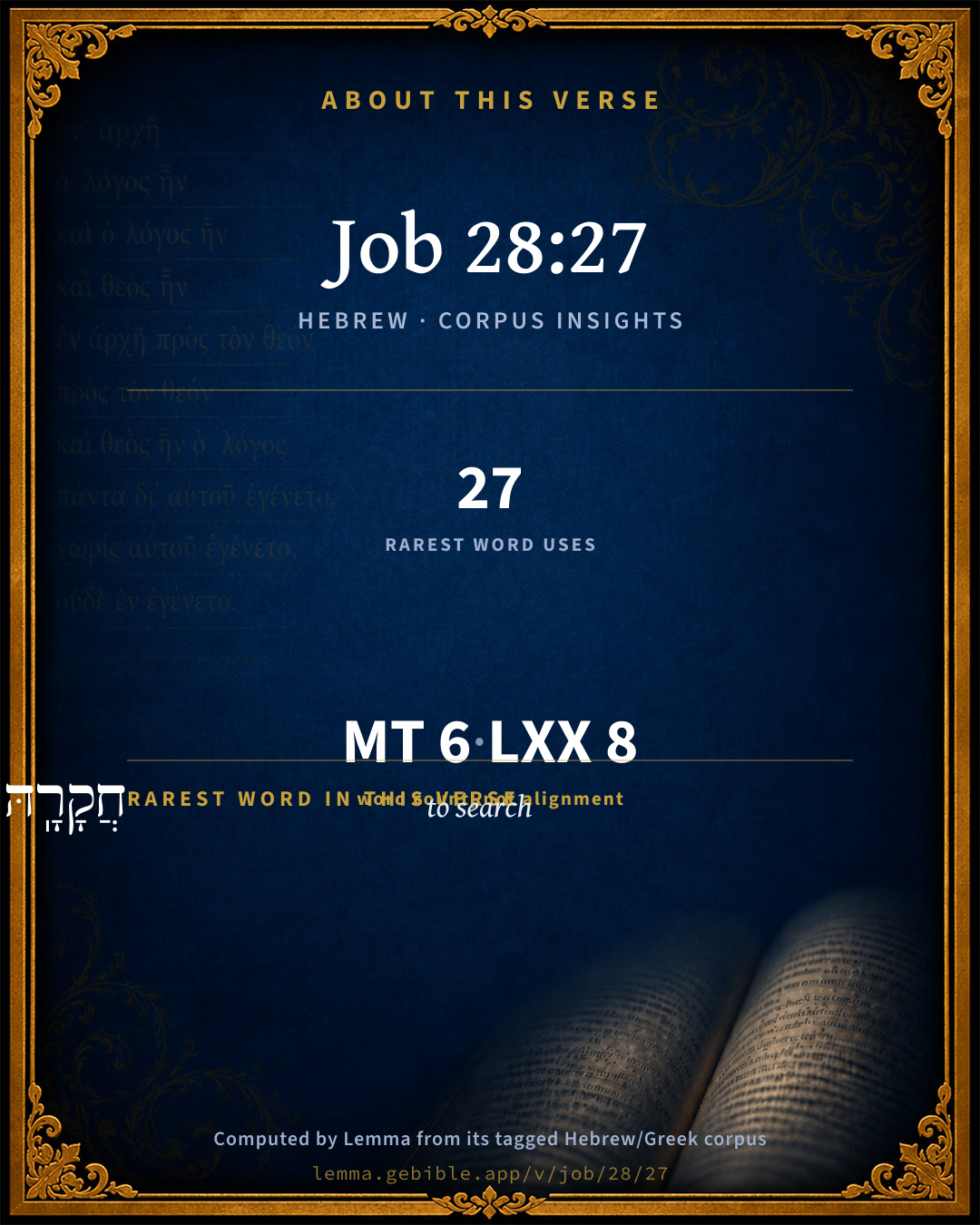
חֲקָרָֽהּ to search H2713 occurs in 26 verses of the Hebrew Bible. Also found in:

Grammatical profile

  • 4 verbs
  • 1 adverb
  • 1 particle

Verb forms

  • רָ֭אָהּ Qal · Perfect
  • וַֽיְסַפְּרָ֑הּ Piel · Sequential Imperfect
  • הֱ֝כִינָ֗הּ Hiphil · Perfect
  • חֲקָרָֽהּ Qal · Perfect

Hebrew & Septuagint length

In English translation the verse runs 16 words from the Hebrew and 14 from the Septuagint (LXX English) — closely comparable.

A rough comparison of the two English renderings, which tokenize alike — not a word-level alignment.

Word counts can differ between the Hebrew and the Greek without any difference in meaning — e.g. the Hebrew direct-object marker אֵת has no separate Greek word, and Greek often adds the article ὁ.

In the original languages it is 6 Hebrew tokens and 8 Greek tokens — but the two are counted differently (Hebrew bundles its prefixes and suffixes into one token; the Greek is in lemma form), so that isn’t a like-for-like length.

Cross-references

2

Topical passages linked to Job 28:27 in the Treasury of Scripture Knowledge — connected by theme and wording, ordered by reader-vote popularity; previews shown in the World English Bible.

  • Psalms 19:1 The heavens declare the glory of God. The expanse shows his handiwork.
  • Proverbs 8:22–29 "Yahweh possessed me in the beginning of his work, Before his deeds of old.

Cross-references courtesy of OpenBible.info (CC BY 4.0).

Hebrew and Greek witnesses Masoretic Hebrew ↔ Greek Septuagint

The same verse in the two great witnesses to the Old Testament, shown verse-for-verse.

These are two independent witnesses, not word-aligned to each other, and the Septuagint is shown in lemma (dictionary) form.

Hebrew Job 28:27 Masoretic · Westminster Leningrad Codex

אָ֣ז רָ֭אָהּ וַֽיְסַפְּרָ֑הּ הֱ֝כִינָ֗הּ וְגַם חֲקָרָֽהּ

Then did he see it, and declare it. He established it, yes, and searched it out.

World English Bible · Public Domain

Greek LXX Job 28:27 Septuagint · lemma form

τότε ὁράω αὐτός καί ἐκἡγέομαι αὐτός ἑτοιμάζω ἐκἰχνεύω

Then he saw it, and declared it: he prepared it and traced it out.

LXX2012 (modern English Septuagint) · Public Domain

Hebrew: Westminster Leningrad Codex (CC BY 4.0). Greek: Septuagint (public domain); English from LXX2012 (modern English Septuagint) (Public Domain). How the Septuagint differs from the Hebrew →

Commentary

Notes on Job 28:27 from classic Christian and Jewish commentators (each source and its license shown beneath its notes). The classic Christian expositions comment on the surrounding passage and are grouped to its opening verse, so a note may address several verses; the Jewish commentaries on the Tanakh (Rashi and others) are per-verse, so they appear only where the commentator wrote on this verse.

Lemma curates 59 commentaries, every one of them public domain or Creative Commons licensed, each selected and text-cleaned for this edition rather than reprinted as found. About our sources →

Trapp's Complete Commentary

John Trapp

Job 28:27 Then did he see it, and declare it; he prepared it, yea, and searched it out.

Ver. 27. Then did he see it, and declare it, &c.] Or, Then doth he see it, and number it, &c., sc. When he ordereth winds, waters, and other creatures, he hath wisdom ready et in numerate, as we say; as well known and as familiar as men have those things they daily deal in. Illa vero verborum congeries, saith Merlin. This heap of words, God saw it, numbered it, prepared it, searched it out, serveth but to show how intimate wisdom is with God, and how proper to him. And lest any should say, Hath God then communicated no heavenly wisdom to his creature? Yes, saith Job, but such as is thus circumscribed.

John Trapp, A Commentary or Exposition upon All the Books of the Old and New Testament (1647–1656) — public domain. Text from a community e-Sword module.

Joseph Benson's Commentary

Job 28:27. Then did he see it — Namely, wisdom, which is the subject of the present discourse. This God saw, not without, in any creature formed by him, but within himself; he looked upon it in his own eternal mind, as the rule by which he would proceed in the creation and government of all things. And declared it — Made it evident, first to angels, and then to man, when he created this lower world; that is, discovered by his works the deep wisdom which lay hid before in his own breast. He prepared it — He had it in readiness for the doing of all his works, as if he had, for a long time, been preparing materials for them. So it is spoken of God after the manner of men. Or, as הכינה, hechinah, may be properly rendered, he established it, namely, the order which he first fixed in the world, that it should continue in after ages. And searched it out — Not properly; for so searching implies ignorance, and requires time and industry, all which is repugnant to the divine perfections; but figuratively, he did, and doth, all things with that absolute and perfect wisdom, so exactly and perfectly, as if he had bestowed a long time in searching, to find them out.

Joseph Benson's Commentary on the Old and New Testaments (1811–1818) — public domain. Text from a community e-Sword module.

Jamieson, Fausset & Brown

Robert Jamieson, A. R. Fausset & David Brown

declare--manifest her, namely, in His works (Psa 19:1-2). So the approval bestowed by the Creator on His works (Gen 1:10, Gen 1:31); compare the "rejoicing" of wisdom at the same (Pro 8:30; which UMBREIT translates; "I was the skilful artificer by His side").

prepared--not created, for wisdom is from everlasting (Pro 8:22-31); but "established" her as Governor of the world.

searched . . . out--examined her works to see whether she was adequate to the task of governing the world [MAURER].

Jamieson, Fausset & Brown — Commentary Critical and Explanatory on the Whole Bible (1871) — public domain (CC PDM 1.0). Text via the HelloAO Bible API.

Adam Clarke's Commentary

Verse 27. Then did he see it, and declare it] When he had finished all his creative operations, and tried and proved his work, חקרה chakarah, investigated and found it to be very good; then he gave the needful revelation to man; for,

Adam Clarke's Commentary on the Bible (1810–1826) — public domain. Text from a community e-Sword/MySword module.

Ellicott's Commentary for English Readers

(27) The terms employed with reference to the Lord’s knowledge of wisdom are remarkable. They are: (1) seeing, or intuition; (2) declaring or numbering, ratiocination; (3) preparing or establishing, determination; (4) searching out, or investigation. Each of these actions implies the operation of mind, and is so far opposed to the fatality of an impersonal law or the fixed necessity of an inevitable nature.

A Bible Commentary for English Readers, edited by Charles John Ellicott (1878–1897) — public domain. Text from a community e-Sword module.

The Cambridge Bible for Schools and Colleges

gen. ed. J. J. S. Perowne

27. then did he see it] then, i. e. when He made a decree for the rain—in the act or at the time of creation, when He gave material agencies their laws. Then He “saw” Wisdom, she presented herself to His view.

and declare it] The margin number or count (ch. Job_38:37) gives a very good sense, the meaning being that God went over, enumerated or surveyed the parts and complex powers of Wisdom. The meaning will not be greatly different if the rendering “declare” be retained and taken in the sense of uttered. This might be done by pronouncing the name of Wisdom, as God presents before His own mind the meaning of any servant or agent of His by calling him by his name (Isa_43:1; Isa_45:3). Others take “declare” in the sense that God gave expression to Wisdom in the varied works of creation. This is a very unnatural sense in which to take “declare.” Besides, of the four expressions used, “saw,” “declared,” “established,” “searched out,” the first and last refer exclusively to acts of the Divine mind and it is improbable that the middle terms should refer to acts or operations of God’s creative hand. Nor is there allusion to any to whom the declaration was made, God alone being referred to in the verse.

he prepared it] Or, established it. The sense appears to be the same as in Pro_8:22 “the Lord formed me,” i. e. gave me existence. The Writer conceives Wisdom, if not as a person, at least as something that has being or existence of its own. According to Pro_8:23 seq. Wisdom received its existence prior to the creation of the world. In the present passage it is not quite easy to say whether the idea be that Wisdom received existence in creation or before it, at least it did so in connexion with creation (“then”). It is unnecessary, however, and contrary to the Poet’s vivid conception of Wisdom as a real thing or being, to suppose that it was “established” when embodied in the stable, permanent order of created things, as if, being merely an idea before, with wavering outlines, it then became fixed. Neither can the meaning be that God “set up” Wisdom before Him merely as an object of contemplation; much less that He set it up as a “model” after which to work in creating the world, or constituted it “the conductor of the whole general order of the world.” These are all additional ideas, hardly warranted by the expression employed.

yea, and searched it out] The word yea implies that this searching out of Wisdom was something higher than the preceding acts. God explored Wisdom, He saw through it, and brought before Himself the full idea of all that was in its nature and its powers. The word can hardly mean He proved it, e. g. to see whether it was suitable or able for its great function, the guidance of the course of things in the world. This again is an additional idea, which the word does not express.

The Cambridge Bible for Schools and Colleges (gen. ed. J. J. S. Perowne; Cambridge University Press, 1878–1918) — public domain. Text from a community e-Sword module.

John Gill's Exposition

And unto man he said,.... What follows; unto Adam, so some render it, as Mr. Broughton; taking what is after delivered to be said to the first man; either by suggesting it to his mind and conscience, and inscribing it on his heart, where the law of God was written, and by which he was directed to fear God and avoid evil; or by the express command he gave him not to eat of the fruit of the tree of knowledge; thereby instructing him to fear him, and abstain from evil; which, had he done, would have been his highest wisdom, and a proof of it, and of his understanding; but it seems best to understand it in general of the sons of men, as the Targum and others: this is the substance of what God says in his works, which are done that men might fear him, and stand in awe of him, Psa 33:6; and in his word, and by his prophets, and their ministry in all ages; whereby it appears, that this is the whole of men, to fear God and keep his commandments, Ecc 12:14. Some render the words, "but unto men he said" (p); though he knows his own wisdom, and the way and place of it, the course it steers in Providence, and has seen, observed, and shown it; has prepared, disposed, ordered, and searched it out, and perfectly knows it, and the causes and reasons of it; yet he has not thought fit to make these known clearly to men; who therefore must be content they should be secrets to them, and attend to the wisdom which is revealed, and is of the greatest importance and consequence to them; namely, what follows,

behold, the fear of the Lord, that is wisdom; by which is meant, not a fear of his wrath, and of eternal damnation, but an affection for God with reverence of him; such as is peculiar to children, a godly filial fear; and which is consistent with strong faith, great joy, and true courage; is opposite to pride and self-confidence, and takes in the whole worship of God both external and internal: and it is called the fear of the Lord, because he is the object and author of it; it is not from nature, or in men naturally, but comes from the grace of God, and is a gift of it; it is wrought in conversion, and is increased by the discoveries of the love and goodness of and is that wisdom which God makes his people know, in the hidden part; no man is wise till he fears the Lord; and when that grace is put into him, he begins to be wise, for this is the beginning of wisdom, Pro 1:7; and is a principal part of it, and very profitable to men, both for this life, and for that to come; and therefore it is their highest wisdom to be concerned for it: the heart of God is towards them that fear him; his eye is upon them; his hand communicates to them; his secret with them; he sets a guard of angels about them; causes the sun of righteousness to arise on them, and he has laid up much for them, for time and eternity:

and to depart from evil is understanding; this is the fruit and effect of the fear of the Lord, through which men have an hatred of sin, and an aversion to it, and are careful not to commit it; through it they depart from evil, and abstain from all appearance of it; see Pro 8:13; and it puts them upon a regard to God and his commandments, and to all that is good, and which is an evidence and proof of a good understanding, Psa 111:10. Now Job suggests by this, that his friends should be solicitous about, and satisfied with, such wisdom and understanding as this, and not pry into the secrets of Providence, and the wisdom of that, which are not to be found out; and so cease to charge him with being an hypocrite, and a wicked man, because of the dealings of God with him, which were not to be accounted for: and by this Job appears to be a good man, and had an experience what he here expresses; that he was one that feared God and eschewed evil, according to the testimony given of him, Job 1:1; and this he gave proof of his former life and conversation; of which an account is given in the following chapter.

(p) , Sept. "dixit autem", Tigurine version, Beza; "dixit vero", Junius & Tremellius, Piscator.

Next: Job Chapter 29

John Gill's Exposition of the Whole Bible (1746–1763) — public domain (CC PDM 1.0). Text via the HelloAO Bible API.

Albert Barnes' Notes on the Bible

Then did he see it - That is, then did he see wisdom. When in the work of creation he gave laws to the rain and the thunder storm; when he weighed out the winds and measured out the waters, then he saw and understood the principles of true wisdom. There is a remarkable similarity between the expression here and Pro 8:27-30, “When he prepared the heavens, I (wisdom) was there; when he set a compass upon the face of the depth; when he established the clouds above; when he strengthened the foundations of the deep; when he gave to the sea his decree, that the waters should not pass his commandment; when he appointed the foundations of the earth; then I was by him as one brought up with him; I was daily his delight, rejoicing always before him.”

And declare it - Margin, “number.” The word (ספר sâphar) means, however, rather to “declare,” or to “narrate;” and the idea is, that even then he made known to intelligent beings the true principles of wisdom, as consisting in the fear of the Lord, and in suitable veneration for the Most High. “In what way” this was made known, Job does not say; but there can be no doubt of the fact to which he adverts, that even in his time the great principles of all real wisdom were made known to created intelligences, as consisting in profound veneration of God, in a willingness to bow under his dispensations, and to confide in him.

He prepared it - Made it a matter of “thought” and “inquiry” to find out what was real wisdom, and communicated it in a proper way to his creatures. The idea is, that it was not the result of chance, nor did it spring up of its own accord, but it was a matter of “intelligent investigation” on the part of God to know what constituted true wisdom. Probably, also, Job here means to refer to the attempts of man to investigate it, and to say that its value was enhanced from the fact that it had even required “the search of God” to find it out. Beautiful eulogiums of Wisdom may be seen in the Apocryphal book Ecclesiasticus, of which the following is a specimen:

Wisdom shall praise herself,

And shall glory in the midst of her people.

In the congregation of the Most High shall she open her mouth,

And triumph before his power.

I came out of the mouth of the Most High,

And covered the earth as a cloud.

I dwell in high places,

And my throne is in a cloudy pillar.

I alone compassed the circuit of heaven,

And walked in the bottom of the deep.

In the waves of the sea, and in all the earth,

And in every people and nation, I got a possession.

He created me from the beginning, before the world,

And I shall never fall. Ecclus. 24

Albert Barnes' Notes on the Bible (1834–1885) — public domain. Text from a community e-Sword/MySword module.

Haydock's Catholic Bible Commentary

It. All the works of God proclaim his wisdom. (Haydock) --- He never made an acquisition of it, but possessed it from all eternity, Proverbs viii. 23.

George Leo Haydock (1774–1849), Haydock's Catholic Family Bible and Commentary, 1859 edition — public domain. Excludes Psalms (Douay-Rheims chapter numbering differs from Protestant) and Deuterocanonical books (Catholic canon only).

Matthew Poole's English Annotations

Then; either from eternity, when he decreed what he would do, or when he first created them.

Did he see it, i.e. wisdom, which is the subject matter of the present discourse. This God saw not abroad, but within himself; he looked or reflected upon it in his own mind, as the rule by which he would proceed in the creation and government of all things, managing them in such ways and methods as were most agreeable to his own most wise and unsearchable counsels, which no human or created wit can reach or pierce into. Or, he saw it, so as to declare it, as it follows; so as to make it visible and manifest in some measure to his creatures. Or, he saw it, i.e. he enjoyed it, seeing being oft put for enjoying, as Psa 27:13; 34:12; Ecc 2:1; 3:13. Compare Pro 8:22.

Declare it, i.e. he made it evident, he discovered his deep wisdom, which lay hid before in his own breast; or he laid the foundation of that discovery of it, which then was, or afterward should be, made to angels and men, as the heavens did in themselves declare the glory of God, Psa 19:1, before there was such a creature as man to take notice of it, because the object was visible in itself, and not made so by the eye which afterwards beheld it. Or, did number it, i.e. showed it as it were by number; not only in gross, but as it were by retail, in all the several works which he made.

He prepared it, i.e. he had it in readiness for the doing of all his works, as if he had been for a long time preparing materials for them. So it is a speech of God after the manner of men. Or, he disposed it, i.e. used or employed it in his works. Or, he settled or established it, i.e. he firmly purposed to do such and such things in such manner as he thought meet, and he established the order which he first made in the world, that it should continue in after-ages. Or, he directed it, and directed and ordered all things by it.

Searched it out; not properly; for so searching implies ignorance, and that a man is at a loss, and requires time and industry, all which is repugnant to the Divine reflections; but figuratively, as such expressions are oft used concerning God, i.e. he did and doth all things with that absolute and perfect wisdom, and he knoweth all his own counsels and actions, and the reasons of them, so exactly and perfectly, as if he had bestowed a long time in searching and judging to find them out. And this and the other acts mentioned in this verse are to be understood of God solely and exclusively, it being here, as it is oft elsewhere in this book, sufficiently implied, that this kind of Divine wisdom, which consists in the accurate knowledge of all God’s counsels and works, is far above, out of man’s reach. Man doth not see this wisdom but only so far as God is pleased to reveal it to him, and therefore he cannot

declare it to others; man did not prepare, nor order, nor contrive it, and therefore no wonder if he cannot search it out. And so this is most fitly connected with the following verse; for as here he tells us what wisdom is denied to man, so there he informeth us what is granted to him.

Matthew Poole's English Annotations on the Holy Bible (1683–1685) — public domain. Text from a community e-Sword/MySword module.

Whedon's Commentary on the Bible

Daniel D. Whedon

27. Then — At the time of creation, He contemplated Wisdom; made her known through the medium of her works; established her as governor of the world; and searched out her works to see whether they might answer their high design, or “whether she was adequate to the task of governing the world.” — Maurer.

Declare it — Nature is a perpetual discloser of the mind of deity. Rom_1:20.

Prepared — Established.

Daniel D. Whedon (gen. ed.), Commentary on the Old and New Testaments (1874–1909) — public domain. Text from a community e-Sword module.

The Pulpit Commentary

Then did he see it, and declare it. From the creation of the world, and before it, God foresaw all that was necessary to maintain his universe in the perfect order and the perfect beauty that he designed for it. At the Creation he, in a certain sense, "declared it," or set it forth, before such intelligences as then existed. Subsequently, in part to Adam, in part to Noah, in part to Moses, he further declared, by revelation, at any rate a portion of the design of his creation, and of the laws by which it was regulated. He prepared it, yea, and searched it out. This is an inversion of what seems to us the natural order, whereof there are many examples. God must first have investigated and searched out, in his own secret counsels, the entire scheme of creation, and afterwards have proceeded to the "preparation" or "establishment" of it.

The Pulpit Commentary (1880–1919), ed. H.D.M. Spence-Jones & Joseph S. Exell — public domain. Text from a community e-Sword module.

John Wesley's Explanatory Notes

It - Wisdom, which is the subject of the present discourse. This God saw within himself; he looked upon it in his own mind, as the rule by which he would proceed in the creation and government of all things. Declare - Or reveal it. Prepared - He had it in readiness for doing all his works, as if he had been for a long time preparing materials for them. So it is a speech of God after the manner of men. Searched - Not properly; for so searching implies ignorance, and requires time and industry, all which is repugnant to the Divine perfections; but figuratively, he did, and doth, all things with that absolute and perfect wisdom, so exactly, and perfectly, as if he had bestowed a long time in searching, to find them out.

John Wesley, Explanatory Notes Upon the Whole Bible (1754–1765) — public domain. Text via the GEBible commentary corpus.

Rashi

Rabbi Shlomo Yitzchaki (Rashi)

Then He saw He saw it, looked at it, and with its counsel made everything.

and counted it He counted its letters, the double ones [such as בּב] and the simple ones, the first one (א), middle one (מ), and the final one (ת). אֶמֶת, is the seal of the Holy One, blessed be He. And so with the remaining orders He created everything with these letters. Everything is explained in the secret of Sefer Yetzirah.

prepared it He prepared it [wisdom] for the Creation.

Rashi on the Tanakh — English translations: “The Judaica Press complete Tanach with Rashi, translated by A. J. Rosenberg” (CC BY 4.0); “Pentateuch with Rashi's commentary by M. Rosenbaum and A.M. Silbermann, 1929-1934” (public domain); “The Metsudah Tanach series, Lakewood, N.J” (CC BY 4.0); and “The Book of Joshua, Metsudah Publications, 1997” (CC BY 4.0). Text via Sefaria.

Lesson kit

Teaching starters — assembled from the data on this page, not authored interpretation. Every prompt links to the verse data it draws on. Edit before teaching.

Job, in the Wisdom, opens this verse with 6 words (6 distinct Hebrew lemmas). Its most distinctive word is châqar (“to search”). A historical commentator’s framing appears above. Read the whole chapter for the surrounding context.

Discussion questions

  1. How does “to search” (châqar) shape what this verse is saying?
  2. Deuteronomy 13:14 shares the word «to search» with this verse. How do the two illuminate each other?
  3. These translations render this verse differently; the difference is in the English rendering, not the original. What questions does that raise?
  4. The verb «רָ֭אָהּ» is Qal Perfect. How does its form color the action?
  5. Reading how Trapp's Complete Commentary and Joseph Benson's Commentary read this verse, where do the two commentators agree and where do they part?

Things to notice

Reading settings

Reading text

Shown beneath each verse's original-language words.

Old Testament
Old Testament edition

Read the OT as the Masoretic Hebrew (MT) or the Greek Septuagint (LXX).

English shown for the Greek Septuagint (in the Hebrew ↔ Greek comparison).

Comparing translations? Open the Compare panel on any verse page to stack up to four side by side.