

Proverbs 20:18

Hebrew (Westminster Leningrad Codex) Proverbs 20:18 appears in the Hebrew Old Testament. The text above is from the Westminster Leningrad Codex. Each word links to its Strong’s number, a concise gloss, and parsing drawn from the Open Scriptures Hebrew Bible morphology. Click any word for its full Brown-Driver-Briggs (BDB) entry.
Download image
Cite this verse

Proverbs 20:18 (World English Bible). Public Domain. Lemma interlinear Bible study tool, https://lemma.gebible.app/v/proverbs/20/18.

Show BibTeX & RIS
BibTeX
RIS
English Translation
Plans are established by advice; By wise guidance you wage war!
World English Bible · Public Domain
Download a study sheet

One document with this verse’s original text, its word-by-word gloss line, the meaning frame, cross-references with their text, attributed commentary, and full source and license credits — printable, and it pastes into notes with its structure intact.

This verse Autodidact and up

Study sheet (.html) Plain text (.txt)

A passage Seminary Student

Up to 50 verses in one chapter. A passage sheet keeps up to 6 commentary sources and 12 cross-references per verse, in the order this page ranks them, and says so on the sheet whenever that leaves anything out. Ask for a single verse and you get the Autodidact verse sheet above.

Everything on this page stays free to read, with no account — the sheet is a download of what is already on screen, not access to it.

Want to remove ads? Support Godless Engineer
Compare translations 3

The same verse in 3 English versions, stacked beneath the original-language interlinear above. Click any original word for its lexicon entry.

Each is an independent rendering of the whole verse — the interlinear is not word-aligned to these translations.

Highlighted words mark where these versions differ — a whole-verse word diff, not a word-by-word alignment.

  • World English Bible Public Domain
    Plans are established by advice; By wise guidance you wage war!
  • King James Version Public Domain
    Every purpose is established by counsel: and with good advice make war.
  • unfoldingWord Literal Text CC BY-SA 4.0
    Plans by counsel are established, and by guidance make war.

unfoldingWord Literal Text — © unfoldingWord, licensed CC BY-SA 4.0. Word-aligned USFM3 via Door43 (git.door43.org/unfoldingWord/en_ult).

Versions to compare (up to 4)

3 of 4 selected

Show all 18 translations

Every available English version of this verse, each an independent rendering of the whole verse.

  • World English Bible Public Domain
    Plans are established by advice; By wise guidance you wage war!
  • Berean Standard Bible Public Domain
    Set plans by consultation, and wage war under sound guidance.
  • Majority Standard Bible Public Domain
    Set plans by consultation, and wage war under sound guidance.
  • King James Version Public Domain
    Every purpose is established by counsel: and with good advice make war.
  • American Standard Version (1901) Public Domain
    Every purpose is established by counsel; And by wise guidance make thou war.
  • Revised Version (1885) Public Domain
    Every purpose is established by counsel: and by wise guidance make thou war,
  • Geneva Bible (1599) Public Domain
    Establish the thoughtes by counsell: and by counsell make warre.
  • Douay-Rheims (1899) Public Domain
    Designs are strengthened by counsels: and wars are to be managed by governments.
  • Young's Literal Translation Public Domain
    Purposes by counsel thou dost establish, And with plans make thou war.
  • Literal Standard Version CC BY-SA 4.0
    You establish purposes by counsel, || And with plans you make war.
  • Unlocked Literal Bible CC BY-SA 4.0
    Plans are established by advice and only with wise guidance should you wage war.
  • unfoldingWord Literal Text CC BY-SA 4.0
    Plans by counsel are established, and by guidance make war.
  • Darby Bible Public Domain
    Plans are established by counsel; and with good advice make war.
  • World Messianic Bible Public Domain
    Plans are established by advice; by wise guidance you wage war!
  • Webster's Bible Public Domain
    Every purpose is established by counsel: and with good advice make war.
  • Free Bible Version CC BY-SA 4.0
    With sound advice, plans are successful; if you're going to war, make sure you have good guidance.
  • Bible in Basic English Public Domain
    Every purpose is put into effect by wise help: and by wise guiding make war.
  • JPS Tanakh (1917) Public Domain
    Every purpose is established by counsel; and with good advice carry on war.

Literal Standard Version (2020), Covenant Press — licensed CC BY-SA 4.0. Text via the HelloAO Bible API (eBible.org). Unlocked Literal Bible (unfoldingWord) — licensed CC BY-SA 4.0. Text via the HelloAO Bible API (eBible.org). unfoldingWord Literal Text — © unfoldingWord, licensed CC BY-SA 4.0. Word-aligned USFM3 via Door43 (git.door43.org/unfoldingWord/en_ult). Free Bible Version, Dr. Jonathan Gallagher — licensed CC BY-SA 4.0. Text via the HelloAO Bible API (eBible.org).

Word by word

More ways to search: Search by grammar → Find every occurrence → Compare this word →

Practice this passage: Drill this verse → Learn its vocabulary →

About this verse

These counts appear in no published source. They are computed here, from the morphology-tagged text and Lemma’s own curated glosses. What Lemma adds →

6
words
6
distinct lemmas
Wisdom
section

Notable vocabulary

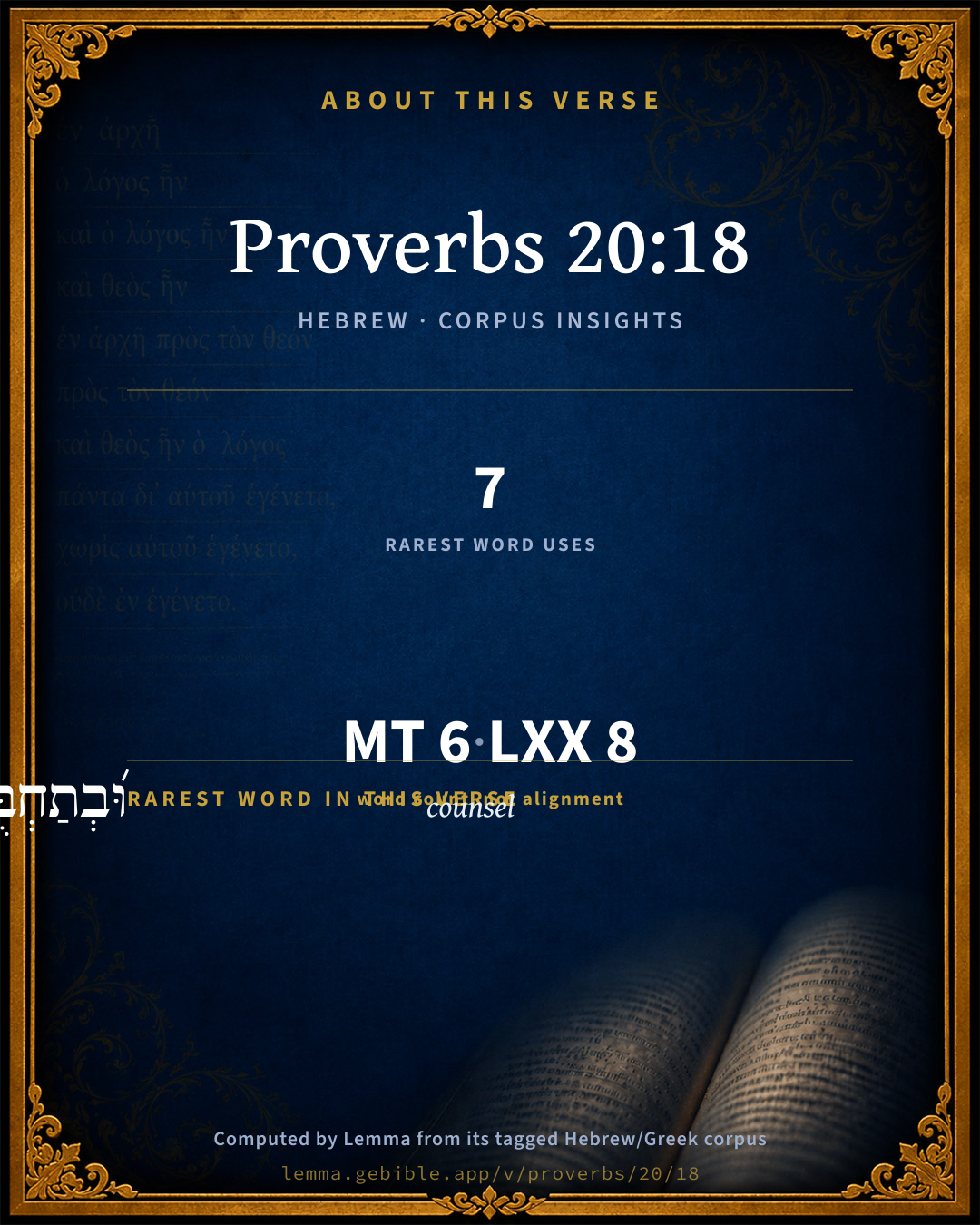
The rarest word here is וּ֝בְתַחְבֻּל֗וֹת counsel H8458 — appearing just 7 times in the whole Hebrew Bible.

Shared distinctive vocabulary

וּ֝בְתַחְבֻּל֗וֹת counsel H8458 occurs in 6 verses of the Hebrew Bible. Also found in:

Grammatical profile

  • 2 verbs
  • 4 nouns

Verb forms

  • תִכּ֑וֹן Niphal · Imperfect
  • עֲשֵׂ֣ה Qal · Imperative

Hebrew & Septuagint length

In the original languages it is 6 Hebrew tokens and 8 Greek tokens — but the two are counted differently (Hebrew bundles its prefixes and suffixes into one token; the Greek is in lemma form), so that isn’t a like-for-like length.

Cross-references

13

Topical passages linked to Proverbs 20:18 in the Treasury of Scripture Knowledge — connected by theme and wording, ordered by reader-vote popularity; previews shown in the World English Bible.

  • Proverbs 15:22 Where there is no counsel, plans fail; But in a multitude of counselors they are established.
  • Proverbs 24:6 For by wise guidance you wage your war; And victory is in many advisors.
  • Luke 14:31 Or what king, as he goes to encounter another king in war, will not sit down first and consider whether he is able with ten thousand to meet him who comes against him with twenty thousand?
  • Judges 1:1–2 It happened after the death of Joshua, the children of Israel asked of Yahweh, saying, Who shall go up for us first against the Canaanites, to fight against them?
  • Proverbs 11:14 Where there is no wise guidance, the nation falls, But in the multitude of counselors there is victory.
  • Judges 20:18 The children of Israel arose, and went up to Bethel, and asked counsel of God; and they said, Who shall go up for us first to battle against the children of Benjamin? Yahweh said, Judah [shall go up] first.
  • Judges 20:7 Behold, you children of Israel, all of you, give here your advice and counsel.
  • 2 Samuel 2:26–27 Then Abner called to Joab, and said, "Shall the sword devour forever? Don't you know that it will be bitterness in the latter end? How long shall it be then, before you bid the people return from following their brothers?"
  • Judges 9:29 Would that this people were under my hand! then would I remove Abimelech. He said to Abimelech, Increase your army, and come out.
  • Judges 20:26–28 Then all the children of Israel, and all the people, went up, and came to Bethel, and wept, and sat there before Yahweh, and fasted that day until even; and they offered burnt-offerings and peace-offerings before Yahweh.
  • 2 Chronicles 25:17–23 Then Amaziah king of Judah took advice, and sent to Joash, the son of Jehoahaz the son of Jehu, king of Israel, saying, Come, let us look one another in the face.
  • Proverbs 25:8 Don't be hasty in bringing charges to court. What will you do in the end when your neighbor shames you?
  • Judges 20:23 The children of Israel went up and wept before Yahweh until even; and they asked of Yahweh, saying, Shall I again draw near to battle against the children of Benjamin my brother? Yahweh said, Go up against him.

Cross-references courtesy of OpenBible.info (CC BY 4.0).

Hebrew and Greek witnesses Masoretic Hebrew ↔ Greek Septuagint

The same verse in the two great witnesses to the Old Testament, shown verse-for-verse.

These are two independent witnesses, not word-aligned to each other, and the Septuagint is shown in lemma (dictionary) form.

Hebrew Proverbs 20:18 Masoretic · Westminster Leningrad Codex

מַ֭חֲשָׁבוֹת בְּעֵצָ֣ה תִכּ֑וֹן וּ֝בְתַחְבֻּל֗וֹת עֲשֵׂ֣ה מִלְחָמָֽה

Plans are established by advice; By wise guidance you wage war!

World English Bible · Public Domain

Greek LXX Proverbs 20:18 Septuagint · lemma form

φῶς κύριος πνοή ἄνθρωπος ὅς ἐρευνάω ταμιεῖον κοιλία

No English rendering of this Greek verse — the small residue in the structurally divergent books.

Hebrew: Westminster Leningrad Codex (CC BY 4.0). Greek: Septuagint (public domain); English from a public-domain English Septuagint. How the Septuagint differs from the Hebrew →

Commentary

Notes on Proverbs 20:18 from classic Christian and Jewish commentators (each source and its license shown beneath its notes). The classic Christian expositions comment on the surrounding passage and are grouped to its opening verse, so a note may address several verses; the Jewish commentaries on the Tanakh (Rashi and others) are per-verse, so they appear only where the commentator wrote on this verse.

Lemma curates 59 commentaries, every one of them public domain or Creative Commons licensed, each selected and text-cleaned for this edition rather than reprinted as found. About our sources →

Trapp's Complete Commentary

John Trapp

Pro 20:18 [Every] purpose is established by counsel: and with good advice make war.

Ver. 18. Every purpose is established by counsel.] That thy proceedings be not either unconstant or uncomfortable, deliberate long ere thou resolve on any enterprise. {a} Advise with God especially, who hath said, "Woe be to the rebellious children that take counsel, but not of me." {Isa 30:1} David had able counsellors about him: but those he most esteemed and made use of were God’s testimonies. "Thy testimonies also are my delight, and the men of my counsel." {Psa 119:24} Princes had learned men ever with them, called Mνημονες, remembrancers, monitors, counsellors; as Themistocles had his Anaxagoras; Alexander his Aristotle; Scipio his Panaetius and Polybius: of which latter Pausanias {b} testifieth, that he was so great a politician, that what he advised never miscarried. But that is very remarkable that Gellius reports of Scipio Africanus, that it was his custom before day to go into the capital in cellam Iovis , and there to stay a great while, quasi consultans de Rep cum Iove, as if he were there advising with his god concerning the commonwealth. Whence it was that his deeds were pleraque admiranda, admirable for the most part, saith the author. {c} But we have a better example. David in all his straits went to ask counsel of the Lord, who answered him. Do we so, and God will not fail us, for he hath made Christ wisdom unto us, and a "wonderful counsellor." {1Co 1:30 Isa 9:6}

And with good advice make war.] Ahab in this might have been a precedent to good Josiah. He would not go against Ramothgilead, till he had first advised with his false prophets. But that other peerless prince, though the famous prophet Jeremiah was then living, and Zephaniah, and a whole college of seers, yet he doth not so much as once send out of doors to ask, Shall I go up against the king of Egypt? Sometimes both grace and wit are asleep in the holiest and wariest breasts. The soldiers’ rule among the Romans was, Non sequi, non fugere bellum. {d} Neither to fly, nor to follow after war. The Christian motto is, Nec temere nec timide, Be neither temerarious nor timorous. And that is a very true saying of the Greek poet, “η βραδυπους βουλη μεν αμεινων: η δε παχεια αι Aιεν ε φελκουενηενην την μετανοιαν εχει.” - Lucian.

{a} Deliberandum est diu quod statuendum est semel.

{b} Pausan, lib. viii.

{c} Gell, lib. vii.

{d} Veget., lib. i. c. 17.

John Trapp, A Commentary or Exposition upon All the Books of the Old and New Testament (1647–1656) — public domain. Text from a community e-Sword module.

The Biblical Illustrator

Joseph S. Exell

Pro_20:18

Every purpose is established by counsel.

Counsel

Of all apostolic habits the most habitual, writes arehbishop Benson, was the usage of counsel. The upper chamber, the house, the home of Mary, Jerusalem, Antioch, the school of Ephesus, the Hired House at Rome, were so many conciliabula and scenes of high debate. How full is the Acts of the Apostles of mentions of disputation, conference, reasoning, and of such expressions as these: They came together to consider the matter, It pleased the apostles and elders and the whole Church, Being assembled together with one accord, and the like. How strong are the injunctions to assemble themselves, to come together in the assembly, to be gathered together with one spirit!

1. It is a familiar experience that we can tune ourselves for any work of our own by placing ourselves in touch with some kindred work by a master hand. By this simple method we can in some measure kindle when we will the fire which in the heart resides. Our spirits drink in refreshment from those living founts of inspiration. What others have consummately done lends us at least the impulse to go and do likewise.

2. By withdrawing ourselves, if only for a brief space, from the absorbing interests, the keen controversies, of the present into the serener regions of the past, where principles and men and methods can be more impartially studied, by going back to the Bible in the modest but unflinching spirit, and with the enriched equipment of scientific research--our minds are tranquillised and balanced as well as quickened and enlightened for dealing with the urgent needs, the burning questions, the conflicting points of view and policies of the hour. So by Gods help may it be with us as we rapidly survey the type and model of Christian councils of every kind and degree, and thus look for guiding principles, practical indications, and spiritual tone to the rock whence we are hewn. (Bp. Jayne, D. D.)

The Biblical Illustrator, edited by Joseph S. Exell (c. 1880s–1900s) — public domain. Text from a community e-Sword module.

Joseph Benson's Commentary

Pro 20:18. Every purpose is established by counsel — “Rashness spoils the best designs, which must be carried on prudently, and with good advice, if we would have them to prove successful.” And with good advice make war — Warlike expeditions are not to be undertaken without great deliberation. It should be maturely considered, whether the war ought to be begun or not; whether it be just, whether it be prudent. And, when it is begun, how, and by what arts, it may be successfully prosecuted: for skill is as necessary as courage. Going to law is a kind of going to war, and therefore should not be done without good advice.

Joseph Benson's Commentary on the Old and New Testaments (1811–1818) — public domain. Text from a community e-Sword module.

The Preacher's Complete Homiletical Commentary

Joseph S. Exell (gen. ed.)

CRITICAL NOTES.—

Pro_20:18. The first clause may be read, Establish thy purpose by counsel.

Pro_20:19. “Him that flattereth.” Rather, him that openeth wide his lips, i.e., the babbler.

MAIN HOMILETICS OF Pro_20:18

THOUGHT BEFORE ACTION

I. The permanent success of an undertaking is generally in proportion to the thought bestowed upon it beforehand. It is an act of extreme folly to commit ourselves to any course, or to undertake any task without first weighing all the probable consequences, and providing against the most likely contingencies. Such a wise forethought by no means excludes entire dependence upon God, for while it is most true that “Man’s goings are of the Lord,” and “a man cannot understand his own way” (Pro_20:24), both common sense and the Word of God plainly teach that man must use the powers of forethought with which he has been endowed, or he must be content to see his purposes frustrated and his plans miscarry. If he desires his “purposes” to be “established,” in other words—what he does to have a lasting result in the direction desired—he must “sit down first” and “count the cost” (Luk_14:28; Luk_14:31).

II. It is advisable to call in the wisdom of others to help us in our deliberations. Since one man is rarely, if ever, able to look at a matter from every point of view, his plans are most likely to be wisely laid, and his purposes most likely to succeed, if he looks at them with the eyes of other men as well as with his own. They may discern a weak spot where he saw nothing to fear, or a point of vantage which had escaped his notice entirely. Or they may see good reasons for dissuading him altogether from the undertaking, or may make him so much the stronger for the task by encouragement and counsel. It is not generally those who are most able to act alone who lightly esteem the advice of others—those men who are most successful in that to which they put their hand are not as a rule given to undervalue the wisdom of other people.

OUTLINES AND SUGGESTIVE COMMENTS

The greatest trust between man and man is the trust of giving counsel.… Things will have their first or second agitation; if they be not tossed upon the waves of counsel, they will be tossed upon the waves of fortune, and be full of inconstancy, doing and undoing, like the reeling of a drunken man.—Lord Bacon.

Ponder Bishop Hall’s description of the spiritual war. “It admits of no intermission. It knows no night, no winter. It abides no peace, no truce. It calls us not into garrison, where we may have ease and respite, but into pitched fields continually. We see our enemies in the face always, and are always seen and assaulted; ever resisting, ever defending, receiving and returning blows. If either we be negligent or weary, we die. What other hope is there, while one fights and the other stands still? We can never have safety and peace but in victory. Then must our resistance be courageous and constant, when both yielding is death, and all treaties of peace mortal.” Does not this war bring the greatest need of deliberate counsel, carefully counting the cost (Luk_14:31-32); cleaving to our All-wise Counsellor (Isa_9:6) and Almighty Helper?—Bridges.

Among the Romans, though a man were never so strong, never so valiant, yet, if he wanted wisdom and counsel, he was said to be miles sine oculis, a soldier without his eyes.—Jermin.

See Critical Notes for the correct rendering of the second clause of Pro_20:19, and for Homiletics see on chap. Pro_10:19 and Pro_11:13, pages 168 and 211.

The Preacher's Complete Homiletical Commentary (gen. ed. Joseph S. Exell; Funk & Wagnalls, c. 1892) — public domain (pre-1929). A full-Bible homiletical/sermon-outline anthology covering 65 of 66 books (2 John is absent from the source module). Text from a community e-Sword module.

Matthew Henry's Commentary

Note, 1. It is good in every thing to act with deliberation, and to consult with ourselves at least, and, in matters of moment, with our friends, too, before we determine, but especially to ask counsel of God, and beg direction from him, and observe the guidance of this eye. This is the way to have both our minds and our purposes established, and to succeed well in our affairs; whereas what is done hastily and with precipitation is repented of at leisure. Take time, and you will have done the sooner. Deliberandum est diu, quod statuendum est semel - A final decision should be preceded by mature deliberation. 2. It is especially our wisdom to be cautious in making war. Consider, and take advice, whether the war should be begun or no, whether it be just, whether it be prudent, whether we be a match for the enemy, and able to carry it on when it is too late to retreat (Luk 14:31); and, when it is begun, consider how and by what arts it may be prosecuted, for management is as necessary as courage. Going to law is a kind of going to war, and therefore must be done with good advice, Pro 25:8. The rule among the Romans was nec sequi bellum, nec fugere - neither to urge war nor yet to shun it.

Matthew Henry's Commentary on the Whole Bible (1708–1710) — public domain (CC PDM 1.0). Text via the HelloAO Bible API.

Jamieson, Fausset & Brown

Robert Jamieson, A. R. Fausset & David Brown

(Compare Pro 15:22). Be careful and considerate in important plans.

Jamieson, Fausset & Brown — Commentary Critical and Explanatory on the Whole Bible (1871) — public domain (CC PDM 1.0). Text via the HelloAO Bible API.

Adam Clarke's Commentary

Verse 18. With good advice make war,] Perhaps there is not a precept in this whole book so little regarded as this. Most of the wars that are undertaken are wars of injustice, ambition, aggrandizement, and caprice, which can have had no previous good counsel. A minister, who is perhaps neither a good nor a great man, counsels his king to make war; the cabinet must be brought into it, and a sufficient number out of the states of the kingdom gained over to support it. By and by, what was begun through caprice must be maintained through necessity. Places must be created, and offices must be filled with needy dependents, whose interest it may be to protract the war, till they get enough to pay their debts, and secure independence for life. And for these most important ends the blood of the country is spilled, and the treasures of the people exhausted! I have met with a fact precisely of this kind under the reign of Louis XIV.

Adam Clarke's Commentary on the Bible (1810–1826) — public domain. Text from a community e-Sword/MySword module.

The Cambridge Bible for Schools and Colleges

gen. ed. J. J. S. Perowne

18. with good advice] or, by wise guidance, R.V., make war. Comp. Luk_14:31-32.

The Cambridge Bible for Schools and Colleges (gen. ed. J. J. S. Perowne; Cambridge University Press, 1878–1918) — public domain. Text from a community e-Sword module.

John Gill's Exposition

Every purpose is established by counsel,.... Or "the thought" (f) of a man, everyone of them, what he has thought to do, formed a scheme of in his mind, and resolved upon, by taking advice of his friends, and especially by asking counsel of God, who gives, wisdom liberally, and upbraids not; he is confirmed in his good designs; and he cheerfully pursues them, and they are ordered and directed to the glory of God, his own good and the good of others; for this can only be understood of wise and good thoughts and purposes;

and with good advice make war; this should not be entered upon rashly, without first considering whether there is a just and lawful cause of it; and without consulting the necessary charge and expense of it; whether there is a sufficiency of men and money to carry it on; and what may probably be the issue of it. It is right in a king to advise with his privy council, or with the chief council of the nation; but, above all, both he and his people should seek advice of the Lord on such an occasion; see Luk 14:31. This may be applied to our spiritual warfare with sin, Satan, and the world; not that it should be any doubt with whether we should engage in such a war; but we should advise with experienced soldiers, and especially with God and his word, what weapons to take, and how to use them; and consider in whose name and strength we are to fight; and inquire and learn the force, methods, and designs of the enemy, and where to guard against them or attack them. Jarchi interprets it of making war with Satan by repentance, prayer, and fasting.

(f) "cogitationes", V. L. Pagninus, Montanus, Cocceius, Gejerus; "unaquaeque cogitationum", Piscator, Mercerus, Michaelis.

John Gill's Exposition of the Whole Bible (1746–1763) — public domain (CC PDM 1.0). Text via the HelloAO Bible API.

Haydock's Catholic Bible Commentary

Governments. Or prudence, else the best designs may prove abortive.

George Leo Haydock (1774–1849), Haydock's Catholic Family Bible and Commentary, 1859 edition — public domain. Excludes Psalms (Douay-Rheims chapter numbering differs from Protestant) and Deuterocanonical books (Catholic canon only).

Matthew Poole's English Annotations

Every purpose is established by counsel; the way to bring our purposes and desires to a good effect, is to manage them with serious consideration and good advice. And; or, therefore. This is necessary in every common undertaking, and much more in a thing of such high importance as war is.

Matthew Poole's English Annotations on the Holy Bible (1683–1685) — public domain. Text from a community e-Sword/MySword module.

Whedon's Commentary on the Bible

Daniel D. Whedon

18. Every purpose, etc. — Or, thou shall establish purposes, plans, enterprises, etc., by counsel — thus thou shall make them sure and successful.

With good advice make war — This is a precept for rulers, guarding them against rash enterprises, and especially against plunging into a war for insufficient reasons, or without due preparations and sufficient resources, or consideration of probable results. The same principles apply, in a private sphere, to litigations in civil courts. Comp. Pro_24:6; Pro_15:22; Luk_14:31.

Daniel D. Whedon (gen. ed.), Commentary on the Old and New Testaments (1874–1909) — public domain. Text from a community e-Sword module.

The Pulpit Commentary

Every purpose is established by counsel. (comp. Pro_15:22, where see note) The Talmud says, "Even the most prudent of men needs friends" counsels;" and none but the most conceited would deem himself superior to advice, or would fail to allow that, as the Vulgate puts it, cogitationes consillis roborantur. This is true in all relations of life, in great and small matters alike, in peace, and, as our moralist adds, in war. With good advice make war; Vulgate, Gubernaculis tractanda sunt bella; Revised Version, By wise guidance make thou war. The word here used is takebuloth, for which see note, Pro_1:5. It is a maritime metaphor, rightly retained by the Vulgate, and might be rendered "pilotings," "steerings." War is a necessary evil, but it must be undertaken prudently and with a due consideration of circumstances, means, etc. Our Lord illustrates the necessity of due circumspection in following him by the case of a threatened conflict between two contending kings. (Luk_14:31, etc.) Grotius quotes the gnome Gnwmai pleon kratousin h syenov cerwn . "Titan strength of hands availeth counsel more.

To which we may add Boulhv gasteron . "Good counsel is the safest thing of all. (Comp. Pro_24:6, where the hemistich is re-echoed)

The Pulpit Commentary (1880–1919), ed. H.D.M. Spence-Jones & Joseph S. Exell — public domain. Text from a community e-Sword module.

John Wesley's Explanatory Notes

Established - The way to bring our purposes to good effect is to manage them with serious consideration.

John Wesley, Explanatory Notes Upon the Whole Bible (1754–1765) — public domain. Text via the GEBible commentary corpus.

Keil & Delitzsch

C. F. Keil & F. Delitzsch

18 Plans are established by counsel,

And with prudent government make war.

From the conception of a thought, practically influencing the formation of our own life and the life of the community, to its accomplishment there is always a long way which does not lead to the end unless one goes forward with counsel and strength combined, and considers all means and eventualities. The Niph. of כּוּן means, in a passive sense: to be accomplished or realized (Psa 141:2). The clause 18a is true for times of war as well as for times of peace; war is disastrous, unless it is directed with strategic skill (vid., regarding תּחבּות, Pro 1:5). Grotius compares the proverb, Γνῶμαι πλέον δρατοῦσιν ἢ σθένος χειρῶν. In Pro 24:6, the necessity of counsel is also referred to the case of war. Ewald would read [the infin.] עשׂה, or עשׂה: with management it is that one carries on war. But why? Because to him the challenge to carry on war appears to be contrary to the spirit of proverbial poetry. But the author of the proverb does certainly mean: if thou hast to carry on war, carry it on with the skill of a general; and the imper. is protected by Pro 24:6 against that infin., which is, besides, stylistically incongruous.

Keil & Delitzsch — Biblical Commentary on the Old Testament (1861–1891) — public domain (CC PDM 1.0). Text via the HelloAO Bible API. (Old Testament only.)

Bridges on Proverbs

Charles Bridges

This is true wisdom — to deliberate before we act, and to establish our purpose by sound and experienced counsel. Even the wisest of men valued this strengthening resource. (1Ki 12:6 .) God has placed us in society more or less dependent upon each other. And therefore, while it is most important to possess a calm and decided judgment; it is not less so to guard against an obstinate and exclusive adherence to our own opinions. (Pro 15:22 .) Especially in the national counsels the rule is most weighty. With good advice make war. (Pro 11:14 ; Pro 24:6 .) Wars for the purpose of ambition or aggrandizement can never be wisely made. Fearful may be the result of inconsiderate, self-willed measures. David took counsel of the LORD;†1 Nehemiah, while supporting his courage by faith,†2 established his purpose by counsel, and called his counsel to deliberate in all emergencies.†3 Ahab, asking counsel of his false prophets;†4 Amaziah, despising the sound counsel given to him†5 — both with bad advice made war to their own ruin. Even godly Josiah — making every allowance for his circumstances, was probably chargeable with precipitation; and, neglecting to establish his purpose by the counsel of the LORD’s prophets then living among his people, was chastened with temporal destruction.†6

Now ponder Bishop Hall’s description of the spiritual war. ’It admits of no intermission. It knows no night, no winter. It abides no peace, no truce. It calls us not into garrison, where we may have ease and respite, but into pitched fields continually. We see our enemies in the face always, and are always seen and assaulted; ever resisting, ever defending, receiving and returning blows. If either we be negligent or weary, we die. What other hope is there, while one fights, and the other stands still? We can never have safety and peace, but in victory. Then must our resistance be courageous and constant, when both yielding is death, and all treaties of peace mortal.’†7 Does not this war bring the greatest need of deliberate counsel, carefully counting the cost (Luk 14:31-32 ); cleaving to our All-wise Counselor (Isa 9:6 ) and Almighty Helper? Yet fear not, under the conscious direction of his counsel, and support of his grace, to take up the song of praise — "Blessed be the LORD, my strength, which teacheth my hands to war, and my fingers to fight!" (Psa 144:1 .)

Footnotes:

†1 2Sa 5:17-23 .

†2 Neh 2:17-20; Neh 3:1-32 ; Neh 4:1-23 .

†3 Neh 4:19-20.

†4 1Ki 22:6 .

†5 2Ki 14:8-12 .

†6 2Ch 35:20-24 . Scott in loco.

†7 Holy Observations, xxv.

Charles Bridges, An Exposition of the Book of Proverbs (1846) — public domain. Text from a community e-Sword module.

Kretzmann's Popular Commentary

Paul E. Kretzmann

v. 18. Every purpose is established by counsel, definite plans should be formulated only after a careful consultation with such as are in a position to advise; and with good advice make war, after considering all emergencies and possibilities. Cf Luk 14:31.

Paul E. Kretzmann, Popular Commentary of the Bible (1921–1924) — public domain. Text from a community e-Sword module.

Rashi

Rabbi Shlomo Yitzchaki (Rashi)

Plans with counsel will be established, and with strategies wage war If you come to wage war against Satan, come with strategies of repentance, prayer and fasting.

Rashi on the Tanakh — English translations: “The Judaica Press complete Tanach with Rashi, translated by A. J. Rosenberg” (CC BY 4.0); “Pentateuch with Rashi's commentary by M. Rosenbaum and A.M. Silbermann, 1929-1934” (public domain); “The Metsudah Tanach series, Lakewood, N.J” (CC BY 4.0); and “The Book of Joshua, Metsudah Publications, 1997” (CC BY 4.0). Text via Sefaria.

Lesson kit

Teaching starters — assembled from the data on this page, not authored interpretation. Every prompt links to the verse data it draws on. Edit before teaching.

Proverbs, in the Wisdom, opens this verse with 6 words (6 distinct Hebrew lemmas). Its most distinctive word is tachbulâh (“counsel”). A historical commentator’s framing appears above. Read the whole chapter for the surrounding context.

Discussion questions

  1. What does “counsel” (tachbulâh) contribute to the verse as a whole?
  2. Job 37:12 shares the word «counsel» with this verse. How do the two illuminate each other?
  3. The translations on this page render this verse differently — a whole-verse word diff, not a word-by-word alignment. What might account for the different wordings?
  4. The verb «תִכּ֑וֹן» is Niphal Imperfect. How does its form color the action?
  5. Reading how Trapp's Complete Commentary and The Biblical Illustrator read this verse, where do the two commentators agree and where do they part?

Things to notice

Reading settings

Reading text

Shown beneath each verse's original-language words.

Old Testament
Old Testament edition

Read the OT as the Masoretic Hebrew (MT) or the Greek Septuagint (LXX).

English shown for the Greek Septuagint (in the Hebrew ↔ Greek comparison).

Comparing translations? Open the Compare panel on any verse page to stack up to four side by side.