
Jeremiah 33:2

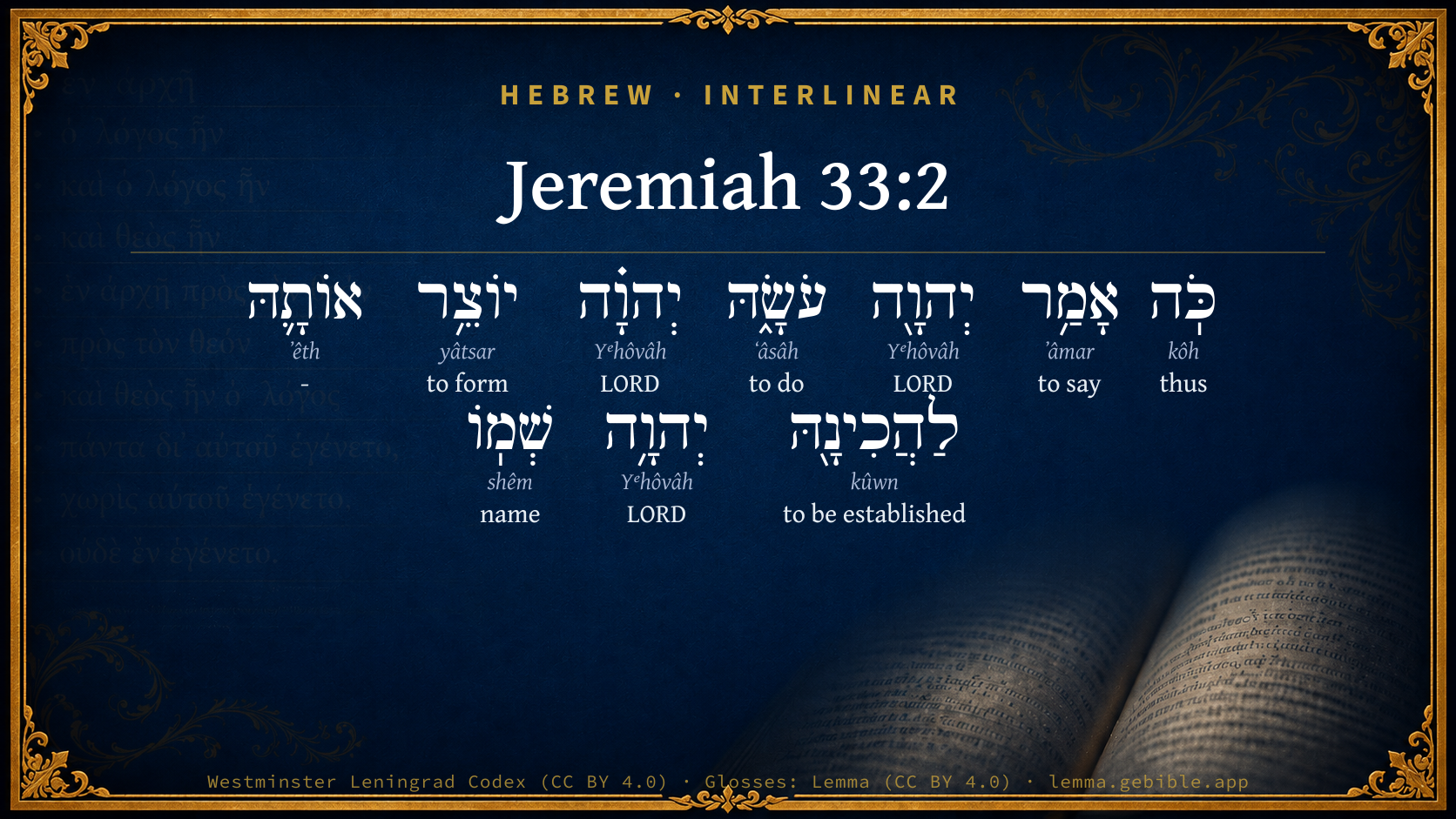
Hebrew (Westminster Leningrad Codex) Jeremiah 33:2 appears in the Hebrew Old Testament. The text above is from the Westminster Leningrad Codex. Each word links to its Strong’s number, a concise gloss, and parsing drawn from the Open Scriptures Hebrew Bible morphology. Click any word for its full Brown-Driver-Briggs (BDB) entry.
Download image
Cite this verse

Jeremiah 33:2 (World English Bible). Public Domain. Lemma interlinear Bible study tool, https://lemma.gebible.app/v/jeremiah/33/2.

Show BibTeX & RIS
BibTeX
RIS
English Translation
Thus says Yahweh who does it, Yahweh who forms it to establish it; Yahweh is his name:
World English Bible · Public Domain
Download a study sheet

One document with this verse’s original text, its word-by-word gloss line, the meaning frame, cross-references with their text, attributed commentary, and full source and license credits — printable, and it pastes into notes with its structure intact.

This verse Autodidact and up

Study sheet (.html) Plain text (.txt)

A passage Seminary Student

Up to 50 verses in one chapter. A passage sheet keeps up to 6 commentary sources and 12 cross-references per verse, in the order this page ranks them, and says so on the sheet whenever that leaves anything out. Ask for a single verse and you get the Autodidact verse sheet above.

Everything on this page stays free to read, with no account — the sheet is a download of what is already on screen, not access to it.

Want to remove ads? Support Godless Engineer
Compare translations 3

The same verse in 3 English versions, stacked beneath the original-language interlinear above. Click any original word for its lexicon entry.

Each is an independent rendering of the whole verse — the interlinear is not word-aligned to these translations.

Highlighted words mark where these versions differ — a whole-verse word diff, not a word-by-word alignment.

  • World English Bible Public Domain
    Thus says Yahweh who does it, Yahweh who forms it to establish it; Yahweh is his name:
  • King James Version Public Domain
    Thus saith the LORD the maker thereof, the LORD that formed it, to establish it; the LORD is his name;
  • unfoldingWord Literal Text CC BY-SA 4.0
    “Yahweh the maker, says this—Yahweh, who forms in order to establish—Yahweh is his name,

unfoldingWord Literal Text — © unfoldingWord, licensed CC BY-SA 4.0. Word-aligned USFM3 via Door43 (git.door43.org/unfoldingWord/en_ult).

Versions to compare (up to 4)

3 of 4 selected

Show all 18 translations

Every available English version of this verse, each an independent rendering of the whole verse.

  • World English Bible Public Domain
    Thus says Yahweh who does it, Yahweh who forms it to establish it; Yahweh is his name:
  • Berean Standard Bible Public Domain
    “Thus says the LORD who made the earth, the LORD who formed it and established it, the LORD is His name:
  • Majority Standard Bible Public Domain
    “Thus says the LORD who made the earth, the LORD who formed it and established it, the LORD is His name:
  • King James Version Public Domain
    Thus saith the LORD the maker thereof, the LORD that formed it, to establish it; the LORD is his name;
  • American Standard Version (1901) Public Domain
    Thus saith Jehovah that doeth it, Jehovah that formeth it to establish it; Jehovah is his name:
  • Revised Version (1885) Public Domain
    Thus saith the LORD that doeth it, the LORD that formeth it to establish it; the LORD is his name:
  • Geneva Bible (1599) Public Domain
    Thus sayth the Lord, the maker thereof, the Lord that formed it, and established it, the Lord is his Name.
  • Douay-Rheims (1899) Public Domain
    Thus saith the Lord, who will do, and will form it, and prepare it, the Lord is his name.
  • Young's Literal Translation Public Domain
    Thus said Jehovah its maker, Jehovah its former, at establishing it, Jehovah `is' His name:
  • Literal Standard Version CC BY-SA 4.0
    “Thus said YHWH who has made it, YHWH who has formed it, to establish it, YHWH [is] His Name:
  • Unlocked Literal Bible CC BY-SA 4.0
    “Yahweh the maker, says this—Yahweh, who forms in order to establish—Yahweh is his name,
  • unfoldingWord Literal Text CC BY-SA 4.0
    “Yahweh the maker, says this—Yahweh, who forms in order to establish—Yahweh is his name,
  • Darby Bible Public Domain
    Thus saith Jehovah the doer of it, Jehovah that formeth it to establish it, Jehovah is his name:
  • World Messianic Bible Public Domain
    “The LORD who does it, the LORD who forms it to establish it—the LORD is his name, says:
  • Webster's Bible Public Domain
    Thus saith the LORD the maker of this, the LORD that formed it, to establish it; the LORD is his name;
  • Free Bible Version CC BY-SA 4.0
    This is what the Lord says, the Lord who made the earth, the Lord who shaped it and set it in place, the Lord is his name:
  • Bible in Basic English Public Domain
    These are the words of the Lord, who is doing it, the Lord who is forming it, to make it certain; the Lord is his name;
  • JPS Tanakh (1917) Public Domain
    Thus saith the LORD the Maker thereof, the LORD that formed it to establish it, the LORD is His name:

Literal Standard Version (2020), Covenant Press — licensed CC BY-SA 4.0. Text via the HelloAO Bible API (eBible.org). Unlocked Literal Bible (unfoldingWord) — licensed CC BY-SA 4.0. Text via the HelloAO Bible API (eBible.org). unfoldingWord Literal Text — © unfoldingWord, licensed CC BY-SA 4.0. Word-aligned USFM3 via Door43 (git.door43.org/unfoldingWord/en_ult). Free Bible Version, Dr. Jonathan Gallagher — licensed CC BY-SA 4.0. Text via the HelloAO Bible API (eBible.org).

Word by word

More ways to search: Search by grammar → Find every occurrence → Compare this word →

Practice this passage: Drill this verse → Learn its vocabulary →

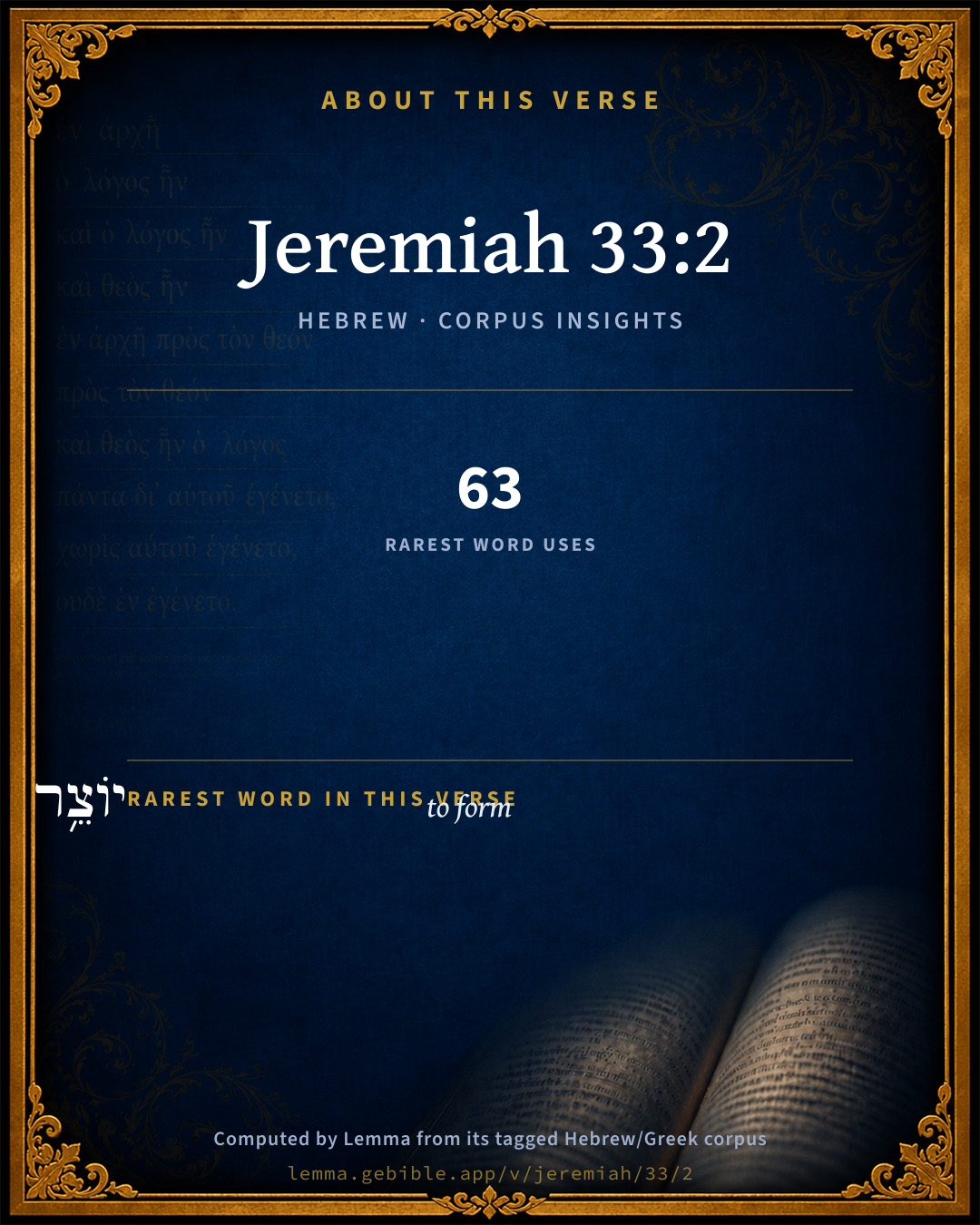
יוֹצֵ֥ר
yâtsar
H3335
“forming”
Verb, Qal, Participle Active, Masculine, Singular, Absolute
Part of Speech
Verb
Stem
Qal
Form
Participle Active
Gender
Masculine
Number
Singular
State
Absolute
Full BDB Definition

Origin: probably identical with H3334 (through the squeezing into shape), ([compare H3331 ])

TWOT: 898

to form, fashion, frame - (Qal) to form, fashion - of human activity - of divine activity - of creation - of original creation - of individuals at conception - of Israel as a people - to frame, pre-ordain, plan (figuratively of divine) purpose of a situation) - (Niphal) to be formed, be created - (Pual) to be predetermined, be pre-ordained - (Hophal) to be formed
  1. כֹּֽה kôh H3541 “thus” Adverb
  2. אָמַ֥ר ʼâmar H559 “to say” Verb, Qal, Perfect, 3rd Person, Masculine, Singular
  3. יְהוָ֖ה Yᵉhôvâh H3068 “LORD” Noun, Proper
  4. עֹשָׂ֑הּ ʻâsâh H6213 “doing · her” Verb, Qal, Participle Active, Masculine, Singular, Construct + Suffix, Personal, 3rd Person, Feminine, Singular
  5. יְהוָ֗ה Yᵉhôvâh H3068 “LORD” Noun, Proper
  6. אוֹתָ֛הּ ʼêth H853 “- · her” Particle, Direct Object + Suffix, Personal, 3rd Person, Feminine, Singular
  7. לַהֲכִינָ֖הּ kûwn H3559 “to be established · her” Preposition + Verb, Hiphil, Infinitive Construct + Suffix, Personal, 3rd Person, Feminine, Singular
  8. יְהוָ֥ה Yᵉhôvâh H3068 “LORD” Noun, Proper
  9. שְׁמֽוֹ shêm H8034 “name · his” Noun, Common, Masculine, Singular, Construct + Suffix, Personal, 3rd Person, Masculine, Singular

About this verse

These counts appear in no published source. They are computed here, from the morphology-tagged text and Lemma’s own curated glosses. What Lemma adds →

10
words
8
distinct lemmas
Prophets
section

Grammatical profile

  • 4 verbs
  • 4 nouns
  • 1 adverb
  • 1 particle

Verb forms

  • אָמַ֥ר Qal · Perfect
  • עֹשָׂ֑הּ Qal · Participle Active
  • יוֹצֵ֥ר Qal · Participle Active
  • לַהֲכִינָ֖הּ Hiphil · Infinitive Construct

Repetition

A word recurs within this verse — often emphatic in Hebrew:

  • יְהוָ֖ה LORD H3068 ×3

Cross-references

18

Topical passages linked to Jeremiah 33:2 in the Treasury of Scripture Knowledge — connected by theme and wording, ordered by reader-vote popularity; previews shown in the World English Bible.

  • Exodus 6:3 and I appeared to Abraham, to Isaac, and to Jacob, as God Almighty; but by my name Yahweh I was not known to them.
  • Exodus 15:3 Yahweh is a man of war. Yahweh is his name.
  • Isaiah 37:26 Have you not heard how I have done it long ago, and formed it of ancient times? now have I brought it to pass, that it should be your to lay waste fortified cities into ruinous heaps.
  • Exodus 3:14–15 God said to Moses, "I AM WHO I AM," and he said, "You shall tell the children of Israel this: "I AM has sent me to you."
  • Psalms 87:5 Yes, of Zion it will be said, "This one and that one was born in her;" The Most High himself will establish her.
  • Psalms 102:16 For Yahweh has built up Zion. He has appeared in his glory.
  • Isaiah 14:32 What then shall one answer the messengers of the nation? That Yahweh has founded Zion, and in her shall the afflicted of his people take refuge.
  • Isaiah 43:1 But now thus says Yahweh who created you, Jacob, and he who formed you, Israel: Don't be afraid, for I have redeemed you; I have called you by your name, you are mine.
  • Isaiah 43:21 the people which I formed for myself, that they might set forth my praise.
  • Isaiah 62:7 and give him no rest, until he establish, and until he make Jerusalem a praise in the earth.
  • Hebrews 11:10 For he looked for the city which has the foundations, whose builder and maker is God.
  • Revelation 21:10 He carried me away in the Spirit to a great and high mountain, and showed me the holy city, Jerusalem, coming down out of heaven from God,
  • Jeremiah 10:16 The portion of Jacob is not like these; for he is the former of all things; and Israel is the tribe of his inheritance: Yahweh of Hosts is his name.
  • Jeremiah 32:18 who show loving kindness to thousands, and recompense the iniquity of the fathers into the bosom of their children after them; the great, the mighty God, Yahweh of Hosts is his name;
  • Amos 5:8 Seek him who made the Pleiades and Orion, And turns the shadow of death into the morning, And makes the day dark with night; Who calls for the waters of the sea, And pours them out on the surface of the earth, Yahweh is his name,
  • Amos 9:6 It is he who builds his chambers in the heavens, and has founded his vault on the earth; he who calls for the waters of the sea, and pours them out on the surface of the earth; Yahweh is his name.
  • Hebrews 11:16 But now they desire a better country, that is, a heavenly one. Therefore God is not ashamed of them, to be called their God, for he has prepared a city for them.
  • Revelation 21:2 I saw the holy city, New Jerusalem, coming down out of heaven from God, made ready like a bride adorned for her husband.

Cross-references courtesy of OpenBible.info (CC BY 4.0).

Hebrew and Greek witnesses Masoretic Hebrew ↔ Greek Septuagint

The same verse in the two great witnesses to the Old Testament, shown verse-for-verse.

These are two independent witnesses, not word-aligned to each other, and the Septuagint is shown in lemma (dictionary) form.

Hebrew Jeremiah 33:2 Masoretic · Westminster Leningrad Codex

כֹּֽה אָמַ֥ר יְהוָ֖ה עֹשָׂ֑הּ יְהוָ֗ה יוֹצֵ֥ר אוֹתָ֛הּ לַהֲכִינָ֖הּ יְהוָ֥ה שְׁמֽוֹ

Thus says Yahweh who does it, Yahweh who forms it to establish it; Yahweh is his name:

World English Bible · Public Domain

Greek LXX Structure differs

In the Septuagint, Jeremiah is about an eighth shorter than the Hebrew and arranges its material differently — the Oracles Against the Nations (Hebrew chapters 46–51) appear in the middle of the Greek book, after 25:13. Because the chapter and verse boundaries do not line up, a verse-for-verse comparison with the Hebrew is not shown.

A verse-for-verse comparison isn’t shown here because the chapters and verses don’t line up. Switch to the LXX edition with the MT / LXX toggle above to read the Greek directly.

On this verse, The Cambridge Bible for Schools and Colleges discusses the Septuagint’s reading. Read the note in Commentary ↓

Hebrew: Westminster Leningrad Codex (CC BY 4.0). Greek: Septuagint (public domain); English from a public-domain English Septuagint. How the Septuagint differs from the Hebrew →

Targum (Aramaic paraphrase)

1

The Targum is the ancient Jewish Aramaic paraphrase of the Hebrew Scriptures — an interpretive translation, not the Hebrew text itself. Onkelos (literal) and Pseudo-Jonathan (expansive) render the Torah, and Jonathan the Prophets. Coverage is partial: where no permissively-licensed English translation exists for a verse, only the Aramaic is shown. This is verse-level text, not a word-by-word alignment to the Hebrew.

  1. Targum Jonathan Prophets (Joshua–Malachi)
    כִּדְנַן אֲמַר יְיָ דַעֲבָדָהּ יְיָ בָּרָא יָתָהּ לְאַתְקְנוּתָהּ יְיָ שְׁמֵיהּ:

    (no public-domain English translation for this verse)

    Targum Jonathan — Aramaic: “Mikraot Gedolot” (public domain). English: “Sefaria Community Translation” (CC0 1.0 (public-domain dedication)); “London "Chaldee Paraphrase," 1871” (public domain). Text via Sefaria.

Commentary

Notes on Jeremiah 33:2 from classic Christian and Jewish commentators (each source and its license shown beneath its notes). The classic Christian expositions comment on the surrounding passage and are grouped to its opening verse, so a note may address several verses; the Jewish commentaries on the Tanakh (Rashi and others) are per-verse, so they appear only where the commentator wrote on this verse.

Lemma curates 59 commentaries, every one of them public domain or Creative Commons licensed, each selected and text-cleaned for this edition rather than reprinted as found. About our sources →

Trapp's Complete Commentary

John Trapp

Jer 33:2 Thus saith the LORD the maker thereof, the LORD that formed it, to establish it; the LORD [is] his name;

Ver. 2. Thus saith the Lord the maker thereof.] i.e., Of the promise of restoration. {Jer 32:41-44} Or of Jerusalem, which he is said to make in the sense that he "made Moses and Aaron," that is, "advanced" them. {1Sa 12:6, marg.}

The Lord is his name.] Jehovah the essentiator, who giveth being to all things, and particularly to his word.

John Trapp, A Commentary or Exposition upon All the Books of the Old and New Testament (1647–1656) — public domain. Text from a community e-Sword module.

Joseph Benson's Commentary

Jer 33:2. Thus saith the Lord, the maker thereof — That is, as many interpreters understand it, of the city of Jerusalem, a figure of that church spoken of before: see Jer 32:36; Jer 32:44, compared with the 4th, 6th, and 9th verses of this chapter. Blaney, however, renders the clause, Thus saith Jehovah the doer of it, Jehovah the framer of it, who also disposeth it, considering the pronoun it as referring to the thing which God here says he is about to do.

Joseph Benson's Commentary on the Old and New Testaments (1811–1818) — public domain. Text from a community e-Sword module.

Keil & Delitzsch

C. F. Keil & F. Delitzsch

Introduction. - Jer 33:2. "Thus saith Jahveh who makes it, Jahveh who forms it in order to establish it, Jahveh is His name: Jer 33:3. Call on me and I will answer thee, and tell thee great and hidden things which thou knowest not." The reference of the suffixes in עשׂהּ, אותהּ, and הכינהּ is evident from the contents of the propositions: the Lord does what He says, and forms what He wants to make, in order to accomplish it, i.e., He completes what He has spoken and determined on. יצר, to frame, namely, in the mind, as if to think out, just as in Jer 18:11 : the expression is parallel with חשׁב; in this sense also we find Isa 46:11. הכין, to establish, realize what has been determined on, prepare, is also found in Isa 9:6; Isa 40:20, but more frequently in Jeremiah (Jer 10:12; Jer 51:12, Jer 51:15), and pretty often in the Old Testament generally. On the phrase "Jahveh is His name," cf. Jer 31:35. The idea contained in Jer 33:2 reminds us of similar expressions of Isaiah, as in Isa 22:11; Isa 37:26; Isa 46:11, etc.; but this similarity offers no foundation for the doubts of Movers and Hitzig regarding the genuineness of this verse. The same holds as regards Jer 33:3. The first proposition occurs frequently in the Psalms, e.g., Jer 4:4; Jer 28:1; Jer 30:9, also in Jer 7:27; Jer 11:14; but קתא with אל is unusual in Isaiah. The words בּצרות לא are certainly an imitation of נצרות ולא ידעתּם, Isa 48:6; but they are modified, in the manner peculiar to Jeremiah, by the change of נצרות into בצרות. The combination גּדלות וּבצרות noit is elsewhere used only of the strong cities of the Canaanites, Deu 1:28; Deu 9:1; Jos 14:12, cf. Num 13:28; here בּצרות is transferred to things which lie beyond the limits of human power to discover, and become known to men only through divine revelation. There is no good reason for Ewald's change of בצרות in accordance with Isa 48:6. - On the contents of these verses Hengstenberg remarks: "It may seem strange that, though in the opening part the prophet is promised a revelation of greater, unknown things, for which he is to call on God, yet the succeeding announcement contains scarcely anything remarkable or peculiar." Graf also adds the remark of Hitzig, that the command to pray, addressed to Jeremiah, cannot have the effect of keeping us from the conclusion that the verses are an addition by a later hand. Ngelsbach replies that the mode of expression presents nothing specially unlike Jeremiah, and that what is most calculated to give the impression of being unlike Jeremiah's, namely, this introduction in itself, and especially the peculiar turn of Jer 33:3, "Call unto me," etc., is occasioned by the prayer of the prophet, Jer 32:16-25. To this prayer the prophet had received an answer, Jer 32:36-44; but he is here admonished to approach the Lord more frequently with such a request. The God who has the power to execute as well as make decrees is quite prepared to give him an insight into His great thoughts regarding the future; and of this a proof is at once given. Thus, Jer 33:1-3 must be viewed as the connecting link between Jer 32; 33.

Yet these remarks are not sufficient to silence the objections set forth against the genuineness of Jer 33:2, Jer 33:3; for the specializing title of our chapter, in Jer 33:1, is opposed to the close connection which Ngelsbach maintains between Jer 32; 33. The fact that, in Jer 32, Jeremiah addresses the Lord in prayer for further revelation regarding the purchase of the field, as commanded, and that he receives the information he desired regarding it, gives no occasion for warning to the prophet, to betake himself more frequently to God for disclosures regarding His purposes of salvation. And Ngelsbach has quite evaded the objection that Jeremiah does not obey the injunction. Moreover, the succeeding revelation made in vv. 4-26 is not of the nature of a "proof," for it does not contain a single great leading feature in God's purposes as regards the future. - Hengstenberg also points out the difficulty, "that the Scripture everywhere refuses to recognise a dead knowledge as true knowledge, and that the hope of restoration has an obstacle in the natural man, who strives to obscure and to extinguish it; that, consequently, the promise of restoration is always new, and the word of God always great and grand;" but what he adduces for the solution of the difficulty contained in the command, "Call on me, and I will show thee great and unknown things," is insufficient for his purpose. The objection which expositors have taken to these verses has arisen from an improper application of them; the words קרא אלי have been understood as referring to the request that God should give some revelation regarding the future, or His purposes of deliverance, and ענה as referring to the communication of His purposes for increasing our knowledge of them. But "to call on God" rather signifies to pray to God, i.e., to beseech Him for protection, or help, or deliverance in time of need, cf. Psa 3:5; Psa 28:1; Psa 30:9; Psa 55:17, etc.; and to "answer" is the reply of God made when He actually vouchsafes the aid sought for; cf. e.g., Psa 55:17, "I call on God, and Jahveh answers me (saves me);" Psa 4:2, Psa 4:4; Psa 18:7; Psa 27:7, etc. Consequently, also, "to make known" (הגּיד) is no mere communication of knowledge regarding great and unknown things, no mere letting them be known, but a making known by deeds. The words עשׂהּ and יוצר אותהּ, ascribed to the Lord, suggest and require that the words should be thus understood. With the incorrect reference of these words to knowing and making known there is connected the further error, that the command, "Call unto me," is directed to the person of the prophet, and gives an admonition for his behaviour towards God, for which the text affords on foundation whatever; for it does not run: "Thus saith Jahveh to me" (אלי), and the insertion of this אלי is unwarranted, and inconsistent with the use of כּי which introduces the announcement. Hitzig, Graf, and others have passed by this כּי without remark; and what Ngelsbach says about it is connected with his view, already refuted, as to the essential unity of Jer 32; 33. Lastly, Ewald has enclosed Jer 33:3 within parentheses, and considers that the introductory formula of Jer 33:2 is resumed in Jer 33:4 : "Yea, thus saith Jahveh." This is a conclusion hastily formed by one who is in difficulty, for Jer 33:3 has not the nature of a parenthesis. If we allow the arbitrary addition "to me" after the words, "Thus saith the Lord," Jer 33:2, and if we take the words in their simplest sense - the invocation of the Lord as a call to God for help in need - then Jer 33:2, Jer 33:3 do not contain a mere prelude to the revelation which follows, but an exhortation to the people to betake themselves to the Lord their God in their calamity, when He will make known to them things unattainable by human discernment; for (כּי, Jer 33:4) He announces, in reference to the ruined houses of the city, that He will repair their injuries.

Keil & Delitzsch — Biblical Commentary on the Old Testament (1861–1891) — public domain (CC PDM 1.0). Text via the HelloAO Bible API. (Old Testament only.)

Tyndale Open Study Notes

Tyndale Open Resources

33:2 The Lord grounded this message in his power as the Creator of all things, and in the power of his name.

Tyndale Open Study Notes — © Tyndale Open Resources, licensed CC BY-SA 4.0. Text via the HelloAO Bible API.

Geneva Bible (1599)

Geneva Bible translators

To wit, of Jerusalem, who as he made it, so will he preserve it, read Isa. 37:26.

Geneva Bible (1599) marginal notes — public domain. Text via Bolls.life.

Jamieson, Fausset & Brown

Robert Jamieson, A. R. Fausset & David Brown

maker thereof--rather, "the doer of it," namely, that which Jeremiah is about to prophesy, the restoration of Israel, an act which is thought now impossible, but which the Almighty will effect.

formed it--namely, Jerusalem (Jer 32:44) [CALVIN]. Rather, "that formed," that is, moulds His purpose into due shape for execution (Isa 37:26).

Lord . . . his name-- (Exo 3:14-15).

Jamieson, Fausset & Brown — Commentary Critical and Explanatory on the Whole Bible (1871) — public domain (CC PDM 1.0). Text via the HelloAO Bible API.

Adam Clarke's Commentary

Verse 2. Thus saith the Lord the Maker thereof] עשה osah, the doer of it. That is, he who is to perform that which he is now about to promise. Thus translated by Dahler.-Voici ce que dit l'Eternel, qui fait ce qu'il a dit.-"Thus saith the Lord, who doth that which he hath said." The word Jehovah, not Lord, should be used in all such places as this.

Adam Clarke's Commentary on the Bible (1810–1826) — public domain. Text from a community e-Sword/MySword module.

John Calvin's Commentaries

But before God promised anything respecting the return of the people, he strengthened the mind of the Prophet by a preface, and also encouraged and animated the godly to entertain good hope. The preface is, that God created and formed Jerusalem There was, then, no doubt but he would at length rescue it from the hands of enemies; nay, that he would raise it up even from hell itself. To prove this, he says that he is Jehovah We hence see why the Prophet, before he recited the promise, honored God with magnificent titles. But it is doubtful whether the past or the present time is to be understood, when it is said, Jehovah the maker of it, Jehovah the former of it; for either would be suitable, — that is, that God at the beginning built Jerusalem and was its founder, or that he had purposed again to create and form it anew. If the past time be taken, then the meaning is, that the city, which had been built by God, could not possibly perish, because his will was that it should remain perpetually. And the same sentiment often occurs in the Prophets, and also in the Psalms. For it was God’s design to be regarded as the founder of Jerusalem, in order that he might distinguish it from all other cities of the world. We know that there is nothing under the sun perpetual, for the whole world is subject to various changes; nay,

“the fashion of this world,” as Paul says, “passeth away.” (1 Corinthians 7:31)

As, then, changes so various take place in all cities, God, by a singular privilege, exempted Jerusalem from this common lot; and hence the Prophet truly and wisely concludes, that the ruin of the city would not be perpetual, because God had formed it. And hence its future restitution is sufficiently proved.

But if any one prefers the present time, then the meaning would be, that he who had resolved to create and form Jerusalem is Jehovah, the God of hosts: no one then can hinder his work. As this sense is not unsuitable, I do not reject it, though I follow the former. We must, at the same time, bear in mind this principle, — that restoration is promised to the Jews, because Jerusalem had been, as it were, chosen by God, so that he took it under his care and protection, so as to preserve it perpetually. Whether then we take the words to be in the past or present time, that God is the creator and former of Jerusalem, we see that the promise of deliverance is founded on the mercy of God, even because he had cliosen Jerusalem for his own habitation, according to what is in the Psalms,

“His foundations are on the holy mountains.” (Psalm 87:1)

And there, also, the pronoun is used instead of God’s name, as here instead of the city’s name, Thus saith Jehovah, who has created it, who has formed it, that he might establish it Here Jerusalem is not named; but the narrative is much more emphatical than if it was expressed, as also in the place we have just quoted, the word God is not given, nor the word Church, if I mistake not, in the 37th chapter of Isaiah (Isaiah 37). When the Prophet says,

“His foundations are on the holy mountains,”

there is no doubt but that the word God is to be understood, though not expressed. So here, when speaking of the city, he says that Jehovah formed it, or will form it.

He adds, Jehovah is his name Here he exalts the power of God, that the Jews might not set up against him what otherwise might have terrified them, and, as it were, reduced them to a lifeless state, and caused them wholly to faint away. He, therefore, sets before their eyes the power of God, as though he had said, that there would be no obstacle which could delay God’s work, for he had resolved to form and create anew his own city after its demolition; it is, in a word, the same as though he had bidden the people to turn their eyes and all their thoughts to God, to consider his immeasurable power, and so to entertain hope, and thus to look down, as it were, from on high on all the impediments which might have otherwise wholly weakened their confidence.

John Calvin's Commentaries (1540-1563) — public domain. Text from the Calvin Translation Society English edition (1840s-50s) via the Christian Classics Ethereal Library (ccel.org). Calvin's coverage is partial (roughly two-thirds of the Bible); uncommented books and verses are honest gaps, never fabricated. The 19th-century editor's footnotes and remarks are omitted so the notes are faithfully Calvin's own voice.

The Cambridge Bible for Schools and Colleges

gen. ed. J. J. S. Perowne

2. the Lord is his name] He is God and not man, and so is unchangeable and omnipotent. A similar expression is frequent in Isaiah (Isa_47:4, Isa_48:2, etc.). Cp. Jer_10:16, in connexion, as here, with Jehovah as Creator (“former”) of all things.

2, 3. These vv. bear a close affinity to several passages in 2 Isaiah (e.g. Isa_45:18, Isa_48:6), and are probably an insertion by a later hand. For the indefinite “that doeth it,” etc., which in the Hebrew still more than the English resembles Isa_22:11 (cp. Jer_33:4 f. here with Isa_22:10), we should probably read with LXX “who made the earth and formed it to establish it.” Cp. Isa_45:18.

The Cambridge Bible for Schools and Colleges (gen. ed. J. J. S. Perowne; Cambridge University Press, 1878–1918) — public domain. Text from a community e-Sword module.

John Gill's Exposition

Thus saith the Lord, the Maker thereof,.... The Syriac version is, "that made thee"; the prophet. The Septuagint and Arabic versions are, "the Maker of the earth"; see Jer 32:17. Kimchi interprets it of Jerusalem; rather it is to be understood of the New Jerusalem, or church of God in Gospel times. Jarchi seems to understand it of this prophecy or promise, and so others; the promise of restoring and rebuilding Jerusalem; which, if taken of the church of God, may be admitted;

the Lord that formed it, to establish it; who drew the scheme and model of this spiritual building, his church, in his eternal mind, and resolved upon its stability and glory; who forms it, and everyone in it, for himself, and for his praise, in order to establish it in the world; as it will be more especially in the latter day: we often read of the Lord's establishing his church and people in the world, Psa 48:8;

the Lord is his name; Jehovah, the self-existing Being, the Being of beings; who is able to perform whatever he undertakes, and so is equal to this work, of settling and establishing his interest.

John Gill's Exposition of the Whole Bible (1746–1763) — public domain (CC PDM 1.0). Text via the HelloAO Bible API.

Albert Barnes' Notes on the Bible

Or, Thus saith Yahweh the doer of it, Yahweh who formeth it, that He may establish it, Yahweh is His name. The word “it” means whatsoever Yahweh wills.

Albert Barnes' Notes on the Bible (1834–1885) — public domain. Text from a community e-Sword/MySword module.

Haydock's Catholic Bible Commentary

Thus. Hebrew uses the feminine for the neuter. Septuagint, "forming the earth," &c.

George Leo Haydock (1774–1849), Haydock's Catholic Family Bible and Commentary, 1859 edition — public domain. Excludes Psalms (Douay-Rheims chapter numbering differs from Protestant) and Deuterocanonical books (Catholic canon only).

Matthew Poole's English Annotations

The maker thereof, that is, say some, of Jerusalem, (so Mr. Calvin,) or the maker of these promises, (so others interpret it,) his name is Jehovah; so as he hath a sufficiency in himself to make good his word to establish Jerusalem, or to establish the word spoken by him for the establishment of it.

Matthew Poole's English Annotations on the Holy Bible (1683–1685) — public domain. Text from a community e-Sword/MySword module.

Whedon's Commentary on the Bible

Daniel D. Whedon

2. Maker… formed… establish — The logical order is preserved, but there is a progress from extent to intensity of meaning.

The Lord is his name — This appeal to the import of the name Jehovah suggests the stability of his word and the perpetuity of his covenant. The pronouns in this verse, thereof and it, are used impersonally, and mean that which results from the action of the verbs.

Daniel D. Whedon (gen. ed.), Commentary on the Old and New Testaments (1874–1909) — public domain. Text from a community e-Sword module.

The Pulpit Commentary

Thus saith the Lord, the Maker thereof, etc.; rather, Thus saith Jehovah, who doeth it, Jehovah who frameth it that he may establish it, whose name is Jehovah. It was needless to express the object of the verbs. Jehovah"s great purpose is the regeneration of his people. To "frame" or "form" is synonomous with "purpose". (see on Jer_38:11) The meaning of the verse is that Jehovah"s very Name is a pledge of his fidelity to his promises. (comp. Jer_32:18) To "establish" is synonymous with "to carry out."

The Pulpit Commentary (1880–1919), ed. H.D.M. Spence-Jones & Joseph S. Exell — public domain. Text from a community e-Sword module.

John Wesley's Explanatory Notes

The Lord - The maker thereof, of Jerusalem, or of these promises, his name is Jehovah; he hath a sufficiency in himself to make good his word.

John Wesley, Explanatory Notes Upon the Whole Bible (1754–1765) — public domain. Text via the GEBible commentary corpus.

Rashi

Rabbi Shlomo Yitzchaki (Rashi)

So said the Lord, the Maker thereof Who makes this.

Rashi on the Tanakh — English translations: “The Judaica Press complete Tanach with Rashi, translated by A. J. Rosenberg” (CC BY 4.0); “Pentateuch with Rashi's commentary by M. Rosenbaum and A.M. Silbermann, 1929-1934” (public domain); “The Metsudah Tanach series, Lakewood, N.J” (CC BY 4.0); and “The Book of Joshua, Metsudah Publications, 1997” (CC BY 4.0). Text via Sefaria.

Lesson kit

Teaching starters — assembled from the data on this page, not authored interpretation. Every prompt links to the verse data it draws on. Edit before teaching.

Jeremiah, in the Prophets, opens this verse with 10 words (8 distinct Hebrew lemmas). Its most distinctive word is yâtsar (“to form”). A historical commentator’s framing appears above. Read the whole chapter for the surrounding context.

Discussion questions

  1. What does “to form” (yâtsar) contribute to the verse as a whole?
  2. How does Exodus 6:3, which shares this passage’s theme, read alongside this verse?
  3. What does the repetition of “LORD” (3× in this one verse) do in this verse?
  4. The translations on this page render this verse differently — a whole-verse word diff, not a word-by-word alignment. What might account for the different wordings?
  5. «אָמַ֥ר» is a Qal Perfect verb. How does that grammatical form shape the action described?
  6. Compare how Trapp's Complete Commentary and Joseph Benson's Commentary read this verse. Where do they agree or differ?

Things to notice

Reading settings

Reading text

Shown beneath each verse's original-language words.

Old Testament
Old Testament edition

Read the OT as the Masoretic Hebrew (MT) or the Greek Septuagint (LXX).

English shown for the Greek Septuagint (in the Hebrew ↔ Greek comparison).

Comparing translations? Open the Compare panel on any verse page to stack up to four side by side.