
1 Chronicles 22:10

Hebrew (Westminster Leningrad Codex) 1 Chronicles 22:10 appears in the Hebrew Old Testament. The text above is from the Westminster Leningrad Codex. Each word links to its Strong’s number, a concise gloss, and parsing drawn from the Open Scriptures Hebrew Bible morphology. Click any word for its full Brown-Driver-Briggs (BDB) entry.
Download image
Cite this verse

1 Chronicles 22:10 (World English Bible). Public Domain. Lemma interlinear Bible study tool, https://lemma.gebible.app/v/1-chronicles/22/10.

Show BibTeX & RIS
BibTeX
RIS
English Translation
he shall build a house for my name; and he shall be my son, and I will be his father; and I will establish the throne of his kingdom over Israel for ever.
World English Bible · Public Domain
Download a study sheet

One document with this verse’s original text, its word-by-word gloss line, the meaning frame, cross-references with their text, attributed commentary, and full source and license credits — printable, and it pastes into notes with its structure intact.

This verse Autodidact and up

Study sheet (.html) Plain text (.txt)

A passage Seminary Student

Up to 50 verses in one chapter. A passage sheet keeps up to 6 commentary sources and 12 cross-references per verse, in the order this page ranks them, and says so on the sheet whenever that leaves anything out. Ask for a single verse and you get the Autodidact verse sheet above.

Everything on this page stays free to read, with no account — the sheet is a download of what is already on screen, not access to it.

Want to remove ads? Support Godless Engineer
Compare translations 3

The same verse in 3 English versions, stacked beneath the original-language interlinear above. Click any original word for its lexicon entry.

Each is an independent rendering of the whole verse — the interlinear is not word-aligned to these translations.

Highlighted words mark where these versions differ — a whole-verse word diff, not a word-by-word alignment.

  • World English Bible Public Domain
    he shall build a house for my name; and he shall be my son, and I will be his father; and I will establish the throne of his kingdom over Israel for ever.
  • King James Version Public Domain
    He shall build an house for my name; and he shall be my son, and I will be his father; and I will establish the throne of his kingdom over Israel for ever.
  • unfoldingWord Literal Text CC BY-SA 4.0
    He, he will build a house for my name. And he, he will be a son to me, and I a father to him. And I will establish the throne of his kingdom over Israel to forever.’

unfoldingWord Literal Text — © unfoldingWord, licensed CC BY-SA 4.0. Word-aligned USFM3 via Door43 (git.door43.org/unfoldingWord/en_ult).

Versions to compare (up to 4)

3 of 4 selected

Show all 18 translations

Every available English version of this verse, each an independent rendering of the whole verse.

  • World English Bible Public Domain
    he shall build a house for my name; and he shall be my son, and I will be his father; and I will establish the throne of his kingdom over Israel for ever.
  • Berean Standard Bible Public Domain
    He is the one who will build a house for My Name. He will be My son, and I will be his Father. And I will establish the throne of his kingdom over Israel forever.’
  • Majority Standard Bible Public Domain
    He is the one who will build a house for My Name. He will be My son, and I will be his Father. And I will establish the throne of his kingdom over Israel forever.’
  • King James Version Public Domain
    He shall build an house for my name; and he shall be my son, and I will be his father; and I will establish the throne of his kingdom over Israel for ever.
  • American Standard Version (1901) Public Domain
    he shall build a house for my name; and he shall be my son, and I will be his father; and I will establish the throne of his kingdom over Israel for ever.
  • Revised Version (1885) Public Domain
    he shall build an house for my name; and he shall be my son, and I will be his father; and I will establish the throne of his kingdom over Israel for ever.
  • Geneva Bible (1599) Public Domain
    Hee shall builde an house for my Name, and he shalbe my sonne, and I will be his father, and I will establish the throne of his kingdome vpon Israel for euer.
  • Douay-Rheims (1899) Public Domain
    He shall build a house to my name, and he shall be a son to me, and I will be a father to him: and I will establish the throne of his kingdom over Israel for ever.
  • Young's Literal Translation Public Domain
    he doth build a house to My name, and he is to Me for a son, and I `am' to him for a father, and I have established the throne of his kingdom over Israel unto the age.
  • Literal Standard Version CC BY-SA 4.0
    he builds a house for My Name, and he is to Me for a son, and I [am] to him for a father, and I have established the throne of his kingdom over Israel for all time.
  • Unlocked Literal Bible CC BY-SA 4.0
    He will build a house for my name. He will be my son, and I will be his father. I will establish the throne of his kingdom over Israel forever.'
  • unfoldingWord Literal Text CC BY-SA 4.0
    He, he will build a house for my name. And he, he will be a son to me, and I a father to him. And I will establish the throne of his kingdom over Israel to forever.’
  • Darby Bible Public Domain
    He shall build a house unto my name; and he shall be my son, and I will be his father; and I will establish the throne of his kingdom over Israel for ever.
  • World Messianic Bible Public Domain
    He shall build a house for my name; and he will be my son, and I will be his father; and I will establish the throne of his kingdom over Israel forever.’
  • Webster's Bible Public Domain
    He shall build a house for my name; and he shall be my son, and I will be his father; and I will establish the throne of his kingdom over Israel for ever.
  • Free Bible Version CC BY-SA 4.0
    He is the one who will build a house to honor me. He will be my son, and I will be his father. And I will make sure the throne of his kingdom over Israel lasts forever.’
  • Bible in Basic English Public Domain
    He will be the builder of a house for my name; he will be to me a son, and I will be to him a father; and I will make the seat of his rule over Israel certain for ever.
  • JPS Tanakh (1917) Public Domain
    He shall build a house for My name; and he shall be to Me for a son, and I will be to him for a father; and I will establish the throne of his kingdom over Israel for ever.

Literal Standard Version (2020), Covenant Press — licensed CC BY-SA 4.0. Text via the HelloAO Bible API (eBible.org). Unlocked Literal Bible (unfoldingWord) — licensed CC BY-SA 4.0. Text via the HelloAO Bible API (eBible.org). unfoldingWord Literal Text — © unfoldingWord, licensed CC BY-SA 4.0. Word-aligned USFM3 via Door43 (git.door43.org/unfoldingWord/en_ult). Free Bible Version, Dr. Jonathan Gallagher — licensed CC BY-SA 4.0. Text via the HelloAO Bible API (eBible.org).

Word by word

More ways to search: Search by grammar → Find every occurrence → Compare this word →

Practice this passage: Drill this verse → Learn its vocabulary →

מַלְכוּת֛וֹ
malkûwth
H4438
“kingdom · his”
Noun, Common, Feminine, Singular, Construct + Suffix, Personal, 3rd Person, Masculine, Singular
Part of Speech
Noun
Type
Common
Gender
Feminine
Number
Singular
State
Construct
Full BDB Definition

Origin: from H4427

TWOT: 1199e

royalty, royal power, reign, kingdom, sovereign power - royal power, dominion - reign - kingdom, realm
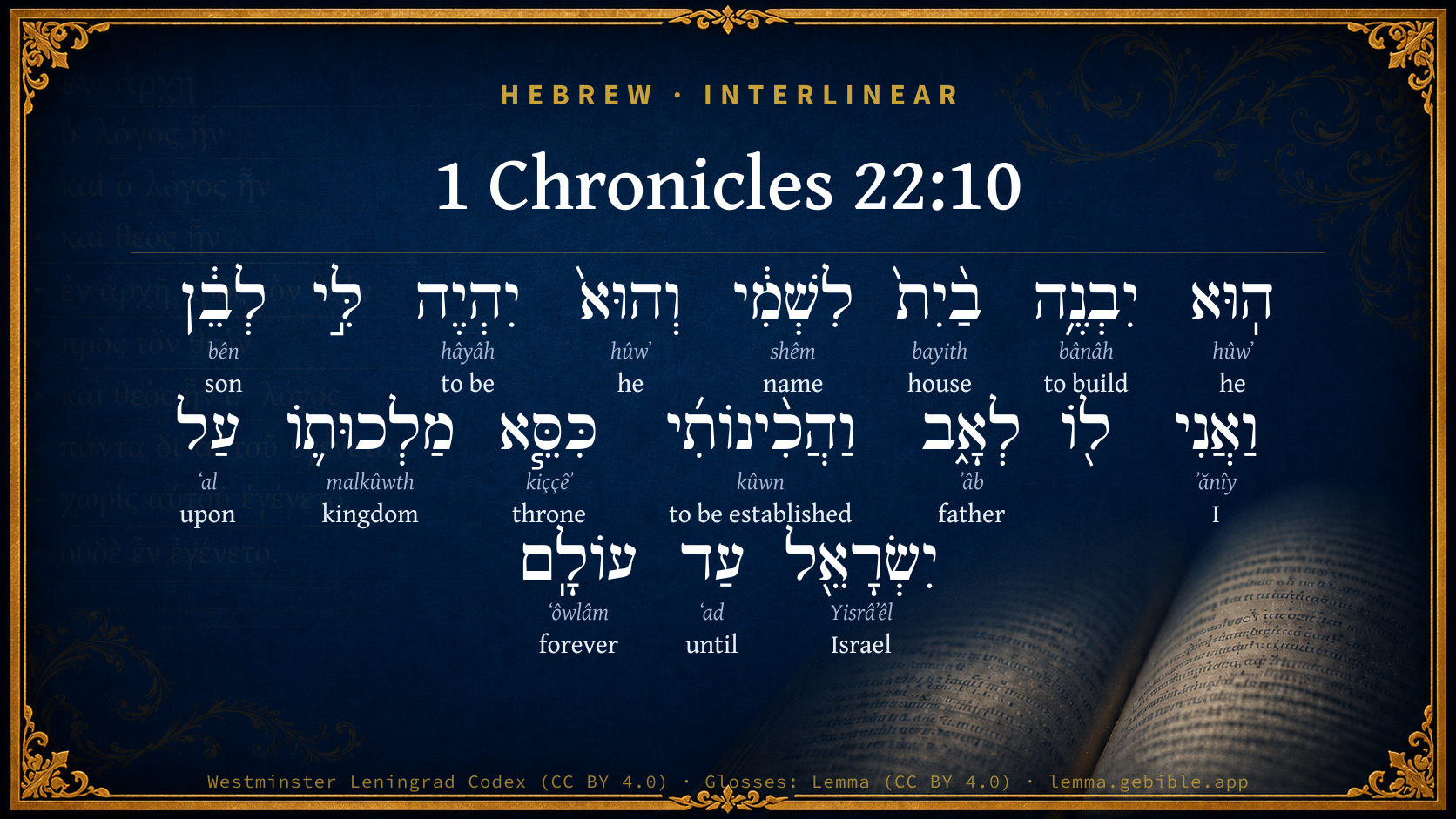
  1. הֽוּא hûwʼ H1931 “he” Pronoun, Personal, 3rd Person, Masculine, Singular
  2. יִבְנֶ֥ה bânâh H1129 “to build” Verb, Qal, Imperfect, 3rd Person, Masculine, Singular
  3. בַ֨יִת֙ bayith H1004 “house” Noun, Common, Masculine, Singular, Absolute
  4. לִשְׁמִ֔י shêm H8034 “to/for · name · my” Preposition + Noun, Common, Masculine, Singular, Construct + Suffix, Personal, 1st Person, Common, Singular
  5. וְהוּא֙ hûwʼ H1931 “and · he” Conjunction + Pronoun, Personal, 3rd Person, Masculine, Singular
  6. יִהְיֶה hâyâh H1961 “to be” Verb, Qal, Imperfect, 3rd Person, Masculine, Singular
  7. לְבֵ֔ן bên H1121 “to/for · son” Preposition + Noun, Common, Masculine, Singular, Absolute
  8. וַאֲנִי ʼănîy H589 “and · I” Conjunction + Pronoun, Personal, 1st Person, Common, Singular
  9. לְאָ֑ב ʼâb H1 “to/for · father” Preposition + Noun, Common, Masculine, Singular, Absolute
  10. וַהֲכִ֨ינוֹתִ֜י kûwn H3559 “and · to be established” Conjunction + Verb, Hiphil, Sequential Perfect, 1st Person, Common, Singular
  11. כִּסֵּ֧א kiççêʼ H3678 “throne of” Noun, Common, Masculine, Singular, Construct
  12. עַל ʻal H5921 “upon” Preposition
  13. יִשְׂרָאֵ֖ל Yisrâʼêl H3478 “Israel” Noun, Proper
  14. עַד ʻad H5704 “until” Preposition
  15. עוֹלָֽם ʻôwlâm H5769 “forever” Noun, Common, Masculine, Singular, Absolute

About this verse

These counts appear in no published source. They are computed here, from the morphology-tagged text and Lemma’s own curated glosses. What Lemma adds →

18
words
15
distinct lemmas
Historical
section

Grammatical profile

  • 3 verbs
  • 8 nouns
  • 3 pronouns
  • 4 prepositions

Verb forms

  • יִבְנֶ֥ה Qal · Imperfect
  • יִהְיֶה Qal · Imperfect
  • וַהֲכִ֨ינוֹתִ֜י Hiphil · Sequential Perfect

Repetition

A word recurs within this verse — often emphatic in Hebrew:

  • הֽוּא he H1931 ×2

Hebrew & Septuagint length

In English translation the verse runs 33 words from the Hebrew and 37 from the Septuagint (LXX English) — closely comparable.

A rough comparison of the two English renderings, which tokenize alike — not a word-level alignment.

Word counts can differ between the Hebrew and the Greek without any difference in meaning — e.g. the Hebrew direct-object marker אֵת has no separate Greek word, and Greek often adds the article ὁ.

In the original languages it is 18 Hebrew tokens and 25 Greek tokens — but the two are counted differently (Hebrew bundles its prefixes and suffixes into one token; the Greek is in lemma form), so that isn’t a like-for-like length.

Cross-references

10

Topical passages linked to 1 Chronicles 22:10 in the Treasury of Scripture Knowledge — connected by theme and wording, ordered by reader-vote popularity; previews shown in the World English Bible.

  • Hebrews 1:5 For to which of the angels did he say at any time, "You are my Son, Today have I become your father?" and again, "I will be to him a Father, And he will be to me a Son?"
  • 2 Samuel 7:13–14 He shall build a house for my name, and I will establish the throne of his kingdom forever.
  • 1 Chronicles 17:12–14 He shall build me a house, and I will establish his throne forever.
  • 1 Kings 5:5 Behold, I purpose to build a house for the name of Yahweh my God, as Yahweh spoke to David my father, saying, Your son, whom I will set on your throne in your room, he shall build the house for my name.
  • Psalms 89:26 He will call to me, 'You are my Father, My God, and the rock of my salvation!'
  • Isaiah 9:7 Of the increase of his government and of peace there shall be no end, on the throne of David, and on his kingdom, to establish it, and to uphold it with justice and with righteousness from henceforth even forever. The zeal of Yahweh of Hosts will perform this.
  • Zechariah 6:12–13 and speak to him, saying, 'Thus says Yahweh of Hosts, "Behold, the man whose name is the Branch: and he shall grow up out of his place; and he shall build the temple of Yahweh;
  • 1 Kings 8:19–20 nevertheless you shall not build the house; but your son who shall come forth out of your loins, he shall build the house for my name.
  • 1 Chronicles 28:6–7 He said to me, Solomon your son, he shall build my house and my courts; for I have chosen him to be my son, and I will be his father.
  • Psalms 89:36–37 His seed will endure forever, His throne like the sun before me.

Cross-references courtesy of OpenBible.info (CC BY 4.0).

Hebrew and Greek witnesses Masoretic Hebrew ↔ Greek Septuagint

The same verse in the two great witnesses to the Old Testament, shown verse-for-verse.

These are two independent witnesses, not word-aligned to each other, and the Septuagint is shown in lemma (dictionary) form.

Hebrew 1 Chronicles 22:10 Masoretic · Westminster Leningrad Codex

הֽוּא יִבְנֶ֥ה בַ֨יִת֙ לִשְׁמִ֔י וְהוּא֙ יִהְיֶה לִּ֣י לְבֵ֔ן וַאֲנִי ל֖וֹ לְאָ֑ב וַהֲכִ֨ינוֹתִ֜י כִּסֵּ֧א מַלְכוּת֛וֹ עַל יִשְׂרָאֵ֖ל עַד עוֹלָֽם

he shall build a house for my name; and he shall be my son, and I will be his father; and I will establish the throne of his kingdom over Israel for ever.

World English Bible · Public Domain

Greek LXX 1 Chronicles 22:10 Septuagint · lemma form

οὗτος οἰκοδομέω οἶκος ὁ ὄνομα ἐγώ καί οὗτος εἰμί ἐγώ εἰς υἱός καΐἐγώ αὐτός εἰς πατήρ καί ἀναὀρθόω θρόνος βασιλεία αὐτός ἐν ἰσραήλ ἕως αἰών

He shall build a house to my name; and he shall be a son to me, and I will be a father to him; and I will establish the throne of his kingdom in Israel for ever.

LXX2012 (modern English Septuagint) · Public Domain

Hebrew: Westminster Leningrad Codex (CC BY 4.0). Greek: Septuagint (public domain); English from LXX2012 (modern English Septuagint) (Public Domain). How the Septuagint differs from the Hebrew →

Commentary

Notes on 1 Chronicles 22:10 from classic Christian and Jewish commentators (each source and its license shown beneath its notes). The classic Christian expositions comment on the surrounding passage and are grouped to its opening verse, so a note may address several verses; the Jewish commentaries on the Tanakh (Rashi and others) are per-verse, so they appear only where the commentator wrote on this verse.

Lemma curates 59 commentaries, every one of them public domain or Creative Commons licensed, each selected and text-cleaned for this edition rather than reprinted as found. About our sources →

Trapp's Complete Commentary

John Trapp

1Ch 22:10 He shall build an house for my name; and he shall be my son, and I [will be] his father; and I will establish the throne of his kingdom over Israel for ever.

Ver. 10. {See Trapp on "2Sa 7:13"} {See Trapp on "2Sa 7:14"}

John Trapp, A Commentary or Exposition upon All the Books of the Old and New Testament (1647–1656) — public domain. Text from a community e-Sword module.

Ellicott's Commentary for English Readers

(10) He shall build an house.—Comp. 1 Chronicles 17; parts of 1Ch_22:11-13 are here repeated. (See the Notes there.)

A Bible Commentary for English Readers, edited by Charles John Ellicott (1878–1897) — public domain. Text from a community e-Sword module.

The Cambridge Bible for Schools and Colleges

gen. ed. J. J. S. Perowne

10. for ever] Cp. 2Sa_7:13-16.

The Cambridge Bible for Schools and Colleges (gen. ed. J. J. S. Perowne; Cambridge University Press, 1878–1918) — public domain. Text from a community e-Sword module.

John Gill's Exposition

He shall build an house for my name,.... For the worship of God, and for his honour and glory:

and he shall be my son, and I will be his father; see Sa2 7:13 and which is applied to Christ, Heb 1:5.

and I will establish the throne of his kingdom over Israel forever; that is, for a long time in his posterity; and which will have its fulfilment in Christ, his antitype, in the utmost sense of the expression, whose kingdom is an everlasting kingdom, and his throne for ever and ever, Luk 1:32.

John Gill's Exposition of the Whole Bible (1746–1763) — public domain (CC PDM 1.0). Text via the HelloAO Bible API.

Haydock's Catholic Bible Commentary

Name. See 2 Kings vii. 13. (Menochius) --- A son. The crimes into which Solomon fell, hinder us from explaining this literally of him. St. Paul refers the expression to Jesus Christ, Hebrews i. 5. (Calmet) --- St. Augustine (de C.[City of God?] xvii. 8 and 9.) observes that the promises were not perfectly fulfilled in Solomon.

George Leo Haydock (1774–1849), Haydock's Catholic Family Bible and Commentary, 1859 edition — public domain. Excludes Psalms (Douay-Rheims chapter numbering differs from Protestant) and Deuterocanonical books (Catholic canon only).

Matthew Poole's English Annotations

Of this See Poole "2Sa 7:13".

Matthew Poole's English Annotations on the Holy Bible (1683–1685) — public domain. Text from a community e-Sword/MySword module.

The Pulpit Commentary

The substance of this verse is found also in Nathan"s language (1Ch_17:12, 1Ch_17:13; 2Sa_7:13, 2Sa_7:14)

Early signs of the filial relation.

God gathers up into one expressive, suggestive, and satisfying term the relation in which he would stand to Solomon. That term could be no other than Father "And I will be his Father;" "He shall be my son." The revelation of the Divine fatherhood was the distinctive mission of Christ. The commendation of the filial spirit was the special duty of the apostles. These may be illustrated as introductory to the subject on which we now more particularly dwell; which is, the Old Testament indications of the fatherhood of God and sonship of men. It must be admitted that the term Father as applied to God in the Old Testament is only a figure of speech, designed to bring out and express God"s affectionate interest in his people; and the Lord Jesus Christ, by his own sonship and teaching, brought to light those comprehensive, inspiring, and ennobling views of the Divine fatherhood which we now know and properly regard as characteristically Christian. The figure of God as a Father was an aid to the complete apprehension of God, but it is now the one all-including conception of God, which is at once the foundation of theology and of faith. In this, as in so much else, the Old Testament prepared for the New. In reviewing Old Testament references to God as a Father, we notice

I THE TEACHING OF THE PATRIARCHAL RELIGION. It has not been sufficiently considered that the first relation in which God placed man to a being outside himself was that of father. Eve was part of Adam"s self. Cain was Adam"s son. The most essential relation of human beings is that of the parent and children. This highest and most necessary relation was the shadow and revelation of the Divine relation. For a long period the patriarchal system kept the fatherhood prominently before the minds of men. The great tribal father patriarch was the earthly representative of the Divine Being, through whom right ideas concerning God and his relations with men were reached. Note that, in the very first form of fatherhood, rule, authority, governance, were essential elements: the father was virtual king, and much more.

II THE SON-LIKE ATTITUDE OF TRUE PIETY IN EVERY AGE. The good man is conceived as a son; and the very ideal of goodness is an obedient, affectionate, and submissive son. Illustrate from Isaac"s relation to Abraham, especially in the matter of the required sacrifice. But fully illustrate from the Book of Psalms. The more perfectly the spirit which the psalmist wins and seeks is apprehended, the more clearly it appears that it will go into the one word "sonship." The submission of reverence and confidence, with the obedience of tenderest affection, are chief features of sincere piety, and as certainly precise features of good sonship. The son-figures, as used in the Old Testament-such as in the text should be given.

III THE NEW FORCE PUT INTO THE RELATION BY THE PROPHETS. Giving prominence to the spiritual over the ceremonial and governmental, the prophets cannot be satisfied with a kingly representation of God, or a priestly. They want to present a Divine relation to men which is more than official, other than official; so they use the parental figure, and the terms "father" and "son." Illustrative instances may be found in Isa_9:6 Isa_63:16 Isa_64:8; Jer_31:9; Mal_1:6 Mal_2:10, etc. God in judgment will certainly be misapprehended unless we see him to be the Father-God in judgment, and are willing to take our illustrative figures from the father, wisely, judiciously, and with a view to the highest good, chastening his child whom he loves. "Whom the Lord loveth he chasteneth." In a similar way every relation of God may be taken, and the importance of accepting the last and fullest revelation of God, as Father, may be shown to be necessary to its proper apprehension. We should rise from such preparatory and suggestive figures of speech as this in the text, to the high Christian conception of God as the "Father of Jesus," the "holy Father," the righteous Father. R.T.

The Pulpit Commentary (1880–1919), ed. H.D.M. Spence-Jones & Joseph S. Exell — public domain. Text from a community e-Sword module.

Keil & Delitzsch

C. F. Keil & F. Delitzsch

He shall build an house for my name,.... For the worship of God, and for his honour and glory:

and he shall be my son, and I will be his father; see Sa2 7:13 and which is applied to Christ, Heb 1:5.

and I will establish the throne of his kingdom over Israel forever; that is, for a long time in his posterity; and which will have its fulfilment in Christ, his antitype, in the utmost sense of the expression, whose kingdom is an everlasting kingdom, and his throne for ever and ever, Luk 1:32.

Keil & Delitzsch — Biblical Commentary on the Old Testament (1861–1891) — public domain (CC PDM 1.0). Text via the HelloAO Bible API. (Old Testament only.)

Lesson kit

Teaching starters — assembled from the data on this page, not authored interpretation. Every prompt links to the verse data it draws on. Edit before teaching.

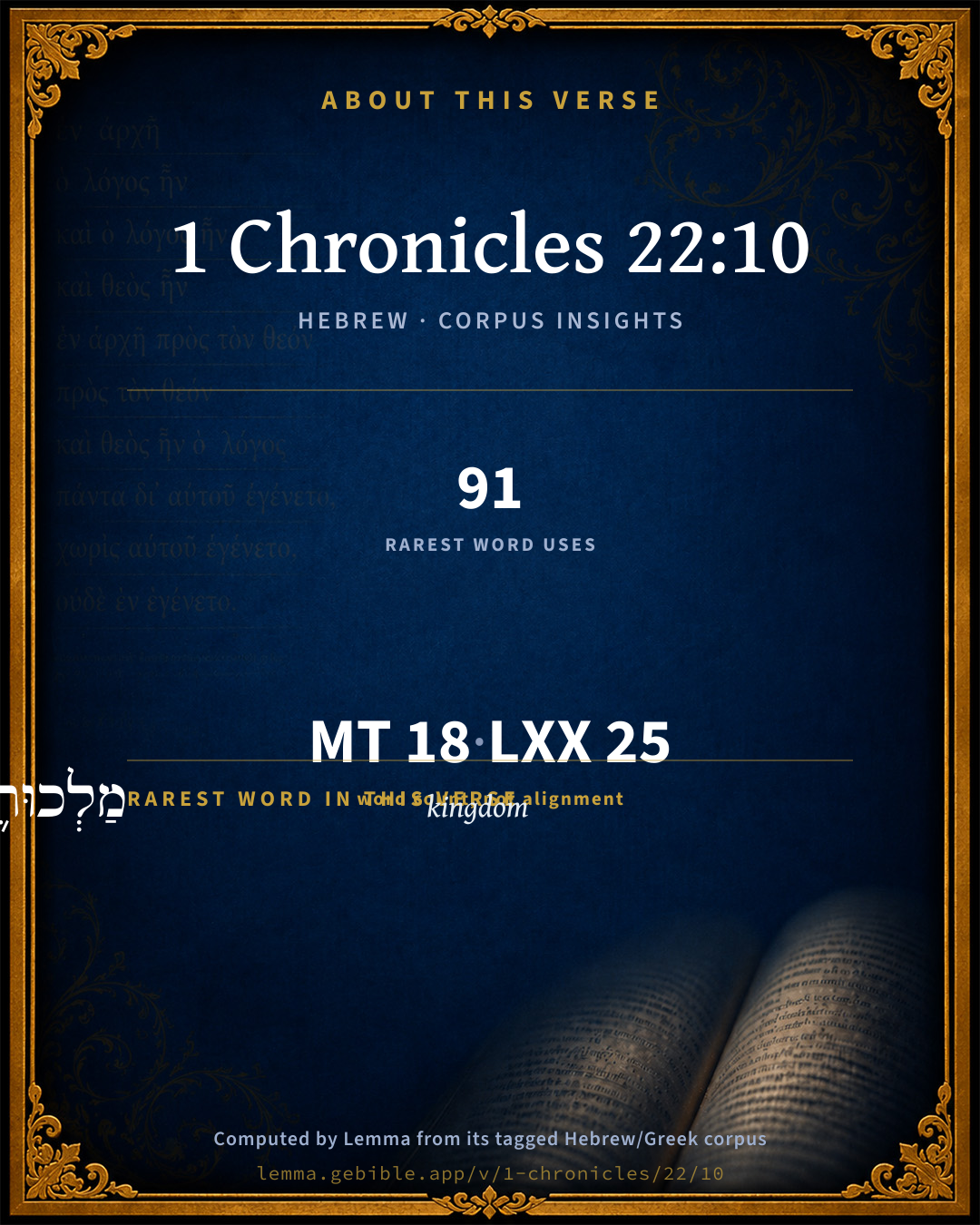
1 Chronicles, in the Historical, opens this verse with 18 words (15 distinct Hebrew lemmas). Its most distinctive word is malkûwth (“kingdom”). A historical commentator’s framing appears above. Read the whole chapter for the surrounding context.

Discussion questions

  1. How does “kingdom” (malkûwth) shape what this verse is saying?
  2. Hebrews 1:5 shares this passage’s theme. How do the two illuminate each other?
  3. “he” occurs 2× in this one verse. What is the effect of the repetition?
  4. The translations on this page render this verse differently — a whole-verse word diff, not a word-by-word alignment. What might account for the different wordings?
  5. The verb «יִבְנֶ֥ה» is Qal Imperfect. How does its form color the action?
  6. Reading how Trapp's Complete Commentary and Ellicott's Commentary for English Readers read this verse, where do the two commentators agree and where do they part?

Things to notice

Reading settings

Reading text

Shown beneath each verse's original-language words.

Old Testament
Old Testament edition

Read the OT as the Masoretic Hebrew (MT) or the Greek Septuagint (LXX).

English shown for the Greek Septuagint (in the Hebrew ↔ Greek comparison).

Comparing translations? Open the Compare panel on any verse page to stack up to four side by side.