Psalms 57:6

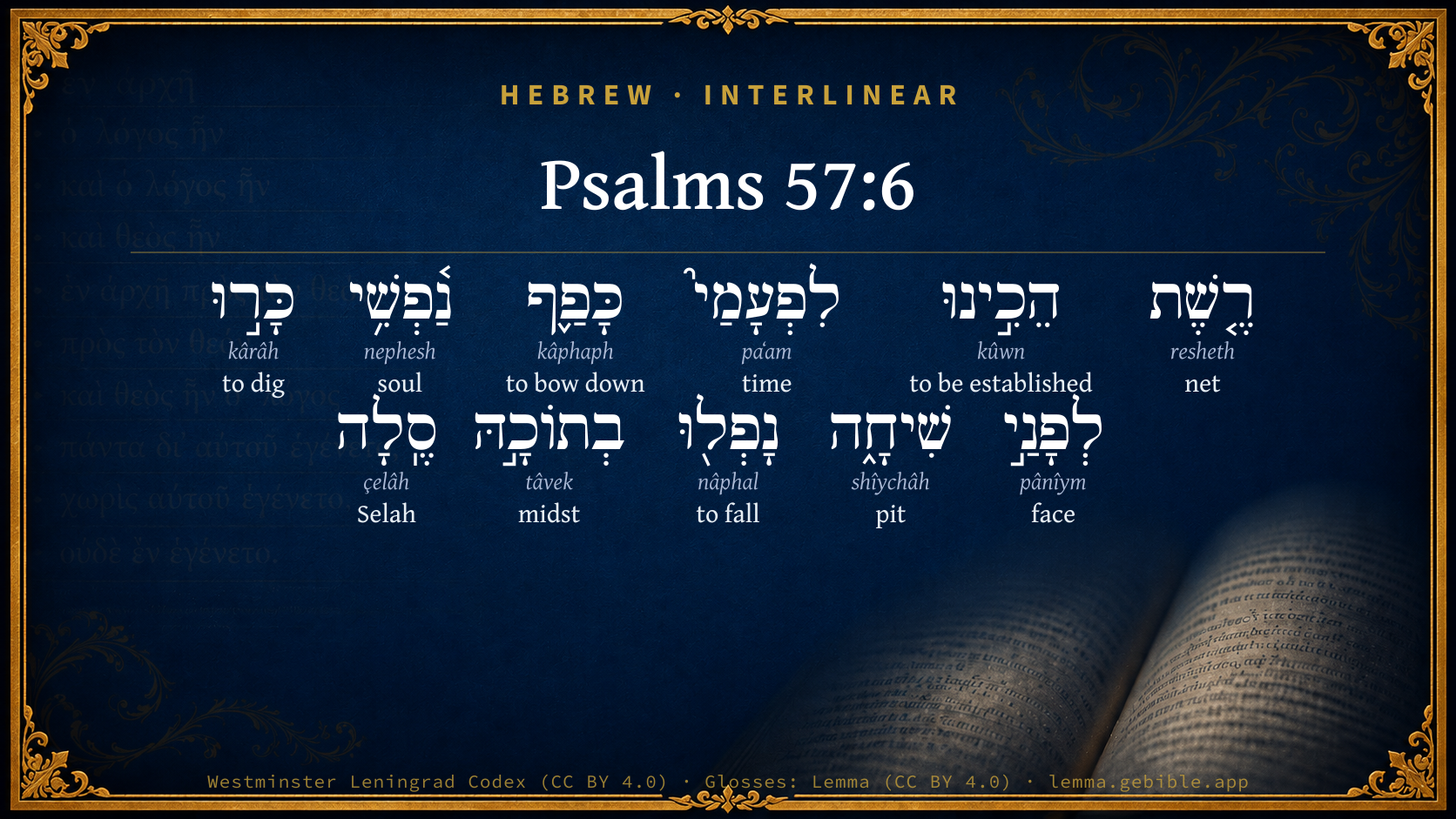
Hebrew (Westminster Leningrad Codex) Psalms 57:6 appears in the Hebrew Old Testament. The text above is from the Westminster Leningrad Codex. Each word links to its Strong’s number, a concise gloss, and parsing drawn from the Open Scriptures Hebrew Bible morphology. Click any word for its full Brown-Driver-Briggs (BDB) entry.
Download image
Cite this verse

Psalms 57:6 (World English Bible). Public Domain. Lemma interlinear Bible study tool, https://lemma.gebible.app/v/psalms/57/6.

Show BibTeX & RIS
BibTeX
RIS
English Translation
They have prepared a net for my steps. My soul is bowed down. They dig a pit before me. They fall into the midst of it themselves. Selah.
World English Bible · Public Domain
Highlights
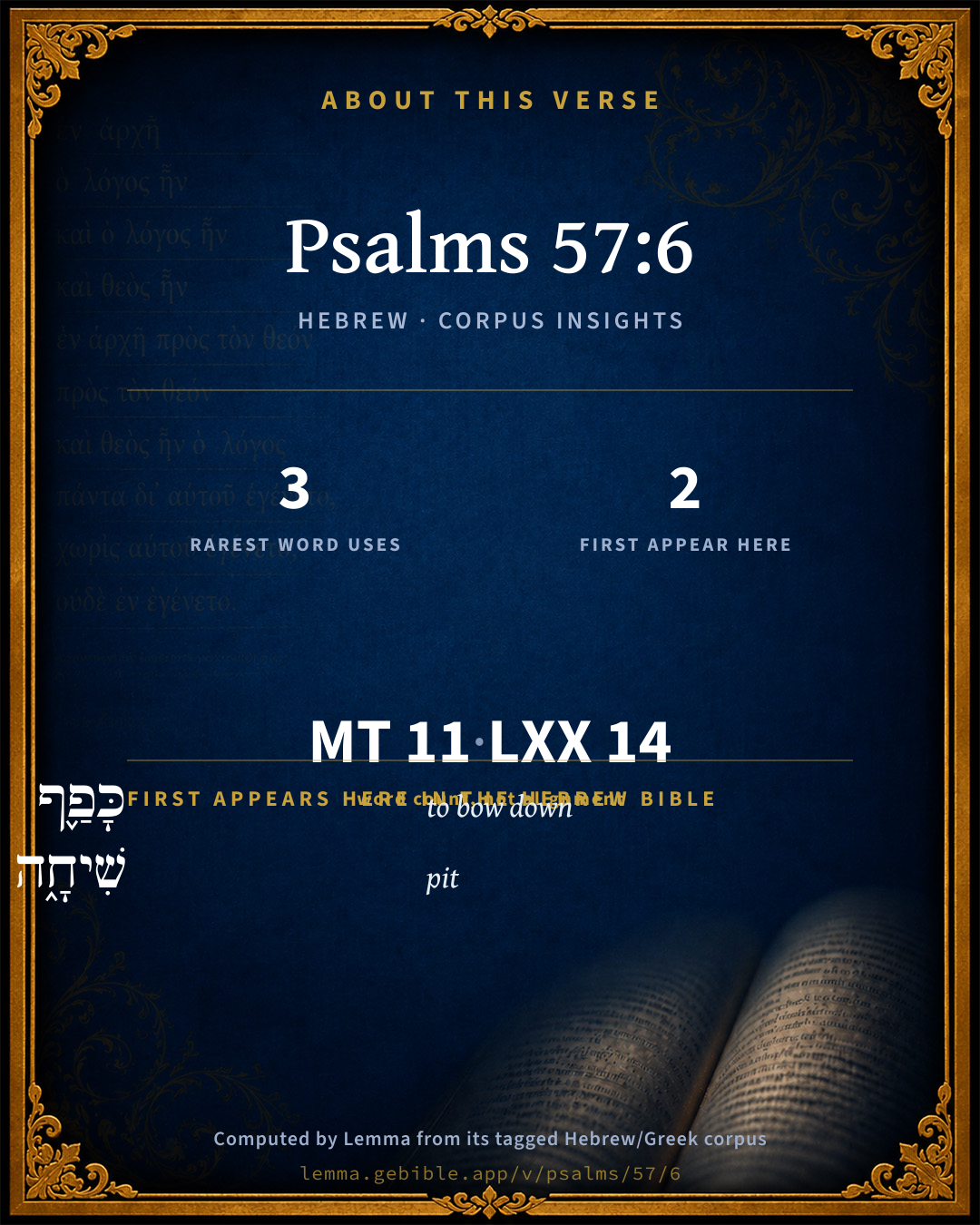
  • 2 first appearances in the Hebrew Bible
Full analysis ↓
Download a study sheet

One document with this verse’s original text, its word-by-word gloss line, the meaning frame, cross-references with their text, attributed commentary, and full source and license credits — printable, and it pastes into notes with its structure intact.

This verse Autodidact and up

Study sheet (.html) Plain text (.txt)

A passage Seminary Student

Up to 50 verses in one chapter. A passage sheet keeps up to 6 commentary sources and 12 cross-references per verse, in the order this page ranks them, and says so on the sheet whenever that leaves anything out. Ask for a single verse and you get the Autodidact verse sheet above.

Everything on this page stays free to read, with no account — the sheet is a download of what is already on screen, not access to it.

Want to remove ads? Support Godless Engineer
Compare translations 3

The same verse in 3 English versions, stacked beneath the original-language interlinear above. Click any original word for its lexicon entry.

Each is an independent rendering of the whole verse — the interlinear is not word-aligned to these translations.

Highlighted words mark where these versions differ — a whole-verse word diff, not a word-by-word alignment.

  • World English Bible Public Domain
    They have prepared a net for my steps. My soul is bowed down. They dig a pit before me. They fall into the midst of it themselves. Selah.
  • King James Version Public Domain
    They have prepared a net for my steps; my soul is bowed down: they have digged a pit before me, into the midst whereof they are fallen themselves. Selah.
  • unfoldingWord Literal Text CC BY-SA 4.0
    They prepare a net for my steps; my soul bows down. They dig a pit to my face; they fall into the midst of it. Selah

unfoldingWord Literal Text — © unfoldingWord, licensed CC BY-SA 4.0. Word-aligned USFM3 via Door43 (git.door43.org/unfoldingWord/en_ult).

Versions to compare (up to 4)

3 of 4 selected

Show all 18 translations

Every available English version of this verse, each an independent rendering of the whole verse.

  • World English Bible Public Domain
    They have prepared a net for my steps. My soul is bowed down. They dig a pit before me. They fall into the midst of it themselves. Selah.
  • Berean Standard Bible Public Domain
    They spread a net for my feet; my soul was despondent. They dug a pit before me, but they themselves have fallen into it! Selah
  • Majority Standard Bible Public Domain
    They spread a net for my feet; my soul was despondent. They dug a pit before me, but they themselves have fallen into it! Selah
  • King James Version Public Domain
    They have prepared a net for my steps; my soul is bowed down: they have digged a pit before me, into the midst whereof they are fallen themselves. Selah.
  • American Standard Version (1901) Public Domain
    They have prepared a net for my steps; My soul is bowed down: They have digged a pit before me; They are fallen into the midst thereof themselves. Selah
  • Revised Version (1885) Public Domain
    They have prepared a net for my steps; thy soul is bowed down: they have digged a pit before me; they are fallen into the midst thereof themselves. Selah
  • Geneva Bible (1599) Public Domain
    They haue layd a net for my steps: my soule is pressed downe: they haue digged a pit before me, and are fallen into the mids of it. Selah.
  • Douay-Rheims (1899) Public Domain
    Be thou exalted, O God, above the heavens, and thy glory above all the earth.
  • Young's Literal Translation Public Domain
    A net they have prepared for my steps, Bowed down hath my soul, They have digged before me a pit, They have fallen into its midst. Selah.
  • Literal Standard Version CC BY-SA 4.0
    They have prepared a net for my steps, || My soul has bowed down, || They have dug a pit before me, || They have fallen into its midst. Selah.
  • Unlocked Literal Bible CC BY-SA 4.0
    They spread out a net for my feet; I was distressed. They dug a pit in front of me. They themselves have fallen into the middle of it! Selah
  • unfoldingWord Literal Text CC BY-SA 4.0
    They prepare a net for my steps; my soul bows down. They dig a pit to my face; they fall into the midst of it. Selah
  • Darby Bible Public Domain
    They have prepared a net for my steps; my soul was bowed down: they have digged a pit before me; they are fallen into the midst thereof. Selah.
  • World Messianic Bible Public Domain
    They have prepared a net for my steps. My soul is bowed down. They dig a pit before me. They fall into the middle of it themselves. Selah.
  • Webster's Bible Public Domain
    \\57:5\\Be thou exalted, O God, above the heavens; let thy glory be above all the earth.
  • Free Bible Version CC BY-SA 4.0
    They set a trap to catch me. I was so depressed. They dug a pit on my path but they were the ones who fell into it. Selah.
  • Bible in Basic English Public Domain
    They have made ready a net for my steps; my soul is bent down; they have made a great hole before me, and have gone down into it themselves. (Selah.)
  • JPS Tanakh (1917) Public Domain
    (57-7) They have prepared a net for my steps, my soul is bowed down; they have digged a pit before me, they are fallen into the midst thereof themselves. Selah

Literal Standard Version (2020), Covenant Press — licensed CC BY-SA 4.0. Text via the HelloAO Bible API (eBible.org). Unlocked Literal Bible (unfoldingWord) — licensed CC BY-SA 4.0. Text via the HelloAO Bible API (eBible.org). unfoldingWord Literal Text — © unfoldingWord, licensed CC BY-SA 4.0. Word-aligned USFM3 via Door43 (git.door43.org/unfoldingWord/en_ult). Free Bible Version, Dr. Jonathan Gallagher — licensed CC BY-SA 4.0. Text via the HelloAO Bible API (eBible.org).

Word by word

More ways to search: Search by grammar → Find every occurrence → Compare this word →

Practice this passage: Drill this verse → Learn its vocabulary →

שִׁיחָ֑ה
shîychâh
H7882
“pit”
Noun, Common, Feminine, Singular, Absolute
Part of Speech
Noun
Type
Common
Gender
Feminine
Number
Singular
State
Absolute
Full BDB Definition

Origin: for H7745

TWOT: 2343 . 1b

pit
  1. רֶ֤שֶׁת resheth H7568 “net” Noun, Common, Feminine, Singular, Absolute
  2. הֵכִ֣ינוּ kûwn H3559 “to be established” Verb, Hiphil, Perfect, 3rd Person, Common, Plural
  3. לִפְעָמַי֮ paʻam H6471 “to/for · times · my” Preposition + Noun, Common, Feminine, Plural, Construct + Suffix, Personal, 1st Person, Common, Singular
  4. כָּפַ֪ף kâphaph H3721 “to bow down” Verb, Qal, Perfect, 3rd Person, Masculine, Singular
  5. נַ֫פְשִׁ֥י nephesh H5315 “soul · my” Noun, Common, Both, Singular, Construct + Suffix, Personal, 1st Person, Common, Singular
  6. כָּר֣וּ kârâh H3738 “to dig” Verb, Qal, Perfect, 3rd Person, Common, Plural
  7. לְפָנַ֣י pânîym H6440 “to/for · face(s) · my” Preposition + Noun, Common, Both, Plural, Construct + Suffix, Personal, 1st Person, Common, Singular
  8. נָפְל֖וּ nâphal H5307 “to fall” Verb, Qal, Perfect, 3rd Person, Common, Plural
  9. בְתוֹכָ֣הּ tâvek H8432 “in/at · midst · her” Preposition + Noun, Common, Masculine, Singular, Construct + Suffix, Personal, 3rd Person, Feminine, Singular
  10. סֶֽלָה çelâh H5542 “Selah” Particle, Interjection

About this verse

These counts appear in no published source. They are computed here, from the morphology-tagged text and Lemma’s own curated glosses. What Lemma adds →

11
words
11
distinct lemmas
Wisdom
section

Notable vocabulary

The rarest word here is שִׁיחָ֑ה pit H7882 — appearing just 3 times in the whole Hebrew Bible.

First appearance in Scripture

These words make their first canonical appearance in the Hebrew Bible here:

  • כָּפַ֪ף to bow down H3721
  • שִׁיחָ֑ה pit H7882

Shared distinctive vocabulary

שִׁיחָ֑ה pit H7882 occurs in 3 verses of the Hebrew Bible. Also found in:

Grammatical profile

  • 4 verbs
  • 6 nouns
  • 1 particle

Verb forms

  • הֵכִ֣ינוּ Hiphil · Perfect
  • כָּפַ֪ף Qal · Perfect
  • כָּר֣וּ Qal · Perfect
  • נָפְל֖וּ Qal · Perfect

Hebrew & Septuagint length

In English translation the verse runs 28 words from the Hebrew and 27 from the Septuagint (LXX English) — closely comparable.

A rough comparison of the two English renderings, which tokenize alike — not a word-level alignment.

Word counts can differ between the Hebrew and the Greek without any difference in meaning — e.g. the Hebrew direct-object marker אֵת has no separate Greek word, and Greek often adds the article ὁ.

In the original languages it is 11 Hebrew tokens and 14 Greek tokens — but the two are counted differently (Hebrew bundles its prefixes and suffixes into one token; the Greek is in lemma form), so that isn’t a like-for-like length.

Cross-references

13

Topical passages linked to Psalms 57:6 in the Treasury of Scripture Knowledge — connected by theme and wording, ordered by reader-vote popularity; previews shown in the World English Bible.

  • Psalms 145:14 Yahweh upholds all who fall, And raises up all those who are bowed down.
  • Psalms 7:15–16 He has dug a hole, And has fallen into the pit which he made.
  • Proverbs 28:10 Whoever causes the upright to go astray in an evil way, He will fall into his own trap; But the blameless will inherit good.
  • Micah 7:2 The godly man has perished out of the earth, And there is no one upright among men. They all lie in wait for blood; Every man hunts his brother with a net.
  • Psalms 35:7–8 For without cause they have hidden their net in a pit for me. Without cause they have dug a pit for my soul.
  • Psalms 140:5 The proud have hidden a snare for me, They have spread the cords of a net by the path. They have set traps for me. Selah.
  • Psalms 9:15–16 The nations have sunk down in the pit that they made; In the net which they hid, their own foot is taken.
  • Psalms 142:3 When my spirit was overwhelmed within me, You knew my path. In the way in which I walk, They have hidden a snare for me.
  • Proverbs 29:5 A man who flatters his neighbor, Spreads a net for his feet.
  • 1 Samuel 23:22–26 Please go make yet more sure, and know and see his place where his haunt is, [and] who has seen him there; for it is told me that he deals very subtly.
  • Psalms 42:6 My God, my soul is in despair within me. Therefore I remember you from the land of the Jordan, The heights of Hermon, from the hill Mizar.
  • Psalms 143:4 Therefore my spirit is overwhelmed within me. My heart within me is desolate.
  • Matthew 26:37–38 He took with him Peter and the two sons of Zebedee, and began to be sorrowful and severely troubled.

Cross-references courtesy of OpenBible.info (CC BY 4.0).

Hebrew and Greek witnesses Masoretic Hebrew ↔ Greek Septuagint

The same verse in the two great witnesses to the Old Testament, shown verse-for-verse.

You’re reading Greek Psalm 56 (Hebrew Psalm 57). The Septuagint counts the superscription, so verse numbers can differ from the Hebrew — chapter-level alignment, not verse-by-verse. Numbering follows Rahlfs.

These are two independent witnesses, not word-aligned to each other, and the Septuagint is shown in lemma (dictionary) form.

Hebrew Psalms 57:6 Masoretic · Westminster Leningrad Codex

רֶ֤שֶׁת הֵכִ֣ינוּ לִפְעָמַי֮ כָּפַ֪ף נַ֫פְשִׁ֥י כָּר֣וּ לְפָנַ֣י שִׁיחָ֑ה נָפְל֖וּ בְתוֹכָ֣הּ סֶֽלָה

They have prepared a net for my steps. My soul is bowed down. They dig a pit before me. They fall into the midst of it themselves. Selah.

World English Bible · Public Domain

Greek LXX Greek Psalm 56:6 Septuagint · lemma form

ὑψόω ἐπί ὁ οὐρανός ὁ θεός καί ἐπί πᾶς ὁ γῆ ὁ δόξα σύ

They have prepared snares for my feet, and have bowed down my soul: they have dug a pit before my face, and fallen into it themselves. Pause.

LXX2012 (modern English Septuagint) · Public Domain

On this verse, The Cambridge Bible for Schools and Colleges discusses the Septuagint’s reading. Read the note in Commentary ↓

Hebrew: Westminster Leningrad Codex (CC BY 4.0). Greek: Septuagint (public domain); English from LXX2012 (modern English Septuagint) (Public Domain). How the Septuagint differs from the Hebrew →

Commentary

Notes on Psalms 57:6 from classic Christian and Jewish commentators (each source and its license shown beneath its notes). The classic Christian expositions comment on the surrounding passage and are grouped to its opening verse, so a note may address several verses; the Jewish commentaries on the Tanakh (Rashi and others) are per-verse, so they appear only where the commentator wrote on this verse.

Lemma curates 59 commentaries, every one of them public domain or Creative Commons licensed, each selected and text-cleaned for this edition rather than reprinted as found. About our sources →

The Cambridge Bible for Schools and Colleges

gen. ed. J. J. S. Perowne

6. The transposition of Psa_57:5-6, proposed by Cheyne and others, simply ruins the sense, Psa_57:6 is the fitting sequel of Psa_57:5. Just as in Psa_56:5 ff, he returns after the refrain to contemplate his present situation. But now Faith sees the prayer of Psa_57:5 answered, and with the manifestation of God’s supreme authority all opposition is subdued, nay, his foes’ own schemes prove their ruin.

my soul is bowed down] Perhaps we should read with the LXX, they have bowed down my soul; i.e. (the perf. as in Psa_56:1) they have made sure of capturing me. But it is tempting to go further and read (with Ewald), their soul is bowed down, thereby securing a double parallelism in the verse. Lines 1 and 3 then describe their plots: lines 2 and 4 describe how they are caught in their own trap. The metaphors are taken from the nets and pitfalls used by hunters. Cp. Psa_7:15; Psa_9:15 f.; Psa_35:7; Eze_19:4; Ecc_10:8.

into the midst whereof they are fallen themselves] Better, they are fallen into the midst of It.

6–11. Convinced that God will manifest His authority, the Psalmist sees the machinations of his enemies turning to their own defeat, and utters resolutions of joyous thanksgiving.

The Cambridge Bible for Schools and Colleges (gen. ed. J. J. S. Perowne; Cambridge University Press, 1878–1918) — public domain. Text from a community e-Sword module.

Trapp's Complete Commentary

John Trapp

Psa 57:6 They have prepared a net for my steps; my soul is bowed down: they have digged a pit before me, into the midst whereof they are fallen [themselves]. Selah.

Ver. 6. They have prepared a net for my steps] So that I can hardly keep foot out of snare. I dare not lift up one foot till I find sure footing for the other; and that is hard to do. See Saul’s charge to the Ziphites, 1Sa 23:22.

My soul is bowed down] I am glad to shrink in myself (as fearful people use to do), that I may shun those gins and snares that they have set to maim and mischief me.

They have digged a pit, &c.] They have forced me into this subterranean cave; and, behold, Saul himself is cast into mine hands, in this mine hiding hole.

Oι αυτω κακα τευχει ανηρ, αλλω κακα τευχων.

John Trapp, A Commentary or Exposition upon All the Books of the Old and New Testament (1647–1656) — public domain. Text from a community e-Sword module.

Joseph Benson's Commentary

Psa 57:6. They have prepared a net for my steps — In which to take me, that I might not again escape out of their hands. My soul is bowed down — Hebrew, כפŠ נפשׁי, he hath bowed down my soul; referring to Saul at the head of his troops, pursuing David to his ruin. They have digged a pit before me — Hebrew, before my face: not in my sight, for that would have been in vain, Pro 1:17, but in my way, where they thought I would go; into the midst whereof they are fallen — This was fulfilled in Saul, who, by pursuing David, fell into his hands, 1Sa 24:3.

Joseph Benson's Commentary on the Old and New Testaments (1811–1818) — public domain. Text from a community e-Sword module.

Keil & Delitzsch

C. F. Keil & F. Delitzsch

In this second half of the Psalm the poet refreshes himself with the thought of seeing that for which he longs and prays realized even with the dawning of the morning after this night of wretchedness. The perfect in Psa 57:7 is the perfect of certainty; the other perfects state what preceded and is now changed into the destruction of the crafty ones themselves. If the clause כּפף נפשׁי is rendered: my soul was bowed down (cf. חלל, Psa 109:22), it forms no appropriate corollary to the crafty laying of snares. Hence kpp must be taken as transitive: he had bowed down my soul; the change of number in the mention of the enemies is very common in the Psalms relating to these trials, whether it be that the poet has one enemy κατ ̓ ἐξοχήν before his mind or comprehends them all in one. Even the lxx renders καὶ κατέκαμψαν τὴν ψυχὴν μου, it is true, as though it were וכפפו, but can scarcely have read it thus. This line is still remarkable; one would expect for Psa 57:7 a thought parallel with Psa 57:7, and perhaps the poet wrote כפף נפשׁו, his (the net-layer's) own soul bends (viz., in order to fall into the net). Then כפף like נפל would be praet. confidentiae. In this certainty, to express which the music here becomes triumphantly forte, David's heart is confident, cheerful (Symmachus ἐδραία), and a powerful inward impulse urges him to song and harp. Although נכון may signify ready, equipped (Exo 34:2; Job 12:5), yet this meaning is to be rejected here in view of Psa 51:12, Psa 78:37, Psa 112:7 : it is not appropriate to the emphatic repetition of the word. His evening mood which found expression in Psa 57:4, was hope of victory; the morning mood into which David here transports himself, is certainty of victory. He calls upon his soul to awake (כּבודי as in Psa 16:9; 30:13), he calls upon harp and cithern to awake (הנּבל וכנּור with one article that avails for both words, as in Jer 29:3; Neh 1:5; and עוּרה with the accent on the ultima on account of the coming together of two aspirates), from which he has not parted even though a fugitive; with the music of stringed instruments and with song he will awake the not yet risen dawn, the sun still slumbering in its chamber: אעירה, expergefaciam (not expergiscar), as e.g., in Sol 2:7, and as Ovid (Metam. xi. 597) says of the cock, evocat auroram.

(Note: With reference to the above passage in the Psalms, the Talmud, B. Berachoth 3b, says, "A cithern used to hang above David's bed; and when midnight came, the north wind blew among the strings, so that they sounded of themselves; and forthwith he arose and busied himself with the Tra until the pillar of the dawn (עמוד השׁחר) ascended." Rashi observes, "The dawn awakes the other kings; but I, said David, will awake the dawn (אני מעורר את השׁחר).")

His song of praise, however, shall not resound in a narrow space where it is scarcely heard; he will step forth as the evangelist of his deliverance and of his Deliverer in the world of nations (בעמּים; and the parallel word, as also in Psa 108:4; Psa 149:7, is to be written בּלעמּים with Lamed raphatum and Metheg before it); his vocation extends beyond Israel, and the events of his life are to be for the benefit of mankind. Here we perceive the self-consciousness of a comprehensive mission, which accompanied David from the beginning to the end of his royal career (vid., Psa 18:50). What is expressed in v. 11 is both motive and theme of the discourse among the peoples, viz., God's mercy and truth which soar high as the heavens (Psa 36:6). That they extend even to the heavens is only an earthly conception of their infinity (cf. Eph 3:18). In the refrain, v. 12, which only differs in one letter from Psa 57:6, the Psalm comes back to the language of prayer. Heaven and earth have a mutually involved history, and the blessed, glorious end of this history is the sunrise of the divine doxa over both, here prayed for.

Keil & Delitzsch — Biblical Commentary on the Old Testament (1861–1891) — public domain (CC PDM 1.0). Text via the HelloAO Bible API. (Old Testament only.)

J. A. Alexander on Psalms

Joseph Addison Alexander

7. (Psa 57:6). A net they prepared for my steps; he pressed down my soul; they digged before me a pit; they fell into the midst of it. Selah. This verse assigns the reason or occasion of the praise ascribed to God in that before it. The image here presented is the same as in Psa 7:15; Psa 9:15. The sudden change of number is particularly common in the Psalms when speaking of an ideal person, representing many real individuals. See above, on Psa 51:2. The phrase pressed down is borrowed from the Prayer-Book version, and is well suited to convey the idea of an animal caught and held down by a trap or snare. That version is also more correct than the English Bible in giving to the verb an active meaning; of the neuter or passive there is no example elsewhere. Before me, in my path, where am I walking. The Selah at the close is almost equivalent to an Amen, as expressing acquiescence in God's righteous retributions.

Joseph Addison Alexander, The Psalms Translated and Explained (1850) — public domain. Text from a community e-Sword module.

Geneva Bible (1599)

Geneva Bible translators

For very fear seeing the great dangers on all sides.

Geneva Bible (1599) marginal notes — public domain. Text via Bolls.life.

Jamieson, Fausset & Brown

Robert Jamieson, A. R. Fausset & David Brown

(Compare Psa 7:15; Psa 9:15-16).

Jamieson, Fausset & Brown — Commentary Critical and Explanatory on the Whole Bible (1871) — public domain (CC PDM 1.0). Text via the HelloAO Bible API.

Adam Clarke's Commentary

Verse 6. They have prepared a net for my steps] A gin or springe, such as huntsmen put in the places which they know the prey they seek frequents: such, also, as they place in passages in hedges, c., through which the game creeps.

They have digged a pit] Another method of catching game and wild beasts. They dig a pit, cover it over with weak sticks and turf. The beasts, not suspecting danger where none appears, in attempting to walk over it, fall through, and are taken. Saul digged a pit, laid snares for the life of David and fell into one of them himself, particularly at the cave of En-gedi; for he entered into the very pit or cave where David and his men were hidden, and his life lay at the generosity of the very man whose life he was seeking! The rabbins tell a curious and instructive tale concerning this: "God sent a spider to weave her web at the mouth of the cave in which David and his men lay hid. When Saul saw the spider's web over the cave's mouth, he very naturally conjectured that it could neither be the haunt of men nor wild beasts; and therefore went in with confidence to repose." The spider here, a vile and contemptible animal, became the instrument in the hand of God of saving David's life and of confounding Saul in his policy and malice. This may be a fable; but it shows by what apparently insignificant means God, the universal ruler, can accomplish the greatest and most beneficent ends. Saul continued to dig pits to entrap David; and at last fell a prey to his own obstinacy. We have a proverb to the same effect: Harm watch, harm catch. The Greeks have one also: Ἡ τε κακη βουλη τῳ βουλευσαντι κακιστη, "An evil advice often becomes most ruinous to the adviser." The Romans have one to the same effect: -

Neque enim lex justior ulla est

Quam necis artificem arte perire sua.

"There is no law more just than that which condemns a man to suffer death by the instrument which he has invented to take away the life of others."

Adam Clarke's Commentary on the Bible (1810–1826) — public domain. Text from a community e-Sword/MySword module.

Ellicott's Commentary for English Readers

(6) A net.—For this image, so common in Hebrew hymns, see Psa_9:15, &c, and for that of the pit, Psa_7:15, &c

My soul is bowed down.—The verb so rendered is everywhere else transitive. So LXX. and Vulg. here, “And have pressed down my soul.” Despite the grammar, Ewald alters “my soul” into “their soul.” But no conjecture of the kind restores the parallelism, which is here hopelessly lost. We expect,

They have prepared a net for my steps;

They are caught in it themselves.

A Bible Commentary for English Readers, edited by Charles John Ellicott (1878–1897) — public domain. Text from a community e-Sword module.

John Gill's Exposition

They have prepared a net for my steps,.... They laid snares for him, as the fowler does for the bird, in order to take him. It denotes the insidious ways used by Saul and his men to get David into their hands; so the Pharisees consulted together how they might entangle Christ in his talk, Mat 22:15;

my soul is bowed down; dejected by reason of his numerous enemies, and the crafty methods they took to ensnare and ruin him; so the soul of Christ was bowed down with the sins of his people, and with a sense of divine wrath because of them; and so their souls are often bowed down; or they are dejected in their spirits, on account of sin, Satan's temptations, various afflictions, and divine desertions. The Targum renders it,

"he bowed down my soul;''

that is, the enemy; Saul in particular. The Septuagint, Arabic, and Ethiopic versions, "they bowed down my soul"; the same that prepared a net for his steps; everyone of his enemies; they all were the cause of the dejection of his soul: the Syriac version leaves out the clause;

they have digged a pit before me, into the midst whereof they are fallen themselves; contriving and seeking to find out the places where David's haunt was, Saul got into the very cave where he and his men were; and had his skirt cut off, when his life might as easily have been taken away, Sa1 23:22. See Psa 7:15.

Selah; on this word; see Gill on Psa 3:2.

John Gill's Exposition of the Whole Bible (1746–1763) — public domain (CC PDM 1.0). Text via the HelloAO Bible API.

Albert Barnes' Notes on the Bible

They have prepared a net for my steps - A net for my goings; or, into which I may fall. See the notes at Psa 9:15.

My soul is bowed down - The Septuagint, the Vulgate, and Luther render this in the plural, and in the active form: “They have bowed down my soul;” that is, they have caused my soul to be bowed down. The Hebrew may be correctly rendered, “he pressed down my soul,” - referring to his enemies, and speaking of them in the singular number.

They have digged a pit before me ... - See Psa 7:15-16, notes; Psa 9:15, note; Job 5:13, note.

Albert Barnes' Notes on the Bible (1834–1885) — public domain. Text from a community e-Sword/MySword module.

Matthew Poole's English Annotations

Is bowed down; or, was bowed down: I was even ready to fall and perish. Or, mine heart was oppressed, and almost overwhelmed.

Before me, Heb. before my face; not in my sight, for that would have been in vain, Pro 1:17; but in my way, where they thought I would go. They are fallen themselves: this was fulfilled in Saul, who by pursuing fell into his hands, 1Sa 24:4.

Matthew Poole's English Annotations on the Holy Bible (1683–1685) — public domain. Text from a community e-Sword/MySword module.

The Treasury of David

Charles H. Spurgeon

Ver. 6. They have prepared a net for my steps. The enemies of the godly spare no pains, but go about their wicked work with the coolest deliberation. As for each sort of fish, or bird, or beast, a fitting net is needed, so do the ungodly suit their net to their victim's circumstances and character with a careful craftiness of malice. Whatever David might do, and whichever way he might turn, his enemies were ready to entrap him in some way or other.

My soul is bowed down. He was held down like a bird in a trap; his enemies took care to leave him no chance of comfort.

They have digged a pit before me, into the midst whereof they are fallen themselves. He likens the design of his persecutors to pits, which were commonly dug by hunters to entrap their prey; these were made in the usual path of the victim, and in this case David says, before me, i.e., in my ordinary way. He rejoices because these devices had recoiled upon themselves. Saul hunted David, but David caught him more than once and might have slain him on the spot. Evil is a stream which one day flows back to its source.

Selah. We may sit down at the pit's mouth and view with wonder the just retaliations of providence.

Ver. 6. Net. Not having fire arms, the ancients were much more skilful than the moderns in the use of snares, nets, and pits for capturing wild animals. A large class of Biblical figures and allusions necessarily presuppose this state of things. W. M. Thomson.

Ver. 6. (first clause).

I. Who are they?

1. Those who lead us into sin.

2. Who argue from worldly philosophy.

3. Who proclaim priestly and sacramental superstition.

4. Who decoy us from the church of God.

5. Who teach Antinomian doctrine. II. How shall we escape them?

1. Keep out of their way.

2. Keep to God's way.

3. Trust daily in the Lord.

Ver. 6. My soul is bowed down.

I. The prostration.

1. Caused by enemies, weakness, fear, pain.

2. Deep, agonizing, self revealing.

3. Common to the Head and the members. II. The consolation.

1. Bowed down, but not condemned.

2. Hoping in the promise.

3. Trusting in God.

4. Expecting a blessing from the trial.

Psalms 57:7*

Charles H. Spurgeon's The Treasury of David (1869–1885) — public domain. Psalms only. Text from a community e-Sword/MySword module.

Whedon's Commentary on the Bible

Daniel D. Whedon

6. They have prepared a net—He returns to the artful designs of his enemies, which he illustrates by an eastern method of catching wild animals by snares and pitfalls. See Isa_24:17-18.

Into the midst whereof they are fallen—By faith David sees the retributive justice of God meeting out to them the evil they had plotted against himself. Saul had fallen into David’s hands, not David into Saul’s. Comp. 1Sa_24:2; 1Sa_24:8. The selah, or pause, which to the reader is a call to meditation on the import of what is said, and is nearly equal to the amen, closes this first division of the psalm, which otherwise might be ended with the refrain of Psa_57:5

Daniel D. Whedon (gen. ed.), Commentary on the Old and New Testaments (1874–1909) — public domain. Text from a community e-Sword module.

The Pulpit Commentary

Vers. 6-11. The strophe of "triumphant confidence" now begins, but with an echo from the strophe of complaint. The enemy is still at work, still plotting against the psalmist, still seeking to do him a mischief; but the efforts made are in vain. They only bring the enemy himself into trouble (ver. 6), and cause the psalmist to pour forth a song of joy (vers. 7-11).

They have prepared a net for my steps. (comp. Psa_9:15 Psa_10:10 Psa_25:15 Psa_31:4 Psa_35:7) These metaphors from the chase are peculiarly appropriate at the time when Saul was "hunting David upon the mountains". (1Sa_26:20) My soul is bowed down; rather, they have bowed down my soul; literally, he has bowed down; but the alternate use of the singular and the plural, without any real change of subject, is very common. They have digged a pit before me. (comp. Psa_7:15 Psa_119:85) Into the midst whereof they are fallen themselves. Here is the first note of triumph a very familiar note, (Psa_7:15 Psa_9:15 Psa_39:8 Psa_141:10) but one always sounded with marked satisfaction.

The Pulpit Commentary (1880–1919), ed. H.D.M. Spence-Jones & Joseph S. Exell — public domain. Text from a community e-Sword module.

unfoldingWord translationNotes

Door43 World Missions Community

They spread out a net for my feet

His enemies' plans to capture him are spoken of as if they had spread out a net on the ground to trap him. AT: "It is as though my enemies have spread a net out to trap me" or "They planned to capture me like people who spread out a net to trap an animal" (See: Metaphor)

They dug a pit in front of me

His enemies' plans to capture him are spoken of as if they had dug a pit for him to fall into. AT: "It is as though they dug a pit for me to fall into" or "They planned to capture me like people who dig a hole in the ground to trap an animal" (See: Metaphor)

They themselves have fallen into the middle of it

The harm that came to his enemies when they tried to capture him is spoken of as if they fell into the trap that they had made for him. AT: "They themselves fell into the pit they had dug for me" or "But they themselves were hurt by what they planned to do to me" (See: Metaphor)

translationWords

pit

selah

unfoldingWord translationNotes — © Distant Shores Media and the Door43 World Missions Community, licensed CC BY-SA 4.0. Source: git.door43.org/Door43/en_tn.

Rashi

Rabbi Shlomo Yitzchaki (Rashi)

Be exalted above the heavens Withdraw from the earthlings, who are unworthy of having Your Shechinah rest among them, and on the earth You shall be honored by this.

Rashi on the Tanakh — English translations: “The Judaica Press complete Tanach with Rashi, translated by A. J. Rosenberg” (CC BY 4.0); “Pentateuch with Rashi's commentary by M. Rosenbaum and A.M. Silbermann, 1929-1934” (public domain); “The Metsudah Tanach series, Lakewood, N.J” (CC BY 4.0); and “The Book of Joshua, Metsudah Publications, 1997” (CC BY 4.0). Text via Sefaria.

Lesson kit

Teaching starters — assembled from the data on this page, not authored interpretation. Every prompt links to the verse data it draws on. Edit before teaching.

Psalms, in the Wisdom, opens this verse with 11 words (11 distinct Hebrew lemmas). Its most distinctive word is shîychâh (“pit”). A historical commentator’s framing appears above. Read the whole chapter for the surrounding context.

Discussion questions

  1. The word shîychâh carries the sense “pit.” How does it shape the verse?
  2. 2 words here appear for the first time in Scripture. What is being introduced at this debut?
  3. Psalms 119:85 shares the word «pit» with this verse. How do the two illuminate each other?
  4. These translations render this verse differently. What is at stake in choosing one wording over another?
  5. The verb «הֵכִ֣ינוּ» is Hiphil Perfect. How does its form color the action?
  6. Reading how The Cambridge Bible for Schools and Colleges and Trapp's Complete Commentary read this verse, where do the two commentators agree and where do they part?

Things to notice

Reading settings

Reading text

Shown beneath each verse's original-language words.

Old Testament
Old Testament edition

Read the OT as the Masoretic Hebrew (MT) or the Greek Septuagint (LXX).

English shown for the Greek Septuagint (in the Hebrew ↔ Greek comparison).

Comparing translations? Open the Compare panel on any verse page to stack up to four side by side.