
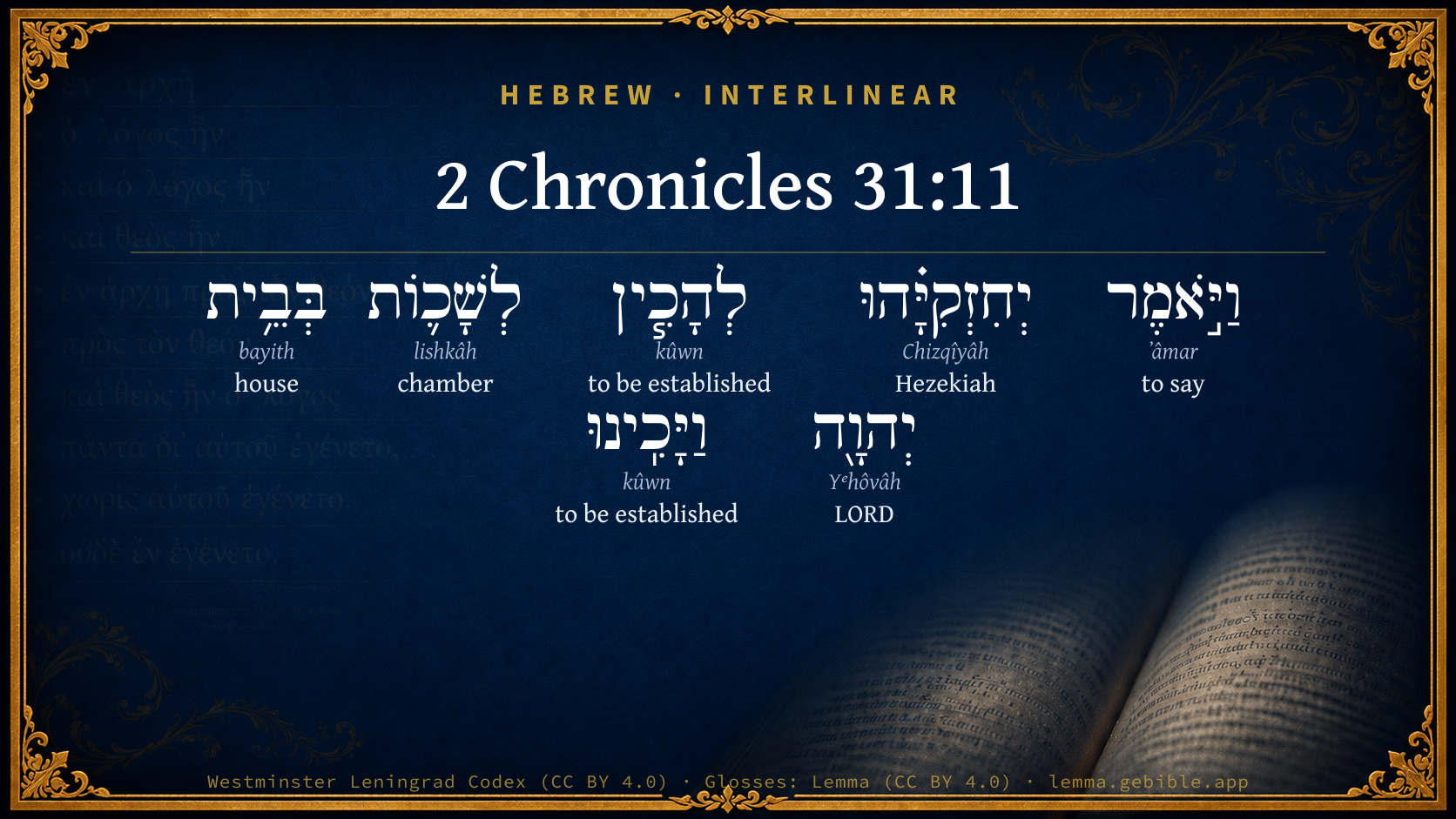
2 Chronicles 31:11

Hebrew (Westminster Leningrad Codex) 2 Chronicles 31:11 appears in the Hebrew Old Testament. The text above is from the Westminster Leningrad Codex. Each word links to its Strong’s number, a concise gloss, and parsing drawn from the Open Scriptures Hebrew Bible morphology. Click any word for its full Brown-Driver-Briggs (BDB) entry.
Download image
Cite this verse

2 Chronicles 31:11 (World English Bible). Public Domain. Lemma interlinear Bible study tool, https://lemma.gebible.app/v/2-chronicles/31/11.

Show BibTeX & RIS
BibTeX
RIS
English Translation
Then Hezekiah commanded to prepare chambers in the house of Yahweh; and they prepared them.
World English Bible · Public Domain
Download a study sheet

One document with this verse’s original text, its word-by-word gloss line, the meaning frame, cross-references with their text, attributed commentary, and full source and license credits — printable, and it pastes into notes with its structure intact.

This verse Autodidact and up

Study sheet (.html) Plain text (.txt)

A passage Seminary Student

Up to 50 verses in one chapter. A passage sheet keeps up to 6 commentary sources and 12 cross-references per verse, in the order this page ranks them, and says so on the sheet whenever that leaves anything out. Ask for a single verse and you get the Autodidact verse sheet above.

Everything on this page stays free to read, with no account — the sheet is a download of what is already on screen, not access to it.

Want to remove ads? Support Godless Engineer
Compare translations 3

The same verse in 3 English versions, stacked beneath the original-language interlinear above. Click any original word for its lexicon entry.

Each is an independent rendering of the whole verse — the interlinear is not word-aligned to these translations.

Highlighted words mark where these versions differ — a whole-verse word diff, not a word-by-word alignment.

  • World English Bible Public Domain
    Then Hezekiah commanded to prepare chambers in the house of Yahweh; and they prepared them.
  • King James Version Public Domain
    Then Hezekiah commanded to prepare chambers in the house of the LORD; and they prepared them,
  • unfoldingWord Literal Text CC BY-SA 4.0
    And Hezekiah said to prepare the chambers in the house of Yahweh, and they prepared.

unfoldingWord Literal Text — © unfoldingWord, licensed CC BY-SA 4.0. Word-aligned USFM3 via Door43 (git.door43.org/unfoldingWord/en_ult).

Versions to compare (up to 4)

3 of 4 selected

Show all 18 translations

Every available English version of this verse, each an independent rendering of the whole verse.

  • World English Bible Public Domain
    Then Hezekiah commanded to prepare chambers in the house of Yahweh; and they prepared them.
  • Berean Standard Bible Public Domain
    Then Hezekiah commanded them to prepare storerooms in the house of the LORD, and they did so.
  • Majority Standard Bible Public Domain
    Then Hezekiah commanded them to prepare storerooms in the house of the LORD, and they did so.
  • King James Version Public Domain
    Then Hezekiah commanded to prepare chambers in the house of the LORD; and they prepared them,
  • American Standard Version (1901) Public Domain
    Then Hezekiah commanded to prepare chambers in the house of Jehovah; and they prepared them.
  • Revised Version (1885) Public Domain
    Then Hezekiah commanded to prepare chambers in the house of the LORD; and they prepared them.
  • Geneva Bible (1599) Public Domain
    And Hezekiah commanded to prepare chambers in the house of the Lord: and they prepared them,
  • Douay-Rheims (1899) Public Domain
    Then Ezechias commanded to prepare storehouses in the house of the Lord. And when they had done so,
  • Young's Literal Translation Public Domain
    And Hezekiah saith to prepare chambers in the house of Jehovah, and they prepare,
  • Literal Standard Version CC BY-SA 4.0
    And Hezekiah commands to prepare chambers in the house of YHWH, and they prepare,
  • Unlocked Literal Bible CC BY-SA 4.0
    Then Hezekiah commanded storerooms to be prepared in the house of Yahweh, and they prepared them.
  • unfoldingWord Literal Text CC BY-SA 4.0
    And Hezekiah said to prepare the chambers in the house of Yahweh, and they prepared.
  • Darby Bible Public Domain
    And Hezekiah commanded to prepare chambers in the house of Jehovah; and they prepared [them],
  • World Messianic Bible Public Domain
    Then Hezekiah commanded them to prepare rooms in the LORD’s house, and they prepared them.
  • Webster's Bible Public Domain
    Then Hezekiah commanded to prepare chambers in the house of the LORD; and they prepared them,
  • Free Bible Version CC BY-SA 4.0
    Hezekiah ordered the construction of storehouses in the Lord's Temple. Once they were ready,
  • Bible in Basic English Public Domain
    Then Hezekiah said that store-rooms were to be made ready in the house of the Lord; and this was done.
  • JPS Tanakh (1917) Public Domain
    Then Hezekiah commanded to prepare chambers in the house of the LORD; and they prepared them.

Literal Standard Version (2020), Covenant Press — licensed CC BY-SA 4.0. Text via the HelloAO Bible API (eBible.org). Unlocked Literal Bible (unfoldingWord) — licensed CC BY-SA 4.0. Text via the HelloAO Bible API (eBible.org). unfoldingWord Literal Text — © unfoldingWord, licensed CC BY-SA 4.0. Word-aligned USFM3 via Door43 (git.door43.org/unfoldingWord/en_ult). Free Bible Version, Dr. Jonathan Gallagher — licensed CC BY-SA 4.0. Text via the HelloAO Bible API (eBible.org).

Word by word

More ways to search: Search by grammar → Find every occurrence → Compare this word →

Practice this passage: Drill this verse → Learn its vocabulary →

About this verse

These counts appear in no published source. They are computed here, from the morphology-tagged text and Lemma’s own curated glosses. What Lemma adds →

7
words
6
distinct lemmas
Historical
section

Shared distinctive vocabulary

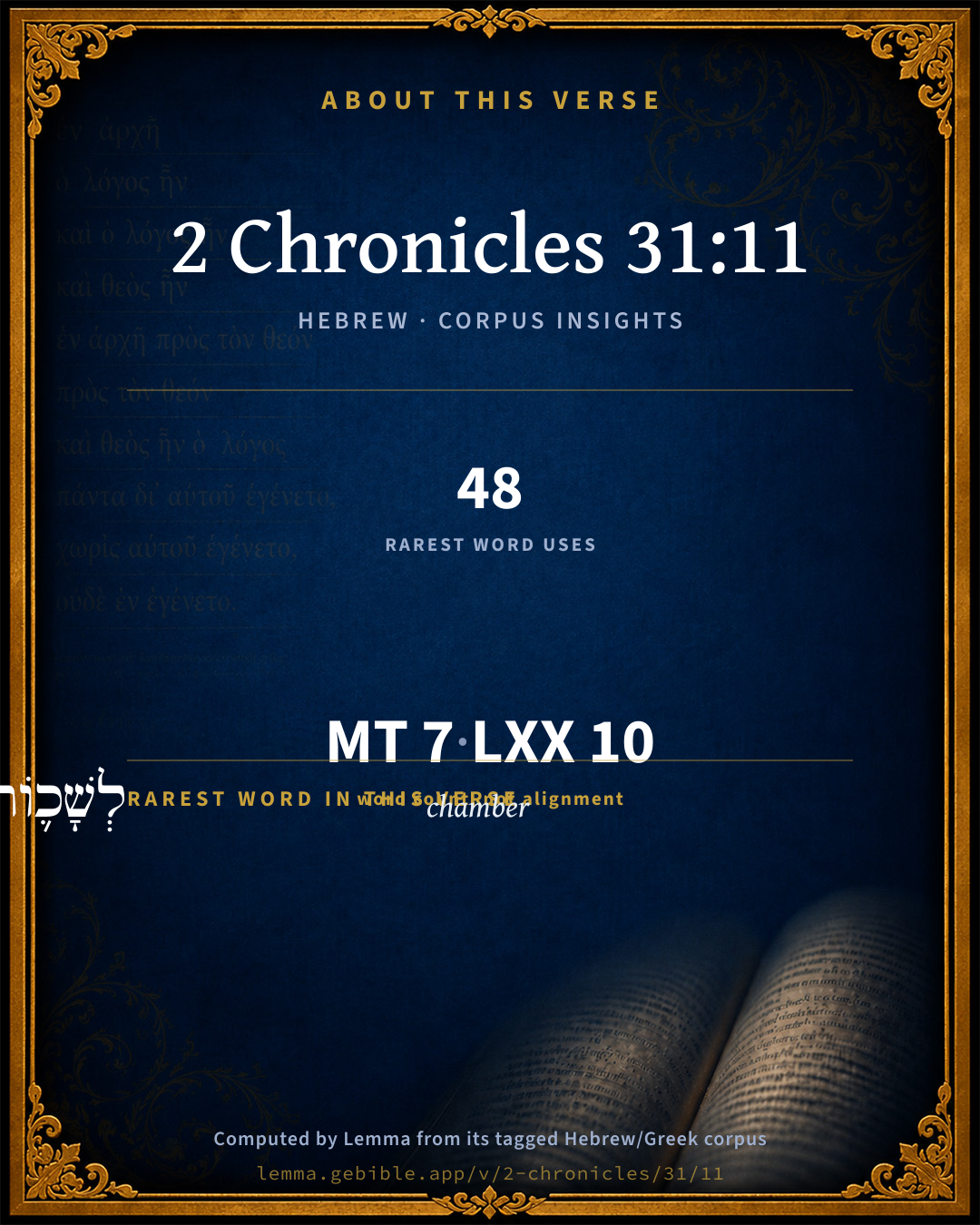
לְשָׁכ֛וֹת chamber H3957 occurs in 41 verses of the Hebrew Bible. Also found in:

Grammatical profile

  • 3 verbs
  • 4 nouns

Verb forms

  • וַיֹּ֣אמֶר Qal · Sequential Imperfect
  • לְהָכִ֧ין Hiphil · Infinitive Construct
  • וַיָּכִֽינוּ Hiphil · Sequential Imperfect

Repetition

A word recurs within this verse — often emphatic in Hebrew:

  • לְהָכִ֧ין to be established H3559 ×2

Hebrew & Septuagint length

In English translation the verse runs 15 words from the Hebrew and 19 from the Septuagint (LXX English) — closely comparable.

A rough comparison of the two English renderings, which tokenize alike — not a word-level alignment.

Word counts can differ between the Hebrew and the Greek without any difference in meaning — e.g. the Hebrew direct-object marker אֵת has no separate Greek word, and Greek often adds the article ὁ.

In the original languages it is 7 Hebrew tokens and 10 Greek tokens — but the two are counted differently (Hebrew bundles its prefixes and suffixes into one token; the Greek is in lemma form), so that isn’t a like-for-like length.

Cross-references

3

Topical passages linked to 2 Chronicles 31:11 in the Treasury of Scripture Knowledge — connected by theme and wording, ordered by reader-vote popularity; previews shown in the World English Bible.

  • Nehemiah 10:38–39 The priest the son of Aaron shall be with the Levites, when the Levites take tithes: and the Levites shall bring up the tithe of the tithes to the house of our God, to the chambers, into the treasure-house.
  • Nehemiah 13:5 had prepared for him a great chamber, where before they laid the meal-offerings, the frankincense, and the vessels, and the tithes of the grain, the new wine, and the oil, which were given by commandment to the Levites, and the singers, and the porters; and the heave-offerings for the priests.
  • Nehemiah 13:12–13 Then brought all Judah the tithe of the grain and the new wine and the oil to the treasuries.

Cross-references courtesy of OpenBible.info (CC BY 4.0).

Hebrew and Greek witnesses Masoretic Hebrew ↔ Greek Septuagint

The same verse in the two great witnesses to the Old Testament, shown verse-for-verse.

These are two independent witnesses, not word-aligned to each other, and the Septuagint is shown in lemma (dictionary) form.

Hebrew 2 Chronicles 31:11 Masoretic · Westminster Leningrad Codex

וַיֹּ֣אמֶר יְחִזְקִיָּ֗הוּ לְהָכִ֧ין לְשָׁכ֛וֹת בְּבֵ֥ית יְהוָ֖ה וַיָּכִֽינוּ

Then Hezekiah commanded to prepare chambers in the house of Yahweh; and they prepared them.

World English Bible · Public Domain

Greek LXX 2 Chronicles 31:11 Septuagint · lemma form

καί εἶπον εζεκιας ἑτοιμάζω παστοφόριον εἰς οἶκος κύριος καί ἑτοιμάζω

And Ezekias told them yet farther to prepare chambers for the house of the Lord; and they prepared them,

LXX2012 (modern English Septuagint) · Public Domain

Hebrew: Westminster Leningrad Codex (CC BY 4.0). Greek: Septuagint (public domain); English from LXX2012 (modern English Septuagint) (Public Domain). How the Septuagint differs from the Hebrew →

Commentary

Notes on 2 Chronicles 31:11 from classic Christian and Jewish commentators (each source and its license shown beneath its notes). The classic Christian expositions comment on the surrounding passage and are grouped to its opening verse, so a note may address several verses; the Jewish commentaries on the Tanakh (Rashi and others) are per-verse, so they appear only where the commentator wrote on this verse.

Lemma curates 59 commentaries, every one of them public domain or Creative Commons licensed, each selected and text-cleaned for this edition rather than reprinted as found. About our sources →

Matthew Henry's Commentary

Here we have,

I. Two particular instances of the care of Hezekiah concerning church matters, having put them into good order, to keep them so. The tithes and other holy things being brought in, he provided, 1. That they should be carefully laid up, and not left exposed in loose heaps, liable to be wasted and embezzled. He ordered chambers to be made ready in some of the courts of the temple for store-chambers (Ch2 31:11), and into them the offerings were brought and there kept under lock and key, Ch2 31:12, Ch2 31:13. Treasures or store-keepers were appointed, who had the oversight of them, to see that moth and rust did not corrupt them nor thieves break through to steal. This wisdom of laying up the surplus in days of plenty we may learn from the ant, who provideth meat in summer. The laying up in store what was brought in was an encouragement to people to pay in their contributions. That will be given cheerfully by the public which appears to be well husbanded. 2. That they should be faithfully laid out, according to the uses they were intended for. Church treasures are not to be hoarded any longer than till there is occasion for them, lest even the rust should be a witness against those who hoard them. Officers were appointed, men (no doubt) of approved wisdom and faithfulness, to distribute the oblations of the Lord and the most holy things among the priests (Ch2 31:14), and to see that they all had a competent maintenance for themselves and their families. The law provided sufficient for them all, and therefore, if some had too little, it must be because others had too much; to prevent such inequality these officers were to go by some certain rule of proportion in the disposal of the incomes of the temple. It is said of the priests here (Ch2 31:18) that in their set office they sanctified themselves; in faith they sanctified themselves (so the word is), that is, as bishop Patrick explains it, they attended their ministry at the house of God, not doubting but they should be provided with all things necessary. Now, because they served God in that confidence, care was taken that they should not be made ashamed of their hope. Note, Those that sanctify themselves to God and his service in faith, believing that he will see them want for nothing that is good for them, shall certainly be fed. Out of the offerings of the Lord distribution was made, (1.) To the priests in the cities (Ch2 31:15), who staid at home while their brethren went to Jerusalem, and did good there in teaching the good knowledge of the Lord. The preaching priests were maintained as well as the sacrificing priests, and those that abode by the stuff as well as those that warred the warfare. (2.) To those that entered into the house of the Lord, all the males from three years old and upwards; for the male children even at that tender age, it seems, were allowed to come into the temple with their parents, and shared with them in this distribution, Ch2 31:16. (3.) Even the Levites from twenty years old and upwards had their share, Ch2 31:17. (4.) The wives and children of the priests and Levites had a comfortable maintenance out of those offerings, Ch2 31:18. In maintaining ministers, regard must be had to their families, that not they only, but theirs, may have food convenient. In some countries where ministers have their salary paid them by the state an addition is made to it upon the birth of a child. (5.) The priests in the country, that lived in the fields of the suburbs, were not overlooked in this ministration, Ch2 31:19. Those also had their share who were inhabitants of the villages, though they might be supposed to live at a less expense.

II. A general character of Hezekiah's services for the support of religion, Ch2 31:20, Ch2 31:21. 1. His pious zeal reached to all the parts of his kingdom: Thus he did throughout all Judah; every part of the country, and not those only that lay next him, shared in the good fruits of his government. 2. He sincerely designed to please God, and approved himself to him in all he did: He wrought that which was good before the Lord his God; all his care was to do that which should be accepted of God, which was right (that is, agreeable to natural equity), and truth (that is, agreeable to divine revelation and his covenant with God), before the Lord; to do according to that law which is holy, just, and good. 3. What he began he went through with, prosecuted it with vigour, and did it with all his heart. 4. All his good intentions were brought to a good issue; whatever he did in the service of the house of God, and in the government of his kingdom, he prospered in it. Note, What is undertaken with a sincere regard to the glory of God will succeed to our own honour and comfort at last.

Matthew Henry's Commentary on the Whole Bible (1708–1710) — public domain (CC PDM 1.0). Text via the HelloAO Bible API.

Jamieson, Fausset & Brown

Robert Jamieson, A. R. Fausset & David Brown

HEZEKIAH APPOINTS OFFICERS TO DISPOSE OF THE TITHES. (Ch2 31:11-19)

Hezekiah commanded to prepare chambers in the house of the Lord--storehouses, granaries, or cellars; either the old ones, which had been allowed through neglect to fall into decay, were to be repaired, or additional ones built. Private individuals brought their own first-fruits to the temple; but the tithes were levied by the Levites, who kept a faithful account of them in their several places of abode and transmitted the allotted proportion to the priests. Officers were appointed to distribute equal rations to all in the cities of the priests who, from age or other reasons, could not repair to the temple. With the exception of children under three years of age--an exception made probably from their being considered too young to receive solid food--lists were kept of the number and age of every male; of priests according to their fathers' house, and Levites from twenty years (see Num 4:3; Num 28:24; Ch1 23:24). But, besides, provision was also made for their wives, daughters, and servants.

Jamieson, Fausset & Brown — Commentary Critical and Explanatory on the Whole Bible (1871) — public domain (CC PDM 1.0). Text via the HelloAO Bible API.

Trapp's Complete Commentary

John Trapp

2Ch 31:11 Then Hezekiah commanded to prepare chambers in the house of the LORD; and they prepared [them],

Ver. 11. To prepare chambers.] Or, Storehouses. Prepared they were before by Solomon: but now they were put in order, and made fit for such a use.

John Trapp, A Commentary or Exposition upon All the Books of the Old and New Testament (1647–1656) — public domain. Text from a community e-Sword module.

Adam Clarke's Commentary

Verse 11. To prepare chambers] To make granaries to lay up this superabundance.

Adam Clarke's Commentary on the Bible (1810–1826) — public domain. Text from a community e-Sword/MySword module.

The Cambridge Bible for Schools and Colleges

gen. ed. J. J. S. Perowne

11. chambers] Cp. 1Ch_9:26, note.

The Cambridge Bible for Schools and Colleges (gen. ed. J. J. S. Perowne; Cambridge University Press, 1878–1918) — public domain. Text from a community e-Sword module.

John Gill's Exposition

And brought in the offerings, and the tithes, and the dedicated things, faithfully,.... Kept nothing back for their own private use, but faithfully delivered in and laid up the whole that was brought which remained; this was done by the priests and Levites, in whose hands and care they were:

over which Cononiah the Levite was ruler, and Shimei his brother was the next; these two had the charge and care of the whole, the one as deputy to the other.

John Gill's Exposition of the Whole Bible (1746–1763) — public domain (CC PDM 1.0). Text via the HelloAO Bible API.

Haydock's Catholic Bible Commentary

Storehouses. Sept. Greek: pastophoria. Solomon had prepared such. T. --- But they had gone to ruin, and others might be requisite. C. --- The old granaries were to be repaired. M. --- People brought their first-fruits to the temple: but the Levites gathered the tithes, and gave a share to the priests, and to those who were on duty, 2 Esdras x. 36.

George Leo Haydock (1774–1849), Haydock's Catholic Family Bible and Commentary, 1859 edition — public domain. Excludes Psalms (Douay-Rheims chapter numbering differs from Protestant) and Deuterocanonical books (Catholic canon only).

Matthew Poole's English Annotations

In the house of the Lord; largely so called, to wit, in the courts, or in the chambers adjoining to the house.

Matthew Poole's English Annotations on the Holy Bible (1683–1685) — public domain. Text from a community e-Sword/MySword module.

Whedon's Commentary on the Bible

Daniel D. Whedon

11. Prepare chambers in… house of the Lord — Probably the side chambers described in 1Ki_6:5-10 had been formerly used for similar purposes, but having been disused for some time they needed special preparation to fit them for storing the abundance of the offerings that had been brought, and laid in heaps.

2Ch_31:12-19 treat of the storing and distribution of the tithes and dedicated things. We note the chronicler’s peculiar care to record the names of those charged with these Levitical duties.

Daniel D. Whedon (gen. ed.), Commentary on the Old and New Testaments (1874–1909) — public domain. Text from a community e-Sword module.

The Pulpit Commentary

To prepare chambers; i.e. to prepare for present use the chambers constructed for the purpose. (1Ki_6:5)

Vers. 11-21.

Systematic Church finance.

Hezekiah was careful to provide for the distribution of the firstfruits and tithes and special offerings among the priests and Levites. So he had cells, or chambers, constructed for their reception (ver. 11), and every needful arrangement made for the due apportionment of all that was stored among those for whom it was intended. There are three points worthy of consideration,

I THE DISTINCTLY SACRED CHARACTER OF CHURCH FINANCE. What was given here was placed within the precincts of the temple, for it was given to the Lord while it was appropriated to his ministers. It was a religious act on the part of the donors, and not less so on the part of those whose special duty it was to distribute it. "They brought in the dedicated things faithfully" (ver. 12); and "according to their fidelity did they show themselves holy in regard to the holy; i.e. " they acted in a holy manner with the holy gifts, distributed them disinterestedly and impartially" (Keil). There is no reason why both the giving of money to the cause of God (and included in this is the contribution to the sustenance of the Christian ministry) and also the allocation of all such money should not be a thoroughly devout and pious action. It may be rendered as truly "unto the Lord" as the singing of a hymn or the delivery of a discourse. It should be a sacred service, offered conscientiously, devoutly, holily.

II SYSTEMATIC COLLECTION OF CHURCH FINANCE. While considerable room was left under the Law for spontaneous liberality and for special offerings under peculiar circumstances, there were certain regulations as to tithes and firstfruits (ver. 5). These latter were not optional, but obligatory; at the same time, they do not seem to have been recoverable by legal process; but they point to systematic contribution not unattended with special and spontaneous bestowments. And this surely is the right principle in the Christian Church.

1. Let every man consider what proportion of his income, considering

(1) the amount of his receipts, and also

(2) the measure of his liabilities, he can possibly devote to the cause of God and man, of religion and philanthropy; and let him set that apart.

2. Let every one of us be prompted to give special help whenever somespecially powerful appeal is made to our spiritual convictions or our human sympathies.

III SYSTEMATIC DISTRIBUTION. This is something which must depend upon the constitution of each particular Church, and must vary according to that constitution. But there are some general principles, partly suggested by these verses.

1. Let every care be taken that all that is contributed be devoted and distributed, none being wasted or perverted. Here is scope for carefulness and for faithfulness.

2. Let the necessities of those on whom God has laid the weightierdomestic burdens be generously met.

3. Let those who are engaged in theless prominent places be as much regarded as those who are "serving at Jerusalem" (see vers. 15, 19).

4. Let men of acknowledged probity and capacity have charge of thetreasury (see vers. 12-14). C.

The Pulpit Commentary (1880–1919), ed. H.D.M. Spence-Jones & Joseph S. Exell — public domain. Text from a community e-Sword module.

Kretzmann's Popular Commentary

Paul E. Kretzmann

The Tithes And The Dedicated Things

v. 11. Then Hezekiah commanded to prepare chambers, special rooms for storage, in the house of the Lord; either the old ones were repaired or additional ones were built. And they prepared them,

v. 12. and brought in the offerings and the tithes and the dedicated things faithfully, with conscientious care; over which Cononiah, the Levite, was ruler, and Shimei, his brother, was the next, these two men having charge of all the stores as deposited in the Temple under this arrangement.

v. 13. And Jehiel, and Azaziah, and Nahath, and Asahel, and Jerimoth, and Jozabad, and Eliel, and Ismachiah, and Mahath, and Benaiah were overseers under the hand of Cononiah and Shimei, his brother, at the commandment of Hezekiah the king, and Azariah, the ruler of the house of God. These two having given the orders, the appointments were made at once.

v. 14. And Kore, the son of Imnah, the Levite, the porter toward the east, where the main entrance of the Temple was, was over the free-will offerings of God, the portion of the peace-offerings belonging to Jehovah, and by Him designated for the use of the priests, to distribute the oblations of the Lord and the most holy things, the part of the sin and trespass-offerings to be eaten by the priests in the Temple.

v. 15. And next him were Eden, and Miniamin, and Jeshua, and Shemaiah, Amariah, and Shecaniah, as his assistants, in the cities of the priests, in their set office, rather, "in faithfulness," for they also worked with conscientious application, to give to their brethren by courses, as well to the great as to the small, with absolute fairness to all;

v. 16. beside their genealogy of males, the register of all male children, from three years old and upward, even unto everyone that entereth into the house of the Lord, consecrated to the Temple service, his daily portion for their service in their charges according to their courses; each one who was entitled to it received his share of the income of the Temple;

v. 17. both to the genealogy of the priests by the house of their fathers, those registered in the genealogical lists, and the Levites from twenty years old and upward, in their charges by their courses;

v. 18. and to the genealogy of all their little ones, their wives, and their sons, and their daughters, through all the congregation, all these being registered in the lists of the tribe of Levi; for in their set office they sanctified themselves in holiness, that is, in their faithfulness they sanctified themselves in the holy thing, righteously distributing the offerings which they were entitled to receive for that purpose;

v. 19. also of the sons of Aaron, the priests, which were in the fields of the suburbs of their cities, the pasturelands of the priestly cities being assigned to them, Deu 25:19; Num 35:5, in every several city, the men that were expressed by name, to give portions to all the males among the priests, and to all that were reckoned by genealogies among the Levites. All those who were included in the tribe of Levi were provided for in accordance with the precept of Jehovah.

v. 20. And thus did Hezekiah throughout all Judah and wrought that which was good, of real value, and right, in agreement with the Law, and truth, done in all faithfulness, before the Lord, his God.

v. 21. And in every work that he began in the service of the house of God, in the cause of true religion, and in the Law, and in the commandments, to seek his God, while he made it his object to set the kingdom on the old footing in its relation to the covenant God, he did it with all his heart, and prospered. Godliness is profitable unto all things, having the promise of the life that now is and of that which is to come.

Paul E. Kretzmann, Popular Commentary of the Bible (1921–1924) — public domain. Text from a community e-Sword module.

unfoldingWord translationNotes

Door43 World Missions Community

Hezekiah commanded storerooms to be prepared

This can be stated in active form. AT: "Hezekiah commanded the priests and Levites to prepare storerooms" (See: Active or Passive)

Konaniah ... Shimei ... Jehiel, Azaziah, Nahath, Asahel, Jerimoth, Jozabad, Eliel, Ismakiah, Mahath, and Benaiah

These are names of men. (See: How to Translate Names)

were managers under the hand of Konaniah and Shimei his brother

Here "hand" represents power or control. The phrase "under the hand" is an idiom that means to be under someone's authority. AT: "were managers whom Konaniah and Shimei his brother supervised" (See: Metonymy and Idiom)

the official over the house of God

Here "over" is an idiom that means to be in charge of. AT: "the official in charge of everyone who served in the house of God" (See: Idiom)

translationWords

command

faithful

sacrifice

storehouse

hand

appoint

king

house of God

unfoldingWord translationNotes — © Distant Shores Media and the Door43 World Missions Community, licensed CC BY-SA 4.0. Source: git.door43.org/Door43/en_tn.

Rashi

Rabbi Shlomo Yitzchaki (Rashi)

to prepare the chambers in the House of the Lord in which to deposit the heave-offerings.

Rashi on the Tanakh — English translations: “The Judaica Press complete Tanach with Rashi, translated by A. J. Rosenberg” (CC BY 4.0); “Pentateuch with Rashi's commentary by M. Rosenbaum and A.M. Silbermann, 1929-1934” (public domain); “The Metsudah Tanach series, Lakewood, N.J” (CC BY 4.0); and “The Book of Joshua, Metsudah Publications, 1997” (CC BY 4.0). Text via Sefaria.

Lesson kit

Teaching starters — assembled from the data on this page, not authored interpretation. Every prompt links to the verse data it draws on. Edit before teaching.

2 Chronicles, in the Historical, opens this verse with 7 words (6 distinct Hebrew lemmas). Its most distinctive word is lishkâh (“chamber”). A historical commentator’s framing appears above. Read the whole chapter for the surrounding context.

Discussion questions

  1. The word lishkâh carries the sense “chamber.” How does it shape the verse?
  2. 1 Samuel 9:22 shares the word «chamber» with this verse. How do the two illuminate each other?
  3. “to be established” occurs 2× in this one verse. What is the effect of the repetition?
  4. The translations on this page render this verse differently — a whole-verse word diff, not a word-by-word alignment. What might account for the different wordings?
  5. The verb «וַיֹּ֣אמֶר» is Qal Sequential Imperfect. How does its form color the action?
  6. Reading how Matthew Henry's Commentary and Jamieson, Fausset & Brown read this verse, where do the two commentators agree and where do they part?

Things to notice

Reading settings

Reading text

Shown beneath each verse's original-language words.

Old Testament
Old Testament edition

Read the OT as the Masoretic Hebrew (MT) or the Greek Septuagint (LXX).

English shown for the Greek Septuagint (in the Hebrew ↔ Greek comparison).

Comparing translations? Open the Compare panel on any verse page to stack up to four side by side.