
1 Chronicles 29:2

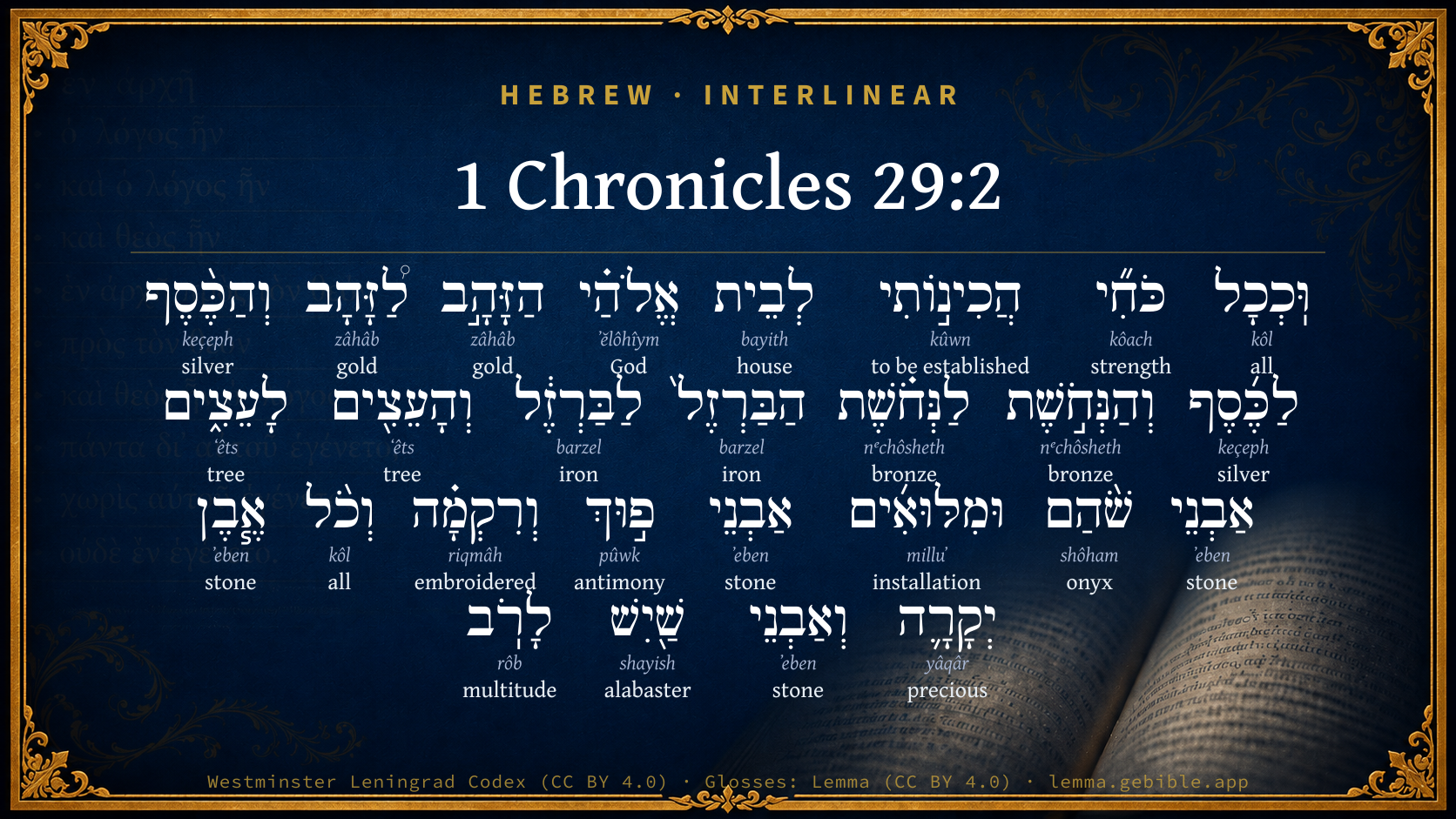
Hebrew (Westminster Leningrad Codex) 1 Chronicles 29:2 appears in the Hebrew Old Testament. The text above is from the Westminster Leningrad Codex. Each word links to its Strong’s number, a concise gloss, and parsing drawn from the Open Scriptures Hebrew Bible morphology. Click any word for its full Brown-Driver-Briggs (BDB) entry.
Download image
Cite this verse

1 Chronicles 29:2 (World English Bible). Public Domain. Lemma interlinear Bible study tool, https://lemma.gebible.app/v/1-chronicles/29/2.

Show BibTeX & RIS
BibTeX
RIS
English Translation
Now I have prepared with all my might for the house of my God the gold for the [things of] gold, and the silver for the [things of] silver, and the brass for the [things of] brass, the iron for the [things of] iron, and wood for the [things of] wood; onyx stones, and [stones] to be set, stones for inlaid work, and of various colors, and all manner of precious stones, and marble stones in abundance.
World English Bible · Public Domain
Highlights Full analysis ↓
Download a study sheet

One document with this verse’s original text, its word-by-word gloss line, the meaning frame, cross-references with their text, attributed commentary, and full source and license credits — printable, and it pastes into notes with its structure intact.

This verse Autodidact and up

Study sheet (.html) Plain text (.txt)

A passage Seminary Student

Up to 50 verses in one chapter. A passage sheet keeps up to 6 commentary sources and 12 cross-references per verse, in the order this page ranks them, and says so on the sheet whenever that leaves anything out. Ask for a single verse and you get the Autodidact verse sheet above.

Everything on this page stays free to read, with no account — the sheet is a download of what is already on screen, not access to it.

Want to remove ads? Support Godless Engineer
Compare translations 3

The same verse in 3 English versions, stacked beneath the original-language interlinear above. Click any original word for its lexicon entry.

Each is an independent rendering of the whole verse — the interlinear is not word-aligned to these translations.

Highlighted words mark where these versions differ — a whole-verse word diff, not a word-by-word alignment.

  • World English Bible Public Domain
    Now I have prepared with all my might for the house of my God the gold for the [things of] gold, and the silver for the [things of] silver, and the brass for the [things of] brass, the iron for the [things of] iron, and wood for the [things of] wood; onyx stones, and [stones] to be set, stones for inlaid work, and of various colors, and all manner of precious stones, and marble stones in abundance.
  • King James Version Public Domain
    Now I have prepared with all my might for the house of my God the gold for things to be made of gold, and the silver for things of silver, and the brass for things of brass, the iron for things of iron, and wood for things of wood; onyx stones, and stones to be set, glistering stones, and of divers colors, and all manner of precious stones, and marble stones in abundance.
  • unfoldingWord Literal Text CC BY-SA 4.0
    And according to all of my power I have prepared for the house of my God gold for the gold, and silver for the silver and bronze for the bronze; iron for the iron and wood for the wood; stones of onyx and settings, stones of antimony and variegation, and every precious stone and stones of marble, to abundance.

unfoldingWord Literal Text — © unfoldingWord, licensed CC BY-SA 4.0. Word-aligned USFM3 via Door43 (git.door43.org/unfoldingWord/en_ult).

Versions to compare (up to 4)

3 of 4 selected

Show all 18 translations

Every available English version of this verse, each an independent rendering of the whole verse.

  • World English Bible Public Domain
    Now I have prepared with all my might for the house of my God the gold for the [things of] gold, and the silver for the [things of] silver, and the brass for the [things of] brass, the iron for the [things of] iron, and wood for the [things of] wood; onyx stones, and [stones] to be set, stones for inlaid work, and of various colors, and all manner of precious stones, and marble stones in abundance.
  • Berean Standard Bible Public Domain
    Now with all my ability I have made provision for the house of my God—gold for the gold articles, silver for the silver, bronze for the bronze, iron for the iron, and wood for the wood, as well as onyx for the settings, turquoise, stones of various colors, all kinds of precious stones, and slabs of marble—all in abundance.
  • Majority Standard Bible Public Domain
    Now with all my ability I have made provision for the house of my God—gold for the gold articles, silver for the silver, bronze for the bronze, iron for the iron, and wood for the wood, as well as onyx for the settings, turquoise, stones of various colors, all kinds of precious stones, and slabs of marble—all in abundance.
  • King James Version Public Domain
    Now I have prepared with all my might for the house of my God the gold for things to be made of gold, and the silver for things of silver, and the brass for things of brass, the iron for things of iron, and wood for things of wood; onyx stones, and stones to be set, glistering stones, and of divers colors, and all manner of precious stones, and marble stones in abundance.
  • American Standard Version (1901) Public Domain
    Now I have prepared with all my might for the house of my God the gold for the `things of' gold, and the silver for the `things of' silver, and the brass for the `things of' brass, the iron for the `things of' iron, and wood for the `things of' wood; onyx stones, and `stones' to be set, stones for inlaid work, and of divers colors, and all manner of precious stones, and marble stones in abundance.
  • Revised Version (1885) Public Domain
    Now I have prepared with all my might for the house of my God the gold for the things of gold, and the silver for the things of silver, and the brass for the things of brass, the iron for the things of iron, and wood for the things of wood; onyx stones, and stones to be set, stones for inlaid work, and of divers colours, and all manner of precious stones, and marble stones in abundance.
  • Geneva Bible (1599) Public Domain
    Now I haue prepared with all my power for the house of my God, golde for vessels of golde, and siluer for them of siluer, and brasse for things of brasse, yron for things of yron, and wood for things of wood, and onix stones, and stones to be set, and carbuncle stones and of diuers colours, and all precious stones, and marble stones in aboundance.
  • Douay-Rheims (1899) Public Domain
    And I with all my ability have prepared the expenses for the house of my God. Gold for vessels of gold, and silver for vessels of silver, brass for things of brass, iron for things of iron, wood for things of wood: and onyx stones, and stones like alabaster, and of divers colours, and all manner of precious stones, and marble of Paros in great abundance.
  • Young's Literal Translation Public Domain
    and with all my power I have prepared for the house of my God, the gold for `things of' gold, and the silver for `those of' silver, and the brass for `those of' brass, the iron for `those of' iron, and the wood for `those of' wood, shoham stones, and settings, and stones of painting and of diverse colours, and all `kinds of' precious stone, and stones of white marble, in abundance.
  • Literal Standard Version CC BY-SA 4.0
    and with all my power I have prepared for the house of my God, the gold for [things of] gold, and the silver for [things of] silver, and the bronze for [things of] bronze, the iron for [things of] iron, and the wood for [things of] wood, shoham stones, and settings, and stones of painting and of diverse colors, and all [kinds of] precious stone, and stones of white marble, in abundance.
  • Unlocked Literal Bible CC BY-SA 4.0
    So I have done my best to provide for the temple of my God. I am giving gold for the things to be made of gold, silver for the things to be made of silver, bronze for the things to be made of bronze, iron for the things to be made of iron, and wood for the things to be made of wood. I am also giving onyx stones, stones to be set, stones for inlaid work of various colors—all kinds of precious stones—and marble stone in abundance.
  • unfoldingWord Literal Text CC BY-SA 4.0
    And according to all of my power I have prepared for the house of my God gold for the gold, and silver for the silver and bronze for the bronze; iron for the iron and wood for the wood; stones of onyx and settings, stones of antimony and variegation, and every precious stone and stones of marble, to abundance.
  • Darby Bible Public Domain
    And I have prepared according to all my power for the house of my God gold for [things of] gold, and silver for [things of] silver, and brass for [things of] brass, iron for [things of] iron, and wood for [things of] wood; onyx stones, and [stones] to be set, glistering stones, and of divers colours, and all manner of precious stones, and white marble in abundance.
  • World Messianic Bible Public Domain
    Now I have prepared with all my might for the house of my God the gold for the things of gold, the silver for the things of silver, the bronze for the things of bronze, iron for the things of iron, and wood for the things of wood, also onyx stones, stones to be set, stones for inlaid work of various colors, all kinds of precious stones, and marble stones in abundance.
  • Webster's Bible Public Domain
    Now I have prepared with all my might for the house of my God the gold for things to he made of gold, and the silver for things of silver, and the brass for things of brass, the iron for things of iron, and wood for things of wood; onyx-stones, and stones to be set, glittering stones, and of divers colors, and all manner of precious stones, and marble stones in abundance.
  • Free Bible Version CC BY-SA 4.0
    Using all my means I have provided for the house of my God—gold for the articles made of gold, silver for the silver, bronze for the bronze, iron for the iron, and wood for the wood; onyx stones and stones for settings: turquoise, different colored stones, every kind of precious stone; and plenty of marble.
  • Bible in Basic English Public Domain
    Now as far as I am able, I have made ready what is needed for the house of my God; the gold for the things of gold, and the silver for the silver things, and the brass for the brass things, iron for the things of iron, and wood for the things of wood; beryls and jewels to be framed, and stones of different colours for ornament; all sorts of stones of great price, and polished building-stone, as much as is needed and more.
  • JPS Tanakh (1917) Public Domain
    Now I have prepared with all my might for the house of my God the gold for the things of gold, and the silver for the things of silver, and the brass for the things of brass, the iron for the things of iron, and wood for the things of wood; onyx stones, and stones to be set, glistering stones, and of divers colours, and all manner of precious stones, and marble stones in abundance.

Literal Standard Version (2020), Covenant Press — licensed CC BY-SA 4.0. Text via the HelloAO Bible API (eBible.org). Unlocked Literal Bible (unfoldingWord) — licensed CC BY-SA 4.0. Text via the HelloAO Bible API (eBible.org). unfoldingWord Literal Text — © unfoldingWord, licensed CC BY-SA 4.0. Word-aligned USFM3 via Door43 (git.door43.org/unfoldingWord/en_ult). Free Bible Version, Dr. Jonathan Gallagher — licensed CC BY-SA 4.0. Text via the HelloAO Bible API (eBible.org).

Word by word

More ways to search: Search by grammar → Find every occurrence → Compare this word →

Practice this passage: Drill this verse → Learn its vocabulary →

שַׁ֖יִשׁ
shayish
H7893
“alabaster”
Noun, Common, Masculine, Singular, Absolute
Part of Speech
Noun
Type
Common
Gender
Masculine
Number
Singular
State
Absolute
Full BDB Definition

Origin: from an unused root meaning to bleach, i.e. whiten

TWOT: 2379

alabaster
  1. וּֽכְכָל kôl H3605 “and · like/as · all of” Conjunction + Preposition + Noun, Common, Masculine, Singular, Construct
  2. כֹּחִ֞י kôach H3581 “strength · my” Noun, Common, Masculine, Singular, Construct + Suffix, Personal, 1st Person, Common, Singular
  3. הֲכִינ֣וֹתִי kûwn H3559 “to be established” Verb, Hiphil, Perfect, 1st Person, Common, Singular
  4. לְבֵית bayith H1004 “to/for · house of” Preposition + Noun, Common, Masculine, Singular, Construct
  5. אֱלֹהַ֗י ʼĕlôhîym H430 “God(s) · my” Noun, Common, Masculine, Plural, Construct + Suffix, Personal, 1st Person, Common, Singular
  6. הַזָּהָ֣ב zâhâb H2091 “the · gold” Particle, Definite Article + Noun, Common, Masculine, Singular, Absolute
  7. לַ֠זָּהָב zâhâb H2091 “to/for the · gold” Preposition, Determined + Noun, Common, Masculine, Singular, Absolute
  8. וְהַכֶּ֨סֶף keçeph H3701 “and · the · silver” Conjunction + Particle, Definite Article + Noun, Common, Masculine, Singular, Absolute
  9. לַכֶּ֜סֶף keçeph H3701 “to/for the · silver” Preposition, Determined + Noun, Common, Masculine, Singular, Absolute
  10. וְהַנְּחֹ֣שֶׁת nᵉchôsheth H5178 “and · the · bronze” Conjunction + Particle, Definite Article + Noun, Common, Feminine, Singular, Absolute
  11. לַנְּחֹ֗שֶׁת nᵉchôsheth H5178 “to/for the · bronze” Preposition, Determined + Noun, Common, Feminine, Singular, Absolute
  12. הַבַּרְזֶל֙ barzel H1270 “the · iron” Particle, Definite Article + Noun, Common, Masculine, Singular, Absolute
  13. לַבַּרְזֶ֔ל barzel H1270 “to/for the · iron” Preposition, Determined + Noun, Common, Masculine, Singular, Absolute
  14. וְהָעֵצִ֖ים ʻêts H6086 “and · the · trees” Conjunction + Particle, Definite Article + Noun, Common, Masculine, Plural, Absolute
  15. לָעֵצִ֑ים ʻêts H6086 “to/for the · trees” Preposition, Determined + Noun, Common, Masculine, Plural, Absolute
  16. אַבְנֵי ʼeben H68 “stones of” Noun, Common, Feminine, Plural, Construct
  17. שֹׁ֨הַם shôham H7718 “onyx” Noun, Common, Masculine, Singular, Absolute
  18. וּמִלּוּאִ֜ים milluʼ H4394 “and · installations” Conjunction + Noun, Common, Masculine, Plural, Absolute
  19. אַבְנֵי ʼeben H68 “stones of” Noun, Common, Feminine, Plural, Construct
  20. פ֣וּךְ pûwk H6320 “antimony” Noun, Common, Masculine, Singular, Absolute
  21. וְרִקְמָ֗ה riqmâh H7553 “and · embroidered” Conjunction + Noun, Common, Feminine, Singular, Absolute
  22. וְכֹ֨ל kôl H3605 “and · all of” Conjunction + Noun, Common, Masculine, Singular, Construct
  23. אֶ֧בֶן ʼeben H68 “stone” Noun, Common, Feminine, Singular, Absolute
  24. יְקָרָ֛ה yâqâr H3368 “precious” Adjective, Adjective, Feminine, Singular, Absolute
  25. וְאַבְנֵי ʼeben H68 “and · stones of” Conjunction + Noun, Common, Feminine, Plural, Construct
  26. לָרֹֽב rôb H7230 “to/for · multitude” Preposition + Noun, Common, Both, Singular, Absolute

About this verse

These counts appear in no published source. They are computed here, from the morphology-tagged text and Lemma’s own curated glosses. What Lemma adds →

27
words
18
distinct lemmas
Historical
section

Notable vocabulary

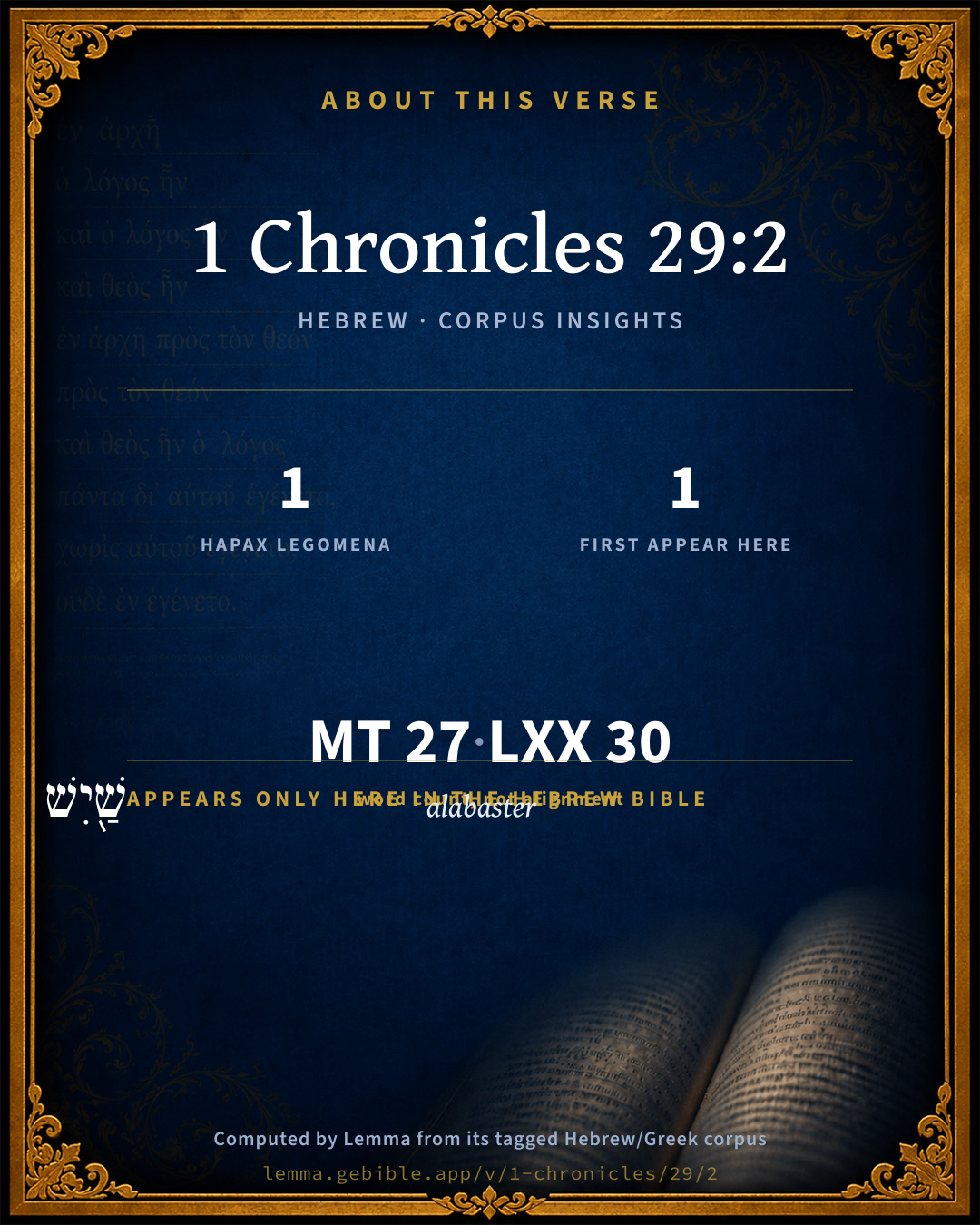
1 hapax legomenon — a word that appears only here in the entire Hebrew Bible:

  • שַׁ֖יִשׁ alabaster H7893

First appearance in Scripture

This word makes its first canonical appearance in the Hebrew Bible here:

  • שַׁ֖יִשׁ alabaster H7893

Shared distinctive vocabulary

פ֣וּךְ antimony H6320 occurs in 4 verses of the Hebrew Bible. Also found in:

Grammatical profile

  • 1 verb
  • 25 nouns
  • 1 adjective

Verb forms

  • הֲכִינ֣וֹתִי Hiphil · Perfect

Repetition

Words recur within this verse — often emphatic in Hebrew:

  • אַבְנֵי stone H68 ×4
  • וּֽכְכָל all H3605 ×2
  • הַזָּהָ֣ב gold H2091 ×2
  • וְהַכֶּ֨סֶף silver H3701 ×2
  • וְהַנְּחֹ֣שֶׁת bronze H5178 ×2
  • הַבַּרְזֶל֙ iron H1270 ×2
  • וְהָעֵצִ֖ים tree H6086 ×2

Hebrew & Septuagint length

In English translation the verse runs 77 words from the Hebrew and 36 from the Septuagint (LXX English) — the Septuagint runs noticeably shorter here. See the side-by-side →

A rough comparison of the two English renderings, which tokenize alike — not a word-level alignment.

Word counts can differ between the Hebrew and the Greek without any difference in meaning — e.g. the Hebrew direct-object marker אֵת has no separate Greek word, and Greek often adds the article ὁ.

In the original languages it is 27 Hebrew tokens and 30 Greek tokens — but the two are counted differently (Hebrew bundles its prefixes and suffixes into one token; the Greek is in lemma form), so that isn’t a like-for-like length.

Cross-references

16

Topical passages linked to 1 Chronicles 29:2 in the Treasury of Scripture Knowledge — connected by theme and wording, ordered by reader-vote popularity; previews shown in the World English Bible.

  • 1 Chronicles 22:3–5 David prepared iron in abundance for the nails for the doors of the gates, and for the couplings; and brass in abundance without weight;
  • 2 Chronicles 31:20–21 Thus did Hezekiah throughout all Judah; and he worked that which was good and right and faithful before Yahweh his God.
  • Ecclesiastes 9:10 Whatever your hand finds to do, do it with your might; for there is no work, nor device, nor knowledge, nor wisdom, in Sheol, where you are going.
  • Isaiah 54:11–12 you afflicted, tossed with tempest, and not comforted, behold, I will set your stones in beautiful colors, and lay your foundations with sapphires.
  • 2 Corinthians 8:3 For according to their power, I testify, yes and beyond their power, they gave of their own accord,
  • Colossians 3:23 And whatever you do, work heartily, as for the Lord, and not for men,
  • 1 Peter 4:10–11 According as each has received a gift, be ministering it among yourselves, as good stewards of the grace of God in its various forms.
  • Genesis 2:12 and the gold of that land is good. There is aromatic resin and the onyx stone.
  • Exodus 28:17 You shall set in it settings of stones, four rows of stones: a row of ruby, topaz, and beryl shall be the first row;
  • Exodus 28:20 and the fourth row a chrysolite, an onyx, and a jasper: they shall be enclosed in gold in their settings.
  • Exodus 39:6 They worked the onyx stones, enclosed in settings of gold, engraved with the engravings of a signet, according to the names of the children of Israel.
  • Exodus 39:13 and the fourth row, a chrysolite, an onyx, and a jasper. They were enclosed in gold settings.
  • 1 Chronicles 22:14–16 Now, behold, in my affliction I have prepared for the house of Yahweh one hundred thousand talents of gold, and one thousand thousand talents of silver, and of brass and iron without weight; for it is in abundance: timber also and stone have I prepared; and you may add to them.
  • 1 Chronicles 28:14–18 of gold by weight for the [vessels of] gold, for all vessels of every kind of service; [of silver] for all the vessels of silver by weight, for all vessels of every kind of service;
  • Job 28:16 It can't be valued with the gold of Ophir, With the precious onyx, or the sapphire.
  • Revelation 21:18–21 The construction of its wall was jasper. The city was pure gold, like pure glass.

Cross-references courtesy of OpenBible.info (CC BY 4.0).

Hebrew and Greek witnesses Masoretic Hebrew ↔ Greek Septuagint

The same verse in the two great witnesses to the Old Testament, shown verse-for-verse.

Here the Septuagint runs noticeably shorter than the Hebrew — LXX2012 (modern English Septuagint) 36 words vs World English Bible 77. A rough length comparison of the two English translations, not a word-level alignment — read both below.

These are two independent witnesses, not word-aligned to each other, and the Septuagint is shown in lemma (dictionary) form.

Hebrew 1 Chronicles 29:2 Masoretic · Westminster Leningrad Codex

וּֽכְכָל כֹּחִ֞י הֲכִינ֣וֹתִי לְבֵית אֱלֹהַ֗י הַזָּהָ֣ב לַ֠זָּהָב וְהַכֶּ֨סֶף לַכֶּ֜סֶף וְהַנְּחֹ֣שֶׁת לַנְּחֹ֗שֶׁת הַבַּרְזֶל֙ לַבַּרְזֶ֔ל וְהָעֵצִ֖ים לָעֵצִ֑ים אַבְנֵי שֹׁ֨הַם וּמִלּוּאִ֜ים אַבְנֵי פ֣וּךְ וְרִקְמָ֗ה וְכֹ֨ל אֶ֧בֶן יְקָרָ֛ה וְאַבְנֵי שַׁ֖יִשׁ לָרֹֽב

Now I have prepared with all my might for the house of my God the gold for the [things of] gold, and the silver for the [things of] silver, and the brass for the [things of] brass, the iron for the [things of] iron, and wood for the [things of] wood; onyx stones, and [stones] to be set, stones for inlaid work, and of various colors, and all manner of precious stones, and marble stones in abundance.

World English Bible · Public Domain

Greek LXX 1 Chronicles 29:2 Septuagint · lemma form

κατά πᾶς ὁ δύναμις ἑτοιμάζω εἰς οἶκος θεός ἐγώ χρυσίον ἀργύριον χαλκός σίδηρος ξύλον λίθος σοομ καί πλήρωσις καί λίθος πολυτελής καί ποικίλος καί πᾶς λίθος τίμιος καί πάριος πολύς

I have prepared according to all my might for the house of my God gold, silver, brass, iron, wood, onyx stones, and costly and variegated stones for setting, and every precious stone, and much Parian marble.

LXX2012 (modern English Septuagint) · Public Domain

On this verse, Ellicott's Commentary for English Readers discusses the Septuagint’s reading. Read the note in Commentary ↓

Hebrew: Westminster Leningrad Codex (CC BY 4.0). Greek: Septuagint (public domain); English from LXX2012 (modern English Septuagint) (Public Domain). How the Septuagint differs from the Hebrew →

Commentary

Notes on 1 Chronicles 29:2 from classic Christian and Jewish commentators (each source and its license shown beneath its notes). The classic Christian expositions comment on the surrounding passage and are grouped to its opening verse, so a note may address several verses; the Jewish commentaries on the Tanakh (Rashi and others) are per-verse, so they appear only where the commentator wrote on this verse.

Lemma curates 59 commentaries, every one of them public domain or Creative Commons licensed, each selected and text-cleaned for this edition rather than reprinted as found. About our sources →

Trapp's Complete Commentary

John Trapp

1Ch 29:2 Now I have prepared with all my might for the house of my God the gold for [things to be made] of gold, and the silver for [things] of silver, and the brass for [things] of brass, the iron for [things] of iron, and wood for [things] of wood; onyx stones, and [stones] to be set, glistering stones, and of divers colours, and all manner of precious stones, and marble stones in abundance.

Ver. 2. Now I have prepared.] This he speaketh not of vainglory, but to God’s glory, {1Ch 29:10} and for the good example of his princes and people. Of Vespasian it is said that he was imperio maximus, exemplo maior, and that he did segnes exemplo incitare saepius quam coercere, {a} prevail with his subjects most of all by his own good practice. David did so much more; he knew well that examples are the best lectures, and virtue the best example.

Onyx stones.] These are white stones, like the white of a man’s nail, whence also they have their name.

Glistering stones.] Heb., Stones of ornament: lapides fuci, Vatablus rendereth it: qui scilicet intuentibus fucum facerent, saith A Lapide, stones that deceive the beholders with seeming shows: such as are agates: you would think that there were in them the pictures of trees, of birds, of swimming islands, &c. Stones "of fair colours" such stones are called in Isa 54:11.

And all manner of precious stones.] Whereof see Exo 28:17-21 Eze 28:13; Plin. Nat. Hist. passim, Rueum de Gemmis, &c.

And marble stones in abundance.] The Vulgate hath it, Et marmor Parium abundantissime. Paros is an island - one of the Cyclades - that yieldeth the best marble: no question but David had provided the very best of the best for this use, to be foundation stones. {1Ki 5:17}

{a} Tacit., lib. ii., Hist.

John Trapp, A Commentary or Exposition upon All the Books of the Old and New Testament (1647–1656) — public domain. Text from a community e-Sword module.

Joseph Benson's Commentary

1Ch 29:2-4. I have prepared with all my might — He did not intend to throw all the burden upon them, nor that it should be built wholly by the contributions of the people, although intended for their benefit; but he himself contributed to the erection of it to the uttermost of his power. Work for God must be done with all our might, or we shall bring nothing to pass in it. Onyx-stones, and stones to be set — Diamonds, or emeralds, or rubies, or any of those precious stones which are usually set in rings or such things. Of my own proper good — Of that which I had reserved as a peculiar treasure for my own use, after I had separated those things which I had devoted to God. Three thousand talents of the gold of Ophir — Which was accounted the best and purest gold. By this it appears probable that the hundred thousand talents, mentioned 1Ch 22:14, were of an inferior kind of gold. To overlay the walls of the house — The walls of the temple with gold, and of the rooms adjoining to it with silver, beaten out into plates, and put upon the cedar and other materials in different places, as was judged most fit.

Joseph Benson's Commentary on the Old and New Testaments (1811–1818) — public domain. Text from a community e-Sword module.

Adam Clarke's Commentary

Verse 2. And marble stones] אבני שיש abney shayish, which the Vulgate translates marmor Parium, Parian marble. Paros was one of the Cyclade islands, and produced the whitest and finest marble, that of which most of the finest works of antiquity have been made. That the word shaish means marble is probable from the Chaldee, which has אבני מרמורייה abney marmoraiyah, marble stones. Josephus says that the temple was built of large blocks of white marble, beautifully polished, so as to produce a most splendid appearance. - Jos., De Bell. Jud., lib. v., c. 5, s. 2.

Adam Clarke's Commentary on the Bible (1810–1826) — public domain. Text from a community e-Sword/MySword module.

Ellicott's Commentary for English Readers

(2) Now I have prepared.—And with all might have I prepared (1Ch_22:14; comp. also Deu_6:5; Deu_28:9).

The gold for things to be made of gold.—Literally, the gold for the gold, and the silver for the silver, &c. (Comp. 1Ch_28:14.)

Onyx (shôham).—So Vulg. The LXX. keeps the Hebrew word Σοάμ. (See Gen. ii 12; Exo_25:7; Exo_28:9; Exo_28:20; Job_28:16.) The uncertainty of meaning is illustrated by the fact that the LXX. in various passages translates shôham by onyx, beryl, sardius, emerald, and sapphire.

Stones to be set (’abnê millû’îm).—Stones of settings; strictly, fillings; LXX., πληρώσεως (Exo_25:7; Exo_35:9).

Glistering stones, and of divers colours.—Literally, stones of pûk and riqmâh. Pûk is the pigment used by Eastern ladies for darkening the eyebrows and lashes (kohl: 2Ki_9:30). It here seems to denote the colour of the stones in question. Perhaps some kind of decorative marble is intended (comp. Isa_54:11). Riqmâh stones are veined or variegated marbles, or, perhaps, tesselated work (comp. Eze_17:3; Jdg_5:30). The LXX. renders the phrase “costly and variegated stones.”

All manner of precious stones.—2Ch_3:6.

Marble stones.—Stones of shàyish, a word only read here. It means white marble. The LXX. and Vulg. have Parian marble, but the Targum simply marmora, “marbles.” (Comp. Est_1:6; Son_5:15, where shêsh is equivalent to the present form.)

A Bible Commentary for English Readers, edited by Charles John Ellicott (1878–1897) — public domain. Text from a community e-Sword module.

The Cambridge Bible for Schools and Colleges

gen. ed. J. J. S. Perowne

2. with all my might] Cp. 1Ch_22:14, in my affliction (R.V.).

the gold for things to be made of gold] R.V. the gold for the things of gold.

onyx] R.V. mg. beryl. Cp. Gen_2:12 (R.V. mg. beryl).

glistering stones] R.V. stones for inlaid work (Hebrew, “stones of pûch”). Cp. Isa_54:11, I will lay thy stones with fair colours (Hebrew, “with pûch”). Glister is an old form of glisten.

The Cambridge Bible for Schools and Colleges (gen. ed. J. J. S. Perowne; Cambridge University Press, 1878–1918) — public domain. Text from a community e-Sword module.

John Gill's Exposition

Now I have prepared with all my might for the house of my God,.... According to the utmost of his ability for the building and decorating of it:

the gold for the things to be made of gold; as the candlesticks, shewbread tables, &c.

and the silver for things of silver; as for basins, &c.

and the brass for things of brass; as the brasen altar, brasen laver:

and iron for things of iron; for nails, hinges, &c.

and wood for things of wood; for rafters, ceilings, floors, &c.

onyx stones; the Targum, stones of beryl: and stones to be set; other precious stones to be set in gold and silver:

glistering stones; the Targum, emeralds; the word is used for stibium, or black lead, with which women painted their eyes; and so may signify black stones, like black lead; as white marble is after mentioned, perhaps black is here meant, or such stones Solomon paved the ways with leading to Jerusalem (y): but as such stones are not very glistering, there seems to be no reason for such an epithet; unless the stone "phengites" should be meant, which was a clear bright stone, and served for looking glasses. Domitian the Roman emperor, when under suspicion of being murdered by persons he had offended, garnished the porticos of his palace with this stone, which was of such brightness, that by the images formed in it he could see what was behind him (z); and so Lucian speaks (a) of Astarte having a splendid stone about her, called which in the night gave much light to the temple, but shone weakly in the day time, and looked like fire:

and of divers colours; that is, stones of various colours, as jaspers, amethysts, &c. Kimchi interprets it of embroidered clothes, and garments of needlework, and in these precious stones were sometimes inserted:

and all manner of precious stones; as pearls, diamonds, &c. it is hard to say what all these precious stones were for; Jarchi and Kimchi think they were to decorate the walls overlaid with gold, in which they were set; it is certain they were for garnishing and beautifying the house, see Ch2 3:6.

and marble stones in abundance; for pillars, tables, and pavement, as Jarchi; this was Parian marble, according to the Septuagint and Vulgate Latin versions; the whitest of marble (b), found the island of Paros, and which agrees with the word here used.

(y) Joseph. Antiqu. l. 8. c. 7. sect. 4. (z) Sueton. Vit. Domitian. c. 14. Vid. Plin. Nat. Hist. l. 36. c. 22. Isidor. Origin. l. 16. c. 4. (a) De Dea Syria. (b) "----Pario marmore purius." Horat. Carmin. l. 1. ode 19.

John Gill's Exposition of the Whole Bible (1746–1763) — public domain (CC PDM 1.0). Text via the HelloAO Bible API.

Albert Barnes' Notes on the Bible

Glistering stones - Rather, “colored stones;” or, “dark stones” - stones of a hue like that of the antimony wherewith women painted their eyes.

Marble stones - or, “white stones” - perhaps “alabaster,” which is found near Damascus. On the use made of the “stones” in building the temple, see 2Ch 3:6 note.

Albert Barnes' Notes on the Bible (1834–1885) — public domain. Text from a community e-Sword/MySword module.

Haydock's Catholic Bible Commentary

Onyx, or "emeralds." (Calmet) --- Septuagint, "soom," form the Hebrew shoham. --- Alabaster. Hebrew puc. (Haydock) --- The dark paint used for the eyes, has the same name, 4 Kings ix. 30., and Jeremias iv. 30. Yet the stibium or stimmi, or alabaster, mentioned by Pliny, ([Natural History?] xxxiii. 6.) was of a sliver colour, but not transparent. The stone here specified was probably alabaster, as it was used for the pavement. There is a very fine species at Damascus, and in Arabia, which was much sought after to decorate buildings. (Calmet) --- Chaldean has "emeralds." Septuagint, "stones of perfection, rich and various, and every precious stone, and much Parion." (Haydock) --- But [in] Isaias liv. 11, they translate the same term, "carbuncle." (Calmet) --- The stone might resemble the agate, which is beautifully shaded with clouds and other fanciful figures. (Tirinus) --- Paros: this is taken from the Septuagint. Hebrew has simply, "and stones of ssiss." (Haydock) --- Whether it denote the isle of Chio, or that of Chitis, in the Red Sea, the former famous for marble, and the latter for topaz; or it may refer to Sais, a city of Egypt, which had most beautiful porphyry. (Pliny, [Natural History?] xxxvi. 7., and xxxvii. 8.) --- But Paros, one of the Cyclades, was most renowned for its white marble. (Pliny xxxvi. 5.) --- Josephus (Jewish Wars vi. 6.) informs us, that the temple was built of large white marble stones; so that it appeared, at a distance, to be covered with snow. (Calmet)

George Leo Haydock (1774–1849), Haydock's Catholic Family Bible and Commentary, 1859 edition — public domain. Excludes Psalms (Douay-Rheims chapter numbering differs from Protestant) and Deuterocanonical books (Catholic canon only).

Matthew Poole's English Annotations

Stones to be set; diamonds, or emeralds, or rubies, or any of those precious stones which are usually set in rings or such things.

Matthew Poole's English Annotations on the Holy Bible (1683–1685) — public domain. Text from a community e-Sword/MySword module.

The Pulpit Commentary

The six designations of stones in this verse are as follows:

1. Onyx stones; (Gen_2:12; Exo_25:7 Exo_28:9 Exo_35:9; Job_28:16; Eze_28:13)

1. Stones to be set or (Exo_25:7 Exo_35:9, Exo_35:27; the

2. feminine form of the same word is found in. (Exo_28:17, 20 39:13) The other meanings of this word are inauguration to the priest"s office, (Lev_8:33) and the sacrifice of inauguration. (Lev_7:37)

3. Glistering stones; Gesenius says this is the same root with fukov, seaweed. From this seaweed an alkaline pigment was prepared, which came to be called by the same word. This Hebrew word also meant a "dye" made from stribium, the Latin name of antimony (Septuagint, stimmi: Vulgate, stibium), with which Hebrew women stained their eyelashes (see 2Ki_9:30; Isa_54:11; Jer_4:30) Gesenius

would translate here "stones of pigment," and understands them to mean possibly marble for covering, as though with a solid paint, the walls.

4. Stones of divers colours; hmqri. This word, which means "variegated," is only in this passage applied to stones. It is applied once to the feathers of the eagle; (Eze_17:3) but almost always to needlework or garments, often being translated in the Authorized Version as "broidered" (Judges Psa_45:15; Eze_16:10, Eze_16:13, 18 26:16 27:7, 16, 24)

5. All manner of precious stones. The feminine form, hrqyi. The simplest idea of the word is "heavy," thence precious, dear, rare (2Sa 5:31 2Sa_7:9 2Sa_10:2; 1Ch_20:2; 2Ch_3:6 2Ch_9:1; Job_28:16 Job_31:26; Pro_1:13 Pro_3:15; Isa_28:16; Eze_28:13; Dan_11:38)

6. Marble stones; vyiv," the elementary idea of which is whiteness. This word is found only here; Septuagint and Vulgate, "Parian marble." A word akin (vve), meaning also "white marble" is found in Est_1:6; Song of Son_5:16. The further treatment of these stones will be found on 2Ch_3:6.

Vers. 2-9.

A pattern for religious devotion.

There is much religious feeling that fails of fruitfulness. It resembles often the fragrant blossom of the early spring on the fruit tree, and which promises well even beyond the time of the setting, but still fails most disappointingly of bringing fruit to perfection. These failures are generally easily traceable in each successive instance to their proper cause. But when so traced the mischief is done, the forfeiture is suffered, and the wisdom comes all too late. The real composition of genuine religious devotion, the elements necessary to practical religious devotion, are well illustrated in this series of verses. They have much in common with the characteristic marks of Christian compassion. Either of these principles is very often found to pine, just as though for want of stamina. To prevent this disappointment and waste would be to add an incalculable amount to the growth of goodness and to the benefit of the world. And the pattern good for religious devotion exhibited to us here shows the following characteristics:

I IT SEEKS AN INDIVIDUAL OBJECT. The house to be builded for the Lord, the temple, is now the thought of David"s heart and the object of what remains to him of earthly life. And of this he might truly say in the language used long after by St. Paul, "This one thing I do." This was confessedly in David"s time, and from the point of view of his nation, a very great enterprise; yet it was one thing to think of and another to do. How much time and feeling and earnestness are frittered away, counting for nothing except mournful moral reflection in the retrospect, with those who wait to do anything until they might, as they fondly imagine, do all, or, if not all, might embrace a very large compass in their beneficent aspiration I Universal observation rebukes the large foible. The useful men have been those who have steadily and with determination pursued one thing at the time. This is the first healthy sign of religious devotion, when with heart and hand it weds itself to one object of zeal and pursuit. Concentration of purpose, of affection, of energy, is as much the secret of great usefulness directed to the very highest ends as it is of that poor travesty of it, earthly success, so often mistaken and mishonoured as the equivalent of usefulness.

II IT STUDIES ITS OBJECT WITH DISCRIMINATING, PAINSTAKING CARE. We are often tempted to buy off individual responsibility by doing just what others do, and giving just what others give, and suffering ourselves to be borne on the general stream of opinion, or on the old stream of opinion, as though no individual judgment, or conscience, or conviction were possible to us. This, however, is the very opposite of what we do when we feel our own individual interest to be concerned. If we are to give reality and honesty to God"s work and grace and finish to our work for man, for Christ"s sake, it must be by this latter "rule" that we are guided. And very lovingly and heartily must we resign ourselves to its methods. How carefully David had surveyed in thought the whole and every part of the one work to which he had "set his affection "l The gold, and silver, and brass, and iron, and wood, and onyx stones, and glistering stones, and stones of divers colours, and all manner of precious stones, and marble stones in abundance, all the variety of them had been imagined and provided for, or all the weight and purity of the metal had been measured and contracted for. Thought and discrimination and pains had been spared in nothing of all these. The circumspection and minuteness of care and fond anxiety which men know so well to spend on themselves and their own transient, temporal interests, David now spends on the work of God. Such exercise of religious devotion throws thrilling interest and unwonted animation into any holy work, and invokes with unerring importunity Heaven"s abounding blessing.

III IT PURSUES ITS ANXIOUS PREPARATIONS, AND, IF NECESSARY, PURSUES THEM FOR A LONG TIME IN SILENCE, OR IN COMPARATIVE SILENCE. Nothing less needs ostentation, nothing less warrants display, than our work for God. When any man is deeply conscious that it is God"s work that he has in hand, then he feels it is God"s glory that he has at heart, and this dispenses with all craving for notice and applause. This latter is poor food for any one whomsoever who has already known and tasted the other. Now, the case of David at the present time was such that what he was doing must needs have been known. It could not have been hidden in his own heart or anywhere else. Yet it is plain that he had for some time been patiently, and with no needless publicity, making his zealous preparations. He was certainly far from finding himself in the position of Noah when planning and building the ark the object of ridicule, hindrance, and jeering of the people. No, nor, on the other hand, is he continually sounding the trumpet and calling attention to himself and his doings. But now the ripe moment had come when the loving and patient preparations of one must be handed over, not exactly to another, but into the trust of the representatives of a nation as well It was a moment when it was needful that the deeds and the purposes of David should no longer simply escape into the knowledge of others, but be formally and solemnly announced to all a listening people. The work of Christ in the world loved silence, patience, hiddenness long time. Neither he nor his kingdom nor his chiefest servants "come with observation," nor live "with observation;" yet the longer the delay and the humbler the obscurity, the more effective and heart-stirring will the final "manifestation" be. The self-denial, the deep interest, the long labour of the humblest faithful servant will be proclaimed before a kingdom and in a kingdom which shall have gathered all others into itself, and by the King of kings himself.

IV IT GIVES OF ITS OWN SUBSTANCE. The temptation is great with some leaders of the people merely to lead, to direct, to administer. And when this is the case the deficiency will very generally express itself somewhere before long. Enthusiasm will be wanting in the followers. In their minds an irresistible sense of unreality will get awakened. With a good conscience, indeed, David can appeal to the liberality of others by a simple reference to his own example. "Of his own proper good," i.e. "private substance," he had contributed largely. The influence of such an announcement is at least twofold.

1. It attests the honesty of the leader.

2. It speaks more strongly than any words could urge the powerful,sometimes omnipotent, stimulus of example.

V IT OWNS TO AN INTRINSIC ZEAL IN APPEALING TO OTHERS. One can almost imagine David saying to himself, after all that he has thought, prepared, done, still this further, "Woe is to me if I do not testify with my dying lips, and testify in this way by appealing earnestly to others!" True enough, there is preaching that is of the weakest. Its feeble tones, its timid essaying of its vocabulary, its apologetic style, bespeak its insincerity, at all events its untrustworthiness. It has no ring about it. But the devotion that is real is confident in itself. If it sometimes seem to overstep the threshold of moderation, it is ashamed to stay this side of it. The very best zeal for inflaming others is that which consumes self. So the "greater Son of David" came to a time when the truest utterance of his pure life was this, "The zeal of thine house hath eaten me up." The highest Christian devotion has never failed to find this voice: "Who is willing to consecrate his service this day unto the Lord?" Who is willing to consecrate himself this day unto the Lord? Who is willing "to fill his hand," and bring such handful to the Lord? These are the appeals that are likely to be heard by all classes of men, the rich and the poor, people and princes. And they sound the keynote; they constitute themselves just the watchword; joy is awakened unfeigned in every heart; praise leaps to the lips of all. Then men "offer willingly and with perfect heart." The scene an inspiration itself would not have had its place on the page of God"s Word, but for the religious devotion, real, practical, of which David unconsciously offers us an illustrious example, model lesson.

The Pulpit Commentary (1880–1919), ed. H.D.M. Spence-Jones & Joseph S. Exell — public domain. Text from a community e-Sword module.

John Wesley's Explanatory Notes

My might - Work for God must be done with all our might, or we shall bring nothing to pass in it.

John Wesley, Explanatory Notes Upon the Whole Bible (1754–1765) — public domain. Text via the GEBible commentary corpus.

Keil & Delitzsch

C. F. Keil & F. Delitzsch

Now I have prepared with all my might for the house of my God,.... According to the utmost of his ability for the building and decorating of it:

the gold for the things to be made of gold; as the candlesticks, shewbread tables, &c.

and the silver for things of silver; as for basins, &c.

and the brass for things of brass; as the brasen altar, brasen laver:

and iron for things of iron; for nails, hinges, &c.

and wood for things of wood; for rafters, ceilings, floors, &c.

onyx stones; the Targum, stones of beryl: and stones to be set; other precious stones to be set in gold and silver:

glistering stones; the Targum, emeralds; the word is used for stibium, or black lead, with which women painted their eyes; and so may signify black stones, like black lead; as white marble is after mentioned, perhaps black is here meant, or such stones Solomon paved the ways with leading to Jerusalem (y): but as such stones are not very glistering, there seems to be no reason for such an epithet; unless the stone "phengites" should be meant, which was a clear bright stone, and served for looking glasses. Domitian the Roman emperor, when under suspicion of being murdered by persons he had offended, garnished the porticos of his palace with this stone, which was of such brightness, that by the images formed in it he could see what was behind him (z); and so Lucian speaks (a) of Astarte having a splendid stone about her, called which in the night gave much light to the temple, but shone weakly in the day time, and looked like fire:

and of divers colours; that is, stones of various colours, as jaspers, amethysts, &c. Kimchi interprets it of embroidered clothes, and garments of needlework, and in these precious stones were sometimes inserted:

and all manner of precious stones; as pearls, diamonds, &c. it is hard to say what all these precious stones were for; Jarchi and Kimchi think they were to decorate the walls overlaid with gold, in which they were set; it is certain they were for garnishing and beautifying the house, see Ch2 3:6.

and marble stones in abundance; for pillars, tables, and pavement, as Jarchi; this was Parian marble, according to the Septuagint and Vulgate Latin versions; the whitest of marble (b), found the island of Paros, and which agrees with the word here used.

(y) Joseph. Antiqu. l. 8. c. 7. sect. 4. (z) Sueton. Vit. Domitian. c. 14. Vid. Plin. Nat. Hist. l. 36. c. 22. Isidor. Origin. l. 16. c. 4. (a) De Dea Syria. (b) "----Pario marmore purius." Horat. Carmin. l. 1. ode 19.

Keil & Delitzsch — Biblical Commentary on the Old Testament (1861–1891) — public domain (CC PDM 1.0). Text via the HelloAO Bible API. (Old Testament only.)

Rashi

Rabbi Shlomo Yitzchaki (Rashi)

onyx stones and filling stones on the model of the Tabernacle (Ex. 25:7): “Onyx stones and filling stones, etc.”

carbuncle stones and embroidery, and all precious stones to put onto the golden walls and into the silver vessels.

and marble stones for the pillars, for the tables, and for the floor.

Rashi on the Tanakh — English translations: “The Judaica Press complete Tanach with Rashi, translated by A. J. Rosenberg” (CC BY 4.0); “Pentateuch with Rashi's commentary by M. Rosenbaum and A.M. Silbermann, 1929-1934” (public domain); “The Metsudah Tanach series, Lakewood, N.J” (CC BY 4.0); and “The Book of Joshua, Metsudah Publications, 1997” (CC BY 4.0). Text via Sefaria.

Lesson kit

Teaching starters — assembled from the data on this page, not authored interpretation. Every prompt links to the verse data it draws on. Edit before teaching.

1 Chronicles, in the Historical, opens this verse with 27 words (18 distinct Hebrew lemmas). Its most distinctive word is shayish (“alabaster”). The Greek Septuagint runs shorter here. A historical commentator’s framing appears above. Read the whole chapter for the surrounding context.

Discussion questions

  1. The word shayish carries the sense “alabaster.” How does it shape the verse?
  2. This verse holds 1 word here found nowhere else in the Hebrew Bible. What might the rare word draw attention to?
  3. The word “alabaster” first appears here in Scripture. What is being introduced at this debut?
  4. 2 Kings 9:30 shares the word «antimony» with this verse. How do the two illuminate each other?
  5. “stone” occurs 4× in this one verse. What is the effect of the repetition?
  6. Compared with the Hebrew, the Septuagint runs shorter here. What questions does that raise?
  7. These translations render this verse differently. What is at stake in choosing one wording over another?
  8. The verb «הֲכִינ֣וֹתִי» is Hiphil Perfect. How does its form color the action?

Things to notice

  • 1 word in this verse appears nowhere else in the Hebrew Bible.
  • 1 word makes its first canonical appearance in Scripture here.
  • This verse counts 27 Hebrew ↔ 30 Greek words.
  • These translations choose different wording for 21 words in this verse.
  • “stone” occurs 4× in this single verse.

Reading settings

Reading text

Shown beneath each verse's original-language words.

Old Testament
Old Testament edition

Read the OT as the Masoretic Hebrew (MT) or the Greek Septuagint (LXX).

English shown for the Greek Septuagint (in the Hebrew ↔ Greek comparison).

Comparing translations? Open the Compare panel on any verse page to stack up to four side by side.