
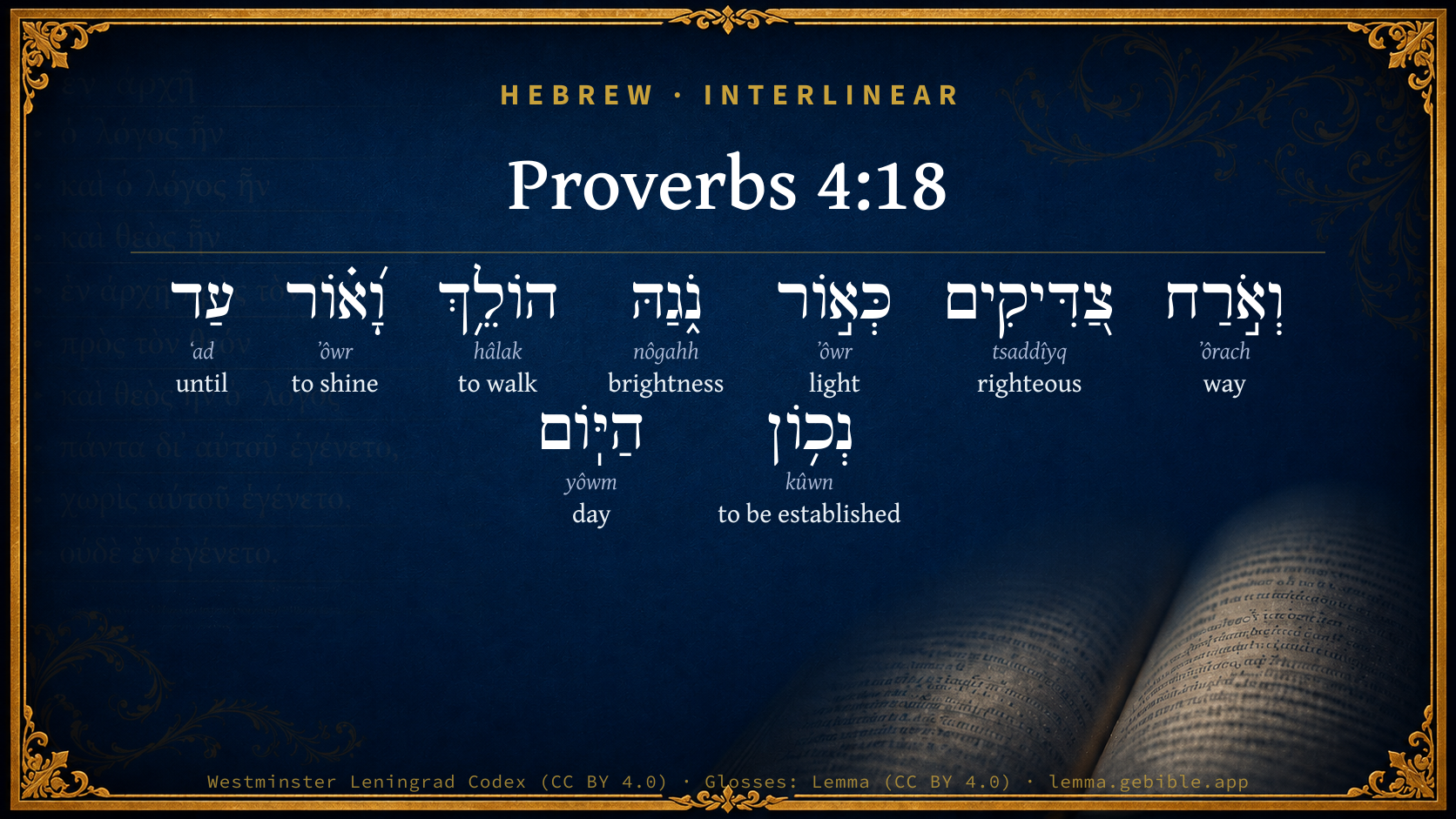
Proverbs 4:18

Hebrew (Westminster Leningrad Codex) Proverbs 4:18 appears in the Hebrew Old Testament. The text above is from the Westminster Leningrad Codex. Each word links to its Strong’s number, a concise gloss, and parsing drawn from the Open Scriptures Hebrew Bible morphology. Click any word for its full Brown-Driver-Briggs (BDB) entry.
Download image
Cite this verse

Proverbs 4:18 (World English Bible). Public Domain. Lemma interlinear Bible study tool, https://lemma.gebible.app/v/proverbs/4/18.

Show BibTeX & RIS
BibTeX
RIS
English Translation
But the path of the righteous is like the dawning light, That shines more and more until the perfect day.
World English Bible · Public Domain
Download a study sheet

One document with this verse’s original text, its word-by-word gloss line, the meaning frame, cross-references with their text, attributed commentary, and full source and license credits — printable, and it pastes into notes with its structure intact.

This verse Autodidact and up

Study sheet (.html) Plain text (.txt)

A passage Seminary Student

Up to 50 verses in one chapter. A passage sheet keeps up to 6 commentary sources and 12 cross-references per verse, in the order this page ranks them, and says so on the sheet whenever that leaves anything out. Ask for a single verse and you get the Autodidact verse sheet above.

Everything on this page stays free to read, with no account — the sheet is a download of what is already on screen, not access to it.

Want to remove ads? Support Godless Engineer
Compare translations 3

The same verse in 3 English versions, stacked beneath the original-language interlinear above. Click any original word for its lexicon entry.

Each is an independent rendering of the whole verse — the interlinear is not word-aligned to these translations.

Highlighted words mark where these versions differ — a whole-verse word diff, not a word-by-word alignment.

  • World English Bible Public Domain
    But the path of the righteous is like the dawning light, That shines more and more until the perfect day.
  • King James Version Public Domain
    But the path of the just is as the shining light, that shineth more and more unto the perfect day.
  • unfoldingWord Literal Text CC BY-SA 4.0
    But the path of the righteous ones like the light of brightness, going and shining until the day established.

unfoldingWord Literal Text — © unfoldingWord, licensed CC BY-SA 4.0. Word-aligned USFM3 via Door43 (git.door43.org/unfoldingWord/en_ult).

Versions to compare (up to 4)

3 of 4 selected

Show all 18 translations

Every available English version of this verse, each an independent rendering of the whole verse.

  • World English Bible Public Domain
    But the path of the righteous is like the dawning light, That shines more and more until the perfect day.
  • Berean Standard Bible Public Domain
    The path of the righteous is like the first gleam of dawn, shining brighter and brighter until midday.
  • Majority Standard Bible Public Domain
    The path of the righteous is like the first gleam of dawn, shining brighter and brighter until midday.
  • King James Version Public Domain
    But the path of the just is as the shining light, that shineth more and more unto the perfect day.
  • American Standard Version (1901) Public Domain
    But the path of the righteous is as the dawning light, That shineth more and more unto the perfect day.
  • Revised Version (1885) Public Domain
    But the path of the righteous is as the shining light, that shineth more and more unto the perfect day.
  • Geneva Bible (1599) Public Domain
    But the way of the righteous shineth as the light, that shineth more and more vnto the perfite day.
  • Douay-Rheims (1899) Public Domain
    But the path of the just, as a shining light, goeth forwards and increaseth even to perfect day.
  • Young's Literal Translation Public Domain
    And the path of the righteous `is' as a shining light, Going and brightening till the day is established,
  • Literal Standard Version CC BY-SA 4.0
    And the path of the righteous [is] as a shining light, || Going and brightening until the day is established,
  • Unlocked Literal Bible CC BY-SA 4.0
    But the path of righteous people is like the first light that grows brighter; it shines more and more until the fullness of the day comes.
  • unfoldingWord Literal Text CC BY-SA 4.0
    But the path of the righteous ones like the light of brightness, going and shining until the day established.
  • Darby Bible Public Domain
    But the path of the righteous is as the shining light, going on and brightening until the day be fully come.
  • World Messianic Bible Public Domain
    But the path of the righteous is like the dawning light that shines more and more until the perfect day.
  • Webster's Bible Public Domain
    But the path of the just is as the shining light, that shineth more and more to the perfect day.
  • Free Bible Version CC BY-SA 4.0
    The way of life of the good is like the light of the sunrise, glowing brighter and brighter until the full light of day shines out.
  • Bible in Basic English Public Domain
    But the way of the upright is like the light of early morning, getting brighter and brighter till the full day.
  • JPS Tanakh (1917) Public Domain
    But the path of the righteous is as the light of dawn, that shineth more and more unto the perfect day.

Literal Standard Version (2020), Covenant Press — licensed CC BY-SA 4.0. Text via the HelloAO Bible API (eBible.org). Unlocked Literal Bible (unfoldingWord) — licensed CC BY-SA 4.0. Text via the HelloAO Bible API (eBible.org). unfoldingWord Literal Text — © unfoldingWord, licensed CC BY-SA 4.0. Word-aligned USFM3 via Door43 (git.door43.org/unfoldingWord/en_ult). Free Bible Version, Dr. Jonathan Gallagher — licensed CC BY-SA 4.0. Text via the HelloAO Bible API (eBible.org).

Word by word

More ways to search: Search by grammar → Find every occurrence → Compare this word →

Practice this passage: Drill this verse → Learn its vocabulary →

About this verse

These counts appear in no published source. They are computed here, from the morphology-tagged text and Lemma’s own curated glosses. What Lemma adds →

9
words
9
distinct lemmas
Wisdom
section

Notable vocabulary

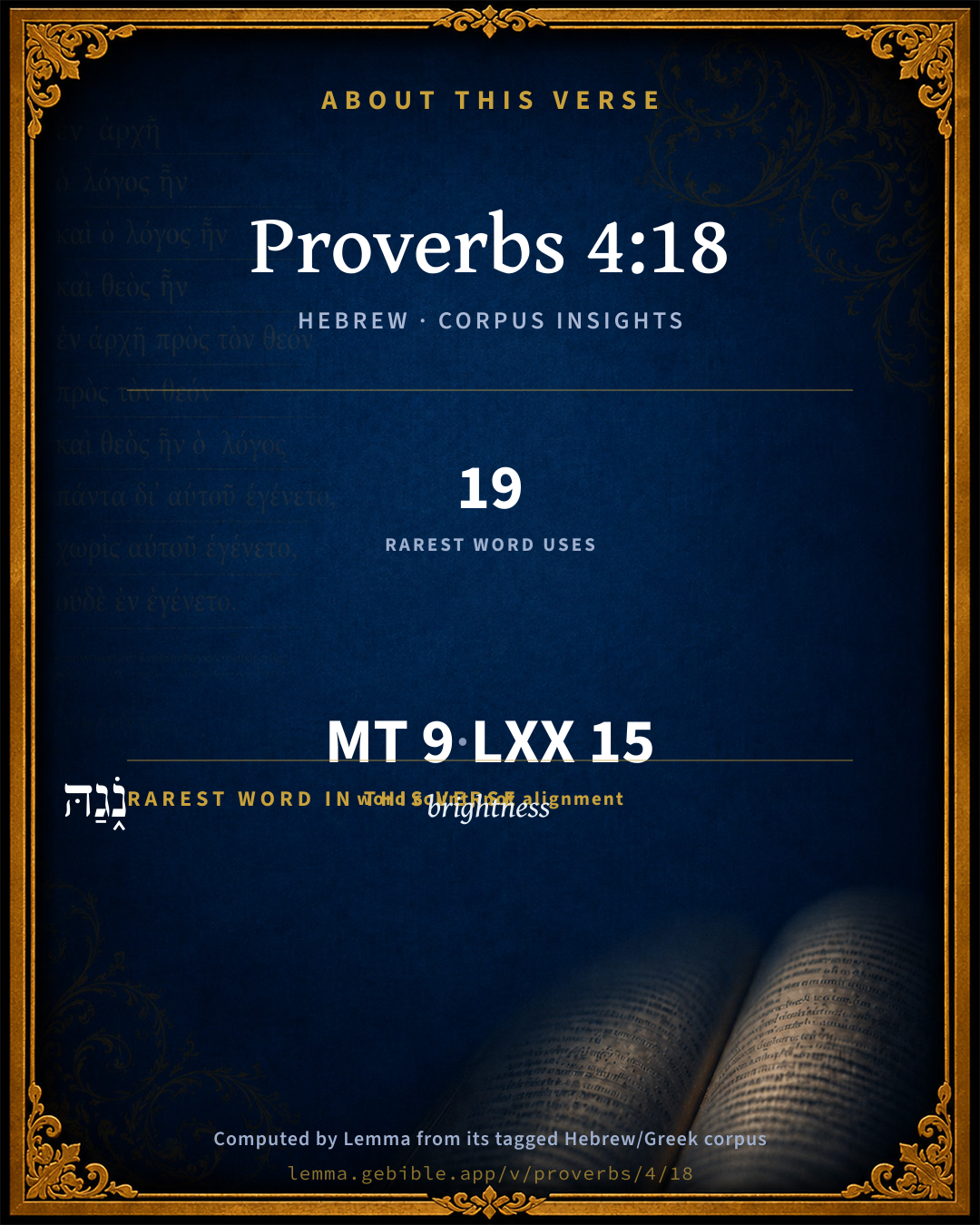
The rarest word here is נֹ֑גַהּ brightness H5051 — appearing just 19 times in the whole Hebrew Bible.

Shared distinctive vocabulary

נֹ֑גַהּ brightness H5051 occurs in 19 verses of the Hebrew Bible. Also found in:

Grammatical profile

  • 3 verbs
  • 4 nouns
  • 1 adjective
  • 1 preposition

Verb forms

  • הוֹלֵ֥ךְ Qal · Participle Active
  • וָ֝א֗וֹר Qal · Participle Active
  • נְכ֥וֹן Niphal · Participle Active

Hebrew & Septuagint length

In English translation the verse runs 20 words from the Hebrew and 20 from the Septuagint (LXX English) — the same length.

A rough comparison of the two English renderings, which tokenize alike — not a word-level alignment.

Word counts can differ between the Hebrew and the Greek without any difference in meaning — e.g. the Hebrew direct-object marker אֵת has no separate Greek word, and Greek often adds the article ὁ.

In the original languages it is 9 Hebrew tokens and 15 Greek tokens — but the two are counted differently (Hebrew bundles its prefixes and suffixes into one token; the Greek is in lemma form), so that isn’t a like-for-like length.

Cross-references

18

Topical passages linked to Proverbs 4:18 in the Treasury of Scripture Knowledge — connected by theme and wording, ordered by reader-vote popularity; previews shown in the World English Bible.

  • John 8:12 Again, therefore, Jesus spoke to them, saying, "I am the light of the world. He who follows me will not walk in the darkness, but will have the light of life."
  • Job 11:17 Life shall be clearer than the noonday; Though there is darkness, it shall be as the morning.
  • Daniel 12:3 Those who are wise shall shine as the brightness of the expanse; and those who turn many to righteousness as the stars forever and ever.
  • Philippians 2:15 that you may become blameless and harmless, children of God without blemish in the midst of a crooked and perverse generation, among whom you are seen as lights in the world,
  • 2 Corinthians 3:18 But we all, with unveiled face beholding as in a mirror the glory of the Lord, are transformed into the same image from glory to glory, even as from the Lord, the Spirit.
  • 2 Peter 1:19 We have the more sure word of prophecy; whereunto you do well that you take heed, as to a lamp shining in a dark place, until the day dawns, and the day star arises in your hearts:
  • Psalms 84:7 They go from strength to strength. Everyone of them appears before God in Zion.
  • Matthew 5:14 You are the light of the world. A city located on a hill can't be hidden.
  • Isaiah 26:7 The way of the just is uprightness: you that are upright do direct the path of the just.
  • Matthew 5:16 Even so, let your light shine before men; that they may see your good works, and glorify your Father who is in heaven.
  • 2 Samuel 23:4 [He shall be] as the light of the morning, when the sun rises, A morning without clouds, [When] the tender grass [springs] out of the earth, Through clear shining after rain.
  • Revelation 22:5 There will be no night, and they need no lamp light; for the Lord God will illuminate them. They will reign forever and ever.
  • 2 Peter 3:18 But grow in the grace and knowledge of our Lord and Savior Jesus Christ. To him be the glory both now and forever. Amen.
  • Revelation 21:23 The city has no need for the sun, neither of the moon, to shine, for the very glory of God illuminated it, and its lamp is the Lamb.
  • Zechariah 14:6–7 It will happen in that day, that there will not be light, cold, or frost.
  • Job 23:10 But he knows the way that I take. When he has tried me, I shall come forth like gold.
  • Hosea 6:3 Let us acknowledge Yahweh. Let us press on to know Yahweh. As surely as the sun rises, Yahweh will appear. He will come to us like the rain, Like the spring rain that waters the earth."
  • Matthew 5:45 that you may be children of your Father who is in heaven. For he makes his sun to rise on the evil and the good, and sends rain on the just and the unjust.

Cross-references courtesy of OpenBible.info (CC BY 4.0).

Hebrew and Greek witnesses Masoretic Hebrew ↔ Greek Septuagint

The same verse in the two great witnesses to the Old Testament, shown verse-for-verse.

These are two independent witnesses, not word-aligned to each other, and the Septuagint is shown in lemma (dictionary) form.

Hebrew Proverbs 4:18 Masoretic · Westminster Leningrad Codex

וְאֹ֣רַח צַ֭דִּיקִים כְּא֣וֹר נֹ֑גַהּ הוֹלֵ֥ךְ וָ֝א֗וֹר עַד נְכ֥וֹן הַיּֽוֹם

But the path of the righteous is like the dawning light, That shines more and more until the perfect day.

World English Bible · Public Domain

Greek LXX Proverbs 4:18 Septuagint · lemma form

ὁ δέ ὁδός ὁ δίκαιος ὁμοίως φῶς λάμπω προπορεύομαι καί φωτίζω ἕως καταὀρθόω ὁ ἡμέρα

But the ways of the righteous shine like light; they go on and shine, until the day be fully come.

LXX2012 (modern English Septuagint) · Public Domain

On this verse, The Cambridge Bible for Schools and Colleges discusses the Septuagint’s reading. Read the note in Commentary ↓

Hebrew: Westminster Leningrad Codex (CC BY 4.0). Greek: Septuagint (public domain); English from LXX2012 (modern English Septuagint) (Public Domain). How the Septuagint differs from the Hebrew →

Commentary

Notes on Proverbs 4:18 from classic Christian and Jewish commentators (each source and its license shown beneath its notes). The classic Christian expositions comment on the surrounding passage and are grouped to its opening verse, so a note may address several verses; the Jewish commentaries on the Tanakh (Rashi and others) are per-verse, so they appear only where the commentator wrote on this verse.

Lemma curates 59 commentaries, every one of them public domain or Creative Commons licensed, each selected and text-cleaned for this edition rather than reprinted as found. About our sources →

Trapp's Complete Commentary

John Trapp

Pro 4:18 But the path of the just [is] as the shining light, that shineth more and more unto the perfect day.

Ver. 18. But the path of the just is as the shining light.] He sets forth betime in the morning, and travels to meet the day. He proceeds from virtue to virtue, till at length he shine as the sun in his strength. {Mat 13:43}

John Trapp, A Commentary or Exposition upon All the Books of the Old and New Testament (1647–1656) — public domain. Text from a community e-Sword module.

The Biblical Illustrator

Joseph S. Exell

Pro_4:18

The path of the just is as the shining light.

The path of the just

The essentials of a just mans character have been in all ages the same. The path, the life-course, of such a man, is like the shining light. I do not think that the path of the justified is compared to the course of the sun, from the period of his appearance in the morning to the time of his meridian height. The sun is an emblem, not of the justified, but of the Justifier. The just are those whom the Sun of Righteousness shines upon. The new life of the converted is like the morning light. At first it seems an uncertain struggle between the darkness and the dawn. It quivers long in the balance. When the contest begins, however, the result is not doubtful, although it may for a time appear so. Once begun, it shineth more and more unto the perfect day; and it is perfect clay when the sun has arisen, as compared with the sweet but feeble tints of earliest dawning. The path of the just will be like the morning, it will increase until dawn break into day. The analogy holds good more exactly still, if we take into view the actually ascertained motions of the planetary system. When any portion of the earths surface begins to experience a dawn diminishing its darkness, it is because that portion is gradually turning round towards the sun; while any part of the earth lies away from the sun, in proportion to the measure of its aversion, it is dark and cold; in proportion as it turns to him again, its atmosphere grows clearer, until, in its gradual progress, it comes in sight of the sun, and its day is perfect then. The path of the just is precisely like this. Arrested in his darkness by a love in Christ, which he does not understand as yet, he is secretly drawn towards Him in whom that love, in infinite measure, is treasured up. As he is drawn nearer, his light increases, until at last he finds himself in the presence of the Lord. There follows in the text a counterpart intimation fitted to overawe the boldest heart. The way of the wicked is as darkness; they know not at what they stumble. The darkness is in him. A dark place in the path may be got over, but darkness in his own heart the traveller carries with him wherever he goes. To the blind, every place and every time is alike dark. It is an evil heart of unbelief. The way to get light is to turn from sin. (W. Arnot, D. D.)

The Christians light

The righteous man possesses an understanding brightened by the rays of Divine truth, for the Sun of Righteousness hath shone into his soul. His heart is beautified by the light of purity, diffusing a pleasant lustre around him in his conversation; and his spirit is cheered with the light of joy and consolation from the countenance of God. This light is not like that of a taper which burns itself away into darkness, but like that of the morning sun, which shines brighter and brighter, till it blazes with meridian splendour. (G. Lawson.)

The path of the just

The point of resemblance between the path of the just and the shining light.

I. As to origin. The shining light emerges from the darkness at the dawn of the day, and so does the path of the just, or the believer on the morning of conversion. There is a great spiritual crisis, call it by whatever name you will. Our Lord speaks of it as a new birth.

II. As to progress. There should be progress--

1. In knowledge of Divine things.

2. In holiness of heart and life.

3. In Christian usefulness and activity.

4. In growing meetness for heaven.

III. As to perfection. Progress ending in perfection, but not here. The perfect day is not for earth, but for heaven. As to knowledge of Divine things, here we know in part, there we shall know even as we are known. Here the feeble intellect is soon exhausted in its search after knowledge, there it shall soar with untiring wing. As to purity, what a change! There are spots on the disc of the brightest sun that ever shone, but there are none on the spotless robes that have been made white in the blood of the Lamb. As to useful activity, it will assume a more exalted character, it will embrace a wider range. (A. Wallace, D. D.)

The path of the just

I. The character of this man--the just man. A just or righteous man is he who conforms himself to the laws of Gods government over men. The perfectly just man is he who has never in any matter trampled upon the rule of life laid down by the all wise God, and who continues to walk onwards by the same perfect rule. But no such character is to be found among men. The all-wise God has found out a way whereby He may be just and the justifier of them that believe in Jesus. All the righteousness and merit of Gods own Son becomes theirs. The child of faith is the only just man.

II. The starting-point of his life-course--from dawn.

1. The believer is likened to the light, inasmuch as now he has attained to wisdom, holiness, and happiness. Light, as symbolical of the good, speaks to us of the enlightenment of the understanding, the purity of holiness, and true happiness. Light is also significant of natural good, of happiness.

2. The believer is likened to the shining light, or the bright dawn of morning. This figure speaks to us of the transcendent beauty of holiness. It is the heavenly ideal of all that is bright and fair and fresh.

III. His actual course--shineth more and more. Growth is the one grand law in the kingdom of light. The believer at his new birth is but a babe in Christ. The children of the kingdom grow from strength to strength. Where there is no growth there is no life. Perfect manhood, the measure of the stature of the fulness of Christ, is the goal short of which no child of the Father dare stop. Every being grows according to the measure of his own inward nature, and so does the child of God. This Divine necessity of the Christians growth is symbolised by the figure of the text. The Christians growth, like all growth, is gradual; it even proceeds often by means of apparent retrogressions. Often the Christian seems to retrograde. Yet even from a sad eclipse he will come forth, shining with a fuller splendour of blessed light.

IV. His goal--everlasting noon--the perfect day. From the path of the just all shadows of the darkness shall pass away. Children of light though we be, we are often doing the deeds of darkness and walking in the dark and cloudy day of trial. But it shall not be so always. A Godlike purity, and God Himself as our joy, constitute the two elements of the light of the perfect day, into which our faith and patience grow more and more. (James Hamilton, M.A.)

The path of the just

I. The believers natural state of darkness and misery.

II. The brilliant course he pursues after being turned from darkness to light. His way is as the shining light.

1. Beautiful in its appearance. The light of grace begins from the first to adorn the actions of the righteous. Their simplicity of mind and teachableness of spirit endear them to all their brethren; their lowliness and humility attract universal notice, while the fervour of their love excites admiration and esteem. The very shades in their character serve as a contrast to the excellency of the change that has passed upon them. As they proceed, their graces are more matured, and even thus early they adorn the doctrine of God their Saviour.

2. They shall continue to be beneficial in their influence. They have a work to do, and God will ensure them in a course of well-doing, or the Divine purpose would fail.

3. Believers, like the sun, are constant in their progress. The sun invariably pursues his wonted course. The believers progress is directed by the same power.

III. The glorious consummation of the text. (The National Preacher.)

The path of the just

It is not from the observation of earthly circumstances that we believe in the reign of eternal righteousness. It is because the voice of God has spoken the truth into the hearts of men, because we are ethical beings, because we know by the divinest instinct within us that righteousness reigns. The destiny of men is ethically determined. It is not so altogether upon this earth, where great distinctions are created through other circumstances; but in the long run, in the eternal issue, moral character will determine destiny.

I. The beauty of the simile. The reference is evidently to the light of day, the sunlight. It suggests--

1. Gladness.

2. Power.

3. Beauty.

4. Order.

5. Glory.

II. The progressive aspect. From dawn to full day. The life of the just is not completed at once. All progress. Not all at the same rate.

III. The words path of the just include character, condition, and destiny. The light of goodness, of joy, and of glorious destiny. And these three things are involved in one another. (John Thomas, M.A.)

The path of the just, like the shining light

Religious virtue is recommended to our affectionate esteem, to our choice and constant pursuit, by the character of wisdom. The goodness of the sincere is like the morning dawn, which is weak in its beginning, but gradually increases in brightness, till it arises to its meridian glory. The path of the just is nothing else but the practice of virtue, of moral piety, of righteousness, of temperance, of charity. The whole of virtue is comprehended, and every essential branch of it must be reduced to practice in the path of the just.

1. The way of the just, morally considered, is a regular scheme formed according to one model, and under one uniform direction. The principle of virtue is always an unvarying guide, admirable for its simplicity, without a mixture of interfering counsels, without a diversity of inconsistent views.

2. The path of the just is accompanied with inward serenity and satisfaction. The principles of religion, diffusing their influence through the whole scheme of life, set everything about us in a fair and amiable light.

3. The path of the just sends light abroad--that is, communicates profitable instruction to, and hath a useful influence on, those who have the opportunity of observing it. The path of the just is like the spring of the day animated by an inward undecaying principle; it rises in splendour from its low and more obscure beginnings, going on gradually to perfection. (J. Abernethy, M.A.)

The path of the first, or persevering piety

The just man here is not the man who merely begins, it is the man who perseveres. This mans path is no meteor, which gleams and expires; no rising day, lowering into mist and darkness; it is the path of the cloudless light of heaven. Persevering piety is as the light that shineth more and more.

I. Because of the increasing demonstration which it furnishes of the truth and excellency of religion. There are many proofs of that excellency, some argumentative, others experimental. These last have always an increasing power.

II. Persevering piety possesses an increasing assurance of the Divine favour. This is the very light of the soul, the only source of peace in the conscience. At first it is obtained by faith; but in the case we are supposing faith grows into a habit, and keeps the soul in perfect peace.

III. Persevering piety has increasing pleasures. There can be no growing happiness without a preserved sense of Divine acceptance. Piety opens sources of mental pleasures: pure, because not applied to sinful objects; rich and constant, because flowing from sources of real good. All these have in them a principle of increase. Increasing pleasures are opened by the Word and ordinances of God, by Christian communion and religious exertions. All these, to a spirit prepared for them by the salvation which is of grace, through faith, present pleasures which never cloy, which afford richer and still richer satisfaction.

IV. Persevering piety has the advantage of an increasing evidence of the wisdom and care of God in His providential arrangements. The man who perseveres in piety is more wise to see, and more careful to mark, the abounding instances of Divine interposition.

V. Persevering piety has brighter and more cheering views of the eternal state. The conviction of the worlds vanity, experience of the worlds trials, are designed to quicken the progress of the affections towards mans heavenly home. Everything in piety moves towards God; but it is God in heaven, as fully revealed there.

1. See, then, that your path be indeed the path of the just. Walk in it by the strength of regenerate habits, fed by prayer, and by communion with God.

2. Remember that the way of the wicked is darkness; it is all error and perplexity.

3. Recollect, for your encouragement, that, bright and cheering as is the light upon your path, it is but the light of the morning. (R. Watson.)

Two paths before the young man

The Word of God hath imposed upon man a choice of alternatives. Two ways--two ends; two characters--two consequences; two aims or objects in the life that now is--two states or conditions in the life that is to come. When the alternative is presented to a rational and responsible being we think he can only make one choice; he would surely reject the evil and embrace the good. Two things, however, are practically opposed to this reasonable conclusion; the choice may be evaded or postponed, and human philosophy and vain deceit have left no artifices unassayed to perplex what God has made straight. The period of life when for the most part the path of the individual is to be chosen is that of youth; a stage of life in which the passions are strong, and the judgment is weak, the mind sometimes scantily furnished, and the will too often altogether unregulated and uncontrolled. Hence, in a moral sense, the period of youth is doubly endangered, because, impetuous and precipitate in its very nature, and urged by impulse rather than actuated by principle, it will not readily pause to deliberate at all; and if it does, false views are enticingly presented to it. The one of these dangers--which the apostle calls the vain deceit of philosophy--may be escaped by taking truth for a counsellor; and the other--the perilous folly of procrastination--by hearkening to reason as our guide.

I. The path of the just. The path of light is that which discloses to those who pursue it their own motive of action; to others who examine them, their principles; and both to themselves and to others who assume the same standard of judgment, the consequences of those actions. Ignorance of what is personally, relatively, socially, or even politically right, can never co-exist with a genuine belief in the gospel of Christ Jesus. By the just we understand the man who has determined to do right simply because it is right; resolving all first principles of right into the expressed and recorded will of God. By the path of such a man we understand the habitual tenor of his course and conduct among mankind.

II. The way of the wicked. By the wicked we understand the man who is indifferent to that which is good; who acknowledges, or at least obeys, no law of action but his own pleasure, or his own interest, or his own inclination, or his own appetite. The way of such a man is darkness, from the absence of any fixed principle or of any certain end. If peace is essential to happiness, on Scriptural principles happiness never can be realised by the ungodly. All nature is full of enemies to him who hath not God for his friend. See, then, the importance of making the right choice in early life. (Thomas Dale, M.A.)

Of increase of grace, and perseverance therein unto the end

Increase of grace and perseverance are benefits flowing from or accompanying justification.

I. Increase or growth of grace. That real grace does increase is evident from three things. Scripture testimony. God has appointed a certain stature that His children shall grow to. This is the end of Divine influences and the effect of Divine ordinances.

II. How a Christian grows in grace.

1. Inward, into Christ.

2. Outward, in good works, in all the parts of a holy life, piety towards God, and righteousness towards men.

3. Upward, in a heavenly disposition.

4. Downward, in humility, self-denial, self-loathing, resignation to the will of God.

III. The causes of this growth.

1. Union with Christ.

2. Communion with Christ in His ordinances and in His providences.

IV. The difference between true and false growths.

1. True Christian growth is universal.

2. The hypocrite soon comes to a stand, the Christian goes on to perfection.

V. True grace grows always.

1. It does not always grow, nor at every particular season.

2. It never decays utterly.

3. A Christian may be growing and yet not be sensible of it. This may cause fear and trembling. (T. Boston.)

Perseverance in grace

is another benefit flowing from or accompanying justification.

I. What this perseverance is. To persevere is to continue and abide in a state into which one is brought.

II. How is this perseverance to be understood.

1. Not of all who profess Christ.

2. Of all real saints, those who are endowed with saving grace. Saints may lose the evidence of grace, so that they cannot discern it in themselves. They may lose the exercise of grace. They may lose much of the measure of grace they have had.

III. The saints shall persevere to the end.

IV. What are the things which make hypocrites fall away?

1. Satans temptations.

2. The worlds snares.

3. The corruptions and lusts of the heart.

V. The grounds of the perseverance of the saints.

1. The unchangeable decree of Gods election flowing from the free and unchangeable love of the Father to them.

2. The merit and intercession of Christ the Son.

3. The perpetual abiding of the Spirit.

4. The nature of the covenant of grace.

VI. The means of perseverance.

1. Gods ordinances and providences.

2. The duties of religion, and exercise of the graces, faith, fear, watchfulness, etc.

Then look well to the foundation of your religion, for sincerity will last, but hypocrisy is a disease in the vitals that will end in death. Let those whose care it is to be found in Christ be comforted amidst all their temptations, snares, and corruptions, in that God has begun the good work and will perfect it. (T. Boston, D.D.)

The Christian life a progressive state

I. It is in every mans power to make his life a progressive state. If we trace the progress of the human mind from the first dawnings of sense and reason, we may see from what small beginnings it acquires a prodigious store of intellectual knowledge. The moral powers, like the natural perfections of the body, are more equally distributed than the intellectual; and in them there is as large a field laid open for our advancement towards perfection as there is in the intellectual. No man knows what he can do till he is firmly resolved to do whatever he can. There are often abilities unknown to the possessors which lie hid in the mind for want of an occasion to call them forth. One can scarcely have too high an opinion of the powers of the human soul, especially in the affair of our salvation, and scarce too low an opinion of mens inclinations to exert these powers in that important case. But God gives to every man adapted and effectual grace. We have the same natural power, the same gracious aid and assistance, for persevering and improving in every virtue and grace, as we had originally for attaining them. What, then, should restrain or hinder our continual progress? One reason why men do not quicken their pace more in the ways of goodness is the mistaken judgment they form by using a deceitful standard. They are not at any trouble to get exact notions of perfection and goodness, and to examine their lives by such truly imitable patterns. So far, then, from considering this life as a dull round of the same insignificant trifles, we ought to look upon it as an indefinite line wherein every step we take is, or ought to be, an important and valuable advance in goodness.

II. Some reasons and considerations to engage us in such a practice.

1. This progressive state is our duty. Gods design is to make men as virtuous and pious as possible. It is in our power to make a constant and continued progress in the kinds of these perfections, and thence arises our obligation to advance in the degrees as far as the sum of our faculties, exercised and improved to the utmost, can carry us. Our condemnation will not lie in this, that we did not exactly transcribe the original, but that we did not make the copy so complete as was in our power. If a man thinks himself already as virtuous and good as he needs to be, it is a certain sign that he has not yet arrived at any eminence in virtue.

2. The advantages we shall reap from the progressive state.

(1) It will supersede the trust and confidence which too many are apt to repose in repentance.

(2) It is the best means for bringing us to a uniform and unreserved obedience.

(3) It is the only security for our preservance in such obedience.

(4) It is the best testimony we can have of our being in a salvable condition.

Reflections:

1. How groundless and unreasonable are all complaints of human life as an insignificant, capricious, and wayward state.

2. If the progressive is the right state of life, what shall we think of those who are pursuing an opposite course? (J. Seed, M. A.)

The progressive lustre of the Christians character and example

The use of light is twofold--it enables us to see and to be seen; and from this twofold use of light arises a twofold application of the text.

I. The path of the just, as he sees it himself. As a shining light.

1. Because it is the path of Christ. He is the true light. Whatever light exists upon earth, whether physical, intellectual, or spiritual, comes from Him as the Creator by whom all things were made. By Him the lights of reason and of conscience were lit up in the soul of man to guide him to a knowledge of God and duty. And after the candle of the Lord had been so dimmed and defiled by sin as to become comparatively useless, then did He, as the Sun of Righteousness, arise with healing in His beams, to restore in the minds of His believing people that light which sin had so grievously obscured and beclouded. To this light the eyes of Gods people were from the earliest ages of the world directed, for its dawn was coeval with the fall of man. Taking the Lord Jesus as his guide and exemplar in the ways of salvation, the path of the just is as a shining light.

2. In respect of the increasing certainty and confidence wherewith he walks in it. As the rays of light move in straight lines, so also the path of the just is a straight-forward path--free from those perplexing turnings and windings which mark the ways of worldly wisdom and carnal policy. It is also a path of security in which he can walk without fear of danger. The path is moreover pleasant and joyful. So far, then, as his own understanding and feelings are concerned, the analogy between the path of the just and the shining light is evident and exact.

II. the path of the just as it appears to his neighbours. As the light of Divine truth and love is reflected to us from the person and character of our Lord Jesus Christ, in like manner the light of His grace and holiness is reflected to the world from the lives and characters of His faithful disciples. As a comet increases in brilliancy in proportion to the nearness of its approach to the sun, so the Christians light will always be more conspicuous in proportion to the closeness of his communion with the Sun of Righteousness. As light is the most plain and conspicuous object in nature, so the Christian, walking in the integrity of his heart, is so transparent and straightforward a character as to be known and approved of all. As the same light shining upon a smooth and polished surface is reflected with greater lustre than from a rough and muddy one, so the same grace is reflected with greater brilliancy by some Christians than by others. As a professed follower and disciple of the Son of God, the Christian is imperatively called upon to let his light shine before men. If we are the children of light, we are called upon to walk as such. Beware, then, of continuing in the dim twilight of a lukewarm and unstable profession. Look to the Lord Jesus Christ as the Sun of Righteousness. Take Him for your guide and exemplar, and He will assuredly lead you to everlasting joy. (William Ford Vance, M. A.)

Quiet progress

All life means progress. Stagnation is death. Our life is either a halt, a return, or a pressing forward.

I. In quiet times we see more of the truth.

II. It shows us more in truth. Not only more of it, but more in it.

III. In quiet progress we make more use of truth. Through quiet progress in our lives, we are extending Christs kingdom.

IV. In this quiet progress you will be more reconciled to changes that must come.

V. We are more restful in the inner evidences of truth. (W. M. Statham.)

On the progressive nature of religion in the soul

We derive a great part of our ideas from comparison, and the mind is pleased with similitudes. No comparison can be more appropriate and beautiful than that employed in the text.

I. The character which is here denoted by the term just. Just expresses a person who has, without omission or fault, fulfilled every branch of moral obligation. The same word is employed to denote that character which extends not its virtuous exertions beyond the discharge of the demands of strict justice. A distinction is made between justice and goodness. Just also characterises the person who, having adopted right principles, directs his conduct by them, as far as is compatible with human infirmity. The term is also employed to signify those who, through the merits of Jesus Christ, and the means of grace and salvation which He hath instituted, are restored to the favour of God. The two last of these meanings come into the text. The just man here is he who, with an understanding as much enlightened as his situation will permit, and with a heart impressed with the importance of religion, endeavours to fulfil the law of God, through the whole of his conduct, and renders the cultivation of holiness and virtue his grand and predominant object.

II. All the faculties of man are of a progressive nature. The human faculties ascend to the most sublime attainments; but for this progressive and boundless improvement, culture and discipline are necessary. The faith of the just man, though founded on rational convictions, will, at first, be weak and wavering. Whether he contemplate nature or revelation, he will meet with obscurity to perplex, with difficulties to embarrass, and with objections to stagger him. But though these obscurities hang over the path of the good man, and these obstacles start up, as he advances, they neither involve him in complete darkness, nor even retard his progress. As the faith of the man truly pious advances with increasing brightness, his works observe the same tenor. From the frailties and defects incident to humanity, the man of piety and virtue is not exempt. But the good man sins from infirmity alone, loathes himself on account of every fault he commits, and strives to acquire greater firmness and resolution against future temptations. Advancing in his virtuous progress, he acquires, at every step, fresh vigour and alacrity, and, at last, arrives at that confirmed habit of obedience, which places him beyond the power of such temptations as seem to other men irresistible, and enables him, through Divine grace, to triumph, in some measure, over nature herself. The good man having the principles of virtue lodged in his soul, and gradually brought forward by Divine energy, begins his course with difficulty, and amidst obscurity and temptation. Gradually doubts and difficulties disappear, and he rises at last to that settled temper of virtue and holiness which makes him a light shining in a dark place. (W. L. Brown, D. D.)

Signs of progress

In whatever path we set out, there is no standing still. The grace of God, which is given to men, lies not dormant.

I. How shall we know if we have made progress in the paths of righteousness?

1. Are you sensible of your faults and imperfections? The first indication of wisdom is to confess our ignorance, and the first step to virtue is to be sensible of our own imperfections. Till we feel our own weakness we can never be strong in the Lord; we can never rise in the Divine sight till we sink in our own estimation.

2. What is the strength of your attachment to the cause of righteousness? Are you enamoured with the beauty of holiness? Men will never imitate what they do not love. If, then, you are not lovers of goodness and virtue, you never will be good and virtuous.

3. Are your resolutions as firm and your application as vigorous now as when you first set out in the spiritual life? True religion does not consist in fits and starts of devotion. He alone is a good man who perseveres in goodness. Are you as much in earnest now as when your first love to God began to bring forth the fruits of righteousness? As you advance in years, all the passions will gradually cool. You will not feel that degree of ardour in your devotions which you experienced in your early years. But your devotions may continue as sincere, though not so inflamed, as before, and religion may be as effectual as ever in the regulation of your life.

4. Another mark of increasing grace is when you obey the Divine commandments from affection and love. He alone will make progress in the path of the just who is drawn by the cords of love.

II. Directions how to make further progress in the path of the just.

1. Make a serious business of a holy life. The true Christian will not be deficient in his attention to the externals of religion; but he will not rest there. We must make a study of the holy life, in order to advance from strength to strength in the ways of the Lord.

2. Never rest satisfied with any degrees of holiness or virtue which you attain. The law of the spiritual life is to aim at perfection. Absolutely perfect we can never become in this life; but we must be always aspiring and endeavouring after perfection.

3. Be alway employed in the improvement of your souls. Evil habits may be weakened; inclinations may be counteracted. You may call forth graces that have not yet made their appearance, and bring forward to perfection those that have.

4. Abound in prayer to God for the assistance of His Holy Spirit.

III. Exhortation to a life of progressive virtue.

1. It is your duty to make progress in the ways of righteousness. You must abound in the work of the Lord if you expect your labours to be attended with success.

2. Be assured that you will be successful in the attempt. Here, all who run may obtain.

3. Think of the beauty and the pleasantness of such a progress. These are pleasures that time will not take away. While the animal spirits fail, and the joys which depend upon the liveliness of the passions decline with years, the solid comforts of a holy life, the delights of virtue and a good conscience, will be a new source of happiness in old age, and have a charm for the end of life.

4. Let me exhort you to this progressive state of virtue, from the pleasant consideration that it has no period. There are limits and boundaries set to all human affairs; but in the progress of the mind to intellectual and moral perfection there is no period set. On what you do, on what you now do, all depends. (John Logan.)

Progression and perfection

There are two ideas in the text--progression and perfection. The life of the believer here and there is one. If we have believed, we have everlasting life--we possess already the immortal life which will be perfected in heaven.

I. Progression the characteristic of the Christian life on earth. Is it a remarkable thing that we should look for the growth of the Divine life in man? Ought we to expect progress in ourselves as Christians? It is a reasonable thing for the parent to look for growth in his child; and he is greatly concerned if he does not discover it. It is a reasonable thing for the farmer to look for growth in the seed which he has scattered upon the prepared soil. It is a reasonable thing that men should expect the sun to shine more and more unto the perfect day. But let us put it to our own hearts whether we have looked for this progress in ourselves. What is Gods thought, expressed in His Word, about this progression? Pauls prayer on behalf of the Ephesians, that they might be strengthened with might by Gods Spirit in the inner man; that they might be rooted and grounded in love; that they might comprehend more fully the love of Christ; that they might be filled with the fulness of God--certainly implies the possibility and desirability of progression. Then again, the words of the same apostle concerning the same people, that they be no longer children but growing up unto Him in all things, who is the Head, even Christ; coming unto a perfect man, unto the measure of the stature of the fulness of Christ: these again imply the possibility and desirability of progression. And again, Paul desires for the Colossians that they be filled with the knowledge of His will unto all wisdom and spiritual understanding; that they might walk worthy of the Lord unto all pleasing, being fruitful in every good work, and increasing in the knowledge of God; strengthened with all might according to His glorious power unto all patience and long-suffering with joyfulness. Shall we not be concerned about our own growth? Shall we not be grieved if we do not grow in our views and feelings in reference to sin? The older we are as the children of God, the longer we have had fellowship with the Pure and Holy One, the more we should hate everything which is sinful. Shall we not be grieved if, as the months go by, we do not find ourselves more decided and resolute and settled in our religious convictions and habits? Shall we not be concerned if we are not gaining greater power over the sin which easily besets us? Shall we not be concerned if we are not more humble, more heavenly-minded, more gentle and forgiving, more Christlike than we were?

II. Perfection the characteristic of the Christian life in heaven. Progression here; perfection there. Perfection there according to progression here. Is it so? We think so. If we mistake not, the ordinary notion is--no matter what our life may be here, if only we have faith in Christ, the moment this mortal shall put on immortality we shall be perfect in heaven. We ordinarily think of our perfection there as apart from our progression here. But the teaching of Scripture is not the stagnant pool here becoming the gushing fountain there; it is the well of water here, and there springing up into everlasting life. It is not the babe, or rather the dwarfed child here, appearing there the strong, wise, well-proportioned man; it is the babe growing up here, till there he attains the stature of the perfect man. We know it is very true, though the well of water spring up here ever so continuously and copiously, it shall there in comparison gush forth like a fountain of living waters. If we search the Scriptures with this design in view, to discover whether a careless, inactive Christian will attain the same perfection in heaven as a man like the apostle Paul, we shall quickly see that progression here has something to do with perfection there. What glories are these which are set before us! To be without sin; to know as we are known; to love as we are loved; to have ourselves possessed with the peace of God. Every one of us will reach the perfect day. There will be no imperfection in heaven. Yet those who grow more here shall have larger capabilities there. Those who are the more faithful here shall have the larger range for faithfulness there. Here is something to fill us with joyful anticipation. (James Neobard.)

From dawn to noon

No nobler expression has ever been given of the great thought of Christian progress than these words contain. But it is not always observed that that thought is presented twice in the text, once in the familiar condensed metaphor of life as a path, and once in the lovely expanded figure which follows. A path leads some whither; and the travellers on it are marching in a definite direction. Then, if we turn to the other emblem of our text, the idea is even more completely carried out in the original than our translation would suggest to an ordinary reader. For the words rendered shining light do really mean light of dawn, and those rendered perfect day do really mean, literally though clumsily translated, the steadfast (moment) of the day, the instant when the sun seems to pause on the meridian, like the tongue of the balance right in the centre, and inclining to neither side.

I. So let me ask you to look, first, at the great possibility opened here for us all. Now, it is true that every life, of whatever kind, tends to completeness in its own kind; that the good becomes better, and the bad worse. Single actions consolidate into habits, just as the minute grains of sand, beneath the pressure of the ocean, are hardened into rock. Convictions acted on are strengthened. Light stands as the emblem of three things--knowledge, purity, and joy. The Christian life is capable of continual increase in all three.

1. It is capable of continual increase in knowledge. Of course, I do not mean merely the intellectual apprehension of certain propositions which are received as true. We know a book or a science or a thought in one way; we know a person in another; and Christian knowledge is the knowledge of God in Christ, and of Christ in God. That knowledge is something a great deal more warm-blooded and full-pulsed than an intellectual perception of the truth of a statement. And it is this knowledge which it is intended should grow unceasingly in Christian experience, and in our daily life. We have an infinite object on whom to fix our minds and hearts. A man begins to be a Christian when perhaps through many a cloud, and with many hesitations and doubts, and with a very inadequate apprehension of the truth that he is receiving and the Person that he is grasping, his faith puts out an empty hand, and lays hold of Christ as his hope and his all. But as his days go on, if he be truly in possession of that initial truth, he will find that it opens out into splendours, and discloses depths and assumes a power controlling all life and thought, which he never dreamt of when he first apprehended it. We begin, like gold-seekers, with surface-washings; we end with crushing quartz. We begin on the edge of the great continent, we travel onwards and inwards, through all the leagues of its mountains and plains and lakes, and we never shall traverse it altogether. Life interprets Christ, if we let Christ interpret life. When the night of sorrow closes in over our heads, there are truths that shine out bright and starry, like the light points in a keen, frosty winters night, which never could be seen in the garish day.

2. Again, the Christian life is capable of a perpetual increase in purity. And if a man be truly a Christian, there is nothing more certain than that, day by day, his conscience will become more sensitive and quick to discriminate between good and evil. The more we rise in the moral scale, the more solemn, sovereign, and far reaching we discern the commandment to be, that we shall be like our Lord. Depend upon it, all of us have things in our characters, and acts in our daily ordering of our lives, which, if we had advanced further along the path, we should avoid as a pestilence.

3. Again, the Christian life is capable of a continual increase in gladness. Yes! As sorrowful, yet always rejoicing. All other kinds of gladness fade, and all other sources pass away. But Jesus Christs gladness, as He said Himself, is given to us that our joy may be full, because His joy remains in us. Time takes the gloss off most things. It does not take the brightness out of the Christian life.

II. Let us mark the frequent failure to realise this possibility. What I have been saying must sound to many of us liker irony than a description of fact, when we turn our eyes from the possibility for which provision is made by the gift of an infinite Christ, and an infinite Spirit, to the facts of Christian experience as we see them lying round us. Progress! Stagnation is the truth about hosts of us. A path! Well, it is a circular path if it is a path at all. They mark time, as the soldiers say, one foot up and the other down, but the feet are always planted in the same place. Sure I am that in a tragically large number of cases a professing Christians early days are his best. Many of us seem to have gone to school to the Japanese gardeners, that will take you an oak, and stick it into a flower-pot, and stunt it there, so that it is warranted never to break the flower-pot, and never to grow an inch. There is another kind of opposite to that steady incease in brightness only too common amongst us, and that is--spasmodic growth by fits and starts; brief summer followed by a dreary winter, and no continuous and steadfast advance.

III. Lastly, let me ask you to consider the cure of the failure, and the way of realising the possibility. What made a man who is a Christian in reality light at first? The apostle tells us, Now are ye light in the Lord. The reason why so many Christian people do not grow is because there is no depth and reality of union between them and Jesus Christ; and there is no depth or reality of union between them and Jesus Christ because they have no strength of faith. It is not merely for getting escape from some hell, or forgiveness for sins, that the faith is essential, but it is needful that there may be flowing into our hearts that which will change our darkness into radiance of light. Take a lesson from your electric lights. The instant that you break the contact, that instant the flame disappears. The first requisite, then, is to kep our union with Christ, and that is done by thinking about Him by the occupation of mind and heart with Him. And the second requisite is, to bring all our life under the influence of Christs truth, and to bring all Christs truth to bear upon our life. And then, we shall be as the sun shineth in his strength. (A. Maclaren, D. D.)

Character and destiny of the just

There are three methods of using natural facts as moral illustrations.

1. The poetic: which employs facts according to their impressions on the senses.

2. The scientific: which employs facts according to their best ascertained laws, with respect to sensible impressions.

3. The composite: which unites the poetic and scientific; applying facts in accordance both with the laws that govern them and the manifestations which accompany them. The poetic method is generally employed in the Bible. The scientific method would have required a scientific revelation, and the time for this had not yet come. The text is an example of poetic illustration.

I. The character of the just. It is distinguished by these two facts--

1. Its elements are pure and complete. They are matters of intellect, sentiment, propensity, conscience, and will. The intellect of the just man is always thoughtful of moral principles. The sentiments of the just man admire moral principles. He sees that they sustain self-respect, and claim, rightly, the respect of the community. The propensities of the just man cling to moral principles. As thought excites admiration, so admiration excites love. The conscience of the just man is responsive to moral principles. Its instant intuitions of virtue and vice, and its instinctive excitments, consequent upon these intuitions, aid the intellect in its studies, encourage the sentiments in their admiration, and confirm the propensities in their attachment. Not vain, however, of its natural sagacity, it acknowledges the necessity and superiority of revelation, and corrects its own errors by the infallible decisions of the Word of God. The will is faithful to moral principles. This is his grandest distinction.

1. These elements are well proportioned in their combination, in the character of the just. What is wanted is a balance of powers: all the faculties and principles in equal and harmonious action. The elements of chaacter in the just man are pure, complete, and well-proportioned.

II. The destiny of the just. What are the distinctions of the suns path?

1. It is a high path. Far too high for any earthly obstruction.

2. It is a radiant path. It is glorious because it is radiant. The glory of the just is from within. It is a radiation.

3. It is a triumphant path.

4. It is a benignant path. (T. H. Stockton.)

The path of the just

I. The path of the just resembles the shining light in being preceded by a state of darkness (Eph_5:8). The darkness of ignorance gives way to spiritual knowledge. The darkness of depravity gives way to the light of grace (1Pe_2:9).

II. The path of the just resembles the shining light in its progressive character. Sanctification is a work which, beginning in conversion, is carried on gradually. And where there is true grace in the heart, there is a desire and a capability of geater perfection, just as in the seed there is an ability and tendency to vegetate and spring up into a plant or a tree. The pleasure, too, felt in the way of righteousness, naturally leads a man to aim at greater attainments.

IV. The path of the just resembles the shining light in at length reaching to the perfect day. (Jas. Kirkwood, M. A.)

The path of the just

I. The just.

II. Their path.

1. Of penitence.

2. Of prayer.

3. Of self- denial.

4. Of humility.

5. Of struggling, yet of peace.

6. Of weakness and strength.

III. Perfect day.

1. Possessors (Rev_8:13-14).

2. Of full revelation.

(1) Of Gods glory.

(2) Of the saints reflection.

IV. The crows of life. Certainty in truth, pardon, joy, peace. (Henry Bennett.)

The advantages of a religious life

I. The certainty and evidence afforded by a religious life. Its subject is sure that it is the path of Gods commandment. He sees that it is the path of life.

II. The beauty and excellence of a holy life.

III. The pleasantness of a holy life.

1. Pleasures of action.

2. Pleasures of reflection.

3. Pleasures of hope.

IV. Its instructiveness.

V. Its progressive nature. The good man improves--

1. In knowledge of Divine things.

2. In the adhesion of his will to Divine things.

3. In the perfection of his example.

4. In the ease and pleasure of well-doing.

VI. It will at last issue in consummate perfection--a perfection of holiness and happiness. (H. Grove.)

Marks of the Christians progress towards the perfection of heaven

I. His knowledge is gradually increasing. It must be very evident, that the more a heaven-taught man devotes himself to serious meditation, that he will obtain clearer views of the subtle and disguised workings of corruption--he will be more thoroughly satisfied of the desperate alienation of the human heart from God. He will, accordingly, be conducted to a more profound view of the value and importance of that work which was finished at Calvary, to a more unreserved renunciation of every claim to Divine favour on the ground of his own good works, and to a more heartfelt conviction that he must be justified by faith alone.

II. His humility is deepening. The knowledge of his unworthiness prostrates him who is enlightened. As the genius who has arrived at the highest proficiency in any art or science finds it hardest to please himself with his own work, and sees best the inferiority of his attainments to the standard of perfection, so the saint who entertains the loftiest views of the holy character of God will form the most lowly estimate of his own strength and performances.

III. His desire and alacrity to do the will of God are becoming more ardent. This is the result of all that he knows of the Sovereign of the Universe, since He delights in righteousness. This is the natural result of the unreserved admission of gospel truth into the mind, since those who believe in God must be careful to maintain good works.

IV. His affection for the things of time is diminishing. Where the treasure is, there will the heart be also. As any body rises above the ground, up into the regions of space, that which philosophers call the attraction of gravitation affects it less and less; and if it could be elevated sufficiently, the earth would at length lose its power over it altogether, and it would be drawn away towards some other planet. This explains, in the way of illustration, the process which takes place with respect to the human soul.

V. By his increasing love for God and His people, he evinces his progressive meetness for that heaven which is love. (David Strong.)

Christian progress

In mountain climbing the traveller is not conscious of getting nearer to heaven, only of getting farther from earth. The sun and the stars are no nearer, but the houses and the fields are more distant. So is it in the Divine life. We may not grow consciously meet for heaven, and are apt to deplore our want of progress. But the fact may be that we have been advancing and ascending, and that now we have a higher standard whereby we judge ourselves. If we look back, one thing we are certain of, that the world has less charm for us and less hold upon us. But farther from earth is nearer heaven. (J. Halsey.)

Grace perfected

It is the nature of all the works of Gods creation to seek, and to go on to, their perfection. The first dawn of morn continues to increase until it shines in the noontide radiance. The feeble plant which is just breaking the clod continues to grow until in the course of years it stands a flourishing and a stately tree. In the animal kingdom we see Gods creatures gradually emerging from the weakness and insignificance of infancy, and rising, where no obstructions exist, into the vigour and maturity of age. And shall the light go on to perfection, the plant and the flower to blossom, the tree to bring forth its fruit; and all Gods creatures grow up and flourish each in its own perfection, and grace--the immortal plant of grace--this little tree of the Lords own planting--shall this alone be denied the benefits of Gods universal law? No! grace has its destined perfection. (H. G. Salter.)

The Biblical Illustrator, edited by Joseph S. Exell (c. 1880s–1900s) — public domain. Text from a community e-Sword module.

Keil & Delitzsch

C. F. Keil & F. Delitzsch

The two ways that lie for his choice before the youth, are distinguished from one another as light is from darkness:

18 And the path of the just is like the brightness of the morning light,

Which shines more and more till the perfect day.

19 The way of the wicked is deep darkness,

They know not at what they stumble.

The Hebr. style is wont to conceal in its Vav (ו) diverse kinds of logical relations, but the Vav of 18a may suitably stand before 19a, where the discontinuance of this contrast of the two ways is unsuitable. The displacing of a Vav from its right position is not indeed without example (see under Psa 16:3); but since Pro 4:19 joins itself more easily than Pro 4:18 to Pro 4:17 without missing a particle, thus it is more probable that the two verses are to be transposed, than that the ו of וארח (Pro 4:17) is to be prefixed to דּרך (Pro 4:18). Sinning, says Pro 4:16, has become to the godless as a second nature, so that they cannot sleep without it; they must continually be sinning, adds Pro 4:17, for thus and not otherwise do they gain for themselves their daily bread. With reference to this fearful self-perversion to which wickedness has become a necessity and a condition of life, the poet further says that the way of the godless is כּאפלה,

(Note: In good MSS and printed copies the כ has the Pathach, as Kimchi states the rule in Michlol 45a: כל כּאפלה פתח, כל כּאבנים פתח.)

as deep darkness, as the entire absence of light: it cannot be otherwise than that they fall, but they do not at all know whereat they fall, for they do not at all know wickedness as such, and have no apprehension of the punishment which from an inward necessity it brings along with it; on the contrary, the path of the just is in constantly increasing light - the light of knowledge, and the light of true happiness which is given

(Note: Hitzig inverts the order of Pro 4:18 and Pro 4:19, and connects the כּי of 16a immediately with Pro 4:19 (for the way of the wicked...). He moreover regards Pro 4:16, Pro 4:17 as an interpolation, and explains Pro 4:16 as a gloss transforming the text of Pro 4:19. "That the wicked commit wickedness," says Hitzig, "is indeed certain (Sa1 24:14), and the warning of Pro 4:15 ought not to derive its motive from their energy in sinning." But the warning against the way of the wicked is founded not on their energy in sinning, but on their bondage to sin: their sleep, their food and drink - their life both when they sleep and when they wake - is conditioned by sin and is penetrated by sin. This foundation of the warning furnishes what is needed, and is in nothing open to objection. And that in Pro 4:16 and Pro 4:19 לא ירעוּ and לא ידעוּ, יכשׁולוּ and יכּשׁלוּ, נגזלה and כּאפלה seem to be alike, does not prove that Pro 4:16 originated as a parallel text from Pro 4:19 - in the one verse as in the other the thoughts are original.)

in and with knowledge. On בּמּה vid., under Isa 2:22; it is מכשׁול, σκάνδαλον, that is meant, stumbling against which (cf. Lev 26:37) they stumble to their fall. נגהּ,

(Note: Bttcher, under Sa2 23:4, explains נגהּ of the brightness striking against, conquering (cf. נגח, נגף) the clouds; but ferire or percutere lies nearer (cf. נגע, Eze 17:10, נכה, Psa 121:6, and the Arab. darb, used of strong sensible impressions), as Silius, iv. 329, says of the light: percussit lumine campos.)

used elsewhere than in the Bible, means the morning star (Venus), (Sirach 50:4, Syr.); when used in the Bible it means the early dawn, the light of the rising sun, the morning light, Sa2 23:4; Isa 62:1, which announces itself in the morning twilight, Dan 6:20. The light of this morning sunshine is הולך ואור, going and shining, i.e., becoming ever brighter. In the connection of הולך ואור it might be a question whether אור is regarded as gerundive (Gen 8:3, Gen 8:5), or as participle (Sa2 16:5; Jer 41:6), or as a participial adjective (Gen 26:13; Jdg 4:24); in the connection of הלוך ואור, on the contrary, it is unquestionably the gerundive: the partic. denoting the progress joins itself either with the partic., Jon 1:11, or with the participial adjective, Sa2 3:1; Ch2 17:12, or with another adjective formation, Sa2 15:12; Est 9:4 (where וגדול after וגדל of other places appears to be intended as an adjective, not after Sa2 5:10 as gerundive). Thus ואור, as also וטוב, Sa1 2:26, will be participial after the form בּושׁ, being ashamed (Ges. 72, 1); cf. בּוס, Zac 10:5, קום, Kg2 16:7. "נכון היּום quite corresponds to the Greek τὸ σταθηρὸν τῆς ἡμέρας, ἡ σταθηρὰ μεσημβρία (as one also says τὸ σταθηρὸν τῆς νυκτός), and to the Arabic qâ'mt ‛l-nhâr and qâ'mt ‛l-dhyrt. The figure is probably derived from the balance (cf. Lucan's Pharsalia, lib. 9: quam cardine summo Stat librata dies): before and after midday the tongue on the balance of the day bends to the left and to the right, but at the point of midday it stands directly in the midst" (Fleischer). It is the midday time that is meant, when the clearness of the day has reached its fullest intensity - the point between increasing and decreasing, when, as we are wont to say, the sun stands in the zenith (= Arab. samt, the point of support, i.e., the vertex). Besides Mar 4:28, there is no biblical passage which presents like these two a figure of gradual development. The progress of blissful knowledge is compared to that of the clearness of the day till it reaches its midday height, having reached to which it becomes a knowing of all in God, Pro 28:5; Jo1 2:20.

Keil & Delitzsch — Biblical Commentary on the Old Testament (1861–1891) — public domain (CC PDM 1.0). Text via the HelloAO Bible API. (Old Testament only.)

MacLaren's Expositions of Holy Scripture

Alexander MacLaren

Proverbs

THE TWO PATHS

FROM DAWN TO NOON

Pro 4:18. - Mat 13:43.

The metaphor common to both these texts is not infrequent throughout Scripture. In one of the oldest parts of the Old Testament, Deborah’s triumphal song, we find, ‘Let all them that love Thee be as the sun when he goeth forth in his might.’ In one of the latest parts of the Old Testament, Daniel’s prophecy, we read, ‘They that be wise shall shine as the brightness of the firmament; and they that turn many to righteousness as the stars for ever and ever.’ Then in the New Testament we have Christ’s comparison of His servants to light, and the great promise which I have read as my second text. The upshot of them all is this-the most radiant thing on earth is the character of a good man. The world calls men of genius and intellectual force its lights. The divine estimate, which is the true one, confers the name on righteousness.

But my first text follows out another analogy; not only brightness, but progressive brightness, is the characteristic of the righteous man.

We are to think of the strong Eastern sun, whose blinding light steadily increases till the noontide. ‘The perfect day’ is a somewhat unfortunate translation. What is meant is the point of time at which the day culminates, and for a moment, the sun seems to stand steady, up in those southern lands, in the very zenith, raying down ‘the arrows that fly by noonday.’ The text does not go any further, it does not talk about the sad diminution of the afternoon. The parallel does not hold; though, if we consult appearance and sense alone, it seems to hold only too well. For, sadder than the setting of the suns, which rise again to-morrow, is the sinking into darkness of death, from which there seems to be no emerging. But my second text comes in to tell us that death is but as the shadow of eclipse which passes, and with it pass obscuring clouds and envious mists, and ‘then shall the righteous blaze forth like the sun in their Heavenly Father’s kingdom.’

And so the two texts speak to us of the progressive brightness, and the ultimate, which is also the progressive, radiance of the righteous.

I. In looking at them together, then, I would notice, first, what a Christian life is meant to be.

I must not linger on the lovely thoughts that are suggested by that attractive metaphor of life. It must be enough, for our present purpose, to say that the light of the Christian life, like its type in the heavens, may be analysed into three beams-purity, knowledge, blessedness. And these three, blended together, make the pure whiteness of a Christian soul.

But what I wish rather to dwell upon is the other thought, the intention that every Christian life should be a life of increasing lustre, uninterrupted, and the natural result of increasing communion with, and conformity to, the very fountain itself of heavenly radiance.

Remember how emphatically, in all sorts of ways, progress is laid down in Scripture as the mark of a religious life. There is the emblem of my text. There is our Lord’s beautiful one of vegetable growth: ‘First the blade, then the ear, then the full corn in the ear.’ There is the other metaphor of the stages of human life, ‘babes in Christ,’ young men in Him, old men and fathers. There is the metaphor of the growth of the body. There is the metaphor of the gradual building up of a structure. We are to ‘edify ourselves together,’ and to ‘build ourselves up on our most holy faith.’ There is the other emblem of a race-continual advance as the result of continual exertion, and the use of the powers bestowed upon us.

And so in all these ways, and in many others that I need not now touch upon, Scripture lays it down as a rule that life in the highest region, like life in the lowest, is marked by continual growth. It is so in regard to all other things. Continuity in any kind of practice gives increasing power in the art. The artisan, the blacksmith with his hammer, the skilled artificer at his trade, the student at his subject, the good man in his course of life, and the bad man in his, do equally show that use becomes second nature. And so, in passing, let me say what incalculable importance there is in our getting habit, with all its mystical power to mould life, on the side of righteousness, and of becoming accustomed to do good, and so being unfamiliar with evil.

Let me remind you, too, how this intention of continuous growth is marked by the gifts that are bestowed upon us in Jesus Christ. He gives us-and it is by no means the least of the gifts that He bestows-an absolutely unattainable aim as the object of our efforts. For He bids us not only be ‘perfect, as our Father in Heaven is perfect,’ but He bids us be entirely conformed to His own Self. The misery of men is that they pursue aims so narrow and so shabby that they can be attained, and are therefore left behind, to sink hull down on the backward horizon. But to have before us an aim which is absolutely unreachable, instead of being, as ignorant people say, an occasion of despair and of idleness, is, on the contrary, the very salt of life. It keeps us young, it makes hope immortal, it emancipates from lower pursuits, it diminishes the weight of sorrows, it administers an anaesthetic to every pain. If you want to keep life fresh, seek for that which you can never fully find.

Christ gives us infinite powers to reach that unattainable aim, for He gives us access to all His own fullness, and there is more in His storehouses than we can ever take, not to say more than we can ever hope to exhaust. And therefore, because of the aim that is set before us, and because of the powers that are bestowed upon us to reach it, there is stamped upon every Christian life unmistakably as God’s purpose and ideal concerning it, that it should for ever and for ever be growing nearer and nearer, as some ascending spiral that ever circles closer and closer, and yet never absolutely unites with the great central Perfection which is Himself.

So, brethren, for every one of us, if we are Christian people at all, ‘this is the will of God, even your perfection.’

II. Consider the sad contrast of too many Christian lives.

I would not speak in terms that might seem to be reproach and scolding. The matter is far too serious, the disease far too widespread, to need or to warrant any exaggeration. But, dear brethren, there are many so-called and, in a fashion, really Christian people to whom Christ and His work are mainly, if not exclusively, the means of escaping the consequences of sin-a kind of ‘fire-escape.’ And to very many it comes as a new thought, in so far as their practical lives are concerned, that these ought to be lives of steadily increasing deliverance from the love and the power of sin, and steadily increasing appropriation and manifestation of Christ’s granted righteousness. There are, I think, many of us from whom the very notion of progress has faded away. I am sure there are some of us who were a great deal farther on on the path of the Christian life years ago, when we first felt that Christ was anything to us, than we are to-day. ‘When for the time ye ought to be teachers, ye have need that one teach you which be the first principles of the oracles of God.’

There is an old saying of one of the prophets that a child would die a hundred years old, which in a very sad sense is true about very many folk within the pale of the Christian Church who are seventy-year-old babes still, and will die so. Suns ‘growing brighter and brighter until the noonday!’ Ah! there are many of us who are a great deal more like those strange variable stars that sometimes burst out in the heavens into a great blaze, that brings them up to the brightness of stars of the first magnitude, for a day or two; and then they dwindle until they become little specks of light that the telescope can hardly see.

And there are hosts of us who are instances, if not of arrested, at any rate of unsymmetrical, development. The head, perhaps, is cultivated; the intellectual apprehension of Christianity increases, while the emotional, and the moral, and the practical part of it are all neglected. Or the converse may be the case; and we may be full of gush and of good emotion, and of fervour when we come to worship or to pray, and our lives may not be a hair the better for it all. Or there may be a disproportion because of an exclusive attention to conduct and the practical side of Christianity, while the rational side of it, which should be the basis of all, and the emotional side of it, which should be the driving power of all, are comparatively neglected.

So, dear brethren! what with interruptions, what with growing by fits and starts, and long, dreary winters like the Arctic winters, coming in between the two or three days of rapid, and therefore brief and unwholesome, development, we must all, I think, take to heart the condemnation suggested by this text when we compare the reality of our lives with the divine intention concerning them. Let us ask ourselves, ‘Have I more command over myself than I had twenty years ago? Do I live nearer Jesus Christ today than I did yesterday? Have I more of His Spirit in me? Am I growing? Would the people that know me best say that I am growing in the grace and knowledge of my Lord and Saviour?’ Astronomers tell us that there are dark suns, that have burnt themselves out, and are wandering unseen through the skies. I wonder if there are any extinguished suns of that sort listening to me at this moment.

III. How the divine purpose concerning us may be realised by us.

Now the Alpha and the Omega of this, the one means which includes all other, is laid down by Jesus Christ Himself in another metaphor when He said, ‘Abide in Me, and I in you; so shall ye bring forth much fruit.’ Our path will brighten, not because of any radiance in ourselves, but in proportion as we draw nearer and nearer to the Fountain of heavenly radiance.

The planets that move round the sun, further away than we are on earth, get less of its light and heat; and those that circle around it within the limits of our orbit, get proportionately more. The nearer we are to Him, the more we shall shine. The sun shines by its own light, drawn indeed from the shrinkage of its mass, so that it gives away its very life in warming and illuminating its subject-worlds. But we shine only by reflected light, and therefore the nearer we keep to Him the more shall we be radiant.

That keeping in touch with Jesus Christ is mainly to be secured by the direction of thought, and love, and trust to Him. If we follow close upon Him we shall not walk in darkness. It is to be secured and maintained very largely by what I am afraid is much neglected by Christian people of all sorts nowadays, and that is the devotional use of their Bibles. That is the food by which we grow. It is to be secured and maintained still more largely by that which I, again, am afraid is but very imperfectly attained to by Christian people now, and that is, the habit of prayer. It is to be secured and maintained, again, by the honest conforming of our lives, day by day, to the present amount of our knowledge of Him and of His will. Whosoever will make all his life the manifestation of his belief, and turn all his creed into principles of action, will grow both in the comprehensiveness, and in the depths of his Christian character. ‘Ye are the light in the Lord.’ Keep in Him, and you will become brighter and brighter. So shall we ‘go from strength to strength, till we appear before God in Zion.’

IV. Lastly, what brighter rising will follow the earthly setting?

My second text comes in here. Beauty, intellect, power, goodness; all go down into the dark. The sun sets, and there is left a sad and fading glow in the darkening pensive sky, which may recall the vanished light for a little while to a few faithful hearts, but steadily passes into the ashen grey of forgetfulness.

But ‘then shall the righteous blaze forth like the sun, in their Heavenly Father’s kingdom.’ The momentary setting is but apparent. And ere it is well accomplished, a new sun swims into the ‘ampler ether, the diviner air’ of that future life, ‘and with new spangled beams, flames in the forehead of the morning sky.’

The reason for that inherent brightness suggested in our second text is that the soul of the righteous man passes from earth into a region out of which we ‘gather all things that offend, and them that do iniquity.’ There are other reasons for it, but that is the one which our Lord dwells on. Or, to put it into modern scientific language, environment corresponds to character. So, when the clouds have rolled away, and no more mists from the undrained swamps of selfishness and sin and animal nature rise up to hide the radiance, there shall be a fuller flood of light poured from the re-created sun.

That brightness thus promised has for its highest and most blessed character that it is conformity to the Lord Himself. For, as you may remember, the last use of this emblem that we find in Scripture refers not to the servant but to the Master, whom His beloved disciple in Apocalyptic vision saw, with His ‘countenance as the sun shining in his strength.’ Thus ‘we shall be like Him, for we shall see Him as He is.’ And therefore that radiance of the sainted dead is progressive, too. For it has an infinite fulness to draw upon, and the soul that is joined to Jesus Christ, and derives its lustre from Him, cannot die until it has outgrown Jesus and emptied God. The sun will one day be a dark, cold ball. We shall outlast it.

But, brethren, remember that it is only those who here on earth have progressively appropriated the brightness that Christ bestows who have a right to reckon on that better rising. It is contrary to all probability to believe that the passage from life can change the ingrained direction and set of a man’s nature. We know nothing that warrants us in affirming that death can revolutionise character. Do not trust your future to such a dim peradventure. Here is a plain truth. They who on earth are as ‘the shining light that shineth more and more unto the perfect day,’ shall, beyond the shadow of eclipse, shine on as the sun does, behind the opaque, intervening body, all unconscious of what looks to mortal eyes on earth an eclipse, and ‘shall blaze out like the sun in their Heavenly Father’s kingdom.’ For all that we know and are taught by experience, religious and moral distinctions are eternal. ‘He that is righteous, let him be righteous still; and he that is filthy, let him be filthy still.’

Alexander MacLaren, Expositions of Holy Scripture (1904–1910) — public domain. Text from a community e-Sword module.

Tyndale Open Study Notes

Tyndale Open Resources

4:18-19 Light stands for wisdom and righteousness, and darkness stands for foolishness and wickedness (see Eccl 2:12-14). Light brings actions into the open; darkness hides them. Righteous people have nothing to hide, while the wicked try to hide what they do and end up stumbling over obstacles in the dark (see Matt 4:16; 5:14-16; John 1:14; Rom 2:19).

Tyndale Open Study Notes — © Tyndale Open Resources, licensed CC BY-SA 4.0. Text via the HelloAO Bible API.

Geneva Bible (1599)

Geneva Bible translators

Signifying, that the godly increase daily in knowledge and perfection, till they come to full perfection, which is when they shall be joined to their head in the heavens.

Geneva Bible (1599) marginal notes — public domain. Text via Bolls.life.

Jamieson, Fausset & Brown

Robert Jamieson, A. R. Fausset & David Brown

As shining light increases from twilight to noonday splendor, so the course of the just increases in purity, but that of the wicked is as thickest darkness, in which one knows not on what he stumbles.

Jamieson, Fausset & Brown — Commentary Critical and Explanatory on the Whole Bible (1871) — public domain (CC PDM 1.0). Text via the HelloAO Bible API.

Adam Clarke's Commentary

Verse 18. But the path of the just] The path of the wicked is gloomy, dark, and dangerous; that of the righteous is open, luminous, and instructive. This verse contains a fine metaphor; it refers to the sun rising above the horizon, and the increasing twilight, till his beams shine full upon the earth. The original, הולך ואור עד נכון היום holech vaor ad nechon haiyom, may be translated, "going and illuminating unto the prepared day." This seems plainly to refer to the progress of the rising sun while below the horizon; and the gradual increase of the light occasioned by the reflection of his rays by means of the atmosphere, till at last he is completely elevated above the horizon, and then the prepared day has fully taken place, the sun having risen at the determined time. So, the truly wise man is but in his twilight here below; but he is in a state of glorious preparation for the realms of everlasting light; till at last, emerging from darkness and the shadows of death, he is ushered into the full blaze of endless felicity. Yet previously to his enjoyment of this glory, which is prepared for him, he is going - walking in the commandments of his God blameless; and illuminating - reflecting the light of the salvation which he has received on all those who form the circle of his acquaintance.

Adam Clarke's Commentary on the Bible (1810–1826) — public domain. Text from a community e-Sword/MySword module.

Ellicott's Commentary for English Readers

(18) But the path of the just . . .—The just have the Lord for their light (Psa_27:1), on them the “Sun of righteousness” has arisen (Mal_4:2). as “the light of the morning, even a morning without clouds” (2Sa_23:4), and this light, that is, their knowledge of God, will become clearer and clearer till the “perfect day,” when they shall see Him as He is (1Jn_3:2). (Comp. Job_11:17; and Notes on Pro_6:23.)

A Bible Commentary for English Readers, edited by Charles John Ellicott (1878–1897) — public domain. Text from a community e-Sword module.

The Cambridge Bible for Schools and Colleges

gen. ed. J. J. S. Perowne

18. the shining light] Some would render, the light of dawn, with R.V. marg., but this is rather implied in the figure than expressed in the words.

the perfect day] Lit. the standing firm of the day. ἕως κατορθώσῃ ἡ ἡμέρα, LXX. As the sun climbs the heavens, shining brighter and brighter, from the first faint glimmer of dawn till he reaches his meridian height and appears to stand there firm and motionless; so is the path of the righteous. His sun standeth still at last in the heavens, and hasteth not to go down for the whole everlasting day.

The Cambridge Bible for Schools and Colleges (gen. ed. J. J. S. Perowne; Cambridge University Press, 1878–1918) — public domain. Text from a community e-Sword module.

John Gill's Exposition

But the path of the just is as the shining light,.... The "just" man is one that is made righteous through the righteousness of Christ imputed to him; and who is created anew in Christ, in righteousness and true holiness; and, under the influence of divine grace, lives soberly, righteously, and godly: the "path" he is directed to walk in, and does, is Christ himself, the way, the truth, and the life; through whose blood, righteousness, and sacrifice, he goes to God for grace and mercy, for peace, pardon, and acceptance, for fresh supplies of grace, and in order to enjoy communion with him; and who also is the way of salvation, and to eternal life and happiness: and, besides this grand and principal path, there are the paths of truth, righteousness, and holiness; the path of duty and obedience; the way of the commandments of God, and ordinances of Christ: and this path he walks in, whether of grace or duty, is "as the shining light"; or of the morning, when the day first dawns, or at least when the sun rises. Such is the light beamed in at first conversion, which directs men to walk in the above mentioned paths; it is a light after a night of darkness, as such is the state of unregeneracy; which, though at first is but glimmering, yet afterwards is clear and shining; especially when Christ the sun of righteousness appears, or is revealed, as the hope of glory. The first grace in conversion is a "true light that shines", Jo1 2:8, by which a soul sees its own vileness and filthiness, the insufficiency of its own righteousness; and the fulness, suitableness, and ability Christ as a Saviour, and has some discerning of Gospel truths;

that shineth more and more unto the perfect day; or "going and shining" (z), or "enlightening": it shines clearer and clearer, so does true grace; it grows and increases more and more, every grace does, faith, hope, love, patience, humility, &c. the light of the knowledge of Christ the way, though it is imperfect, yet capable of being increased, and is increased by means of the ministry of the word and ordinances; which increase God has promised, saints pursue after, and attain unto. Light into the Gospel, and the doctrines of it, increases yet more and more; whereby a soul walks pleasantly, comfortably, and safely, in right path, "until the perfect day" of glory comes, a day without clouds; when there will be nothing to interpose between God and them; when there will be no more clouds of darkness, unbelief, doubts, and fears; when the sun will always be seen, no more withdrawn, eclipsed, or set; even Christ, the sun of righteousness, whose glory will always be beheld by the righteous to all eternity: when there will be no more night of affliction, desertion, and death; when the light of knowledge will be clear and perfect, and saints shall see face to face, and know as they are known; and when not only the light of the righteous shall be so clear, distinct, and perfect, but they themselves shall shine as the sun in the kingdom of God. The words may be rendered, "the prepared day" (a); appointed in the decrees of God, and firmly established by them: the invisible glories of the heavenly state, which make this everlasting day, are things which God has prepared for his people; the kingdom and glory itself, the inheritance of the saints in light, is prepared for them from the foundation of the world. And, since such is the path of the just, who would walk in the ways of the wicked? which are the reverse of this, as the following words show.

(z) "vadens et illuminans", Montanus; "ambulans et lucens", Gejerus; "pergens et lucens", Michaelis; "procedens et lucens", Schultens. (a) "usque ad paratum diem", Pagninus, Montanus.

John Gill's Exposition of the Whole Bible (1746–1763) — public domain (CC PDM 1.0). Text via the HelloAO Bible API.

Haydock's Catholic Bible Commentary

Day. They are children of light, (John xii. 35.) and give edification, always advancing in virtue. (Menochius)

George Leo Haydock (1774–1849), Haydock's Catholic Family Bible and Commentary, 1859 edition — public domain. Excludes Psalms (Douay-Rheims chapter numbering differs from Protestant) and Deuterocanonical books (Catholic canon only).

Matthew Poole's English Annotations

The path of the just is as the shining light; the common course of their lives or actions is pure and spotless, clear and certain, safe and comfortable, as light is.

That shineth more and more unto the perfect day; just men do daily more and more grow in knowledge, and grace, and consolation, until all be perfected and swallowed up in glory.

Matthew Poole's English Annotations on the Holy Bible (1683–1685) — public domain. Text from a community e-Sword/MySword module.

Whedon's Commentary on the Bible

Daniel D. Whedon

18. The path of the just… shining light — It becomes brighter and brighter, till it ends in the established day. “It is like the light of dawn, that groweth in brightness to the perfect, or noon day.” — Zockler.

Daniel D. Whedon (gen. ed.), Commentary on the Old and New Testaments (1874–1909) — public domain. Text from a community e-Sword module.

The Pulpit Commentary

A contrast is drawn in this and the following verse between the path of the just and the way of the wicked. The former is, by an extremely beautiful image, likened to the light at dawn, which goes on increasing in brightness and intensity as the day advances, until at length it reaches its meridian splendour and glory. An exactly similar figure is found in David"s last words. (2Sa_23:4) The path of the just; i.e. their moral course. As the shining light (k"or nogah); i.e. as the light of dawn. The word nogah, from nagah, "to shine," is a noun, and properly signifies "brightness," "shining." "splendour." It is used also to designate the dawn, the light of the sun when it first mounts the horizon, and sheds its beams over the landscape, as in Isa_9:3, "Kings (shall come) to the brightness (nogah) of thy rising;" and Isa_62:1, "Until the righteousness thereof go forth as the brightness (nogah)". (cf. 2Sa_23:4, where the same word also occurs) Michaelis and Schultens refer nogah to "the path," and render, "The path of the just is splendid as the light." So Dathe and others; and in this sense it was understood by the LXX, "The path of the just shall shine as the light shines." The Vulgate renders, quasi lux splendens. That shineth more and more (holek vaor); literally, going and shining a common Hebrew idiom denoting progression or increase. The construction of the participle holek, from halak, "to go," with the participle of another verb, is found in 1Sa_17:41, "The Philistine came nearer and nearer (holek v"karev);" 1Sa_2:26. "The child Samuel grew on more and more (holek v"hadel)". (cf. 2Ch_17:12Jo 2Ch_1:11) Unto the perfect day (ad-n"kon hayyom); Vulgate, usque ad perfectam diem. The Hebrew, n"kon hayyom, corresponds to the Greek, hh stayera , equivalent to "the high noon," when the sun seems to stand still in the heavens. The figure, as Fleiseher remarks, is probably derived from the balance, the tongue of the balance of day, which before or after is inclined either to the right or the left, being at midday perfectly upright, and as it were firm. So kun, the unused kal, from which n"kon, the niph. participle, is derived, is "to stand upright," and in hiph. "to be set," "to stand firm," "to be established," and hence the expression might be rendered, "until the steady, or established day," which, however, refers to the midday, or noon, and not to that point when day succeeds dawn, as Rosenmuller and Schultens on Hos_6:3 maintain. The comparison is not extended beyond the midday, because the wish of the father was to indicate the full knowledge which the just attain in God, and which can knew of no decline. A similar figure of gradual development is found in our Lord"s parable of the seed growing secretly, (Mar_4:28) and is visible in Psa_84:7, "They grow from strength to strength, every one of them in Zion appeareth before God." The verse illustrates the gradual growth and increase of the righteous in knowledge, holiness, and joy, all of which are inseparably connected in the career of such.

"The path of the just.

I A SHINING LIGHT.

1. It has all the great leading characteristics suggested by light, viz. truth, purity, joy, life. Perhaps the leading idea is that of holy gladness. This is to be enjoyed here on earth in those pleasant ways and paths of peace through which Wisdom leads her votaries. The Christian may be a martyr, but he need not be a victim of melancholy.

2. It is open to the day. They who do evil love the darkness that hides their deeds. "The dark places of the earth are full of the habitations of cruelty." Goodness fears no exposure. Cato had no fear of his neighbours looking into his garden. Daniel could afford to let his habits be public.

3. It is bright with reflected Divine light. Here is the source of the brightness like that of the dawn that reflects the sun"s beams. Christ shines on the soul, and it brightens under his love as the dark hills and darker valleys take on the colours of life before the rising sun.

4. It is always giving out light around it. It is a shining light, a glistening light; not mere colour, but radiance. The true Christian is a light of the world; it is his duty to let his light shine to the glory of God.

II A GROWING LIGHT. We must not stumble at that word "just," as though it removed the whole subject to lofty regions far beyond all possible attainments of ours. The just man in the Old Testament, like the saint in the New Testament, is not necessarily a person of fully ripened perfection, but one whose course and aim and tendency are towards righteousness. Such a man will begin with many imperfections. His course, however, will be one of growing brightness. Unless there is growth there must be death. The stagnant Christian is the dead Christian, soon to become the corrupt Christian. It is for our encouragement that we may expect growth if we employ the right means. There is growth in personal piety. Every victory over sin is so much new light gained. There is growth in grace. The richest stores of God"s grace are in the future. There is ever "more to follow," and the best wine is reserved for the last. There is growth in knowledge. The light of truth is a growing light. What we know not now we shall know hereafter. "Now we see as in a mirror darkly, but then face to face." There is growth in joy and peace. The best fruits of Christian blessedness take time to ripen. The young Christian is disappointed at finding them green and acid. Time must mellow them. Now, this growth is gradual like the dawn, so that the Christian is carried on from stage to stage. But the rate is not uniform. With some there is a long twilight. With others the day hastens on with tropical speed. tie who has most of Christ will find his dawn spread most rapidly.

III A LIGHT THAT LEADS TO PERFECT DAY. All that we now see is but the dull, chill twilight. It may be a cheerful dawn, but it is not to be compared with the rich splendour of the noon. The Christian progress is not to cease till it reaches perfection. It is far from that as yet. With some of us but a few grey streaks have as yet broken out of the old sad night.

But all Christians may have the same glad hope of the full and perfect day. Heaven will be the coincidence of ripened character with perfected blessedness. And this day has no afternoon. There are no lengthening shadows to sadden us with threats of the chill evening and the dread darkness, lot "there is no night there." A greater than Joshua arrests the sun at the meridian. Or rather there will be no need of the sun, because we shall be beyond this world of successive changes in the life eternal of that new Jerusalem, where it is ever day, because "the Lord God is the Light thereof.

Vers. 18, 19. Darkness and light.

We have two perfect contrasts in these two verses the path of the just and the way of the wicked; the one is very closely connected with light and the other with darkness.

I SIN AND DARKNESS. (Ver. 19) We may say that:

1. Sin is darkness. It is

(1) the ignorance of the mind; it is

(2) the error of the heart it is the soul"s supreme mistake, misreading, misunderstanding every one and everything from the highest to the lowest.

2. Sin spreads darkness

(1) over the soul of the sinner himself, blinding his eyes, distorting his vision, confusing his perceptions;

(2) over the souls of others, leading them into the darkness of folly, superstition, wrong doing.

3. Sin leads to the ruin which attends darkness; it ends in making the sinner blind to the true character of his own transgressions: "They know not at what they stumble;" blind, also, to the final issue of his guilt: they know not into what they stumble into what a "blackness of darkness.

II WISDOM AND LIGHT. (Ver. 18) By "the just" in this verse we understand not particularly the man who is equitable in his dealings with his fellows, but the good and wise man the man who, in the fear of God, seeks to act with rectitude in all his relations. This man is closely associated with the light.

1. Knowledge is light, and heavenly wisdom is the truest and best knowledge that of God, and of the human soul, and of the path of eternal life.

2. That which reveals is light, and heavenly wisdom is the best and most beneficent revealing power. The wise, the "just" man is "making manifest" (see Eph_5:13) the highest, the most far-reaching, deep-descending truths. He does this

(1) by his direct endeavour to instruct;

(2) unconsciously, by the influence of his life. "The life is the light of men" in our case as in his who was "the Life made manifest.

3. The light of the just man grows ever stronger and more illuminating: it "shineth more and more unto the perfect day." With added opportunities of inquiry and acquisition, with multiplied privileges, with more of Divine discipline, with increase of power resulting from the exercise of spiritual faculty, there is

(1) growing light within, burning more steadily and lustrously; and

(2) advancing influence for good which flows forth in wider, deeper, and larger streams. C.

The Pulpit Commentary (1880–1919), ed. H.D.M. Spence-Jones & Joseph S. Exell — public domain. Text from a community e-Sword module.

John Wesley's Explanatory Notes

But - Just men daily grow in knowledge, and grace, and consolation, 'till all be perfected and swallowed up in glory.

John Wesley, Explanatory Notes Upon the Whole Bible (1754–1765) — public domain. Text via the GEBible commentary corpus.

Bridges on Proverbs

Charles Bridges

This is a fine contrast of the Christian’s path of light with the dark and dangerous path of the wicked. It is not the feeble wasting light of a taper, nor the momentary blaze of the meteor; but the grand luminary of heaven, "coming out of his chamber, and rejoicing as a strong man to run his race" (Psa 19:5 ), from earliest dawn to his noon-day glory. And a beautiful sight it is, to see the Christian thus rising out of darkness; not indeed with uniform brightness, but deepening from the first faint beginning of his course; rising higher and higher; widening his circle; advancing onward with increasing brightness unto the perfect day. Knowledge, faith, love, holiness, irradiate every step. It is at first but a glimmering ray, the first dawn of day. He does not come at once into the "marvellous light." There is much — often long-continued — struggle with his own wisdom and self-righteousness. And even when brought to a simple dependence on the great work of Christ, it is long ere he sees the fitness and proportion of its several parts, providing for the honour of every perfection of God, as well as the supply of every want of man. Long also is it, ere he marks the just balance of promise and precept; the sure connection between justification and sanctification; the accurate arrangement, by which, while we are not saved by works, we cannot be saved without them; and while we work ourselves, our strength and trust is in another. Nor is it at the outset that we discern the identity of happiness with conformity to Christ, and find heaven in communion with God, and consecration to his service. Thus also, in the indistinct beginning of the course, sin lies within a narrow compass. It includes little besides the grosser enormities. Many things are thought harmless, which the spiritual law condemns. But as the line becomes more marked, old habits and associations, hitherto unsuspected, become convicted by a clearer light, and are ultimately relinquished. It is in this path that as the Christian "follows on," the eye is more unveiled (Hos 6:3 . Compare Mar 8:22-25 ), the heart more enlightened, the truth more vividly impressed upon the conscience, the "understanding" more quick in "the fear of the Lord," the taste more discerning between good and evil. Faith now becomes more strong in the Savior’s love, more simple in the promises of God.

Obviously also love will increase as light expands. In proportion to knowledge of our sinfulness and ruin must be the gratitude for the remedy. The view of heaven — in proportion to the clearness of our apprehension of it — must enlarge our love to him, who has obtained our title to it. Thus our knowledge converts itself into a motive, expanding our love more widely to all the legitimate objects of it. We cannot, indeed, always compare its warmth at different periods. But knowledge and love, like the light and heat, must go together under the beams of knowledge; subjection to the Redeemer’s sceptre becomes more unreserved; love rises to a higher estimation, to a closer union with him, to a more intimate complacency in him. Experience may be confused. But light will clear away the mists. Practice in some points may be inconsistent. But the advances, however weak, will be sure. "Beholding as in a glass the glory of the Lord, we are changed into his image from glory to glory, even as by the Spirit of the Lord." (2Co 3:18 . Job 17:9 . Psa 84:7 .) Such is the path of the just. The devout Nathanael was cheered with the promise of a brighter day. (Joh 1:46-51 .) The clouds on the minds of the apostles gradually melted away before a brighter sun. (Mar 6:52 ; Mar 10:35 ; Mar 16:14, with Joh 16:13 ; Acts 2.) The Eunuch and Cornelius, sincerely seeking, rejoiced in the full sunshine of Gospel light. (Act 8:27-39 ; Acts 10.) The Thessalonian Church shone more and more with Christian graces. (1Th 1:3 . 2Th 1:3 .)

But is this shining light the picture of my path? There is no command given — "Sun, stand thou still." (Jos 10:12 .) Therefore it rebukes a stationary profession. It is a rising and advancing, not a declining, sun. Therefore it rebukes a backsliding state. It is not necessary that every thing should be perfect at once. There may be an occasional cloud, or even (as in the cases of David and Peter) a temporary eclipse. But when did the sun fail of carrying its early dawn unto perfect day? Despise not, then, "the day of small things." (Zec 4:10 .) But be not satisfied with it. Aim high, and you will reach nearer the mark. A fitful, fluctuating course, instead of illustrating this beautiful figure, throws around the profession a saddening uncertainty. Religion must be a shining and progressive light. We must not mistake the beginning for the end of the course. We must not sit down on the entry, and say to our soul — "Soul — take thine ease." There is no point, where we may repose with complacency, as if there were no loftier heights, which it was our duty to climb. Christian perfection is the continual aiming at perfection. (See Php 3:12-15 .) Let us hasten on to the perfect day, when the path of the just shall be eternally consummated; when ’they shall come to full perfection, which is — when they shall be joined to their Head in the heavens.’†1 "Then shall they shine forth as the sun in the kingdom of their Father." (Mat 13:43 .) And yet even here will not the path of eternity, no less than of time, be shining more and more? Shall we not be exploring that unsearchable "height, and depth, and length, and breadth, that passeth knowledge," until we "be filled with all the fulness of God"? (Eph 3:18-19 .) Will not light therefore be more glorious, and love more full of praise and adoration? Yes, surely, the world of eternity will be one perfect day of ever-increasing light and joy. "Their sun shall no more go down — for the LORD shall be their everlasting light. The city had no need of the sun, neither of the moon, to shine in it, for the glory of the Lord did lighten it, and the Lamb is the light thereof."†2

Footnotes

†1 Reformers’ Notes. Comp. Diodati in loco.

†2 Isa 60:20. Rev 21:23 . The LXX version is very beautiful — ’The ways of the righteous shine like the light; they go on shining, until the day be perfected.’ Dr. Watts’ Hymn on the Summer Evening — written for the infant mind, but glowing to the finest taste — furnishes a most exquisite exposition of this verse, —

’How fine has the day been; how bright was the sun,’ &c.

Charles Bridges, An Exposition of the Book of Proverbs (1846) — public domain. Text from a community e-Sword module.

unfoldingWord translationNotes

Door43 World Missions Community

the path of righteous people ... The way of the wicked

The writer speaks of the actions and lifestyles of righteous people and wicked people as if they were a "path" or "way" upon which they walk. AT: "the lifestyle of righteous people ... The lifestyle of the wicked" (See: Metaphor)

the path of righteous people is like the first light that grows brighter

The writer compares the path of righteous people to the sunrise, meaning that they are safe because they have light to see where they are walking. AT: "righteous people walk along their path safely because the morning sun shines on it and grows brighter" (See: Simile)

the first light

This refers to the dawn or sunrise.

until the fullness of the day comes

This refers to the time of day at which the sun shines the brightest. AT: "until the sun shines most brightly" or "until full daylight" (See: Idiom)

The way of the wicked is like darkness

The writer compares the way of wicked people to darkness, meaning that they are always in danger because they have no light to see where they are walking. AT: "Wicked people walk dangerously along their path because they have no light to be able to see" (See: Simile)

they do not know what it is they stumble over

The writer speaks of experiencing harm as if it were stumbling over an object in the path along which the person walks. AT: "they do not know why they experience harm and misfortune" (See: Metaphor)

translationWords

evil

darkness

stumble

unfoldingWord translationNotes — © Distant Shores Media and the Door43 World Missions Community, licensed CC BY-SA 4.0. Source: git.door43.org/Door43/en_tn.

Rashi

Rabbi Shlomo Yitzchaki (Rashi)

But the way of the righteous is like the light of dawn which shines and illuminates from the first ray of dawn.

until the day is perfect Until midday, which is the brightest time of day.

Rashi on the Tanakh — English translations: “The Judaica Press complete Tanach with Rashi, translated by A. J. Rosenberg” (CC BY 4.0); “Pentateuch with Rashi's commentary by M. Rosenbaum and A.M. Silbermann, 1929-1934” (public domain); “The Metsudah Tanach series, Lakewood, N.J” (CC BY 4.0); and “The Book of Joshua, Metsudah Publications, 1997” (CC BY 4.0). Text via Sefaria.

Lesson kit

Teaching starters — assembled from the data on this page, not authored interpretation. Every prompt links to the verse data it draws on. Edit before teaching.

Proverbs, in the Wisdom, opens this verse with 9 words (9 distinct Hebrew lemmas). Its most distinctive word is nôgahh (“brightness”). A historical commentator’s framing appears above. Read the whole chapter for the surrounding context.

Discussion questions

  1. The word nôgahh carries the sense “brightness.” How does it shape the verse?
  2. 2 Samuel 22:13 shares the word «brightness» with this verse. How do the two illuminate each other?
  3. These translations render this verse differently. What is at stake in choosing one wording over another?
  4. The verb «הוֹלֵ֥ךְ» is Qal Participle Active. How does its form color the action?
  5. Reading how Trapp's Complete Commentary and The Biblical Illustrator read this verse, where do the two commentators agree and where do they part?

Things to notice

Reading settings

Reading text

Shown beneath each verse's original-language words.

Old Testament
Old Testament edition

Read the OT as the Masoretic Hebrew (MT) or the Greek Septuagint (LXX).

English shown for the Greek Septuagint (in the Hebrew ↔ Greek comparison).

Comparing translations? Open the Compare panel on any verse page to stack up to four side by side.