
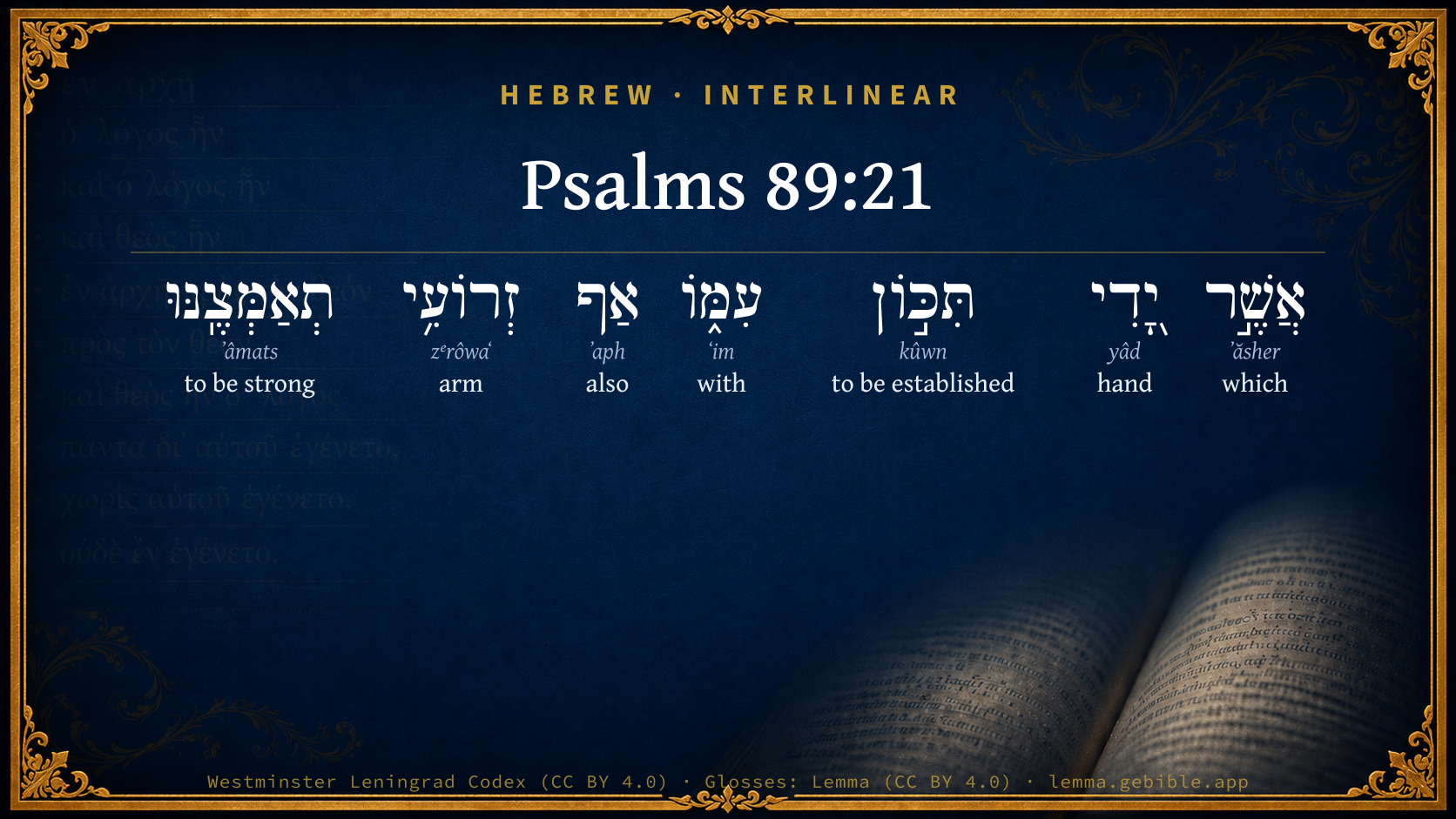
Psalms 89:21

Hebrew (Westminster Leningrad Codex) Psalms 89:21 appears in the Hebrew Old Testament. The text above is from the Westminster Leningrad Codex. Each word links to its Strong’s number, a concise gloss, and parsing drawn from the Open Scriptures Hebrew Bible morphology. Click any word for its full Brown-Driver-Briggs (BDB) entry.
Download image
Cite this verse

Psalms 89:21 (World English Bible). Public Domain. Lemma interlinear Bible study tool, https://lemma.gebible.app/v/psalms/89/21.

Show BibTeX & RIS
BibTeX
RIS
English Translation
With whom my hand shall be established. My arm will also strengthen him.
World English Bible · Public Domain
Download a study sheet

One document with this verse’s original text, its word-by-word gloss line, the meaning frame, cross-references with their text, attributed commentary, and full source and license credits — printable, and it pastes into notes with its structure intact.

This verse Autodidact and up

Study sheet (.html) Plain text (.txt)

A passage Seminary Student

Up to 50 verses in one chapter. A passage sheet keeps up to 6 commentary sources and 12 cross-references per verse, in the order this page ranks them, and says so on the sheet whenever that leaves anything out. Ask for a single verse and you get the Autodidact verse sheet above.

Everything on this page stays free to read, with no account — the sheet is a download of what is already on screen, not access to it.

Want to remove ads? Support Godless Engineer
Compare translations 3

The same verse in 3 English versions, stacked beneath the original-language interlinear above. Click any original word for its lexicon entry.

Each is an independent rendering of the whole verse — the interlinear is not word-aligned to these translations.

Highlighted words mark where these versions differ — a whole-verse word diff, not a word-by-word alignment.

  • World English Bible Public Domain
    With whom my hand shall be established. My arm will also strengthen him.
  • King James Version Public Domain
    With whom my hand shall be established: mine arm also shall strengthen him.
  • unfoldingWord Literal Text CC BY-SA 4.0
    with whom my hand will be established; my arm will also strengthen him.

unfoldingWord Literal Text — © unfoldingWord, licensed CC BY-SA 4.0. Word-aligned USFM3 via Door43 (git.door43.org/unfoldingWord/en_ult).

Versions to compare (up to 4)

3 of 4 selected

Show all 18 translations

Every available English version of this verse, each an independent rendering of the whole verse.

  • World English Bible Public Domain
    With whom my hand shall be established. My arm will also strengthen him.
  • Berean Standard Bible Public Domain
    My hand will sustain him; surely My arm will strengthen him.
  • Majority Standard Bible Public Domain
    My hand will sustain him; surely My arm will strengthen him.
  • King James Version Public Domain
    With whom my hand shall be established: mine arm also shall strengthen him.
  • American Standard Version (1901) Public Domain
    With whom my hand shall be established; Mine arm also shall strengthen him.
  • Revised Version (1885) Public Domain
    With whom my hand shall be established; mine arm also shall strengthen him.
  • Geneva Bible (1599) Public Domain
    Therefore mine hande shall be established with him, and mine arme shall strengthen him.
  • Douay-Rheims (1899) Public Domain
    I have found David my servant: with my holy oil I have anointed him.
  • Young's Literal Translation Public Domain
    With whom My hand is established, My arm also doth strengthen him.
  • Literal Standard Version CC BY-SA 4.0
    With whom My hand is established, || My arm also strengthens him.
  • Unlocked Literal Bible CC BY-SA 4.0
    My hand will support him; my arm will strengthen him.
  • unfoldingWord Literal Text CC BY-SA 4.0
    with whom my hand will be established; my arm will also strengthen him.
  • Darby Bible Public Domain
    With whom my hand shall be established; and mine arm shall strengthen him.
  • World Messianic Bible Public Domain
    with whom my hand shall be established. My arm will also strengthen him.
  • Webster's Bible Public Domain
    \\89:20\\I have found David my servant; with my holy oil have I anointed him:
  • Free Bible Version CC BY-SA 4.0
    I have placed my hand on him to steady him; and I have made him strong by my powerful arm.
  • Bible in Basic English Public Domain
    My hand will be his support; my arm will give him strength.
  • JPS Tanakh (1917) Public Domain
    (89-22) With whom My hand shall be established; Mine arm also shall strengthen him.

Literal Standard Version (2020), Covenant Press — licensed CC BY-SA 4.0. Text via the HelloAO Bible API (eBible.org). Unlocked Literal Bible (unfoldingWord) — licensed CC BY-SA 4.0. Text via the HelloAO Bible API (eBible.org). unfoldingWord Literal Text — © unfoldingWord, licensed CC BY-SA 4.0. Word-aligned USFM3 via Door43 (git.door43.org/unfoldingWord/en_ult). Free Bible Version, Dr. Jonathan Gallagher — licensed CC BY-SA 4.0. Text via the HelloAO Bible API (eBible.org).

Word by word

More ways to search: Search by grammar → Find every occurrence → Compare this word →

Practice this passage: Drill this verse → Learn its vocabulary →

תְאַמְּצֶֽנּוּ
ʼâmats
H553
“to be strong · him”
Verb, Piel, Imperfect, 3rd Person, Feminine, Singular + Suffix, Personal, 3rd Person, Masculine, Singular
Part of Speech
Verb
Stem
Piel
Form
Imperfect
Person
3rd Person
Gender
Feminine
Number
Singular
Full BDB Definition

Origin: a primitive root

TWOT: 117

to be strong, alert, courageous, brave, stout, bold, solid, hard - (Qal) to be strong, brave, bold - (Piel) to strengthen, secure (for oneself), harden (heart), make firm, make obstinate, assure - (Hithpael) to be determined, to make oneself alert, strengthen oneself, confirm oneself, persist in, prove superior to - (Hiphil) to exhibit strength, be strong, feel strong
  1. אֲשֶׁ֣ר ʼăsher H834 “which” Particle, Relative
  2. יָ֭דִי yâd H3027 “hand · my” Noun, Common, Both, Singular, Construct + Suffix, Personal, 1st Person, Common, Singular
  3. תִּכּ֣וֹן kûwn H3559 “to be established” Verb, Niphal, Imperfect, 3rd Person, Feminine, Singular
  4. עִמּ֑וֹ ʻim H5973 “with · him” Preposition + Suffix, Personal, 3rd Person, Masculine, Singular
  5. אַף ʼaph H637 “also” Particle, Accusative
  6. זְרוֹעִ֥י zᵉrôwaʻ H2220 “arm · my” Noun, Common, Both, Singular, Construct + Suffix, Personal, 1st Person, Common, Singular

About this verse

These counts appear in no published source. They are computed here, from the morphology-tagged text and Lemma’s own curated glosses. What Lemma adds →

7
words
7
distinct lemmas
Wisdom
section

Shared distinctive vocabulary

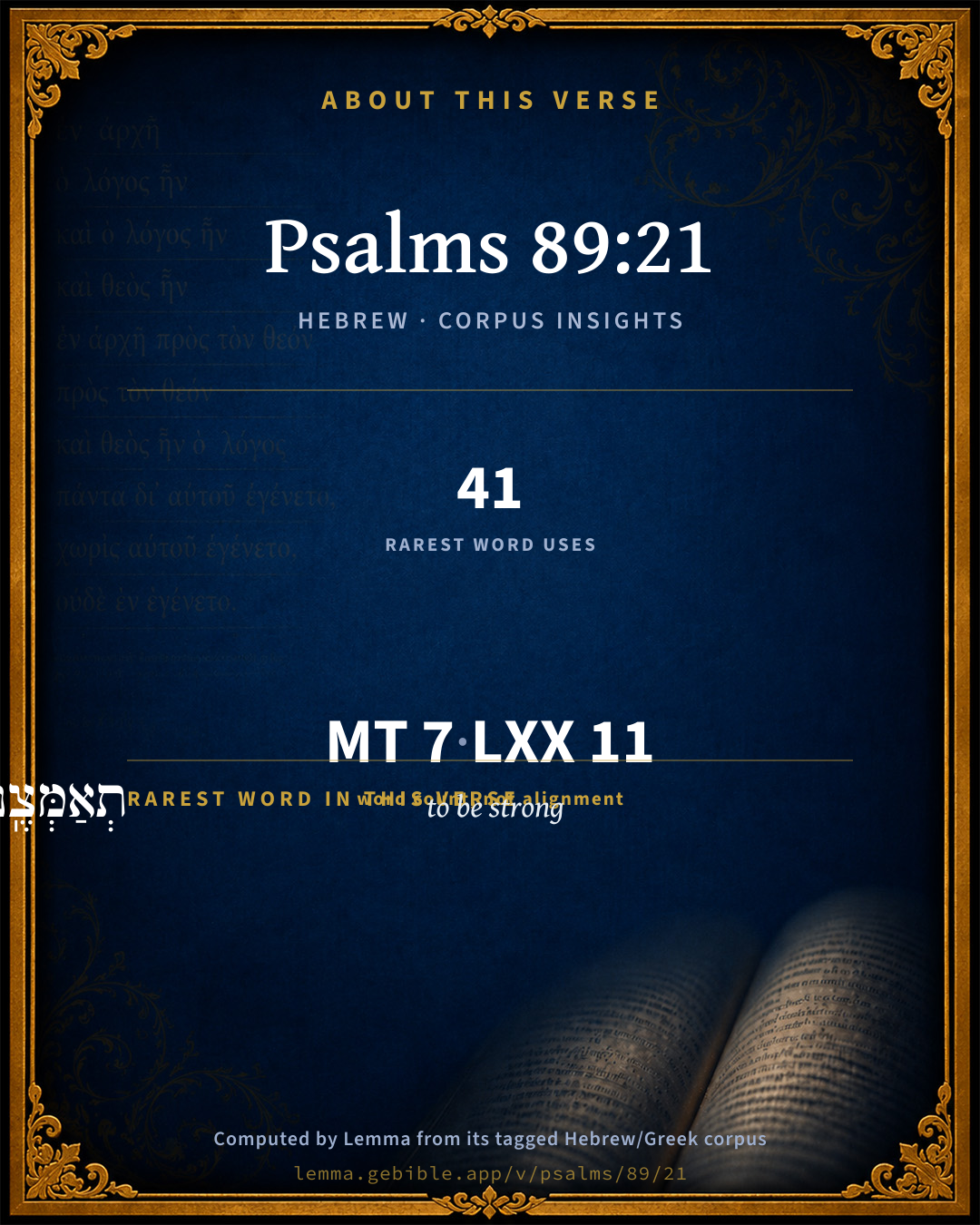
תְאַמְּצֶֽנּוּ to be strong H553 occurs in 41 verses of the Hebrew Bible. Also found in:

Grammatical profile

  • 2 verbs
  • 2 nouns
  • 1 preposition
  • 2 particles

Verb forms

  • תִּכּ֣וֹן Niphal · Imperfect
  • תְאַמְּצֶֽנּוּ Piel · Imperfect

Hebrew & Septuagint length

In English translation the verse runs 13 words from the Hebrew and 12 from the Septuagint (LXX English) — closely comparable.

A rough comparison of the two English renderings, which tokenize alike — not a word-level alignment.

Word counts can differ between the Hebrew and the Greek without any difference in meaning — e.g. the Hebrew direct-object marker אֵת has no separate Greek word, and Greek often adds the article ὁ.

In the original languages it is 7 Hebrew tokens and 11 Greek tokens — but the two are counted differently (Hebrew bundles its prefixes and suffixes into one token; the Greek is in lemma form), so that isn’t a like-for-like length.

Cross-references

9

Topical passages linked to Psalms 89:21 in the Treasury of Scripture Knowledge — connected by theme and wording, ordered by reader-vote popularity; previews shown in the World English Bible.

  • Psalms 18:32–39 The God who arms me with strength, and makes my way perfect?
  • Isaiah 42:1 Behold, my servant, whom I uphold; my chosen, in whom my soul delights: I have put my Spirit on him; he will bring forth justice to the Gentiles.
  • Psalms 89:13 You have a mighty arm. Your hand is strong, and your right hand is exalted.
  • Isaiah 41:10 Don't you be afraid, for I am with you; don't be dismayed, for I am your God; I will strengthen you; yes, I will help you; yes, I will uphold you with the right hand of my righteousness.
  • Psalms 80:15–17 The stock which your right hand planted, The branch that you made strong for yourself.
  • Ezekiel 30:24–25 I will strengthen the arms of the king of Babylon, and put my sword in his hand: but I will break the arms of Pharaoh, and he shall groan before him with the groanings of a deadly wounded man.
  • 2 Samuel 7:8–16 Now therefore thus shall you tell my servant David, Thus says Yahweh of Hosts, I took you from the sheep pen, from following the sheep, that you should be prince over my people, over Israel;
  • Isaiah 49:8 Thus says Yahweh, In an acceptable time have I answered you, and in a day of salvation have I helped you; and I will preserve you, and give you for a covenant of the people, to raise up the land, to make them inherit the desolate heritage:
  • Zechariah 10:12 I will strengthen them in Yahweh; And they will walk up and down in his name," says Yahweh.

Cross-references courtesy of OpenBible.info (CC BY 4.0).

Hebrew and Greek witnesses Masoretic Hebrew ↔ Greek Septuagint

The same verse in the two great witnesses to the Old Testament, shown verse-for-verse.

You’re reading Greek Psalm 88 (Hebrew Psalm 89). The Septuagint counts the superscription, so verse numbers can differ from the Hebrew — chapter-level alignment, not verse-by-verse. Numbering follows Rahlfs.

These are two independent witnesses, not word-aligned to each other, and the Septuagint is shown in lemma (dictionary) form.

Hebrew Psalms 89:21 Masoretic · Westminster Leningrad Codex

אֲשֶׁ֣ר יָ֭דִי תִּכּ֣וֹן עִמּ֑וֹ אַף זְרוֹעִ֥י תְאַמְּצֶֽנּוּ

With whom my hand shall be established. My arm will also strengthen him.

World English Bible · Public Domain

Greek LXX Greek Psalm 88:21 Septuagint · lemma form

εὑρίσκω δαυίδ ὁ δοῦλος ἐγώ ἐν ἔλαιον ἅγιος ἐγώ χρίω αὐτός

For my hand shall support him; and my arm shall strengthen him.

LXX2012 (modern English Septuagint) · Public Domain

On this verse, Albert Barnes' Notes on the Bible discusses the Septuagint’s reading. Read the note in Commentary ↓

Hebrew: Westminster Leningrad Codex (CC BY 4.0). Greek: Septuagint (public domain); English from LXX2012 (modern English Septuagint) (Public Domain). How the Septuagint differs from the Hebrew →

Commentary

Notes on Psalms 89:21 from classic Christian and Jewish commentators (each source and its license shown beneath its notes). The classic Christian expositions comment on the surrounding passage and are grouped to its opening verse, so a note may address several verses; the Jewish commentaries on the Tanakh (Rashi and others) are per-verse, so they appear only where the commentator wrote on this verse.

Lemma curates 59 commentaries, every one of them public domain or Creative Commons licensed, each selected and text-cleaned for this edition rather than reprinted as found. About our sources →

Trapp's Complete Commentary

John Trapp

Psa 89:21 With whom my hand shall be established: mine arm also shall strengthen him.

Ver. 21. With whom my hand shall be established] I will conduct and carry him through all conditions with comfort. See Ezr 8:22, {See Trapp on "Ezr 8:22"}

Mine arm also shall strengthen him] i.e. Omnipotentia mea et opitulatio , the arm hath more strength than the hand.

John Trapp, A Commentary or Exposition upon All the Books of the Old and New Testament (1647–1656) — public domain. Text from a community e-Sword module.

J. A. Alexander on Psalms

Joseph Addison Alexander

22. (Psa 89:21) With whom my hand shall be ever present; also my arm shall strengthen him. Ever present, literally established, permanently fixed. See below, Psa 89:37, and above, Psa 78:37. The hand and arm, as usual, are emblems of strength. See above, on Psa 89:10; Psa 89:13.

Joseph Addison Alexander, The Psalms Translated and Explained (1850) — public domain. Text from a community e-Sword module.

The Cambridge Bible for Schools and Colleges

gen. ed. J. J. S. Perowne

21. With whom &c.] My helping hand shall continually be with him: a stronger equivalent for “the Lord was with him,” 1Sa_18:12; 1Sa_18:14; 2Sa_5:10.

The Cambridge Bible for Schools and Colleges (gen. ed. J. J. S. Perowne; Cambridge University Press, 1878–1918) — public domain. Text from a community e-Sword module.

John Gill's Exposition

The enemy shall not exact upon him,.... The enemy is the devil, as in the interpretation of the parable of the tares, Mat 13:39, the implacable enemy of Christ and his church; and yet, notwithstanding all his enmity and malice, he could not "exact", or get more inflicted on him, than the law and justice of God required of him, as the sinner's surety; or could not "exact" a tribute of him, or make him tributary to him; or, in other words, conquer him, and subject him to him: so far from it, that he was conquered by Christ, and all his principalities and powers spoiled; or could not "deceive" him, in which sense the word (b) is sometimes used; and so the Targum here: though he deceived Eve, he could not deceive the Messiah, the seed of the woman; he tried it, in person, by his temptations in the wilderness, and by his agents and instruments, the Scribes and Pharisees: but in vain, and to no purpose; he could not succeed:

nor the son of wickedness afflict him: at least not always: he was indeed afflicted, as by wicked men, and by Satan the wicked one, yet not so as to be overcome by any; and as Christ personal, so Christ mystical, or his church and people, are afflicted by the sons of wickedness; yet, sooner or later, they are delivered out of all their afflictions. Antichrist, that man of sin, and son of perdition, that wicked one, that is eminently so, and may be well called "the son of wickedness", has long and greatly oppressed the people of Christ, and his interest; but he shall not always; he shall be destroyed with the spirit of his mouth, and with the brightness of his coming, Th2 2:3. This passage is applied to the Messiah by the Jews (c).

(b) "non imponet ei", Tigurine version; "non seducet eum", so some in Vatablus; "non decipiet eum", Gejerus, Schmidt. (c) Yalkut Simeoni, par. 2. fol. 56. 3.

John Gill's Exposition of the Whole Bible (1746–1763) — public domain (CC PDM 1.0). Text via the HelloAO Bible API.

Albert Barnes' Notes on the Bible

With whom my hand shall be established - Septuagint: “My hand shall aid him.” Luther; “My hand shall hold him.” DeWette; “With him my hand shall be continually.” Professor Alexander; “Shall ever be present.” The idea is, that God would always defend or protect him. He would not merely interpose at times, or at intervals, but he would be his constant protector. His hand would be permanently, or constantly, extended for his aid - as if it were a part of David’s own person, or were his own hand, to be used as he pleased. So God is the constant helper of his people. They may rely on his power; they may avail themselves of it, as if it were their own.

Mine arm also shall strengthen him - In using his own arm, he will in fact make use of the strength of mine. The people of God are as really defended as if the strength of God were theirs; or as if they were themselves almighty. The omnipotence of God is employed in their defense, and it will be as certainly exerted in their favor, and as constantly, as if it were their own. It will be no less surely employed in their defense in the hand of God than if it were in their own hand. It will be more wisely employed by him in their behalf than it would be by themselves.

Albert Barnes' Notes on the Bible (1834–1885) — public domain. Text from a community e-Sword/MySword module.

Matthew Poole's English Annotations

With whom my hand shall be established, i.e. constantly abide to protect and assist him.

Matthew Poole's English Annotations on the Holy Bible (1683–1685) — public domain. Text from a community e-Sword/MySword module.

The Treasury of David

Charles H. Spurgeon

Ver. 21. With whom my hand shall be established, or, "with whom my hand shall ever be present." The almightiness of God abides permanently with Jesus in his work as Redeemer and Ruler of his people.

Mine arm also shall strengthen him. The fulness of divine power shall attend him. This covenant promise ought to be urged in prayer before the Lord, for the great lack of the church at this time is power. We have everything except the divine energy, and we must never rest content until we see it in full operation among us. Jesus must be among us, and then there will be no lack of force in any of our church agencies.

Psalms 89:22*

Charles H. Spurgeon's The Treasury of David (1869–1885) — public domain. Psalms only. Text from a community e-Sword/MySword module.

Whedon's Commentary on the Bible

Daniel D. Whedon

21. Established… strengthen him—God, having anointed him for the office, now pledges continued and adequate help. Thus far he speaks in general terms; the particulars follow.

Daniel D. Whedon (gen. ed.), Commentary on the Old and New Testaments (1874–1909) — public domain. Text from a community e-Sword module.

The Pulpit Commentary

With whom my hand shall be established; i.e. "to whom I will give continual support". (see 1Sa_18:12, 14 2Sa_5:10 2Sa_7:9) Mine arm also shall strengthen him (comp. ver. 13).

The Pulpit Commentary (1880–1919), ed. H.D.M. Spence-Jones & Joseph S. Exell — public domain. Text from a community e-Sword module.

Lesson kit

Teaching starters — assembled from the data on this page, not authored interpretation. Every prompt links to the verse data it draws on. Edit before teaching.

Psalms, in the Wisdom, opens this verse with 7 words (7 distinct Hebrew lemmas). Its most distinctive word is ʼâmats (“to be strong”). A historical commentator’s framing appears above. Read the whole chapter for the surrounding context.

Discussion questions

  1. The word ʼâmats carries the sense “to be strong.” How does it shape the verse?
  2. Genesis 25:23 shares the word «to be strong» with this verse. How do the two illuminate each other?
  3. These translations render this verse differently. What is at stake in choosing one wording over another?
  4. The verb «תִּכּ֣וֹן» is Niphal Imperfect. How does its form color the action?
  5. Reading how Trapp's Complete Commentary and J. A. Alexander on Psalms read this verse, where do the two commentators agree and where do they part?

Things to notice

Reading settings

Reading text

Shown beneath each verse's original-language words.

Old Testament
Old Testament edition

Read the OT as the Masoretic Hebrew (MT) or the Greek Septuagint (LXX).

English shown for the Greek Septuagint (in the Hebrew ↔ Greek comparison).

Comparing translations? Open the Compare panel on any verse page to stack up to four side by side.