
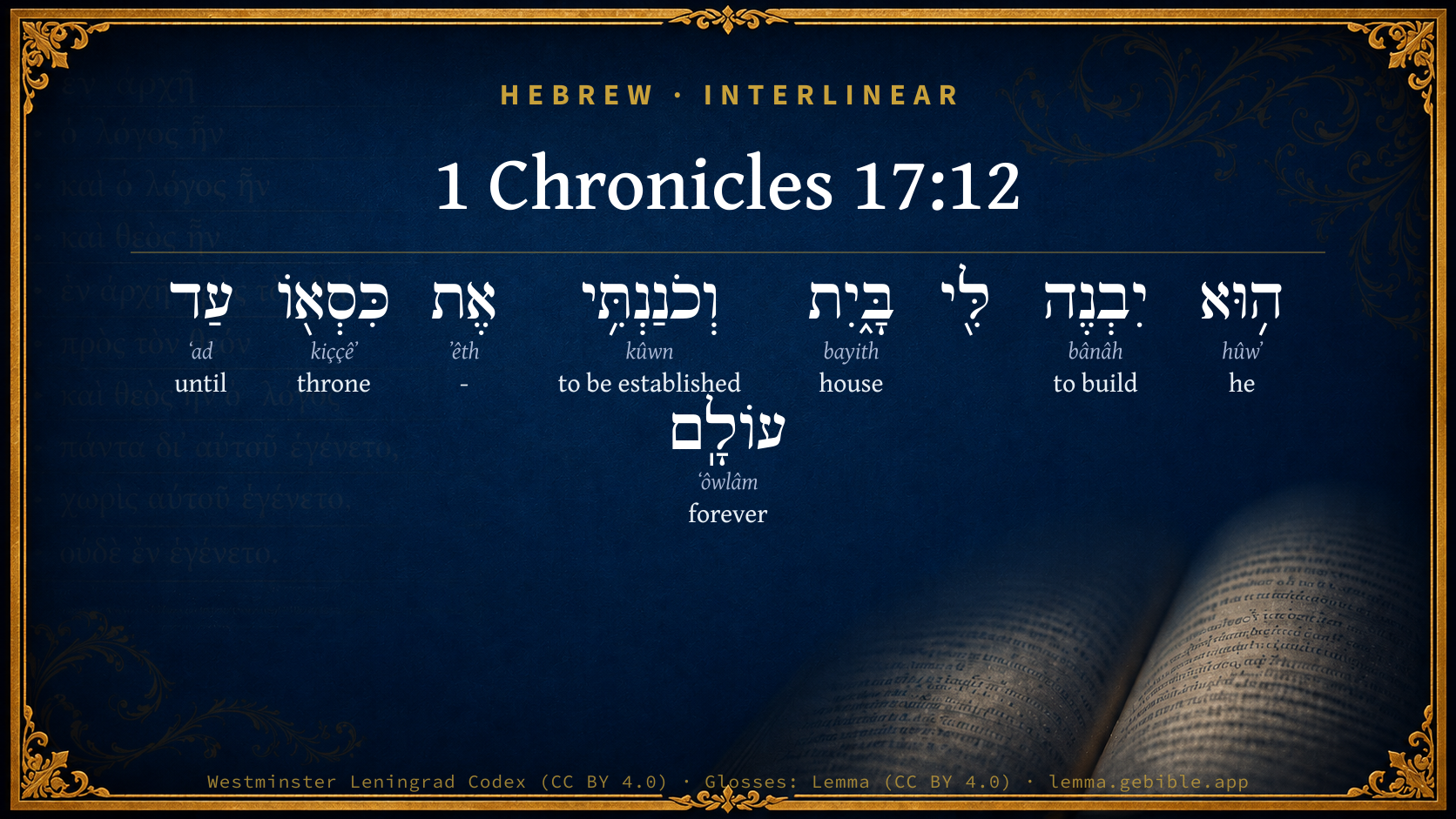
1 Chronicles 17:12

Hebrew (Westminster Leningrad Codex) 1 Chronicles 17:12 appears in the Hebrew Old Testament. The text above is from the Westminster Leningrad Codex. Each word links to its Strong’s number, a concise gloss, and parsing drawn from the Open Scriptures Hebrew Bible morphology. Click any word for its full Brown-Driver-Briggs (BDB) entry.
Download image
Cite this verse

1 Chronicles 17:12 (World English Bible). Public Domain. Lemma interlinear Bible study tool, https://lemma.gebible.app/v/1-chronicles/17/12.

Show BibTeX & RIS
BibTeX
RIS
English Translation
He shall build me a house, and I will establish his throne forever.
World English Bible · Public Domain
Download a study sheet

One document with this verse’s original text, its word-by-word gloss line, the meaning frame, cross-references with their text, attributed commentary, and full source and license credits — printable, and it pastes into notes with its structure intact.

This verse Autodidact and up

Study sheet (.html) Plain text (.txt)

A passage Seminary Student

Up to 50 verses in one chapter. A passage sheet keeps up to 6 commentary sources and 12 cross-references per verse, in the order this page ranks them, and says so on the sheet whenever that leaves anything out. Ask for a single verse and you get the Autodidact verse sheet above.

Everything on this page stays free to read, with no account — the sheet is a download of what is already on screen, not access to it.

Want to remove ads? Support Godless Engineer
Compare translations 3

The same verse in 3 English versions, stacked beneath the original-language interlinear above. Click any original word for its lexicon entry.

Each is an independent rendering of the whole verse — the interlinear is not word-aligned to these translations.

Highlighted words mark where these versions differ — a whole-verse word diff, not a word-by-word alignment.

  • World English Bible Public Domain
    He shall build me a house, and I will establish his throne forever.
  • King James Version Public Domain
    He shall build me an house, and I will stablish his throne for ever.
  • unfoldingWord Literal Text CC BY-SA 4.0
    He, he will build a house for me, and I will establish his throne to forever.

unfoldingWord Literal Text — © unfoldingWord, licensed CC BY-SA 4.0. Word-aligned USFM3 via Door43 (git.door43.org/unfoldingWord/en_ult).

Versions to compare (up to 4)

3 of 4 selected

Show all 18 translations

Every available English version of this verse, each an independent rendering of the whole verse.

  • World English Bible Public Domain
    He shall build me a house, and I will establish his throne forever.
  • Berean Standard Bible Public Domain
    He will build a house for Me, and I will establish his throne forever.
  • Majority Standard Bible Public Domain
    He will build a house for Me, and I will establish his throne forever.
  • King James Version Public Domain
    He shall build me an house, and I will stablish his throne for ever.
  • American Standard Version (1901) Public Domain
    He shall build me a house, and I will establish his throne for ever.
  • Revised Version (1885) Public Domain
    He shall build me an house, and I will establish his throne for ever.
  • Geneva Bible (1599) Public Domain
    He shall builde me an house, and I will stablish his throne for euer.
  • Douay-Rheims (1899) Public Domain
    He shall build me a house, and I will establish his throne for ever.
  • Young's Literal Translation Public Domain
    he doth build for Me a house, and I have established his throne unto the age;
  • Literal Standard Version CC BY-SA 4.0
    he builds a house for Me, and I have established his throne for all time;
  • Unlocked Literal Bible CC BY-SA 4.0
    He will build me a house, and I will establish his throne forever.
  • unfoldingWord Literal Text CC BY-SA 4.0
    He, he will build a house for me, and I will establish his throne to forever.
  • Darby Bible Public Domain
    It is he who shall build me a house, and I will establish his throne for ever.
  • World Messianic Bible Public Domain
    He will build me a house, and I will establish his throne forever.
  • Webster's Bible Public Domain
    He shall build me a house, and I will establish his throne for ever.
  • Free Bible Version CC BY-SA 4.0
    He will be the one to build me a house, and I will make sure his kingdom lasts forever.
  • Bible in Basic English Public Domain
    He will be the builder of my house, and I will make the seat of his authority certain for ever.
  • JPS Tanakh (1917) Public Domain
    He shall build Me a house, and I will establish his throne for ever.

Literal Standard Version (2020), Covenant Press — licensed CC BY-SA 4.0. Text via the HelloAO Bible API (eBible.org). Unlocked Literal Bible (unfoldingWord) — licensed CC BY-SA 4.0. Text via the HelloAO Bible API (eBible.org). unfoldingWord Literal Text — © unfoldingWord, licensed CC BY-SA 4.0. Word-aligned USFM3 via Door43 (git.door43.org/unfoldingWord/en_ult). Free Bible Version, Dr. Jonathan Gallagher — licensed CC BY-SA 4.0. Text via the HelloAO Bible API (eBible.org).

Word by word

More ways to search: Search by grammar → Find every occurrence → Compare this word →

Practice this passage: Drill this verse → Learn its vocabulary →

About this verse

These counts appear in no published source. They are computed here, from the morphology-tagged text and Lemma’s own curated glosses. What Lemma adds →

9
words
8
distinct lemmas
Historical
section

Grammatical profile

  • 2 verbs
  • 3 nouns
  • 1 pronoun
  • 2 prepositions
  • 1 particle

Verb forms

  • יִבְנֶה Qal · Imperfect
  • וְכֹנַנְתִּ֥י Polel · Sequential Perfect

Hebrew & Septuagint length

In English translation the verse runs 13 words from the Hebrew and 15 from the Septuagint (LXX English) — closely comparable.

A rough comparison of the two English renderings, which tokenize alike — not a word-level alignment.

Word counts can differ between the Hebrew and the Greek without any difference in meaning — e.g. the Hebrew direct-object marker אֵת has no separate Greek word, and Greek often adds the article ὁ.

In the original languages it is 9 Hebrew tokens and 11 Greek tokens — but the two are counted differently (Hebrew bundles its prefixes and suffixes into one token; the Greek is in lemma form), so that isn’t a like-for-like length.

Cross-references

16

Topical passages linked to 1 Chronicles 17:12 in the Treasury of Scripture Knowledge — connected by theme and wording, ordered by reader-vote popularity; previews shown in the World English Bible.

  • Isaiah 9:7 Of the increase of his government and of peace there shall be no end, on the throne of David, and on his kingdom, to establish it, and to uphold it with justice and with righteousness from henceforth even forever. The zeal of Yahweh of Hosts will perform this.
  • Daniel 2:44 In the days of those kings shall the God of heaven set up a kingdom which shall never be destroyed, nor shall the sovereignty of it be left to another people; but it shall break in pieces and consume all these kingdoms, and it shall stand forever.
  • 1 Kings 5:5 Behold, I purpose to build a house for the name of Yahweh my God, as Yahweh spoke to David my father, saying, Your son, whom I will set on your throne in your room, he shall build the house for my name.
  • Acts 7:47–48 But Solomon built him a house.
  • Revelation 11:15 The seventh angel sounded, and great voices in heaven followed, saying, "The kingdom of the world has become the Kingdom of our Lord, and of his Christ. He will reign forever and ever!"
  • 1 Chronicles 22:9–10 Behold, a son shall be born to you, who shall be a man of rest; and I will give him rest from all his enemies round about; for his name shall be Solomon, and I will give peace and quietness to Israel in his days:
  • 1 Chronicles 28:6–10 He said to me, Solomon your son, he shall build my house and my courts; for I have chosen him to be my son, and I will be his father.
  • Psalms 89:36–37 His seed will endure forever, His throne like the sun before me.
  • 2 Chronicles 3:1–4 Then Solomon began to build the house of Yahweh at Jerusalem on Mount Moriah, where [Yahweh] appeared to David his father, which he made ready in the place that David had appointed, in the threshing floor of Ornan the Jebusite.
  • Ezra 5:11 Thus they returned us answer, saying, We are the servants of the God of heaven and earth, and are building the house that was built these many years ago, which a great king of Israel built and finished.
  • Psalms 89:4 'I will establish your seed forever, And build up your throne to all generations.'" Selah.
  • Psalms 89:29 I will also make his seed endure forever, And his throne as the days of heaven.
  • Zechariah 6:12–13 and speak to him, saying, 'Thus says Yahweh of Hosts, "Behold, the man whose name is the Branch: and he shall grow up out of his place; and he shall build the temple of Yahweh;
  • John 2:19–21 Jesus answered them, "Destroy this temple, and in three days I will raise it up."
  • 1 Corinthians 15:25 For he must reign until he has put all his enemies under his feet.
  • Colossians 2:9 For in him all the fullness of the Godhead dwells bodily,

Cross-references courtesy of OpenBible.info (CC BY 4.0).

Hebrew and Greek witnesses Masoretic Hebrew ↔ Greek Septuagint

The same verse in the two great witnesses to the Old Testament, shown verse-for-verse.

These are two independent witnesses, not word-aligned to each other, and the Septuagint is shown in lemma (dictionary) form.

Hebrew 1 Chronicles 17:12 Masoretic · Westminster Leningrad Codex

ה֥וּא יִבְנֶה לִּ֖י בָּ֑יִת וְכֹנַנְתִּ֥י אֶת כִּסְא֖וֹ עַד עוֹלָֽם

He shall build me a house, and I will establish his throne forever.

World English Bible · Public Domain

Greek LXX 1 Chronicles 17:12 Septuagint · lemma form

αὐτός οἰκοδομέω ἐγώ οἶκος καί ἀναὀρθόω ὁ θρόνος αὐτός ἕως αἰών

He shall build me a house, and I will set up his throne for ever.

LXX2012 (modern English Septuagint) · Public Domain

Hebrew: Westminster Leningrad Codex (CC BY 4.0). Greek: Septuagint (public domain); English from LXX2012 (modern English Septuagint) (Public Domain). How the Septuagint differs from the Hebrew →

Commentary

Notes on 1 Chronicles 17:12 from classic Christian and Jewish commentators (each source and its license shown beneath its notes). The classic Christian expositions comment on the surrounding passage and are grouped to its opening verse, so a note may address several verses; the Jewish commentaries on the Tanakh (Rashi and others) are per-verse, so they appear only where the commentator wrote on this verse.

Lemma curates 59 commentaries, every one of them public domain or Creative Commons licensed, each selected and text-cleaned for this edition rather than reprinted as found. About our sources →

Tyndale Open Study Notes

Tyndale Open Resources

17:12 The construction of the Temple was a central aspect of God’s kingdom on earth. Solomon later built the Temple (2 Chr 2–7) and fulfilled this promise.

Tyndale Open Study Notes — © Tyndale Open Resources, licensed CC BY-SA 4.0. Text via the HelloAO Bible API.

Geneva Bible (1599)

Geneva Bible translators

That is, unto the coming of Christ: for then these figures should cease.

Geneva Bible (1599) marginal notes — public domain. Text via Bolls.life.

Adam Clarke's Commentary

Verse 12. I will establish his throne for ever.] David was a type of Christ; and concerning him the prophecy is literally true. See Isa 9:7, where there is evidently the same reference.

Adam Clarke's Commentary on the Bible (1810–1826) — public domain. Text from a community e-Sword/MySword module.

Ellicott's Commentary for English Readers

(12) He.—The emphatic word.

Build me.—Samuel, “for my name.” (See 1Ki_8:29; 1Ki_9:3.)

His throne.—Samuel, “throne of his kingdom”—a characteristic abridgment.

A Bible Commentary for English Readers, edited by Charles John Ellicott (1878–1897) — public domain. Text from a community e-Sword module.

The Cambridge Bible for Schools and Colleges

gen. ed. J. J. S. Perowne

12. me a house] Sam. an house for my name.

The Cambridge Bible for Schools and Colleges (gen. ed. J. J. S. Perowne; Cambridge University Press, 1878–1918) — public domain. Text from a community e-Sword module.

Haydock's Catholic Bible Commentary

Ever often means only a long duration. The dominion of Christ shall have no end. (Calmet) --- The Church founded by this true David, (Haydock) falls heir to these promises. (Du Hamel)

George Leo Haydock (1774–1849), Haydock's Catholic Family Bible and Commentary, 1859 edition — public domain. Excludes Psalms (Douay-Rheims chapter numbering differs from Protestant) and Deuterocanonical books (Catholic canon only).

The Pulpit Commentary

Vers. 12-14. The reference of these promises was also to Solomon, and to him they were faithfully fulfilled. They were early perceived to be prophecies also, and of the highest significance and application (Psa_89:26-37; Isa_9:7 Isa_55:3, Isa_55:4; Jer_23:5, 6 33:17-21; Zec_6:12, Zec_6:13; Heb_1:5 Heb_3:6) The alternative of the "son who commits iniquity" (2Sa_7:14) is omitted from the middle of our thirteenth verse. The latter half of ver. 13 manifestly purports to say, "I will not take my mercy away from Solomon, as I did take it away from Saul." The close of our fourteenth verse is in the parallel place (2Sa_7:16) distinctly referred to David, with the use of the second person possessive pronoun.

A mutual covenant.

This prophetic declaration must be read in the light of subsequent events; for it was fulfilled in the annals of Solomon"s peaceful and prosperous reign. The king did build God a house, a service and honour not permitted to his father. God did establish Solomon"s throne, giving him victory, peace, wealth, wisdom, and fame. The connection between the two parts of this verse is very instructive, exhibiting as it does the relation between God and his people. He, in mercy, condescends to accept their services, and at the same time confers upon them the tokens of his favour, blessing and prosperity.

I WHAT WE MAY DO FOR GOD. In using such language, we must bear in mind our entire dependence. It is only by employing the powers our Creator has given, the opportunities he has afforded us, that we can be enabled to accomplish any work for his glory. He gives the motive to all service in the love of Christ, the power for all service in the grace of the Holy Spirit. Still, just as Solomon was permitted to build God a house, so every Christian has some edifice of holy, devoted, acceptable service to rear to his Saviour"s praise. It is matter for wondering gratitude that we, poor, ignorant, feeble, helpless creatures, should be allowed to do anything for the honour of the Most High God; that he should deign to accept anything at our unworthy hands. Yet we are not only at liberty, we are actually invited, first, to provide in our heart a habitation for the Eternal, and further to construct some building of fair deeds of holiness and benevolence which shall glorify his sacred name.

II WHAT GOD WILL DO FOR US. Regarding Solomon, this was the Lord"s promise: "I will establish his throne for ever." Our calling, our circumstances, differ from those of Israel"s king. Yet there is a certain appropriateness in this language, as applied to all the people of God. The blessings of spiritual strength, stability, and peace, are assured by a gracious and covenant God to all his people. He is their "Sun and Shield." His compassion toward them shall not fail. They shall rejoice in his favour and his faithfulness. "They shall not be ashamed or confounded, world without end.

CONCLUSION.

1. Let us diligently seek God"s favour. It is in Christ that he has shownhimself gracious. His favour is life, and it may be secured by every lowly, faithful applicant.

2. Let us show our sense of God"s favour to us, by offering our devotedservice to him. The wonder is even greater that God should suffer us to do aught for him, than that he should do so much for us. Let us respond to his summons, and "arise and build. T.

The Pulpit Commentary (1880–1919), ed. H.D.M. Spence-Jones & Joseph S. Exell — public domain. Text from a community e-Sword module.

Lesson kit

Teaching starters — assembled from the data on this page, not authored interpretation. Every prompt links to the verse data it draws on. Edit before teaching.

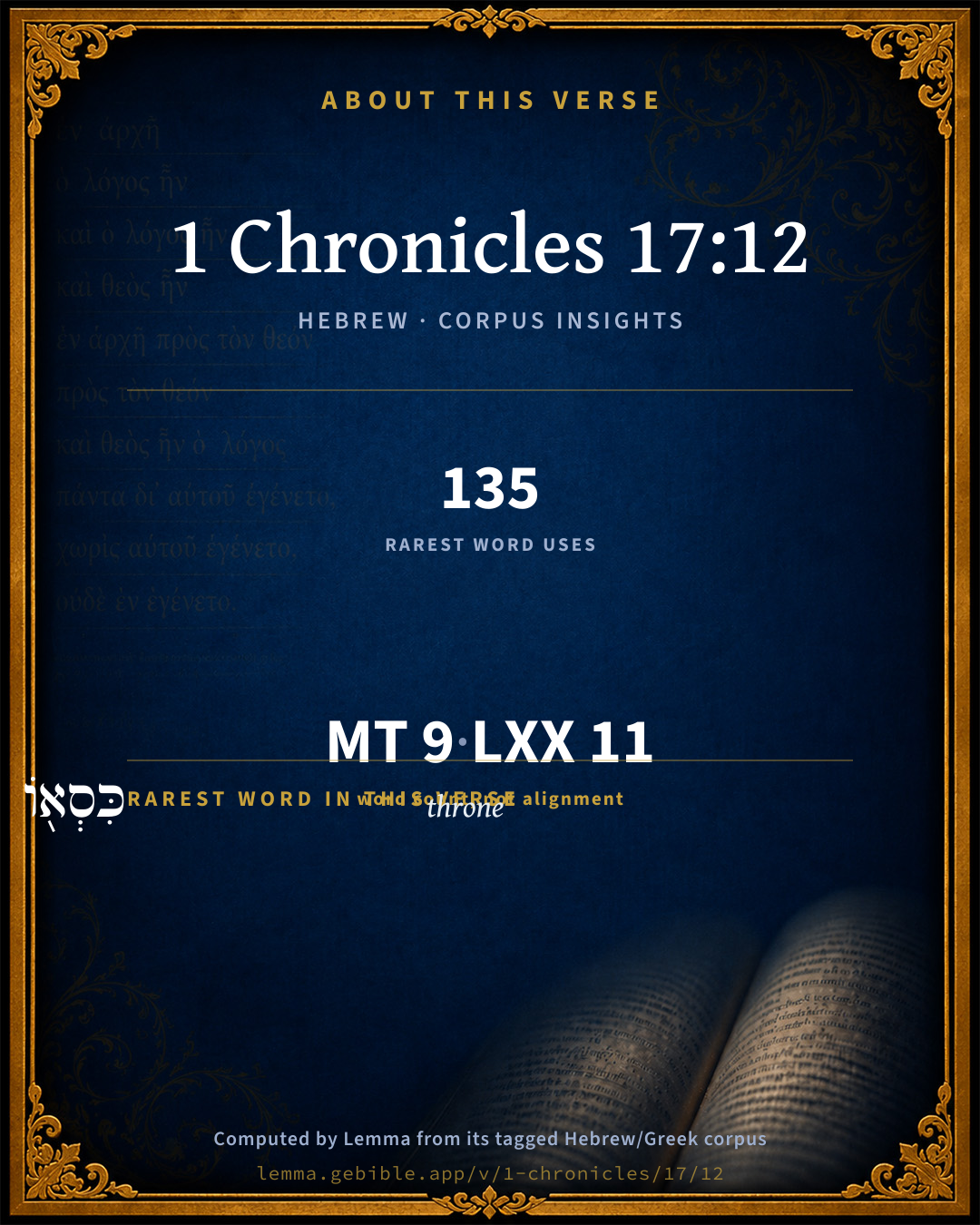
1 Chronicles, in the Historical, opens this verse with 9 words (8 distinct Hebrew lemmas). Its most distinctive word is kiççêʼ (“throne”). A historical commentator’s framing appears above. Read the whole chapter for the surrounding context.

Discussion questions

  1. The word kiççêʼ carries the sense “throne.” How does it shape the verse?
  2. Isaiah 9:7 shares this passage’s theme. How do the two illuminate each other?
  3. These translations render this verse differently; the difference is in the English rendering, not the original. What questions does that raise?
  4. The verb «יִבְנֶה» is Qal Imperfect. How does its form color the action?
  5. Reading how Tyndale Open Study Notes and Geneva Bible (1599) read this verse, where do the two commentators agree and where do they part?

Things to notice

Reading settings

Reading text

Shown beneath each verse's original-language words.

Old Testament
Old Testament edition

Read the OT as the Masoretic Hebrew (MT) or the Greek Septuagint (LXX).

English shown for the Greek Septuagint (in the Hebrew ↔ Greek comparison).

Comparing translations? Open the Compare panel on any verse page to stack up to four side by side.