
Job 31:15

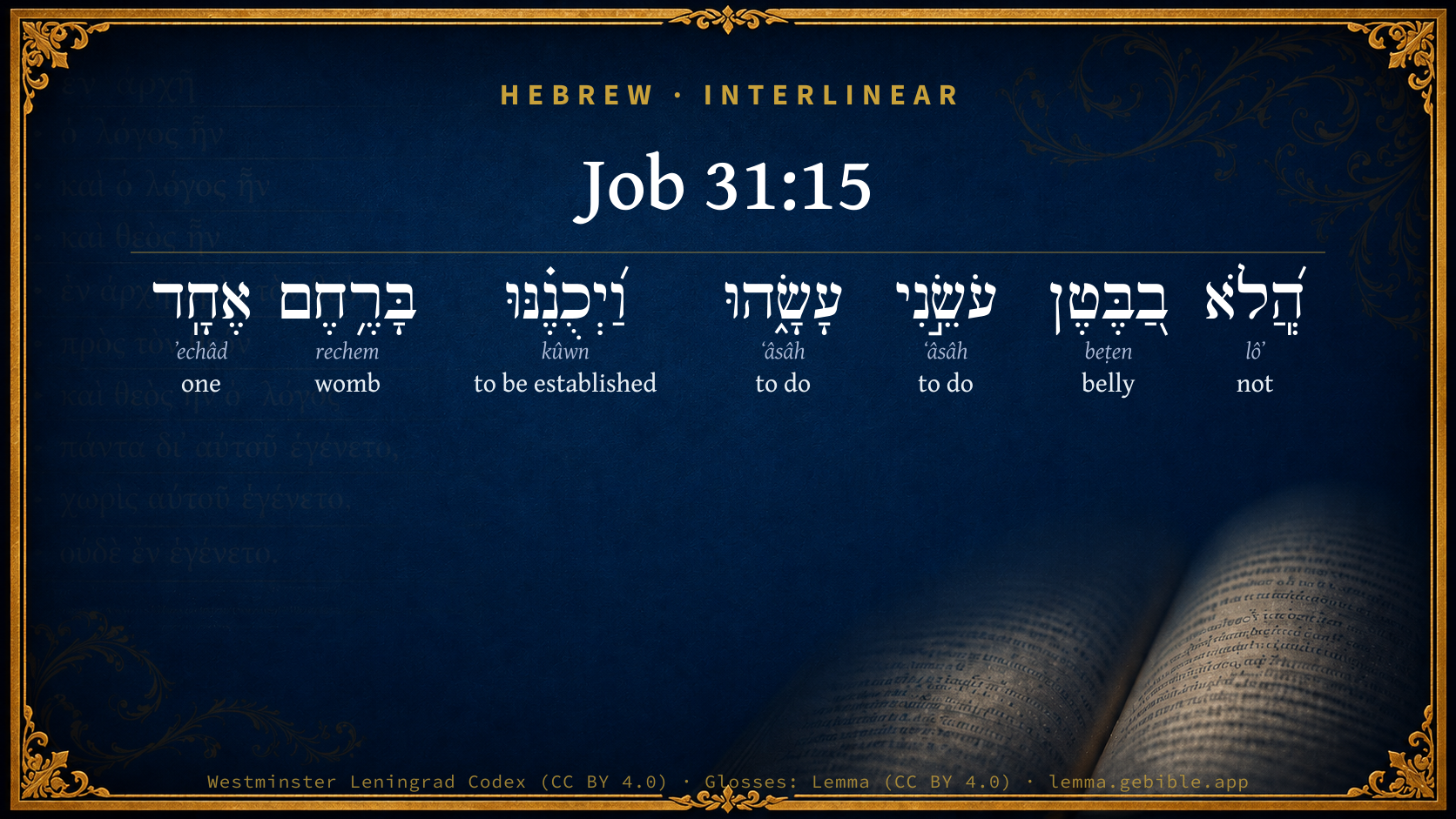
Hebrew (Westminster Leningrad Codex) Job 31:15 appears in the Hebrew Old Testament. The text above is from the Westminster Leningrad Codex. Each word links to its Strong’s number, a concise gloss, and parsing drawn from the Open Scriptures Hebrew Bible morphology. Click any word for its full Brown-Driver-Briggs (BDB) entry.
Download image
Cite this verse

Job 31:15 (World English Bible). Public Domain. Lemma interlinear Bible study tool, https://lemma.gebible.app/v/job/31/15.

Show BibTeX & RIS
BibTeX
RIS
English Translation
Didn't he who made me in the womb make him? Didn't one fashion us in the womb?
World English Bible · Public Domain
Download a study sheet

One document with this verse’s original text, its word-by-word gloss line, the meaning frame, cross-references with their text, attributed commentary, and full source and license credits — printable, and it pastes into notes with its structure intact.

This verse Autodidact and up

Study sheet (.html) Plain text (.txt)

A passage Seminary Student

Up to 50 verses in one chapter. A passage sheet keeps up to 6 commentary sources and 12 cross-references per verse, in the order this page ranks them, and says so on the sheet whenever that leaves anything out. Ask for a single verse and you get the Autodidact verse sheet above.

Everything on this page stays free to read, with no account — the sheet is a download of what is already on screen, not access to it.

Want to remove ads? Support Godless Engineer
Compare translations 3

The same verse in 3 English versions, stacked beneath the original-language interlinear above. Click any original word for its lexicon entry.

Each is an independent rendering of the whole verse — the interlinear is not word-aligned to these translations.

Highlighted words mark where these versions differ — a whole-verse word diff, not a word-by-word alignment.

  • World English Bible Public Domain
    Didn't he who made me in the womb make him? Didn't one fashion us in the womb?
  • King James Version Public Domain
    Did not he that made me in the womb make him? and did not one fashion us in the womb?
  • unfoldingWord Literal Text CC BY-SA 4.0
    Did not the one making me in the belly make him? And did one fashion us in the womb?

unfoldingWord Literal Text — © unfoldingWord, licensed CC BY-SA 4.0. Word-aligned USFM3 via Door43 (git.door43.org/unfoldingWord/en_ult).

Versions to compare (up to 4)

3 of 4 selected

Show all 18 translations

Every available English version of this verse, each an independent rendering of the whole verse.

  • World English Bible Public Domain
    Didn't he who made me in the womb make him? Didn't one fashion us in the womb?
  • Berean Standard Bible Public Domain
    Did not He who made me in the womb also make them? Did not the same One form us in the womb?
  • Majority Standard Bible Public Domain
    Did not He who made me in the womb also make them? Did not the same One form us in the womb?
  • King James Version Public Domain
    Did not he that made me in the womb make him? and did not one fashion us in the womb?
  • American Standard Version (1901) Public Domain
    Did not he that made me in the womb make him? And did not one fashion us in the womb?
  • Revised Version (1885) Public Domain
    Did not he that made me in the womb make him? and did not one fashion us in the womb?
  • Geneva Bible (1599) Public Domain
    He that hath made me in the wombe, hath he not made him? hath not he alone facioned vs in the wombe?
  • Douay-Rheims (1899) Public Domain
    Did not he that made me in the womb make him also: and did not one and the same form me in the womb?
  • Young's Literal Translation Public Domain
    Did not He that made me in the womb make him? Yea, prepare us in the womb doth One.
  • Literal Standard Version CC BY-SA 4.0
    Did He that made me in the womb not make him? Indeed, One prepares us in the womb.
  • Unlocked Literal Bible CC BY-SA 4.0
    Did the one who made me in the womb not make them also? Did not the same one mold us all in the womb?
  • unfoldingWord Literal Text CC BY-SA 4.0
    Did not the one making me in the belly make him? And did one fashion us in the womb?
  • Darby Bible Public Domain
    Did not he that made me in the womb make him? and did not One fashion us in the womb?
  • World Messianic Bible Public Domain
    Didn’t he who made me in the womb make him? Didn’t one fashion us in the womb?
  • Webster's Bible Public Domain
    Did not he that made me in the womb make him? and did not one fashion us in the womb?
  • Free Bible Version CC BY-SA 4.0
    Didn't the same God make all of us?
  • Bible in Basic English Public Domain
    Did not God make him as well as me? did he not give us life in our mothers' bodies?
  • JPS Tanakh (1917) Public Domain
    Did not He that made me in the womb make him? And did not One fashion us in the womb?

Literal Standard Version (2020), Covenant Press — licensed CC BY-SA 4.0. Text via the HelloAO Bible API (eBible.org). Unlocked Literal Bible (unfoldingWord) — licensed CC BY-SA 4.0. Text via the HelloAO Bible API (eBible.org). unfoldingWord Literal Text — © unfoldingWord, licensed CC BY-SA 4.0. Word-aligned USFM3 via Door43 (git.door43.org/unfoldingWord/en_ult). Free Bible Version, Dr. Jonathan Gallagher — licensed CC BY-SA 4.0. Text via the HelloAO Bible API (eBible.org).

Word by word

More ways to search: Search by grammar → Find every occurrence → Compare this word →

Practice this passage: Drill this verse → Learn its vocabulary →

בָּרֶ֥חֶם
rechem
H7358
“in/at the · womb”
Preposition, Determined + Noun, Common, Masculine, Singular, Absolute
Part of Speech
Preposition + Noun
Type
Common
Gender
Masculine
Number
Singular
State
Absolute
Full BDB Definition

Origin: from H7355

TWOT: 2146a

womb - womb - womb-man, woman-slave, woman, two women
  1. הֲֽ֝לֹא lôʼ H3808 “not” Particle, Interrogative + Particle, Negative
  2. בַ֭בֶּטֶן beṭen H990 “in/at the · belly” Preposition, Determined + Noun, Common, Feminine, Singular, Absolute
  3. עֹשֵׂ֣נִי ʻâsâh H6213 “doing · me” Verb, Qal, Participle Active, Masculine, Singular, Construct + Suffix, Personal, 1st Person, Common, Singular
  4. עָשָׂ֑הוּ ʻâsâh H6213 “to do · him” Verb, Qal, Perfect, 3rd Person, Masculine, Singular + Suffix, Personal, 3rd Person, Masculine, Singular
  5. וַ֝יְכֻנֶ֗נּוּ kûwn H3559 “and · to be established · us” Conjunction + Verb, Polel, Sequential Imperfect, 3rd Person, Masculine, Singular + Suffix, Personal, 1st Person, Common, Plural
  6. אֶחָֽד ʼechâd H259 “one” Adjective, Cardinal number, Masculine, Singular, Absolute

About this verse

These counts appear in no published source. They are computed here, from the morphology-tagged text and Lemma’s own curated glosses. What Lemma adds →

7
words
6
distinct lemmas
Wisdom
section

Shared distinctive vocabulary

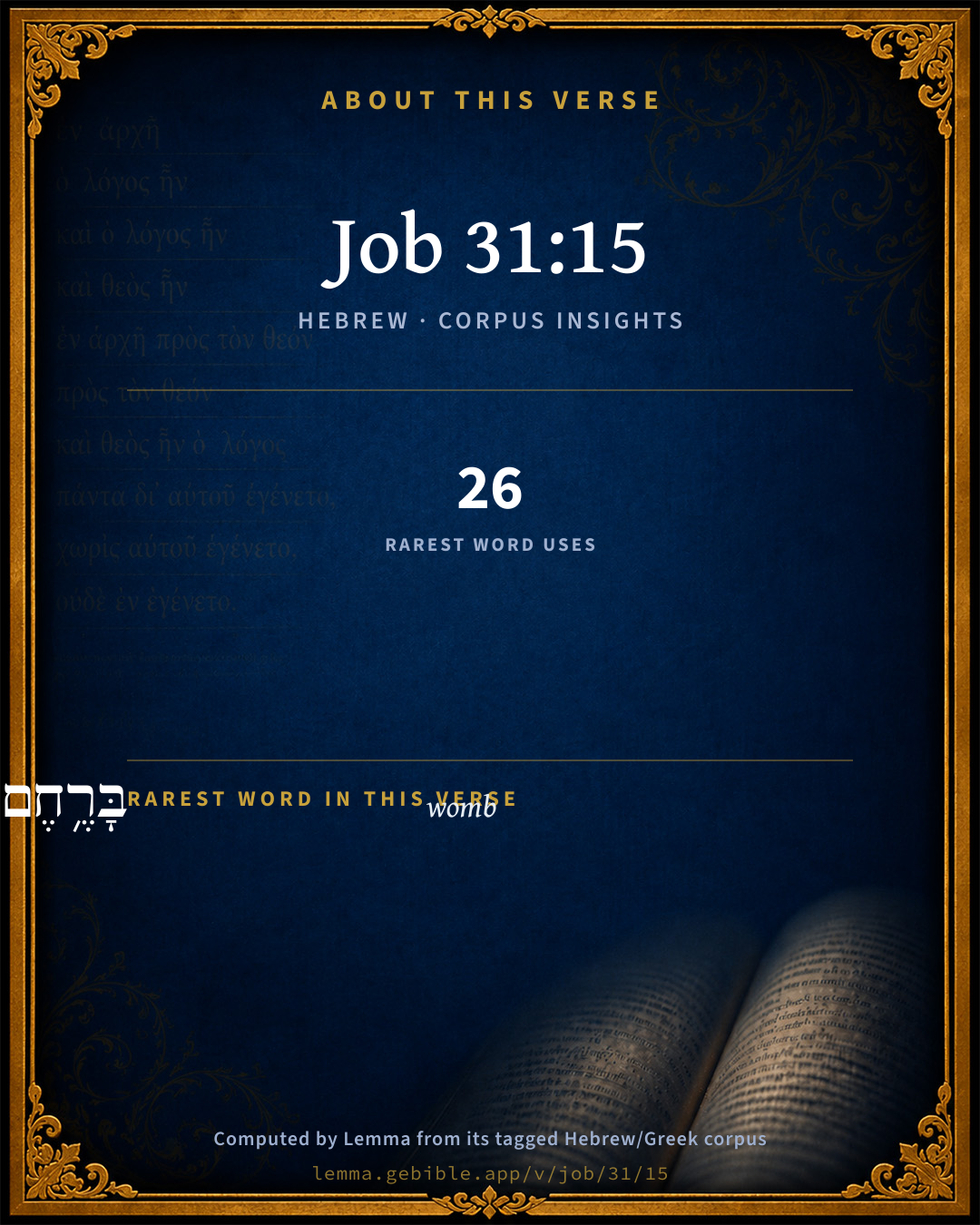
בָּרֶ֥חֶם womb H7358 occurs in 25 verses of the Hebrew Bible. Also found in:

Grammatical profile

  • 3 verbs
  • 2 nouns
  • 1 adjective
  • 1 particle

Verb forms

  • עֹשֵׂ֣נִי Qal · Participle Active
  • עָשָׂ֑הוּ Qal · Perfect
  • וַ֝יְכֻנֶ֗נּוּ Polel · Sequential Imperfect

Repetition

A word recurs within this verse — often emphatic in Hebrew:

  • עֹשֵׂ֣נִי to do H6213 ×2

Hebrew & Septuagint length

In English translation the verse runs 17 words from the Hebrew and 21 from the Septuagint (LXX English) — closely comparable.

A rough comparison of the two English renderings, which tokenize alike — not a word-level alignment.

Word counts can differ between the Hebrew and the Greek without any difference in meaning — e.g. the Hebrew direct-object marker אֵת has no separate Greek word, and Greek often adds the article ὁ.

Cross-references

9

Topical passages linked to Job 31:15 in the Treasury of Scripture Knowledge — connected by theme and wording, ordered by reader-vote popularity; previews shown in the World English Bible.

  • Proverbs 14:31 He who oppresses the poor shows contempt for his Maker, But he who is kind to the needy honors him.
  • Job 34:19 Who doesn't respect the persons of princes, Nor regards the rich more than the poor; For they all are the work of his hands.
  • Proverbs 22:2 The rich and the poor have this in common: Yahweh is the maker of them all.
  • Malachi 2:10 Don't we all have one father? Hasn't one God created us? Why do we deal treacherously every man against his brother, profaning the covenant of our fathers?
  • Job 10:8–12 'Your hands have framed me and fashioned me altogether; Yet you destroy me.
  • Nehemiah 5:5 Yet now our flesh is as the flesh of our brothers, our children as their children: and, behold, we bring into bondage our sons and our daughters to be servants, and some of our daughters are brought into bondage [already]: neither is it in our power to help it; for other men have our fields and our vineyards.
  • Job 10:3 Is it good to you that you should oppress, That you should despise the work of your hands, And smile on the counsel of the wicked?
  • Psalms 139:14–16 I will give thanks to you, For I am fearfully and wonderfully made. Your works are wonderful. My soul knows that very well.
  • Isaiah 58:7 Isn't it to deal your bread to the hungry, and that you bring the poor who are cast out to your house? when you see the naked, that you cover him; and that you not hide yourself from your own flesh?

Cross-references courtesy of OpenBible.info (CC BY 4.0).

Hebrew and Greek witnesses Masoretic Hebrew ↔ Greek Septuagint

The same verse in the two great witnesses to the Old Testament, shown verse-for-verse.

These are two independent witnesses, not word-aligned to each other, and the Septuagint is shown in lemma (dictionary) form.

Hebrew Job 31:15 Masoretic · Westminster Leningrad Codex

הֲֽ֝לֹא בַ֭בֶּטֶן עֹשֵׂ֣נִי עָשָׂ֑הוּ וַ֝יְכֻנֶ֗נּוּ בָּרֶ֥חֶם אֶחָֽד

Didn't he who made me in the womb make him? Didn't one fashion us in the womb?

World English Bible · Public Domain

Greek LXX Job 31:15 Septuagint · lemma form

πότερον οὐ ὡς καί ἐγώ γίγνομαι ἐν γαστήρ καί ἐκεῖνος γίγνομαι γίγνομαι δέ ἐν ὁ αὐτός κοιλία

Were not they too formed as I also was formed in the womb? yes, we were formed in the same womb.

LXX2012 (modern English Septuagint) · Public Domain

Hebrew: Westminster Leningrad Codex (CC BY 4.0). Greek: Septuagint (public domain); English from LXX2012 (modern English Septuagint) (Public Domain). How the Septuagint differs from the Hebrew →

Commentary

Notes on Job 31:15 from classic Christian and Jewish commentators (each source and its license shown beneath its notes). The classic Christian expositions comment on the surrounding passage and are grouped to its opening verse, so a note may address several verses; the Jewish commentaries on the Tanakh (Rashi and others) are per-verse, so they appear only where the commentator wrote on this verse.

Lemma curates 59 commentaries, every one of them public domain or Creative Commons licensed, each selected and text-cleaned for this edition rather than reprinted as found. About our sources →

Trapp's Complete Commentary

John Trapp

Job 31:15 Did not he that made me in the womb make him? and did not one fashion us in the womb?

Ver. 15. Did not he that made me in the womb, make him?] In which regard have not we all one Father, and hath not one God created us? Mal 2:10. Is it not he who formeth and shapeth us, and all by the book, Psa 139:16. We are all of all sorts in this respect (whether kings or captives, lords or lowlies), made of the same mould, hewn out of the same rock, digged out of the same pit, cut out of the same piece, the shears only going between, as they say. Thus for our bodies, and for our better part, is not the meanest made in God’s image, and as capable of heaven, if God please, as the greatest? In the law the servant paid the half shekel as well as the master; and in Christ Jesus, as there is neither Jew nor Greek, so neither bond nor free, Gal 3:28. Truth it is, God hath made these distinctions and degrees among men, but himself is no respecter of persons. He acknowledgeth no faces (so the Hebrew expresseth it). He taketh no notice of any man’s outward condition, as country, sex, wisdom, wealth, dignity, &c. These neither please God nor displease him, but as they are in a good or bad man; as a cipher by itself is nothing without a figure before it. This reason wrought with Job, and should do, doubtless, with all superiors, to bring them to a moderation. Why should a poor man be slighted or brow beaten? Is he not God’s handiwork also? Was he not made in secret, and curiously wrought in the lowest parts of the earth? Psa 139:15, that is, in his mother’s womb, as it followeth.

And did not one (that is God) fashion (Heb. apt or fit) us in the womb?] Quum fortuna, non natura eos fecerit servos, cur, propter fortunam, eos contemptiores habuissem? Forasmuch as not Nature, but Providence, hath made them my servants, why should I for that cause deal hardly with them; and not rather favour them the more, for our common condition of birth, and death, and coming to judgment? Apte et concinne elaboravit (Brent.). Servus αυναδελφος vei ομοδελφος domini sui est.

John Trapp, A Commentary or Exposition upon All the Books of the Old and New Testament (1647–1656) — public domain. Text from a community e-Sword module.

The Biblical Illustrator

Joseph S. Exell

Job_31:15

Did not He that made me in the womb make him?

God the universal Creator

I. Illustrate the doctrine here conveyed. Both high and low, rich and poor, all sorts and conditions of men, have one common Creator.

1. The unity of creation, Mens tastes, habits, abodes, and appearances differ, but men are one family.

2. The high position of the Divine Being. There are none to divide His praise, none to claim His position.

3. The harmony of Gods providential dealings. He can cause one event to fit in with another, one person to assist and help his fellow, and out of the apparently diverse elements to make one perfect,, harmonious, and beautiful whole.

II. Apply the subject to our own improvement. We are taught from the fact stated by Job. If we see another sin, our language should be, Did not He that made me make him? And we should bear with him tenderly. If we see another in want or poverty our thoughts should be, Did not He that made me make him? And we should afford our best relief.

1. Some suggestions for our duty towards God. He is our Creator. As our supreme Benefactor and Maker we should manifest our sense of His authority over us and our dependence on His care.

2. Some reflections on our duty one to another. (Homilist.)

Mans common rights

Had we not one and the same Creator, and have we not consequently the same nature? We may observe in regard to this sentiment--

1. That it indicates a very advanced state of view in regard to man. The attempt has been always made by those who wish to tyrannise over others, or who aim to make slaves of others, to show that they are of a different race, and that in the design for which they were made, they are wholly inferior. Arguments have been derived from their complexion, from their supposed inferiority of intellect, and the deep degradation of their condition, often little above that of brutes, to prove that they were originally inferior to the rest of mankind. On this the plea has been often urged, and oftener felt than urged, that it is right to reduce them to slavery. Since this feeling so early existed, and since there is so much that may be plausibly said in defence of it, it shows that Job had derived his views from something more than the speculations of men and the desire of power, when he says that he regarded all men as originally equal, and as having the same Creator. It is, in fact, a sentiment which men have been practically very reluctant to believe, and which works its way very slowly even yet on the earth.

2. This sentiment, if fairly embraced and carried out, would soon destroy slavery everywhere. If men felt that they were reducing to bondage those who were originally on a level with themselves,--made by the same God, with the same faculties, and for the same end; if they felt that in their very origin, in their nature, there was that which could not be made mere property, it would soon abolish the whole system. It is kept up only where men endeavour to convince themselves that there is some original inferiority in the slave which makes it proper that he should be reduced to servitude, and be held as property. But as soon as there can be diffused abroad the sentiment of Paul, that God hath made of one blood all nations of men, that moment the shackles of the slave will fall, and he will be free. (Albert Barnes.)

The Biblical Illustrator, edited by Joseph S. Exell (c. 1880s–1900s) — public domain. Text from a community e-Sword module.

Geneva Bible (1599)

Geneva Bible translators

He was moved to show pity unto servants, because they were God’s creatures as he was.

Geneva Bible (1599) marginal notes — public domain. Text via Bolls.life.

Jamieson, Fausset & Brown

Robert Jamieson, A. R. Fausset & David Brown

Slaveholders try to defend themselves by maintaining the original inferiority of the slave. But Mal 2:10; Act 17:26; Eph 6:9 make the common origin of masters and servants the argument for brotherly love being shown by the former to the latter.

Jamieson, Fausset & Brown — Commentary Critical and Explanatory on the Whole Bible (1871) — public domain (CC PDM 1.0). Text via the HelloAO Bible API.

Adam Clarke's Commentary

Verse 15. Did not he that made me - make him?] I know that God is the Judge of all; that all shall appear before him in that state where the king and his subject, the master and his slave, shall be on an equal footing, all civil distinctions being abolished for ever. If, then I had treated my slaves with injustice, how could I stand before the judgment-seat of God? I have treated others as I wish to be treated.

Adam Clarke's Commentary on the Bible (1810–1826) — public domain. Text from a community e-Sword/MySword module.

Ellicott's Commentary for English Readers

(15) Did not he that made me in the womb make him?—He here meets the charges of Eliphaz (Job_22:6-7; Job_22:9).

A Bible Commentary for English Readers, edited by Charles John Ellicott (1878–1897) — public domain. Text from a community e-Sword module.

John Gill's Exposition

If I have withheld the poor from their desire,.... Their reasonable desires, and which it was in his power to grant; as when they desired a piece of bread, being hungry, or clothes to cover them, being naked; but not unreasonable desires, seeking and asking great things for themselves, or unlimited and unbounded ones, such as the two sons of Zebedee desired of Christ, Mar 10:35;

or have caused the eyes of the widow to fail; through long waiting for, and expecting help and succour from him, and at last disappointed. Job did not use the widow in such a manner as to give her reason to hope for relief or counsel from him she came for, and make her wait long, and then send her away empty, as he was charged, Job 22:9; but he soon dispatched her, by granting her what she sued to him for.

John Gill's Exposition of the Whole Bible (1746–1763) — public domain (CC PDM 1.0). Text via the HelloAO Bible API.

Albert Barnes' Notes on the Bible

Did not he that made me in the womb make him? - Had we not one and the same Creator, and have we not consequently the same nature? We may observe in regard to this sentiment, (1.) That it indicates a very advanced state of view in regard to man. The attempt has been always made by those who wish to tyrannize over others, or who aim to make slaves of others, to show that they are of a different race, and that in the design for which they were made, they are wholly inferior. Arguments have been derived from their complexion, from their supposed inferiority of intellect, and the deep degradation of their condition, often little above that of brutes, to prove that they were originally inferior to the rest of mankind. On this the plea has been often urged, and oftener felt than urged, that it is right to reduce them to slavery. Since this feeling so early existed, and since there is so much that may be plausibly said in defense of it, it shows that Job had derived his views from something more than the speculations of people, and the desire of power, when he says that he regarded all people as originally equal, and as having the same Creator. It is in fact a sentiment which people have been practically very reluctant to believe, and which works its way very slowly even yet on the earth; compare Act 17:26. (2.) This sentiment, if fairly embraced and carried out, would soon destroy slavery everywhere.

If people felt that they were reducing to bondage those who were originally on a level with themselves - made by the same God, with the same faculties, and for the same end; if they felt that in their very origin, in their nature, there was that which could not be made mere property, it would soon abolish the whole system. It is kept up only where people endeavor to convince themselves that there is some original inferiority in the slave which makes it proper that he should be reduced to servitude and be held as property. But as soon as there can be diffused abroad the sentiment of Paul, that “God hath made of one blood all nations of men,” Act 17:26, or the sentiment of the patriarch Job, that “the same God made us and them in the womb,” that moment the shackles of the slave will fall, and he will be free. Hence it is apparent, how Christianity, that carries this lesson on its fore-front, is the grand remedy for the evils of slavery, and needs only to be universally diffused to bring the system to an end.

And did not one fashion us in the womb - Margin, Or, did he not fashion us in one womb? The Hebrew will bear either construction, but the parallelism rather requires that given in the text, and most expositors agree in this interpretation. The sentiment is, whichever interpretation be adopted, that they had a common origin; that God would watch over them alike as his children; and that, therefore, they had equal rights.

Albert Barnes' Notes on the Bible (1834–1885) — public domain. Text from a community e-Sword/MySword module.

Matthew Poole's English Annotations

I considered that he was, though my servant, yet my fellow creature, made by the same God, and therefore one of God’s subjects, whom I could not abuse without the injury of his supreme Lord.

Did not one fashion us in the womb, Heb. did he not form us in one womb? not in one individual womb, but in a womb of the same kind, in a human womb, with a body and soul of the same nature and quality, a reasonable and immortal creature, and made after God’s image, no less than myself, to whom therefore I owed some respect for God’s sake.

Matthew Poole's English Annotations on the Holy Bible (1683–1685) — public domain. Text from a community e-Sword/MySword module.

Whedon's Commentary on the Bible

Daniel D. Whedon

15. Did not one fashion us — “There is,” said Seneca, “the same beginning, the same origin, for all; no one is more noble than another.” — De Benef., 3:28. Nature, as she contemplates her two great estates, life and death, man’s entrance into and his departure from life, has many a moral for man, such as humility, forbearance, charity, and brotherly love. The charter of human rights rests upon our oneness in nature, and our equality before the ONE who made us — God.

Daniel D. Whedon (gen. ed.), Commentary on the Old and New Testaments (1874–1909) — public domain. Text from a community e-Sword module.

Rashi

Rabbi Shlomo Yitzchaki (Rashi)

and form us both in the womb? I in my mother’s womb and he in his mother’s womb—did not One creator form us?

Rashi on the Tanakh — English translations: “The Judaica Press complete Tanach with Rashi, translated by A. J. Rosenberg” (CC BY 4.0); “Pentateuch with Rashi's commentary by M. Rosenbaum and A.M. Silbermann, 1929-1934” (public domain); “The Metsudah Tanach series, Lakewood, N.J” (CC BY 4.0); and “The Book of Joshua, Metsudah Publications, 1997” (CC BY 4.0). Text via Sefaria.

Lesson kit

Teaching starters — assembled from the data on this page, not authored interpretation. Every prompt links to the verse data it draws on. Edit before teaching.

Job, in the Wisdom, opens this verse with 7 words (6 distinct Hebrew lemmas). Its most distinctive word is rechem (“womb”). A historical commentator’s framing appears above. Read the whole chapter for the surrounding context.

Discussion questions

  1. The word rechem carries the sense “womb.” How does it shape the verse?
  2. How does Genesis 20:18, which shares the word «womb», read alongside this verse?
  3. What does the repetition of “to do” (2× in this one verse) do in this verse?
  4. The translations on this page render this verse differently — a whole-verse word diff, not a word-by-word alignment. What might account for the different wordings?
  5. «עֹשֵׂ֣נִי» is a Qal Participle Active verb. How does that grammatical form shape the action described?
  6. Compare how Trapp's Complete Commentary and The Biblical Illustrator read this verse. Where do they agree or differ?

Things to notice

  • These translations choose different wording for 6 words in this verse.
  • “to do” occurs 2× in this single verse.
  • 6 distinct Hebrew lemmas span 7 words in this verse.

Reading settings

Reading text

Shown beneath each verse's original-language words.

Old Testament
Old Testament edition

Read the OT as the Masoretic Hebrew (MT) or the Greek Septuagint (LXX).

English shown for the Greek Septuagint (in the Hebrew ↔ Greek comparison).

Comparing translations? Open the Compare panel on any verse page to stack up to four side by side.