Genesis 41:32

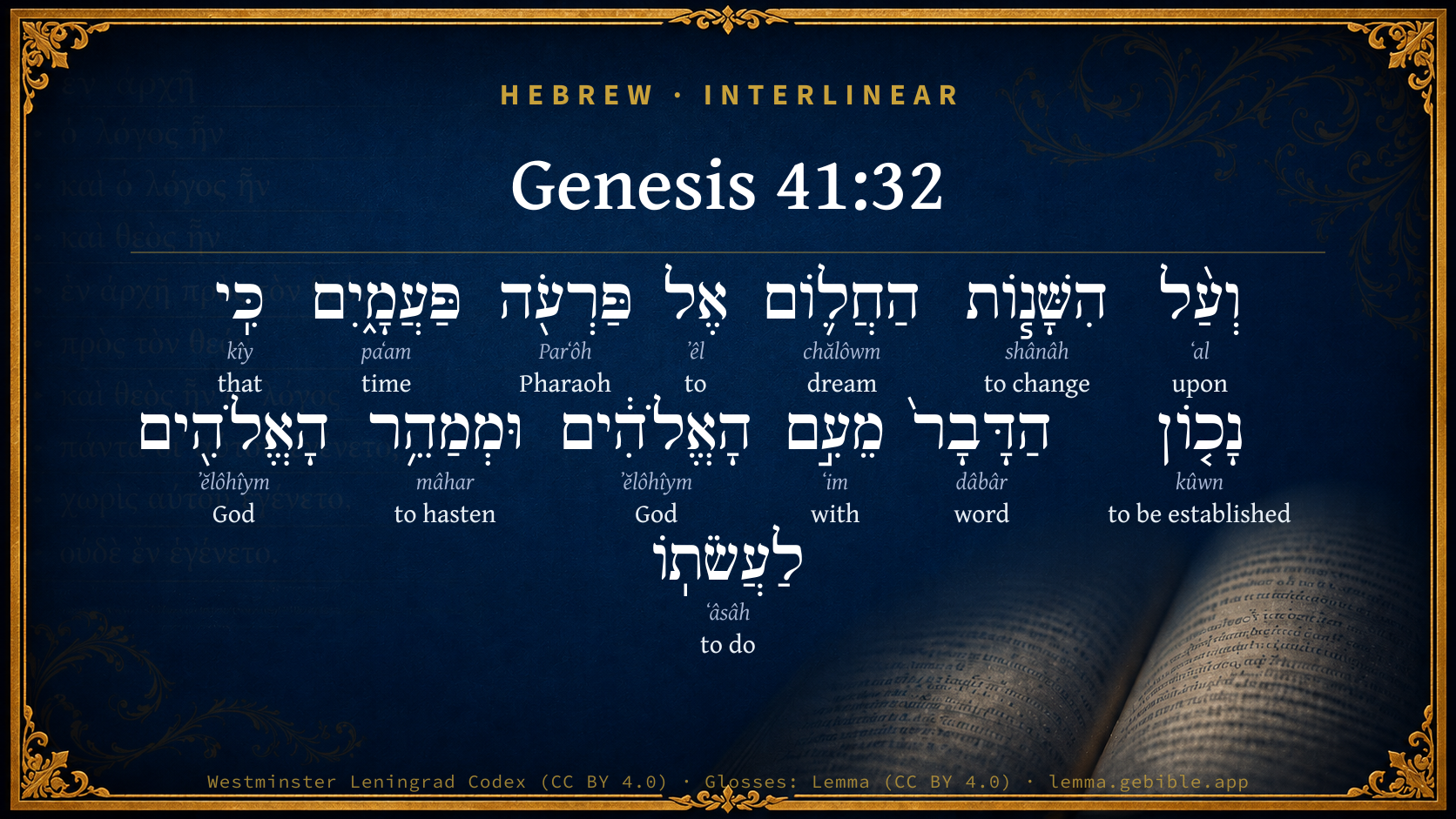
Hebrew (Westminster Leningrad Codex) Genesis 41:32 appears in the Hebrew Old Testament. The text above is from the Westminster Leningrad Codex. Each word links to its Strong’s number, a concise gloss, and parsing drawn from the Open Scriptures Hebrew Bible morphology. Click any word for its full Brown-Driver-Briggs (BDB) entry.
Download image
Cite this verse

Genesis 41:32 (World English Bible). Public Domain. Lemma interlinear Bible study tool, https://lemma.gebible.app/v/genesis/41/32.

Show BibTeX & RIS
BibTeX
RIS
English Translation
The dream was doubled to Pharaoh, because the thing is established by God, and God will shortly bring it to pass.
World English Bible · Public Domain
Highlights
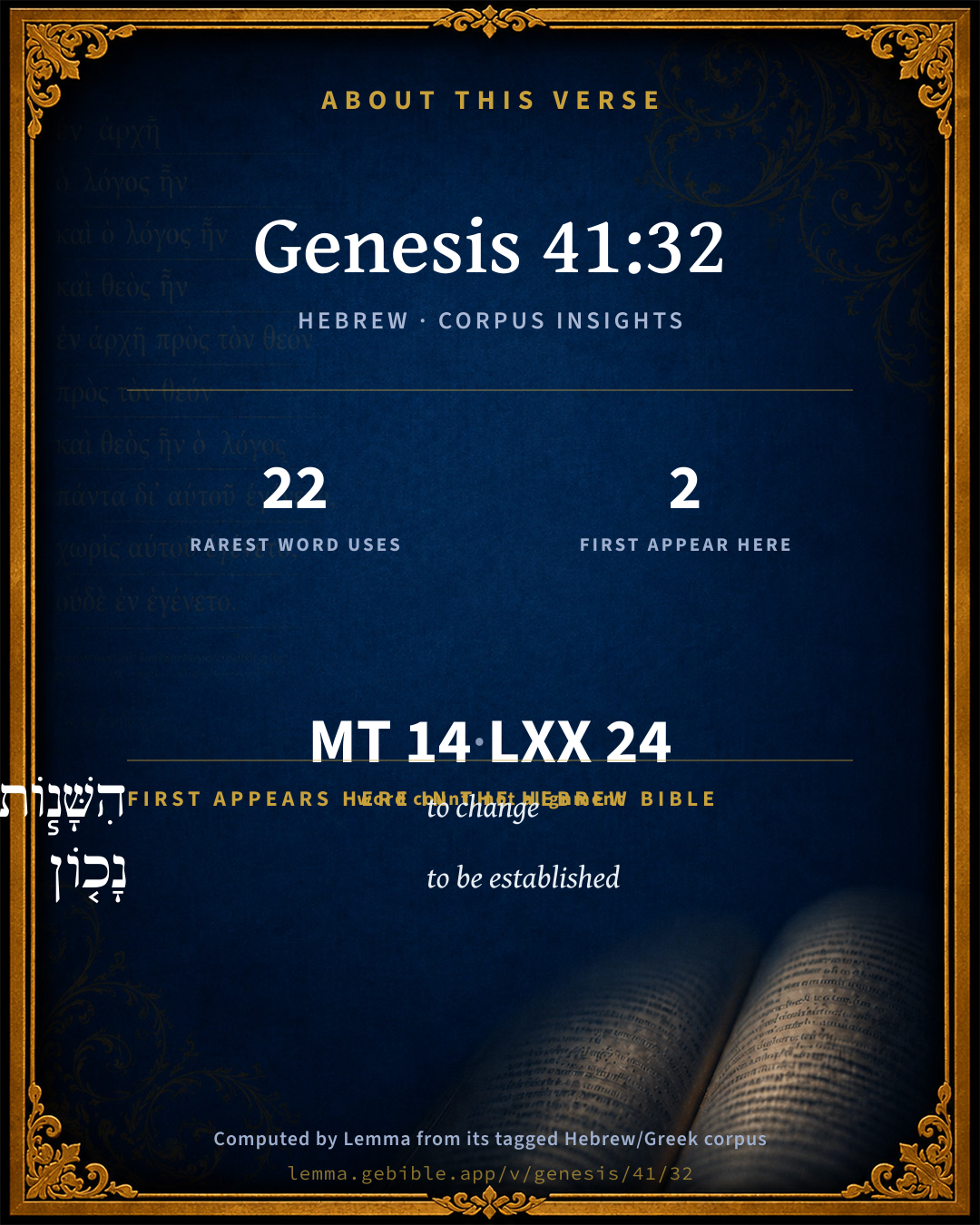
  • 2 first appearances in the Hebrew Bible
Full analysis ↓
Download a study sheet

One document with this verse’s original text, its word-by-word gloss line, the meaning frame, cross-references with their text, attributed commentary, and full source and license credits — printable, and it pastes into notes with its structure intact.

This verse Autodidact and up

Study sheet (.html) Plain text (.txt)

A passage Seminary Student

Up to 50 verses in one chapter. A passage sheet keeps up to 6 commentary sources and 12 cross-references per verse, in the order this page ranks them, and says so on the sheet whenever that leaves anything out. Ask for a single verse and you get the Autodidact verse sheet above.

Everything on this page stays free to read, with no account — the sheet is a download of what is already on screen, not access to it.

Want to remove ads? Support Godless Engineer
Compare translations 3

The same verse in 3 English versions, stacked beneath the original-language interlinear above. Click any original word for its lexicon entry.

Each is an independent rendering of the whole verse — the interlinear is not word-aligned to these translations.

Highlighted words mark where these versions differ — a whole-verse word diff, not a word-by-word alignment.

  • World English Bible Public Domain
    The dream was doubled to Pharaoh, because the thing is established by God, and God will shortly bring it to pass.
  • King James Version Public Domain
    And for that the dream was doubled unto Pharaoh twice; it is because the thing is established by God, and God will shortly bring it to pass.
  • unfoldingWord Literal Text CC BY-SA 4.0
    And as for the repeating of the dream to Pharaoh twice, because the matter has been established by God, and God will soon do it.

unfoldingWord Literal Text — © unfoldingWord, licensed CC BY-SA 4.0. Word-aligned USFM3 via Door43 (git.door43.org/unfoldingWord/en_ult).

Versions to compare (up to 4)

3 of 4 selected

Show all 18 translations

Every available English version of this verse, each an independent rendering of the whole verse.

  • World English Bible Public Domain
    The dream was doubled to Pharaoh, because the thing is established by God, and God will shortly bring it to pass.
  • Berean Standard Bible Public Domain
    Moreover, because the dream was given to Pharaoh in two versions, the matter has been decreed by God, and He will carry it out shortly.
  • Majority Standard Bible Public Domain
    Moreover, because the dream was given to Pharaoh in two versions, the matter has been decreed by God, and He will carry it out shortly.
  • King James Version Public Domain
    And for that the dream was doubled unto Pharaoh twice; it is because the thing is established by God, and God will shortly bring it to pass.
  • American Standard Version (1901) Public Domain
    And for that the dream was doubled unto Pharaoh, it is because the thing is established by God, and God will shortly bring it to pass.
  • Revised Version (1885) Public Domain
    And for that the dream was doubled unto Pharaoh twice, it is because the thing is established by God, and God will shortly bring it to pass.
  • Geneva Bible (1599) Public Domain
    And therefore the dreame was doubled vnto Pharaoh the second time, because the thing is established by God, and God hasteth to performe it.
  • Douay-Rheims (1899) Public Domain
    After which shall follow other seven years of so great scacity, that all the abundance before shall be forgotten: for the famine shall consume all the land,
  • Young's Literal Translation Public Domain
    `And because of the repeating of the dream unto Pharaoh twice, surely the thing is established by God, and God is hastening to do it.
  • Literal Standard Version CC BY-SA 4.0
    And because of the repeating of the dream to Pharaoh twice, surely the thing is established by God, and God is hurrying to do it.
  • Unlocked Literal Bible CC BY-SA 4.0
    That the dream was repeated to Pharaoh is because the matter has been established by God, and God will soon do it.
  • unfoldingWord Literal Text CC BY-SA 4.0
    And as for the repeating of the dream to Pharaoh twice, because the matter has been established by God, and God will soon do it.
  • Darby Bible Public Domain
    And as regards the double repetition of the dream to Pharaoh, it is that the thing is established by God, and God will hasten to do it.
  • World Messianic Bible Public Domain
    The dream was doubled to Pharaoh, because the thing is established by God, and God will shortly bring it to pass.
  • Webster's Bible Public Domain
    And for that the dream was doubled to Pharaoh twice; it is because the thing is established by God, and God will shortly bring it to pass.
  • Free Bible Version CC BY-SA 4.0
    The fact that the dream was repeated twice means that it has definitely been decided by God, and that God is going to do this soon.
  • Bible in Basic English Public Domain
    And this dream came to Pharaoh twice, because this thing is certain, and God will quickly make it come about.
  • JPS Tanakh (1917) Public Domain
    And for that the dream was doubled unto Pharaoh twice, it is because the thing is established by God, and God will shortly bring it to pass.

Literal Standard Version (2020), Covenant Press — licensed CC BY-SA 4.0. Text via the HelloAO Bible API (eBible.org). Unlocked Literal Bible (unfoldingWord) — licensed CC BY-SA 4.0. Text via the HelloAO Bible API (eBible.org). unfoldingWord Literal Text — © unfoldingWord, licensed CC BY-SA 4.0. Word-aligned USFM3 via Door43 (git.door43.org/unfoldingWord/en_ult). Free Bible Version, Dr. Jonathan Gallagher — licensed CC BY-SA 4.0. Text via the HelloAO Bible API (eBible.org).

Word by word

More ways to search: Search by grammar → Find every occurrence → Compare this word →

Practice this passage: Drill this verse → Learn its vocabulary →

הִשָּׁנ֧וֹת
shânâh
H8138
“to change”
Verb, Niphal, Infinitive Construct
Part of Speech
Verb
Stem
Niphal
Form
Infinitive Construct
Full BDB Definition

Origin: a primitive root

TWOT: 2421

to repeat, do again, change, alter - (Qal) to change - (Niphal) to be repeated - (Piel) to change, alter - (Hithpael) to disguise oneself
  1. וְעַ֨ל ʻal H5921 “and · upon” Conjunction + Preposition
  2. הַחֲל֛וֹם chălôwm H2472 “the · dream” Particle, Definite Article + Noun, Common, Masculine, Singular, Absolute
  3. אֶל ʼêl H413 “to” Preposition
  4. פַּרְעֹ֖ה Parʻôh H6547 “Pharaoh” Noun, Proper
  5. פַּעֲמָ֑יִם paʻam H6471 “times” Noun, Common, Feminine, Dual, Absolute
  6. כִּֽי kîy H3588 “that” Conjunction
  7. נָכ֤וֹן kûwn H3559 “being established” Verb, Niphal, Participle Active, Masculine, Singular, Absolute
  8. הַדָּבָר֙ dâbâr H1697 “the · word” Particle, Definite Article + Noun, Common, Masculine, Singular, Absolute
  9. מֵעִ֣ם ʻim H5973 “from · with” Preposition + Preposition
  10. הָאֱלֹהִ֔ים ʼĕlôhîym H430 “the · God(s)” Particle, Definite Article + Noun, Common, Masculine, Plural, Absolute
  11. וּמְמַהֵ֥ר mâhar H4116 “and · hastening” Conjunction + Verb, Piel, Participle Active, Masculine, Singular, Absolute
  12. הָאֱלֹהִ֖ים ʼĕlôhîym H430 “the · God(s)” Particle, Definite Article + Noun, Common, Masculine, Plural, Absolute
  13. לַעֲשֹׂתֽוֹ ʻâsâh H6213 “to do · him” Preposition + Verb, Qal, Infinitive Construct + Suffix, Personal, 3rd Person, Masculine, Singular

About this verse

These counts appear in no published source. They are computed here, from the morphology-tagged text and Lemma’s own curated glosses. What Lemma adds →

14
words
13
distinct lemmas
Pentateuch
section

Notable vocabulary

The rarest word here is הִשָּׁנ֧וֹת to change H8138 — appearing just 22 times in the whole Hebrew Bible.

First appearance in Scripture

These words make their first canonical appearance in the Hebrew Bible here:

  • הִשָּׁנ֧וֹת to change H8138
  • נָכ֤וֹן to be established H3559

Shared distinctive vocabulary

הִשָּׁנ֧וֹת to change H8138 occurs in 21 verses of the Hebrew Bible. Also found in:

Grammatical profile

  • 4 verbs
  • 6 nouns
  • 3 prepositions
  • 1 conjunction

Verb forms

  • הִשָּׁנ֧וֹת Niphal · Infinitive Construct
  • נָכ֤וֹן Niphal · Participle Active
  • וּמְמַהֵ֥ר Piel · Participle Active
  • לַעֲשֹׂתֽוֹ Qal · Infinitive Construct

Repetition

A word recurs within this verse — often emphatic in Hebrew:

  • הָאֱלֹהִ֔ים God H430 ×2

Hebrew & Septuagint length

In English translation the verse runs 21 words from the Hebrew and 29 from the Septuagint (LXX English) — closely comparable.

A rough comparison of the two English renderings, which tokenize alike — not a word-level alignment.

Word counts can differ between the Hebrew and the Greek without any difference in meaning — e.g. the Hebrew direct-object marker אֵת has no separate Greek word, and Greek often adds the article ὁ.

In the original languages it is 14 Hebrew tokens and 24 Greek tokens — but the two are counted differently (Hebrew bundles its prefixes and suffixes into one token; the Greek is in lemma form), so that isn’t a like-for-like length.

Cross-references

14

Topical passages linked to Genesis 41:32 in the Treasury of Scripture Knowledge — connected by theme and wording, ordered by reader-vote popularity; previews shown in the World English Bible.

  • Numbers 23:19 God is not a man, that he should lie, Neither the son of man, that he should repent: Has he said, and will he not do it? Or has he spoken, and will he not make it good?
  • Isaiah 46:10–11 declaring the end from the beginning, and from ancient times things that are not [yet] done; saying, My counsel shall stand, and I will do all my pleasure;
  • Isaiah 14:24–27 Yahweh of Hosts has sworn, saying, Surely, as I have thought, so shall it happen; and as I have purposed, so shall it stand:
  • Matthew 24:35 Heaven and earth will pass away, but my words will not pass away.
  • 2 Corinthians 13:1 This is the third time I am coming to you. "At the mouth of two or three witnesses shall every word established."
  • Genesis 37:7 for, behold, we were binding sheaves in the field, and behold, my sheaf arose and also stood upright; and behold, your sheaves came around, and bowed down to my sheaf."
  • Genesis 37:9 He dreamed yet another dream, and told it to his brothers, and said, "Behold, I have dreamed yet another dream: and behold, the sun and the moon and eleven stars bowed down to me."
  • Job 33:14–15 For God speaks once, Yes twice, though man pays no attention.
  • Isaiah 30:33 For a Topheth is prepared of old; yes, for the king it is made ready; he has made it deep and large; the pile of it is fire and much wood; the breath of Yahweh, like a stream of sulfur, does kindle it.
  • Matthew 25:34 Then the King will tell those on his right hand, 'Come, blessed of my Father, inherit the Kingdom prepared for you from the foundation of the world;
  • Matthew 25:41 Then he will say also to those on the left hand, 'Depart from me, you cursed, into the eternal fire which is prepared for the devil and his angels;
  • Mark 10:40 but to sit at my right hand and at my left hand is not mine to give, but for whom it has been prepared."
  • 1 Corinthians 2:9 But as it is written, "Things which an eye didn't see, and an ear didn't hear, Which didn't enter into the heart of man, These God has prepared for those who love him."
  • Revelation 9:15 The four angels were freed who had been prepared for that hour and day and month and year, so that they might kill one third of mankind.

Cross-references courtesy of OpenBible.info (CC BY 4.0).

Hebrew and Greek witnesses Masoretic Hebrew ↔ Greek Septuagint

The same verse in the two great witnesses to the Old Testament, shown verse-for-verse.

These are two independent witnesses, not word-aligned to each other, and the Septuagint is shown in lemma (dictionary) form.

Hebrew Genesis 41:32 Masoretic · Westminster Leningrad Codex

וְעַ֨ל הִשָּׁנ֧וֹת הַחֲל֛וֹם אֶל פַּרְעֹ֖ה פַּעֲמָ֑יִם כִּֽי נָכ֤וֹן הַדָּבָר֙ מֵעִ֣ם הָאֱלֹהִ֔ים וּמְמַהֵ֥ר הָאֱלֹהִ֖ים לַעֲשֹׂתֽוֹ

The dream was doubled to Pharaoh, because the thing is established by God, and God will shortly bring it to pass.

World English Bible · Public Domain

Greek LXX Genesis 41:32 Septuagint · lemma form

περί δέ ὁ δευτερόω ὁ ἐνύπνιον φαραώ δίς ὅτι ἀληθής εἰμί ὁ ῥῆμα ὁ παρά ὁ θεός καί ταχύνω ὁ θεός ὁ ποιέω αὐτός

And concerning the repetition of the dream to Pharao twice, it is because the saying which is from God shall be true, and God will hasten to accomplish it.

LXX2012 (modern English Septuagint) · Public Domain

Hebrew: Westminster Leningrad Codex (CC BY 4.0). Greek: Septuagint (public domain); English from LXX2012 (modern English Septuagint) (Public Domain). How the Septuagint differs from the Hebrew →

Targum (Aramaic paraphrase)

2

The Targum is the ancient Jewish Aramaic paraphrase of the Hebrew Scriptures — an interpretive translation, not the Hebrew text itself. Onkelos (literal) and Pseudo-Jonathan (expansive) render the Torah, and Jonathan the Prophets. Coverage is partial: where no permissively-licensed English translation exists for a verse, only the Aramaic is shown. This is verse-level text, not a word-by-word alignment to the Hebrew.

  1. Targum Onkelos Torah (Genesis–Deuteronomy)
    וְעַל דְּאִתַּנֵּית חֶלְמָא לְפַרְעֹה תַּרְתֵּין זִמְנִין אֲרֵי תַקִּין פִּתְגָּמָא מִן קֳדָם יְיָ וְאוֹחִי יְיָ לְמֶעְבְּדֵהּ

    (no public-domain English translation for this verse)

    Targum Onkelos — Aramaic: “Onkelos Genesis” (public domain); “Onkelos Exodus” (public domain); “Onkelos Leviticus” (public domain); “Onkelos Numbers” (public domain); “Onkelos Deuteronomy” (public domain). English: “Sefaria Community Translation” (CC0 1.0 (public-domain dedication)); “J.W. Etheridge. The Targums of Onkelos and Jonathan Ben Uzziel on the Pentateuch. London: Longmans, Green, 1862” (public domain). Text via Sefaria.

  2. Targum Pseudo-Jonathan Torah (Genesis–Deuteronomy)
    וּמִן בִּגְלַל דְאִיתְנֵי חֵילְמָא לְפַרְעה תַּרְתֵּין זִמְנִין אֲרוּם תַּקִיף פִּתְגָמָא מִן קֳדָם יְיָ וּמוֹחִי יְיָ לְמֶעֱבְדֵיהּ

    And forasmuch as the dream was repeated to Pharoh twice, therefore is the thing confirmed before the Lord, and the Lord hasteneth to do it.

    Targum Pseudo-Jonathan — Aramaic: “Targum Jonathan on Genesis” (public domain); “Targum Jonathan on Exodus” (public domain); “Targum Jonathan on Leviticus” (public domain); “Targum Jonathan on Numbers” (public domain); “Targum Jonathan on Deuteronomy” (public domain). English: “The Targum of Jonathan ben Uzziel, trans. J. W. Etheridge, London, 1862” (public domain). Text via Sefaria.

Commentary

Notes on Genesis 41:32 from classic Christian and Jewish commentators (each source and its license shown beneath its notes). The classic Christian expositions comment on the surrounding passage and are grouped to its opening verse, so a note may address several verses; the Jewish commentaries on the Tanakh (Rashi and others) are per-verse, so they appear only where the commentator wrote on this verse.

Lemma curates 59 commentaries, every one of them public domain or Creative Commons licensed, each selected and text-cleaned for this edition rather than reprinted as found. About our sources →

Trapp's Complete Commentary

John Trapp

Gen 41:32 And for that the dream was doubled unto Pharaoh twice; [it is] because the thing [is] established by God, and God will shortly bring it to pass.

Ver. 32. The dream was doubled.] {See Trapp on "Gen 41:25"}

John Trapp, A Commentary or Exposition upon All the Books of the Old and New Testament (1647–1656) — public domain. Text from a community e-Sword module.

Tyndale Open Study Notes

Tyndale Open Resources

41:32 The two similar dreams confirmed that the message was decreed by God and would soon . . . happen, just as the dreams of the two prisoners were quickly fulfilled (40:5-23). Joseph’s own two dreams (37:5-11) were about to come true as well (41:37-46; 42:6-9).

Tyndale Open Study Notes — © Tyndale Open Resources, licensed CC BY-SA 4.0. Text via the HelloAO Bible API.

John Calvin's Commentaries

32. And for that the dream was doubled. Joseph does not mean to say, that what God may have declared but once, is mutable: but he would prevent Pharaoh’s confidence respecting the event revealed, from being shaken. For since God pronounces nothing but from his own fixed and steadfast purpose, it is enough that he should have spoken once. But our dullness and inconstancy cause him to repeat the same thing the more frequently, in order that what he has certainly decreed, may be fixed in our hearts; otherwise, as our disposition is variable, so, what we have once heard from his mouth, is tossed up and down by us, until it entirely escapes our memory. Moreover, Joseph not only commemorates the stability of the heavenly decree, but also declares that what God has determined to do, is near at hand, lest Pharaoh himself should slumber in the confident expectation of longer delay. For though we confess that the judgments of God are always hanging over our heads, yet unless we are stimulated by the thought of their speedy approach, we are but slightly affected with anxiety and fear respecting them.

John Calvin's Commentaries (1540-1563) — public domain. Text from the Calvin Translation Society English edition (1840s-50s) via the Christian Classics Ethereal Library (ccel.org). Calvin's coverage is partial (roughly two-thirds of the Bible); uncommented books and verses are honest gaps, never fabricated. The 19th-century editor's footnotes and remarks are omitted so the notes are faithfully Calvin's own voice.

The Cambridge Bible for Schools and Colleges

gen. ed. J. J. S. Perowne

32. doubled … twice] This is a literal rendering. The repetition of the dream shewed emphatically that the thing was “established,” i.e. made fixed and sure, by the decree of God. Cf. Psa_93:2, “Thy throne is established”; Hos_6:3, “sure as the morning.”

will shortly bring it to pass] Lit. “hasteneth to do it.” Hence there is urgent need to take measures in good time to meet the crisis which is bound to come.

The Cambridge Bible for Schools and Colleges (gen. ed. J. J. S. Perowne; Cambridge University Press, 1878–1918) — public domain. Text from a community e-Sword module.

John Gill's Exposition

And let them, gather all the food of those good years that come,.... That is, let the under officers collect together the fifth part of all fruits of the land during the seven years of plenty:

and lay up corn under the hand of Pharaoh; as his property, and only to be disposed of by his orders; for as it was to be purchased with his money, it was right that it should be in his hands, or in the hands of his officers appointed by him, as the Targum of Jonathan:

and let them keep food in the cities; reserve it in the several cities throughout the land, against the years of famine.

John Gill's Exposition of the Whole Bible (1746–1763) — public domain (CC PDM 1.0). Text via the HelloAO Bible API.

Whedon's Commentary on the Bible

Daniel D. Whedon

32. The dream was doubled unto Pharaoh twice — Here is incidentally given a principle of interpretation which may be profitable in the interpretation of prophecy. As God repeated the dream to Pharaoh under different symbols, so he gave through his prophets under various symbols the ideas of things that were future. So Nebuchadnezzar’s dream and Daniel’s vision of the beasts (Daniel 2, 7) were one. So, doubtless, in the Apocalypse, many of the symbols, which have been explained as chronological and consecutive, are but different foreshadowings of the same thing. The repetition is but to show that the thing is established by God, and at the same time to deepen and intensify the impression.

Daniel D. Whedon (gen. ed.), Commentary on the Old and New Testaments (1874–1909) — public domain. Text from a community e-Sword module.

Rashi

Rabbi Shlomo Yitzchaki (Rashi)

נכון —means PREPARED.

Rashi on the Tanakh — English translations: “The Judaica Press complete Tanach with Rashi, translated by A. J. Rosenberg” (CC BY 4.0); “Pentateuch with Rashi's commentary by M. Rosenbaum and A.M. Silbermann, 1929-1934” (public domain); “The Metsudah Tanach series, Lakewood, N.J” (CC BY 4.0); and “The Book of Joshua, Metsudah Publications, 1997” (CC BY 4.0). Text via Sefaria.

Ramban (Nachmanides)

Rabbi Moshe ben Nachman (Ramban / Nachmanides)

AND FOR THAT THE DREAM WAS REPEATED UNTO PHARAOH TWICE. The verse is explaining the reason for the repetition of the dream — i.e., that it occurred twice in one night — although it would have been possible for both the cows and the ears of corn to be shown in one dream and make known that there shall neither be plowing nor harvest. Yet He showed them in two separate dreams, one after another, in one night — an unusual circumstance for dreamers in order to make known that the matter is prepared, and G-d hasteneth to do it. This is the meaning of the word pa’amayim (twice) as the dreams concerning the cows and the ears of corn were not presented at one time.But Rabbi Abraham ibn Ezra explains that the repetition of the theme of the dream — through the medium of the cows and the ears of corn — attested to the fact that the matter is set and established. And the fact that the dream occurred twice in one night attested that G-d hasteneth to do it. But if so, could have been accomplished by repeating the same dream. we would say that the dream concerning the ears of corn would have been sufficient since that dream informed Pharaoh of the famine.

Ramban (Nachmanides) on the Tanakh — English translation: “Commentary on the Torah by Ramban (Nachmanides). Translated and annotated by Charles B. Chavel. New York, Shilo Pub. House, 1971-1976” (CC BY 4.0). Text via Sefaria.

Radak

Rabbi David Kimhi (Radak)

ועל השנות, Joseph added the word פעמים, in order to make this more plain after he had used the expression השנות.

Radak on the Tanakh — English translations: “Sefaria Community Translation” (CC0 1.0 (public-domain dedication)); “Eliyahu Munk, HaChut Hameshulash” (CC BY 4.0); “Rabbi Mike Feuer, Jerusalem Anthology” (CC BY 4.0); and “R. David Kimhi on the first book of Psalms, Translated by R.G. Finch, London, 1919” (public domain). Text via Sefaria.

Lesson kit

Teaching starters — assembled from the data on this page, not authored interpretation. Every prompt links to the verse data it draws on. Edit before teaching.

Genesis, in the Pentateuch, opens this verse with 14 words (13 distinct Hebrew lemmas). Its most distinctive word is shânâh (“to change”). A historical commentator’s framing appears above. Read the whole chapter for the surrounding context.

Discussion questions

  1. How does “to change” (shânâh) shape what this verse is saying?
  2. 2 words here appear for the first time in Scripture. What is being introduced at this debut?
  3. 1 Samuel 21:13 shares the word «to change» with this verse. How do the two illuminate each other?
  4. “God” occurs 2× in this one verse. What is the effect of the repetition?
  5. These translations render this verse differently; the difference is in the English rendering, not the original. What questions does that raise?
  6. The verb «הִשָּׁנ֧וֹת» is Niphal Infinitive Construct. How does its form color the action?
  7. Reading how Trapp's Complete Commentary and Tyndale Open Study Notes read this verse, where do the two commentators agree and where do they part?

Things to notice

Reading settings

Reading text

Shown beneath each verse's original-language words.

Old Testament
Old Testament edition

Read the OT as the Masoretic Hebrew (MT) or the Greek Septuagint (LXX).

English shown for the Greek Septuagint (in the Hebrew ↔ Greek comparison).

Comparing translations? Open the Compare panel on any verse page to stack up to four side by side.