Isaiah 54:14

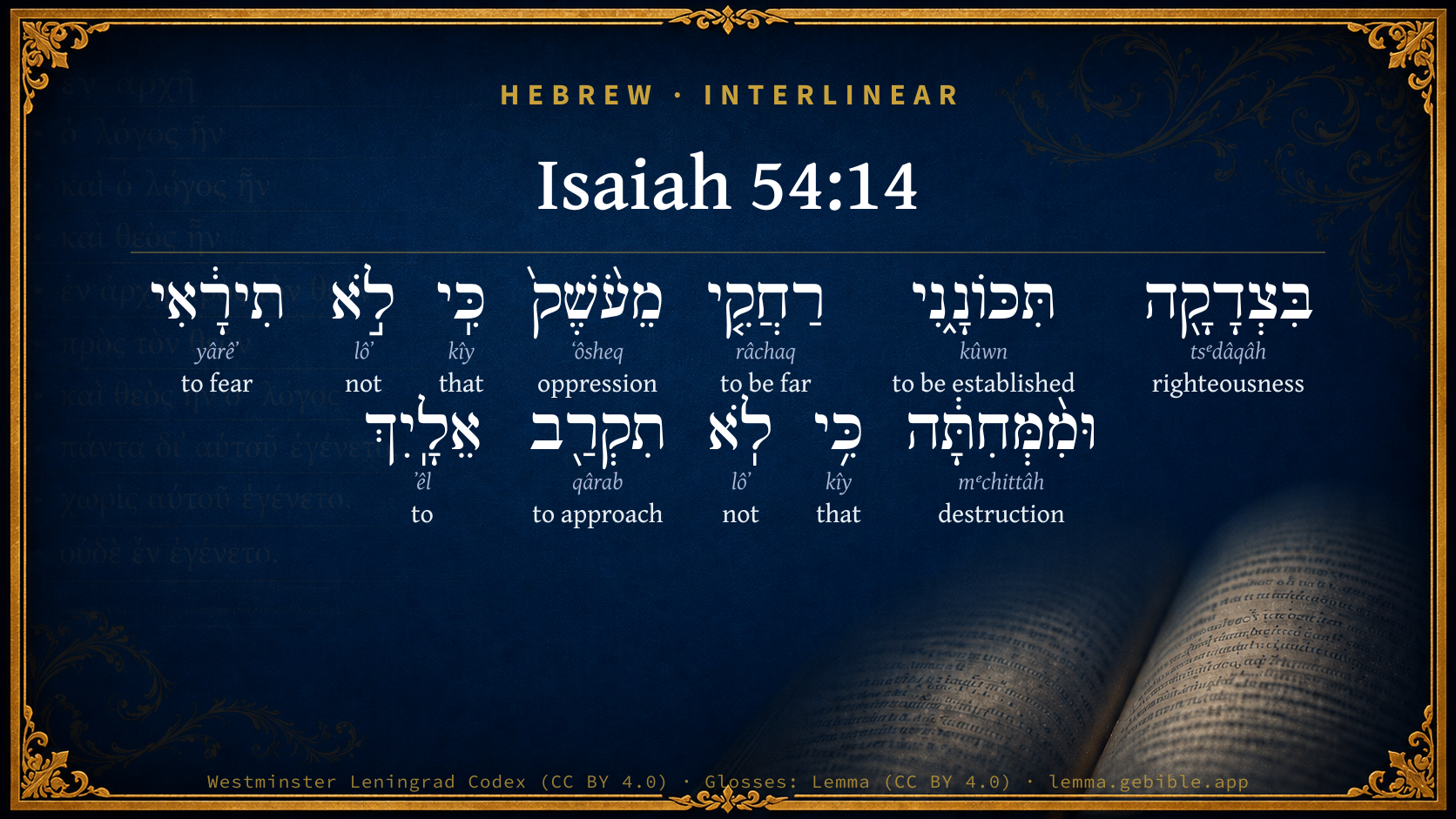
Hebrew (Westminster Leningrad Codex) Isaiah 54:14 appears in the Hebrew Old Testament. The text above is from the Westminster Leningrad Codex. Each word links to its Strong’s number, a concise gloss, and parsing drawn from the Open Scriptures Hebrew Bible morphology. Click any word for its full Brown-Driver-Briggs (BDB) entry.
Download image
Cite this verse

Isaiah 54:14 (World English Bible). Public Domain. Lemma interlinear Bible study tool, https://lemma.gebible.app/v/isaiah/54/14.

Show BibTeX & RIS
BibTeX
RIS
English Translation
In righteousness shall you be established: you shall be far from oppression, for you shall not be afraid; and from terror, for it shall not come near you.
World English Bible · Public Domain
Download a study sheet

One document with this verse’s original text, its word-by-word gloss line, the meaning frame, cross-references with their text, attributed commentary, and full source and license credits — printable, and it pastes into notes with its structure intact.

This verse Autodidact and up

Study sheet (.html) Plain text (.txt)

A passage Seminary Student

Up to 50 verses in one chapter. A passage sheet keeps up to 6 commentary sources and 12 cross-references per verse, in the order this page ranks them, and says so on the sheet whenever that leaves anything out. Ask for a single verse and you get the Autodidact verse sheet above.

Everything on this page stays free to read, with no account — the sheet is a download of what is already on screen, not access to it.

Want to remove ads? Support Godless Engineer
Compare translations 3

The same verse in 3 English versions, stacked beneath the original-language interlinear above. Click any original word for its lexicon entry.

Each is an independent rendering of the whole verse — the interlinear is not word-aligned to these translations.

Highlighted words mark where these versions differ — a whole-verse word diff, not a word-by-word alignment.

  • World English Bible Public Domain
    In righteousness shall you be established: you shall be far from oppression, for you shall not be afraid; and from terror, for it shall not come near you.
  • King James Version Public Domain
    In righteousness shalt thou be established: thou shalt be far from oppression; for thou shalt not fear: and from terror; for it shall not come near thee.
  • unfoldingWord Literal Text CC BY-SA 4.0
    You will be established in righteousness. Be far from oppression, for you will not fear, and from terror, for it will not come near to you.

unfoldingWord Literal Text — © unfoldingWord, licensed CC BY-SA 4.0. Word-aligned USFM3 via Door43 (git.door43.org/unfoldingWord/en_ult).

Versions to compare (up to 4)

3 of 4 selected

Show all 18 translations

Every available English version of this verse, each an independent rendering of the whole verse.

  • World English Bible Public Domain
    In righteousness shall you be established: you shall be far from oppression, for you shall not be afraid; and from terror, for it shall not come near you.
  • Berean Standard Bible Public Domain
    In righteousness you will be established, far from oppression, for you will have no fear. Terror will be far removed, for it will not come near you.
  • Majority Standard Bible Public Domain
    In righteousness you will be established, far from oppression, for you will have no fear. Terror will be far removed, for it will not come near you.
  • King James Version Public Domain
    In righteousness shalt thou be established: thou shalt be far from oppression; for thou shalt not fear: and from terror; for it shall not come near thee.
  • American Standard Version (1901) Public Domain
    In righteousness shalt thou be established: thou shalt be far from oppression, for thou shalt not fear; and from terror, for it shall not come near thee.
  • Revised Version (1885) Public Domain
    In righteousness shalt thou be established: thou shalt be far from oppression, for thou shalt not fear; and from terror, for it shall not come near thee.
  • Geneva Bible (1599) Public Domain
    In righteousnes shalt thou be established, and be farre from oppression: for thou shalt not feare it: and from feare, for it shall not come neere thee.
  • Douay-Rheims (1899) Public Domain
    And thou shalt be founded in justice: depart far from oppression, for thou shalt not fear; and from terror, for it shall not come near thee.
  • Young's Literal Translation Public Domain
    In righteousness thou establishest thyself, Be far from oppression, for thou fearest not, And from ruin, for it cometh not near unto thee.
  • Literal Standard Version CC BY-SA 4.0
    You establish yourself in righteousness, || Be far from oppression, for you do not fear, || And from ruin, for it does not come near to you.
  • Unlocked Literal Bible CC BY-SA 4.0
    In righteousness you will be established, and you will be far from oppression, for you will not fear; and from terror, for it will not come near to you.
  • unfoldingWord Literal Text CC BY-SA 4.0
    You will be established in righteousness. Be far from oppression, for you will not fear, and from terror, for it will not come near to you.
  • Darby Bible Public Domain
    In righteousness shalt thou be established: thou shalt be far from oppression, for thou shalt not fear; and from terror, for it shall not come near thee.
  • World Messianic Bible Public Domain
    You will be established in righteousness. You will be far from oppression, for you will not be afraid, and far from terror, for it shall not come near you.
  • Webster's Bible Public Domain
    In righteousness shalt thou be established: thou shalt be far from oppression; for thou shalt not fear: and from terror; for it shall not come near thee.
  • Free Bible Version CC BY-SA 4.0
    Your society will operate from principles of goodness and right; nobody will be there to oppress you. You won't be afraid; you won't have to face any kind of terror.
  • Bible in Basic English Public Domain
    All your rights will be made certain to you: have no fear of evil, and destruction will not come near you.
  • JPS Tanakh (1917) Public Domain
    In righteousness shalt thou be established; be thou far from oppression, for thou shalt not fear, and from ruin, for it shall not come near thee.

Literal Standard Version (2020), Covenant Press — licensed CC BY-SA 4.0. Text via the HelloAO Bible API (eBible.org). Unlocked Literal Bible (unfoldingWord) — licensed CC BY-SA 4.0. Text via the HelloAO Bible API (eBible.org). unfoldingWord Literal Text — © unfoldingWord, licensed CC BY-SA 4.0. Word-aligned USFM3 via Door43 (git.door43.org/unfoldingWord/en_ult). Free Bible Version, Dr. Jonathan Gallagher — licensed CC BY-SA 4.0. Text via the HelloAO Bible API (eBible.org).

Word by word

More ways to search: Search by grammar → Find every occurrence → Compare this word →

Practice this passage: Drill this verse → Learn its vocabulary →

וּמִ֨מְּחִתָּ֔ה
mᵉchittâh
H4288
“and · from · destruction”
Conjunction + Preposition + Noun, Common, Feminine, Singular, Absolute
Part of Speech
Conjunction + Preposition + Noun
Type
Common
Gender
Feminine
Number
Singular
State
Absolute
Full BDB Definition

Origin: from H2846

TWOT: 784g

destruction, ruin, terror, a breaking - terror, dismay, object of terror - ruin
  1. בִּצְדָקָ֖ה tsᵉdâqâh H6666 “in/at · righteousness” Preposition + Noun, Common, Feminine, Singular, Absolute
  2. תִּכּוֹנָ֑נִי kûwn H3559 “to be established” Verb, Hithpolel, Imperfect, 2nd Person, Feminine, Singular
  3. רַחֲקִ֤י râchaq H7368 “be far” Verb, Qal, Imperative, 2nd Person, Feminine, Singular
  4. מֵעֹ֨שֶׁק֙ ʻôsheq H6233 “from · oppression” Preposition + Noun, Common, Masculine, Singular, Absolute
  5. כִּֽי kîy H3588 “that” Conjunction
  6. לֹ֣א lôʼ H3808 “not” Particle, Negative
  7. תִירָ֔אִי yârêʼ H3372 “to fear” Verb, Qal, Imperfect, 2nd Person, Feminine, Singular
  8. כִּ֥י kîy H3588 “that” Conjunction
  9. לֹֽא lôʼ H3808 “not” Particle, Negative
  10. תִקְרַ֖ב qârab H7126 “to approach” Verb, Qal, Imperfect, 3rd Person, Feminine, Singular
  11. אֵלָֽיִךְ ʼêl H413 “to · you” Preposition + Suffix, Personal, 2nd Person, Feminine, Singular

About this verse

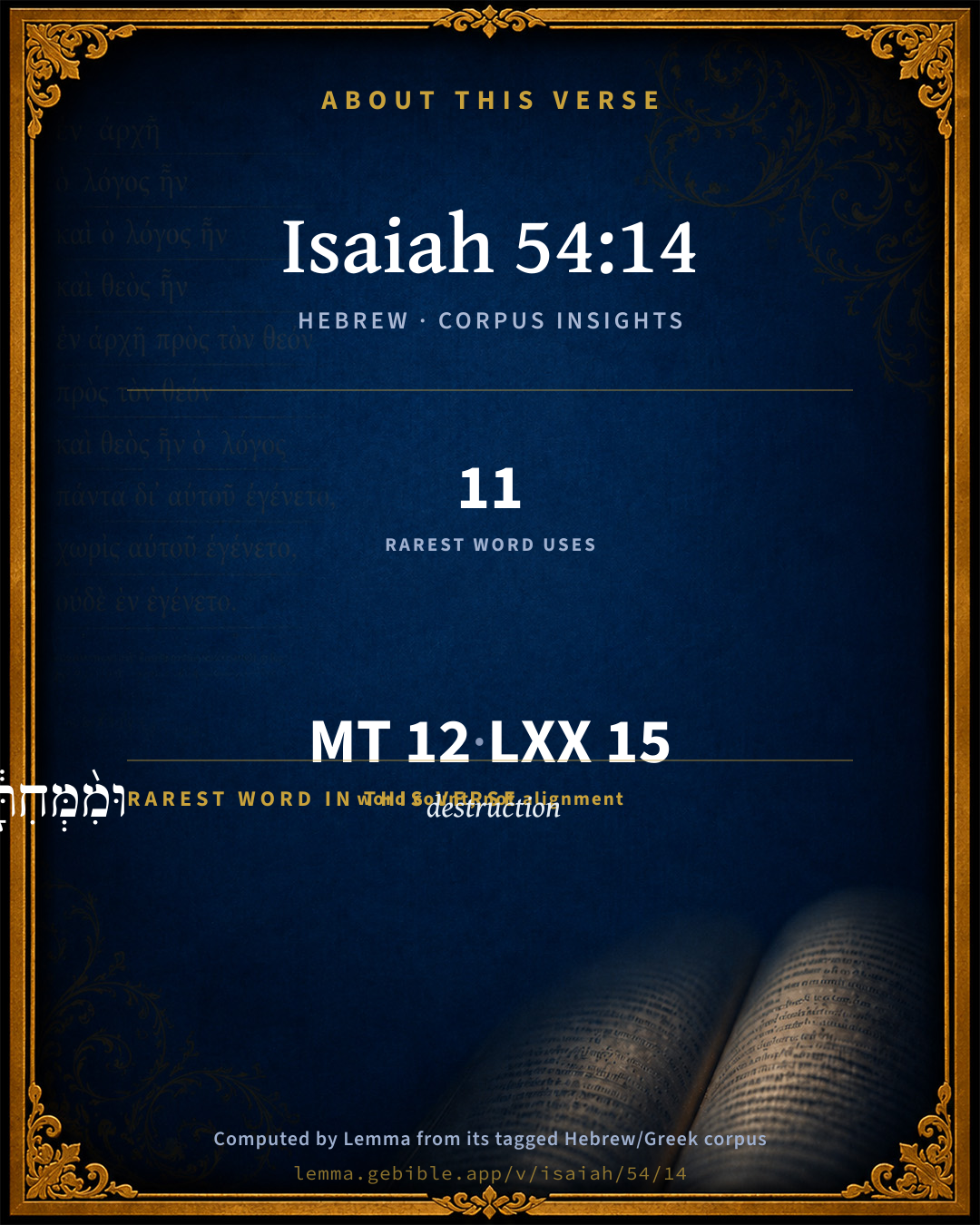
These counts appear in no published source. They are computed here, from the morphology-tagged text and Lemma’s own curated glosses. What Lemma adds →

12
words
10
distinct lemmas
Prophets
section

Notable vocabulary

The rarest word here is וּמִ֨מְּחִתָּ֔ה destruction H4288 — appearing just 11 times in the whole Hebrew Bible.

Shared distinctive vocabulary

וּמִ֨מְּחִתָּ֔ה destruction H4288 occurs in 11 verses of the Hebrew Bible. Also found in:

Grammatical profile

  • 4 verbs
  • 3 nouns
  • 1 preposition
  • 2 conjunctions
  • 2 particles

Verb forms

  • תִּכּוֹנָ֑נִי Hithpolel · Imperfect
  • רַחֲקִ֤י Qal · Imperative
  • תִירָ֔אִי Qal · Imperfect
  • תִקְרַ֖ב Qal · Imperfect

Repetition

Words recur within this verse — often emphatic in Hebrew:

  • כִּֽי that H3588 ×2
  • לֹ֣א not H3808 ×2

Hebrew & Septuagint length

In English translation the verse runs 28 words from the Hebrew and 22 from the Septuagint (LXX English) — closely comparable.

A rough comparison of the two English renderings, which tokenize alike — not a word-level alignment.

Word counts can differ between the Hebrew and the Greek without any difference in meaning — e.g. the Hebrew direct-object marker אֵת has no separate Greek word, and Greek often adds the article ὁ.

In the original languages it is 12 Hebrew tokens and 15 Greek tokens — but the two are counted differently (Hebrew bundles its prefixes and suffixes into one token; the Greek is in lemma form), so that isn’t a like-for-like length.

Cross-references

21

Topical passages linked to Isaiah 54:14 in the Treasury of Scripture Knowledge — connected by theme and wording, ordered by reader-vote popularity; previews shown in the World English Bible.

  • Proverbs 3:25–26 Don't be afraid of sudden fear, Neither of the desolation of the wicked, when it comes:
  • Jeremiah 30:10 Therefore don't you be afraid, O Jacob my servant, says Yahweh; neither be dismayed, Israel: for, behold, I will save you from afar, and your seed from the land of their captivity; and Jacob shall return, and shall be quiet and at ease, and none shall make him afraid.
  • Zechariah 9:8 I will encamp around my house against the army, That none pass through or return; And no oppressor will pass through them any more: For now I have seen with my eyes.
  • Ezekiel 36:27–28 I will put my Spirit within you, and cause you to walk in my statutes, and you shall keep my ordinances, and do them.
  • Zechariah 2:4–5 and said to him, "Run, speak to this young man, saying, 'Jerusalem will be inhabited as villages without walls, because of the multitude of men and cattle in it.
  • Zechariah 8:3 Thus says Yahweh: "I have returned to Zion, and will dwell in the midst of Jerusalem. Jerusalem shall be called 'The City of Truth;' and the mountain of Yahweh of Hosts, 'The Holy Mountain.'"
  • Isaiah 9:4 For the yoke of his burden, and the staff of his shoulder, the rod of his oppressor, you have broken as in the day of Midian.
  • Isaiah 1:26 I will restore your judges as at the first, And your counselors as at the beginning. Afterward you shall be called 'The city of righteousness, A faithful town.'
  • Isaiah 61:10–62:1 I will greatly rejoice in Yahweh, my soul shall be joyful in my God; for he has clothed me with the garments of salvation, he has covered me with the robe of righteousness, as a bridegroom decks himself with a garland, and as a bride adorns herself with her jewels.
  • Isaiah 2:4 He will judge between the nations, And will decide concerning many peoples; And they shall beat their swords into plowshares, And their spears into pruning-hooks. Nation shall not lift up sword against nation, Neither shall they learn war any more.
  • Isaiah 60:21 Your people also shall be all righteous; they shall inherit the land forever, the branch of my planting, the work of my hands, that I may be glorified.
  • Micah 4:3–4 And he will judge between many peoples, And will decide concerning strong nations afar off. They will beat their swords into plowshares, And their spears into pruning hooks. Nation will not lift up sword against nation, Neither will they learn war any more.
  • 2 Peter 3:13 But, according to his promise, we look for new heavens and a new earth, in which dwells righteousness.
  • Isaiah 45:24 Only in Yahweh, it is said of me, is righteousness and strength; even to him shall men come; and all those who were incensed against him shall be disappointed.
  • Zephaniah 3:13–16 The remnant of Israel will not do iniquity, nor speak lies, neither will a deceitful tongue be found in their mouth, for they will feed and lie down, and no one will make them afraid."
  • Isaiah 51:13 and have forgotten Yahweh your Maker, who stretched forth the heavens, and laid the foundations of the earth; and fear continually all the day because of the fury of the oppressor, when he makes ready to destroy? and where is the fury of the oppressor?
  • Isaiah 52:1 Awake, awake, put on your strength, Zion; put on your beautiful garments, Jerusalem, the holy city: for henceforth there shall no more come into you the uncircumcised and the unclean.
  • Jeremiah 23:3–4 I will gather the remnant of my flock out of all the countries where I have driven them, and will bring them again to their folds; and they shall be fruitful and multiply.
  • Jeremiah 31:23 Thus says Yahweh of Hosts, the God of Israel, Yet again shall they use this speech in the land of Judah and in the cities of it, when I shall bring again their captivity: Yahweh bless you, habitation of righteousness, mountain of holiness.
  • Ezekiel 37:23–26 neither shall they defile themselves any more with their idols, nor with their detestable things, nor with any of their transgressions; but I will save them out of all their dwelling-places, in which they have sinned, and will cleanse them: so shall they be my people, and I will be their God.
  • Joel 3:17–21 "So you will know that I am Yahweh, your God, Dwelling in Zion, my holy mountain. Then Jerusalem will be holy, And no strangers will pass through her any more.

Cross-references courtesy of OpenBible.info (CC BY 4.0).

Hebrew and Greek witnesses Masoretic Hebrew ↔ Greek Septuagint

The same verse in the two great witnesses to the Old Testament, shown verse-for-verse.

These are two independent witnesses, not word-aligned to each other, and the Septuagint is shown in lemma (dictionary) form.

Hebrew Isaiah 54:14 Masoretic · Westminster Leningrad Codex

בִּצְדָקָ֖ה תִּכּוֹנָ֑נִי רַחֲקִ֤י מֵעֹ֨שֶׁק֙ כִּֽי לֹ֣א תִירָ֔אִי וּמִ֨מְּחִתָּ֔ה כִּ֥י לֹֽא תִקְרַ֖ב אֵלָֽיִךְ

In righteousness shall you be established: you shall be far from oppression, for you shall not be afraid; and from terror, for it shall not come near you.

World English Bible · Public Domain

Greek LXX Isaiah 54:14 Septuagint · lemma form

καί ἐν δικαιοσύνη οἰκοδομέω ἀποἔχω ἀπό ἄδικος καί οὐ φοβέω καί τρόμος οὐ ἐγγίζω σύ

And you shall be built in righteousness: abstain from injustice, and you shall not fear; and trembling shall not come near you.

LXX2012 (modern English Septuagint) · Public Domain

Hebrew: Westminster Leningrad Codex (CC BY 4.0). Greek: Septuagint (public domain); English from LXX2012 (modern English Septuagint) (Public Domain). How the Septuagint differs from the Hebrew →

Targum (Aramaic paraphrase)

1

The Targum is the ancient Jewish Aramaic paraphrase of the Hebrew Scriptures — an interpretive translation, not the Hebrew text itself. Onkelos (literal) and Pseudo-Jonathan (expansive) render the Torah, and Jonathan the Prophets. Coverage is partial: where no permissively-licensed English translation exists for a verse, only the Aramaic is shown. This is verse-level text, not a word-by-word alignment to the Hebrew.

  1. Targum Jonathan Prophets (Joshua–Malachi)
    בְזָכוּתָא תִּתַּקְנִין אִתְרַחֲקִי מֵעוּשְׁקָא אֲרֵי לָא תִדְחֲלִין וּמִתְּבִירָא אֲרֵי לָא יֵעוּל עֲלָךְ:

    In righteousness shalt thou be established: thou shalt be far removed from oppression, for thou shalt not fear it: and from terror; for it shall not come upon thee.

    Targum Jonathan — Aramaic: “Mikraot Gedolot” (public domain). English: “Sefaria Community Translation” (CC0 1.0 (public-domain dedication)); “London "Chaldee Paraphrase," 1871” (public domain). Text via Sefaria.

Commentary

Notes on Isaiah 54:14 from classic Christian and Jewish commentators (each source and its license shown beneath its notes). The classic Christian expositions comment on the surrounding passage and are grouped to its opening verse, so a note may address several verses; the Jewish commentaries on the Tanakh (Rashi and others) are per-verse, so they appear only where the commentator wrote on this verse.

Lemma curates 59 commentaries, every one of them public domain or Creative Commons licensed, each selected and text-cleaned for this edition rather than reprinted as found. About our sources →

Trapp's Complete Commentary

John Trapp

Isa 54:14 In righteousness shalt thou be established: thou shalt be far from oppression; for thou shalt not fear: and from terror; for it shall not come near thee.

Ver. 14. In righteousness shalt thou be established.] Righteousness is here opposed to oppression. Regiment without righteousness, is but robbery with authority.

For thou shalt not fear.] Or, That thou mayest not fear.

And from terror.] Tyranny is terrible.

For it shall not come near thee.] See Psa 32:6. {See trapp on "Psa 32:6"}

John Trapp, A Commentary or Exposition upon All the Books of the Old and New Testament (1647–1656) — public domain. Text from a community e-Sword module.

Tyndale Open Study Notes

Tyndale Open Resources

54:14 Jerusalem would again be a righteous city, secure under a government that is just and fair (see 1:26).

Tyndale Open Study Notes — © Tyndale Open Resources, licensed CC BY-SA 4.0. Text via the HelloAO Bible API.

Geneva Bible (1599)

Geneva Bible translators

In stability and sureness, so that it shall stand forever.

Geneva Bible (1599) marginal notes — public domain. Text via Bolls.life.

Jamieson, Fausset & Brown

Robert Jamieson, A. R. Fausset & David Brown

righteousness--the characteristic of the reign of Messiah (Isa 11:4-5; Psa 72:2, Psa 72:4; Rev 19:11).

far from oppression, &c.--far from suffering oppression; "for thou shall have nothing to fear."

Jamieson, Fausset & Brown — Commentary Critical and Explanatory on the Whole Bible (1871) — public domain (CC PDM 1.0). Text via the HelloAO Bible API.

Ellicott's Commentary for English Readers

(14) Thou shalt be far from oppression . . .—On the assumption of Isaiah’s authorship the words stand out in contrast with his own experience of the “oppression” of Ahaz, of the “fear” and “terror” caused by Sargon and Sennacherib.

A Bible Commentary for English Readers, edited by Charles John Ellicott (1878–1897) — public domain. Text from a community e-Sword module.

The Cambridge Bible for Schools and Colleges

gen. ed. J. J. S. Perowne

14. In righteousness shalt thou be established] (lit. shalt thou establish thyself) cf. Pro_24:3. “Righteousness” may describe the character of the citizens, but more probably it means that the position of the commonwealth is unassailable because based on right—on conformity to the divine order (see Isa_54:17).

thou shalt be far from oppression] lit. be thou far from oppression (R.V. marg.), i.e. let it be far from thy thoughts. Here it is obvious from the context that “oppression” is not wrong perpetrated within the city, but external oppression which might be inflicted by its enemies.

thou shalt not fear] i.e. hast no cause to fear.

terror] or destruction.

The Cambridge Bible for Schools and Colleges (gen. ed. J. J. S. Perowne; Cambridge University Press, 1878–1918) — public domain. Text from a community e-Sword module.

John Gill's Exposition

In righteousness shalt thou be established,.... In the righteousness of Christ, from whence flows the peace before spoken of, and which is the stability of the church of Christ, and the security of it and its members from condemnation. The doctrine of justification by Christ's righteousness is, as Luther calls it, "articulus stantis vel cadentis ecclesiae", the article of the church, by which, as it is held fast or neglected, it stands or falls: or be established in exercising righteousness, doing justice and judgment, which, as it is the support and establishment of a kingdom and state, so of the church; for if purity of manners, holiness and righteousness, are neglected, a church soon comes to decay and ruin; but such will be the holiness of the professors of religion in the latter day, that every pot and vessel in it shall be holiness to the Lord, Zac 14:20,

thou shalt be far from oppression, for thou shall not fear; so far from it, that thou shalt not be in the least afraid of it, neither from within nor from without; not from false teachers that oppress the mind with legal doctrine; nor from persecutors that oppress and injure in person and property: the church will be now free from the oppression and tyranny of Rome, or mystical Babylon, which will now fall, and from the persecution of the antichristian states, on whom the vials of God's wrath will be poured, and so the church will be no more in fear of them; the words may be rendered, "therefore thou shalt not fear" (b); there will be no cause for it, no occasion of it:

and from terror; it shall not come near thee; the terror of the antichristian beast and powers, which shall be no more, after their last effort next mentioned.

(b) "quare non timebis, vel ideo non metues", Vitringa; "quare ne timeas", Forerius.

John Gill's Exposition of the Whole Bible (1746–1763) — public domain (CC PDM 1.0). Text via the HelloAO Bible API.

Albert Barnes' Notes on the Bible

In righteousness shalt thou be established - This is language which is appropriately addressed to a city or commonwealth. The idea is, that it would not be built up by fraud, and rapine, and conquest, as many cities had been, but by the prevalence of justice.

Thou shalt be far from oppressions - That is, thou shalt be far from being oppressed by others. So the connection demands. The Hebrew would bear an active signification, so that it might be read, ‘be thou far from oppression,’ that is, be far from oppressing others. But the design of the prophet is rather to promise than to command; and the idea is, that they should have no occasion to fear the violence of others anymore.

For it shall not come near thee - This doubtless refers to the security, perpetuity, and prosperity of the church under the Messiah.

Albert Barnes' Notes on the Bible (1834–1885) — public domain. Text from a community e-Sword/MySword module.

Haydock's Catholic Bible Commentary

Thee. The Cutheans rendered the Jews suspected, 1 Esdras iv. 2., and vi. 1

George Leo Haydock (1774–1849), Haydock's Catholic Family Bible and Commentary, 1859 edition — public domain. Excludes Psalms (Douay-Rheims chapter numbering differs from Protestant) and Deuterocanonical books (Catholic canon only).

Matthew Poole's English Annotations

In righteousness; either,

1. As the means of thy establishment. This kingdom shall not be set up and settled by fraud or tyranny, as other kingdoms frequently are, but by justice. Or rather,

2. As the effect of the establishment. Thine affairs shall be managed with righteousness, which is the glory and felicity of any society, and not with oppression, as it follows. Justice shall be freely and impartially executed.

Thou shalt be far from oppression; either by thine own governors, or by foreign powers.

Thou shalt not fear; thou shalt neither have any just cause of fear, nor be given up to the torment of fear without cause.

Matthew Poole's English Annotations on the Holy Bible (1683–1685) — public domain. Text from a community e-Sword/MySword module.

The Pulpit Commentary

In righteousness shalt thou be established; rather, through righteousness. "There is no peace, saith my God, to the wicked"; (Isa_48:22) and conversely, where righteousness abounds, peace prevails, and the nation "is established." Thou shalt be far from oppression; rather, be thou far from anxiety (Delitzsch). Thou shalt not fear; rather, thou needest not fear. There is no danger nothing to be afraid of. "They shall not hurt nor destroy in all my holy mountain". (Isa_11:9) So long as thou art "established through righteousness," there shall no harm happen unto thee.

The secret of stability.

"Through righteousness shalt thou be established." J.A. Alexander paraphrases thus: "When once established by the exercise of righteousness on my part and your own, you may put far off all dread of oppression, for you have no cause to fear it, and of destruction, for it shall not come nigh you". (comp. Isa_32:16, Isa_32:17) It is not assumed that the restored Jerusalem would have no enemies, only that they would have no commission from God to destroy, as the Assyrians and Babylonians had. There are two sides of righteousness regarded as the ground of the Church"s, or the Christian"s, stability and security.

I RIGHTEOUSNESS AS THE FAITHFULNESS OF GOD. This is clearly in the thought of the prophet, for he has been giving large promises from God, and naturally reminds of the righteousness, or faithfulness, of God as the assurance that he will keep his word. The same ground of confidence is presented by the apostle. "Though we believe not, yet he abideth faithful: he cannot deny himself." God"s righteousness is our security, because it guarantees that he never promises

(1) more than he intends to perform;

(2) more than he can perform; and

(3) more than he will perform.

"Put not your trust in princes, nor in the sons of men," for there is no basis of righteousness" in their promises. Trust God utterly, for he is "righteous.

II RIGHTEOUSNESS AS THE OBEDIENCE AND HOLINESS OF MAN. We might have preserved the covenant-figure, and said the "faithfulness" of man. Righteous keeping of covenant was the one condition of stability for the Jewish nation; but this was an illustration of the truth that good is, in its nature as arranged by God, of necessity permanent. It has no element of weakness or decay in it. There are no foes that can overcome it. "What can harm you, if ye be followers of that which is good?" Restored Jerusalem must learn the old lesson, "The reformation of manners, the restoration of purity, the due administration of public justice, and the prevailing of honesty and fair dealing among men, are the strength and stability of any Church or state. The kingdom of God, set up by the gospel of Christ, is not meat and drink, but it is righteousness and peace, holiness and love." Of the workers of righteousness it may always be said, "They that do such things shall never be moved. R.T.

The Pulpit Commentary (1880–1919), ed. H.D.M. Spence-Jones & Joseph S. Exell — public domain. Text from a community e-Sword module.

John Wesley's Explanatory Notes

Established - Thine affairs shall be managed with righteousness, which is the glory of any society. Oppression - Either by thine own governors, or by foreign powers.

John Wesley, Explanatory Notes Upon the Whole Bible (1754–1765) — public domain. Text via the GEBible commentary corpus.

Keil & Delitzsch

C. F. Keil & F. Delitzsch

In perfect keeping with this grace through righteousness, Jerusalem will then stand firm and impregnable. "Through righteousness wilt thou be fortified: be far from anxiety, for thou hast nothing to fear; and from terror, for it will not come near thee. Behold, men crowd together in crowds; my will is not there. Who crowd together against thee? - he shall fall by thee." Both the thought and action of Jerusalem will be righteousness then, and it will thereby acquire strength; תּכּונני is a pausal future hithpalel, with the ת of the reflective opening syllable assimilated (Ges. 53, 2, b). With this reciprocal influence of its moral character and imparted glory, it can, and is to keep far away from all thought of oppression and terror; for, through divine grace and a corresponding divine nature, it has nothing to fear. הן (Isa 54:15), when pointing to any transaction as possible (as, for example, in Job 12:14; Job 23:8), acquires almost the significance of a conditional particle (Ewald, 103, g). The equally hypothetical parallel clause is clothed in the form of an interrogative. For the verb gūr, the meaning "to gather together" (related to אגר), more especially to join together with hostile intention (cf., συνάγεσθαι, Rev 19:19; Rev 20:8), is sustained by Psa 56:7; Psa 59:4; and with גּרה, lacessere, it has nothing to do (Hitzig and Ewald). אתּך has the force of contra te, as in the case of verbs of combat. The first apodosis is this: "but it takes place entirely away from me," i.e., without and against my will; מאותי = מאתּי (as in Isa 59:21), and אותם = אתּם, are no sure signs of a later usage; for this alternation of the two forms of את is met with as early as Jos 14:12. The second apodosis is, "he will fall upon (or against) thee," or, as we should say, "founder," or "be wrecked." It is far more likely that this is the meaning of the words, than that they mean "he will fall to thy lot" (על נפל, like ל נפל elsewhere, to fall to a person); for the context here is a totally different one from Isa 45:14, and we look for nothing more than a declaration of the utter failure and ruin of the undertaking.

Keil & Delitzsch — Biblical Commentary on the Old Testament (1861–1891) — public domain (CC PDM 1.0). Text via the HelloAO Bible API. (Old Testament only.)

J. A. Alexander on Isaiah

Joseph Addison Alexander

“In righteousness shalt thou be established: be far from oppression, for thou shalt not fear, and from destruction, for it shall not come near to thee.” An additional promise of complete security, made more emphatic by its repetition in a variety of forms. By ‘righteousness’, some understand the righteousness or faithfulness of God, securing the performance of His promises; others, the justice of the government itself, or the practice of righteousness among the people. The first, however, comprehends the others as its necessary consequences, public and private virtue being always represented in Scripture as the fruit of divine influence. (Compare Isa 1:27; Isa 9:6; Isa 11:5; Isa 16:5). Of the next clause there are several interpretations. The ancient versions understand it as a warning or dissuasion from the practice of oppression. But this does not agree with the context, which is evidently meant to be consolatory and encouraging. The explanation which has been most generally acquiesced in, is the one which supposes the imperative to represent the future, or a promise to be clothed in the form of a command: ‘Be far from oppression’, (i.e., thou shalt be far from it). Examples of this idiom are supposed to occur in Gen 42:18; Deu 32:50; Pro 20:13. ‘Be far from oppression’ is not a promise of exemption from it, for that follows in the next clause, which the modern interpreters correctly understand as meaning, ‘thou hast no cause to fear’. ‘Be far from oppression’, (i.e., far from apprehending it). The whole may then be paraphrased as follows: ‘When once established by the exercise of righteousness on my part and your own, you may put far off all dread of oppression, for you have no cause to fear it, and of destruction, for it shall not come nigh you.’ With the promise of this clause, compare Isa 32:16 and Isa 62:12. The truth of the promise, in its true sense, is vindicated by the fact that it relates to the course of the new dispensation as a whole, with special reference to its final consummation.

Joseph Addison Alexander, The Prophecies of Isaiah (1846–1847; New York: Scribner, 1870–1878) — public domain. Text from a community e-Sword module.

Rashi

Rabbi Shlomo Yitzchaki (Rashi)

go far away from oppression [Although grammatically this is the imperative, here it is the future,] like (supra 52:2) “Shake yourself from the dust.” You will be far away from those who oppress you.

Printed editions of Rashi contain the following addendum: (go far away from oppression You will stay far from oppressing other peoples in the manner the wicked do, that they accumulate money through robbery, but you will not need to rob, for you will not fear poverty or straits, or ruin, for it shall neither come nor shall it approach you. [Abarbanel])

(With righteousness that you will perform, you will be established with an everlasting redemption, and you will be far from people’s oppression for you will not fear; you will not even have terror or fear of them, and you will be far from ruin, for it will not come near you. [Ayalah Sheluchah])

Rashi on the Tanakh — English translations: “The Judaica Press complete Tanach with Rashi, translated by A. J. Rosenberg” (CC BY 4.0); “Pentateuch with Rashi's commentary by M. Rosenbaum and A.M. Silbermann, 1929-1934” (public domain); “The Metsudah Tanach series, Lakewood, N.J” (CC BY 4.0); and “The Book of Joshua, Metsudah Publications, 1997” (CC BY 4.0). Text via Sefaria.

Ibn Ezra

Rabbi Abraham ibn Ezra

תכנני Shalt thou be established. It is Hithpael. The ת is omitted and compensated by the Dagesh in the כ. In righteousness, etc. Israel will do justice to all, and will oppress no people, as the heathen nations are used to do.

Thou shalt not fear. For the sin of oppression and violence deprives the state of its power.

Ibn Ezra on the Tanakh — English translations: “Sefaria Community Translation” (CC0 1.0 (public-domain dedication)); “Yalkut, Sifsei Chachomim Chumash, Metsudah Publications, 2009” (CC BY 4.0); and “Commentary of Ibn Ezra on Isaiah - trans. by M. Friedlander, 1873” (public domain). Text via Sefaria.

Lesson kit

Teaching starters — assembled from the data on this page, not authored interpretation. Every prompt links to the verse data it draws on. Edit before teaching.

Isaiah, in the Prophets, opens this verse with 12 words (10 distinct Hebrew lemmas). Its most distinctive word is mᵉchittâh (“destruction”). A historical commentator’s framing appears above. Read the whole chapter for the surrounding context.

Discussion questions

  1. How does “destruction” (mᵉchittâh) shape what this verse is saying?
  2. How does Psalms 89:40, which shares the word «destruction», read alongside this verse?
  3. What does the repetition of “that” (2× in this one verse) do in this verse?
  4. These translations render this verse differently. What is at stake in choosing one wording over another?
  5. «תִּכּוֹנָ֑נִי» is a Hithpolel Imperfect verb. How does that grammatical form shape the action described?
  6. Compare how Trapp's Complete Commentary and Tyndale Open Study Notes read this verse. Where do they agree or differ?

Things to notice

Reading settings

Reading text

Shown beneath each verse's original-language words.

Old Testament
Old Testament edition

Read the OT as the Masoretic Hebrew (MT) or the Greek Septuagint (LXX).

English shown for the Greek Septuagint (in the Hebrew ↔ Greek comparison).

Comparing translations? Open the Compare panel on any verse page to stack up to four side by side.