
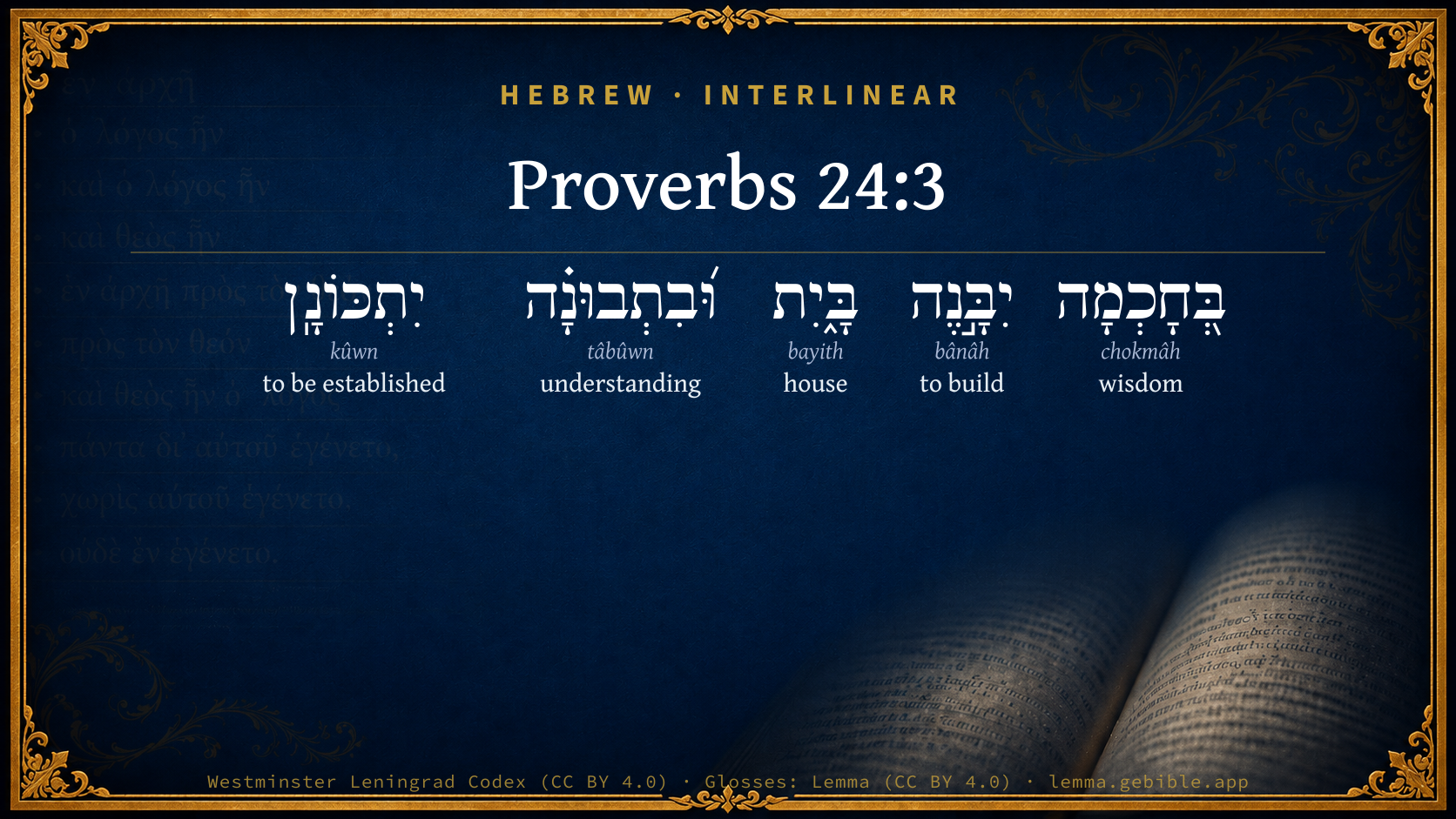
Proverbs 24:3

Hebrew (Westminster Leningrad Codex) Proverbs 24:3 appears in the Hebrew Old Testament. The text above is from the Westminster Leningrad Codex. Each word links to its Strong’s number, a concise gloss, and parsing drawn from the Open Scriptures Hebrew Bible morphology. Click any word for its full Brown-Driver-Briggs (BDB) entry.
Download image
Cite this verse

Proverbs 24:3 (World English Bible). Public Domain. Lemma interlinear Bible study tool, https://lemma.gebible.app/v/proverbs/24/3.

Show BibTeX & RIS
BibTeX
RIS
English Translation
Through wisdom a house is built; By understanding it is established;
World English Bible · Public Domain
Download a study sheet

One document with this verse’s original text, its word-by-word gloss line, the meaning frame, cross-references with their text, attributed commentary, and full source and license credits — printable, and it pastes into notes with its structure intact.

This verse Autodidact and up

Study sheet (.html) Plain text (.txt)

A passage Seminary Student

Up to 50 verses in one chapter. A passage sheet keeps up to 6 commentary sources and 12 cross-references per verse, in the order this page ranks them, and says so on the sheet whenever that leaves anything out. Ask for a single verse and you get the Autodidact verse sheet above.

Everything on this page stays free to read, with no account — the sheet is a download of what is already on screen, not access to it.

Want to remove ads? Support Godless Engineer
Compare translations 3

The same verse in 3 English versions, stacked beneath the original-language interlinear above. Click any original word for its lexicon entry.

Each is an independent rendering of the whole verse — the interlinear is not word-aligned to these translations.

Highlighted words mark where these versions differ — a whole-verse word diff, not a word-by-word alignment.

  • World English Bible Public Domain
    Through wisdom a house is built; By understanding it is established;
  • King James Version Public Domain
    Through wisdom is an house builded; and by understanding it is established:
  • unfoldingWord Literal Text CC BY-SA 4.0
    By wisdom a house is built, and by understanding it is established.

unfoldingWord Literal Text — © unfoldingWord, licensed CC BY-SA 4.0. Word-aligned USFM3 via Door43 (git.door43.org/unfoldingWord/en_ult).

Versions to compare (up to 4)

3 of 4 selected

Show all 18 translations

Every available English version of this verse, each an independent rendering of the whole verse.

  • World English Bible Public Domain
    Through wisdom a house is built; By understanding it is established;
  • Berean Standard Bible Public Domain
    By wisdom a house is built and by understanding it is established;
  • Majority Standard Bible Public Domain
    By wisdom a house is built and by understanding it is established;
  • King James Version Public Domain
    Through wisdom is an house builded; and by understanding it is established:
  • American Standard Version (1901) Public Domain
    Through wisdom is a house builded; And by understanding it is established;
  • Revised Version (1885) Public Domain
    Through wisdom is an house builded; and by understanding it is established:
  • Geneva Bible (1599) Public Domain
    Through wisdome is an house builded, and with vnderstanding it is established.
  • Douay-Rheims (1899) Public Domain
    By wisdom the house shall be built, and by prudence it shall be strengthened.
  • Young's Literal Translation Public Domain
    By wisdom is a house builded, And by understanding it establisheth itself.
  • Literal Standard Version CC BY-SA 4.0
    A house is built by wisdom, || And it establishes itself by understanding.
  • Unlocked Literal Bible CC BY-SA 4.0
    Through wisdom a house is built and by understanding it is established.
  • unfoldingWord Literal Text CC BY-SA 4.0
    By wisdom a house is built, and by understanding it is established.
  • Darby Bible Public Domain
    Through wisdom is a house built, and by understanding it is established;
  • World Messianic Bible Public Domain
    Through wisdom a house is built; by understanding it is established;
  • Webster's Bible Public Domain
    Through wisdom is a house built; and by understanding it is established:
  • Free Bible Version CC BY-SA 4.0
    A house is built by wisdom; its foundation is made secure through understanding.
  • Bible in Basic English Public Domain
    The building of a house is by wisdom, and by reason it is made strong:
  • JPS Tanakh (1917) Public Domain
    Through wisdom is a house builded; and by understanding it is established;

Literal Standard Version (2020), Covenant Press — licensed CC BY-SA 4.0. Text via the HelloAO Bible API (eBible.org). Unlocked Literal Bible (unfoldingWord) — licensed CC BY-SA 4.0. Text via the HelloAO Bible API (eBible.org). unfoldingWord Literal Text — © unfoldingWord, licensed CC BY-SA 4.0. Word-aligned USFM3 via Door43 (git.door43.org/unfoldingWord/en_ult). Free Bible Version, Dr. Jonathan Gallagher — licensed CC BY-SA 4.0. Text via the HelloAO Bible API (eBible.org).

Word by word

More ways to search: Search by grammar → Find every occurrence → Compare this word →

Practice this passage: Drill this verse → Learn its vocabulary →

וּ֝בִתְבוּנָ֗ה
tâbûwn
H8394
“and · in/at · understanding”
Conjunction + Preposition + Noun, Common, Feminine, Singular, Absolute
Part of Speech
Conjunction + Preposition + Noun
Type
Common
Gender
Feminine
Number
Singular
State
Absolute
Full BDB Definition

Origin: from H995

TWOT: 239c

understanding, intelligence - the act of understanding - skill - the faculty of understanding - intelligence, understanding, insight - the object of knowledge - teacher (personification)
  1. בְּ֭חָכְמָה chokmâh H2451 “in/at · wisdom” Preposition + Noun, Common, Feminine, Singular, Absolute
  2. יִבָּ֣נֶה bânâh H1129 “to build” Verb, Niphal, Imperfect, 3rd Person, Masculine, Singular
  3. בָּ֑יִת bayith H1004 “house” Noun, Common, Masculine, Singular, Absolute
  4. יִתְכּוֹנָֽן kûwn H3559 “to be established” Verb, Hithpolel, Imperfect, 3rd Person, Masculine, Singular

About this verse

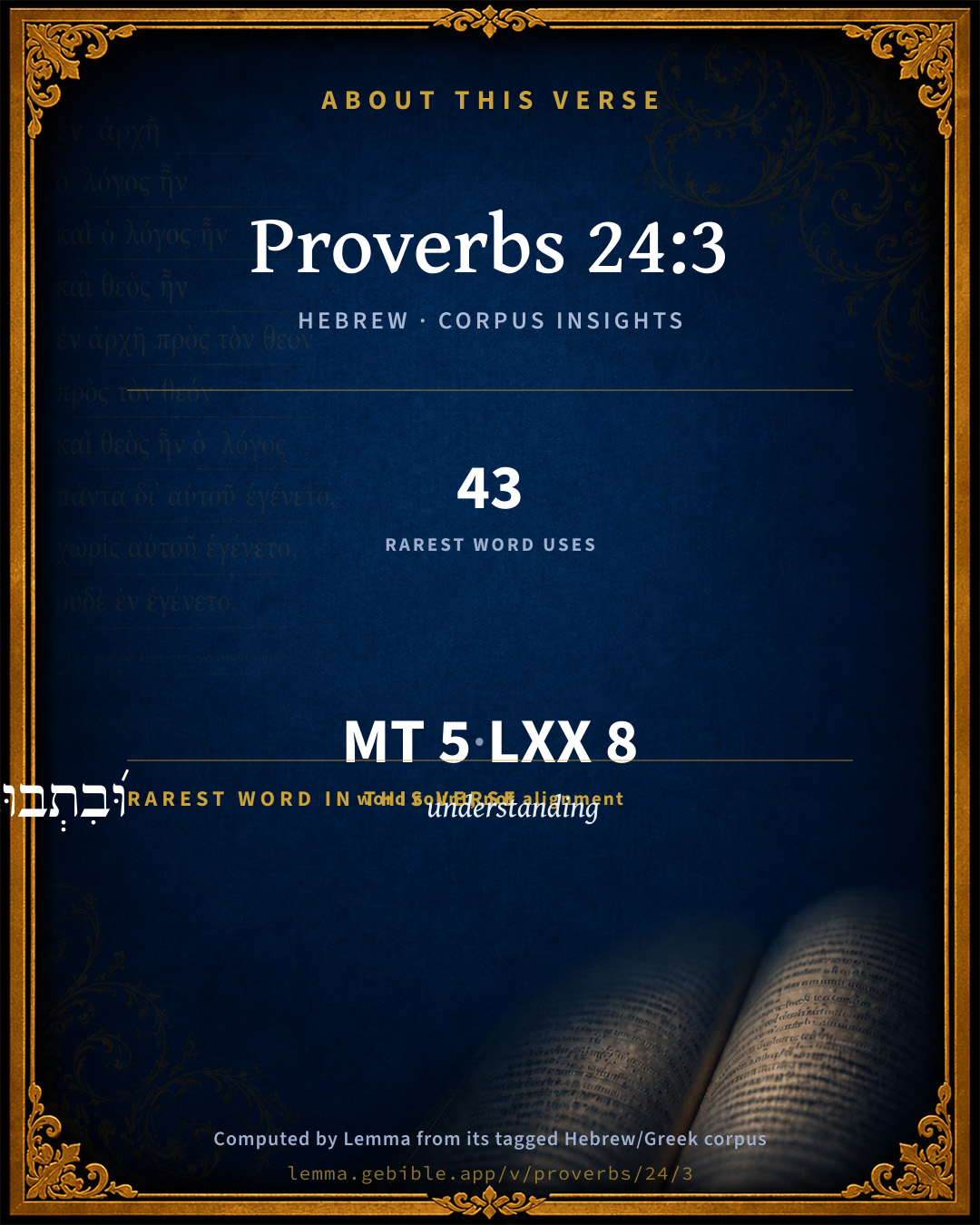
These counts appear in no published source. They are computed here, from the morphology-tagged text and Lemma’s own curated glosses. What Lemma adds →

5
words
5
distinct lemmas
Wisdom
section

Shared distinctive vocabulary

וּ֝בִתְבוּנָ֗ה understanding H8394 occurs in 42 verses of the Hebrew Bible. Also found in:

Grammatical profile

  • 2 verbs
  • 3 nouns

Verb forms

  • יִבָּ֣נֶה Niphal · Imperfect
  • יִתְכּוֹנָֽן Hithpolel · Imperfect

Hebrew & Septuagint length

In English translation the verse runs 11 words from the Hebrew and 12 from the Septuagint (LXX English) — closely comparable.

A rough comparison of the two English renderings, which tokenize alike — not a word-level alignment.

Word counts can differ between the Hebrew and the Greek without any difference in meaning — e.g. the Hebrew direct-object marker אֵת has no separate Greek word, and Greek often adds the article ὁ.

In the original languages it is 5 Hebrew tokens and 8 Greek tokens — but the two are counted differently (Hebrew bundles its prefixes and suffixes into one token; the Greek is in lemma form), so that isn’t a like-for-like length.

Cross-references

6

Topical passages linked to Proverbs 24:3 in the Treasury of Scripture Knowledge — connected by theme and wording, ordered by reader-vote popularity; previews shown in the World English Bible.

  • Proverbs 14:1 Every wise woman builds her house, But the foolish one tears it down with her own hands.
  • Proverbs 9:1 Wisdom has built her house. She has carved out her seven pillars.
  • 1 Corinthians 3:9 For we are God's fellow workers. You are God's farming, God's building.
  • Colossians 2:7 rooted and built up in him, and established in the faith, even as you were taught, abounding in it in thanksgiving.
  • Jeremiah 10:12 He has made the earth by his power, he has established the world by his wisdom, and by his understanding has he stretched out the heavens:
  • 2 Samuel 7:26 Let your name be magnified forever, saying, Yahweh of hosts is God over Israel; and the house of your servant David shall be established before you.

Cross-references courtesy of OpenBible.info (CC BY 4.0).

Hebrew and Greek witnesses Masoretic Hebrew ↔ Greek Septuagint

The same verse in the two great witnesses to the Old Testament, shown verse-for-verse.

These are two independent witnesses, not word-aligned to each other, and the Septuagint is shown in lemma (dictionary) form.

Hebrew Proverbs 24:3 Masoretic · Westminster Leningrad Codex

בְּ֭חָכְמָה יִבָּ֣נֶה בָּ֑יִת וּ֝בִתְבוּנָ֗ה יִתְכּוֹנָֽן

Through wisdom a house is built; By understanding it is established;

World English Bible · Public Domain

Greek LXX Proverbs 24:3 Septuagint · lemma form

μετά σοφία οἰκοδομέω οἶκος καί μετά σύνεσις ἀναὀρθόω

A house is built by wisdom, and is set up by understanding.

LXX2012 (modern English Septuagint) · Public Domain

On this verse, The Pulpit Commentary discusses the Septuagint’s reading. Read the note in Commentary ↓

Hebrew: Westminster Leningrad Codex (CC BY 4.0). Greek: Septuagint (public domain); English from LXX2012 (modern English Septuagint) (Public Domain). How the Septuagint differs from the Hebrew →

Commentary

Notes on Proverbs 24:3 from classic Christian and Jewish commentators (each source and its license shown beneath its notes). The classic Christian expositions comment on the surrounding passage and are grouped to its opening verse, so a note may address several verses; the Jewish commentaries on the Tanakh (Rashi and others) are per-verse, so they appear only where the commentator wrote on this verse.

Lemma curates 59 commentaries, every one of them public domain or Creative Commons licensed, each selected and text-cleaned for this edition rather than reprinted as found. About our sources →

Matthew Henry's Commentary

We are tempted to envy those that grow rich, and raise their estates and families, by such unjust courses as our consciences will by no means suffer us to use. But, to set aside that temptation, Solomon here shows that a man, with prudent management, may raise his estate and family by lawful and honest means, with a good conscience, and a good name, and the blessing of God upon his industry; and, if the other be raised a little sooner, yet these will last a great deal longer. 1. That which is here recommended to us as having the best influence upon our outward prosperity is wisdom, and understanding, and knowledge; that is, both piety towards God (for that is true wisdom) and prudence in the management of our outward affairs. We must govern ourselves in every thing by the rules of religion first and then of discretion. Some that are truly pious do not thrive in the world, for want of prudence; and some that are prudent enough, yet do not prosper, because they lean to their own understanding and do not acknowledge God in their ways; therefore both must go together to complete a wise man. 2. That which is here set before us as the advantage of true wisdom is that it will make men's outward affairs prosperous and successful. (1.) it will build a house and establish it, Pro 24:3. Men may by unrighteous practices build their houses, but they cannot establish them, for the foundation is rotten (Hab 2:9, Hab 2:10); whereas what is honestly got will wear like steel and be an inheritance to children's children. (2.) It will enrich a house and furnish it, Pro 24:4. Those that manage their affairs with wisdom and equity, that are diligent in the use of lawful means for increasing what they have that spare from luxury and spend in charity, are in a fair way to have their shops, their warehouses, their chambers, filled with all precious and pleasant riches - precious because got by honest labour, and the substance of a diligent man is precious - pleasant because enjoyed with holy cheerfulness. Some think this is to be understood chiefly of spiritual riches. By knowledge the chambers of the soul are filled with the graces and comforts of the Spirit, those precious and pleasant riches; for the Spirit, by enlightening the understanding, performs all his other operations on the soul. (3.) It will fortify a house and turn it into a castle: Wisdom is better than weapons of war, offensive or defensive. A wise man is in strength, is in a strong-hold, yea, a man of knowledge strengthens might, that is, increases it, Pro 24:5. As we grow in knowledge we grow in all grace, Pe2 3:18. Those that increase in wisdom are strengthened with all might, Col 1:9, Col 1:11. A wise man will compass that by his wisdom which a strong man cannot effect by force of arms. The spirit is strengthened both for the spiritual work and the spiritual warfare by true wisdom. (4.) It will govern a house and a kingdom too, and the affairs of both, Pro 24:6. Wisdom will erect a college, or council of state. Wisdom will be of use, [1.] For the managing of the public quarrels, so as not to engage in them but for an honest cause and with some probability of success, and, when they are engaged in, to manage them well, and so as to make either an advantageous peace or an honourable retreat: By wise counsel thou shalt make war, which is a thing that may prove of ill consequence if not done by wise counsel. [2.] For the securing of the public peace: In the multitude of counsellors there is safety, for one may foresee the danger, and discern the advantages, which another cannot. In our spiritual conflicts we need wisdom, for our enemy is subtle.

Matthew Henry's Commentary on the Whole Bible (1708–1710) — public domain (CC PDM 1.0). Text via the HelloAO Bible API.

Trapp's Complete Commentary

John Trapp

Pro 24:3 Through wisdom is an house builded; and by understanding it is established:

Ver. 3. Through wisdom is an house builded.] q.d., I will show thee a better project; wouldst thou thrive and grow great? Exercise godliness, wish not wickedness. {See Trapp on "Pro 3:16"} {See Trapp on "Pro 3:17"}

John Trapp, A Commentary or Exposition upon All the Books of the Old and New Testament (1647–1656) — public domain. Text from a community e-Sword module.

The Biblical Illustrator

Joseph S. Exell

Pro_24:3-4

Through wisdom is an house builded.

The spiritual edifice

The subject is wisdom, with its enlargements of understanding and knowledge--terms probably used to denote the expansions of the master principle, and the ramifications into which it extends, as it sways and develops the faculties of the mind. Distinguish between the wisdom of this world and the wisdom of God. They who embrace the wisdom of God beckon the other wisdom with it. They who embrace the latter usually repel the invitation, and continue their warfare in the pride and scorn of self-satisfied security, which ultimately terminates in their destruction.

I. Wisdom is the foundation on which a house must be built. It is the great principle on which all other principles must be founded. But what is this wisdom? Solomon says, the fear of the Lord. True religion. Consisting, not in a mere external or intellectual acknowledgment of an overruling Deity, much less in any amount of mere intellectual knowledge, but in an actual going to Wisdom as to a personage, not merely in possessing a certain quality or disposition of mind, but in really going to God by faith, and so accepting and following the terms of His covenant that the qualities and dispositions of mind, which manifest the being built on wisdom, spring from that source, coming down from God to man as the gifts of His grace, not going up from man towards God.

II. The strength, superstructure, and ornament of the spiritual edifice. The active duties of our profession are implied in carrying out the obligations and requirements of a true and heart-born faith. Store your minds with knowledge; only see that first of all you possess the knowledge of God in Christ Jesus. (R. H. Davies, B.A.)

The wise life-builder

Here evil is contrasted with wisdom: evil throws down, wisdom builds up; evil brings darkness, wisdom brings light. Wisdom is represented as a builder; one who builds with a plan, not merely putting stone upon stone for the sake of building a high tower without purpose or utility, but building a house, signifying arrangement, commodiousness, security, hospitality: a very home that should have in it the elements of a school, the beginning of a sanctuary, and a hint of heaven itself. True building is not to be hurried. Sometimes the builder rests from his labours, that he may give the wall time to settle, lest by overpowering the foundation he bring the work to destruction. True life-building means that plan and a specification has been provided, whereby the work as to its scope and purpose is clearly indicated, and the materials with which the work is to be executed are named one by one, as to their quality and their proportions. It is not to be supposed that men go forth into the open field and begin to build as on the spur of the moment. Every building will speak for itself. If the perpendicular has been broken, if the horizontal line is out of course, if doors and windows are out of proportion, even the fool can see how abortive has been the labours of the builder. Where everything expresses thoughtfulness, experience, and skill, the trained eye will approve the figure of the building, and all men will feel that no encroachment has been made upon the propriety of life. Every duly considered and well-built house comes into existence as if by right; it establishes its own claim to abide among the homes of men. So it is with a heart-house, a life-house, a house representing character and action and purpose; there is nothing violent about the building, and when it is set forth in all its proportions it needs no vindication, for its strength is a defence, and its beauty is an explanation. (J. Parker, D.D.)

The Biblical Illustrator, edited by Joseph S. Exell (c. 1880s–1900s) — public domain. Text from a community e-Sword module.

Joseph Benson's Commentary

Pro 24:3-6. Through wisdom is a house built — There is no need that thou shouldst raise thyself and family by ruining others, as the manner of wicked men is; for thou mayest more easily and effectually do it by wisdom and the fear of God. And by knowledge — Which, in the phraseology of the Scriptures, includes the love and practice of that which we know. A wise man is strong — Is courageous and resolute, and able by wisdom to do greater things than others can accomplish by their own strength. For by wise counsel, &c. — As if he had said, This is plainly seen in war itself, wherein success is often owing more to conduct than force. So this proves what was said in Pro 24:5.

Joseph Benson's Commentary on the Old and New Testaments (1811–1818) — public domain. Text from a community e-Sword module.

Tyndale Open Study Notes

Tyndale Open Resources

24:3-4 Saying 20: See 14:11.

Tyndale Open Study Notes — © Tyndale Open Resources, licensed CC BY-SA 4.0. Text via the HelloAO Bible API.

Jamieson, Fausset & Brown

Robert Jamieson, A. R. Fausset & David Brown

(Compare Pro 14:1; Isa 54:14).

house--including the family.

Jamieson, Fausset & Brown — Commentary Critical and Explanatory on the Whole Bible (1871) — public domain (CC PDM 1.0). Text via the HelloAO Bible API.

Adam Clarke's Commentary

Verse 3. Through wisdom is a house blinded] That is, a family; household affairs. See Clarke on Pr 9:1, &c.

Adam Clarke's Commentary on the Bible (1810–1826) — public domain. Text from a community e-Sword/MySword module.

Ellicott's Commentary for English Readers

XXIV

(3) Through wisdom is an house builded.—See above on Pro_14:1.

A Bible Commentary for English Readers, edited by Charles John Ellicott (1878–1897) — public domain. Text from a community e-Sword module.

The Cambridge Bible for Schools and Colleges

gen. ed. J. J. S. Perowne

3. a house] literal or metaphorical, comp. Pro_14:1.

The Cambridge Bible for Schools and Colleges (gen. ed. J. J. S. Perowne; Cambridge University Press, 1878–1918) — public domain. Text from a community e-Sword module.

John Gill's Exposition

Through wisdom is a house builded,.... A family is built up, furnished and supplied with the necessaries and conveniences of life, and brought into flourishing and prosperous circumstances, by wise and prudent management, by diligence and industry, through the blessing of God upon them, without taking such methods as evil men do. The house of God, the church of the living God, is built by Wisdom, that is, by Christ; on a good foundation, a rock, upon himself, against which the gates of hell can never prevail; see Pro 9:1. Every good man's house, himself, his soul, and the eternal salvation of it, are built on the same; and he is a wise man that builds his house through wisdom; that builds on the foundation of the apostles and prophets, the one and only foundation which God has laid, which is Jesus Christ;

and by understanding it is established; the prosperity of a man's family is continued and secured by his prudent conduct. The church of God is established by Christ, who is understanding as well as wisdom; see Pro 8:14; and every true believer is established in Christ, and in the faith of him; and that as he has more and more an understanding of him and of divine things.

John Gill's Exposition of the Whole Bible (1746–1763) — public domain (CC PDM 1.0). Text via the HelloAO Bible API.

Albert Barnes' Notes on the Bible

The “house” is figurative of the whole life, the “chambers” of all regions, inward and outward, of it.

Albert Barnes' Notes on the Bible (1834–1885) — public domain. Text from a community e-Sword/MySword module.

Haydock's Catholic Bible Commentary

Wisdom and virtue, and not by injustice can the house be established.

George Leo Haydock (1774–1849), Haydock's Catholic Family Bible and Commentary, 1859 edition — public domain. Excludes Psalms (Douay-Rheims chapter numbering differs from Protestant) and Deuterocanonical books (Catholic canon only).

Matthew Poole's English Annotations

There is no need that thou shouldst raise thyself and family by ruining others, as the manner of wicked men is, which thou mayst more easily and effectually do by wisdom, and the fear of God.

Matthew Poole's English Annotations on the Holy Bible (1683–1685) — public domain. Text from a community e-Sword/MySword module.

Whedon's Commentary on the Bible

Daniel D. Whedon

3. A house — A family, an estate, is built up by wisdom and established by understanding, rather than by the fraudulent acts of designing men. Right means may do it more slowly, perhaps, than wrong ones, but more surely and lastingly. Comp. Pro_14:1; Pro_3:19.

Daniel D. Whedon (gen. ed.), Commentary on the Old and New Testaments (1874–1909) — public domain. Text from a community e-Sword module.

The Pulpit Commentary

Vers. 3, 4. In contrast with the conversation of the evil, wisdom is commended.

Through wisdom is a house builded. (see on Pro_14:1) By prudence, probity, and the fear of God a family is supported and blessed, maintained and prospered. Established; (see on Pro_3:19) Septuagint, anoryoutai.

Comp. Pro_1:13 and note Pro_3:10. With all precious and pleasant (Pro_22:18) riches. Material prosperity, copious store of necessaries, and wealth, follow on wisdom; how much more do spiritual blessings attend the fear of God!

Vers. 3-6. Wisdom edifies and invigorates.

How fine a word is "edification," building up, in its moral and Christian uses! Here the image of the house is directly introduced, and may be variously applied.

I WISDOM THE FOUNDATION OF DOMESTIC STABILITY AND HAPPINESS. (Vers. 3, 4) The same great principles apply in the least as well as the most important things. Every day brings humble occasions for the practice of the grandest laws, no less in the house, the farm, or the shop, than in the council chamber or on the battle field. "Method is as efficient in the packing of firewood in a shed, or the harvesting of fruits in a cellar, as in Peninsular campaigns or the files of a department of state." Let a man keep the Law, and his way will be strewn with satisfactions. There is more difference in the quality of our pleasures than in the amount. Comfort and abundance in the home are the certain signs of prudence and sense and action constantly applied.

II WISDOM THE SOURCE OF MANLY STRENGTH. (Vers. 5, 6) It was a great man who said, "Knowledge is power." It is not the force of brute strength, but that of spiritual energy, which in the long run rules the world. The illustration of the text is aptly selected from war, where, if anywhere, brute force might be supposed to prevail. Experience shows that it is not so. The complete failures of men like Hannibal and Napoleon show it in one way. Recent wars have illustrated the truth that it is the deliberate and matured designs of the strategist and far-seeing statesman which command success, rather than the "great battalions" on the side of which Providence was said to be. And in another application, sheer force of intellect is often surpassed and outdone by the steady and constant employment of humbler powers. Strength in any form without prudence is like a giant without eyes. Violence and craft may seem the readiest way to wealth; yet experience shows that prudence and piety lead most surely to desirable prosperity. J.

Vers. 3-6. Building with wisdom.

God is the Divine Builder. "He that built all things is God". (Heb_3:4) Man, also, is a great builder. The whole scenery of the earth is not a little changed by the houses and temples, by the bridges and factories, by the manifold structures of every size and shape, that he has built. But these are not the most serious and important of his works. We look at

I THE HOUSES WE ARE BUILDING. Of these, three are the most deserving of attention.

1. Our estate. The position and provision we secure for ourselves and our family; an honourable place we take among men, as neighbours and fellow citizens. Every man has to set this before him as a thing to be patiently pursued and ultimately attained. Some men think of little else or nothing else, therein making a fatal mistake; but it is the manifest duty as well as the clear interest of us all, to build up a house of this kind.

2. Our character. This is "a house" of the first importance. We are here for this express purpose that we may be daily and hourly building up a noble and estimable character; such a character as God will himself approve; such as man will admire, and will do well to copy; such as will command the commendation of our own conscience; such as will stand firm and strong against all the perils by which it is beset; such as will contain many virtues and graces in its various "chambers" (Ver. 4). "Precious and pleasant rubies," indeed, are these.

3. Some cause of Christian usefulness. We should all be diligently occupied in raising or sustaining some "work" of holy usefulness, by which the seeds of truth may be scattered, hearts may be comforted, lives may be brightened, souls may be won to righteousness and wisdom, Christ may be honored, and his kingdom advanced.

II THE INDISPENSABLE MATERIALS. The wisdom which is from above. "Through wisdom is a house built, and by understanding it is established" (Ver. 3). For wisdom includes or secures:

1. The fear and therefore the favor of God. (See Pro_1:7 Pro_9:10)

(1) To walk and to work in the fear of God is to do all things uprightly and honourably, truly and faithfully, heartily and thoroughly; and this is the way to build up any one of these three "houses.

(2) To enjoy the favour of God is to have behind us that energizing and sustaining power without which all labour is vain; (Psa_127:1) it is to possess the protecting care which will shield us from the storms that might otherwise overthrow us. (Ps 121)

2. The various orders of strength which we need for good building (Ver. 5).

(1) It tends to physical health and strength.

(2) It conduces to mental strength and the increase of knowledge; it supplies us with good judgment, with tact, with prudence, with patience, with the very implements of successful labour.

(3) It ministers to moral and spiritual strength; for it brings us into communion with God and to the study of his Word.

3. The power of resistance and attack. By "wise counsel we make war" (Ver. 6). It is a very great matter, in all spheres of activity, to know when to make peace and when to show a fearless front of opposition. And when the latter course has to be taken, there is much true wisdom needed in order that our house, our stronghold, may not be carried and dismantled. We need courage, decision, watchfulness, energy, self-command, readiness to make terms at the right moment. To attain to the wisdom which will thus build up our house, we need to

(1) yield our hearts fully to the only wise God and Saviour;

(2) open our minds daily to receive his heavenly wisdom;

(3) ask of him who "giveth to all men liberally, upbraiding not. C.

The Pulpit Commentary (1880–1919), ed. H.D.M. Spence-Jones & Joseph S. Exell — public domain. Text from a community e-Sword module.

John Wesley's Explanatory Notes

Through wisdom - There is no need that thou shouldest raise thy family by ruining others, which thou mayest more effectually do by wisdom.

John Wesley, Explanatory Notes Upon the Whole Bible (1754–1765) — public domain. Text via the GEBible commentary corpus.

Keil & Delitzsch

C. F. Keil & F. Delitzsch

The warning against fellowship with the godless is followed by the praise of wisdom, which is rooted in the fear of God.

3 By wisdom is the house builded,

And by understanding is it established.

4 And by knowledge shall the chambers be filled

With all manner of precious and pleasant goods.

What is meant by the "building of the house" is explained at Pro 14:1. It is wisdom, viz., that which originates from God, which is rooted in fellowship with Him, by which every household, be it great or small, prospers and attains to a successful and flourishing state; כּונן, as parallel word to בּנה (Pro 3:19; Pro 2:12), is related to it as statuere to extruere; the Hithpal (as at Num 21:17) means to keep oneself in a state of continuance, to gain perpetuity, to become established. That ימּלאוּ by Athnach has not passed over into the pausal ימּלאוּ, arises from this, that the Athnach, by the poetical system of accents, has only the force of the prose accent Sakef; the clause completes itself only by 4b; the pausal form on that account also is not found, and it is discontinued, because the Athnach does not produce any pausal effect (vid., at Psa 45:6). The form of expression in Pro 24:4 is like Pro 1:13; Pro 3:10. But the חדרים, of storerooms (lxx as Isa 26:20, ταμιεῖα), and נעים, like Pro 22:18; Pro 23:8, is peculiar to this collection.

Keil & Delitzsch — Biblical Commentary on the Old Testament (1861–1891) — public domain (CC PDM 1.0). Text via the HelloAO Bible API. (Old Testament only.)

Bridges on Proverbs

Charles Bridges

Why should we envy the prosperity of the wicked? Even if their house be built,†1 it cannot be established,†2 by iniquity. ’It is only the snow-palace built in the winter, and melting away under the power of the summer’s sun.’†3 "The wise woman buildeth her house" (Pro 14:1 ) upon piety and prudence — a far more solid establishment. Let every chamber of the mind be enriched with these precious and pleasant endowments. Without them the man is without strength of character; the creature of accident, circumstance, or society, thinking and living upon the opinion of others. A general irresolution marks his insignificant course; the soul, when consecrated as God’s house (2Co 6:16 ), is built on an enlightened understanding of divine truth: and every chamber is filled with the precious and pleasant riches of godliness. (2Pe 1:2-4 .) Heresy is restrained by conceding supreme authority to the Bible. The crude professor acts under feverish impulse, a sickly sentimentalist in religion. Instead of retaining a firm hold of truth, he imbibes with ease the most monstrous opinions. He is "carried about with divers and strange doctrines," instead of exhibiting "the good things of an heart established with grace." (Heb 13:9 .) "Growth in" spiritual, as distinct from speculative "knowledge," will always be accompanied with "growth in grace." (2Pe 3:18 .)

And may we not observe, how God has laid the foundations of the spiritual house, shaped and framed the materials by his own divine wisdom, and filled all the chambers with his precious and pleasant riches? Delightful is the contemplation of the building, as it is rising, and as it will be, when it is finished. ’Oh, the transcendent glory’ — exclaimed the heavenly Martyn — ’of this temple of souls; lively stones, perfect in all its parts, the purchase and work of God!’†4

In passing from the universal Church to one section of it, we cannot but remark the wisdom and understanding with which our spiritual house is builded and established. It called for no common wisdom in such jarring times, and such imperfect light, to avoid extremes on both sides, and to frame a system, fraught with solid instruction, yet glowing with spiritual exercise; popular yet reverential; conducive to "prayer" alike "with the spirit and with the understanding." (1Co 14:15 .) Our Reformers were indeed wisely taught, while they cast away the superstition and idolatry of Rome, to apply her primitive treasures for godly use, and when needed, to purify them from their drossy alloy, and to mold the gold in evangelical purity. Truly the chambers of our house are filled with all precious and pleasant riches. And did the mass of our worshippers only imbibe the spirit of their house what a prevailing influence of godliness would spread over our land!

But we take another view of the high advantage of wisdom. A wise man is strong.†5 Every view confirms Lord Bacon’s far-famed aphorism — ’Knowledge is power.’ The discovery of the mechanical forces, and the power of steam, has increased strength in an hundred-fold proportion to physical force. Intellectual knowledge, wisely applied, has immense moral ascendancy. It restrains the King from unadvised wars (Pro 20:18 ); and, if forced into the field, instead of treading his perilous path alone, he ensures the safety of his kingdom by multitude of counselors.†6 The man of spiritual knowledge is a giant in strength. He combines the power to draw the bow, with a steady hand and eye to guide the mark. Conscious ignorance is the first principle of knowledge. "I am but a little child" — said the wisest of men; and this humility of wisdom was the establishment of his kingdom.†7 The Christian, "filled with wisdom and spiritual understanding," is also "strengthened" in his warfare "with all might according to the glorious power of his God." (Col 1:9, Col 1:11 .) For "the people that do know their God shall be strong, and do exploits." (Dan 11:32 .)

Footnotes:

†1 Mic 3:10.

†2 Pro 12:3. Jer 22:13, Jer 22:18 . Amo 5:11 .

†3 Geier in loco.

†4 Life, chapter iii.

†5 Pro 21:22. Ecc 7:19 ; Ecc 9:16 .

†6 Pro 11:14; Pro 15:22 .

†7 1Ki 3:7 ; 1Ki 5:12 ; 1Ki 10:23-29 . 2Ch 27:6 .

Charles Bridges, An Exposition of the Book of Proverbs (1846) — public domain. Text from a community e-Sword module.

Kretzmann's Popular Commentary

Paul E. Kretzmann

v. 3. Through wisdom is an house builded, not only the dwelling, but the occupants of the house being included in the designation, and by understanding it is established, in this way only do people get a home in the true sense of the word;

Paul E. Kretzmann, Popular Commentary of the Bible (1921–1924) — public domain. Text from a community e-Sword module.

unfoldingWord translationNotes

Door43 World Missions Community

General Information:

These verses continue the "thirty sayings" (Proverbs 22:20).

Through wisdom a house is built

The abstract noun "wisdom" can be translated as an adjective. These words can be translated in active form. AT: "People need to be wise if they are to build a good house" (See: Abstract Nouns and Active or Passive)

by understanding it is established

The abstract noun "understanding" can be translated as a verb. These words can be translated in active form. AT: "People need to understand what is morally good and what is morally bad if they are to establish a house" (See: Abstract Nouns and Active or Passive and Assumed Knowledge and Implicit Information)

it is established

The word "established" means made stable and strong. The word "house" is a metonym for the family that lives in the house, and the house being physically stable and strong is a metaphor for a family that lives in peace. (See: Metonymy and Metaphor)

By knowledge the rooms are filled

The abstract noun "knowledge" can be translated as a verb. These words can be translated in active form. AT: "People need to know what is precious and pleasant if they are to fill their rooms" (See: Abstract Nouns and Active or Passive and Assumed Knowledge and Implicit Information)

translationWords

wise

house

know

unfoldingWord translationNotes — © Distant Shores Media and the Door43 World Missions Community, licensed CC BY-SA 4.0. Source: git.door43.org/Door43/en_tn.

Lesson kit

Teaching starters — assembled from the data on this page, not authored interpretation. Every prompt links to the verse data it draws on. Edit before teaching.

Proverbs, in the Wisdom, opens this verse with 5 words (5 distinct Hebrew lemmas). Its most distinctive word is tâbûwn (“understanding”). A historical commentator’s framing appears above. Read the whole chapter for the surrounding context.

Discussion questions

  1. What does “understanding” (tâbûwn) contribute to the verse as a whole?
  2. Exodus 31:3 shares the word «understanding» with this verse. How do the two illuminate each other?
  3. These translations render this verse differently; the difference is in the English rendering, not the original. What questions does that raise?
  4. The verb «יִבָּ֣נֶה» is Niphal Imperfect. How does its form color the action?
  5. Reading how Matthew Henry's Commentary and Trapp's Complete Commentary read this verse, where do the two commentators agree and where do they part?

Things to notice

Reading settings

Reading text

Shown beneath each verse's original-language words.

Old Testament
Old Testament edition

Read the OT as the Masoretic Hebrew (MT) or the Greek Septuagint (LXX).

English shown for the Greek Septuagint (in the Hebrew ↔ Greek comparison).

Comparing translations? Open the Compare panel on any verse page to stack up to four side by side.