
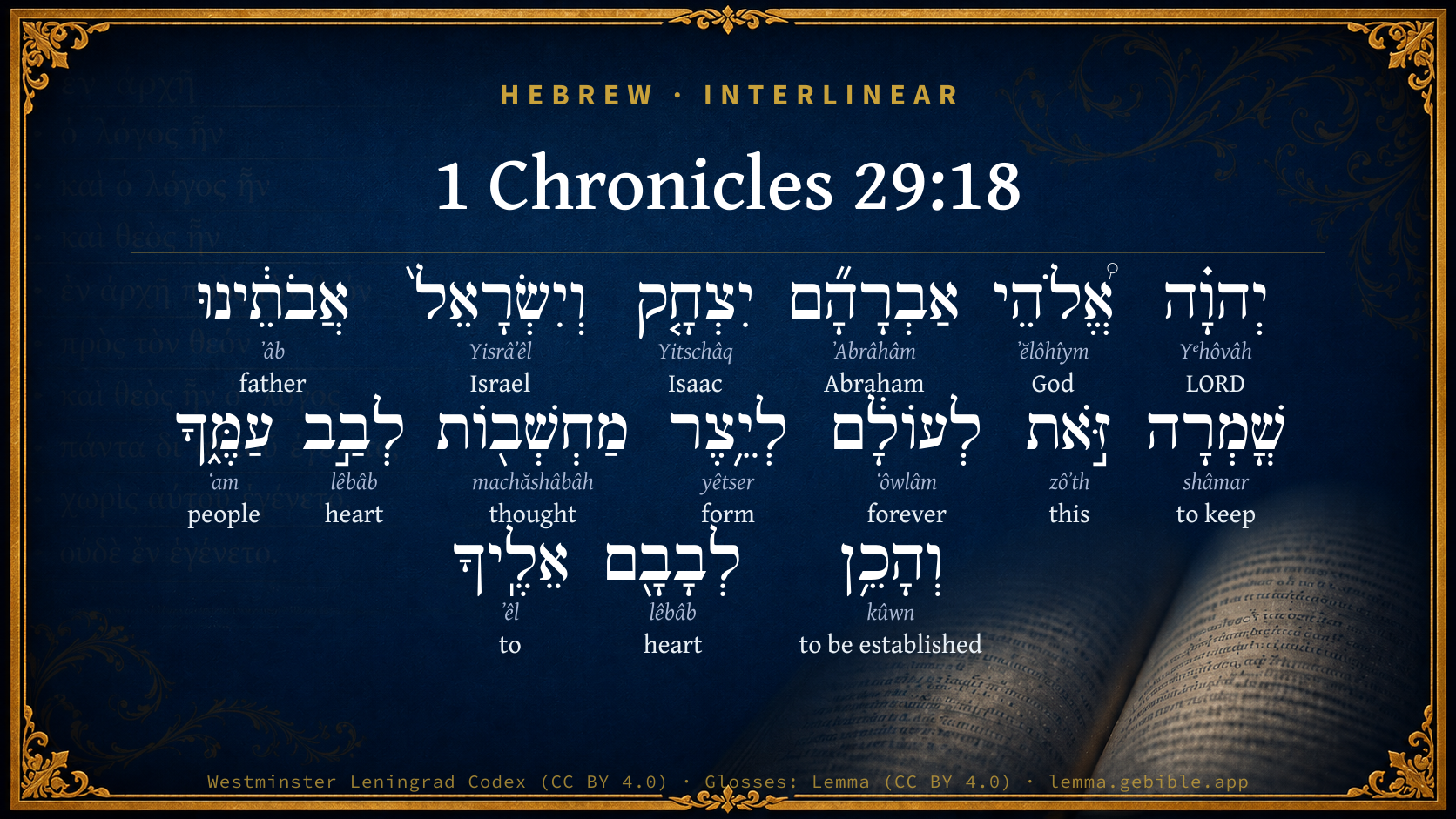
1 Chronicles 29:18

Hebrew (Westminster Leningrad Codex) 1 Chronicles 29:18 appears in the Hebrew Old Testament. The text above is from the Westminster Leningrad Codex. Each word links to its Strong’s number, a concise gloss, and parsing drawn from the Open Scriptures Hebrew Bible morphology. Click any word for its full Brown-Driver-Briggs (BDB) entry.
Download image
Cite this verse

1 Chronicles 29:18 (World English Bible). Public Domain. Lemma interlinear Bible study tool, https://lemma.gebible.app/v/1-chronicles/29/18.

Show BibTeX & RIS
BibTeX
RIS
English Translation
Yahweh, the God of Abraham, of Isaac, and of Israel, our fathers, keep this forever in the imagination of the thoughts of the heart of your people, and prepare their heart to you;
World English Bible · Public Domain
Download a study sheet

One document with this verse’s original text, its word-by-word gloss line, the meaning frame, cross-references with their text, attributed commentary, and full source and license credits — printable, and it pastes into notes with its structure intact.

This verse Autodidact and up

Study sheet (.html) Plain text (.txt)

A passage Seminary Student

Up to 50 verses in one chapter. A passage sheet keeps up to 6 commentary sources and 12 cross-references per verse, in the order this page ranks them, and says so on the sheet whenever that leaves anything out. Ask for a single verse and you get the Autodidact verse sheet above.

Everything on this page stays free to read, with no account — the sheet is a download of what is already on screen, not access to it.

Want to remove ads? Support Godless Engineer
Compare translations 3

The same verse in 3 English versions, stacked beneath the original-language interlinear above. Click any original word for its lexicon entry.

Each is an independent rendering of the whole verse — the interlinear is not word-aligned to these translations.

Highlighted words mark where these versions differ — a whole-verse word diff, not a word-by-word alignment.

  • World English Bible Public Domain
    Yahweh, the God of Abraham, of Isaac, and of Israel, our fathers, keep this forever in the imagination of the thoughts of the heart of your people, and prepare their heart to you;
  • King James Version Public Domain
    O LORD God of Abraham, Isaac, and of Israel, our fathers, keep this for ever in the imagination of the thoughts of the heart of thy people, and prepare their heart unto thee:
  • unfoldingWord Literal Text CC BY-SA 4.0
    Yahweh, the God of Abraham, Isaac, and Israel, our fathers, keep this forever concerning the intention of the thoughts of the heart of your people, and establish their heart toward you.

unfoldingWord Literal Text — © unfoldingWord, licensed CC BY-SA 4.0. Word-aligned USFM3 via Door43 (git.door43.org/unfoldingWord/en_ult).

Versions to compare (up to 4)

3 of 4 selected

Show all 18 translations

Every available English version of this verse, each an independent rendering of the whole verse.

  • World English Bible Public Domain
    Yahweh, the God of Abraham, of Isaac, and of Israel, our fathers, keep this forever in the imagination of the thoughts of the heart of your people, and prepare their heart to you;
  • Berean Standard Bible Public Domain
    O LORD, God of our fathers Abraham, Isaac, and Israel, keep this desire forever in the intentions of the hearts of Your people, and direct their hearts toward You.
  • Majority Standard Bible Public Domain
    O LORD, God of our fathers Abraham, Isaac, and Israel, keep this desire forever in the intentions of the hearts of Your people, and direct their hearts toward You.
  • King James Version Public Domain
    O LORD God of Abraham, Isaac, and of Israel, our fathers, keep this for ever in the imagination of the thoughts of the heart of thy people, and prepare their heart unto thee:
  • American Standard Version (1901) Public Domain
    O Jehovah, the God of Abraham, of Isaac, and of Israel, our fathers, keep this for ever in the imagination of the thoughts of the heart of thy people, and prepare their heart unto thee;
  • Revised Version (1885) Public Domain
    O LORD, the God of Abraham, of Isaac, and of Israel, our fathers, keep this for ever in the imagination of the thoughts of the heart of thy people; and prepare their heart unto thee:
  • Geneva Bible (1599) Public Domain
    O Lord God of Abraham, Izhak and Israel our fathers, keepe this for euer in the purpose, and the thoughts of the heart of thy people, and prepare their hearts vnto thee.
  • Douay-Rheims (1899) Public Domain
    O Lord God of Abraham, and of Isaac, and of Israel our fathers, keep for ever this will of their heart, and let this mind remain always for the worship of thee.
  • Young's Literal Translation Public Domain
    `O Jehovah, God of Abraham, Isaac, and Israel, our fathers, keep this to the age for the imagination of the thoughts of the heart of Thy people, and prepare their heart unto Thee;
  • Literal Standard Version CC BY-SA 4.0
    O YHWH, God of Abraham, Isaac, and Israel, our fathers, keep this for all time for the imagination of the thoughts of the heart of Your people, and prepare their heart for You;
  • Unlocked Literal Bible CC BY-SA 4.0
    Yahweh, the God of Abraham, Isaac, and Israel—our ancestors—keep this forever in the thoughts of the minds of your people. Direct their hearts toward you.
  • unfoldingWord Literal Text CC BY-SA 4.0
    Yahweh, the God of Abraham, Isaac, and Israel, our fathers, keep this forever concerning the intention of the thoughts of the heart of your people, and establish their heart toward you.
  • Darby Bible Public Domain
    Jehovah, God of Abraham, of Isaac, and of Israel, our fathers, keep this for ever in the imagination of the thoughts of the heart of thy people, and direct their hearts to thee!
  • World Messianic Bible Public Domain
    LORD, the God of Abraham, of Isaac, and of Israel, our fathers, keep this desire forever in the thoughts of the heart of your people, and prepare their heart for you;
  • Webster's Bible Public Domain
    O LORD God of Abraham, Isaac, and of Israel, our fathers, keep this for ever in the imagination of the thoughts of the heart of thy people, and prepare their heart to thee:
  • Free Bible Version CC BY-SA 4.0
    Lord, the God of Abraham, Isaac, Israel, and our forefathers, please keep these thoughts and commitments in the minds of your people forever, and make sure they stay loyal to you.
  • Bible in Basic English Public Domain
    O Lord, the God of Abraham, of Isaac, and of Israel, our fathers, keep this for ever in the deepest thoughts of your people, and let their hearts be fixed and true to you;
  • JPS Tanakh (1917) Public Domain
    O LORD, the God of Abraham, of Isaac, and of Israel, our fathers, keep this for ever, even the imagination of the thoughts of the heart of Thy people, and direct their heart unto Thee;

Literal Standard Version (2020), Covenant Press — licensed CC BY-SA 4.0. Text via the HelloAO Bible API (eBible.org). Unlocked Literal Bible (unfoldingWord) — licensed CC BY-SA 4.0. Text via the HelloAO Bible API (eBible.org). unfoldingWord Literal Text — © unfoldingWord, licensed CC BY-SA 4.0. Word-aligned USFM3 via Door43 (git.door43.org/unfoldingWord/en_ult). Free Bible Version, Dr. Jonathan Gallagher — licensed CC BY-SA 4.0. Text via the HelloAO Bible API (eBible.org).

Word by word

More ways to search: Search by grammar → Find every occurrence → Compare this word →

Practice this passage: Drill this verse → Learn its vocabulary →

לְיֵ֥צֶר
yêtser
H3336
“to/for · form of”
Preposition + Noun, Common, Masculine, Singular, Construct
Part of Speech
Preposition + Noun
Type
Common
Gender
Masculine
Number
Singular
State
Construct
Full BDB Definition

Origin: from H3335

TWOT: 898a

form, framing, purpose, framework - form - pottery - graven image - man (as formed from the dust) - purpose, imagination, device (intellectual framework)
  1. יְהוָ֗ה Yᵉhôvâh H3068 “LORD” Noun, Proper
  2. אֱ֠לֹהֵי ʼĕlôhîym H430 “God(s) of” Noun, Common, Masculine, Plural, Construct
  3. אַבְרָהָ֞ם ʼAbrâhâm H85 “Abraham” Noun, Proper
  4. יִצְחָ֤ק Yitschâq H3327 “Isaac” Noun, Proper
  5. וְיִשְׂרָאֵל֙ Yisrâʼêl H3478 “and · Israel” Conjunction + Noun, Proper
  6. אֲבֹתֵ֔ינוּ ʼâb H1 “fathers · our” Noun, Common, Masculine, Plural, Construct + Suffix, Personal, 1st Person, Common, Plural
  7. שֳׁמְרָה shâmar H8104 “keep” Verb, Qal, Imperative, 2nd Person, Masculine, Singular + Suffix, h
  8. זֹּ֣את zôʼth H2063 “this” Pronoun, Demonstrative, Feminine, Singular
  9. לְעוֹלָ֔ם ʻôwlâm H5769 “to/for · forever” Preposition + Noun, Common, Masculine, Singular, Absolute
  10. מַחְשְׁב֖וֹת machăshâbâh H4284 “thoughts of” Noun, Common, Feminine, Plural, Construct
  11. לְבַ֣ב lêbâb H3824 “heart of” Noun, Common, Masculine, Singular, Construct
  12. עַמֶּ֑ךָ ʻam H5971 “people · your” Noun, Common, Masculine, Singular, Construct + Suffix, Personal, 2nd Person, Masculine, Singular
  13. וְהָכֵ֥ן kûwn H3559 “and · be established” Conjunction + Verb, Hiphil, Imperative, 2nd Person, Masculine, Singular
  14. לְבָבָ֖ם lêbâb H3824 “heart · their” Noun, Common, Masculine, Singular, Construct + Suffix, Personal, 3rd Person, Masculine, Plural
  15. אֵלֶֽיךָ ʼêl H413 “to · you” Preposition + Suffix, Personal, 2nd Person, Masculine, Singular

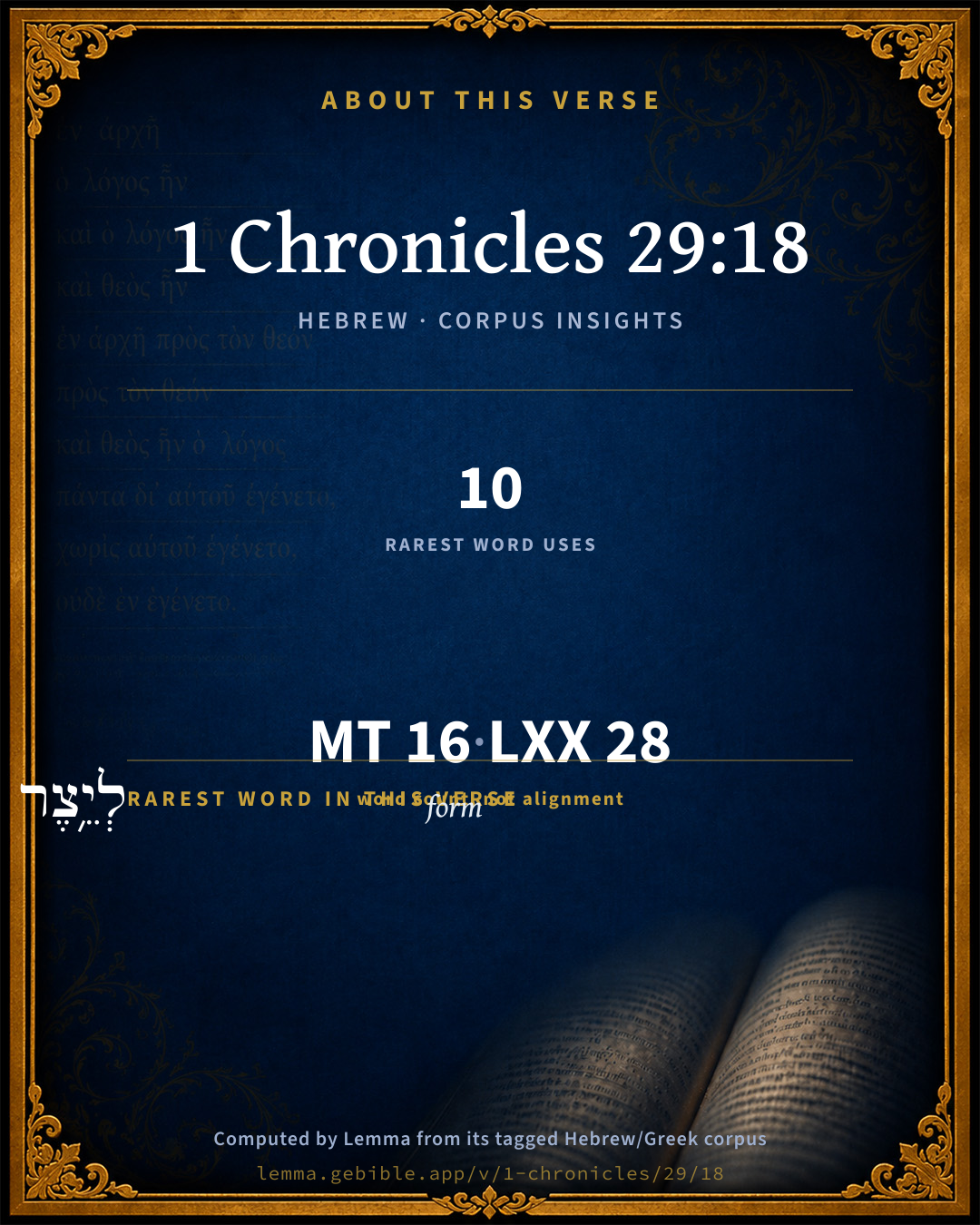
About this verse

These counts appear in no published source. They are computed here, from the morphology-tagged text and Lemma’s own curated glosses. What Lemma adds →

16
words
15
distinct lemmas
Historical
section

Notable vocabulary

The rarest word here is לְיֵ֥צֶר form H3336 — appearing just 10 times in the whole Hebrew Bible.

Shared distinctive vocabulary

לְיֵ֥צֶר form H3336 occurs in 9 verses of the Hebrew Bible. Also found in:

Grammatical profile

  • 2 verbs
  • 12 nouns
  • 1 pronoun
  • 1 preposition

Verb forms

  • שֳׁמְרָה Qal · Imperative
  • וְהָכֵ֥ן Hiphil · Imperative

Repetition

A word recurs within this verse — often emphatic in Hebrew:

  • לְבַ֣ב heart H3824 ×2

Hebrew & Septuagint length

In English translation the verse runs 33 words from the Hebrew and 31 from the Septuagint (LXX English) — closely comparable.

A rough comparison of the two English renderings, which tokenize alike — not a word-level alignment.

Word counts can differ between the Hebrew and the Greek without any difference in meaning — e.g. the Hebrew direct-object marker אֵת has no separate Greek word, and Greek often adds the article ὁ.

In the original languages it is 16 Hebrew tokens and 28 Greek tokens — but the two are counted differently (Hebrew bundles its prefixes and suffixes into one token; the Greek is in lemma form), so that isn’t a like-for-like length.

Cross-references

16

Topical passages linked to 1 Chronicles 29:18 in the Treasury of Scripture Knowledge — connected by theme and wording, ordered by reader-vote popularity; previews shown in the World English Bible.

  • Jeremiah 32:39 and I will give them one heart and one way, that they may fear me forever, for the good of them, and of their children after them:
  • 1 Chronicles 28:9 You, Solomon my son, know the God of your father, and serve him with a perfect heart and with a willing mind; for Yahweh searches all hearts, and understands all the imaginations of the thoughts: if you seek him, he will be found of you; but if you forsake him, he will cast you off forever.
  • Jeremiah 10:23 Yahweh, I know that the way of man is not in himself: it is not in man who walks to direct his steps.
  • Psalms 10:17 Yahweh, you have heard the desire of the humble. You will prepare their heart. You will cause your ear to hear,
  • Psalms 51:10 Create in me a clean heart, O God. Renew a right spirit within me.
  • Psalms 119:113 I hate double-minded men, But I love your law.
  • 1 Thessalonians 3:11 Now may our God and Father himself, and our Lord Jesus Christ, direct our way to you;
  • 2 Thessalonians 2:16–17 Now our Lord Jesus Christ himself, and God our Father, who loved us and gave us eternal comfort and good hope through grace,
  • Hebrews 13:21 make you complete in every good work to do his will, working in you that which is well pleasing in his sight, through Jesus Christ, to whom be the glory forever and ever. Amen.
  • Exodus 3:6 Moreover he said, "I am the God of your father, the God of Abraham, the God of Isaac, and the God of Jacob." Moses hid his face; for he was afraid to look at God.
  • Exodus 3:15 God said moreover to Moses, "You shall tell the children of Israel this, 'Yahweh, the God of your fathers, the God of Abraham, the God of Isaac, and the God of Jacob, has sent me to you.' This is my name forever, and this is my memorial to all generations.
  • Exodus 4:5 "That they may believe that Yahweh, the God of their fathers, the God of Abraham, the God of Isaac, and the God of Jacob, has appeared to you."
  • Deuteronomy 30:6 Yahweh your God will circumcise your heart, and the heart of your seed, to love Yahweh your God with all your heart, and with all your soul, that you may live.
  • Psalms 119:166 I have hoped for your salvation, Yahweh. I have done your commandments.
  • Matthew 22:32 'I am the God of Abraham, and the God of Isaac, and the God of Jacob?' God is not the God of the dead, but of the living."
  • Philippians 1:6 being confident of this very thing, that he who began a good work in you will complete it until the day of Jesus Christ.

Cross-references courtesy of OpenBible.info (CC BY 4.0).

Hebrew and Greek witnesses Masoretic Hebrew ↔ Greek Septuagint

The same verse in the two great witnesses to the Old Testament, shown verse-for-verse.

These are two independent witnesses, not word-aligned to each other, and the Septuagint is shown in lemma (dictionary) form.

Hebrew 1 Chronicles 29:18 Masoretic · Westminster Leningrad Codex

יְהוָ֗ה אֱ֠לֹהֵי אַבְרָהָ֞ם יִצְחָ֤ק וְיִשְׂרָאֵל֙ אֲבֹתֵ֔ינוּ שֳׁמְרָה זֹּ֣את לְעוֹלָ֔ם לְיֵ֥צֶר מַחְשְׁב֖וֹת לְבַ֣ב עַמֶּ֑ךָ וְהָכֵ֥ן לְבָבָ֖ם אֵלֶֽיךָ

Yahweh, the God of Abraham, of Isaac, and of Israel, our fathers, keep this forever in the imagination of the thoughts of the heart of your people, and prepare their heart to you;

World English Bible · Public Domain

Greek LXX 1 Chronicles 29:18 Septuagint · lemma form

κύριος ὁ θεός ἀβραάμ καί ισαακ καί ἰσραήλ ὁ πατήρ ἐγώ φυλάσσω οὗτος ἐν διάνοια καρδία λαός σύ εἰς ὁ αἰών καί καταεὐθύνω ὁ καρδία αὐτός πρός σύ

O Lord God of Abraham, and Isaac, and Israel, our fathers, preserve these things in the thought of the heart of your people for ever, and direct their hearts to you.

LXX2012 (modern English Septuagint) · Public Domain

Hebrew: Westminster Leningrad Codex (CC BY 4.0). Greek: Septuagint (public domain); English from LXX2012 (modern English Septuagint) (Public Domain). How the Septuagint differs from the Hebrew →

Commentary

Notes on 1 Chronicles 29:18 from classic Christian and Jewish commentators (each source and its license shown beneath its notes). The classic Christian expositions comment on the surrounding passage and are grouped to its opening verse, so a note may address several verses; the Jewish commentaries on the Tanakh (Rashi and others) are per-verse, so they appear only where the commentator wrote on this verse.

Lemma curates 59 commentaries, every one of them public domain or Creative Commons licensed, each selected and text-cleaned for this edition rather than reprinted as found. About our sources →

Trapp's Complete Commentary

John Trapp

1Ch 29:18 O LORD God of Abraham, Isaac, and of Israel, our fathers, keep this for ever in the imagination of the thoughts of the heart of thy people, and prepare their heart unto thee:

Ver. 18. Keep this for ever in the imagination of the thoughts of the heart of thy people.] David finding in them that float of good affections, that heat and height, he prays heartily that God would, porro fovere, keep up their hearts in that holy temper, fix their quicksilver, fire up their spirits more and more to a holy contention in godliness, and give them "with full purpose of heart to cleave" to himself, as Barnabas expresseth it. {Act 11:23} Lo, this is David’s remarkable prayer - as one well styleth it - for his people; and this should be our continual request unto God for ourselves and others. For it is with holy affections, saith a grave divine, as with exotic noble plants; this country is not so kindly for them, being but a stepmother to them: therefore they must be much watered and cherished by prayer, and all good endeavour.

John Trapp, A Commentary or Exposition upon All the Books of the Old and New Testament (1647–1656) — public domain. Text from a community e-Sword module.

The Biblical Illustrator

Joseph S. Exell

1Ch_29:18

Keep this for ever in the imagination of the thoughts of the heart of Thy people.

What must Christians do, that the influences of the ordinances may abide upon them

The course to be taken for this purpose lies--

I. In the practice of some things.

1. Get new hearts, and get them daily more and more renewed. A heart thoroughly sanctified is to the ordinances like tinder, which soon takes fire and is apt to keep it till it be forced out; whereas a carnal, unmortified heart is like green wood, which is not soon kindled and will soon go out, if it be not well looked to. Holiness makes the soul both receptive and retentive of holy impressions.

2. Labour to be much affected with the ordinances while you are employed in them. If the ordinances pierce no further than the surface of the soul, the efficacy of them is not likely to continue. Prepare your hearts before you draw near to God. The heart is prepared when it is made--

(a) Tender (Jer_4:3; Hos_10:12). That which can make no impression at all upon a flint will sink deeply into softened wax.

(b) Sensible; apprehensive of your spiritual wants and necessities.

(c) Open. A quick sense of your spiritual condition will open your hearts. Desire opens the heart (Mat_5:6; Psa_107:9). We come to the ordinances too like the Egyptian dog, which laps a little as he runs by the side of Nilus, but stays not to drink. Christ invites us to eat and drink abundantly (Son_5:1).

3. Mind the ordinances after you use them. Be much in meditation. Much of heaven and holiness is engraved on these ordinances; and the seal is, as it were, set upon the heart, while you are under them; but after-consideration lays more weight on it and impresseth it deeper. The heart takes fire at the mind (Psa_39:3).

4. Let the efficacy of the ordinances be pursued presently into act (Psa_119:60). When the blossoms of a fruit-tree are once knit, though the flourish thereof be gone, and you see nothing but the bare rudiment of the expected fruit, yet you think it more secured from the injury of frosts and winds than if it were still in the flower. Good motions, when they are once reduced into act, are thereby, as it were, knit, and brought to more consistency.

5. You must take much pains with your hearts if you would have them retain the virtue and efficacy of the ordinances. The slothful man roasteth not that which he took in hunting (Pro_12:27). He loseth all his former labour because he will not take a little more pains.

6. Comply with the Spirit of God.

7. Be frequent in the use of ordinances. Good impressions do most usually wear off in the intervals of holy duties. It is observed that places under the line are not so hot as some climates at a further distance from it; and this reason is given for it: Those under the equinoctial, though they have the sun more vertical, and the beams, falling more perpendicularly, cause a more intense heat; yet the nights being of equal length with the days, the coolness of those long nights doth more allay the heat than where the nights are shorter. Long intermissions of holy duties are like long nights: you may find them by experience to be great coolers. Elijah in the wilderness had to eat more than once to be strengthened for his journey (1Ki_19:6-8).

8. Look up to God for the continuance of this influence.

II. In the avoidance of other things.

1. Take heed that you perform not your duties negligently (Jer_48:10; Mal_1:8; Mal_1:14; Jer_30:21; Deu_32:46-47).

2. Beware of the world. Meddle not with it more than needs must. Carry yourself amongst worldly objects and employments as though you were amongst cheats and thieves: they have the art to pick your hearts slily. When your hearts are warmed with holy duties, you should be as cautious and wary how you venture into the world as you are of going into the frosty air when you are all in a sweat. What is kindled by the Word or prayer requires as much care to keep it in as to keep a candle in when you would carry it through the open air in a rainy, blustering night. The further you are above the world, the longer may you retain any spiritual impressions. Geographers write of some mountains whose tops are above the middle region of the air; and there lines and figures being drawn in the dust have been found, say they, in the same form and order, untouched, undefaced, a long time after; and the reason is because they are above those winds and showers and storms, which soon wear out and efface any such draughts in this lower region. The lower your minds and hearts and conversations are, the less will anything that is heavenly and spiritual abide upon them.

3. Take heed of any inordinacy in affection, inclination, or design. The ministry of John the Baptist had some influence on Herod (Mar_6:20); but sensuality being predominant, those better inclinations were quite overpowered.

4. Rest not in the best performance of any duty, nor in any assistances you find therein, though they be special and more than ordinary. It is observed that some professors have had the foulest falls, after they have been most elevated in holy employments. We are apt to take the most dangerous colds when we are in the greatest heats.

5. Make not the ordinances your end, but use them as the means to attain it. Application: If the efficacy of thy ordinances abide not in you, you cannot be fruitful under them; at least you cannot bring forth fruit to perfection. (David Clarkson, B. D.)

The Biblical Illustrator, edited by Joseph S. Exell (c. 1880s–1900s) — public domain. Text from a community e-Sword module.

Joseph Benson's Commentary

1Ch 29:18. O Lord God of Abraham, &c. — A God in covenant with them, and with us for their sakes. Keep this for ever, &c. — Since it is from thy grace that thy people have such willing minds, continue that grace to them, that they may persist in the same generous disposition toward thee and thy worship. And grant that by our perseverance in this piety and charity, we may make good our part of the covenant, and so may not forfeit the benefit of it. And prepare their heart unto thee — Or rather, as it is in the margin, stablish or confirm their heart. Thou, who hast begun a good work, confirm and carry it on by thy grace, otherwise it will languish, and this very people will prove degenerate.

Joseph Benson's Commentary on the Old and New Testaments (1811–1818) — public domain. Text from a community e-Sword module.

Tyndale Open Study Notes

Tyndale Open Resources

29:18-19 David did not ask God to grant power, victory, or riches, or for the establishment of Solomon’s kingdom. Instead he asked God to make the people of Israel, and Solomon in particular, always want to obey the Lord. Gaining this kind of heart attitude is a gift from the Lord; success and prosperity are secondary.

Tyndale Open Study Notes — © Tyndale Open Resources, licensed CC BY-SA 4.0. Text via the HelloAO Bible API.

Geneva Bible (1599)

Geneva Bible translators

Continue them in his good mind, that they may serve thee willingly.

Geneva Bible (1599) marginal notes — public domain. Text via Bolls.life.

Adam Clarke's Commentary

Verse 18. Keep this for ever] All the good dispositions which myself and my people have, came from thee; continue to support and strengthen them by the same grace by which they have been inspired!

Adam Clarke's Commentary on the Bible (1810–1826) — public domain. Text from a community e-Sword/MySword module.

Ellicott's Commentary for English Readers

(18) Israel.—1Ch_29:10. (See Gen_32:28, and Exo_3:6.)

Keep this for ever in the imagination.—Rather, preserve this for ever: to wit, “the cast (1Ch_28:9) of the thoughts of the heart of thy people.” Give permanence to the frame of mind which has evinced itself in the freewill offerings of to-day.

Prepare their heart.—Or, direct (1Sa_7:3). (Comp. Eze_4:3; Eze_4:7, “direct the face towards . . .” Pro_16:9, “direct his going.” Comp. also 2Ch_12:14; 2Ch_20:33.)

A Bible Commentary for English Readers, edited by Charles John Ellicott (1878–1897) — public domain. Text from a community e-Sword module.

The Cambridge Bible for Schools and Colleges

gen. ed. J. J. S. Perowne

18. in the imagination] Render, as the imagination. Imagination here means not the faculty, but the result of the exercise of the faculty, a mental image or impression.

prepare] Better R.V. mg., establish. David prays that the people may continue in their present mind.

The Cambridge Bible for Schools and Colleges (gen. ed. J. J. S. Perowne; Cambridge University Press, 1878–1918) — public domain. Text from a community e-Sword module.

John Gill's Exposition

And give unto Solomon my son a perfect heart to keep thy commandments, thy testimonies, and thy statutes,.... All the laws of God, moral, ceremonial, and judicial, even to observe them cordially and sincerely:

and to do all those things; he had suggested to him particularly:

and to build the palace for the which I have made provision; as before declared.

John Gill's Exposition of the Whole Bible (1746–1763) — public domain (CC PDM 1.0). Text via the HelloAO Bible API.

Albert Barnes' Notes on the Bible

Keep this forever ... - i. e., “Preserve forever this spirit of liberal and spontaneous giving in the hearts of Thy people, and establish their hearts toward Thee.”

Albert Barnes' Notes on the Bible (1834–1885) — public domain. Text from a community e-Sword/MySword module.

Haydock's Catholic Bible Commentary

This. Hebrew, "keep this for ever, in the imagination of the thoughts of the heart of thy people, and direct their heart unto thee. Preserve these good dispositions, which though has given them." (Calmet)

George Leo Haydock (1774–1849), Haydock's Catholic Family Bible and Commentary, 1859 edition — public domain. Excludes Psalms (Douay-Rheims chapter numbering differs from Protestant) and Deuterocanonical books (Catholic canon only).

Matthew Poole's English Annotations

Keep this for ever in the imagination of the thoughts of the heart of thy people; since it is from thy grace that thy people have such willing minds to thy service, as was before acknowledged, I beg the continuance of that grace to them, that they may persist in the same generous and pious disposition towards thee and thy worship.

Prepare their heart unto thee, or rather, as it is in the margin, stablish or confirm, &c. Thou who hast begun a good work, confirm and carry it on by thy grace, otherwise it will languish, and this very people will prove degenerate.

Matthew Poole's English Annotations on the Holy Bible (1683–1685) — public domain. Text from a community e-Sword/MySword module.

Whedon's Commentary on the Bible

Daniel D. Whedon

18. Keep this for ever in… the heart of thy people — That is, preserve — continue — in them this liberal spirit of giving.

Daniel D. Whedon (gen. ed.), Commentary on the Old and New Testaments (1874–1909) — public domain. Text from a community e-Sword module.

The Pulpit Commentary

In the imagination of the thoughts of the heart. We have here again a reminiscence of the early language of Genesis (Gen_6:5 Gen_8:21. See also our book, 1Ch_28:9; Deu_31:21) This same word for "imagination" (rx,ye) is found in the Authorized Version in Isa_26:3, "Whose mind is stayed," etc.; and in Psa_103:14; Isa_29:16; Hab_2:18; in the last three passages translated as "frame," "framed," and "work."

The Pulpit Commentary (1880–1919), ed. H.D.M. Spence-Jones & Joseph S. Exell — public domain. Text from a community e-Sword module.

John Wesley's Explanatory Notes

Of Abraham, &c. - A God in covenant with them, and with us for their sakes. Keep forever - Since it is from thy grace that thy people have such willing minds, continue that grace to them, that they may persist in the same generous disposition towards thee and thy worship. Prepare - Or, rather, confirm, thou who hast begun a good work, confirm and carry it on by thy grace.

John Wesley, Explanatory Notes Upon the Whole Bible (1754–1765) — public domain. Text via the GEBible commentary corpus.

Keil & Delitzsch

C. F. Keil & F. Delitzsch

And give unto Solomon my son a perfect heart to keep thy commandments, thy testimonies, and thy statutes,.... All the laws of God, moral, ceremonial, and judicial, even to observe them cordially and sincerely:

and to do all those things; he had suggested to him particularly:

and to build the palace for the which I have made provision; as before declared.

Keil & Delitzsch — Biblical Commentary on the Old Testament (1861–1891) — public domain (CC PDM 1.0). Text via the HelloAO Bible API. (Old Testament only.)

unfoldingWord translationNotes

Door43 World Missions Community

Israel

Here "Israel" refers to the man named "Jacob."

keep this forever in the thoughts of the minds of your people

"keep this in the thoughts and minds of your people forever"

Direct their hearts toward you

Here the people's "hearts" represent their thoughts and desires. AT: "Direct them to be loyal to you" or "Keep them loyal to you" (See: Metonymy)

Give to Solomon my son a wholehearted desire

The word "desire" may be expressed as a verb. AT: "Make my son Solomon fully desire" (See: Abstract Nouns)

translationWords

God

Abraham

Isaac

Jacob

eternity

mind

Solomon

command

covenant

decree

statute

palace

unfoldingWord translationNotes — © Distant Shores Media and the Door43 World Missions Community, licensed CC BY-SA 4.0. Source: git.door43.org/Door43/en_tn.

Rashi

Rabbi Shlomo Yitzchaki (Rashi)

keep this forever Remember for us this donation as a great deed and as a righteous act.

even the creation of the thoughts of Your people for the creation of their two hearts and their thoughts are for good, and this refers back to “for You test the heart, etc.”

and prepare their hearts to You Their two hearts are made perfect to be one heart to You, and so you shall explain...

Rashi on the Tanakh — English translations: “The Judaica Press complete Tanach with Rashi, translated by A. J. Rosenberg” (CC BY 4.0); “Pentateuch with Rashi's commentary by M. Rosenbaum and A.M. Silbermann, 1929-1934” (public domain); “The Metsudah Tanach series, Lakewood, N.J” (CC BY 4.0); and “The Book of Joshua, Metsudah Publications, 1997” (CC BY 4.0). Text via Sefaria.

Lesson kit

Teaching starters — assembled from the data on this page, not authored interpretation. Every prompt links to the verse data it draws on. Edit before teaching.

1 Chronicles, in the Historical, opens this verse with 16 words (15 distinct Hebrew lemmas). Its most distinctive word is yêtser (“form”). A historical commentator’s framing appears above. Read the whole chapter for the surrounding context.

Discussion questions

  1. What does “form” (yêtser) contribute to the verse as a whole?
  2. How does Genesis 6:5, which shares the word «form», read alongside this verse?
  3. What does the repetition of “heart” (2× in this one verse) do in this verse?
  4. The translations on this page render this verse differently — a whole-verse word diff, not a word-by-word alignment. What might account for the different wordings?
  5. «שֳׁמְרָה» is a Qal Imperative verb. How does that grammatical form shape the action described?
  6. Compare how Trapp's Complete Commentary and The Biblical Illustrator read this verse. Where do they agree or differ?

Things to notice

Reading settings

Reading text

Shown beneath each verse's original-language words.

Old Testament
Old Testament edition

Read the OT as the Masoretic Hebrew (MT) or the Greek Septuagint (LXX).

English shown for the Greek Septuagint (in the Hebrew ↔ Greek comparison).

Comparing translations? Open the Compare panel on any verse page to stack up to four side by side.