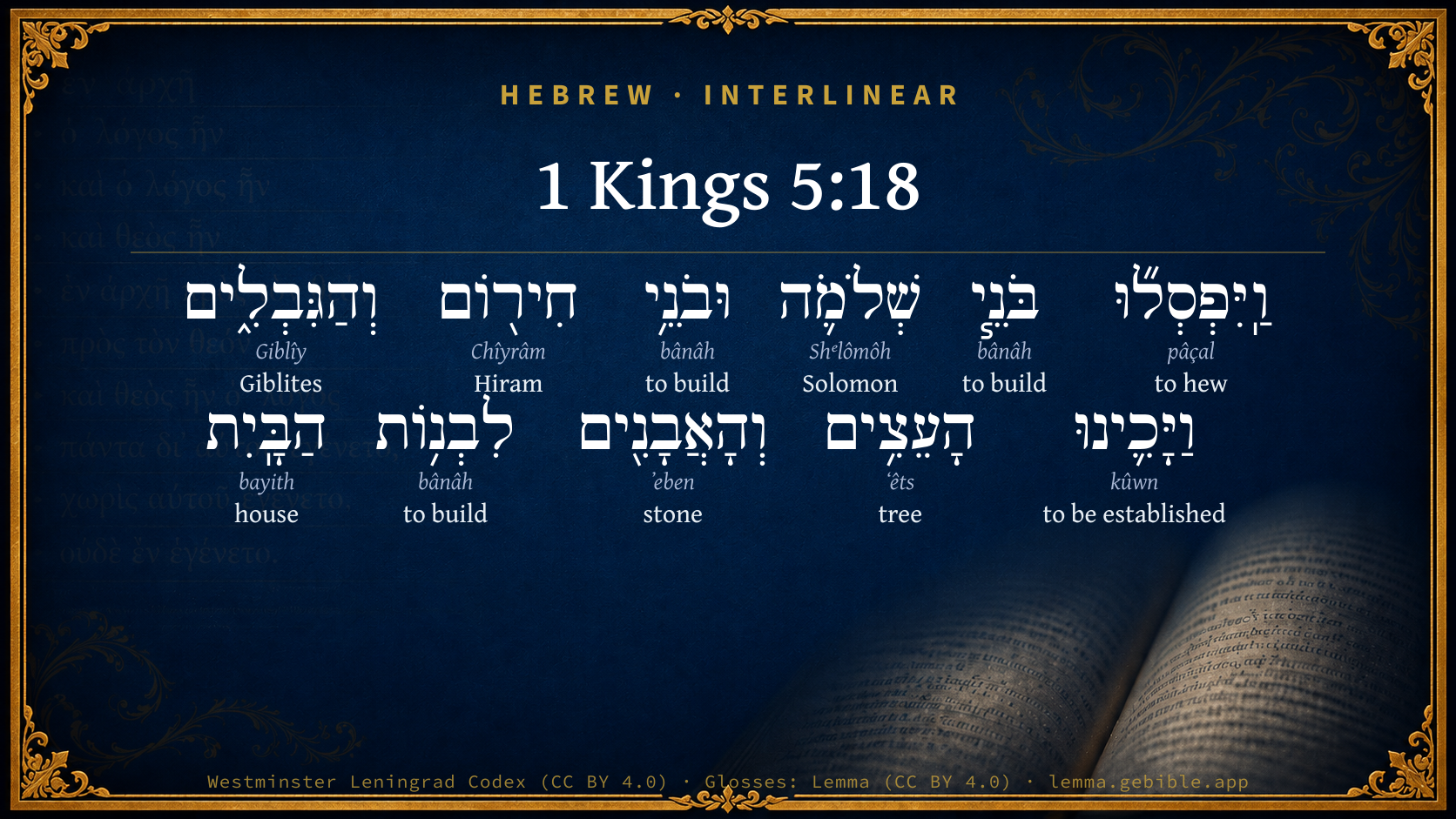
1 Kings 5:18

Hebrew (Westminster Leningrad Codex) 1 Kings 5:18 appears in the Hebrew Old Testament. The text above is from the Westminster Leningrad Codex. Each word links to its Strong’s number, a concise gloss, and parsing drawn from the Open Scriptures Hebrew Bible morphology. Click any word for its full Brown-Driver-Briggs (BDB) entry.
Download image
Cite this verse

1 Kings 5:18 (World English Bible). Public Domain. Lemma interlinear Bible study tool, https://lemma.gebible.app/v/1-kings/5/18.

Show BibTeX & RIS
BibTeX
RIS
English Translation
Solomon's builders and Hiram's builders and the Gebalites did fashion them, and prepared the timber and the stones to build the house.
World English Bible · Public Domain
Download a study sheet

One document with this verse’s original text, its word-by-word gloss line, the meaning frame, cross-references with their text, attributed commentary, and full source and license credits — printable, and it pastes into notes with its structure intact.

This verse Autodidact and up

Study sheet (.html) Plain text (.txt)

A passage Seminary Student

Up to 50 verses in one chapter. A passage sheet keeps up to 6 commentary sources and 12 cross-references per verse, in the order this page ranks them, and says so on the sheet whenever that leaves anything out. Ask for a single verse and you get the Autodidact verse sheet above.

Everything on this page stays free to read, with no account — the sheet is a download of what is already on screen, not access to it.

Want to remove ads? Support Godless Engineer
Compare translations 3

The same verse in 3 English versions, stacked beneath the original-language interlinear above. Click any original word for its lexicon entry.

Each is an independent rendering of the whole verse — the interlinear is not word-aligned to these translations.

Highlighted words mark where these versions differ — a whole-verse word diff, not a word-by-word alignment.

  • World English Bible Public Domain
    Solomon's builders and Hiram's builders and the Gebalites did fashion them, and prepared the timber and the stones to build the house.
  • King James Version Public Domain
    And Solomon's builders and Hiram's builders did hew them, and the stonesquarers: so they prepared timber and stones to build the house.
  • unfoldingWord Literal Text CC BY-SA 4.0
    And the builders of Solomon and the builders of Hiram and the Gebalites hewed, and they prepared the wood and the stones to build the house.

unfoldingWord Literal Text — © unfoldingWord, licensed CC BY-SA 4.0. Word-aligned USFM3 via Door43 (git.door43.org/unfoldingWord/en_ult).

Versions to compare (up to 4)

3 of 4 selected

Show all 18 translations

Every available English version of this verse, each an independent rendering of the whole verse.

  • World English Bible Public Domain
    Solomon's builders and Hiram's builders and the Gebalites did fashion them, and prepared the timber and the stones to build the house.
  • Berean Standard Bible Public Domain
    So Solomon’s and Hiram’s builders, along with the Gebalites, quarried the stone and prepared the timber and stone for the construction of the temple.
  • Majority Standard Bible Public Domain
    So Solomon’s and Hiram’s builders, along with the Gebalites, quarried the stone and prepared the timber and stone for the construction of the temple.
  • King James Version Public Domain
    And Solomon's builders and Hiram's builders did hew them, and the stonesquarers: so they prepared timber and stones to build the house.
  • American Standard Version (1901) Public Domain
    And Solomon's builders and Hiram's builders and the Gebalites did fashion them, and prepared the timber and the stones to build the house.
  • Revised Version (1885) Public Domain
    And Solomon’s builders and Hiram’s builders and the Gebalites did fashion them, and prepared the timber and the stones to build the house.
  • Geneva Bible (1599) Public Domain
    And Salomons workemen, and the workemen of Hiram, and the masons hewed and prepared timber and stones for the buylding of the house.
  • Douay-Rheims (1899) Public Domain
    And the masons of Solomon, and the masons of Hiram hewed them: and the Giblians prepared timber and stones to build the house.
  • Young's Literal Translation Public Domain
    and the builders of Solomon, and the builders of Hiram, and the Giblites hew, and prepare the wood and the stones to build the house.
  • Literal Standard Version CC BY-SA 4.0
    and the builders of Solomon, and the builders of Hiram, and the Giblites hew [them], and prepare the wood and the stones to build the house.
  • Unlocked Literal Bible CC BY-SA 4.0
    So Solomon's builders and Hiram's builders and the Gebalites did the cutting and prepared the timber and the stones to build the temple.
  • unfoldingWord Literal Text CC BY-SA 4.0
    And the builders of Solomon and the builders of Hiram and the Gebalites hewed, and they prepared the wood and the stones to build the house.
  • Darby Bible Public Domain
    And Solomon's builders and Hiram's builders and the Giblites hewed them, and prepared timber and stones to build the house.
  • World Messianic Bible Public Domain
    Solomon’s builders and Hiram’s builders and the Gebalites cut them, and prepared the timber and the stones to build the house.
  • Webster's Bible Public Domain
    And Solomon's builders, and Hiram's builders did hew them, and the stone-squarers: so they prepared timber and stones to build the house.
  • Free Bible Version CC BY-SA 4.0
    So Solomon's and Hiram's builders, together with the Gebalites, cut the stone. They prepared the timber and stone to build the Temple.
  • Bible in Basic English Public Domain
    Solomon's builders and Hiram's builders did the work of cutting them, and put edges on them, and got the wood and the stone ready for the building of the house.
  • JPS Tanakh (1917) Public Domain
    (5-32) And Solomon's builders and Hiram's builders and the Gebalites did fashion them, and prepared the timber and the stones to build the house.

Literal Standard Version (2020), Covenant Press — licensed CC BY-SA 4.0. Text via the HelloAO Bible API (eBible.org). Unlocked Literal Bible (unfoldingWord) — licensed CC BY-SA 4.0. Text via the HelloAO Bible API (eBible.org). unfoldingWord Literal Text — © unfoldingWord, licensed CC BY-SA 4.0. Word-aligned USFM3 via Door43 (git.door43.org/unfoldingWord/en_ult). Free Bible Version, Dr. Jonathan Gallagher — licensed CC BY-SA 4.0. Text via the HelloAO Bible API (eBible.org).

Word by word

More ways to search: Search by grammar → Find every occurrence → Compare this word →

Practice this passage: Drill this verse → Learn its vocabulary →

וְהַגִּבְלִ֑ים
Giblîy
H1382
“and · the · Giblites”
Conjunction + Particle, Definite Article + Noun, Gentilic, Masculine, Plural, Absolute
Part of Speech
Conjunction + Particle + Noun
Type
Gentilic
Gender
Masculine
Number
Plural
State
Absolute
Full BDB Definition

Origin: patrial from H1380

TWOT: None

Giblites = "a boundary" - inhabitants of Gebal
  1. וַֽיִּפְסְל֞וּ pâçal H6458 “and · to hew” Conjunction + Verb, Qal, Sequential Imperfect, 3rd Person, Masculine, Plural
  2. בֹּנֵ֧י bânâh H1129 “building” Verb, Qal, Participle Active, Masculine, Plural, Construct
  3. שְׁלֹמֹ֛ה Shᵉlômôh H8010 “Solomon” Noun, Proper
  4. וּבֹנֵ֥י bânâh H1129 “and · building” Conjunction + Verb, Qal, Participle Active, Masculine, Plural, Construct
  5. חִיר֖וֹם Chîyrâm H2438 “Hiram” Noun, Proper
  6. וַיָּכִ֛ינוּ kûwn H3559 “and · to be established” Conjunction + Verb, Hiphil, Sequential Imperfect, 3rd Person, Masculine, Plural
  7. הָעֵצִ֥ים ʻêts H6086 “the · trees” Particle, Definite Article + Noun, Common, Masculine, Plural, Absolute
  8. וְהָאֲבָנִ֖ים ʼeben H68 “and · the · stones” Conjunction + Particle, Definite Article + Noun, Common, Feminine, Plural, Absolute
  9. לִבְנ֥וֹת bânâh H1129 “to build” Preposition + Verb, Qal, Infinitive Construct
  10. הַבָּֽיִת bayith H1004 “the · house” Particle, Definite Article + Noun, Common, Masculine, Singular, Absolute

About this verse

These counts appear in no published source. They are computed here, from the morphology-tagged text and Lemma’s own curated glosses. What Lemma adds →

11
words
9
distinct lemmas
Historical
section

Notable vocabulary

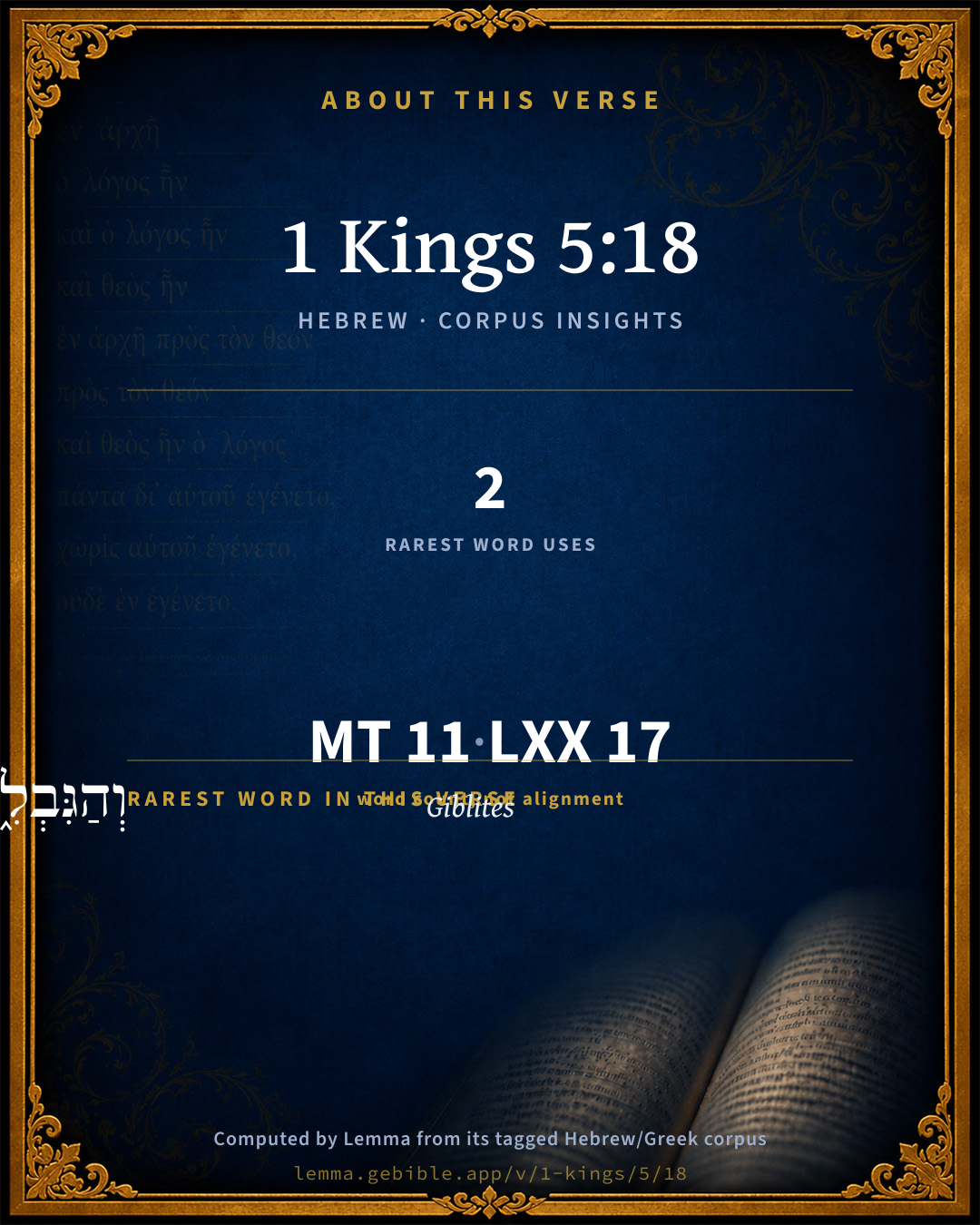
The rarest word here is וְהַגִּבְלִ֑ים Giblites H1382 — appearing just 2 times in the whole Hebrew Bible.

Shared distinctive vocabulary

וְהַגִּבְלִ֑ים Giblites H1382 occurs in 2 verses of the Hebrew Bible. Also found in:

Grammatical profile

  • 5 verbs
  • 6 nouns

Verb forms

  • וַֽיִּפְסְל֞וּ Qal · Sequential Imperfect
  • בֹּנֵ֧י Qal · Participle Active
  • וּבֹנֵ֥י Qal · Participle Active
  • וַיָּכִ֛ינוּ Hiphil · Sequential Imperfect
  • לִבְנ֥וֹת Qal · Infinitive Construct

Repetition

A word recurs within this verse — often emphatic in Hebrew:

  • בֹּנֵ֧י to build H1129 ×3

Hebrew & Septuagint length

In English translation the verse runs 22 words from the Hebrew and 11 from the Septuagint (LXX English) — the Septuagint runs noticeably shorter here. See the side-by-side →

A rough comparison of the two English renderings, which tokenize alike — not a word-level alignment.

Word counts can differ between the Hebrew and the Greek without any difference in meaning — e.g. the Hebrew direct-object marker אֵת has no separate Greek word, and Greek often adds the article ὁ.

In the original languages it is 11 Hebrew tokens and 17 Greek tokens — but the two are counted differently (Hebrew bundles its prefixes and suffixes into one token; the Greek is in lemma form), so that isn’t a like-for-like length.

Cross-references

3

Topical passages linked to 1 Kings 5:18 in the Treasury of Scripture Knowledge — connected by theme and wording, ordered by reader-vote popularity; previews shown in the World English Bible.

  • Joshua 13:5 and the land of the Gebalites, and all Lebanon, toward the sunrise, from Baal Gad under Mount Hermon to the entrance of Hamath;
  • Ezekiel 27:9 The old men of Gebal and the wise men of it were in you your repairers of ship seams: all the ships of the sea with their mariners were in you to deal in your merchandise.
  • Psalms 83:7 Gebal, Ammon, and Amalek; Philistia with the inhabitants of Tyre;

Cross-references courtesy of OpenBible.info (CC BY 4.0).

Hebrew and Greek witnesses Masoretic Hebrew ↔ Greek Septuagint

The same verse in the two great witnesses to the Old Testament, shown verse-for-verse.

Here the Septuagint runs noticeably shorter than the Hebrew — LXX2012 (modern English Septuagint) 11 words vs World English Bible 22. A rough length comparison of the two English translations, not a word-level alignment — read both below.

These are two independent witnesses, not word-aligned to each other, and the Septuagint is shown in lemma (dictionary) form.

Hebrew 1 Kings 5:18 Masoretic · Westminster Leningrad Codex

וַֽיִּפְסְל֞וּ בֹּנֵ֧י שְׁלֹמֹ֛ה וּבֹנֵ֥י חִיר֖וֹם וְהַגִּבְלִ֑ים וַיָּכִ֛ינוּ הָעֵצִ֥ים וְהָאֲבָנִ֖ים לִבְנ֥וֹת הַבָּֽיִת

Solomon's builders and Hiram's builders and the Gebalites did fashion them, and prepared the timber and the stones to build the house.

World English Bible · Public Domain

Greek LXX 1 Kings 5:18 Septuagint · lemma form

καί νῦν ἀναπαύω κύριος ὁ θεός ἐγώ ἐγώ κυκλόθεν οὐ εἰμί ἐπίβουλος καί οὐ εἰμί ἀπάντημα πονηρός

And they prepared the stones and the timber during three years.

LXX2012 (modern English Septuagint) · Public Domain

On this verse, Keil & Delitzsch discusses the Septuagint’s reading. Read the note in Commentary ↓

Hebrew: Westminster Leningrad Codex (CC BY 4.0). Greek: Septuagint (public domain); English from LXX2012 (modern English Septuagint) (Public Domain). How the Septuagint differs from the Hebrew →

Targum (Aramaic paraphrase)

1

The Targum is the ancient Jewish Aramaic paraphrase of the Hebrew Scriptures — an interpretive translation, not the Hebrew text itself. Onkelos (literal) and Pseudo-Jonathan (expansive) render the Torah, and Jonathan the Prophets. Coverage is partial: where no permissively-licensed English translation exists for a verse, only the Aramaic is shown. This is verse-level text, not a word-by-word alignment to the Hebrew.

  1. Targum Jonathan Prophets (Joshua–Malachi)
    וּכְעַן אַנִיחַ יְיָ אֱלָהִי לִי מִסְחוֹר סְחוֹר לֵית שָׂטָן וְלֵית פְּגַע בִּישׁ:

    (no public-domain English translation for this verse)

    Targum Jonathan — Aramaic: “Mikraot Gedolot” (public domain). English: “Sefaria Community Translation” (CC0 1.0 (public-domain dedication)); “London "Chaldee Paraphrase," 1871” (public domain). Text via Sefaria.

Commentary

Notes on 1 Kings 5:18 from classic Christian and Jewish commentators (each source and its license shown beneath its notes). The classic Christian expositions comment on the surrounding passage and are grouped to its opening verse, so a note may address several verses; the Jewish commentaries on the Tanakh (Rashi and others) are per-verse, so they appear only where the commentator wrote on this verse.

Lemma curates 59 commentaries, every one of them public domain or Creative Commons licensed, each selected and text-cleaned for this edition rather than reprinted as found. About our sources →

Trapp's Complete Commentary

John Trapp

1Ki 5:18 And Solomon’s builders and Hiram’s builders did hew [them], and the stonesquarers: so they prepared timber and stones to build the house.

Ver. 18. And Hiram’s builders did hew them.] In Lebanon was the temple framed; in Zion set up: neither hammer nor axe was heard in that holy structure. There was nothing but noise in Lebanon; nothing in Zion, but silence and peace. Whatever tumults are abroad, it is fit - saith a right reverend writer {a} here - there should be all quietness and concord in the Church.

And the stone squarers.] Or Giblites, who were heathens, {Eze 27:9} neighbours to the Sidonians, worshippers of Adonis, saith Strabo, yet used about the holy temple. Ye may likewise make use of human learning in ecclesiastical exercises, but not for ostentation; for that is to make a calf of the treasure gotten out of Egypt.

{a} Dr Hall.

John Trapp, A Commentary or Exposition upon All the Books of the Old and New Testament (1647–1656) — public domain. Text from a community e-Sword module.

Joseph Benson's Commentary

1Ki 5:18. Solomon’s builders and Hiram’s did hew them — It seemed Solomon’s servants learned of Hiram’s, or, at least, were directed by them to assist in the work. And the stone-squarers — Hebrew, the Giblites, the inhabitants of Gebal, a place near Zidon, mentioned Psa 83:7; Eze 27:9, famous for artificers and architects, Jos 13:5. These are here distinguished from the rest of Hiram’s builders, as the most eminent of them. So they prepared timber and stones to build the house — Made all ready, not only to lay the foundation, but to raise the superstructure.

Joseph Benson's Commentary on the Old and New Testaments (1811–1818) — public domain. Text from a community e-Sword module.

Keil & Delitzsch

C. F. Keil & F. Delitzsch

With Kg1 5:18 the account of the preparations for the building of the temple, which were the object of Solomon's negotiations with Hiram, is brought to a close. "Solomon's builders and Hiram's builders, even the Giblites, hewed and prepared the wood and the stones for the building of the house." The object to יפסלוּ is not the square stones mentioned before, but the trees (beams) and stones mentioned after ויּכנוּ. והגּבלים is to be taken as explanatory, "even the Giblites," giving a more precise definition of "Hiram's builders." The Giblites are the inhabitants of the town of Gebal, called Byblos by the Greeks, to the north of Beirut (see at Jos 13:5), which was the nearest to the celebrated cedar forest of the larger Phoenician towns. According to Eze 27:9, the Giblites (Byblians) were experienced in the art of shipbuilding, and therefore were probably skilful builders generally, and as such the most suitable of Hiram's subjects to superintend the working of the wood and stone for Solomon's buildings. For it was in the very nature of the case that the number of the Phoenician builders was only a small one, and that they were merely the foremen; and this may also be inferred from the large number of his own subjects whom Solomon appointed to the work.

(Note: Without any satisfactory ground Thenius has taken offence at the word והגּבלים, and on the strength of the critically unattested καὶ ἔβαλον αὐτούς of the lxx and the paraphrastic ἁρμόσαντας καὶ συνδήσαντας of Josephus, which is only introduced to fill in the picture, has altered it into ויּגבּילוּם, "they bordered them (the stones)." This he explains as relating to the "bevelling" of the stones, upon the erroneous assumption that the grooving of the stones in the old walls encircling the temple area, which Robinson (Pal. i. 423) was the first to notice and describe, "occurs nowhere else in precisely the same form;" whereas Robinson found them in the ancient remains of the foundations of walls in different places throughout the land, not only in the neighbourhood of Jerusalem, viz., at Bethany, but also at Carmel on the mountains of Judah, at Hebron, Semua (Esthemoa), Beit Nusib (Nezib), on Tabor, and especially in the north, in the old remains of the walls of the fortification es Shukif, Hunn, Banias, Tyrus, Jebail (Byblus), Baalbek, on the island of Ruwad (the ancient Aradus), and in different temples on Lebanon (see Rob. Pal. ii. 101,198, 434,627; iii. 12,213, 214; and Bibl. Researches, p. 229). Bttcher (n. ex. Krit. Aehrenl. ii. p. 32) has therefore properly rejected this conjecture as "ill-founded," though only to put in its place another which is altogether unfounded, namely, that before והגּבלים the word הצּרים ("the Tyrians") has dropped out. For this has nothing further in its favour than the most improbable assumption, that king Hiram gathered together the subjects of his whole kingdom to take part in Solomon's buildings. - The addition of τρία ἔτη, which is added by the lxx at the end of the verse, does not warrant the assumption of Thenius and Bttcher, that שׁנים שׁלשׁ has dropped out of the text. For it is obvious that the lxx have merely made their addition e conjectura, and indeed have concluded that, as the foundation for the temple was laid in the fourth year of Solomon's reign, the preliminary work must have occupied the first three years of his reign.)

Keil & Delitzsch — Biblical Commentary on the Old Testament (1861–1891) — public domain (CC PDM 1.0). Text via the HelloAO Bible API. (Old Testament only.)

Geneva Bible (1599)

Geneva Bible translators

The Hebrew word is Giblim, which some say were excellent masons.

Geneva Bible (1599) marginal notes — public domain. Text via Bolls.life.

Jamieson, Fausset & Brown

Robert Jamieson, A. R. Fausset & David Brown

and the stone squarers--The Margin, which renders it "the Giblites" (Jos 13:5), has long been considered a preferable translation. This marginal translation also must yield to another which has lately been proposed, by a slight change in the Hebrew text, and which would be rendered thus: "Solomon's builders, and Hiram's builders, did hew them and bevel them" [THENIUS]. These great bevelled or grooved stones, measuring some twenty, others thirty feet in length, and from five to six feet in breadth, are still seen in the substructures about the ancient site of the temple; and, in the judgment of the most competent observers, were those originally employed "to lay the foundation of the house."

Next: 1 Kings Chapter 6

Jamieson, Fausset & Brown — Commentary Critical and Explanatory on the Whole Bible (1871) — public domain (CC PDM 1.0). Text via the HelloAO Bible API.

Adam Clarke's Commentary

Verse 18. And the stone-squarers] Instead of stone-squarers the margin very properly reads Giblites, הגבלים haggiblim; and refers to Eze 27:9, where we find the inhabitants of Gebal celebrated for their knowledge in ship-building. Some suppose that these Giblites were the inhabitants of Biblos, at the foot of Mount Libanus, northward of Sidon, on the coast of the Mediterranean Sea; famous for its wines; and now called Gaeta. Both Ptolemy and Stephanus Byzantinus speak of a town called Gebala, to the east of Tyre: but this was different from Gebal, or Biblos. It seems more natural to understand this of a people than of stone-squarers, though most of the versions have adopted this idea which we follow in the text.

Adam Clarke's Commentary on the Bible (1810–1826) — public domain. Text from a community e-Sword/MySword module.

Ellicott's Commentary for English Readers

(18) The stone-squarers.—This rendering is a curious gloss on the proper name, “Giblites” (see margin)—the inhabitants of Gebal (mentioned in Eze_27:9 in connection with Tyre, and probably in Psa_83:7), a city on the coast of Phœnicia—simply because the context shows that they were clever in stone-squaring. As they are distinguished from Hiram’s builders, it is possible that they were serfs under them, like the Canaanites under Solomon’s builders.

A Bible Commentary for English Readers, edited by Charles John Ellicott (1878–1897) — public domain. Text from a community e-Sword module.

The Cambridge Bible for Schools and Colleges

gen. ed. J. J. S. Perowne

18. and the stonesquarers] The text of A.V. is due to the Targum, which translates by ‘masons’. But the margin of A. V. suggests that the word is not a common but a proper noun and gives ‘Giblites’ as in Eze_27:9. This is certainly a much more natural combination, than to class along with the men of Solomon and the men of Hiram, the stone squarers as of a different order. In Ezekiel the men of Gebal are spoken of as skilled in caulking ships, and they were not improbably able handicraftsmen in other branches. Josephus gives us no help. He speaks merely of ‘workmen whom Hiram sent.’ But the Vulgate reads ‘Giblii’ as a proper name and in many MSS. Biblii or Byblii. In the Vatican LXX. the verse is left out, but the Alexandrine gives καὶ οἱ Βίβλιοι. Now Gebal was a Phœnician city not far from the sea coast, to the north of Berytus (Beyrout). The Greeks called it Byblos, but the name is found also spelt Βίβλος (Zosim. i. 58; Eze_27:9. LXX.). Thus the LXX. supports the proper name, which, to keep clear that it means the people of Gebal, we ought to write ‘the Gebalites.’ This has been adopted by R.V.

The Cambridge Bible for Schools and Colleges (gen. ed. J. J. S. Perowne; Cambridge University Press, 1878–1918) — public domain. Text from a community e-Sword module.

John Gill's Exposition

And Solomon's builders and Hiram's builders did hew them,.... The stones; for it seems Solomon had not only hewers of wood, but of stone, from Hiram:

and the stonesquarers; or rather the Giblites, the men of Gebal, which were under the jurisdiction of Tyre, and were skilful in this sort of work, as some of them were in others, see Eze 27:9;

so they prepared timber and stones to build the house; both Solomon's and Hiram's builders, and the large number of workmen, both Israelites and strangers; which latter were an emblem of the Gentiles concerned in the building of the spiritual temple, the church of Christ, Zac 6:15; and whereas the number of strangers that wrought for the building was far greater than that of the Israelites, it may denote the greater number of Gentiles in the Gospel church state mentioned besides these: thus gave Solomon to Hiram year by year: so long as the building lasted, and the workmen were employed; but Abarbinel thinks that he gave it to him as long as he lived, out of his great munificence and liberality.

Next: 1 Kings Chapter 6

John Gill's Exposition of the Whole Bible (1746–1763) — public domain (CC PDM 1.0). Text via the HelloAO Bible API.

Albert Barnes' Notes on the Bible

The stone-squarers - The Gebalites (see the margin), the inhabitants of Gebal, a Phoenician city between Beyrout and Tripolis, which the Greeks called Byblus, and which is now known as Jebeil.

Albert Barnes' Notes on the Bible (1834–1885) — public domain. Text from a community e-Sword/MySword module.

Haydock's Catholic Bible Commentary

Giblians. Ezechiel (xxvii. 9,) commends them for building ships. Giblos of Gebal is supposed to be the town, which profane authors style Biblos, at the foot of Libanus. Ptolemy also mentions Gabala, to the east of Tyre. (Calmet)

George Leo Haydock (1774–1849), Haydock's Catholic Family Bible and Commentary, 1859 edition — public domain. Excludes Psalms (Douay-Rheims chapter numbering differs from Protestant) and Deuterocanonical books (Catholic canon only).

Matthew Poole's English Annotations

The stone-squarers, Heb. the Gibites; the inhabitants of Gebel, a place near Zidon, named Psa 83:7; Eze 27:9, famous for artificers and architects, Jos 13:5. These are here mentioned apart, as distinct from the rest of Hiram’s builders, as the most eminent of them.

Matthew Poole's English Annotations on the Holy Bible (1683–1685) — public domain. Text from a community e-Sword/MySword module.

Whedon's Commentary on the Bible

Daniel D. Whedon

18. The stonesquarers — Rather, as in the margin, the Giblites, whose city, Gebal, lay on the seacoast, and whose land lay in the vicinity of Lebanon. See on Jos_13:5. According to Eze_27:9, they were skilled in ship building. In one of the ravines of Lebanon, which opens at the port of the ancient Gebal, Tristram discovered extensive cedar groves; and observes that the Giblites probably cut and launched at their own port cedars from this very valley, which would be far more accessible to them than those on the distant inland moraines and snow-covered heights.

Daniel D. Whedon (gen. ed.), Commentary on the Old and New Testaments (1874–1909) — public domain. Text from a community e-Sword module.

The Pulpit Commentary

And Solomon"s builders and Hiram"s builders did hew them, and the stone squarers: the marg. Giblites, i.e., people of Gebal, is to be preferred. For Gebal (=mountain) see; Jos_13:5 ("the land of the Giblites and Lebanon" Psa_83:7 ("Gebal and they of Tyro" Eze_27:9, where the LXX translate the word Biblus, which was the Greek name of the city and district north of the famous river Adonis, on the extreme border of Phoenicia. It is now known as Jebeil. It has been already remarked that Tyre and Sidon, as well as Gebal, have Hebrew meanings. These are among the proofs of the practical identity of the Hebrew and Phoenician tongues. The Aramaean immigrants (Deu_26:5; Gen_12:5) no doubt adopted the language of Canaan (Dict. Bib., art. "Phoenicians"). Keil renders, "even the Giblites." He would understand, i.e. , that the Zidonian workmen were Giblites; but this is doubtful. The Giblites are selected, no doubt, for special mention because of the prominent part they took in the work. Gebal, as its ancient and extensive ruins prove, was a place of much importance, and lying as it did on the coast, and near the cedar forests, would naturally have an important share in the cutting and shipping of the timber. Indeed, it is not improbable that it was at this port that the land transport ended, and the rafts were made. A road ran anciently from Gebal to Baalbak, so that the transport was not impracticable. But as the forests were probably of great extent, there may have been two or three depots at which the timber was floated so they prepared timber Heb. the timber and stones Heb. the stones to build the house. The LXX (Vat. and Alex. alike) add here, three years. It is barely possible that these words may have dropped out of the text, but they look more like a gloss, the inference from the chronological statement of 1Ki_6:1.

The Pulpit Commentary (1880–1919), ed. H.D.M. Spence-Jones & Joseph S. Exell — public domain. Text from a community e-Sword module.

John Wesley's Explanatory Notes

Stone-squarers - Hebrew. the Giblites, the inhabitants of Gebel, a place near Zidon, famous for artificers and architects, Josh. xiii, 5. These are here mentioned apart, distinct from the rest of Hiram's builders, as the most eminent of them.

John Wesley, Explanatory Notes Upon the Whole Bible (1754–1765) — public domain. Text via the GEBible commentary corpus.

Lesson kit

Teaching starters — assembled from the data on this page, not authored interpretation. Every prompt links to the verse data it draws on. Edit before teaching.

1 Kings, in the Historical, opens this verse with 11 words (9 distinct Hebrew lemmas). Its most distinctive word is Giblîy (“Giblites”). The Greek Septuagint runs shorter here. A historical commentator’s framing appears above. Read the whole chapter for the surrounding context.

Discussion questions

  1. The word Giblîy carries the sense “Giblites.” How does it shape the verse?
  2. How does Joshua 13:5, which shares the word «Giblites», read alongside this verse?
  3. What does the repetition of “to build” (3× in this one verse) do in this verse?
  4. The Septuagint runs shorter here than the Hebrew. What might account for the difference?
  5. These translations render this verse differently. What is at stake in choosing one wording over another?
  6. «וַֽיִּפְסְל֞וּ» is a Qal Sequential Imperfect verb. How does that grammatical form shape the action described?
  7. Compare how Trapp's Complete Commentary and Joseph Benson's Commentary read this verse. Where do they agree or differ?

Things to notice

Reading settings

Reading text

Shown beneath each verse's original-language words.

Old Testament
Old Testament edition

Read the OT as the Masoretic Hebrew (MT) or the Greek Septuagint (LXX).

English shown for the Greek Septuagint (in the Hebrew ↔ Greek comparison).

Comparing translations? Open the Compare panel on any verse page to stack up to four side by side.