
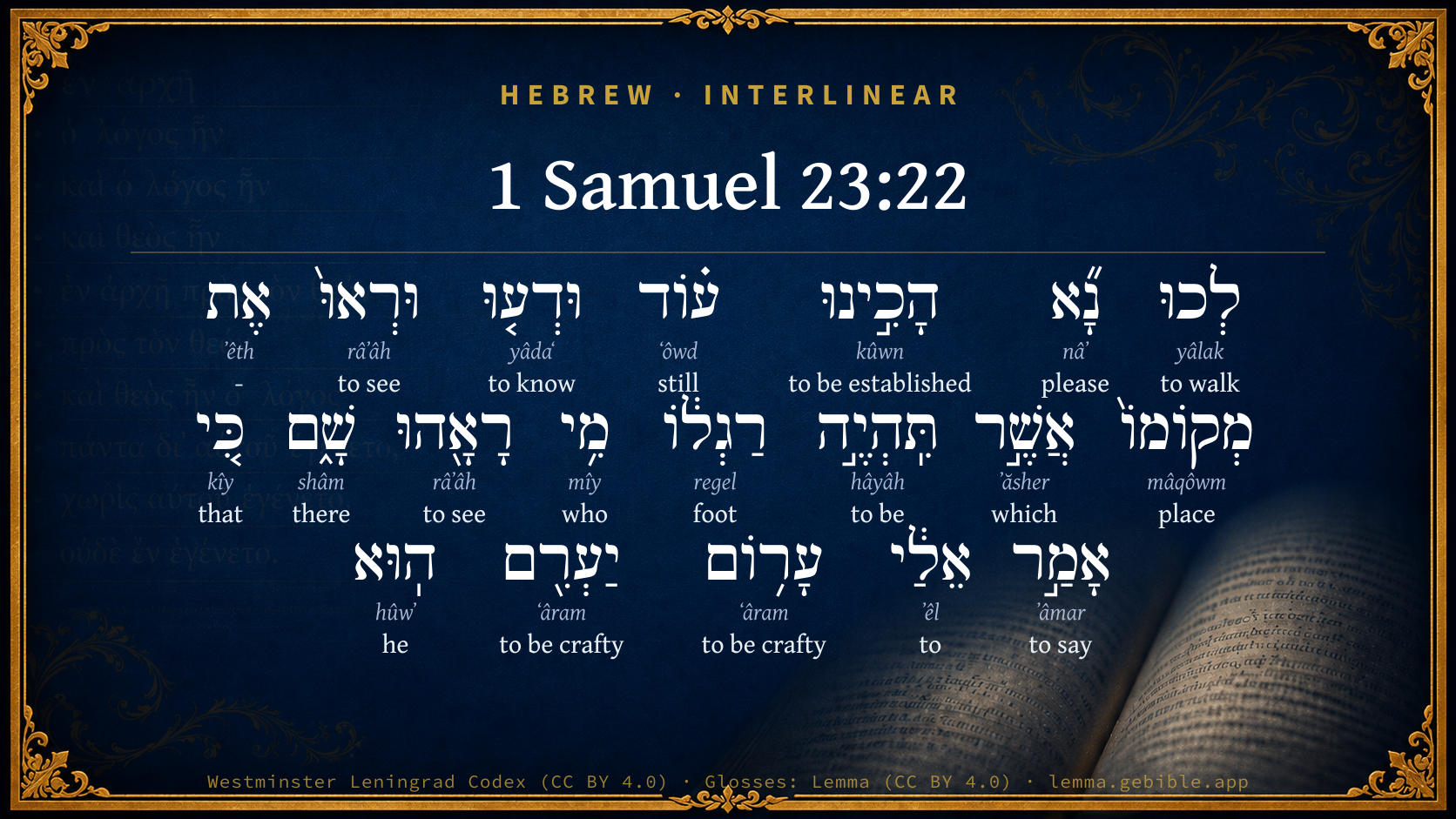
1 Samuel 23:22

Hebrew (Westminster Leningrad Codex) 1 Samuel 23:22 appears in the Hebrew Old Testament. The text above is from the Westminster Leningrad Codex. Each word links to its Strong’s number, a concise gloss, and parsing drawn from the Open Scriptures Hebrew Bible morphology. Click any word for its full Brown-Driver-Briggs (BDB) entry.
Download image
Cite this verse

1 Samuel 23:22 (World English Bible). Public Domain. Lemma interlinear Bible study tool, https://lemma.gebible.app/v/1-samuel/23/22.

Show BibTeX & RIS
BibTeX
RIS
English Translation
Please go make yet more sure, and know and see his place where his haunt is, [and] who has seen him there; for it is told me that he deals very subtly.
World English Bible · Public Domain
Highlights
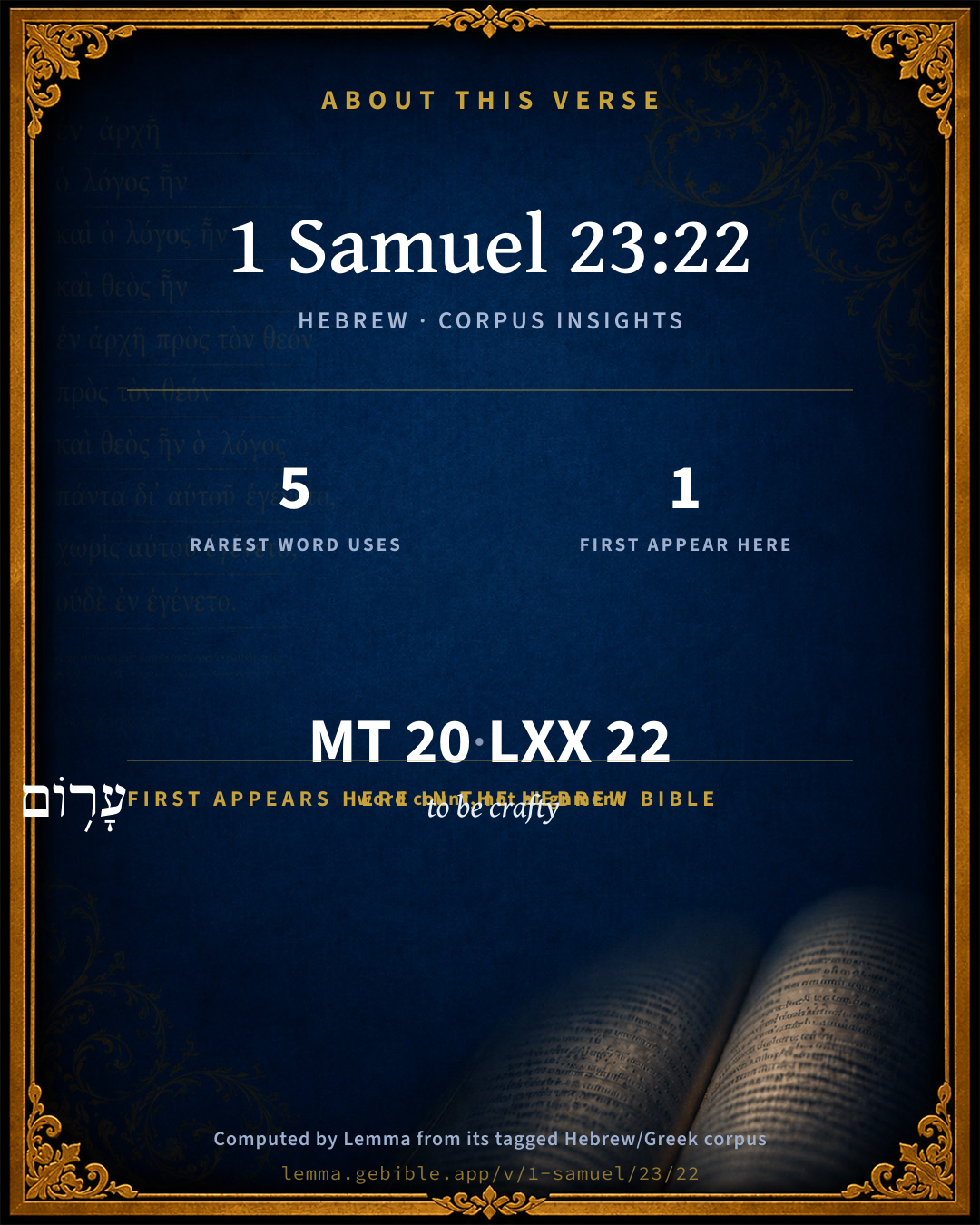
  • 1 first appearance in the Hebrew Bible
Full analysis ↓
Download a study sheet

One document with this verse’s original text, its word-by-word gloss line, the meaning frame, cross-references with their text, attributed commentary, and full source and license credits — printable, and it pastes into notes with its structure intact.

This verse Autodidact and up

Study sheet (.html) Plain text (.txt)

A passage Seminary Student

Up to 50 verses in one chapter. A passage sheet keeps up to 6 commentary sources and 12 cross-references per verse, in the order this page ranks them, and says so on the sheet whenever that leaves anything out. Ask for a single verse and you get the Autodidact verse sheet above.

Everything on this page stays free to read, with no account — the sheet is a download of what is already on screen, not access to it.

Want to remove ads? Support Godless Engineer
Compare translations 3

The same verse in 3 English versions, stacked beneath the original-language interlinear above. Click any original word for its lexicon entry.

Each is an independent rendering of the whole verse — the interlinear is not word-aligned to these translations.

Highlighted words mark where these versions differ — a whole-verse word diff, not a word-by-word alignment.

  • World English Bible Public Domain
    Please go make yet more sure, and know and see his place where his haunt is, [and] who has seen him there; for it is told me that he deals very subtly.
  • King James Version Public Domain
    Go, I pray you, prepare yet, and know and see his place where his haunt is, and who hath seen him there: for it is told me that he dealeth very subtilly.
  • unfoldingWord Literal Text CC BY-SA 4.0
    Please go, confirm again, and know and see his place, where his foot is. Who has seen him there? For one has said to me, ‘Being craftly, he is crafty.’

unfoldingWord Literal Text — © unfoldingWord, licensed CC BY-SA 4.0. Word-aligned USFM3 via Door43 (git.door43.org/unfoldingWord/en_ult).

Versions to compare (up to 4)

3 of 4 selected

Show all 18 translations

Every available English version of this verse, each an independent rendering of the whole verse.

  • World English Bible Public Domain
    Please go make yet more sure, and know and see his place where his haunt is, [and] who has seen him there; for it is told me that he deals very subtly.
  • Berean Standard Bible Public Domain
    Please go and prepare further. Investigate and watch carefully where he goes and who has seen him there, for I am told that he is extremely cunning.
  • Majority Standard Bible Public Domain
    Please go and prepare further. Investigate and watch carefully where he goes and who has seen him there, for I am told that he is extremely cunning.
  • King James Version Public Domain
    Go, I pray you, prepare yet, and know and see his place where his haunt is, and who hath seen him there: for it is told me that he dealeth very subtilly.
  • American Standard Version (1901) Public Domain
    Go, I pray you, make yet more sure, and know and see his place where his haunt is, `and' who hath seen him there; for it is told me that he dealeth very subtly.
  • Revised Version (1885) Public Domain
    Go, I pray you, make yet more sure, and know and see his place where his haunt is, and who hath seen him there: for it is told me that he dealeth very subtilly.
  • Geneva Bible (1599) Public Domain
    Goe, I pray you, and prepare ye yet better: know and see his place where he haunteth, and who hath seene him there: for it is sayd to me, He is subtile, and craftie.
  • Douay-Rheims (1899) Public Domain
    Go therefore, I pray you, and use all diligence, and curiously inquire, and consider the place where his foot is, and who hath seen him there: for he thinketh of me, that I lie craftily in wait for him.
  • Young's Literal Translation Public Domain
    go, I pray you, prepare yet, and know and see his place where his foot is; who hath seen him there? for `one' hath said unto me, He is very subtile.
  • Literal Standard Version CC BY-SA 4.0
    now go prepare yet, and know and see his place where his foot is; who has seen him there? For [one] has said to me, He is very cunning.
  • Unlocked Literal Bible CC BY-SA 4.0
    Go, make even more sure. Learn and find out where his hiding place is and who has seen him there. It is told to me that he is very crafty.
  • unfoldingWord Literal Text CC BY-SA 4.0
    Please go, confirm again, and know and see his place, where his foot is. Who has seen him there? For one has said to me, ‘Being craftly, he is crafty.’
  • Darby Bible Public Domain
    Go, I pray you, make yet more sure, and know and see his place where his track is, who has seen him there; for it is told me that he deals very subtilly.
  • World Messianic Bible Public Domain
    Please go make yet more sure, and know and see his place where his haunt is, and who has seen him there; for I have been told that he is very cunning.
  • Webster's Bible Public Domain
    Go, I pray you, prepare yet, and know, and see his place where his haunt is, and who hath seen him there: for it is told to me that he dealeth very subtilly.
  • Free Bible Version CC BY-SA 4.0
    “Please go and make absolutely sure you know exactly where he is—where he stays and who has seen him there—because people tell me that he's very devious.
  • Bible in Basic English Public Domain
    Go now, and take more steps, and see where he is living: for they say that he is expert in deceit.
  • JPS Tanakh (1917) Public Domain
    Go, I pray you, make yet more sure, and know and see his place where his haunt is, and who hath seen him there; for it is told me that he dealeth very subtly.

Literal Standard Version (2020), Covenant Press — licensed CC BY-SA 4.0. Text via the HelloAO Bible API (eBible.org). Unlocked Literal Bible (unfoldingWord) — licensed CC BY-SA 4.0. Text via the HelloAO Bible API (eBible.org). unfoldingWord Literal Text — © unfoldingWord, licensed CC BY-SA 4.0. Word-aligned USFM3 via Door43 (git.door43.org/unfoldingWord/en_ult). Free Bible Version, Dr. Jonathan Gallagher — licensed CC BY-SA 4.0. Text via the HelloAO Bible API (eBible.org).

Word by word

More ways to search: Search by grammar → Find every occurrence → Compare this word →

Practice this passage: Drill this verse → Learn its vocabulary →

עָר֥וֹם
ʻâram
H6191
“to be crafty”
Verb, Qal, Infinitive Absolute
Part of Speech
Verb
Stem
Qal
Form
Infinitive Absolute
Full BDB Definition

Origin: a primitive root

TWOT: 1698

to be subtle, be shrewd, be crafty, beware, take crafty counsel, be prudent - (Qal) to be crafty, be subtle - (Hiphil) to be crafty, be or become shrewd
  1. לְכוּ yâlak H3212 “walk” Verb, Qal, Imperative, 2nd Person, Masculine, Plural
  2. נָ֞א nâʼ H4994 “please” Particle, Exhortation
  3. הָכִ֣ינוּ kûwn H3559 “be established” Verb, Hiphil, Imperative, 2nd Person, Masculine, Plural
  4. ע֗וֹד ʻôwd H5750 “still” Adverb
  5. וּדְע֤וּ yâdaʻ H3045 “and · know” Conjunction + Verb, Qal, Imperative, 2nd Person, Masculine, Plural
  6. וּרְאוּ֙ râʼâh H7200 “and · see” Conjunction + Verb, Qal, Imperative, 2nd Person, Masculine, Plural
  7. אֶת ʼêth H853 “-” Particle, Direct Object
  8. מְקוֹמוֹ֙ mâqôwm H4725 “place · his” Noun, Common, Masculine, Singular, Construct + Suffix, Personal, 3rd Person, Masculine, Singular
  9. אֲשֶׁ֣ר ʼăsher H834 “which” Particle, Relative
  10. תִּֽהְיֶ֣ה hâyâh H1961 “to be” Verb, Qal, Imperfect, 3rd Person, Feminine, Singular
  11. רַגְל֔וֹ regel H7272 “foot · his” Noun, Common, Feminine, Singular, Construct + Suffix, Personal, 3rd Person, Masculine, Singular
  12. מִ֥י mîy H4310 “who” Particle, Interrogative
  13. רָאָ֖הוּ râʼâh H7200 “to see · him” Verb, Qal, Perfect, 3rd Person, Masculine, Singular + Suffix, Personal, 3rd Person, Masculine, Singular
  14. שָׁ֑ם shâm H8033 “there” Adverb
  15. כִּ֚י kîy H3588 “that” Conjunction
  16. אָמַ֣ר ʼâmar H559 “to say” Verb, Qal, Perfect, 3rd Person, Masculine, Singular
  17. אֵלַ֔י ʼêl H413 “to · me” Preposition + Suffix, Personal, 1st Person, Common, Singular
  18. יַעְרִ֖ם ʻâram H6191 “to be crafty” Verb, Qal, Imperfect, 3rd Person, Masculine, Singular
  19. הֽוּא hûwʼ H1931 “he” Pronoun, Personal, 3rd Person, Masculine, Singular

About this verse

These counts appear in no published source. They are computed here, from the morphology-tagged text and Lemma’s own curated glosses. What Lemma adds →

20
words
18
distinct lemmas
Historical
section

Notable vocabulary

The rarest word here is עָר֥וֹם to be crafty H6191 — appearing just 5 times in the whole Hebrew Bible.

First appearance in Scripture

This word makes its first canonical appearance in the Hebrew Bible here:

  • עָר֥וֹם to be crafty H6191

Shared distinctive vocabulary

עָר֥וֹם to be crafty H6191 occurs in 4 verses of the Hebrew Bible. Also found in:

Grammatical profile

  • 9 verbs
  • 2 nouns
  • 1 pronoun
  • 1 preposition
  • 1 conjunction
  • 2 adverbs
  • 4 particles

Verb forms

  • לְכוּ Qal · Imperative
  • הָכִ֣ינוּ Hiphil · Imperative
  • וּדְע֤וּ Qal · Imperative
  • וּרְאוּ֙ Qal · Imperative
  • תִּֽהְיֶ֣ה Qal · Imperfect
  • רָאָ֖הוּ Qal · Perfect
  • אָמַ֣ר Qal · Perfect
  • עָר֥וֹם Qal · Infinitive Absolute
  • יַעְרִ֖ם Qal · Imperfect

Repetition

Words recur within this verse — often emphatic in Hebrew:

  • וּרְאוּ֙ to see H7200 ×2
  • עָר֥וֹם to be crafty H6191 ×2

Hebrew & Septuagint length

In English translation the verse runs 32 words from the Hebrew and 33 from the Septuagint (LXX English) — closely comparable.

A rough comparison of the two English renderings, which tokenize alike — not a word-level alignment.

Word counts can differ between the Hebrew and the Greek without any difference in meaning — e.g. the Hebrew direct-object marker אֵת has no separate Greek word, and Greek often adds the article ὁ.

In the original languages it is 20 Hebrew tokens and 22 Greek tokens — but the two are counted differently (Hebrew bundles its prefixes and suffixes into one token; the Greek is in lemma form), so that isn’t a like-for-like length.

Cross-references

1

Topical passages linked to 1 Samuel 23:22 in the Treasury of Scripture Knowledge — connected by theme and wording, ordered by reader-vote popularity; previews shown in the World English Bible.

  • Job 5:13 He takes the wise in their own craftiness; The counsel of the cunning is carried headlong.

Cross-references courtesy of OpenBible.info (CC BY 4.0).

Hebrew and Greek witnesses Masoretic Hebrew ↔ Greek Septuagint

The same verse in the two great witnesses to the Old Testament, shown verse-for-verse.

These are two independent witnesses, not word-aligned to each other, and the Septuagint is shown in lemma (dictionary) form.

Hebrew 1 Samuel 23:22 Masoretic · Westminster Leningrad Codex

לְכוּ נָ֞א הָכִ֣ינוּ ע֗וֹד וּדְע֤וּ וּרְאוּ֙ אֶת מְקוֹמוֹ֙ אֲשֶׁ֣ר תִּֽהְיֶ֣ה רַגְל֔וֹ מִ֥י רָאָ֖הוּ שָׁ֑ם כִּ֚י אָמַ֣ר אֵלַ֔י עָר֥וֹם יַעְרִ֖ם הֽוּא

Please go make yet more sure, and know and see his place where his haunt is, [and] who has seen him there; for it is told me that he deals very subtly.

World English Bible · Public Domain

Greek LXX 1 Samuel 23:22 Septuagint · lemma form

πορεύομαι δή καί ἑτοιμάζω ἔτι καί γιγνώσκω ὁ τόπος αὐτός ὅς εἰμί ὁ πούς αὐτός ἐν ταχύς ἐκεῖ ὅς εἶπον μήποτε πανουργεύω

Go, I pray you, and make preparations yet, and notice his place where his foot shall be, quickly, in that place which you⌃ spoke of, lest by any means he should deal craftily.

LXX2012 (modern English Septuagint) · Public Domain

On this verse, Haydock's Catholic Bible Commentary discusses the Septuagint’s reading. Read the note in Commentary ↓

Hebrew: Westminster Leningrad Codex (CC BY 4.0). Greek: Septuagint (public domain); English from LXX2012 (modern English Septuagint) (Public Domain). How the Septuagint differs from the Hebrew →

Targum (Aramaic paraphrase)

1

The Targum is the ancient Jewish Aramaic paraphrase of the Hebrew Scriptures — an interpretive translation, not the Hebrew text itself. Onkelos (literal) and Pseudo-Jonathan (expansive) render the Torah, and Jonathan the Prophets. Coverage is partial: where no permissively-licensed English translation exists for a verse, only the Aramaic is shown. This is verse-level text, not a word-by-word alignment to the Hebrew.

  1. Targum Jonathan Prophets (Joshua–Malachi)
    אֱזִילוּ כְעַן אַתְקִינוּ עוֹד וּדְעוֹ וַחֲזוֹ יַת אַתְרֵיה דְשָׁרֵי בֵיהּ מַן חֲזָהִי תַמָן אֲרֵי אָמְרִין לִי דְעָרִים וְנָפִיק הוּא:

    (no public-domain English translation for this verse)

    Targum Jonathan — Aramaic: “Mikraot Gedolot” (public domain). English: “Sefaria Community Translation” (CC0 1.0 (public-domain dedication)); “London "Chaldee Paraphrase," 1871” (public domain). Text via Sefaria.

Commentary

Notes on 1 Samuel 23:22 from classic Christian and Jewish commentators (each source and its license shown beneath its notes). The classic Christian expositions comment on the surrounding passage and are grouped to its opening verse, so a note may address several verses; the Jewish commentaries on the Tanakh (Rashi and others) are per-verse, so they appear only where the commentator wrote on this verse.

Lemma curates 59 commentaries, every one of them public domain or Creative Commons licensed, each selected and text-cleaned for this edition rather than reprinted as found. About our sources →

Trapp's Complete Commentary

John Trapp

1Sa 23:22 Go, I pray you, prepare yet, and know and see his place where his haunt is, [and] who hath seen him there: for it is told me [that] he dealeth very subtilly.

Ver. 22. Go, I pray you, prepare yet.] Saul maketh use of these traitors, which a Roman Fabricius would have scorned to have done.

For it is told me.] Or, My heart telleth me so; {Psa 36:1} or, He hath told me, viz., David, when I have asked him sometimes how he so easily overcame his enemies, hath told me that he used subtlety and policy.

John Trapp, A Commentary or Exposition upon All the Books of the Old and New Testament (1647–1656) — public domain. Text from a community e-Sword module.

Geneva Bible (1599)

Geneva Bible translators

Hebrew, where his foot hath been.

Geneva Bible (1599) marginal notes — public domain. Text via Bolls.life.

The Cambridge Bible for Schools and Colleges

gen. ed. J. J. S. Perowne

22. where his haunt is] Lit. “where his foot is.” Observe his tracks as you would those of a wild beast.

The Cambridge Bible for Schools and Colleges (gen. ed. J. J. S. Perowne; Cambridge University Press, 1878–1918) — public domain. Text from a community e-Sword module.

John Gill's Exposition

Go, I pray you, prepare yet,.... That is, go home, return to their habitations, and get things in a greater readiness for him; inquire more diligently after David, get more intelligence of him, and inform themselves more exactly about him:

and know and see his place where his haunt is; or "foot" (s) is, where that steps and walks most frequently, not only get knowledge of it by information, but if they could get sight of it with their own eyes, that they might describe it more exactly:

and who hath seen him there; not only seen the place, but him in the place, and that often, that it may be certain it is the place he usually resorts to:

for it is told me that he dealeth very subtilly; sometimes he is seen in one place, and sometimes in another; he is here today, and elsewhere tomorrow; and by such crafty methods it is not easy to know where the place is, and where to be found; this Saul had information of from some, who knew the methods David took to keep it unknown where it was; or "it says to me"; my heart says so to me, as R. Isaiah interprets it; my mind suggests this to me, knowing the man, that he uses such wiles as these: or "he said to me", so Kimchi; when he was with me, and we were intimate, when I used to ask him how he smote the Philistines, so and so, and preserved himself from them; his answer was, "that he dealt very subtilly", he used a good deal of craftiness; and so I imagine he does now.

(s) "pes ejus", Pagninus, Montanus.

John Gill's Exposition of the Whole Bible (1746–1763) — public domain (CC PDM 1.0). Text via the HelloAO Bible API.

Haydock's Catholic Bible Commentary

Him, and therefore will be upon his guard. (Haydock) --- Syriac, "because I am told he is crafty." (Calmet) --- Septuagint, "because Saul said, lest this crafty man should exert all his art;" or, "lest he should be very cunning." (Haydock) --- Saul foreboded that he would again elude his pursuit. (Vatable)

George Leo Haydock (1774–1849), Haydock's Catholic Family Bible and Commentary, 1859 edition — public domain. Excludes Psalms (Douay-Rheims chapter numbering differs from Protestant) and Deuterocanonical books (Catholic canon only).

Matthew Poole's English Annotations

Prepare yet, to wit, the matter; inform yourselves certainly of things, and dispose them so that we may not be frustrated in our attempt.

Where his haunt is; in what cave, or wood, or mountain he is most frequently.

Matthew Poole's English Annotations on the Holy Bible (1683–1685) — public domain. Text from a community e-Sword/MySword module.

Keil & Delitzsch

C. F. Keil & F. Delitzsch

In his anxiety, however, lest David should escape him after all, he charged them, "Go, and give still further heed (הכין without לב, as in Jdg 12:6), and reconnoitre and look at his place where his foot cometh (this simply serves as a more precise definition of the nominal suffix in מקומו, his place), who hath seen him there (sc., let them inquire into this, that they may not be deceived by uncertain or false reports): for it is told me that he dealeth very subtilly."

Keil & Delitzsch — Biblical Commentary on the Old Testament (1861–1891) — public domain (CC PDM 1.0). Text via the HelloAO Bible API. (Old Testament only.)

Rashi

Rabbi Shlomo Yitzchaki (Rashi)

For [someone] told me. The one who told.

He is very cunning. He is accustomed to behave cunningly, by being in one place today and tomorrow somewhere else, so that his place not be known.

Rashi on the Tanakh — English translations: “The Judaica Press complete Tanach with Rashi, translated by A. J. Rosenberg” (CC BY 4.0); “Pentateuch with Rashi's commentary by M. Rosenbaum and A.M. Silbermann, 1929-1934” (public domain); “The Metsudah Tanach series, Lakewood, N.J” (CC BY 4.0); and “The Book of Joshua, Metsudah Publications, 1997” (CC BY 4.0). Text via Sefaria.

Lesson kit

Teaching starters — assembled from the data on this page, not authored interpretation. Every prompt links to the verse data it draws on. Edit before teaching.

1 Samuel, in the Historical, opens this verse with 20 words (18 distinct Hebrew lemmas). Its most distinctive word is ʻâram (“to be crafty”). A historical commentator’s framing appears above. Read the whole chapter for the surrounding context.

Discussion questions

  1. How does “to be crafty” (ʻâram) shape what this verse is saying?
  2. This is the first place “to be crafty” appears in Scripture (first appears here). What does its debut here establish?
  3. How does Psalms 83:3, which shares the word «to be crafty», read alongside this verse?
  4. What does the repetition of “to see” (2× in this one verse) do in this verse?
  5. These translations render this verse differently; the difference is in the English rendering, not the original. What questions does that raise?
  6. «לְכוּ» is a Qal Imperative verb. How does that grammatical form shape the action described?
  7. Compare how Trapp's Complete Commentary and Geneva Bible (1599) read this verse. Where do they agree or differ?

Things to notice

Reading settings

Reading text

Shown beneath each verse's original-language words.

Old Testament
Old Testament edition

Read the OT as the Masoretic Hebrew (MT) or the Greek Septuagint (LXX).

English shown for the Greek Septuagint (in the Hebrew ↔ Greek comparison).

Comparing translations? Open the Compare panel on any verse page to stack up to four side by side.