
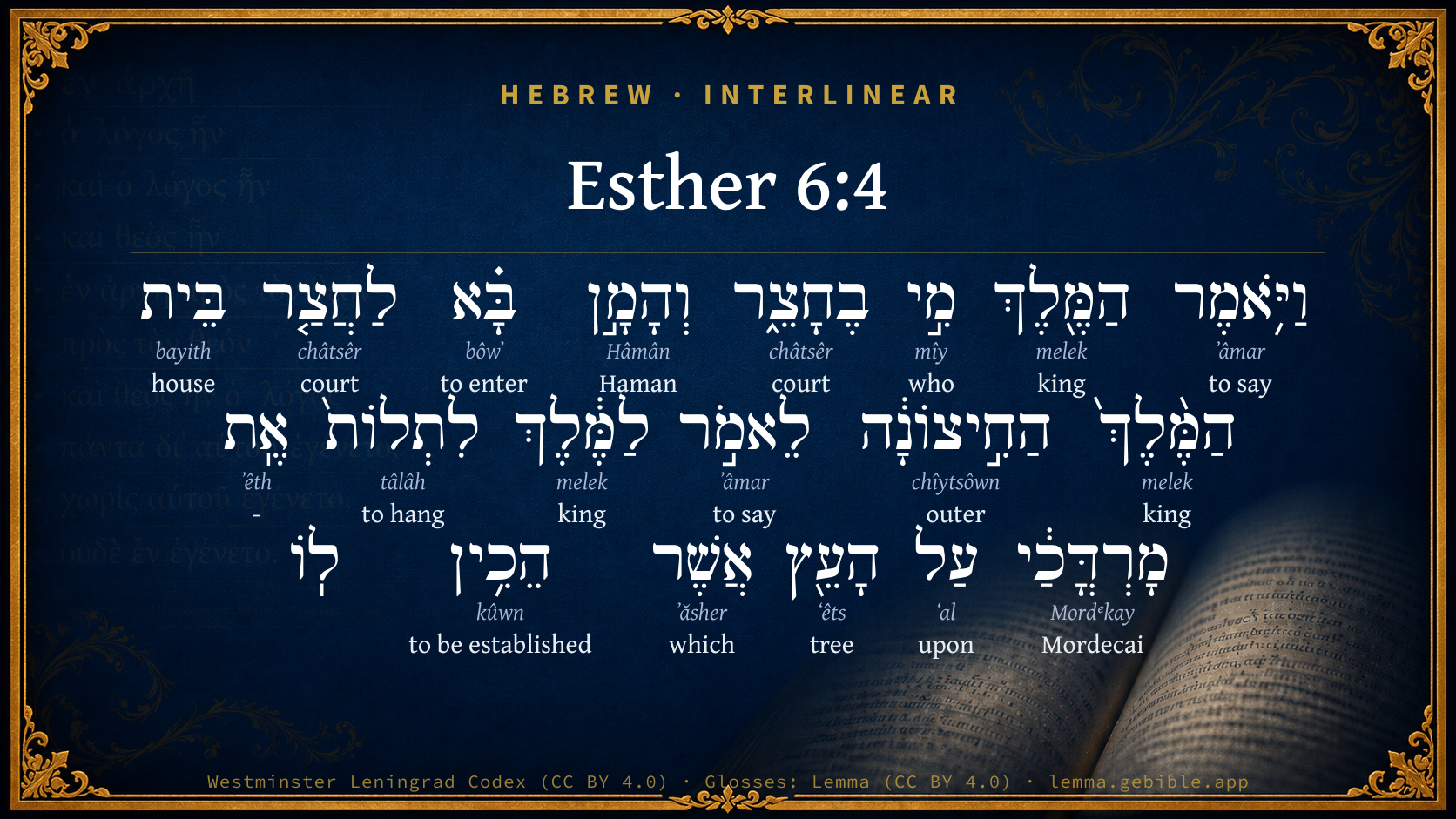
Esther 6:4

Hebrew (Westminster Leningrad Codex) Esther 6:4 appears in the Hebrew Old Testament. The text above is from the Westminster Leningrad Codex. Each word links to its Strong’s number, a concise gloss, and parsing drawn from the Open Scriptures Hebrew Bible morphology. Click any word for its full Brown-Driver-Briggs (BDB) entry.
Download image
Cite this verse

Esther 6:4 (World English Bible). Public Domain. Lemma interlinear Bible study tool, https://lemma.gebible.app/v/esther/6/4.

Show BibTeX & RIS
BibTeX
RIS
English Translation
The king said, "Who is in the court?" Now Haman was come into the outward court of the king's house, to speak to the king to hang Mordecai on the gallows that he had prepared for him.
World English Bible · Public Domain
Download a study sheet

One document with this verse’s original text, its word-by-word gloss line, the meaning frame, cross-references with their text, attributed commentary, and full source and license credits — printable, and it pastes into notes with its structure intact.

This verse Autodidact and up

Study sheet (.html) Plain text (.txt)

A passage Seminary Student

Up to 50 verses in one chapter. A passage sheet keeps up to 6 commentary sources and 12 cross-references per verse, in the order this page ranks them, and says so on the sheet whenever that leaves anything out. Ask for a single verse and you get the Autodidact verse sheet above.

Everything on this page stays free to read, with no account — the sheet is a download of what is already on screen, not access to it.

Want to remove ads? Support Godless Engineer
Compare translations 3

The same verse in 3 English versions, stacked beneath the original-language interlinear above. Click any original word for its lexicon entry.

Each is an independent rendering of the whole verse — the interlinear is not word-aligned to these translations.

Highlighted words mark where these versions differ — a whole-verse word diff, not a word-by-word alignment.

  • World English Bible Public Domain
    The king said, "Who is in the court?" Now Haman was come into the outward court of the king's house, to speak to the king to hang Mordecai on the gallows that he had prepared for him.
  • King James Version Public Domain
    And the king said, Who is in the court? Now Haman was come into the outward court of the king's house, to speak unto the king to hang Mordecai on the gallows that he had prepared for him.
  • unfoldingWord Literal Text CC BY-SA 4.0
    And the king asked, “Who is in the court?” Now Haman had come into the outer court of the house of the king to say to the king to hang Mordecai on the pole that he had prepared for him.

unfoldingWord Literal Text — © unfoldingWord, licensed CC BY-SA 4.0. Word-aligned USFM3 via Door43 (git.door43.org/unfoldingWord/en_ult).

Versions to compare (up to 4)

3 of 4 selected

Show all 18 translations

Every available English version of this verse, each an independent rendering of the whole verse.

  • World English Bible Public Domain
    The king said, "Who is in the court?" Now Haman was come into the outward court of the king's house, to speak to the king to hang Mordecai on the gallows that he had prepared for him.
  • Berean Standard Bible Public Domain
    “Who is in the court?” the king asked. Now Haman had just entered the outer court of the palace to ask the king to hang Mordecai on the gallows he had prepared for him.
  • Majority Standard Bible Public Domain
    “Who is in the court?” the king asked. Now Haman had just entered the outer court of the palace to ask the king to hang Mordecai on the gallows he had prepared for him.
  • King James Version Public Domain
    And the king said, Who is in the court? Now Haman was come into the outward court of the king's house, to speak unto the king to hang Mordecai on the gallows that he had prepared for him.
  • American Standard Version (1901) Public Domain
    And the king said, Who is in the court? Now Haman was come into the outward court of the king's house, to speak unto the king to hang Mordecai on the gallows that he had prepared for him.
  • Revised Version (1885) Public Domain
    And the king said, Who is in the court? Now Haman was come into the outward court of the king’s house, to speak unto the king to hang Mordecai on the gallows that he had prepared for him.
  • Geneva Bible (1599) Public Domain
    And the King sayde, Who is in the court? (Now Haman was come into the inner court of the Kings house, that he might speake vnto the King to hang Mordecai on the tree that he had prepared for him.)
  • Douay-Rheims (1899) Public Domain
    And the king said immediately: Who is in the court? for Aman was coming in to the inner court of the king's house, to speak to the king, that he might order Mardochai to be hanged upon the gibbet which was prepared for him.
  • Young's Literal Translation Public Domain
    And the king saith, `Who `is' in the court?' -- and Haman hath come in to the outer court of the house of the king, to say to the king to hang Mordecai on the tree that he had prepared for him --
  • Literal Standard Version CC BY-SA 4.0
    And the king says, “Who [is] in the court?” And Haman has come into the outer court of the house of the king, to say to the king to hang Mordecai on the tree that he had prepared for him.
  • Unlocked Literal Bible CC BY-SA 4.0
    The king said, “Who is in the courtyard?” Now Haman had entered the outer courtyard of the king's house to speak to him about hanging Mordecai on the gallows he set up for him.
  • unfoldingWord Literal Text CC BY-SA 4.0
    And the king asked, “Who is in the court?” Now Haman had come into the outer court of the house of the king to say to the king to hang Mordecai on the pole that he had prepared for him.
  • Darby Bible Public Domain
    And the king said, Who is in the court? Now Haman had come into the outward court of the king's house, to speak to the king to hang Mordecai on the gallows that he had prepared for him.
  • World Messianic Bible Public Domain
    The king said, “Who is in the court?” Now Haman had come into the outer court of the king’s house, to speak to the king about hanging Mordecai on the gallows that he had prepared for him.
  • Webster's Bible Public Domain
    And the king said, Who is in the court? Now Haman had come into the outward court of the king's house, to speak to the king to hang Mordecai on the gallows that he had prepared for him.
  • Free Bible Version CC BY-SA 4.0
    “Who's here in the court?” the king asked. Haman had just happened to arrive in the outer court of the royal palace to ask the king to have Mordecai impaled on the pole he had set up for him.
  • Bible in Basic English Public Domain
    Then the king said, Who is in the outer room? Now Haman had come into the outer room to get the king's authority for the hanging of Mordecai on the pillar which he had made ready for him.
  • JPS Tanakh (1917) Public Domain
    And the king said: 'Who is in the court?' — Now Haman was come into the outer court of the king's house, to speak unto the king to hang Mordecai on the gallows that he had prepared for him. —

Literal Standard Version (2020), Covenant Press — licensed CC BY-SA 4.0. Text via the HelloAO Bible API (eBible.org). Unlocked Literal Bible (unfoldingWord) — licensed CC BY-SA 4.0. Text via the HelloAO Bible API (eBible.org). unfoldingWord Literal Text — © unfoldingWord, licensed CC BY-SA 4.0. Word-aligned USFM3 via Door43 (git.door43.org/unfoldingWord/en_ult). Free Bible Version, Dr. Jonathan Gallagher — licensed CC BY-SA 4.0. Text via the HelloAO Bible API (eBible.org).

Word by word

More ways to search: Search by grammar → Find every occurrence → Compare this word →

Practice this passage: Drill this verse → Learn its vocabulary →

הַחִ֣יצוֹנָ֔ה
chîytsôwn
H2435
“the · outer”
Particle, Definite Article + Adjective, Adjective, Feminine, Singular, Absolute
Part of Speech
Particle + Adjective
Type
Adjective
Gender
Feminine
Number
Singular
State
Absolute
Full BDB Definition

Origin: from H2434

TWOT: 627b

outer, external, outward
  1. וַיֹּ֥אמֶר ʼâmar H559 “and · to say” Conjunction + Verb, Qal, Sequential Imperfect, 3rd Person, Masculine, Singular
  2. הַמֶּ֖לֶךְ melek H4428 “the · king” Particle, Definite Article + Noun, Common, Masculine, Singular, Absolute
  3. מִ֣י mîy H4310 “who” Particle, Interrogative
  4. בֶחָצֵ֑ר châtsêr H2691 “in/at the · court” Preposition, Determined + Noun, Common, Both, Singular, Absolute
  5. וְהָמָ֣ן Hâmân H2001 “and · Haman” Conjunction + Noun, Proper
  6. בָּ֗א bôwʼ H935 “to enter” Verb, Qal, Perfect, 3rd Person, Masculine, Singular
  7. לַחֲצַ֤ר châtsêr H2691 “to/for · court of” Preposition + Noun, Common, Both, Singular, Construct
  8. בֵּית bayith H1004 “house of” Noun, Common, Masculine, Singular, Construct
  9. הַמֶּ֨לֶךְ֙ melek H4428 “the · king” Particle, Definite Article + Noun, Common, Masculine, Singular, Absolute
  10. לֵאמֹ֣ר ʼâmar H559 “to say” Preposition + Verb, Qal, Infinitive Construct
  11. לַמֶּ֔לֶךְ melek H4428 “to/for the · king” Preposition, Determined + Noun, Common, Masculine, Singular, Absolute
  12. לִתְלוֹת֙ tâlâh H8518 “to hang” Preposition + Verb, Qal, Infinitive Construct
  13. אֶֽת ʼêth H853 “-” Particle, Direct Object
  14. מָרְדֳּכַ֔י Mordᵉkay H4782 “Mordecai” Noun, Proper
  15. עַל ʻal H5921 “upon” Preposition
  16. הָעֵ֖ץ ʻêts H6086 “the · tree” Particle, Definite Article + Noun, Common, Masculine, Singular, Absolute
  17. אֲשֶׁר ʼăsher H834 “which” Particle, Relative
  18. הֵכִ֥ין kûwn H3559 “to be established” Verb, Hiphil, Perfect, 3rd Person, Masculine, Singular

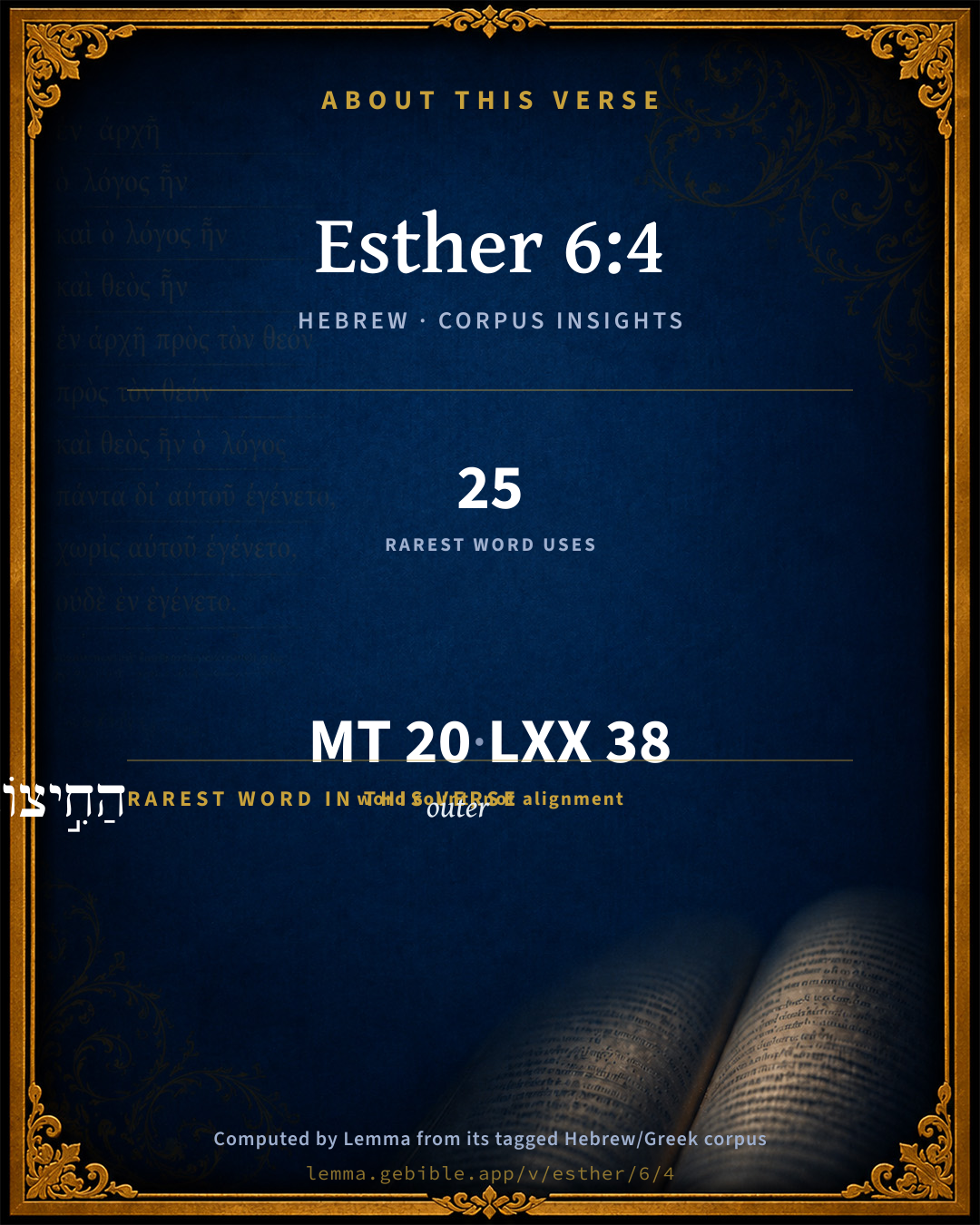
About this verse

These counts appear in no published source. They are computed here, from the morphology-tagged text and Lemma’s own curated glosses. What Lemma adds →

20
words
15
distinct lemmas
Historical
section

Notable vocabulary

The rarest word here is הַחִ֣יצוֹנָ֔ה outer H2435 — appearing just 25 times in the whole Hebrew Bible.

Shared distinctive vocabulary

הַחִ֣יצוֹנָ֔ה outer H2435 occurs in 24 verses of the Hebrew Bible. Also found in:

Grammatical profile

  • 5 verbs
  • 9 nouns
  • 1 adjective
  • 2 prepositions
  • 3 particles

Verb forms

  • וַיֹּ֥אמֶר Qal · Sequential Imperfect
  • בָּ֗א Qal · Perfect
  • לֵאמֹ֣ר Qal · Infinitive Construct
  • לִתְלוֹת֙ Qal · Infinitive Construct
  • הֵכִ֥ין Hiphil · Perfect

Repetition

Words recur within this verse — often emphatic in Hebrew:

  • הַמֶּ֖לֶךְ king H4428 ×3
  • וַיֹּ֥אמֶר to say H559 ×2
  • בֶחָצֵ֑ר court H2691 ×2

Hebrew & Septuagint length

In English translation the verse runs 37 words from the Hebrew and 48 from the Septuagint (LXX English) — closely comparable.

A rough comparison of the two English renderings, which tokenize alike — not a word-level alignment.

Word counts can differ between the Hebrew and the Greek without any difference in meaning — e.g. the Hebrew direct-object marker אֵת has no separate Greek word, and Greek often adds the article ὁ.

In the original languages it is 20 Hebrew tokens and 38 Greek tokens — but the two are counted differently (Hebrew bundles its prefixes and suffixes into one token; the Greek is in lemma form), so that isn’t a like-for-like length.

Cross-references

10

Topical passages linked to Esther 6:4 in the Treasury of Scripture Knowledge — connected by theme and wording, ordered by reader-vote popularity; previews shown in the World English Bible.

  • Esther 5:14 Then said Zeresh his wife and all his friends to him, Let a gallows be made fifty cubits high, and in the morning speak you to the king that Mordecai may be hanged thereon: then go you in merrily with the king to the banquet. The thing pleased Haman; and he caused the gallows to be made.
  • Esther 4:11 All the king's servants, and the people of the king's provinces, do know, that whoever, whether man or woman, shall come to the king into the inner court, who is not called, there is one law for him, that he be put to death, except those to whom the king shall hold out the golden scepter, that he may live: but I have not been called to come in to the king these thirty days.
  • Esther 5:1 Now it happened on the third day, that Esther put on her royal clothing, and stood in the inner court of the king's house, over against the king's house: and the king sat on his royal throne in the royal house, over against the entrance of the house.
  • Psalms 2:4 He who sits in the heavens will laugh. The Lord will have them in derision.
  • Esther 3:8–11 Haman said to king Ahasuerus, There is a certain people scattered abroad and dispersed among the peoples in all the provinces of your kingdom; and their laws are diverse from [those of] every people; neither keep they the king's laws: therefore it is not for the king's profit to allow them.
  • Esther 7:9 Then said Harbonah, one of the chamberlains who were before the king, Behold also, the gallows fifty cubits high, which Haman has made for Mordecai, who spoke good for the king, stands in the house of Haman. The king said, Hang him thereon.
  • Job 5:13 He takes the wise in their own craftiness; The counsel of the cunning is carried headlong.
  • Psalms 33:19 To deliver their soul from death, To keep them alive in famine.
  • Proverbs 3:27–28 Don't withhold good from those to whom it is due, When it is in the power of your hand to do it.
  • Ecclesiastes 9:10 Whatever your hand finds to do, do it with your might; for there is no work, nor device, nor knowledge, nor wisdom, in Sheol, where you are going.

Cross-references courtesy of OpenBible.info (CC BY 4.0).

Hebrew and Greek witnesses Masoretic Hebrew ↔ Greek Septuagint

The same verse in the two great witnesses to the Old Testament, shown verse-for-verse.

These are two independent witnesses, not word-aligned to each other, and the Septuagint is shown in lemma (dictionary) form.

Hebrew Esther 6:4 Masoretic · Westminster Leningrad Codex

וַיֹּ֥אמֶר הַמֶּ֖לֶךְ מִ֣י בֶחָצֵ֑ר וְהָמָ֣ן בָּ֗א לַחֲצַ֤ר בֵּית הַמֶּ֨לֶךְ֙ הַחִ֣יצוֹנָ֔ה לֵאמֹ֣ר לַמֶּ֔לֶךְ לִתְלוֹת֙ אֶֽת מָרְדֳּכַ֔י עַל הָעֵ֖ץ אֲשֶׁר הֵכִ֥ין לֽוֹ

The king said, "Who is in the court?" Now Haman was come into the outward court of the king's house, to speak to the king to hang Mordecai on the gallows that he had prepared for him.

World English Bible · Public Domain

Greek LXX Esther 6:4 Septuagint · lemma form

ἐν δέ ὁ πυνθάνομαι ὁ βασιλεύς περί ὁ εὔνοια μαρδοχαῖος ἰδού αμαν ἐν ὁ αὐλή εἶπον δέ ὁ βασιλεύς τίς ἐν ὁ αὐλή ὁ δέ αμαν εἰςἔρχομαι λέγω ὁ βασιλεύς κρεμάζω ὁ μαρδοχαῖος ἐπί ὁ ξύλον ὅς ἑτοιμάζω

And while the king was enquiring about the kindness of Mardochaeus, behold, Aman was in the court. And the king said, Who is in the court? Now Aman was come in to speak to the king, that he should hang Mardochaeus on the gallows, which he had prepared.

LXX2012 (modern English Septuagint) · Public Domain

Hebrew: Westminster Leningrad Codex (CC BY 4.0). Greek: Septuagint (public domain); English from LXX2012 (modern English Septuagint) (Public Domain). How the Septuagint differs from the Hebrew →

Commentary

Notes on Esther 6:4 from classic Christian and Jewish commentators (each source and its license shown beneath its notes). The classic Christian expositions comment on the surrounding passage and are grouped to its opening verse, so a note may address several verses; the Jewish commentaries on the Tanakh (Rashi and others) are per-verse, so they appear only where the commentator wrote on this verse.

Lemma curates 59 commentaries, every one of them public domain or Creative Commons licensed, each selected and text-cleaned for this edition rather than reprinted as found. About our sources →

Matthew Henry's Commentary

It is now morning, and people begin to stir.

I. Haman is so impatient to get Mordecai hanged that he comes early to court, to be ready at the king's levee, before any other business is brought before him, to get a warrant for his execution (Est 6:4), which he makes sure that he shall have at the first word. The king would gratify him in a greater thing than that; and he could tell the king that he was so confident of the justice of his request, and the king's favour to him in it, that he had got the gallows ready: one word from the king would complete his satisfaction.

II. The king is so impatient to have Mordecai honoured that he sends to know who is in the court that is fit to be employed in it. Word is brought him that Haman is in the court, Est 6:5. Let him come in, says the king, the fittest man to be made use of both in directing and in dispensing the king's favour; and the king knew nothing of any quarrel he had with Mordecai. Haman is brought in immediately, proud of the honour done him in being admitted into the king's bed-chamber, as it should seem, before he was up; for let the king but give orders for the dignifying of Mordecai, and he will be easy in his mind and try to sleep. Now Haman thinks he has the fairest opportunity he can wish for to solicit against Mordecai; but the king's heart is as full as his, and it is fit he should speak first.

III. The king asks Haman how he should express his favour to one whom he had marked for a favourite: What shall be done to the man whom the king delights to honour? Est 6:6. Note, It is a good property in kings, and other superiors, to delight in bestowing rewards and not to delight in punishing. Parents and masters should take a pleasure in commending and encouraging that which is good in those under their charge.

IV. Haman concludes that he himself is the favourite intended, and therefore prescribes the highest expressions of honour that could, for once, be bestowed upon a subject. His proud heart presently suggested, "To whom will the king delight to do honour more than to myself? No one deserves it so well as I," thinks Haman, "nor stands so fair for it." See how men's pride deceives them. 1. Haman had a better opinion of his merits than there was cause for: he thought none so worthy of honour as himself. It is a foolish thing for us thus to think ourselves the only deserving persons, or more deserving than any other. The deceitfulness of our own hearts appears in nothing so much as in the good conceit we have of ourselves and our own performances, against which we should therefore constantly watch and pray. 2. He had a better opinion of his interest than there was reason for. He thought the king loved and valued no one but himself, but he was deceived. We should suspect that the esteem which others profess for us is not so great as it seems to be or as we are sometimes willing to believe it is, that we may not think too well of ourselves nor place too much confidence in others. Now Haman thinks he is carving out honour for himself, and therefore does it very liberally, Est 6:8, Est 6:9. Nay, he does it presumptuously, prescribing honours too great to be conferred upon any subject, that he must be dressed in the royal robes, wear the royal crown, and ride on the king's own horse; in short, he must appear in all the pomp and grandeur of the king himself, only he must not carry the sceptre, the emblem of power. He must be attended by one of the king's most noble princes, who must be his lacquey, and all the people must be made to take notice of him and do him reverence; for he must ride in state through the streets, and it must be proclaimed before him, for his honour, and the encouragement of all to seek the ruler's favour, Thus shall it be done to the man whom the king delights to honour, which had the same intention with that which was proclaimed before Joseph, Bow the knee; for every good subject will honour those whom the king delights to honour. And shall not every good Christian then honour those whom the King of kings delights to honour and call the saints that are on the earth the excellent ones?

V. The king confounds him with a positive order that he should immediately go himself and put all this honour upon Mordecai the Jew, Est 6:10. If the king had but said, as Haman expected, Thou art the man, what a fair opportunity would he have had to do the errand he came on, and to desire that, to grace the solemnity of his triumphs, Mordecai, his sworn enemy, might be hanged at the same time! But how is he thunderstruck when the king bids him not to order all this to be done, but to do it himself to Mordecai the Jew, the very man he hated above all men and whose ruin he was now designing! Now, it is to no purpose to think of moving any thing to the king against Mordecai when he is the man whom the king delights to honour. Solomon says, The heart of the king is unsearchable (Pro 25:3), but it is not unchangeable.

VI. Haman dares not dispute nor so much as seem to dislike the king's order, but, with the greatest regret and reluctance imaginable, brings it to Mordecai, who I suppose did no more cringe to Haman now than he had done, valuing his counterfeit respect no more than he had valued his concealed malice. The apparel is brought, Mordecai is dressed up, and rides in state through the city, recognized as the king's favourite, Est 6:11. It is hard to say which of the two put a greater force upon himself, proud Haman in putting this honour upon Mordecai, or humble Mordecai in accepting it: the king would have it so, and both must submit. Upon this account it was agreeable to Mordecai as it was an indication of the king's favour, and gave hope that Esther would prevail for the reversing of the edict against the Jews.

Matthew Henry's Commentary on the Whole Bible (1708–1710) — public domain (CC PDM 1.0). Text via the HelloAO Bible API.

Trapp's Complete Commentary

John Trapp

Est 6:4 And the king said, Who [is] in the court? Now Haman was come into the outward court of the king’s house, to speak unto the king to hang Mordecai on the gallows that he had prepared for him.

Ver. 4. And the king said, Who is in the court] Josephus saith, that he first asked what time it was, and understanding that it was morning’s light (for so long he had heard his servants read, and till then it was not that Mordecai’s matter was mentioned, Haman being now ready to get a warrant for his execution), he asked, who is there without? as desirous to proceed by counsel in a business of that consequence.

Now Haman was come, &c.] He was early up (and at court for a mischief), but never the nearer, save only to his own utter ruin.

To speak to the king to hang Mordecai] Which till it were done, he could neither sleep in quiet nor eat with comfort. Little considered he how the gallows groaned for himself. "The righteous is delivered out of trouble, and the wicked cometh in his stead," Pro 11:8.

Vivit adhuc Christus, regnat, regnabit et usque:

Atque hostes omnes sub ditione premit.

John Trapp, A Commentary or Exposition upon All the Books of the Old and New Testament (1647–1656) — public domain. Text from a community e-Sword module.

The Preacher's Complete Homiletical Commentary

Joseph S. Exell (gen. ed.)

CRITICAL NOTES.]

Est_6:4.] The question, Who is in the court?] means what officer is now present. The king desires to consult with him as to what distinction would be appropriate to Mordecai. It seems that those desiring to be admitted to the king’s presence bad to wait in the outer court.—Lange. From this question of the king it appears that it was already morning.

Est_6:5.] Haman was waiting in the outer court, till it should be announced that the king was ready to grant audiences. The king commands, Let him come in] (a short order) namely, into the house of the king.

MAIN HOMILETICS OF THE PARAGRAPH. Est_6:4-5

THE KING’S INQUIRY AND CONCESSION

FROM the conduct of Haman on this occasion we learn that hate inspires a man with energy. For anything we know to the contrary Haman may be but an active man, one who is prompt in business, and who scarcely allows himself sufficient leisure to take necessary sleep. But in this case the impelling motive is hate. It will not allow him to sleep. At the first dawn of morning he rushes to carry out his nefarious design. He is waiting with eagerness for the king’s appearance. He is all alert to set a-going his wily and dark scheme. He is ready to speak unto the king to hang an innocent man. Thus there are too many Hamans. Alas! sadly too many to speak for the destruction of their fellows. Alas! sadly too few to speak for the salvation of their fellows. How this proclaims the depravity of human nature! It rushes to destroy; it creeps to save. It is eager to listen to the voice of hate; it is deaf to the voice of love. Oh, love divine, supplant hate by the sweet force of all-mastering love!

I. The human inquiry. The king said, Who is in the court? It does not appear to us likely that the king was aware that Haman was already in the court. The king was evidently still in the bed-chamber, whence he would not see who was waiting outside. He could scarcely have expected Haman at such an early hour. He asks in ignorance. This is characteristic of human inquiries. We are ignorant, and desire to know. We ask for enlightenment. But, further, the king was in perplexity and desired some one to consult. What is to be done to remedy this long neglect? Who is in the court to whom I may speak? This too is characteristic of our humanity. Perplexity will come. In such trial we ask who is in the court? Who will help me in this perplexity? Who is there to whom I may successfully appeal? We seek to men, but they fail. Seek to the court of heaven. If any man lack wisdom let him ask of God.

II. The Divine response. The king’s servants said unto him, Behold, Haman standeth in the court. God speaks by human voices. Holy men are generally the vehicles of Divine messages, but he can and does make use of unlikely vehicles. These servants, heathen though they were, were God’s instruments. They were working out Divine laws. Why did they at once fix upon Haman? Were there no others in the court? Doubtless there were. The true answer is, not that Haman was the favoured minister, but that God directed them to announce Haman’s presence. The king did not hear the Divine response in the answer of his servants, but it was there all the same. God is speaking even when we are too deaf to hear. Be swift to hear the Divine response.

III. The disappointing concession. And the king said, Let him come in. Earthly kings grant their audiences, but the privileged ones find that the concession is disappointing. Haman found it so to his cost. Better almost for him had the king said, Let him stop out. Even when those who seek the king’s presence have no dark designs there is disappointment. The earthly monarch may say, Let the man come in, and then the monarch lets the man go out as empty as he entered. High hopes have often been raised by a monarch’s summons to court, but it has only been a vain parade. No false hopes are raised by King Jesus. Does he say to a man, Let him come in? then he means to enrich; and does he not say it to all? To each the invitation is given, Let him come in, let him come to me. Him that cometh to me I will in no-wise cast out. Even a proud, ambitious, and bloodthirsty Human may come. How sweet the word—come! Come not to further thy dark designs, Haman; come not to seek help in the promotion of thy schemes of self-aggrandizement; but come to be taught a better way; come to be endowed with a nobler spirit; come to learn, Blessed are the merciful: for they shall obtain mercy; Blessed are the meek: for they shall inherit the earth.

IV. The joyful but fatal obedience. So Haman came in. Haman did not go in like one moving to the gallows, which in fact he was doing. He was now much nearer that fatal structure than he knew. Had Haman lived in our days he might have thought, This is now the tide in my affairs which should lead on to further glory. But, oh! it was the dark tide leading on to destruction. Haman went in joyful, but came out sorrowful. The rosy morning was bright and beautiful; clouds gather on the evening sky. The lightnings flash and thunder peals in terrific grandeur. What a picture is presented to the mind by those simple words. So Haman came in. Haman’s mistake was not in obeying the permission of the king, but in obeying the voice of an evil spirit. Had Haman repented during the night, and gone in a right spirit and with wholesome counsel to the king, all might still have been well. The motive, then, counts for much. Let us look to our motives. A wrong motive will cast a blight on the obedient action. See to it that good deeds arise out of faith in Jesus Christ, out of love for his glory.

SUGGESTIVE COMMENTS ON Est_6:4-5

Haman came early, but too late. To us, knowing arrangements made on either side, in the king’s mind, and in his favourite’s, it is a neck-and-neck race. Who should have the first word? The king has it; Haman is lost! “A single moment to tell Ahasuerus of the persevering insolence of one of his menials: I need not name him; enough to say that he is one of the race doomed all to perish on the thirteenth of Adar, and that I am but anticipating the end ordained for him a few months hence.” No, Haman; not a single moment you have for that purpose now or ever. Ahasuerus had no wish to forestall his friend. Had he known that he had a request of his own to present he must have given him permission to state it; and had Haman then only avoided naming Mordecai, the king must have granted his request. It is “another King” who is beforehand with the Jew’s enemy.—Symington.

And the king said, Let him come in. See here, saith Merlin, a sweet and special providence of God in this, that Ahasuerus should take advice about honouring Mordecai, and not of his servants that attended upon his person, but of Haman then present (though for another purpose); and, concealing the man he means, should Haman say what was fit to be done, and then do it accordingly. Neither the king nor his servants, likely, would ever have thought of doing Mordecai so great honour as Haman prescribed. See here, as in a mirror, how the Lord by a secret providence bringeth about and overruleth the wiles of men, their affairs, times, counsels, words, and speeches, to the fulfilling of his own will and decree; and this when they think least of doing God’s will or serving his providence.

So Haman came in, merry and jocund, but went out sad and heavy-hearted. These hosts (profit, pleasure, and preferment), though they welcome us into our inn with smiling countenances, yet, if we watch them not, they will cut our throats in our beds, It is observed of Edward III., that he had always fair weather at his passage into France and foul upon his return. Pharaoh had fair weather till he was in the heart of the Red Sea. The sun shone fair upon the earth that morning that Lot came out of Sodom, but ere night there was a dismal change. He that lives in the height of the world’s blandishments is not far from destruction.—Trapp.

Who is in the court? The morning light may have begun to fill his chamber when the king nervously addressed this question to his attendants. He had spent a sleepless night; and might it not be because another conspiracy was being matured against him? Might it not be something of this kind which was troubling the queen? Did he not deserve that it should be concealed from him, since he had done nothing to reward his former preserver? There might be cause for haste,—at least he was impatient of delay; and who was this, at early morn, pacing the outer court of the king’s palace, as though also in haste about some great work? Haman. His night’s rest had not pacified his thirst for revenge. There was to be the queen’s banquet in an after part of the day; and if he was to go in merrily to it he must first have obtained authority for the execution, and had Mordecai hanged on the gallows prepared for him. How fortunate! thought Haman; the king is early astir, and calleth for me. How fortunate! thought the king; my favourite courtier and counsellor is early in the way this morning, and is the best man to whom I can commit this business. Behind the back of each of them there was the providence of God, secretly working out his own purposes of mercy and judgment. “And the king said, Let Haman come in.”—McEwan.

ILLUSTRATIONS TO CHAPTER 6

Est_6:5. Come, a song-bird. In a lonely cot there sat one night an aged widow, very poor and nearly blind. The Christian lady had been reading from the best of books. “Ah,” said the poor widow, “there is one word sweeter than all the rest. It is a song for my darkness. Can you guess what it is? The visitor thought, and she said presently, “Yes, I think I know; it is Jesus, the name above all other names.” “No,” said the widow; “Jesus is a blessed word, but that is not enough for me, unless I know him for my Saviour. It is no comfort for me that he died for sinners, unless I know he died for me.” “Perhaps you mean heaven,” said the visitor, “for he is there.” “No,” said the widow; “what comfort would it be for me to know that Jesus is in heaven, and others should see his face, and love and serve him there, if I am not bound for heaven. No; it is just one word from his own lips, I call it my little song-bird—come.” Jesus says come in a far different sense from that in which Ahasuerus said, Let him come in. Ahasuerus said this for his own enlightment. Jesus says “Come unto me” for our enrichment.

Royal presents to an official.—The presentation as a gift from a royal personage of that which had been worn on his own person was a special mark of favour and condescension. Morier, in his narrative of “A Second Journey through Persia,” thus illustrates this custom:—“When a treaty between Russia and Persia was concluded, some years since, in the commencement, according to the usual form, the ranks of the two principal persons who were deputed to arrange it had to be specified. The Russian general was found to have more titles than the Persian plenipotentiary, who was therefore at a loss how to make himself appear of equal importance with the other negotiator; but at length, recollecting that, previous to his departure for the place of conference, his sovereign had honoured him by a present of one of his own swords, and of a dagger set with precious stones, to wear which is a peculiar distinction in Persia, and besides had clothed him with one of his own shawl robes, a distinction of still greater value, he therefore designated himself as ‘endowed with the special gifts of the monarch, lord of the dagger set in jewels, of the sword adorned with gems, and of the shawl coat already worn.’ ”

The Preacher's Complete Homiletical Commentary (gen. ed. Joseph S. Exell; Funk & Wagnalls, c. 1892) — public domain (pre-1929). A full-Bible homiletical/sermon-outline anthology covering 65 of 66 books (2 John is absent from the source module). Text from a community e-Sword module.

Tyndale Open Study Notes

Tyndale Open Resources

6:4-6 Just as the king was pondering what to do to honor Mordecai, Haman arrived to seek Mordecai’s death. With great irony, the narrator recounts the king’s consulting with him about how to reward Mordecai.

Tyndale Open Study Notes — © Tyndale Open Resources, licensed CC BY-SA 4.0. Text via the HelloAO Bible API.

Geneva Bible (1599)

Geneva Bible translators

Thus while the wicked imagine the destruction of others, they themselves fall into the same pit.

Geneva Bible (1599) marginal notes — public domain. Text via Bolls.life.

Jamieson, Fausset & Brown

Robert Jamieson, A. R. Fausset & David Brown

Now Haman was come into the outward court--This was early in the morning. It is the invariable custom for kings in Eastern countries to transact business before the sun is hot, often in the open air, and so Haman was in all probability come officially to attend on his master.

Jamieson, Fausset & Brown — Commentary Critical and Explanatory on the Whole Bible (1871) — public domain (CC PDM 1.0). Text via the HelloAO Bible API.

Adam Clarke's Commentary

Verse 4. Who is in the court?] This accords with the dream mentioned by the Targum; and given above.

Now Haman was come] This must have been very early in the morning. Haman's pride and revenge were both on the tenters to be gratified.

Adam Clarke's Commentary on the Bible (1810–1826) — public domain. Text from a community e-Sword/MySword module.

Ellicott's Commentary for English Readers

(4) Haman was come.—It being at length morning, Haman had come to the palace in due course, and was waiting in the outer court till the king should call for him. The king in the inner court ponders what recompense to bestow upon Mordecai, Haman in the outer court stands ready primed with a request that he may be hanged.

A Bible Commentary for English Readers, edited by Charles John Ellicott (1878–1897) — public domain. Text from a community e-Sword module.

The Cambridge Bible for Schools and Colleges

gen. ed. J. J. S. Perowne

4. Who is in the court?] that instructions might be at once given to rectify the omission, and so relieve the king from the stigma of ingratitude. Probably there were always one or two persons in attendance outside the king’s chamber. The answer would naturally name the most important person in waiting.

The Cambridge Bible for Schools and Colleges (gen. ed. J. J. S. Perowne; Cambridge University Press, 1878–1918) — public domain. Text from a community e-Sword module.

John Gill's Exposition

And the king said, who is in the court?.... Being in haste to confer some honour on Mordecai for what he had done:

now Haman was come into the outward court of the king's house; though it was early in the morning, being eager to get to the speech of the king before he was engaged in any business, to obtain a grant from him:

to hang Mordecai on the gallows that he had prepared for him; of which he made no doubt of having, and therefore had prepared for it.

John Gill's Exposition of the Whole Bible (1746–1763) — public domain (CC PDM 1.0). Text via the HelloAO Bible API.

Haydock's Catholic Bible Commentary

Inner court. To which only such favourites and noblemen had access. (Herodotus iii. 72., and 84.) This king had himself come thither with six others, when they conspired to destroy Smerdis. Hebrew, &c., read, "the outward court," in which Aman was, till he heard the king was awake, and called for him. (Calmet)

George Leo Haydock (1774–1849), Haydock's Catholic Family Bible and Commentary, 1859 edition — public domain. Excludes Psalms (Douay-Rheims chapter numbering differs from Protestant) and Deuterocanonical books (Catholic canon only).

Matthew Poole's English Annotations

Haman was come early in the morning, because his malice probably would not suffer him to sleep; and he was impatient till he had executed his desired revenge; and he was resolved to watch for the very first opportunity of speaking to the king, before he was engaged in other matters.

Into the outward court of the king’s house; where he waited, because it was dangerous to come into the inner court without special license, Est 4:11.

Matthew Poole's English Annotations on the Holy Bible (1683–1685) — public domain. Text from a community e-Sword/MySword module.

Whedon's Commentary on the Bible

Daniel D. Whedon

4. Who is in the court — The king’s soul, after that sleepless night, was burdened with impatient desire to honour his benefactor. Haman, on the other hand, was equally impatient to see Mordecai hung upon the lofty stake he had erected. The king waits in the early morning for his chief prince to come and advise him how best to honour this loyal Jew, and Haman also is waiting to be called that he may speak unto the king to hang Mordecai — Mark the wonderful workings of Providence!

Daniel D. Whedon (gen. ed.), Commentary on the Old and New Testaments (1874–1909) — public domain. Text from a community e-Sword module.

The Pulpit Commentary

The king said, Who is in the court? Probably some high officer of state was required to be always in attendance upon the monarch, to take his orders at any moment. Now Haman was come. Early morning is a common time for the transaction of business at an Eastern court. Haman was so anxious to get the business on which he was bent despatched, that he had come perhaps even before daybreak, and was waiting in the outer court, to get, if possible, the first audience. This haste of his to effect Mordecai"s destruction led to his being the person deputed to do him the highest honour.

Vers. 4, 14.

Exaltation and humiliation.

I HASTE. Having seen the gallows prepared for Mordecai over-night, Haman was early astir next morning. He was in the court of the palace while the king was yet having the chronicles read to him, resolved to seize the first moment to get permission to hang the Jew. His plan of revenge was to be executed and done with long before the hour of the queen"s banquet. (Pro_1:16) "The children of this world are wiser," because more diligent, "in their generation than the children of light." If the self-denial and earnestness with which men pursue evil and worldly things were equally exhibited by all the righteous in pursuit of the things of Christ, the world itself would soon be brought to the feet of God.

II COINCIDENCE. When the king wanted an adviser at that early hour, Haman happened to be in the court. The thoughts of both the king and his favourite happened to be occupied and excited by the same man. The haste of Haman to get Mordecai hanged happened to meet the haste of the king to get him rewarded. Faith can often discern the marks of a Divine providence in what men call accidents or coincidences. Belief in a living God is inconsistent with belief in any "fortuitous concourse.

III ERROR. The question put by the king to Haman at once led him astray. Whose honour would the king delight to promote if not that of the man on whom he had already bestowed such unusual distinction? His vain heart betrayed him. How greedy is vanity. How selfish are the slaves of sin. The answer of Haman was shaped by his own desires. The honour he suggested would have been foolish and worthless as given to any other person than himself. But the only thing left for his ambition to aspire to was such a public and resplendent exhibition of the royal delight in him as that which he described. A man of evil does not easily suspect good feeling or good purpose in any associate. He projects himself into his judgment of others. Thus he is very liable to make mistakes. His whole life is a mistake an error from beginning to end.

IV DISAPPOINTMENT. When the king commanded Haman to do unto Mordecai every whit of what he had recommended, the blow that fell on the astonished favourite must have been heavy. That the man for whom he had made a gallows should receive the honour which he had proposed for himself! what a reversing of things. There are many disappointments and reverses which attract our entire sympathy, but we can only rejoice when the expectation of the wicked is cut short. It was a fit measure of justice that Haman should have proposed the honour which Mordecai was to wear. Judgment pursues the evil-doer. In the end all his hopes will be disappointed.

V HUMILIATION. Haman had not only to see done, but to do, what the king commanded. He was the "one of the king"s most noble princes" who had to array Mordecai in royal apparel, and place him on a horse, and lead him through the city, and proclaim before him, "Thus shall it be done to the man whom the king delighteth to honour." And all this he did to the man whom he most hated, and for whom he had erected a gallows. It was a bitter humiliation, but there was no escape from it. Those who climb to worldly greatness by wrong ways have to eat much dirt. They sharpen the knife that will sooner or later enter their soul.

VI EXALTATION. Mordecai yielded himself up to the king"s mode of honouring him. He put himself in the hands of Haman, and went quietly through the whole process. It was a triumph that might be justly enjoyed, and one too that promised greater things. God was manifestly with his servant. Unseen influences were at work. The attempt to deliver Israel was prospering. This public honour would strengthen Esther, and have some effect on the king. The bad man who led the Jew"s horse and proclaimed his favour with the king was declining in power, and the desired redemption of a devoted people was drawing near. Thus God encourages those who trust him. He makes their enemies serve them. Amidst much darkness and fear he causes his light to shine, and gives his servants bright indications of a coming victory.

VII HUMILITY. A Haman would have been intoxicated by such an honour as was conferred on his enemy. To Mordecai the parade through the city was but an empty pageant, except in so far as it might contribute to his purpose of saving Israel. Hence we find him, after putting Off the royal robes, returning to his post at the king"s gate. The passing honours of the world make no change in those who are weighted with the pursuit of honours which the world cannot give. Their chief desire is to be at their post and do the work given them by a higher than an earthly master do justly, to love mercy, and to walk humbly with their God". (Mic_6:8) It required no effort for Mordecai to descend from his momentary exaltation to his humble position as a palace servitor. His duty was in the king"s gate. How blessed to be able to subordinate all merely personal or earthly things to the service of God.

VIII OMENS. The result of that morning"s proceedings was depressing to Haman. He retired to his home again to consult his wife and friends. How different his tale now from that which had inspired him and them the night before. The tall gallows in the courtyard was a gaunt mockery. The shame that had so unaccountably overtaken its lord laid a cold hand on the hearts of all his household. The fear of Israel, that strange people who trusted in a God of gods, entered strongly into their thoughts, and made their words ominous. The conviction was felt and expressed by them that if Mordecai were a Jew, Haman had already begun to fall, and that a disastrous end was inevitable. History affords many instances of the power of omens to destroy the happiness and hope of bad men. The silent workings of Divine providence have their effect on the wicked as well as on the good. In the one they inspire a fear which saps energy and skill; in the other they work a faith which gives strength and light. King Saul is not the only one whose heart and hand have been paralysed by superstitious fears arising from a rebellion against Divine rule. In the path of the wicked speetres of a holy and avenging power are ever rising up to throw blight on their aims and hopes. There is judgment even in this world. God reigns. D.

The Pulpit Commentary (1880–1919), ed. H.D.M. Spence-Jones & Joseph S. Exell — public domain. Text from a community e-Sword module.

John Wesley's Explanatory Notes

Haman - Early in the morning, because his malice would not suffer him to sleep; and he was impatient 'till he had executed his revenge; and was resolved to watch for the very first opportunity of speaking to the king, before he was engaged in other matters. Outward court - Where he waited; because it was dangerous to come into the inner court without special license, chap. iv, 11.

John Wesley, Explanatory Notes Upon the Whole Bible (1754–1765) — public domain. Text via the GEBible commentary corpus.

unfoldingWord translationNotes

Door43 World Missions Community

Haman

See how you translated this man's name in Esther 3:1

the outer courtyard

"the first courtyard from the outside"

hanging Mordecai

It can be made clear what the purpose of hanging him was. AT: "killing Mordecai by hanging him" (See: Assumed Knowledge and Implicit Information)

the gallows he set up for him

The gallows was a structure that was used to kill people by hanging them from it. See how you translated "gallows" in Esther 5:14. AT: "the structure Haman set up for hanging Mordecai" (See: Translate Unknowns)

set up

"built"

What should be done for the man whom the king takes pleasure in honoring

Here the king speaks of himself in the third person. This can be stated in first person and in active form. AT: "What should I do for the man whom I take pleasure in honoring" (See: First, Second, or Third Person and Active or Passive)

the king takes pleasure in honoring

Taking pleasure in doing something is an idiom for being glad to do something or wanting to do something. AT: "the king is glad to honor" or "the king wants to honor" (See: Idiom)

said in his heart

The heart represents the thoughts and attitudes. AT: "thought" or "said to himself" (See: Metaphor)

Whom would the king take pleasure in honoring more than me?

This can be expressed as a statement. "Surely there is no one whom the king would take pleasure in honoring more than me!" (See: Rhetorical Question)

translationWords

court

heart

honor

unfoldingWord translationNotes — © Distant Shores Media and the Door43 World Missions Community, licensed CC BY-SA 4.0. Source: git.door43.org/Door43/en_tn.

Lesson kit

Teaching starters — assembled from the data on this page, not authored interpretation. Every prompt links to the verse data it draws on. Edit before teaching.

Esther, in the Historical, opens this verse with 20 words (15 distinct Hebrew lemmas). Its most distinctive word is chîytsôwn (“outer”). A historical commentator’s framing appears above. Read the whole chapter for the surrounding context.

Discussion questions

  1. The word chîytsôwn carries the sense “outer.” How does it shape the verse?
  2. How does 1 Kings 6:29, which shares the word «outer», read alongside this verse?
  3. What does the repetition of “king” (3× in this one verse) do in this verse?
  4. These translations render this verse differently; the difference is in the English rendering, not the original. What questions does that raise?
  5. «וַיֹּ֥אמֶר» is a Qal Sequential Imperfect verb. How does that grammatical form shape the action described?
  6. Compare how Matthew Henry's Commentary and Trapp's Complete Commentary read this verse. Where do they agree or differ?

Things to notice

Reading settings

Reading text

Shown beneath each verse's original-language words.

Old Testament
Old Testament edition

Read the OT as the Masoretic Hebrew (MT) or the Greek Septuagint (LXX).

English shown for the Greek Septuagint (in the Hebrew ↔ Greek comparison).

Comparing translations? Open the Compare panel on any verse page to stack up to four side by side.